Dickey was born in Atlanta, Georgia. After serving as a pilot in the Second World War, he attended Vanderbilt University. Having earned an MA in 1950, Dickey returned to military duty in the Korean War, serving with the US Air Force. Upon return to civilian life Dickey taught at Rice University in Texas and then at the University of Florida. From 1955 to 1961, he worked for advertising agencies in New York and Atlanta. After the publication of his first book, Into the Stone (Middletown, Conn., 1962), he left advertising and began teaching at various colleges and universities. He became poet-in-residence and Carolina Professor of English at the University of South Carolina.
Dickey's third volume, Buckdancer's Choice (Middletown, 1965), won the prestigious National Book Award in Poetry. From 1966 to 1968 he served as poetry consultant to the Library of Congress. In 1977 Dickey read his poem 'The Strength of Fields' at President Carter's inauguration. The Hollywood film of his novel Deliverance (Boston, 1970) brought Dickey fame not normally enjoyed by poets.
Dickey's poems are a mixture of lyricism and narrative. In some volumes the lyricism dominates, while in others the narrative is the focus. The early books, influenced obviously though not slavishly by Theodore Roethke and perhaps Hopkins, are infused with a sense of private anxiety and guilt. Both emotions are called forth most deeply by the memories of a brother who died before Dickey was born ('In the Tree House at Night') and his war experiences ('Drinking From a Helmet'). These early poems generally employ rhyme and metre.
With Buckdancer's Choice, Dickey left traditional formalism behind, developing what he called a 'split-line' technique to vary the rhythm and look of the poem. Some critics argue that by doing so Dickey freed his true poetic voice. Others lament that the lack of formal device led to rhetorical, emotional, and intellectual excess. The truth probably lies somewhere between these two assessments, and it will be left to the reader to decide which phase of Dickey's career is most attractive.
Dickey's most comprehensive volume is The Whole Motion (Hanover, NH, and London, 1992). His early poems are collected in The Early Motion (Middletown, 1981). Recent individual volumes include The Eagle's Mile (Hanover and London, 1990) and Falling, May Day Sermon, and Other Poems (Hanover and London, 1982). Dickey has also published collections of autobiographical essays, Self Interviews (Garden City, NY, 1970; repr. New York, 1984) and Sorties (Garden City, 197 1; repr. New York, 1984).
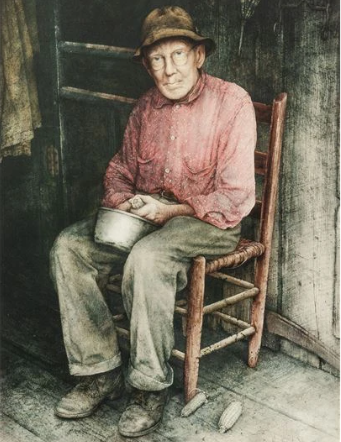
James Dickey is probably best known for his novel, DELIVERANCE, but here he uses his fluid prose to describe the watercolors of Hubert Shuptrine, an artist who specialized in paintings of the American South. It’s a huge book full of artwork that is almost lifelike in its depiction of both animate and inanimate objects. Dickey describes a journey around the South, which provides a background for all the art along the way.
…those who come to the South as strangers, or come to know it through pictures, and so see it as another world: that is, as a set of visions.
The title of the book was chosen because Jericho was the city of the Promised Land. It was the city that fell to Joshua, just as the South fell to Sherman. As Dickey notes, the book is not about magnolias and moonlit nights, but how he and Shuptrine lived the South, a way to represent what they saw to others. Although the “heartland” of the United States is considered to be the Midwest, this book makes the case for the South to hold that distinction. It’s broken barns and rusted orchard rakes. It’s moonshine liquor and tole lanterns. It’s a vision in words and art of a land that was already vanishing before this collaboration took place in 1974.
The watercolors by Shuptrine are amazing, wordless documents that come to life. James Dickey ups the ante with his sumptuous words, full of wonder at the natural world and of the people of a dying era. For example, his description of West Texas is like laundry bluing…you could bury your shadow here. This is very much a coffee table book but make sure it’s a table that can take the weight as the publishers didn’t cut any corners. The binding and text fonts are outstanding, a book that is an example of fine publishing before the age of cut-rate printing appeared. For me, not really knowing much of the South other than its image of the Civil War and racism, it was an intriguing look at everyday life and everyday people.
This was a wonderful, imaginative gift from a dear friend. Shuptrine's watercolors, as Dickey admits, are not designed to "go with" Dickey's text, but if you take Dickey up on his opening invitation (to flit invisible through the South with eyes and self wide-open), they ARE the landscape. Published in the mid-Seventies, it's a bit too nostalgic about its subject--I am not sure Dickey's eyes are THAT wide-open--but it is a ambiguously beautiful book, and some of Dickey's best writing is herein. Thank you, Rex!!!