

What do you think?
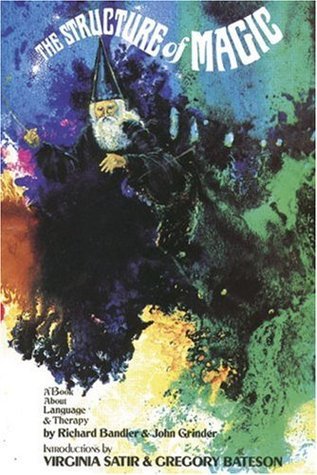
The Structure of Magic I: A Book about Language and Therapy
These seminal works in neurolinguistic programming (NLP) help therapists understand how people create inner models of the world to represent their experience and guide their behavior. Volume I describes the Meta Model, a framework for comprehending the structure of language; Volume II applies NLP theory to nonverbal communication.
419 pages, Hardcover
First published June 1, 1975
Ratings & Reviews
Friends & Following
Create a free account to discover what your friends think of this book!
Community Reviews
Displaying 1 - 30 of 53 reviews
January 26, 2011
I just finished reading an interesting book called The Structure of Magic. It is actually not about magic at all, but about psychology. This book contains some eye-opening insights into the relationship between models and reality. It is an attempt to find the common elements in language-based therapy, a meta-model as they call it, in order to advance the state of the field of therapy as a whole. It also presented the case that concrete-ness is the key to understanding a person’s model of the world. This review will summarize the book by chapter, with my own thoughts added as notes to the side.
Warning to the Reader
The central task of psychology is understanding human behavior. Human behavior is infinitely complex, though not unbounded. For instance, there are infinitely many subtle variations of one’s daily routine (infinite complexity), but people can’t fly (bounded). In a similar fashion, language is also infinitely complex while remaining bounded. This book is based on the insight that human language and human behavior as systems are related. In particular, Transformational Grammar as developed by Noam Chomsky in the 1960s, has shown that infinitely complex entities can be governed by a finite set of rules. It is possible to describe an infinite number of things using English. However, all English sentences must conform to the rules of English grammar and syntax. Grinder and Bandler posit that human behavior acts in the same way. This book is a first attempt at producing a “grammar” of human behavior. This behavioral “grammar” will try to show the basic ground rules that make up a person’s model of the universe and determines that person’s action. It goes on to show how to improve that person’s behavioral grammar, so that he or she can live a more successful life.
The Structure of Choice
“Human beings do not operate directly on the world. Each of us creates a representation of the world in which we live – that is, we create a map or model which we use to generate our behavior.”
This map is not identical to reality. Our model is limited by our physical ability to perceive (neurological constraints), our social background (cultural constraints), and by our life experiences (experiential constraints). So, no one sees reality as it really is. We always have a limited picture. We can only be in one place at one time, we can only hear so far, and see so far. And let's face it, our physical limitations are the least of our problems. We are also conditioned by culture to accept certain things, and our own life experiences condition us even more strongly. Has anyone ever got a new car and then suddenly noticed how many other cars on the road were exactly the same? That is an instance of perceiving things only after they enter our model of reality. Every person has an incomplete, somewhat distorted model of the world (even me, BLAST!), that is close enough to reality so that we can muddle our way through life without too much trouble.
Of these three, the experiential constraints are the most profound for the authors. People who come for counseling are typically in pain because their model does not allow them to see or make the right choices in a given situation. To be successful, a therapist must be able to expand his client’s model of reality. Any model of reality can be affected in three different ways: Generalization, Deletion, and Distortion. Generalization refers to the process of applying a singular occurrence to a broad range of related, but different occurrences. Deletion refers to a person’s inability to perceive happenings that contradict his or her model. Distortion refers to a person’s unconscious shaping of their perceptions to fit their internal model.
The Structure of Language
Language is a tool with one purpose: presenting our views/model. This representation can be either internal (thinking) or external (communication). Language can be thought of as a subset of one’s model of the world. It is, in effect, a model of a model. As such, it is subject to the three universals of human modeling: generalization, deletion, and distortion. Language is also subject to the three universals of linguistics.
1. Native speakers can always tell if a sentence is well-formed (that is, if it follows the syntax and grammar of that language).
2. Native speakers can always tell which elements in a sentence are related, and they can determine the logical semantic relations (presupposition, ambiguity, etc.) that are present.
3. Syntax and grammar are governed by a finite, regular set of rules (which may or may not be known to the speaker).
The two key concepts in this chapter are the ideas of the Surface Structure and the Deep Structure. The Surface Structure is whatever the speaker actually says. The Deep Structure, on the other hand, is the full linguistic representation of what the speaker wants to communicate. It is easier to think of the Deep Structure as the Surface Structure with all of the details filled in. For example, a man says to his wife, “I went to the store.” “I went to the store” is the Surface Structure. The Deep Structure could be something like “I went to the store at 6:00 pm in my truck to buy bread so that we could make sandwiches for dinner.” The Surface Structure weeds out the elements that the speaker considers implicit, irrelevant or undesirable. The authors contend that the Surface Structure is generated from the Deep Structure mostly by unconscious action.
The Structure of Magic
The one commonality of all successful therapy is that the patient changes in some way. This chapter presents an overview of the Meta-model of therapy. It gives a summary of how generalization, deletions, and distortions in a person’s model can be identified and corrected. Deletions result in an impoverished model of the world, which results in a limited range of behavioral options in any situation. The process for recognizing deletions at the Surface Structure level is to take a given utterance by the patient and to use our linguistic intuition to try and imagine the same sentence with more noun arguments. If you can think of any, then the client’s surface Structure is incomplete. The therapist can then choose between ignoring the deletion, asking for the missing piece of the sentence, or guessing at the deletion.
“In general, the effectiveness of a particular form of therapy is associated with its ability to recover ‘suppressed’ or missing pieces of the client’s model. Thus, the first step in acquiring this set of tools is to learn to identify the fact that linguistic deletion has occurred. The pieces that are missing in the Surface Structure are the material which has been removed by the Deletion Transformation. Recovering the missing material involves a movement toward fuller representation – the Deep Structure.”
Presuppositions are another form of deletion. They are the underlying unstated assumptions of a model. All presuppositions should be explored. When one understands a person’s presuppositions, their behavior no matter how bizarre, makes sense.
“The therapist’s task is to challenge deletions which are not useful; those which cause pain …”
There seem to be two parts to challenging a deletion. First, the therapist must work from the Surface Structure to the Deep Structure. Then the therapist must find where the Deep Structure does not correspond with reality. This second step is accomplished by imagining options that the client should be aware of, but isn’t. At this stage, the therapist should not suggest these missing options as solutions to the patient’s problem. The patient is unable to fit these ideas into his model, and will resist them. Instead, the therapist should work to expand the patient’s model of reality until it becomes rich enough to contain these alternative options. Distortion is a reference “to things which are represented in the client’s model, but are twisted in some way which limits his ability to act and increases his potential for pain.” One example of distortion is when the patient perceives a dynamic process as a static event. Viewing a process as an event gives the client the false sense that this happening is fixed and unchangeable. The task of the therapist in this case is to reintroduce the “event” as an ongoing process. Another example of distortion is assigning responsibility to people for actions outside of their control. For example, Bob made me angry. Bob is incapable of “making” me feel a certain emotion. The authors reject this sentence as “semantically ill-formed.” The therapist’s task here is to challenge the client’s model to assist in them in their quest to correctly assign responsibility for their responses.
My Conclusions
The natural question is, "So what?" The reason that all of this is important is because everyone, no matter how WEIRD, is acting in ways that are logical IF you share that person's model of reality. The only real way to change a person's behavior is to change their model of reality. That is one of the reasons why Jesus was such a powerful influence on his disciples. His parables (and his life) were designed to kick the legs out from under the disciples' model of reality, so that he could reshape and expand that model to match God's reality. Amazing how Jesus got as far as he did without a Ph.D in psychology.
I think that this book does a great service in pointing out that no one’s perception of reality is identical with reality itself. I also think that their presentation of the different ways that people typically distort reality to fit their model was helpful. Negatively, I think that they labored under the burden of Transformation Grammar far longer than was helpful. I also think that they are too optimistic about the truthfulness of human beings. They assume that people are trying to faithfully represent their actual remembrances with their words. These things need to be taken into consideration as we attempt to move some of the findings of this book from the counseling arena to the mentoring arena.
Warning to the Reader
The central task of psychology is understanding human behavior. Human behavior is infinitely complex, though not unbounded. For instance, there are infinitely many subtle variations of one’s daily routine (infinite complexity), but people can’t fly (bounded). In a similar fashion, language is also infinitely complex while remaining bounded. This book is based on the insight that human language and human behavior as systems are related. In particular, Transformational Grammar as developed by Noam Chomsky in the 1960s, has shown that infinitely complex entities can be governed by a finite set of rules. It is possible to describe an infinite number of things using English. However, all English sentences must conform to the rules of English grammar and syntax. Grinder and Bandler posit that human behavior acts in the same way. This book is a first attempt at producing a “grammar” of human behavior. This behavioral “grammar” will try to show the basic ground rules that make up a person’s model of the universe and determines that person’s action. It goes on to show how to improve that person’s behavioral grammar, so that he or she can live a more successful life.
The Structure of Choice
“Human beings do not operate directly on the world. Each of us creates a representation of the world in which we live – that is, we create a map or model which we use to generate our behavior.”
This map is not identical to reality. Our model is limited by our physical ability to perceive (neurological constraints), our social background (cultural constraints), and by our life experiences (experiential constraints). So, no one sees reality as it really is. We always have a limited picture. We can only be in one place at one time, we can only hear so far, and see so far. And let's face it, our physical limitations are the least of our problems. We are also conditioned by culture to accept certain things, and our own life experiences condition us even more strongly. Has anyone ever got a new car and then suddenly noticed how many other cars on the road were exactly the same? That is an instance of perceiving things only after they enter our model of reality. Every person has an incomplete, somewhat distorted model of the world (even me, BLAST!), that is close enough to reality so that we can muddle our way through life without too much trouble.
Of these three, the experiential constraints are the most profound for the authors. People who come for counseling are typically in pain because their model does not allow them to see or make the right choices in a given situation. To be successful, a therapist must be able to expand his client’s model of reality. Any model of reality can be affected in three different ways: Generalization, Deletion, and Distortion. Generalization refers to the process of applying a singular occurrence to a broad range of related, but different occurrences. Deletion refers to a person’s inability to perceive happenings that contradict his or her model. Distortion refers to a person’s unconscious shaping of their perceptions to fit their internal model.
The Structure of Language
Language is a tool with one purpose: presenting our views/model. This representation can be either internal (thinking) or external (communication). Language can be thought of as a subset of one’s model of the world. It is, in effect, a model of a model. As such, it is subject to the three universals of human modeling: generalization, deletion, and distortion. Language is also subject to the three universals of linguistics.
1. Native speakers can always tell if a sentence is well-formed (that is, if it follows the syntax and grammar of that language).
2. Native speakers can always tell which elements in a sentence are related, and they can determine the logical semantic relations (presupposition, ambiguity, etc.) that are present.
3. Syntax and grammar are governed by a finite, regular set of rules (which may or may not be known to the speaker).
The two key concepts in this chapter are the ideas of the Surface Structure and the Deep Structure. The Surface Structure is whatever the speaker actually says. The Deep Structure, on the other hand, is the full linguistic representation of what the speaker wants to communicate. It is easier to think of the Deep Structure as the Surface Structure with all of the details filled in. For example, a man says to his wife, “I went to the store.” “I went to the store” is the Surface Structure. The Deep Structure could be something like “I went to the store at 6:00 pm in my truck to buy bread so that we could make sandwiches for dinner.” The Surface Structure weeds out the elements that the speaker considers implicit, irrelevant or undesirable. The authors contend that the Surface Structure is generated from the Deep Structure mostly by unconscious action.
The Structure of Magic
The one commonality of all successful therapy is that the patient changes in some way. This chapter presents an overview of the Meta-model of therapy. It gives a summary of how generalization, deletions, and distortions in a person’s model can be identified and corrected. Deletions result in an impoverished model of the world, which results in a limited range of behavioral options in any situation. The process for recognizing deletions at the Surface Structure level is to take a given utterance by the patient and to use our linguistic intuition to try and imagine the same sentence with more noun arguments. If you can think of any, then the client’s surface Structure is incomplete. The therapist can then choose between ignoring the deletion, asking for the missing piece of the sentence, or guessing at the deletion.
“In general, the effectiveness of a particular form of therapy is associated with its ability to recover ‘suppressed’ or missing pieces of the client’s model. Thus, the first step in acquiring this set of tools is to learn to identify the fact that linguistic deletion has occurred. The pieces that are missing in the Surface Structure are the material which has been removed by the Deletion Transformation. Recovering the missing material involves a movement toward fuller representation – the Deep Structure.”
Presuppositions are another form of deletion. They are the underlying unstated assumptions of a model. All presuppositions should be explored. When one understands a person’s presuppositions, their behavior no matter how bizarre, makes sense.
“The therapist’s task is to challenge deletions which are not useful; those which cause pain …”
There seem to be two parts to challenging a deletion. First, the therapist must work from the Surface Structure to the Deep Structure. Then the therapist must find where the Deep Structure does not correspond with reality. This second step is accomplished by imagining options that the client should be aware of, but isn’t. At this stage, the therapist should not suggest these missing options as solutions to the patient’s problem. The patient is unable to fit these ideas into his model, and will resist them. Instead, the therapist should work to expand the patient’s model of reality until it becomes rich enough to contain these alternative options. Distortion is a reference “to things which are represented in the client’s model, but are twisted in some way which limits his ability to act and increases his potential for pain.” One example of distortion is when the patient perceives a dynamic process as a static event. Viewing a process as an event gives the client the false sense that this happening is fixed and unchangeable. The task of the therapist in this case is to reintroduce the “event” as an ongoing process. Another example of distortion is assigning responsibility to people for actions outside of their control. For example, Bob made me angry. Bob is incapable of “making” me feel a certain emotion. The authors reject this sentence as “semantically ill-formed.” The therapist’s task here is to challenge the client’s model to assist in them in their quest to correctly assign responsibility for their responses.
My Conclusions
The natural question is, "So what?" The reason that all of this is important is because everyone, no matter how WEIRD, is acting in ways that are logical IF you share that person's model of reality. The only real way to change a person's behavior is to change their model of reality. That is one of the reasons why Jesus was such a powerful influence on his disciples. His parables (and his life) were designed to kick the legs out from under the disciples' model of reality, so that he could reshape and expand that model to match God's reality. Amazing how Jesus got as far as he did without a Ph.D in psychology.
I think that this book does a great service in pointing out that no one’s perception of reality is identical with reality itself. I also think that their presentation of the different ways that people typically distort reality to fit their model was helpful. Negatively, I think that they labored under the burden of Transformation Grammar far longer than was helpful. I also think that they are too optimistic about the truthfulness of human beings. They assume that people are trying to faithfully represent their actual remembrances with their words. These things need to be taken into consideration as we attempt to move some of the findings of this book from the counseling arena to the mentoring arena.

January 14, 2019
An attempt to turn 1960's linguistics into a therapy technique. Despite the absurdity of such a quest, the model presented is very impressive and useful.
The authors have a deep admiration for the work of therapists that are so effective at causing the patients to look at their blindspots and develop new, richer models, that it seems like downright magic. They repeatedly mention the work of Virginia Satir, one of the pioneers of family therapy, as one of their big inspirations.
Through their curiosity about those feats of Magic, they came to map out the Structure of the process into concrete mechanical steps even a simple Python script could follow. I'm very fascinated, as my amateruish attempts to follow the model yielded results, though it's hard to know how useful it would have been without Focusing. Overall, I put this model in the category of "things that attempt to get people to do Focusing if you poke at them enough"
Their two full transcripts were very elucidating and I think every therapy book should do this. It also reminded me how 95% of a therapy session is the client trying to not really look at the problem, and 5% is the actual breakthrough into new territory.
Despite the authors' admiration of people like Virginia Satir and the work of other great healers of the heart, they don't strike me as Bodhisattvas such as Marshal Rosenberg or Mr. Rodgers. Looking at their Wikipedia pages and websites, I get the sense they're now some kind of second-rate overly-tanned snake-oil salesmen. Bandler's website informs me that "Dr. Bandler has been nominated for Global Guru in the area of NLP." Too bad.
Their explanation of modeling (map vs. territory) is pretty thorough and contained some new insights even for experienced LW readers. They present properties of maps that are orthogonal to its contents, and also interesting things about congruity between overlapping maps of the same territory, such as language vs. body incongruities.
I really liked their description of double binds and kind of want to go around double-binding everyone just for the fun of it.
The authors have a deep admiration for the work of therapists that are so effective at causing the patients to look at their blindspots and develop new, richer models, that it seems like downright magic. They repeatedly mention the work of Virginia Satir, one of the pioneers of family therapy, as one of their big inspirations.
Through their curiosity about those feats of Magic, they came to map out the Structure of the process into concrete mechanical steps even a simple Python script could follow. I'm very fascinated, as my amateruish attempts to follow the model yielded results, though it's hard to know how useful it would have been without Focusing. Overall, I put this model in the category of "things that attempt to get people to do Focusing if you poke at them enough"
Their two full transcripts were very elucidating and I think every therapy book should do this. It also reminded me how 95% of a therapy session is the client trying to not really look at the problem, and 5% is the actual breakthrough into new territory.
Despite the authors' admiration of people like Virginia Satir and the work of other great healers of the heart, they don't strike me as Bodhisattvas such as Marshal Rosenberg or Mr. Rodgers. Looking at their Wikipedia pages and websites, I get the sense they're now some kind of second-rate overly-tanned snake-oil salesmen. Bandler's website informs me that "Dr. Bandler has been nominated for Global Guru in the area of NLP." Too bad.
Their explanation of modeling (map vs. territory) is pretty thorough and contained some new insights even for experienced LW readers. They present properties of maps that are orthogonal to its contents, and also interesting things about congruity between overlapping maps of the same territory, such as language vs. body incongruities.
I really liked their description of double binds and kind of want to go around double-binding everyone just for the fun of it.

March 4, 2022
Neurolinguistic Programming (NLP) has gone in some questionable directions since its beginnings. But this early book is essential reading for any therapist. It's metamodel of how language represents the way in which humans represent their internal models of reality is brilliant and particularly useful in all sorts of situations where human communication occurs. As others have mentioned, it is a difficult read. But once the concepts are grasped and applied, the metamodel is a powerful set of tools to improve understanding of oneself and others and, when used effectively, after much practice, can enrich relationships -- professional and personal. There are many resources available on the Internet that explain the metamodel in simpler terms. But, at some point, this volume is essential reading. My recommendation of this book does not mean I endorse other aspects of what has become known as NLP which are often highly problematic, and which lack a significant evidence basis in the way the metamodel does.

July 4, 2011
THE STRUCTURE OF MAGIC
This is a little gem of a book which, perhaps more so than any other, helped me understand how our minds work on a linguistic basis (a topic of, no doubt, interest to avid readers).
The downside is that it's basically a textbook writing for pyschologists. But, if you can stomach the dryness, the rewards of insight are well worth the effort.
As many know, this series of books along with Frogs into Princes helped to establish the field of Nero Linguistic Programming or NLP.
This is a little gem of a book which, perhaps more so than any other, helped me understand how our minds work on a linguistic basis (a topic of, no doubt, interest to avid readers).
The downside is that it's basically a textbook writing for pyschologists. But, if you can stomach the dryness, the rewards of insight are well worth the effort.
As many know, this series of books along with Frogs into Princes helped to establish the field of Nero Linguistic Programming or NLP.

August 16, 2016
The Structure of Magic refers to the mental structures that people have about how the world works, and how those structures impact the words that they say in therapy. The book's argument is that understanding these structures can dramatically improve the effectiveness of a therapist, regardless of what type of therapy they practice.
The semantics of the sentences that people say in therapy is determined by their conception of their own experience. So a therapist is two levels removed from what's actually been happening to the person.
A person's experience -> their model of the world -> what they say about the experience
Each level of the structure is different from the preceding level in many ways. These differences all fall into the categories of deletions (ignoring something from a lower level of abstraction), generalizations, and distortions.
By paying attention to what deletions, distortions, and generalizations are in somebody's descriptions of their experiences, a therapist can get a good idea of what that person's model of the world is. By strategically challenging a person's model of the world, it can be enlarged to allow them access to new options.
Overall, I thought this book was great. It's clearly written and full of good examples. It also helped me to understand some things about human interactions that had been confusing me.
For one thing, the idea that people are experts on their own experience seems to conflict with other people being able to come up with better approaches to certain problems. These two observations are harmonized by the idea that people are the experts on their own experiences, but their model of the world may be limiting them such that they can't identify certain options. This also explains why people often fail to follow advice: if the advice conflicts with their model of the world then they will be very unlikely to see it as an option even after the advice has been given.
This book is full of similar realizations.
I was at first put off by the title, and worried that it would be full of wishful thinking about how to solve problems. Instead, the book offers lots of concrete advice backed by case studies and examples.
The semantics of the sentences that people say in therapy is determined by their conception of their own experience. So a therapist is two levels removed from what's actually been happening to the person.
A person's experience -> their model of the world -> what they say about the experience
Each level of the structure is different from the preceding level in many ways. These differences all fall into the categories of deletions (ignoring something from a lower level of abstraction), generalizations, and distortions.
By paying attention to what deletions, distortions, and generalizations are in somebody's descriptions of their experiences, a therapist can get a good idea of what that person's model of the world is. By strategically challenging a person's model of the world, it can be enlarged to allow them access to new options.
Overall, I thought this book was great. It's clearly written and full of good examples. It also helped me to understand some things about human interactions that had been confusing me.
For one thing, the idea that people are experts on their own experience seems to conflict with other people being able to come up with better approaches to certain problems. These two observations are harmonized by the idea that people are the experts on their own experiences, but their model of the world may be limiting them such that they can't identify certain options. This also explains why people often fail to follow advice: if the advice conflicts with their model of the world then they will be very unlikely to see it as an option even after the advice has been given.
This book is full of similar realizations.
I was at first put off by the title, and worried that it would be full of wishful thinking about how to solve problems. Instead, the book offers lots of concrete advice backed by case studies and examples.
June 8, 2012
Despite the fact this info (the meta model) has been reprinted and explained thousands of times over in virtually every NLP book. Mistakenly I thought the authors charismatic personality would add some flair to the content .However the dry academic prose really kills it. Whilst the info is still good the book tends, to become very repetitive fast. Instead i would recomemend NLP for begginers which summarises this 200 page text in 20, Along with many other developments in the field.

November 9, 2017
This book is NOT about mind manipulation, it's NOT about reading minds, it can't even be used for misguided purposes for if anything, this book will tell us how in a simplified way, we operate in the world through our minds and build different internal representations of the world based on what we have experienced - some chances for improvement and action, or lack of choice and freedom. And even the techniques distilled by Bandler and Grinder from all sorts of therapeutic are confied therefor to the walls of therapeutic work, this is NOT to be used idly or for sports but in careful closed guided consideration one must have to fix our learned disabilities if i can use such a word i don't agree with myself.
Now The Structure of Magic specifically applies to the explicit grammatic structure of a person's understanding of the world, it focuses on the 'well formed in therapy'. syntax and consistency between ideas and uttered sentences by the client and the therapist has first and foremost to grasp enough of the client's model of the world so that he can, by asking the right questions, show a hidden option that the client can take or was always able to take but couldn't see.
Very excited about Volume II, should go into integrating sensorial perceptions more brashly with the digital, that is words themselves. A must read for every potential and current therapist, and enthusiasts of the field.
Now The Structure of Magic specifically applies to the explicit grammatic structure of a person's understanding of the world, it focuses on the 'well formed in therapy'. syntax and consistency between ideas and uttered sentences by the client and the therapist has first and foremost to grasp enough of the client's model of the world so that he can, by asking the right questions, show a hidden option that the client can take or was always able to take but couldn't see.
Very excited about Volume II, should go into integrating sensorial perceptions more brashly with the digital, that is words themselves. A must read for every potential and current therapist, and enthusiasts of the field.

October 8, 2016
Bandler and Grinder set out to show how coaches or therapists who are very effective, use a range of very similar skills which the authors here try to pull together: in book 1 they mainly deal with language (book 2 mainly deals with verbal and non-verbal representation systems).
The text of book 1 I found to be much simpler than book 2 which is very hard. Book 1 is similar to 'questions for specificity' in cognitive coaching, but with a much fuller picture of the differences between 'deep structures' (residues of real experience in the mind) and 'surface structures' which are the distorted, deleted and wrongly generalised things one chooses to say about those experiences.
The basic idea is that by mediative questioning about what has been 'left out', the client can more fully engage with the original experience, rather than their simplification of it, and therefore can have more options about how to respond. In this case, some of the work on causality is very close to mindfulness; in other parts it is like cognitive coaching paraphrase work.
The biggest 'plus' of the text, is it makes complete sense of the rather obscure way that cognitive coaching talks about 'deep structures': these words make more sense when you know they come from these texts.
The text of book 1 I found to be much simpler than book 2 which is very hard. Book 1 is similar to 'questions for specificity' in cognitive coaching, but with a much fuller picture of the differences between 'deep structures' (residues of real experience in the mind) and 'surface structures' which are the distorted, deleted and wrongly generalised things one chooses to say about those experiences.
The basic idea is that by mediative questioning about what has been 'left out', the client can more fully engage with the original experience, rather than their simplification of it, and therefore can have more options about how to respond. In this case, some of the work on causality is very close to mindfulness; in other parts it is like cognitive coaching paraphrase work.
The biggest 'plus' of the text, is it makes complete sense of the rather obscure way that cognitive coaching talks about 'deep structures': these words make more sense when you know they come from these texts.

September 21, 2012
I studied it and started evaluating my own language. What surprising things I found out about myself. We get strangled by our own habits and interpretations.
Talk is powerful. However, we would have to agree to be healed by words. Otherwise, we'd just generalise again: it's just smooth-talking.
Talk is powerful. However, we would have to agree to be healed by words. Otherwise, we'd just generalise again: it's just smooth-talking.

April 8, 2022
L'idea centrale di questo libro è l'uso della comunicazione verbale e gestuale in senso terapeutico.
Gli autori tentano di tradurre in senso terapeutico il modello di Grammatica di Chomsky e la teoria dei tipi di Russell.
Il risultato è duplice.
1 Dalla grammatica derivano le più comuni distorsioni del linguaggio, e ne ricavano degli indici di lavoro in senso verbale:
Generalizzazioni, cancellazioni, deformazioni.
Dove ciascuno di questi meccanismi ha dei sottogeneri espressivi associati a domande adeguate per il loro trattamento.
2 dalla teoria dei tipi di Russell gli autori derivano l'idea per cui ogni cliente può risolvere i suoi problemi su un livello più basso della sua struttura psichica raggiungendo una proposizione, una capacità espressiva sul piano immediatamente superiore. Nello specifico, gli autori parlano di: emozioni in ingresso, rappresentazioni, espressioni in uscita, caratteri sotto tensione.
Gli autori aggiungono un piano di malformazioni individuare dalla pratica clinica.
Cerco di spiegare in breve il tutto.
Si parte dall'idea che un tizio arrivi in uno stato psicologico che va cambiato.
Il terapeuta lo deve cambiare in modo tale che il nuovo stato contenga la possibilità il più di sapere descrivere lo stato precedente, non solo di viverlo, perché quello stato è doloroso.
Dunque si parla con il cliente e si tenta prima di tutto di sapere qual è il suo sistema preferito di emozioni in ingressi, di rappresentazioni, di espressioni in uscita.
Quali sono le opzioni più probabili? Preferisce le Vista, l'udito, o il moto (cinestesi).
Come si fa a capire? Controllare le parole che usa e associarle al campo semantico della vista, udito, moto. Quale prevale?
Punto 2, individuare le malformazioni linguistiche, e contestarle.
Quali sono? Nominalizzare (sostituire un processo con un nome, per esempio pensieri per pensare), togliere la referenza precisa (la gente mi odia. Chi è la gente?) Verbo non specificato (mi ha colpito. Dove? Come? Con cosa?) oppure cancellazione ( vorrei cambiare vita. Vorresti cambiare vita ma..?)
Una volta formata un'immagine chiara passare al punto 3.
Punto 3: ricalibrare le malformazioni psicologiche.
1 causa effetto. Da piccoli non distinguiamo esterno interno. A volte questo meccanismo si conserva e ci fa attribuire a cause esterne un atteggiamento interno. Per esempio: mio padre mi fa arrabbiare. Quando fa cosa? Quando tintinna le monete. Quindi non è il padre, ma tintinnare le monete.
2 lettura del pensiero. Lei non mi ama, perché non mi sorride. Tu sorridi ogni volta che esprimi amore? Si. Va bene. Le hai chiesto se per lei è lo stesso? No.. Lo so e basta. Come fai a saperlo? Indagare fino a quando si porta il cliente ad ammettere che non può saperlo.
3 prestazione perduta. A volte il cliente non può sapere cosa pensa qualcuno e si rappresenta un'opzione per lui plausibile. Ma di fatto potrebbe non avere gli elementi per capire davvero qual è l elemento mancante.
L'idea è che prima noi ci formiamo degli agganci semantici tra segni e cose, poi usiamo segni per rappresentare e, infine, usiamo segni per comunicare. A volte una di queste prestazioni è assente.
Per esempio, banalmente, un cieco non può ricevere, né comunicare il concetto di colore, ma lo può rappresentare Con qualcosa che ne faccia le veci (una parola). Un cieco può capire la frase: il sole è giallo. Ma non riceve né esprime questo segno-frase come un vedente.
Passo 4: notare sotto tensione il cliente.
Fa lo yes man? Fa l'accusatore? Fa il freddo calcolatore? Un misto di questi 3?
Bene, ora che sapete queste 6 cose si può procedere.
Parte 1 della terapia:
Arricchire i sistemi ingressi, rappresenta e uscita del cliente facendogli descrivere con un canale non preferenziale una stessa immagine.
È un visivo? Mi descriva il deserto. Cielo fosco, aabbia marrone. Cosa sente? Sabbia granulosa, cielo freddo. Vento che sibila.
Quindi prima far descrivere qualcosa, poi commutare ad un altro sistema (come descriverebbe il sole in temini di moto) oppure aggiungere direttamente un altro sistema (bene cosa ha visto, ora mi descriva cosa sente, cosa tocca). Insistere, perché spesso il cliente dirà:non vedo, non sento, è sfuocato etc.
Parte 2
Recitare con il cliente in questo modo: il cliente avrà un comportamento dominante e uno debole. Recitare il suo dominante e fare recitare a lui il più debole.
1 e 2 dovrebbero fare in modo che il cliente prendesse consapevolezza del suo sistema di preferenza (ingresso, rapp, uscita, carattere, malformazione, meccanismi) e arricchire il suo sistema con le altre opzioni.
L'idea quindi è che le persone soffrono perché si limitano con limiti che non sono funzionali, che cioè non gli consentono di costruire segni per rappresentare o comunicare quello che entra in loro.
Obiezione facile a questo sistema:
si rischia di indurre fantasticherie più di curare, ovvero non ci sono garanzie di cura a lungo termine. Quindi l'idea della manipolazione resta arbitraria.
Gli autori tentano di tradurre in senso terapeutico il modello di Grammatica di Chomsky e la teoria dei tipi di Russell.
Il risultato è duplice.
1 Dalla grammatica derivano le più comuni distorsioni del linguaggio, e ne ricavano degli indici di lavoro in senso verbale:
Generalizzazioni, cancellazioni, deformazioni.
Dove ciascuno di questi meccanismi ha dei sottogeneri espressivi associati a domande adeguate per il loro trattamento.
2 dalla teoria dei tipi di Russell gli autori derivano l'idea per cui ogni cliente può risolvere i suoi problemi su un livello più basso della sua struttura psichica raggiungendo una proposizione, una capacità espressiva sul piano immediatamente superiore. Nello specifico, gli autori parlano di: emozioni in ingresso, rappresentazioni, espressioni in uscita, caratteri sotto tensione.
Gli autori aggiungono un piano di malformazioni individuare dalla pratica clinica.
Cerco di spiegare in breve il tutto.
Si parte dall'idea che un tizio arrivi in uno stato psicologico che va cambiato.
Il terapeuta lo deve cambiare in modo tale che il nuovo stato contenga la possibilità il più di sapere descrivere lo stato precedente, non solo di viverlo, perché quello stato è doloroso.
Dunque si parla con il cliente e si tenta prima di tutto di sapere qual è il suo sistema preferito di emozioni in ingressi, di rappresentazioni, di espressioni in uscita.
Quali sono le opzioni più probabili? Preferisce le Vista, l'udito, o il moto (cinestesi).
Come si fa a capire? Controllare le parole che usa e associarle al campo semantico della vista, udito, moto. Quale prevale?
Punto 2, individuare le malformazioni linguistiche, e contestarle.
Quali sono? Nominalizzare (sostituire un processo con un nome, per esempio pensieri per pensare), togliere la referenza precisa (la gente mi odia. Chi è la gente?) Verbo non specificato (mi ha colpito. Dove? Come? Con cosa?) oppure cancellazione ( vorrei cambiare vita. Vorresti cambiare vita ma..?)
Una volta formata un'immagine chiara passare al punto 3.
Punto 3: ricalibrare le malformazioni psicologiche.
1 causa effetto. Da piccoli non distinguiamo esterno interno. A volte questo meccanismo si conserva e ci fa attribuire a cause esterne un atteggiamento interno. Per esempio: mio padre mi fa arrabbiare. Quando fa cosa? Quando tintinna le monete. Quindi non è il padre, ma tintinnare le monete.
2 lettura del pensiero. Lei non mi ama, perché non mi sorride. Tu sorridi ogni volta che esprimi amore? Si. Va bene. Le hai chiesto se per lei è lo stesso? No.. Lo so e basta. Come fai a saperlo? Indagare fino a quando si porta il cliente ad ammettere che non può saperlo.
3 prestazione perduta. A volte il cliente non può sapere cosa pensa qualcuno e si rappresenta un'opzione per lui plausibile. Ma di fatto potrebbe non avere gli elementi per capire davvero qual è l elemento mancante.
L'idea è che prima noi ci formiamo degli agganci semantici tra segni e cose, poi usiamo segni per rappresentare e, infine, usiamo segni per comunicare. A volte una di queste prestazioni è assente.
Per esempio, banalmente, un cieco non può ricevere, né comunicare il concetto di colore, ma lo può rappresentare Con qualcosa che ne faccia le veci (una parola). Un cieco può capire la frase: il sole è giallo. Ma non riceve né esprime questo segno-frase come un vedente.
Passo 4: notare sotto tensione il cliente.
Fa lo yes man? Fa l'accusatore? Fa il freddo calcolatore? Un misto di questi 3?
Bene, ora che sapete queste 6 cose si può procedere.
Parte 1 della terapia:
Arricchire i sistemi ingressi, rappresenta e uscita del cliente facendogli descrivere con un canale non preferenziale una stessa immagine.
È un visivo? Mi descriva il deserto. Cielo fosco, aabbia marrone. Cosa sente? Sabbia granulosa, cielo freddo. Vento che sibila.
Quindi prima far descrivere qualcosa, poi commutare ad un altro sistema (come descriverebbe il sole in temini di moto) oppure aggiungere direttamente un altro sistema (bene cosa ha visto, ora mi descriva cosa sente, cosa tocca). Insistere, perché spesso il cliente dirà:non vedo, non sento, è sfuocato etc.
Parte 2
Recitare con il cliente in questo modo: il cliente avrà un comportamento dominante e uno debole. Recitare il suo dominante e fare recitare a lui il più debole.
1 e 2 dovrebbero fare in modo che il cliente prendesse consapevolezza del suo sistema di preferenza (ingresso, rapp, uscita, carattere, malformazione, meccanismi) e arricchire il suo sistema con le altre opzioni.
L'idea quindi è che le persone soffrono perché si limitano con limiti che non sono funzionali, che cioè non gli consentono di costruire segni per rappresentare o comunicare quello che entra in loro.
Obiezione facile a questo sistema:
si rischia di indurre fantasticherie più di curare, ovvero non ci sono garanzie di cura a lungo termine. Quindi l'idea della manipolazione resta arbitraria.
January 16, 2025
"Magic is nothing new, it is simply drawing attention to what most people never notice" - Hai Dao.
This is a very insightful book that attempted to break down many of the mysteries behind therapy and mental health. It is both for laymen looking to better understand the innerworkings of their mind as well as a how-to guide for therapist to improve their work.
Chapter 1 and 2 is an introduction which made the claim that many people come to therapy because their mind restricts itself. The world is quite vast so to preserve our sanity, the brain decides to limit access to certain information.
For example, we can only perceive a very small portion of the visual spectrum, and the role of a therapist is to clarify and expand all 5 senses (sight, sound, smell, touch, taste).
Chapter 3 and 4 describes common ways that people often limit themselves through language by omitting certain words, using universal quantifier, distortion, and generalization.
Chapter 5 provides techniques and two conversational excerpts on how a therapist can ask for clarifications, teaching the client to "talk to themselves" by looking inside their mind and searching for the missing details.
Chapter 6 referenced another technique where a therapist can ask a client to create an imaginary scenario to help them process situations in which they have trouble finding a concrete representation.
TLDR: This book is written as a how-to guide for therapists, but I believe that anyone who want to expand their five senses will be able to benefit from this as this book will teach you how to "talk to yourself" when faced with any mental obstacles.
This is a very insightful book that attempted to break down many of the mysteries behind therapy and mental health. It is both for laymen looking to better understand the innerworkings of their mind as well as a how-to guide for therapist to improve their work.
Chapter 1 and 2 is an introduction which made the claim that many people come to therapy because their mind restricts itself. The world is quite vast so to preserve our sanity, the brain decides to limit access to certain information.
For example, we can only perceive a very small portion of the visual spectrum, and the role of a therapist is to clarify and expand all 5 senses (sight, sound, smell, touch, taste).
Chapter 3 and 4 describes common ways that people often limit themselves through language by omitting certain words, using universal quantifier, distortion, and generalization.
Chapter 5 provides techniques and two conversational excerpts on how a therapist can ask for clarifications, teaching the client to "talk to themselves" by looking inside their mind and searching for the missing details.
Chapter 6 referenced another technique where a therapist can ask a client to create an imaginary scenario to help them process situations in which they have trouble finding a concrete representation.
TLDR: This book is written as a how-to guide for therapists, but I believe that anyone who want to expand their five senses will be able to benefit from this as this book will teach you how to "talk to yourself" when faced with any mental obstacles.

March 23, 2017
This book is amazing!
Not only the content but the way it is written shows that the authors live by their own standards in working through the subtleties of language.
This book elucidates the nature of human reality, the only reality that humanity knows. It ties language to the essence of our reality and implies if we can learn how to handle our language, we learn how to handle reality itself (or that which we perceive reality to be).
Learning the content in this book is empowering, I don't say that in the motivational or emotional sense, I say it in a practical sense. "Enrich" your "model", open your mind, and realize the power inherent in you through mere existen.... I'm starting to sound too abstract...
This is exciting.
I can't wait to read volume 2!
Not only the content but the way it is written shows that the authors live by their own standards in working through the subtleties of language.
This book elucidates the nature of human reality, the only reality that humanity knows. It ties language to the essence of our reality and implies if we can learn how to handle our language, we learn how to handle reality itself (or that which we perceive reality to be).
Learning the content in this book is empowering, I don't say that in the motivational or emotional sense, I say it in a practical sense. "Enrich" your "model", open your mind, and realize the power inherent in you through mere existen.... I'm starting to sound too abstract...
This is exciting.
I can't wait to read volume 2!

April 27, 2024
Human behavior follows certain patterns. Human speech also has patterns. If you understand the latter of human speech, then you can know what to listen for in a therapeutic setting, which will give you insight into how to help your client.
That’s what this book is about.
However, I have no experience working in a therapeutic setting because I’m not a therapist. So, I have no experience to back up the validity/usefulness of this therapeutic technique. I only read the book because I was curious. I wanted to know what Neuro-linguistic Processing is. The concept was interesting.
I don’t recommend this book, unless you’re a therapist. And if you are a therapist: I don’t know if this book would help you or not :/
That’s what this book is about.
However, I have no experience working in a therapeutic setting because I’m not a therapist. So, I have no experience to back up the validity/usefulness of this therapeutic technique. I only read the book because I was curious. I wanted to know what Neuro-linguistic Processing is. The concept was interesting.
I don’t recommend this book, unless you’re a therapist. And if you are a therapist: I don’t know if this book would help you or not :/

May 18, 2020
Just a fabulous piece of work that would be great for a novice therapist learning to interview and grasp the concept of internal worlds. As a seasoned therapist it serves to re-align a lot of what I already do and adds some interesting layers. I realize it is considered pseudo science now, and definitely the way NLP is currently handled and taught reflects some nonsense. This book has a purity to it and it's worth looking at seriously. I look forward to reading book 2.

July 5, 2017
Un gran libro para entender como las personas estructuramos el mundo y como lo compartimos y re-creamos a través del lenguaje.
El énfasis está en la práctica terapéutica, sin embargo puede ser extraordinariamente útil para cualquier persona interesada en entender el comportamiento humano.
Este libro es la base de Programación Neurolingüística antes de que se llamara así
El énfasis está en la práctica terapéutica, sin embargo puede ser extraordinariamente útil para cualquier persona interesada en entender el comportamiento humano.
Este libro es la base de Programación Neurolingüística antes de que se llamara así

November 8, 2018
It's divided into two part. The first part is the usueful one.
I think this one is the most valuable book ever ridden by me.
It explains how thoughts are shaped by words, and it explains how to think. Literally, how to think.
This one is the first book about NLP, and yes I am an NLP enthusiast.
I think this one is the most valuable book ever ridden by me.
It explains how thoughts are shaped by words, and it explains how to think. Literally, how to think.
This one is the first book about NLP, and yes I am an NLP enthusiast.
June 13, 2019
Waste of time.
The reason why it seems so difficult to comprehend this book, is because it's a total gibberish. If you were to find any scientific knowledge concerning NLP, you'd have a really hard time, because not much of it exists. It blows my mind, that someone could read that book and claim to get something worthwhile from it.
The reason why it seems so difficult to comprehend this book, is because it's a total gibberish. If you were to find any scientific knowledge concerning NLP, you'd have a really hard time, because not much of it exists. It blows my mind, that someone could read that book and claim to get something worthwhile from it.

July 31, 2021
The original book about the Meta Model. A useful read for NLP oriented coaches and therapists. May not be the easiest and smoothest, but shows a lot of things that have been reduced and deleted in trainings over the years. Some hidden gems on some things that developed into techniques and processeses over the years.
September 5, 2020
This book is good for understanding the influence of language on our lives, but it is really hard to read and understand. I think it might be good for therapists, but I'm not sure if this can help many other people.

August 22, 2021
An approach to therapy from 1970s. The map is not the territory. We are conditioned to use linguistics as a tool to represent and communicate our reality. This book provides techniques for the therapist to accurately understand the client's reality and challenge it.

December 14, 2021
I found this book particularly amazing due to the way it breaks down how words veil the subtlest emotions & how the sub-conscious can be decoded from the word patterns & usages. A bit technical in nature, but will be pretty worth your effort.
#Recommended
#Recommended

December 25, 2021
A deeper dive into the world of neuro-linguistic programming or NLP.
Personally this book began my rewriting my personal operating manual post-diagnosis bipolar.
I was fascinated by the strategies I had previously developed which were unhealthy and not really aligned to my personality or character.
Personally this book began my rewriting my personal operating manual post-diagnosis bipolar.
I was fascinated by the strategies I had previously developed which were unhealthy and not really aligned to my personality or character.

March 28, 2022
This was the second book I ever read about neurolinguistic programming. Although not quite as good as Frogs into Princes, I am grateful to have read it and learned from the author. Life-alter strategies that were easily incorporated into my clinical work. Highly recommend!

January 15, 2025
A brilliant reference text on working with linguistic structure in therapy (and professional coaching, for my purposes) to assist those we are working with to shift from surface to deep in their self-expression and resulting choices.

August 20, 2017
Pro-tip: Skip to the conclusion; see the TOC if you have questions about anything concluded; proceed to Volume II.
November 20, 2017
Mostly about hypnosis.I was expecting this to be more about the power of language and psychology.
January 12, 2018
oriented to licensed therapists
too theoretical for my interests but a serios book
too theoretical for my interests but a serios book

January 15, 2019
Excellent reference book for those who provide Coaching and Therapy

September 15, 2019
Excellent book. If you want to know about the possibilities in the world and the chances you might be missing. Read this book.

December 20, 2020
Great stuff but not concise at all
Displaying 1 - 30 of 53 reviews