David Brin is a scientist, speaker, and world-known author. His novels have been New York Times Bestsellers, winning multiple Hugo, Nebula and other awards. At least a dozen have been translated into more than twenty languages.
Existence, his latest novel, offers an unusual scenario for first contact. His ecological thriller, Earth, foreshadowed global warming, cyberwarfare and near-future trends such as the World Wide Web. A movie, directed by Kevin Costner, was loosely based on his post-apocalyptic novel, The Postman. Startide Rising won the Hugo and Nebula Awards for best novel. The Uplift War also won the Hugo Award.
His non-fiction book -- The Transparent Society: Will Technology Force Us to Choose Between Freedom and Privacy? -- deals with secrecy in the modern world. It won the Freedom of Speech Prize from the American Library Association.
Brin serves on advisory committees dealing with subjects as diverse as national defense and homeland security, astronomy and space exploration, SETI, nanotechnology, and philanthropy.
David appears frequently on TV, including "The Universe" and on the History Channel's "Life After People."
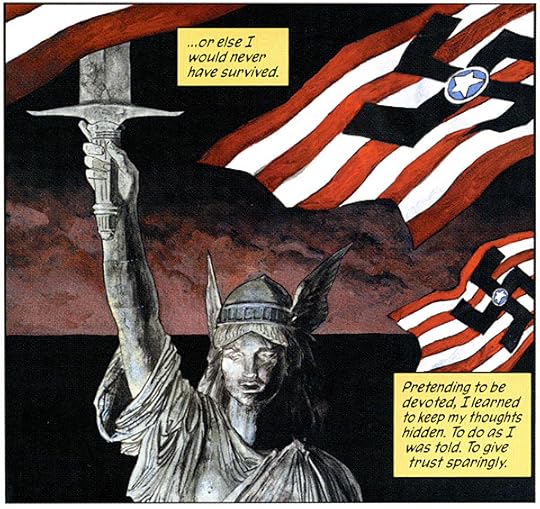
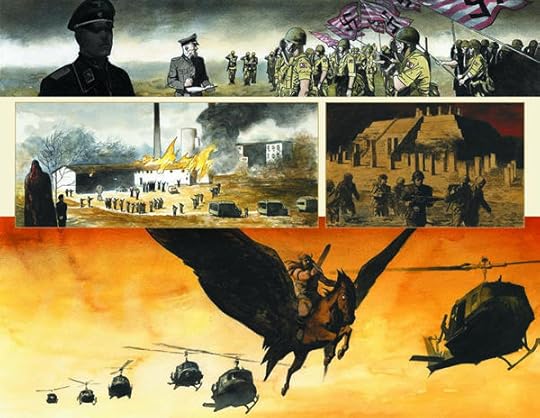
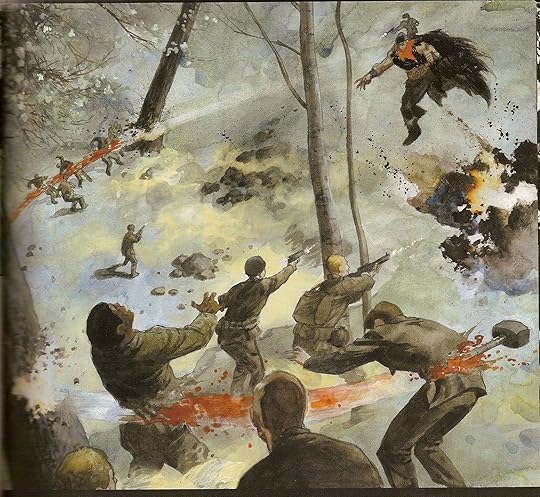
When the Aesir (Norse gods) decide to fight on the side of the Nazis it is Sturm und Drang for the rest of the world. One has to wonder what side this pantheon of gods would have fought on during WWII; this book answers this question in a truly nightmarish way. Amazingly vivid art that is violent and kinetic.
5.0 stars. This is one of the BEST comic/graphic novels I have ever read. That is not an idle comment as I have read quite a few, including many of the ones that are the most higly rated. This amazing story holds its own with all of them in my opinion.
Adapted and expanded by David Brin from his Hugo nominated nevella called "Thor versus Captain America" the basic premise is that the Nazi's, on the eve of losing World War II, discover a way to "conjure" and create an unholy alliance with the Norse gods (Odin, Thor, etc.) and thus change the tide of the war.
The above may sound a bit "pulpish" but the story is anything but, believe me. It is subtle, smart, superbly well written and extremely well told. It also provides an amazingly original explantion for the "holocaust" without taking away from its brutal reality and provides an additional basis for the Nazi SS's fascination with the occult. Put simply, I was blown away by the story.
Despite the brutal and very emotional background of the plot, the true "focus" of the story is about "heroes" and how ordinary people can do extraordinary things and make their lives have meaning for others exactly because they are "ordinary" people. This is not a story about people with super powers (in fact none of the "good guys" are super-heroes). It is about real people doing extraordinary things during extraordinary times. I am sorry if it sounds like I am "gushing" too much over this, but it is one of those stories that you read and just wish could be experienced by a much wider audience. HIGHEST POSSIBLE RECOMMENDATION!!!
"Fatherland" meets "Norse Mythology" in a thrilling uchronic graphic novel, but the ending of this adaption of the novella Thor Meets Captain America by sci-fi author David Brin was just too much abrubt and unsatisfactory for me.
No wonder they chose to side with the Nazi. Their ruse--pretending to be gods--would never have worked in the West! Scientists would probe. People would ask questions.
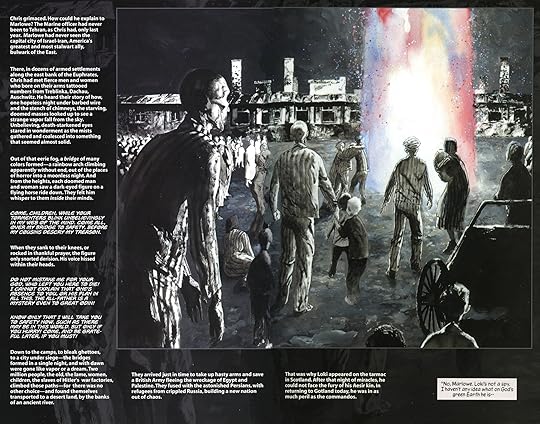
Er, Germany is in the West? And definitely had scientists, unless this is a very alternate 1962. I never found out because there was so much text. Far too much non-dialogue text for a graphic novel. Boring, hard to read.
I was interested in the alternate-Norse-mythology aspect, but not enough to drag through the presentation.
This is an adaptation and expansion of David Brin’s excellent short story “Thor Meets Captain America” from his 1986 collection The River of Time. Although the title of that story would lead one to conclude that it’s about the Marvel characters, it is not. This Thor is the brutal mythological one, working in concert with the Nazis. However, the story does align with Marvel’s underlying theme that ordinary people can be heroes and that greatness is an ideal we should all aspire to.
The first part of this book is a straight adaptation of the story with minimal adjustments. The original tale ends on a note that is simultaneously downbeat and hopeful, a neat trick that blew my 21-year-old mind back in ‘86. The expanded story here manages a similar effect.
Most potent, though, are the themes. This is about cooperation beating despotism, that being considerate of others is better than selfishness, science trumping mysticism, the idea of “we’re all in this together” being superior to “every man for himself”, democracy over dictatorship. It’s a belief Brin comes back to again and again in his stories, and it’s a good one, in my opinion.
Scott Hampton’s art is both gorgeous and good storytelling.
Did I read this because of the Norse god standing next to Hitler on top of dead soldiers pictured on the cover? Certainly. The idea that Hitler, in his belief of mysticism, called on the Aesir to help him win the war is a fascinating supposition. I really enjoyed the addition of gods from multiple faiths. The fact David Brin who wrote The Postman wrote this comic helped. I thought the book would be hokey and fun but it ended less hokey and entertaining. The book reminded me a bit of American Gods where the question of what is belief and what makes something real underlies the story. Is the act of believing strong enough to make something corporeal?
Recent Reads: The Life Eaters. David Brin expands his short story Thor vs Captain America into a graphic novel. Humanity and Enlightenment against the old gods; an explicit political fantasy that pits reason against unreason in a tale for our times. Scott Hampton's art excels.
As a fan of alternate history, graphic novels, and mythology, The Life Eaters makes for a fascinating read. Part "what if the Nazis won the Second World War?" tale, another part superhero story, part Gaiman-esque exploration of the realms of Norse myth (and, eventually, beyond), it's a genuine epic from writer David Brin. Scott Hampton's artwork brings the characters and locations of his writing to life, offering a sense of the familiar alongside the utterly fantastical. Indeed, that might sum up the whole work as it takes readers around the world and across decades of history.
In the end, Brin suggests, what might save us is will not be gods or messiahs of some kind. Instead, our greatest hope is in our humanity, in spite of the terrible things that might have to happen first. It's a timeless message but one that feels especially relevant today. That's not bad from a piece first published 15 years ago (and even further than that if you look at Brin's novella which inspired the opening section and the larger world of the piece).
NOT A MARVEL COMIC. The first section of this graphic novel is an adaptation of David Brin’s short story Thor Meets Captain America and the rest is a sequel to it. Despite the Marvel-ous title, it is not about the Marvel characters. It’s an alternate history story in which the Nazis won by enlisting the help of the Norse gods. Loki defects to the Allies but is still self-serving and devious and the Allies cannot trust his help despite how much they need it. Fans of movie and myth Loki will appreciate his paradoxical nature in this. Also, those who get a kick out of the indirect Marvel connections will probably enjoy that there is an Iron Man of sorts in the story as well.
During the final years of the Second world war, the Axis forces have all but been defeated. The allies have amassed the largest Armada ever known to man, and are getting ready to deal with the final death blow to the Reich. That is when everything went to shit.
It started with the defeat of the Russians on the Eastern front, who were pushed back to their lands due to interference of some new force. The allied offensive pushed forwards, and were shattered, their massive fleets sundered and sent to the bottom of the ocean due to a vengeful sea and the monsters that it spewed.
That is when they encountered the beings that came to be known as Aesirs. Reanimated gods from the Norse Pantheon, Odin, Thor, Baldr all who had appeared on the battlefields in Europe, and were fighting for the Nazis.
Each of these one man armies fell with the lethality of a comet upon unsuspecting allied forces & laid waste to them. Europe was lost, along with Great Britain, the fleets protecting her lost to the sea. There was peace for a while, as the wide expanse of the Atlantic separated the Americas from the full wrath of the so-called Gods.
Scientists in the US, believed these to be members of some alien race, who had co-opted the persona of Gods to easily subjugate the occult obsessed Reich. Formidable in battle, but not unkillable. Though the men, artillery and military resources needed to be expended to bring down even one was astronomical. They had to turn Berlin into a hellscape with ballistic missiles, just to kill one of them.
In time, the reformed Heer, Luftwaffe & Kriegsmarine, Spearheaded by the Aesir, launched the invasion of the United States and Rest of the world. The African subcontinent was subjugated in no time, most of N.America & Asia soon followed. By 1962, large swatches of the world map was dyed in Nazi colors.
Around this time, the secret of the Gods were revealed. When faced with the prospect of defeat, the occult forces of the Nazi high command, invoked a little understood magic ritual, sacrificing countless life to perform Necromancy, and raise from death & legend, entities who believed themselves to be the Gods of old. Or they knew of said method of necromancy, and the whole war as well as the inhumane concentration camps were just them collecting human cattle for sacrifice.
But soon the Gods got tired of them and took over power for themselves, and engaged in perpetual warfare. Not oil, not nuclear power, but the divine power generated from the death and suffering of mortals, which fueled the Aesir and were the new fuel for the world.
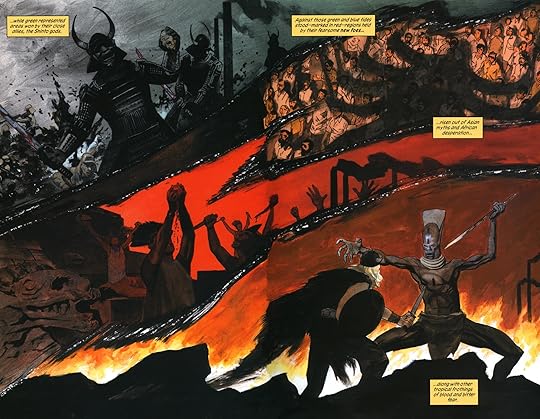
In time an arms race developed with the sacrificed souls as the commodity. Vestiges of the free world & the resistance, centered around the middle & southern hemisphere, where the warmer climates weakened the Norse Gods. In desperation, they performed rituals of their own, and created through sacrifice Gods & demigods of their own, from their own respective Pantheons. Soon Gods from the African, Egyptian, Asian, Shinto pantheons were facing off against the Aesir to stake claim to the land.
In the middle, were caught the remnants of free humanity; the one who were not slaves, sacrifices or had bent their knees to the Gods. They are engaged in a final ditch effort to reclaim the land that was theirs, while the so-called Gods continue their machinations and continue to use humans as pawns in some grand unfathomable game. Now, with the very existence of the planet in peril, which side would come out on top. Or are all marching to Ragnarok the twilight of the Gods.
_________________
Review
The Life Eaters, a graphical adaptation of the novella by Davin Brin, holds the same alternate history world building sensibilities which were made popular by the writings of Philip. K. Dick. Written by the author as part of an anthology challenge titled ‘Hitler Victorious’. Even if it’s a terrible notion, as a reader I have to say; stories where the Nazis come out on top make for some engaging storylines. Be it ‘The Man in the High Castle’, ‘Fatherland’, or the recent highly entertaining Wolfenstein: New Order.
Yet unlike those other retellings, in Life Eaters, the Nazis don’t find some superweapon which allow them to take over the whole world. Well, they do steamroll over two thirds of the allies and make great headway into a pan Atlantic invasion, but even the divine intervention on their side can only bolster their limited forces so much. The allies & Rest of the world have a fighting chance as the war drags over two decades with either side losing and gaining land, and newfronts being opened up keeping the game board ever dynamic.
There is also this poetic, bard-like narrative of the story, which is more reminiscent of some mythological tale, with ever shifting alliances and choke full of symbolism. All of which makes the world feel organic and the storytelling engaging.
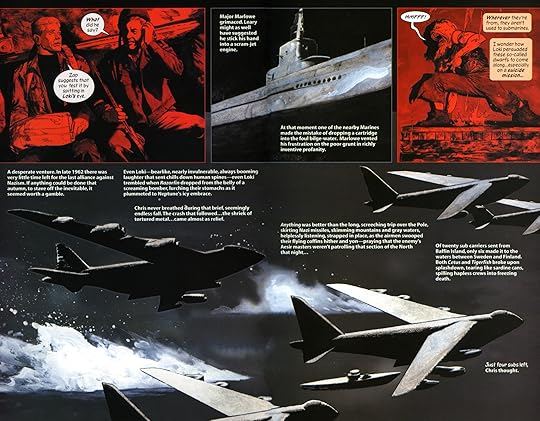
Also, in the case of the graphic adaptation, the artwork is top notch, taking cues from the likes of ‘Kingdom Come’. It has a painting aesthetic, which works well with the subject matter in question. The red of blood, and the grays of the nights, as well as the dark sooth of dust and smoke all really pop out from the pages. It also blurs the faces of many of the characters, which in the case of the Aesir make them all the more menacing and mysterious.
One complaint I have, and this is more fitting for the extended story of the Graphic novel, is how the second half of the story is meandering. It introduces several interesting elements such as the rival gods of Asia & Egypt, as well as the nonviolent tribes of the middle east. But far too little time was given for us to explore their inner workings. Even that of the Aesir or the Nazi Occult regime. Which makes the abrupt conclusion somewhat jarring.
But nonetheless, it did get my neurons firing so, for a short but engaging alternate history tale, I’ll give it 4 out of 5
This entire review has been hidden because of spoilers.
This was an amazing graphic novel. It explores the romanticism-enlightenment discussion, but in a novel way - looking at our fixation on charismatic personages, stars, heroes, kings, demigods and gods to the detriment of our collective human potential, our ability to work together to create new possibilites and technologies.
I especially loved how the author used myths to emphasize how much more humankind could be if we worked together and not let ourselves be torn apart by egotists, ideologies, race, religion and the rest.
The real heroes are the people who work towards unity, collaboration and cooperation.
Cheers to David Brin for a good, thought-provoking read.
Suitably pulpy premise masks a deeply humanist perspective that only fully reveals itself towards the end but runs through the entire book. Plenty of action and intrigue to hold the interest even while communicating the message.
I would say this is better that 99.99% of graphic novels, it has a surprising depth!
When I read Thor Meets Captain America by David Brin, I was impressed at such an original idea for a novella. The Nazi's summon the Aesir through their death camps using necromancy. David Brin pulled it off and it was a fantastic story. Then I found out the story continues, in of all things a graphic novel called The Life Eaters.
The first part of the graphic novel retells the novella in art form. It felt as if they were just adding lines from the novella on top of art, but still entertaining. At the end of the first part, you see a boy that was not in the novella, inspired by "Captain America's" final heroic stand as he is sacrificed.
The second part, told years later and not in the novella, is when things go downhill. Other forces have begun summoning their own gods to do battle with the Nazi's and the Aesir, except for the Japanese who remain allies with their own gods. These new Gods seem to come from Africa, even if in the first part they were saying the Nazi's were doing some bad shit there. How whoever there found out how to use necromancy the way the Nazi's did or have the manpower to pull it off we are not told. I do not like the direction the story went, but I’m sure other’s do.
I have always enjoyed the creativity of David Brin and this is no exception - okay I will say at this point never has been keeping to my self imposed rule of no spoilers been so tricky - even though he has left the realms of science fiction and headed out deep in to the realms of fantasy.
First of all a little history - this book was born out of another story by Brin - Thor Meets Captain America, a short story which was nominated for the 1987 Hugo. That novella was expanded and illustrated to become The Life Eaters.
Here you have the chilling idea that the Norse Gods were summoned by Necromancy fuelled by unspeakable acts by the Nazis. As you can imagine this had dramatic and expected changes on the course of the war and subsequent history.
However things go from bad to worse when obviously the goals of mortal man and the pantheon of gods start of diverge.
This book is not what you would expect especially considering the global sensation of the Marvel movies has brought to our screens (and thanks to merchandising nearly everywhere else as well). This is story that most definitely falls in to the category of alternative history.
Now some hate this book, others applaud its audacity, me I just like the works of the author, however I think that any story that can challenge our preconceptions is worth a look and in this case I thoroughly enjoyed it. There I think I didn't say anything that cannot be gleaned from sales material.
Last year, I read a very interesting short story called "Thor Meets Captain America." Despite the title, it wasn't a Marvel superhero thing, but rather an alternative history tale mixed with sci-fi and fantasy. It was nominated for a Hugo Award at one point, and later adapted and expanded into this graphic novel. THE LIFE EATERS consists of three sections, the first being a faithful adaptation of David Brin's original story. Parts 2 & 3 then treat us to a sequel featuring new protagonists. The adaptation part is done exceptionally well, despite being very text-heavy for a comic book. Part 2 begins on the same high note, but it isn't long before you sense things going off the rails. As soon as the gods began setting fire to oil fields in order to create rapid global warming, an alarm sounded in my head: WARNING! HEAVY-HANDED MESSAGE IMMANENT! Part 2 ends with the hero being rescued in nonsensical fashion by some dolphins and a whale, then Part 3 kicks in and quickly buries the story in humanist philosophy and quasi-socialist mumbo jumbo. Not surprisingly, the plot suffers accordingly, and the whole thing winds up being a giant belly flop. It's sad, 'cause the book showed real potential, especially with Scott Hampton offering up some great artwork. Too bad the three Parts were never released separately, because I would love to own Part 1 as an individual issue, without the lackluster sequel dragging it down.
The squatting monkey-like creature yells out, "NHHHH." Then the caption mentions it being Loki's Dwarf! What kind of a way to start a comic is that and that thing is definitely not a Dwarf...unless it was tossed through a blender or something. Then the American soldier says, "Dig it, daddy-o! There's an AES over by the scope, dope." Holy f**k, did he actually just say that? That's some bad dialogue right there and furthermore, that's beatnik slang from the 50's...not a US soldier in WWII! But the slang keeps on going and it's really hard to get past! This book is pretty, with some great art and splash pages, but that's really all. The story is a jumble and it's all over the place and hard to get through. The biggest problem this book suffers from is it's long-windedness. I made it less than halfway before I just flipped through and looked at the purdy pictures.
An odd book about what happens when Norse Gods decide to join Hitler's side just as he is almost defeated. The war turns, but how do you fight gods? It's a good story, odd but good. Brin writes a good story, but has trouble adapting to the comic medium as he turns whole pages into text. I read the books description at the end, it seems that this was a Novelia that was turned into a comic book, that would explain a lot.
A fascinating story idea, if a bit over-the-top and definitely not subtle in execution. Nazis use necromancy (that's what all the death camps are for) to bring the Norse gods into the world to fight for them. So World War II turns out quite a bit differently. I really liked Brin's original novella ("Thor Meets Captain America") that this was expanded from. Seeing it in graphic form (and continuing the story) is very cool.
Thor Meets Captain America was a truly excellent short story, which translated to a very good comic. The original story is part 1, and they added 2 more chapters. There are -- naturally I, suppose -- several more comic references (for a while he wears an Iron Man suit) in this graphic novelization, but as a whole it works.
An amazing story that tries its hand at an explanation for the industrial level of murder during WWII. While the first part was amazing, the second and third parts leave a bit to be desired, and the art could have been a bit better, still the overall story gives many interesting directions of thought.
Spawned from a David Brin short-story, what would happen if the Holocaust were part of a larger design, in which the Nazis were attempting to summon the ancient Norse gods to come back... and it worked?
As with most of the Graphic Novels I rave about, this one has a unique story, great artwork, comes in hardcover, and stands alone...all things that make graphic novels an artform on their own.
Quite a nice story, about an alternate reality. What if the nordic gods had intervened in WWII and chosen the side of the Nazis? Suspenseful and well drawn/told.
No doubt that my rating is a bias one. I've loved Norse mythology since childhood and seeing a great many of those figures portrayed as the villains didn't sit well with me.