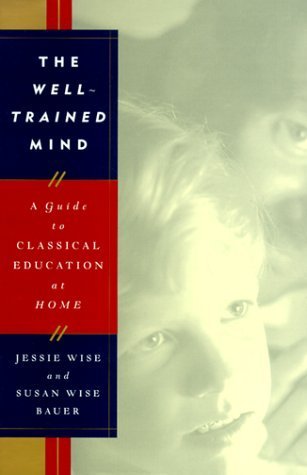
Teach your child at home or supplement his or her classroom learning --this book provides you with the techniques, curriculum, and resources necessary to ensure that your child's education is the best it can be.
Susan Wise Bauer is an American author, English instructor of writing and American literature at The College of William and Mary, and founder of Well-Trained Mind Press (formerly Peace Hill Press).
In 1999, my two boys started school (k and 1st grade) on the same day my daughter was born. We ran so crazy that whole school year that we decided we had to try homeschooling - just to see if life would be any simpler. Lo and behold, it was. And The Well-Trained Mind (aka WTM) was my guide to how to do it.
WTM covers the philosophy and practice of classical education in a homeschool setting. There are other resources on classical ed, but I've found this one to be the most balanced and practical for teaching at home.
Now my oldest boy is in high school and we're still schooling the younger two at home, and I can say that I still use my WTM every year in planning the school year. I also use a lot of the authors' other published materials - they are gentle, fun, and most of all, very effective. My kids are getting the education I wish I had had, and we're closer as a family to boot.
One caveat - you can't do everything this book recommends. You have to pick and choose. But if you can do that, you'll have a wealth of resources at your disposal with this thorough volume.
This is a guide for Neo-Classical Education rather than Classical, eg. the way the "stages" are divided to fit the western 12-year school model rather than applied concurrently in varying degrees as was once the case (and is better-reflected in Charlotte Mason's classical style). It is very rigorous in a fashion more-closely designed to compete with public/private school graduates, but using classical elements to achieve generally higher results (perhaps read Climbing Parnassus for info on Greek/Latin etc.) Charlotte Mason is more focused on developing the person (in the original classical style) rather than competing with the world like this book implies (the same focus in most modern public/private education systems). I don't think this is particularly beneficial and somewhat defeats the object of alternative/individualised forms of education like homeschooling.
TWTM might suit some people who want a better quality of education but not a greatly varied style of schooling to what's available in some public and many private institutions, tending towards a literary base. The book lists a vast number of reasonable quality resources... however I'm not sure that it's much better than what can be gathered online between Tanglewood, SecularCM, and the Christian source Simply Charlotte Mason. I think one doesn't want to get too bogged down in other people's methods of schooling as well - otherwise why provide individualised education at all? Still, this is a good book to find ideas, explore structuring options, and general program discussions.
Part IV of the book is packing with useful general advice that could be applied to almost any homeschooler, with a US-centric/competitive bent in places, eg. homeschool support listed. I might refer back to this section in the future if I don't pass the book on... For anyone wanting to use a timeline-style of study, studying history/literature/science concurrently and neatly, from ancient times to present, the outlines in the other parts of the book will make excellent frameworks to build on as well. It's a great way to organise information, a great form of immersion learning instead of a chaotic spiral approach that doesn't suit all students.
Like most CM/Classical homeschool/other books around, there is a Neo-Christian worldview being pushed in TWTM, some of the resource suggestions are dubious. One expects Middle Eastern religious influence in cultural/historical studies, of course, but the short chapters on religious studies in TWTM describes non-belief as a belief and conflates belief with knowledge. It gets my hackles up a tad. It's equivalent to suggesting that not collecting stamps is a hobby and avoiding walking under ladders with black cats on Friday the 13th can't fail to enrich my worldview. Having experienced a dozen years of Christian education myself, I can only say that it was extremely limiting and I was very relieved to be rid of the blinkers upon entering tertiary and postgraduate education, and I had some significant catching up to do - not in terms of content, but in terms of how to think critically and logically... There are more things in heaven and earth, Horatio... etc. I think if a Classical-style of education survived in common use into the 21st century, it would more closely reflect a Charlotte Mason education with a broader grasp of ancient-modern philosophy and world religions and modern media resources than is presently being applied. I'm not against beliefs, but I am against any limited education it seeks to impose, and the brainwashing small children. The Protestant vs Catholic early-20th century guff that commonly pops up conspicuously in US material is laughable, never mind the fear and rejection of every other culture around the world, past and present... and while it is not wholly pervasive in this particular book/Neo-Classical programme, it is not absent.
This book could help you make decisions about how you want to educate your children, even if you don't follow TWTM program, even if you don't end up homeschooling at all, even if you don't like their competitive, pack-everything-in style. It's good to have a few neat, stand-alone pieces like this on your bookshelf if you have a tendency to fall down the rabbithole that is Google... but like all US Christian material, be cautious - there are limits to what can be achieved with small worldviews. You'll want to judiciously edit and then expand this if you follow it, at the very least... The lack of science and physical education is a good place to start for the health of the mind and body!
* for: best for people who have already decided homeschooling is what they want to do and want established, classical curricula. Also for those who want resource references out the wazoo.
I have mixed feelings about this book. The book is written by a mother and daughter pair. The daughter is one of three homeschooled children, but no mention was made of the experiences and outcome of the other kids' educations, and it bothered me. The daughter is wildly successful by typical high-faluting educational standards. She finished high school at 16, was a National Merit Finalist and went on to excel at college and to homeschool her own children. It's not that this sort of profile is bad -- the person I like best of all was homeschooled, finished high school at 16, was a National Merit Finalist...
but isn't homeschooling a little bit about escaping that one profile of success and helping set up other ones? I think so. The narratives of success are already too narrow, and I feel like The WTM only perpetuates the narrowness and elitism of education.
Also, I'm not sure that a classical education is the best way to go. I do love Latin declensions, and classical education has all sorts of cachet, but there's a lot this curriculum seems to be missing out on (though at the same time it seems like it can't make a decision about what to prioritize and cut out, too).
We've been using this book for "afterschooling" for our first-grader, but it's meant to be more for homeschooling. I love most of the ideas in this book and we have found the history lessons especially interesting and helpful. It's very nice to teach Mads a chronological history of the world that isn't U.S.-centered (I feel like I'm filling in the gaps of my own education). She also loves the poem memorization part of the language lessons. We've found this book to be a great resource and guide, and hope to continue using it through high school for both our girls. We like supporting public schools while still being able to supplement and explore at home.
I did not love this one. I might be the only person I know to say that! I’m very familiar with classical education as a whole so that introduction was not new to me. I struggled with the pace and tone, full of assumptions about children’s intellectual development that also seemed to disregard the very real risks of burnout among homeschool teachers. I was surprised at how little attention was given to the developmental necessity of unstructured play for young children and felt there was far too much pressure on academic rigor at a young age. If it works for some kids, great. But there is a wide range of development in children before age 8 and subtly elevating the kids who read early (or whatever) does not equip parents to teach well when their kids don’t hit above the curve on this. I appreciate the book lists and curriculum recommendations even though I intend to approach education with a very different philosophy. Music, fine art, and handicraft were not given nearly the emphasis I consider necessary for a comprehensive education. This book quickly confirmed that I really am much more a Charlotte Mason mom than a Classical Education mom! In the end, our education philosophy emphasizes well-trained whole persons, which includes but is not limited to the mind.
10 pages into The Well-Trained Mind, I knew I found what I was looking for. (I actually stopped reading, logged onto Amazon and purchased a brand new copy of the newest edition. I knew I was going to want to have this book forever!) I was surprised because I didn't originally think classical education was the way we would go. But it makes SO MUCH SENSE! Here's how Classical Education breaks down:
Grades: 1, 5, 9: Ancients: 5000 B.C.-A.D. 400, Biology, Classification and Human body
Grades 3, 7, 11: Late Renaissance-early Modern 1600-1850, Chemistry
Grades: 4, 8, 12 Modern 1850- present: Physics, Computer Science
Classical education is the philosophy that you read as many "real" books as possible and avoid text books. If you want to know science, read what the best scientists had to say, if you want to know math, read what mathematicians had to say, etc.
You repeat the same curriculum 4 times. Example: Grade 1: You study ancient history. This includes beginning with bible stories, reading the children's version of The Odyssey, studying Greek & Roman Myths, and many other books, fables and folklore. Then in 5th grade you do it all over again but with more difficult material and by the time you get to 9th grade, you do it again but with the real versions of the text. You study the science that was used in that time period. So with ancient history in 1st grade you study biology & the human body. When you get to modern history in 4th grade you study physics and computer science. It makes so much sense to organize it this way!
Memorization is also a large part of classical education. This philosophy suggests 1st graders memorize 4-8 poems during the year. Reading, writing, spelling, grammar and math are the primary focus during the grammar years (grades 1-4). Science is important too, just not the focus.
The Well-Trained Mind follows the concepts found in A Thomas Jefferson Education, but provides a step-by-step "how-to" guide on how to set up a classical home school. I refer to this as my homeschool bible. What I have learned most from this book is that I don't have to alter my life to fit the outline described in the book, but I have altered the outline to fit and meet our individual needs and goals. I have used it as a guideline. It is a great resource for curriculum, etc.
I'm not a big reader of non-fiction, so it's surprising that I'm starting the 2010 year with it. This book was recommended to me by a friend from high school who is homeschooling her two sons this year and enjoyed this book. It's the first book of this type that I've read and while I liked some of the principles and suggestions, a few things were off-putting.
First, I found the introduction a bit arrogant. Some of the authors' assertions about this method of schooling leading to smarter, brighter, better prepared students were a stretch. I don't deny that it's important for students to be educated on the classics and it was this approach to learning that made me pick up this book. But I'm not as convinced as the authors that this is THE only way to raise intelligent children.
I also found the work load as described in the book to be excessive. If I covered everything suggested in this book for my fifth grader next year, it would require 39 hours of weekly learning. That's a pretty tall order for a 10 year old and a daunting, if not impossible, task for a mom new to homeschooling.
If our family does decide to homeschool our eldest daughter next year, I'll take some of the concepts that I liked best from this book (i.e. we'll cover ancient history, ancient lit and Latin) and craft a schedule that I think will meet my daughter's educational needs without inundating her with work.
This book is often called the Bible of classical homeschooling. Like the Bible, the book offers life-changing experiences for its followers. Many parents happily homeschool (or "afterschool") their kids based mainly on its contents. However, many of the items are best understood not as literal truth, but as metaphor. For example, the first grade reading list includes "Anything by or about Aristotle and Cicero". While that sentiment is noble, I challenge anyone to come up with books about (never mind _by_) Aristotle that are accessible to even the most precocious first grader. Assuming that such a book did exist, I would expect the authors to list it explicitly. This lack of specificity makes me wonder how tested the methods and lists really are.
I've been reading as many books and blogs about homeschooling as I can get my hands on, because in preparation for beginning this journey with my daughter this fall for her first grade year I want to have much of a grasp of my educational philosophy and goals as possible. This book was recommended to me early on in my "just thinking about it" stage by a friend who homeeducates her children, but because the book is well over 600 pages in length I had put it off until I've read other, shorter, books first.
What surprised me most about this book was how once I started reading through its pages, I had a difficult time putting it down. That I enjoyed reading this book so much probably stems from the fact that this book was written by proponents of a classical homeschool curriculum, which focuses on reading, writing, math, and history as its main focus, and adding in science, fine arts, foreign languages and the study of Latin, rhetoric, and logic in the high school years. From the start I knew that I wanted to use a curriculum that focuses on this, and because it so firmly matches my educational philosophy, that's why I read through most of this book in a matter of days.
I will admit, I did not read through the chapters dealing with grades 5 through 12, because those years are so far off for me at this point. What I found in the sections about teaching kindergartners through fourth graders, however, was rich in content and resources. The authors have outlined their opinion of a well-balanced and appropriate curriculum for each age, along with expectations and a basic schedule of when and for how long to teach each subject each day, week, and year. Their recommendation for teaching both history and science is in cycles; in first grade a child learns about ancient history, and in her fourth grade year has worked her way up to modern history. Beginning in fifth grade she will return to studying ancient history, but will get more in-depth in content and fact-memorization and accompanying texts. The cycle again repeats itself in ninth grade, with yet more in-depth study and challenging original texts. Science works in a similar fashion: first grade is the study of biology, second grade earth science, third grade chemistry, fourth grade physics. The fifth grade is a return to biology, but more in-depth, and so on.
A classical education is based on learning the basics through repetition and intense study and memorization; it is not a child-led program and is the antithsis of "unschooling", so if the concept of a well-defined, parent-led and structured curriculum is a turn-off I would not recommend reading this book. If you're looking to homeschool with a classical curriculum, however, this book is an excellent resource to add to your home library. It's filled with recommendations of programs and curricula that the authors have used and researched for ease of use and quality of instruction. There are chapters about how to make schoolwork portfolios, how to create high school transcripts, how to prepare for college entrance exams, and how to apply for college as a homeschooled teen.
Although I borrowed this book from the library, I'll be purchasing it for my own collection shortly.
My biggest critique is her inconsistency. She spends one very short chapter saying you cannot ignore religion in education, that your faith informs your worldview and therefore should inform your education, and yet proceeds to ignore religion and faith entirely in her discussion of education.
The secularists should be made to know at every opportunity Whose world they live in, whether they like it or not, and whose culture they are studying. Why cater to their relativism when it is not your belief unless it be for broader appeal and thereby greater monetary profit? It is dishonest of a Christian to imply by silence that non-Christians can have Western culture with any god of their choosing.
There are plenty of other good, and even better, books on classical education and homeschooling. SWB and WTM is not essential.
Great book on classical homeschooling. It gives you a great guide on what to teach each year of homeschooling, but is also a bit ambitious. The author is a homeschool scholar raising geniuses. Even though I could never do all she does in a day, I loved the book for a guide, ideas, and how to keep on track. I would never get rid of the book even if I wasn't homeschooling. I like reading it for my own continued education.
A thick, but quick to read book, especially since several sections do not apply to me at this time. Gives a comprehensive overview of the classical approach to home school. The author has a very thorough, but practical approach to home schooling. This book really gave me the vision of what can be accomplished in the home. It is also an excellent resource, full of lists of suppliers and other books. I especially appreciated the sections on how to make up a transcript for a home schooled child and on dealing with "socialization" and the home schooled child.
I truly believe this book to be a necessary read for anyone planning on taking an active role in their children's education - whether they are taught publicly, privately or in any sort of home environment. The curriculum is thorough and well thought, and the writing could motivate any parent to take a stronger role in teaching their child. Loved it!
I flipped off this book part way through Chapter 4. I'm not sure if I can even finish this book, I may just mine it for resources.
I came to this book becaude I read "Rethinking School" by Susan Wise Bauer, and I thought, despite a great deal of ableism in the first few chapters, that she had some ideas that would benefit neurodivergent families. My son is 4, so I haven't had a chance to really homeschool beyond lockdown remote learning, but when I saw this book included preschool and Kindergarten curricula, I went for it.
Oh no. Oh no no no.
I muddled through the arrogant self mastabatory indulgence of the first two chapters. Ok, yes, I get it. You two are both very smart and very accomplished and you were the best homeschoolers in the existence of homeschool, reading your words is a gift for my eyes. Yes, congratulations, I'll mail you each a cookie. I'm glad the authors love themselves so much. I muddled through because I get that they have a curriculum to sell and probably other products on their website and it was just a pitch. Despite my public school education, I have some critical thinking skills.
It all came crashing down for me when they started talking about the toddler/preschool years. My son is in preschool, so this was the section I needed. The part about babies and toddlers was like a PTSD flashback to all the terribly unhelpful "advice" I heard when my son first presented with communication delays.
The authors encourage parents to play, read, and talk to their young children non stop. Naturally, I don't disagree! This was the tactic I took before the language delay was evident in my child, but then all my friends' kids started babbling and then saying first words and my kid wasn't even pointing or waving. When I started looking for answers pretty much everyone told me to read more, talk more, play more. Turn off the TV (the only time my non-sleeper gave me a break was during TV time! And we didn't watch much!) and the tablet (we didn't have one!) and make sure that he was surrounded by words 24/7. So I did. I talked myself coarse everyday. Couldn't even rest during a walk because I was narrating every thing I did and saw, pointong at everything, verbalizing every thought, and then getting to the park and reading over and over and dping it all again on the way home. I was told that his delay was my fault, if I didn't fix it he would do poorly in school, and he was behind other kids because I wasn't doing enough. All the other mommies sounded just like these pompous, arrogant authors with nonsense like "Don't compare your kid with mine, they're all just very advanced for their ages. I read to them all the time when they were babies, but that just the superior way I was raised..." Yeah, middle finger raised and primal screaming at this book. Can you blame me?
The most triggering moment was when the authors stated that if you do all that they recommend for your baby, they will start to talk earlier. No. Wrong. Bad. Wrong. No. Please stop perperuating this myth that language equals intelligence and early language development equals even more superior intelligence. I did everything I was supposed to, pushed myself to the limit and was suicidal because I thought I wasn't a good enough mom only to find put my kid just processed language differently.
This book, the very little I managed to read, only endorsed one very narrow view of intelligence (which is a shame because Rethinking School by SWB was a little more flexible). I can't imagine my neurodivergent kiddo memorizing without experimenting. He's always jumped ahead to the stuff he liked and skipped the stuff that is harder because his brain is wired differently. I refuse to read a giant book that repeatedly tells me I am wrong and doesn't give my neurodivergent family enough space to find what works for us. There has to be better books out there.
This book will be abandoned, but I do like some of their ideas on how to organize learning, so I will probably just copy the resource list and pick and choose. Reading other reviews, I am glad I quit when I did because we are also a secular family. I really don't want to give my kid the same narrow, white, Christian, US-Centric worldview I got from my education.
I did not realize what I was doing when I ordered this book online, but surely subconscious forces led me to it. I liked it immediately. As this book is written for parents who are home-schooling their child--in fact, a particularly erudite, academically ambitious such parent--I was reading the book on several layers.
Although I wish I'd been a more diligent reader of assigned texts, I received a pretty good classical education throughout my life. I found reading this book led me to much autobiographic ruminating: on my own education, its holes and its denser matter, the teachers I knew, the books I read. It brought me back vividly to my school years when I spent much of the day learning. Funnily, it inspired me to pick up where I left off, as I guess so much of my adult life I have spent trying to learn things I sort of feel that I should have learned by end of high school!
Reading the book also coincided with my 8 year old son being evaluated for dyslexia and ADD, which has led me to take a greater interest in his learning process. I have had some time off at work which enabled us to spend a lot of time together concurrent with my reading, and within the first 30 pages of reading this, I had drawn up a plan for a home great books curriculum (except we will start with WWII history before moving back to Ancient Egypt). Just seems to me a doable, useful project that will be fun for both of us. That is a huge insight and perhaps a new structure for parts of my extracurricular reading in the future.
This book affirmed my view that I had throughout my life, that our education system, including at elite universities, simply does not expect enough of students; and as a culture we've become very lazy in what we expect from kids. I think about the level of commitment and athleticism that we expect from 15 year old varsity athletes... and wonder why we absolutely don't expect anything comparable regarding academic life.
I was impressed by the gumption and ambition of the authors, and often daydreamed about these authors, their readers, homeschoolers, etc. The book made me realize there must be a committed contingent of home schoolers who are exceptionally bright, essentially being far more demanding than even the best schools in the country. I hadn't considered this possibility. It generally made me sympathetic to experiments in far smaller scale school settings.
For the benefits mentioned above, reading the first 150-200 pages of this book are sufficient.
Too much dissing of public schools and other approaches to home-schooling... a tighter focus would be more helpful. I considered home-schooling my youngest, and we even tried it for one year. But I just talked to him (he's got his Associate degree and is making plans to continue) and he says that he's glad he wasn't home-schooled, even though he wasn't particularly fond of school. In his experience, home-schooled college students tend to think that they're smarter and more right than anyone else.
That is: They may know more information about history, world affairs, etc., and have better skills at rhetoric etc., but their socialization isn't always the best. They are better at sympathizing than empathizing... iow, to put it in extreme terminology, to be 'limousine liberals.' The brief mention of 'character education' in this book is not helpful... and among the traits listed are humility, gratefulness, and patience, which I don't see coming from an education guided by acolytes of Bauer and Wise.
That being said, there's a lot of good about the book. I fully support any dedicated parent who has the wherewithal/ resources to commit to this program. It's a lot of work, but probably worth it for many families. And this is probably a better program for many families than Unschooling or more casual approaches.
Of course, I'll always believe that the best education is a decent public school *and* a lot of family enrichment activities.
I love this book! I wish there were more like it! (And perhaps that it was different than it was. I don't want to know what the ideal curriculum is for ME, I want to know what it was for YOU and your kids.)
That being said, when someone does have advice to give I like it when they present their arguments in simple and clear ways, which she does.
For example, I loved her arguments about not teaching reading and writing together. A normal kindergartener can easily read at a 4th grade reading level, but will not be able to write at a 4th grade level until around 4th grade. To combine reading with writing generally requires retarding the child's growth in reading. That was just one of the arguments. She thinks penmanship, reading, grammar (logic), spelling, and rhetoric (writing) are all different subjects and should be taught as such.
I don't buy into the entire classical curriculum of course, but I love the idea of a parent and child created family-centered curriculum. I love her essay about homeschooling.
After studying her reviews of various curriculums (and other people's) this is the conclusion I came to as far as a great home schooling curriculum in math and reading
To say I "finished" this book is perhaps inaccurate, since by no means did I read every word of this 800-page doorstop and I am sure I will be picking it up again when needed, however, I've completed my first pass through the sections currently relevant to our homeschool. Years ago I read portions of the 1st and 3rd editions, but I looked forward to this new 4th edition, which was billed as updated with (1) currently-available curricula options and revised science recommendations, and (2) expanded sections on learning disabilities. The former: YES, definitely, and that alone was worth the pre-order price to me, since our homeschool is entering a new stage. The latter: nah. The new learning disabilities section is a mere 4 pages and boils down to "get assessed and then go look for help elsewhere". Gee, thanks. Oh well, I'm more of an eclectic homeschooler anyway so I will pick up what I need from this book and leave the rest behind. Still, this updated edition was much-needed and I'm sure I will refer to it frequently.
Susan Wise Bauer lost one star right off for being so annoyingly pedantic. By far the best thing about this book is the resource lists, which are extensive and well-organized. I don't buy into the whole grammar-logic-rhetoric stages of child development (Charlotte Mason had a much better understanding of how children are, in my opinion), and the suggested schedules in the back of the book would probably drive any normal homeschooling family insane. However, Bauer at least does advocate bringing back Latin and chronological history, and the idea of academic rigor for homeschoolers. "Classical education" in this case is something of a misnomer, since Bauer's methodology and curriculum are not in line with classical education as practiced for the past two millenia. The more accurate and currently accepted nomenclature for Bauer and her ideas is "neo-classical."
I had some strong feelings while reading this book. There were so many ideas and assumptions about children and education that rubbed me the wrong way. However, as I read more, I found that I begrudgingly agreed with some of the theories and suggestions the authors posit. If you're looking for a thorough approach to the Classical style of home education, then look no further. At least I know now that I'm definitely NOT going to follow this style of education. I suppose it's good to know what you're NOT, since it helps you define what you ARE.
4.5 ⭐️ Prior to reading The Well-Trained Mind, I had no idea that the term “classical education” referred to a very real and specific education method, and not simply to a vaguely traditional homeschooling mindset. I learned a lot reading this, and will certainly implement many of the ideas in my own homeschooling journey. I almost shelved the book once I reached the high school chapters, as it was getting a bit tedious reading the detailed plans for every subject in every grade, but I’m glad I stuck with it til the end. The last few chapters especially were insightful and inspiring and gave a realistic glimpse into Jessie Wise’s own experience as a homeschooling mother of three. This is one I will surely pick up again a few times over the next couple decades, even if just to peruse the many quality resources listed throughout!
Considered the "bible" of classical education. I'm glad I read this tome of a book (naturally, I skipped some reference-y parts) before attempting to follow the Memoria Press homeschool curriculum with my son. I have a better understanding of the trivium and of the importance of latin, but most of all, this book helped me to give myself permission to push my child to pursue hard things, even if he does not want to do them. This approach is VERY different than how I was homeschooled, and there are some areas where I think a more relaxed approach is helpful. I also was not as interested in the "college prep" high achiever sort of stuff, so I plan to take a bit of a toned-down approach compared to this book.
As I'm considering homeschooling this book was extremely helpful. As with any parenting or self help or education book, did I agree with everything 100%? No, but there were some great things in this book. The classical education approach resonated with me and this will be a great resource moving forward. Lots of good information on schedules and curriculum and research behind it all.
Excellent and inspiring plan for pre-K through 12 education. Great ideas to use even as a supplement to traditional schooling. Wise and Bauer make a compelling argument for homeschooling and using the classical trivium. This style of education is appealing to me, especially using three 4-year cycles of history as the framework for the curriculum.
This is a superb resource for resources. I quickly skimmed through the sections I'll return to again when we reach the historical time period that accompanies the school year we are on. It's been a great help in giving me more amazing choices for my boys. I'm really looking forward to this school year!
Exhaustive and full of a mind-boggling amount of resources. Overly specific at times but a compelling and detailed review of what it takes to educate your kids using classical curriculum from first-hand experience.
We are thinking about homeschooling as our oldest approaches kindergarten. TWTM has been mentioned on multiple reddit threads. Our library had a copy so I thought I would give it a read. This has been a wealth of knowledge on classical/neo-classical methods. I'm still toying the idea of blending classical/neo-classical with Charlotte Mason. TWTM will definitely have a spot in on our bookshelves.
Great writing, clear, to the point, excellent curriculum suggestions (some I already use). I can see how this might be a 5 star resource for someone else with a different personality and background than myself. I have to say, I'm very glad this was not the first book I read about homeschooling before taking on this endeavor. The way classical education is presented in this book is very intimidating. It is presented to parents who want to give their children a rigorous (an often used word), disciplined, academically excellent education.
I read Part One (up to page 280), skimmed the middle pages about 4th-12th grade curriculum (my oldest child is 7 years old, didn't find it necessary at the moment), and read the last section (page 700 to end). I read the latest copy published in 2016.
It starts off with the parent taking her children out of public school because they were much more advanced than the other kids in the class, reading at age 4, bored in kindergarten and first grade, and other young students were said to be jealous and hostile because of her kids' easy success. So she started homeschooling to give them a more rigorous education.
I really enjoy reading books about educational philosophies and plans. Even though I didn't agree with everything here, this book still gave me a spark of excitement about our homeschool. There are many things described in this book that we already do and that I see benefit in. There are several things I don't see the benefit in and would need more convincing to actually add into our busy home. There were also many things that I find important that were absent or close to absent.
If these plans inspire you and work for your family, I think that's great and I definitely don't see a problem with it. I'm only rating it 3 stars based on how helpful it seems to my own family and the "vibe" presented with it. The authors and I seem to have very different reasons and goals in homeschooling. And I'm okay with that.