Tom Perkins had a dream. It wasn't to get rich, acquire power, or marry into fame. As the man most responsible for creating Silicon Valley, he had done all that. His venture-capital firm, Kleiner Perkins Caufield & Byers, remains the most celebrated money machine since the Medicis. He'd helped found Genentech and fund Google. And in 2006 his resignation from the Hewlett-Packard board triggered the revelation of a spying scandal that dominated the front pages. Along the way, he also managed to get himself convicted of manslaughter in France and become Danielle Steel's Husband No. 5. No, as he hit his seventies, Perkins wanted to create the biggest, fastest, riskiest, highest-tech, most self-indulgent sailboat ever—the "perfect yacht." His fantasy would be a modern clipper ship—as long as a football field, forty-two feet wide, with three masts each rising twenty stories toward the heavens. This $130 million square-rigger—The Maltese Falcon—would evoke the era of magnificent vessels that raced across the oceans in the nineteenth century. But the Falcon is more than a tribute to the past. Gone are all the deckhands to climb the yardarms. Gone is the intricate rigging that helped give the square-riggers of yore their impressive look. Instead, the Falcon's giant carbon-fiber masts are entirely freestanding and rotate by computer. The bridge looks like something out of Star Trek. And the fifteen huge sails unfurl at the touch of a screen. In short, this is a revolutionary machine—the most significant advance in sailing in 150 years. With keen storytelling and biting wit, Newsweek's David A. Kaplan takes us behind the scenes of an extraordinary project and inside the mind of a larger-than-life character. We discover why any sane man would gamble a sizeable chunk of his net worth on a boat; we meet the cast of engineers who conspired with him; and we learn about the other two monumental yachts just built by gazillionaires that Perkins is ever eyeing. In a battle of egos on the high seas, Perkins loves to preen, "Mine's better! Mine's Bigger!" On the Falcon's climactic maiden voyage across the Mediterranean—sixteen hundred nautical miles from Istanbul to Malta to the Riviera—we revel with Perkins as his creation surges along at record-breaking speeds. This is the biography of a remarkable boat and the man who built it. More than a tale of technology, Mine's Bigger is a profile of ambition, hubris, and the imagination of a legendary entrepreneur.
David A. Kaplan is the former legal affairs of Newsweek, where he covered the Court for a decade. His other books include The Silicon Boys (a New York Times bestseller that was translated into six languages), The Accidental President (an account of the 2000 election on which HBO’s Recount was partially based), and Mine’s Bigger (a biography of the largest sailboat in the world that won the Loeb Award for Best Business Book of 2008). A graduate of Cornell and the New York University School of Law, he teaches courses in journalism and ethics at NYU. He and his family live in Irvington-on-Hudson, New York.
Tom Perkins, member of the notorious HP board during the now infamous board battles (see https://www.goodreads.com/review/show...), was no land-lubber. He could name all of the lines on a clipper ship. He wanted something even bigger and better. But as someone of immense wealth, the push for ever bigger and better became an obsession. “size mattered—as it always had. When it quickly became insufficient to be merely big, then yours had to be bigger. For how shall it profit a man to have a big yacht if somebody else has a bigger one?”
Personally, I don’t like boats that tip sideways, i.e., heel. My idea of a boat is that it has to have a swimming pool although, “I always say that if you encounter a really rough sea in a sailing yacht, you regret having left port. But if you encounter a really rough sea in a motor yacht, you regret having been born.” …
Perkins had lots of experience sailing, and the author details not only how he accumulated that knowledge but also how he amassed his huge personal fortune at HP and as a venture capitalist. Yet the boat Perkins proposed building would cost 20% of his net worth. He loved doing things in a big way and his goal in the development of the new yacht/ship was nothing short of revolutionizing the way sailing is done and ships designed.
One interesting anecdote: Patrick O’Brian, whose stories Perkins had all read and loved was invited once to tour the Mediterranean on one of Perkins’ huge yachts. After all, O’Brian had written well-paced seafaring sagas that always got the details right about sailing—he knew a scupper from a schooner, a jib from a jibe. Unfortunately, as an incredulous Perkins recounted it, O’Brian was clueless how a sailboat actually worked. When he wasn’t steering recklessly or causing more than 10,000 square feet of sail to flail about, he was either drunk or seasick (or both).
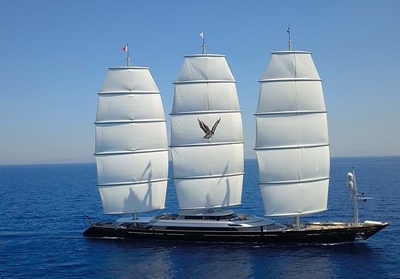
Now, at seventy-four, Perkins was setting out to transform the art of sailing. His $130-million yacht, anchored a few hundred yards out in front of the palace, was the Maltese Falcon, a twenty-first century clipper ship that was bigger, faster, higher-tech, more expensive and riskier than any private sailing craft in the world. The Falcon was as long as a football field, forty-two feet wide, twenty feet deep, with three masts, each soaring nearly twenty stories toward the heavens. On each mast were six horizontal yards—ranging from forty feet to seventy-four feet in width—to support the sails. The size of the Falcon was utterly out of scale with anything nearby—the ramshackle fishing boats, the tourist ferries traversing the Bosphorus, even the palace. The design was unusual. "the masts were entirely freestanding and, unlike masts on any other boat, they were not stationary, but rotated. The sails were deployed at the push of a button, rolling out from inside each twenty-five-ton mast. Dozens of computers and microprocessors—connected by 131,000 feet of cable and wires—integrated the system, allowing helmsman and crew to control the boat nearly effortlessly. And unlike the clippers of yore, with their vast, white expanses of billowing canvas, the Falcon’s sails in effect formed a nearly flat vertical wing.
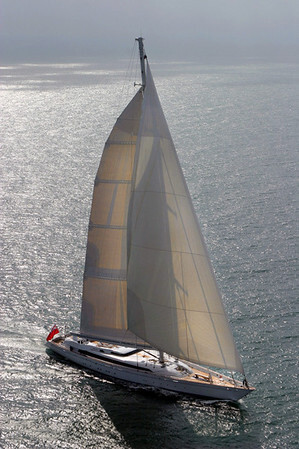
The competition between billionaires to have the biggest and fastest and most luxurious sailing yacht reached preposterous proportions. Joe Vittoria’s Mirabella V, the largest single masted sloop ever built had a mast of 292 feet (as high as a football field is long) with sails that cost $250,000 and was so heavy it had to be lifted on the boat in pieces with a crane and then assembled on board. The mast was so high the boat could not transit the Panama Canal since it couldn’t go under the bridge, nor could it pass under the Golden Gate Bridge. Usually easy to handle, this monstrosity takes 11-14 minutes to tack, and is forbidden by the insurers to jib; it was too risky. The mast is so high that wind velocities may differ from top to bottom creating its own wind shear. Sailing in a moderate breeze, with the boat heeled slightly (it had a thirty-three foot keel) the downward pressure on the mast was 400 tons creating enormous strain on the stays and shrouds. Insurers forbad any heel greater than fifteen degrees as the passengers would have slid over the side or smashed into something. (Thirty degree heels on a traditional sixty-foot sailboat are no big deal.)
What Perkins (and the boat’s designer Perini) managed to do was nothing short of revolutionary. The masts and sails functioned in almost the opposite way they did in a traditional sailing ship. In the Maltese Falcon, the *masts* rotated while the *yards* were fixed. This meant the forces working on the hull were very different. But it also had numerous advantages since there were no stays to get in the way of the sails as they were turned into the wind. It also meant the masts resided on huge bearings that had to take enormous forces not to mention a complicated system of motors (29 per mast) to operate the sails that moved them in and out of the yards. Sails were fixed on both the top and bottom. “Separated only by the yards supporting them, the five tightly stretched sails on each mast effectively formed a single vertical wing of 8,600 square feet of sail area. Properly trimmed, each set of sails—with their aerodynamically shaped masts and yards—became a tall airfoil. Even though there were five sails supported on each mast, the wind acted as though it was blowing over only one large single sail.” He was building “a twenty-first century clipper ship that was bigger, faster, higher-tech, more expensive and riskier than any private sailing craft in the world. The Falcon was as long as a football field, forty-two feet wide, twenty feet deep, with three masts, each soaring nearly twenty stories toward the heavens. On each mast were six horizontal yards—ranging from forty feet to seventy-four feet in width—to support the sails.”
And no one knew if it would work. A marvelous digest of biography, economics, risk, and technology all in a nautical setting. Excellent. *
For the technically minded, I found this discussion of the relationship of hull length to speed to be quite revealing. Froude’s Law states that maximum hull speed is the square root of a boat’s length at the waterline multiplied by 1.34.* A heavy hull, or one with an inefficient shape, obviously couldn’t approach that full hull speed. And the benefits of length were diminishing, since the relationship between speed and length is not linear, but based on a square root. But even so, Froude’s Law was clear: the longer a boat, the faster it can go. Thus, a 100-foot sailboat in theory could go no faster than 13.4 knots; a 200-foot sailboat, no faster than 19 knots; and a 300-foot sailboat, 23.2 knots. (The Perini hull at the waterline was 257 feet, so its maximum theoretical speed was 21.5 knots—three knots faster than its two diesel engines could make it go.) For skippers who wanted speed—while also having a hull with creature comforts and that could be used for cruising—going long was the only way. For length also produces stability—a boat’s ability to stay upright. In fact, stability goes up exponentially—to the fourth power—as the waterline length increases. Assuming all other measurements equal, if you double the length, then stability goes up sixteen times (2 × 2 × 2 × 2). Stability and length are among the few relationships in physics subject to the fourth power. The tendency to heel increases with length as well, but only by the third power: if you double waterline length, the heeling force goes up only eight times (2 × 2 × 2). So the benefits of length still predominate, as the increase in stability is greater than the tendency to heel. God must be a sailor.
This is a relatively slim book that packs a lot of content. the main story line revolves around Tom Perkins' quest to build the world's largest private sailing ship. the amount of technology that goes into the Maltese Falcon is staggering, as is the price. as bonuses, we get a lot of info on Perkins' history in Silicon Valley, which is essentially the history of venture capital and modern high tech, and a survey of sailing through the ages. plus, lots of interesting and funny anecdotes about the high society people that Perkins mingles with. the book moves quickly and remains constantly entertaining, even when describing in detail the manufacturing process of carbon fiber. highly recommended to one and all.
An interesting book about an amazing and ostentatious vessel. It is at once a testimony to innovation and to conspicuous consumption. Perkins had a dream about building a modern age clipper ship and he did so. That he and many of his financier friends have the money to waste on such toys goes largely unquestioned in the book. More information on the actual vessel, how it was built, and what it can do could easily have made this a better read (it has far too much information onPerkins, so much so that it at times reads like a laudatory biography.
This is an unusual book about an unusual man, and even more unusual yacht. It is an account of Tom Perkin’s creation of Maltese Falcon, the first implementation of the Dynarig square rig system. Published some time ago, I believe it will become of much wider interest as modern commercial sail develops.
Perkins was a Silicon Valley billionaire, an investor in many of the most successful IT companies of the seventies, the ones that we all know, love or hate, such as Google. More importantly, he was a yachting obsessive. He’d built and owned several large yachts, sail and motor, but the Big Bird as he called her, took five years to build.
The book recounts this story, starting with the completion ceremony in Istanbul, where she was built. Kaplan, a senior editor at Newsweek, and long time yachtie, was on board and sailed on her maiden voyage. He knows how to write, and he digs deep into Perkins’ character, his intensity and passion, his loner’s longing for the freedom of the open sea, and competitive drive for, as the title says, the biggest and best.
The book is peppered with anecdotes. When once he amended his routine breakfast of eggs and fruit for a chocolate croissant, it was worth noting in the logbook! He was competitive and very hard driving which led to serious trouble. He was at the helm of Mariette, one of his earlier yachts, in 1995 in a French regatta, when she had a fatal collision with another boat, leading to a conviction for manslaughter. He escaped with a fine. Kaplan notes self doubt was anathema to him.
The early chapters include a brief and familiar canter through the history of sailing ships, and Perkins’ early life and business career, intertwined with that of his various yachts, including the lovely Mariette. Then, around page 140, we begin the story proper of the development of the revolutionary new ship, though we also have the story of the rivalry between the sailing superyacht owners.
Perkins’ first new boat had been the Andromeda la Dea, a 154 ft. ketch. He had met Fabio Perini, a like-minded tech geek who had made a fortune from improving tissue making machinery, sold out, and set up a business building big yachts. Mechanising rope handling made a really large yacht possible. He then ordered a bigger version, stood back from business, and sailed her round the world.
This was not enough. After his wife’s death from cancer, he needed a distraction. Perini had a huge slim, unsold hull. Perkins bought it, then started to consider how to rig it to go fast. He invited propositions. Gerry Dijkstra suggested Dynarig, half in jest. This square rig system with rotating masts had been patented by Willem Prolss years earlier for commercial ships, but was considered impractical with a steel mast, likely to fail from constant torsion and flexing. Carbon fibre made the difference. Then there were tank and wind tunnel tests that showed the design was feasible. This reduced the risk, but the designers were faced with a whole range of engineering challenges to handle the sails and rotate the masts and make it work reliably. Their designs worked, though Perkins had to pour cash into the project, as well as being very hands on.
Oddly, he sold her in 2009 after only a couple of years, for $ 99 million, much less than she cost to build, a mark of his restless personality.
I enjoyed the humour in the book, the tales of joshing between owners, the digs at the foibles of the super rich, and crew, and equally the sardonic throwaway comments, e.g. on the interior decor, which cost a huge sum, and Kaplan thinks, was not always in the best of taste.
There is of course nothing new in expensive activities, from the space race to F1 motor racing, that directly are of little use to the common man, driving technical innovation that later create other products of much wider value. So far Dynarig remains the preserve of the superyachts, the Falcon was followed by the even bigger Black Pearl in 2018. Huge composites are now everywhere, from the A380 airliner to massive wind turbines, it must only be a little while before the potential for linking this to commercial vessels takes off. A design for such a vessel, the B9, was developed a decade ago, but seems to have got lost in a takeover.
The commercial maritime industry is beginning to groan under regulatory pressure to meet CO2 cutting targets. Combine Dynarig with flotillas of autonomous sail similar to the 5000 dwt. 4 masted square riggers of old, and there is an alternative to big diesel that would clearly work, and have a host of operational advantages. I’ve written this up, and will gladly send my paper, drop me an email.
Personally, I believe Dynarig will in time prove to be one of those inventions that will become an enduring part of the commercial maritime world, as have some of Perkins investments, such as Google. If I am right, then this is a book that will surely be reissued and reread. At the present, both Dynarig yachts are available for charter, sadly a bit beyond our resources ! If you have just a few spare tens of millions, then PerinI Navi have plenty of more modest Dynarig designs on their books. In some ways this is the perfect companion to David Clement’s book Square Rigger Sunset.
For their grace and beauty alone, the two pioneering Dynarig yachts will surely be remembered for a very long time.
I love buying and reading these types of books. Boats, yachts, historical events and books about the sea are generally excellent. If there are sequels in your series, I would love to read them.
The beauties of owning the books of important authors cannot be discussed. I'm looking forward to your new books.
For friends who want to read this book, I leave the importance of reading a book here. I wish good luck to the sellers and customers...
Top 10 benefits of reading for all ages:
1. Reading Exercises the Brain
As we read, we need to remember the different characters and settings of a particular story. Even if you enjoy reading a book in one sitting, you need to remember the details during the time you devote to reading the book. Therefore, reading is an exercise for your brain that improves memory function.
2. Reading Is a (free) Form of Entertainment
Did you know that most of the popular TV series and movies are based on books? So why not indulge in the original form of entertainment by immersing yourself in reading? Most importantly, it's free with your Markham Public Library card.
3. Reading Improves Concentration and Focus
We all agree that there can be no reading without focus, and we need to concentrate on every page we read to fully understand the story. In a world where gadgets only speed up and shorten our attention span, we must constantly practice concentration and focus. Reading is one of the few activities that requires your undivided attention, so it improves your ability to concentrate.
4. Reading Improves Literacy
Have you ever read a book where you come across a word you don't know? Books have the power to improve your vocabulary by introducing you to new words. The more you read, the more your vocabulary will improve as well as your ability to communicate effectively. Also, reading improves writing skills by helping the reader understand and learn different writing styles.
5. Reading Improves Sleep
By creating a bedtime routine that includes reading, you can signal to your body that it's time to sleep. Now more than ever, we rely on increased screen time to get through the day. That's why you put your phone away and pick up a book and tell your brain it's time to calm down. Also, since reading helps you relieve stress, reading right before bed helps calm your mind and anxiety and improve your sleep quality.
6. Reading Increases General Knowledge
Books are always full of fun and interesting facts. Whether we read fiction or non-fiction, books have the ability to provide us with information we might not otherwise know. Reading various topics can make you a more knowledgeable person and therefore improve your speaking skills.
7. Reading Is Motivating
By reading books about heroes overcoming adversity, we are often encouraged to do the same. Whether it's a romance novel or a self-help book, the right book can motivate you to never give up and stay positive.
If you’ve ever squeezed a wet bar of soap, applying pressure to both sides, and had it go shooting out of your hand, you’ve gained at least an intuitive understanding of how sailboats can sail against the wind. Like squeezed soap, a sailboat has force applied to the sails from the wind, but also has a sizeable sail-like structure hidden from view below the water. The wind tries to tip the boat sideways; the keel, a sort of enormous underwater fin, sincerely resists being tipped. The boat, caught between these opposing forces, does the only thing it can, which is to shoot forwards in a way that has largely shaped human history.
Humans have done a lot of really stupid things in our history, but also some really glorious ones. The invention and deployment of the polio vaccine. Upgrading a harpsichord into a piano. And, over thousands of years and across the entire globe, the gradual improvement of the sailboat. If you’ve ever been blessed with the opportunity to sit on a boat, bobbing up and down while the sails are raised, followed by the whomp sound of the sails catching the wind, and suddenly, gloriously, moving at a decent clip with significant control over where you’re going, no noise, no stinking exhaust, just the rhythmic pulse of the vessel moving over waves….Well, you know what I’m fanboying about. Not only that, but well-built sailboats (and I admit a bit of bias here) are among the most beautiful objects the hands and minds of humankind have ever constructed:
The Mirabella V, one of the three boats described in this book. The mast on this boat is so tall that a journalist once joked, “If the Mirabella ever has a collision at sea, it will probably be with an aircraft.”
Anyway: If, beyond the pleasure of being a passenger in a sailboat, you’ve ever had the privilege of actually steering one, you can feel these competing forces. Let’s say the wind is from the north. It seems axiomatic that the boat will go fastest if you point it south and let the wind simply push it along. However, as per the squirting-soap analogy, you actually go fastest if you line the sails up parallel to the length of the boat and point the boat to the northwest or to the northeast. The sails puff out under the pressure from the wind, the boat tips over, the underwater fin is straining to tip the boat upright again, and off you go. But if you take your hand off the wheel even for a second, the boat will immediately relieve the strain by pointing itself straight north, into the wind, relieving the stress on the mast and the keel. It’s a humbling experience to have your hand on a wheel, knowing that you are controlling a boat that may weigh hundreds of tons. (And even more humbling if you do in fact take your hand off the wheel, allowing the boat to lose wind and speed and leaving you in a deeply vulnerable position. I’m not suggesting you actually try this.)
For thousands of years, the most reliable means of long-range transport were our feet (supplemented by horses in some parts of the world) and sails. The Pacific islands and Australia would be devoid of people were it not for the sail, and when we think of dominant civilizations throughout history – the Egyptians, the Greeks, the British – many were marked by their mastery of sailing. Over time, innovations piled up and made sailing swifter and safer. But the invention of the marine diesel engine has relegated sailing to the playgrounds of the rich. The rich have their uses, and one of those is the ability to further improve the design of sailboats, and that’s nominally what this book is about.
* * * *
Sorry to say it, but author David Kaplan is a bad person. Many years ago, I read a book of his called “The Silicon Boys” which remains one of only two books I have ever literally thrown across the room. (I did not realize it was the same guy until I started reading this, at which point his style came back to me like an outbreak of herpes.) He’s a reporter for Newsweek, and writes well, but exhibits the cynicism that many reporters are known for. Any ennobling endeavor is reduced, in his hands, to dick jokes (viz., the title of this book). How easy to gain an audience by knocking down people who have actual passion! And in this book, we learn that he can also function as a complete toady, fawning over guys rich enough to drop more than a hundred million dollars on a recreational vessel. The subject of this book, Tom Perkins, used his millions to significantly advance sailing technology in a way that augers well for a greener future. But – here’s the critical thing -- he hired other people to do the actual work. Maybe these other people are the ones that should get the praise? Never mind. I’m done talking about David Kaplan.
* * * *
Given my animosity for this author, I was anxious to pounce on any factual errors I could find with respect to sailing, but he actually excels at research and made no errors that I noticed. I’m not sure if his audience was intended to be hard-core yachties – in which case the 60% of the book that was essentially celebrity gossip seems misguided – or casual readers, in which case the exhaustive cataloging of the difference between a sloop, a yawl, a schooner, a square rigger etc etc etc. seemed an odd editorial choice. Having beaten these definitions to death, he then slings around terms like fo’c’sle and clew and sheet and jib and jibe without explanation. (“Sheet” may seem self-explanatory, but on a boat, a sheet is what normal people call a rope.)
The reason to read this book is contained between pages 141 and 187. Here, we learn of a better way to build a sailboat. New materials and new testing methods, combined with old-style wisdom and knowledge of how boats actually behave in the water makes for a pretty thrilling explanation of the first major advances in sailing technology since the invention of nylon rope. The Maltese Falcon is an unusual-looking craft, long and skinny with three large masts, each holding a sail (actually a collection of smaller sails with no space between them) that looks more like a wing. And, here’s the kicker, no ropes!
A German engineer named Wilhelm Prolss, by rights the real hero of this book, figured out a way to do away with all the troublesome ropes and winches that have been the bane of sailors’ existences since time immemorial. Sails are rolled up and stored inside the mast, and motors pull them out and across the masts at the push of a button. The masts themselves, in unprecedented fashion, can rotate. The devil, of course, is in the details. It’s fun stuff. The remaining 188 pages of this book, not so much.
There have been many great books written about sailing, but I haven’t read many of them. The best one I’ve ready was called “Tuning the Rig,” by Harvey Oxenhorn; the title refers to the enormous tension set up between the wind and the water, and how great it feels when everything’s working right. Like David Kaplan, he was a desk-bound soft-palmed bespectacled weenie who was in the right place at the right time and earned his manhood on the high seas. And by the way, I am not a rich yachtie, but have some rich yachtie friends.
File under "The Rich: They're Different From You and Me." Definitely written for the kind of person who wonders, when passed by a fellow in a flashy sports car, "What is he compensating for?" (I am that person, about 30 percent of the time.) Author Kaplan, a Newsweek guy, does a good job of condensing Sailing for Dummies into the 5 page synopsis a non-nautical reader needs to keep up. But he runs aground on that shoal of modern journalism -- the fact that powerful, media-savvy people know better than to say anything interesting or self-revelatory to a journalist. FYI, the title is an instant conversation-starter in bars and subway cars, surprise surprise.
I really enjoyed this book. Apart from the details it gives about Business (Venture Capital) and the history of sailing, the one thing that made me REALLY enjoy this book was Google Images! When reading it, do yourself a favor and search for all the boats he mentions either by name or class. That really made me enjoy reading it, as being no expert on sailing, the pictures and Kaplan's explanations made it very very enjoyable.
Fantastic book about Tom Perkins, the silicon valley legend, and his quest to build the biggest sailing boat ever. The book delves into Perkins (the HP board room brawl etc), but the main point is about the boat Maltese Falcon and it's crew. It's an altogether fascinating view into the world of the super-rich and the idiosyncracies of that life, but also what does it really take to build the most advancedsailing boat ever.
A detailed book about a innovative boat, but the real story is about Tom Perkins and his incredible self-centeredness and ego. His drive to use his millions to build a bigger toy than other billionaires rather than benefit others (such as Bill Gates has done) was contrasted with the previous book I had read (Three Cups of Tea) about one of the world's most unselfish people (Greg Mortenson). As a sailor, I was fascinated by the boat, but repelled by the man.
I enjoyed the early portions of this book discussing the life and career of Tom Perkins. However you'll find the majority of the book is dedicated to discussing the construction of the Maltese Falcon. This is likely interesting to many - but with little knowledge of sailing I felt inundated with details. Overall the insights into Perkins made it a worthy read.
A somber and sober look at the pinnacle of conspicuous consumption mixed with extreme nerdery. A few interesting anecdotes and a whole lot of rehashing of boring (and unimportant) details.