Il comunista racconta un caso di dissenso ideologico, ma non è un romanzo ideologico. Anche se è impressionante l’anticipo con cui questo romanzo, scritto nel 1964-65, tocca problemi e prospettive degli anni successivi, bisogna dire che qui a Morselli preme soprattutto ricomporre uno strato di realtà, un agglomerato di psicologie, di modi di vita, di affinità e di conflitti all’ombra di via delle Botteghe Oscure. Come ogni vero romanziere, Morselli non si preoccupa di giudicare, ma di dare vita e forma. Così, il quadro che ci mostra abbraccia insieme gli elementi più grandiosi e affascinanti come quelli più duri e meschini della vita interna del P.C.I., senza che mai quei caratteri siano usati per una dimostrazione. In questo gioco di continui contrasti, brutali e sottili, Morselli riesce a dare spessore al destino di un personaggio incancellabile: il chiuso, patetico, lucido Ferranini – troppo serio, troppo brusco, tagliato con l’accetta in un legno ruvido, passionalmente attaccato al suo partito eppure incapace di sopprimere delle convinzioni maturate lentamente dal basso, durante anni di solitarie elucubrazioni. Come già nei suoi romanzi precedenti, anche questa volta Morselli sa calarsi con prodigioso mimetismo in una nuova realtà, il P.C.I., presenza imponente nella vita italiana, forse troppo imponente se finora i romanzieri italiani sembrano essersi del tutto bloccati davanti a essa. È perciò quasi un’altra ironia della sorte, fra le molte legate al suo nome, che a cimentarsi in questa difficile impresa, e a riuscire nella prova, sia stato un outsider in ogni senso come Morselli, aiutato soltanto dalla sua rara capacità di aprire le porte di mondi sigillati e da una chiaroveggente attrazione per il concreto.
Guido Morselli (1912–1973) spent his youth in Milan, where his father was an executive with a pharmaceutical company. When he was twelve his mother died from Spanish flu, an event that devastated the reserved child. After attending a Jesuit-run primary school and a classical secondary school, Morselli graduated from the Università degli Studi di Milano with a law degree in 1935. Instead of practicing law, however, he embarked on a long trip around the Continent. Though he wrote consistently from the remote town in the lake region of Lombardy where he lived alone, Morselli succeeded in publishing only two books over the course of his life: the essays Proust o del sentimento (Proust, or On Sentiment, 1943) and Realismo e fantasia (Realism and Invention, 1947). His many works of fiction, journalism, and philosophy were repeatedly rejected by publishers, and, frustrated by his perceived failures, he committed suicide in 1973. Hanging in his library was the motto Etiam si omnes, ego non (Though all do it, I do not). In fact, Morselli’s nine posthumously published novels, among them Roma senza papa (Rome Without the Pope, 1974), Divertimento 1889 (1975), and Dissipatio H.G. (The Dissolution of the Human Race, 1977), enjoyed considerable critical success. Morselli left his farm and lands to the town of Gavirate in his will, and today Parco Morselli looks south onto Lago di Varese and north toward the Alpine foothills.
Follows an Italian Communist member of parliament as he waffles between different perspectives on his relationships and political commitments. None of this ever gets too deep but I liked the little world it constructs. Pokes fun at the PCI without ever descending into trite anti-communism. I probably gave it an extra star because I relate to the grumbling Marxist in his 40's with ambiguous health problems plodding through life.
I'd never heard of The Communist or its author Guido Morselli. But this another of those gems from NYRB that transports the reader into unfamiliar territory while delivering a fertile and hugely entertaining fiction. The Communist is a novel about a deputy in the Italian parliament and a member of the Communist Party, the ICP, which at the time of the novel's setting was the 3d largest Communist party in the world. Walter Ferranini is from a Communist family and has been a Party member his entire adult life. But now in middle age he's suffering some disillusion. He's begun to think the Party more self-serving and counterfeit than devoted to a better world order. Because he's suffering a crisis of belief which shows in his actions and writings, he's in disfavor with the Party. Just as important, the Party disapproves of Walter's romance with Nuccia, who's separated but not divorced. The Party is forcing him to choose between his politics and his love.
Paraphrased that way the novel seems lighter than it is. It's about Walter's midlife crisis, an often-visited theme to be sure, but it's impressively rich in character and circumstance. At first I struggled with reading it. In the early going, maybe as much as the first third, I was immersed in the details of ICP doctrine and technical jargon. I was unable to engage in the political maneuverings swirling in the parliamentary proceedings around him as characters argue this position or that, let along the Communist doctrine and theory they discuss so intensely. I found it difficult to relate to these unfamiliar topics, and so I struggled with making sense of it all. Once the lines of conflict became clear, however, both those within Walter himself and those exerting political pressure on him, I began to sympathize with him. I saw him as a man grappling with issues and opponents he's not certain he can overcome. He's the everyman that every man can pull for.
walter ferranini is a newly elected mp for the pci, from the reddest province in the country, where he's spent the last decade building co-operatives and organizing workers. before that was the experience of going to spain to fight for the republic and living in exile in america, where he married and lived on his wife's father's farm. he misses america a lot and also hates himself for it (he feels guilty enjoying his time in the country that killed sacco and venzetti), one of the many anxieties that give him increasing trouble as the novel progresses.
morselli wasn't a communist as far as i can tell but he makes ferranini sympathetic. ferranini misses his hometown and his time with 'the base' the more he stays in rome, and sees his efforts to contribute either ignored or rejected. he's discouraged from proposing a comprehensive worker safety bill because its not the sort of thing the pci is in parliament to do (meanwhile, one of his friends who works in a printing press dies at 30 of a heart attack) he participates in a disciplinary hearing for a young, motivated worker who has honest concerns about careerism, self-aggrandizement and bureaucratization in the party and is more or less forced to go along with sanctioning him for ideas ferranini agrees with. later, a brief article he writes that suggests that work and mans struggle to control nature will always be alienating and exhausting, gets him an official reprimand from a board of stodgy do-nothing bureaucrats he has no respect for. that, combined with the party's surveillance and disapproval of him seeing a married woman (a woman who's been separated from her husband, in an italy that wouldn't have legal no-fault divorce for another twelve years), leads him to question his loyalty, not really to socialism so much as the organization he thought was capable of implementing it.
the book ends weirdly as other people have remarked. it involves a trip back to america, nearly dying, and an ambiguous final flight to milan. whether ferranini breaks with revisionism completely and joins the red brigades later on is a question left tantalizingly unresolved.
Una macchina del tempo. Un delizioso romanzo di una rara e terribile efficacia che mette a fuoco quel supremo ma controverso valore che e' la coerenza. La coerenza delle proprie azioni con i propri ideali, dell'onesta' non intesa banalmente come il non commettere reati, ma della sincerita'; con se stessi innanzitutto, il non riversare vigliaccamente le proprie frustrazioni sugli altri. Ferranini, il funzionario e parlamentare comunista perno del romanzo, incarna bene queste dinamiche. Lo fa sia dal punto di vista personale (anche se il "personale" e' "politico" in questo caso), sia dal punto di vista ideologico. Un periodo come la fine degli anni '50 offre uno sfondo perfetto per queste tensioni. Aldila' di tutto, della qualita' narrativa e dei contenuti, si impone una piccola riflessione sul senso di straniamento riguardo le dinamiche di vita rappresentate che consentivano (imponevano?) il confronto con ideali e principii lontani dall'immediato tornaconto personale e che avevano l'ardire di aspirare a un futuro collettivo e universale pur viaggiando con le gambe e nelle teste di persone normali, con le meschinita' e i difetti del caso.
Walter Ferranini si è da sempre visto come un uomo del popolo, vicino alla base, agli operai che faticano nella laboriosa Emilia Romagna e che poco capiscono delle teorie marxiste di cui sono pieni i vecchi tomi polverosi.
Ciò che i lavoratori capiscono realmente, l’unico linguaggio che è loro familiare, è la fatica, lo sforzo, il lavoro che debilita e consuma.
“Il lavoro degli operai, il lavoro dei lavoratori, non fa bene. Qualche volta ammazza. Quasi sempre, in un modo o nell’altro, àltera. Fa scadere, debilita. Ottunde.”
Ferranini sa bene cosa sia la fatica, sa bene cosa voglia dire non avere nulla, rinunciare agli studi, all’università, alla sua passione per la biologia, per farsi strada nella vita attraverso lavori umili e pesanti, al solo scopo di mantenere una madre improvvisamente vedova e priva di mezzi.
Bel romanzo di idee, in primo luogo, ma anche di cose e persone, tutte ben delineate senza privilegiare troppo un aspetto a scapito degli altri. Certo, la preoccupazione teorica e l’intento di evidenziare una supposta contraddizione del comunismo innescano e sostengono la storia, ma le idee in lotta si incarnano spontaneamente nella dialettica concreta che lacera, senza composizione, l’animo del protagonista, deputato del PCI alla fine degli anni Cinquanta. (Volendo a tutti i costi trovare un difetto, potrei forse indicare certi dialoghi un po’ irreali che privilegiano lo sviluppo della riflessione – del punto teorico – rispetto all’andamento naturale del discorso fra umani. Ma neanche più di tanto: la concretezza/vicinanza dei personaggi è salvaguardata.)
this one took me places! ideologically, geographically. perfectly describes the natural inner transition from one ideology to another with exceptional inner dialogue and true political theory with I dare say an apolitical conclusion while intertwining this his personal and political journey. Amazing insight on America from a foreigner's perspective and how timely, must add. Quite a surprise with this one. Learned a lot, about myself.
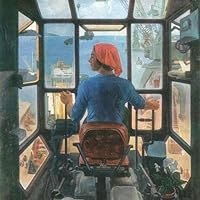
(Premessa: trovato su una bancarella sperduta con una copertina, sempre Adelphi, molto più bella di quest'ultima, un manifesto sovietico conservato nel museo di Zurigo). Considerazione iniziale: scorre come un filo d'olio (industriale). Bene dirlo perché Morselli, poco conosciuto ma ampiamente pubblicato, ha nella sua scrittura un certo ingrippo, restando in tema di macchinari, che lo fa procedere a singhiozzi, come tante isole tropicali scarsamente collegate, o durante la stagione dei tifoni. "Il comunista" è un treno, nel quale il protagonista, un giunco in balia del vento dei tempi della Riappacificazione prima e della Destalinizzazione poi, fa i conti con la dottrina che ha faticosamente introiettato, e con la sua vita stessa. Walter Ferranini si stupisce lui per primo di essere vivo, e deputato della Repubblica nel Partito, proprio lui, il Partito, guidato da Lui, proprio lui, il professore Olinto. Così, come un morto che ha avuto licenza, dopo una giovinezza dedita alla fatica e che lo ha portato in Spagna a combattere, in Russia a imparare, negli Stati Uniti a sposarsi, continua, in maturità, a tenersi libero dal fardello psicologico e si dedica anima e corpo al suo sogno cooperativistico (è un emiliano, meglio: reggiano) e a una esaustiva legge anti-infortunistica. Legato come il suo idolatrato capo a una relazione più o meno extraconiugale con la Nuccia, continua a macerarsi nel suo peccato originale, che a qualcosa gli serve, come potremo leggere in uno dei passaggi più struggenti del romanzo, il processo al povero compagno Mazzola di Rivoli (o Collegno, non ricordo). Nel quadro di una Italia povera e dignitosa, memore della fatica agricola che si è traslata pari pari nel lavoro industriale, Ferranini ha il cuore debole, la fibra forte, un sonno che è morte, un appetito ancestrale. Sono le sue sicurezze, che nemmeno i più grandi scienziati, né della politica né della biologia, riescono ad intaccare, e nemmeno la già strutturata ala intellettuale capeggiata da Moravia (che interpreta se stesso) e che lo invita a scrivere un pezzo sull'"essere marxisti" per la sua rivista "Nuovi Argomenti"; un pezzo magistrale sull'ineluttabilità del lavoro come espiazione da pagare a una Natura che poco ci tollera, e che sarà la sua rovina.
"Parabole strette, ascensioni erte, iniziative e speranze e poi inevitabile, la caduta".
Un romanzo ideologico prezioso, a tratti tragicomico e per altri versi serissimo, che ha toccato molti dubbi che coltivo personalmente da tempo sullo scontro continuo tra ideologia e pratica, tra il fine e il mezzo della propria azione sociale e politica. Da un punto di vista puramente narrativo tuttavia non è senza pecche, e può risultare abbastanza lento. Lo consiglio quindi molto, ma solo a chi ha già qualche conoscenza e soprattutto un sincero interesse per il destino dell'ideologia comunista nella sua pratica quotidiana e nella sua incarnazione storico-politica nell'Italia post-bellica.
Communism in 1950s Italy was a complicated and inconsistent creed, as Walter Ferranini, a ICP member of Parliament, steadily discovers. All a bit too much for me to chew.
The number of readers for a novel titled The Communist, in the United States, with its long history of bogeyman fears about the word itself, much less what it represents, would seem to be very few; an Italian communist at that! For all the enormous impact of communism on the world, the number of communist or socialist protagonists in American novels probably doesn’t amount to the fingers on four hands. Nevertheless New York Review Press was interested enough to publish Frederika Randall’s 2002 translation to English of Guido Morselli’s 1976 novel, along with an interesting introduction by Elizabeth McKenzie. ... it’s an odd sort of novel, of slow loss of faith and direction, not through sudden realization or moment of crisis as for those in The God That Failed but as many have experienced after intense and committed work for an ideal or a cause, whether in youthful volunteer work, in Synanon-like cults, the Catholic Church or Silicon Valley start-ups. Such separation is sometimes fraught with moral struggle, the fear of loss of friends and purpose, or with anger and resentment, but for some, as with Walter, there is simply a recognition of its being over, of being tired, not furious.
What Morselli presents us with is not the romantic revolutionary, in the throes of organizing and beating back the capitalist exploiter or the Fascist gangs. What we have is a man struggling with existential indecision, in 1958, to be or not to be a communist any longer. As the Party and the militancy of his youth loses sap and vigor, as Communist Deputies go to the horse races instead of Party meetings, as a militant sidles up to ask a special favor for a relative, what is a man to do? He is, as he says of himself,
“Ex-proletariat, yes, with a bourgeois nervous system”
Halfway through this novel, I assessed it as an adequately engaging read whose denouement I sincerely looked forward to reading. Then the plot seemed to unravel in a way that struck me as the author trying to find some way bringing it to an end--which doesn't really happen, anyway. Towards the end of the novel (p.310), the main character, Ferranini, reflects, "The whole episode,...so strange and improbable, could not have ended otherwise." Yes, it could have. I don't know how, and it's not my role as the reader, either, but the ending felt illogical, contrived, unsatisfying, and even desperate. My frustration was exacerbated by the many different distracting mistakes about, for instance, the geography of Philadelphia (my bad luck that it's my hometown; otherwise, it would have passed unnoticed) or anachronistically placing Joseph McCarthy's anticommunist crusade in the same time frame as the Peace Corps. Until then, Morselli had rendered Ferranini's character with nuances that evoked sympathy and interest, placing him in a compelling web of political, personal, and existential dilemmas that might have resolved in any range of plausible ways--or at all. That's not what happened, though. Titles in this NYRB series tend to be hit or miss--as "forgotten classics", some of them are more justifiably the former than the latter--and this one turned out to be part hit and part miss.
Premetto che Morselli è un autore che amo molto e che credo sia ingiustamente sottovalutato o ignorato o comunque poco letto. Questo potrebbe influenzare il mio parere. Quando leggo Morselli non so mai cosa aspettarmi: talvolta una storia e uno stile più tradizionali (vd. Uomini e Amori), talaltra sperimentali (vd. Roma senza Papa, ma così, per dirne uno). Certo è che so che leggerò pagine dotte, intelligenti, argute, ironiche e/o drammatiche all'occorrenza. Il Comunista è un bel romanzo e tutto sommato anche autentico. Palesa l'abissale distacco tra teoria e praxis marxista, tra ideali e possibilità (ma sarebbe meglio dire 'impossibilità') di realizzarli. Walter Ferranini, comunista, crede in idee politiche inattuabili e a farglielo capire sono Montecitorio, il partito, una certa retorica e lo stile di vita di quei 'compagni' che vestono i panni del comunista pur essendo profondamente individualisti (contraddizione in termini): insomma la praxis stessa, ben diversa da quella teorizzata. Ecco che la delusione di Walter e il suo disorientamento lo porteranno a inseguire il passato, a viaggiare in America e a ritornare più amareggiato che mai, ma anche più consapevole.
Dryly affectionate for its embattled protagonist, a staunch Communist in the Italian parliament of the mid to late '50s. While skeptical of the communist horizon - everything lapses into bourgeoise hierarchism - it still takes communism and its eponymous subject seriously, sympathetically, with a subtle sense of humor. The NYRB editions of Morselli's books have been some of my happiest discoveries lately. A lonely genius who never received the career or attention he deserved during his lifetime. I'm concerned I will need to learn Italian if I ever want to read his other seven books, but I am willing to take up the challenge for him.
Non so se sono io ad essere diventata stupida o se davvero scelgo solo libri a me poco comprensibili. Parto dalle cose che mi sono chiare: 1. L’autore, che io confondevo col coglione di Riza, era un solitario che ha dedicato la sua breve e sfortunata vita alla scrittura. I suoi lavori venivano ripetutamente rifiutati dagli editori ed a causa di ciò, Morselli si tolse la vita. 2. Cercavo un audiolibro perché da circa due mesi non riesco a leggere UNA pagina che sia una. Mi distraggo, mi addormento, mi vien voglia di guardare la tv. Poi trovo questo libro letto dalla fenomenale Maria Paiato e lo inizio.
Ma ecco che qui fatico a capirlo. Maria Paiato è bravissima come sempre, fa accenti differenti, interpreta tutti i personaggi, mi racconta il libro come se fosse una storia. LEI è riuscita a farmi capire Amuleto di Bolano, eppure qui mi confondo. Ci sono termini politici, concetti troppo teorici per il mio piccolo cervellino che si riprende solo quando la storia diventa più personale e pratica.
Walter Ferranini è un deputato del PCI nella metà degli Anni 60, fedele al partito che ama e onora come fosse sua madre. Esegue diligentemente i suoi incarichi e prende sul serio il suo ruolo di “amplificatore dei bisogni operai” lui che è stato mandato a Roma grazie ad uno zoccolo duro di voti dall’Emilia Romagna. Ferranini però ha vissuto in America a lungo, subito dopo la guerra, si è sposato con la figlia del suo capo che lo trattava meglio di un figlio. È proprio le “seduzioni” del capitalismo americano fanno traballare Walter che sente di tradire la sua ideologia. La moglie Nancy inoltre si rivela una WASP insopportabile che rinnega le proprie origini italiane. In Italia Ferranini ha un’”amica” che ha fatto parte della Resistenza e lo ama teneramente. Anzi gli vuole bene (e qui Maria Paiato dà il meglio di sé nel riprodurre l’accento milanese!!).
Per tutto il libro non ho capito se Ferranini sia solo un mero ingranaggio del partito, oppure una persona in grado di difendere le proprie idee e posizioni.
Ad ogni modo le parti che ho preferito sono state quelle più personali: la vita negli USA, il rapporto con Nuccia, il rientro negli USA e l’attacco di cuore nella cabina. Lì ho visto la capacità di immedesimazione dell’autore.
Walter is a devoted member of the Italian Communist Party, the third-largest Communist party in the world after the Soviet Union and China. But lately, he's become disillusioned. He's dedicated to bringing socialism to every Italian and bettering the conditions of every worker. As a member of parliament, you might think he has an opportunity to make that happen. But during the 1950s, the party didn't cooperate with other parties, it didn't promote legislation, but bided its time, hoping to win a majority and impose communism from above. In other words, it was a lot like the Republican Party in America. So, Walter's job as a member of parliament accomplishes precious little. He's also disillusioned because the Party seems obsessed with ideological purity, to the point where it kicks out people who have differing ideas of how to achieve its goals. Again, just like the Republican Party in America. The Party even tells him to get rid of his mistress, Nucia, because she's a separated but not divorced woman. The Party's also obsessed with moral purity, again, just like a certain American political party of today. Throughout the book, the author says that the Party is just as much a religion as Italy's other great political institution, the Roman Catholic Church. This is a really great account of how political parties work and don't work, but it's also a great character study. I identified closely with Walter. He's a man with high ideals who wants to help people, but reality keeps punching holes in his idealism. He's something of a self-portrait by the author, who killed himself because he couldn't get anyone to publish his novels, not in his lifetime. A man ahead of his time, it seems.
Follows a member of the Italian Communist Party, Walter Ferranini, who represents a regional district at the Parliament in Rome. Ferranini identifies himself first and foremost as a worker, in the Marxist sense. He is resigned to his role in the Parliament, as a functionary of his district and the workers there, but he is increasingly disillusioned by the party politics and personal agendas of Rome. Ferranini is unyieldingly idealistic in his belief in Marxism, even when the Communist Party (and at times, he himself) fails to live upto these theoretical idealisms.
Strangely, the book (called The Communist!) made me think most of Mark Fisher's concept of Capitalist Realism. At one point Ferranini is urged to think of a "third place" between Socialism and Capitalism, and he is completely unable to picture or articulate what this "third place" may be. He is stuck inside the system and cannot conceive of any alternative reality which is not its binary.
The character of Ferranini is earnest, literal, and sometimes dull. The narration, although third person, is a very close third person. There is no humor or irony. The reader is not invited to judge Ferrinini in a space of ironic distance, and his cognitive dissonances are not challenged by the narrator. The reader struggles with him, and feels his pain when his ideals and integrity are tested.
This is a quiet, humanistic study of a man and his struggle to reconcile his idealism with political and social reality. I think alot of us experiencing the existential guilt of late stage capitalism (good reads is owned by Bezos!) will appreciate it.
“L’automazione è un fatto, tuonò Schiassi. No, non è un fatto ribadì tenace Ferranini, è un fantasma. Per costruire e mantenere un automa pseudo-intelligente, ci vuole il doppio del lavoro occorrente per avere i prodotti che esso potrà mai fabbricare. Vi dico che la tecnica non può fare quello che è assurdo. L’inevitabilità del lavoro, come la mortificazione che il lavoro determina, dipende da condizioni oggettive, ossia dalla posizione che la vita, non solo la vita umana, ha dentro la natura” [...] Io dico, seguitò Ferranini che la realtà è un pò diversa: il lavoro degli operai, il lavoro dei lavoratori, non fa bene, qualche volta ammazza. Quasi sempre, in un modo o in un altro, altera. Fa scadere, debilita. Ottunde. In un regime capitalistico! - si oppose Schiassi. Avrebbe voluto ribattere: sono capitalistici tutti i regimi dove è utile dire la menzogna che il lavoro fa bene, ma preferì stare zitto.”
Questa la descrizione di un processo di censura politica all’interno del PCI descritta nel romanzo Il Comunista, questo l’acume di uno scrittore per troppo tempo negletto (forse non a caso) ricordiamoci che questo libro è stato scritto nel 1964, cioè prima ancora delle elaborazioni del sessantotto.
The journey from idealist to pragmatist isn't an easy one. I disagree with the book description here, "Communism no longer explains the life he is living, the future he hoped for, or, perhaps most troubling of all, the life he has led." On the contrary, communism explains it completely.
It wasn't communism that failed the protagonist but his own idealism. I'm using idealism there in every sense of the word. Dwelling in hope is a mistake. It's easy to manipulate by others and even to become self-deluded, like all idealism. That doesn't necessarily make one a pessimist, but more of a realist. You need that ground under your feet to launch anything.
The discussions about marx, communism and politics between the characters were really interesting as was the view of party politics from the inside. The antagonisms between the Italian déclassé bourgeoisie, the intellectuals, petit-bourgeois opportunists using the party for their own ends, and the working class, especially those who had fought in Spain, were well illustrated. Then the contrast with the US Americans threw that all into another light. If one didn't know Marx they would have likely thought the ending was defeatist (as many reviewers seem to) rather than a somewhat subdued and necessary revelation.
Il comunista è senza dubbio un romanzo ricco di spunti, capace di ricostruire con cura un mondo politico e umano lontano dal nostro presente. La storia di Walter Ferranini, sospeso tra ideali, disillusione e una vita divisa tra Italia e Stati Uniti, offre un ritratto complesso della sinistra italiana degli anni ’50.
Detto questo, devo ammettere che il romanzo non mi ha coinvolto al 100%. Non sono mai riuscito a provare una vera empatia per i personaggi, neppure per Ferranini, che pure è tratteggiato con cura. La sua crisi ideologica, i dubbi, le tensioni tra teoria e prassi, tutto è narrato con finezza, ma per me è rimasto sempre un po’ distante.
Forse pesa proprio il fatto che si parli di un tempo lontano, con dinamiche politiche e moralistiche che oggi risultano estranee. Alcune preoccupazioni dei personaggi — dalla disciplina di partito ai dilemmi dottrinari, fino ai dettagli degli schieramenti parlamentari — mi sono sembrate troppo distanti per generare un vero coinvolgimento emotivo.
Riconosco la capacità di Morselli di costruire un mondo coerente e un protagonista attraversato da tensioni sincere, ma per me è stata una lettura più “interessante” che davvero avvincente: un libro che rispetto, ma che non mi ha catturato del tutto.
A wonderfully affective portrait of an ordinary "good Italian Communist" and his psychological and ideological struggles. Ferranini is a surprisingly compelling character, and the world around him- the bourgoisifying realm of nominally radical electoral politics in mid-century Italy- is equally compelling.
I really enjoyed this book. As someone involved in radical politics and electoral politics, it deals with some sticky theoretical and practical questions. As someone concerned with theory and practical questions too, it gives the reader some well-crafted dilemmas to chew on too. The characters occasionally throw around Marxist jargon, but it only serves to clarify their points (if that's what you're in it for) and solidify the setting and the self-serving a absurdity of some of Morselli's cast of Deputies. I'm not sure if this is a case of "the right book at the right time" (I'm certainly far too young to be experiencing a mid-life crisis like Ferranini), but I think that this is a good book, and definitely worth your while.
È un libro noioso e scritto con prosa antiquata, ma ha un merito, anche se forse involontario: fa un ottimo lavoro a mettere in chiaro una volta per tutte, qualora ce ne fosse il bisogno, che il comunismo è una malattia mentale. Morselli presenta le gerarchie del PCI romano negli anni '50 come lontane dai valori originari del movimento, con l'intenzione di fare di Ferranini, il protagonista, una sorta di eroe disincantato. Ma la cosa bella è che seguendo la storia dal punto di vista di Ferranini non ci si può non rendere conto che l'ideologia gli ha completamente mangiato il cervello. Ed è anche un romanzo profetico e di inquietante attualità, aggiungo. Perché sfido chiunque a leggerlo e a dirmi che i compagni descritti da Morselli a metà del secolo scorso sono poi così diversi dai cittadini del movimento cinque stelle di cinque/dieci anni fa. Peccato, appunto, per lo stile pesante e che risente del passaggio del tempo.
this book rules. humorous and tragic grumblings of a humorless marxist losing faith in the progress of history. walter wants to obviate the memory that will not stop spilling out from him--it's politically muddling for him to reminisce and personally distracting too. it is a theoretical problem for him to not know whether an affair is finished, or to assume that it had without ever confirming that the love had indeed ended long ago. the answer will bear on the brilliant levity of nuccia's making, who has the openness to receive what walter cannot divulge. i adore that walter's growing doubts concern the fundamental character of labor: that no liberation might be free enough to save us from the horrible work of living. when walter declares at the end that his previous love--and his previous life--has in fact run its course, he subtly relinquishes more than that to which we are privy. wonderful stuff