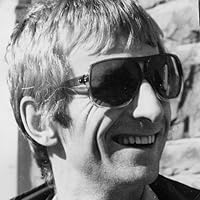
This is the story of Christopher Logue, poet and literary maverick, who counted Ken Russell, Arthur Miller and Marilyn Monroe among his friends. It tells of his South England childhood, his stint in the army, the years in Paris, offending T.S. Eliot and everything else, all in his own words.
Christopher Logue, CBE was an English poet associated with the British Poetry Revival. He also wrote for the theatre and cinema as well as acting in a number of films. His two screenplays are Savage Messiah and The End of Arthur's Marriage. He was also a long-term contributor to Private Eye magazine, as well as writing for the Merlin literary journal of Alexander Trocchi. He won the 2005 Whitbread Poetry Award for Cold Calls.
His early popularity was marked by the release of a loose adaptation of Pablo Neruda's "Twenty Love Poems", later released as an extended play recording, "Red Bird: Jazz and Poetry", backed by a Jazz group led by Tony Kinsey.
One of his poems, "Be Not Too Hard" was set to music by Donovan Leach, and made popular by Joan Baez, from her 1967 album "Joan". Donovan's version appeared in the film "Poor Cow"(1967).
His major poetical work was an ongoing project to render Homer's Iliad into a modernist idiom. This work is published in a number of small books, usually equating to two or three books of the original text. (The volume entitled Homer: War Music was shortlisted for the 2002 International Griffin Poetry Prize.) He also published an autobiography called Prince Charming (1999).
His lines tend to be short, pithy and frequently political, as in Song of Autobiography:
"I, Christopher Logue, was baptized the year Many thousands of Englishmen Fists clenched, their bellies empty, Walked day and night on the capital city."
He wrote the couplet that is sung at the beginning and end of the 1965 film A High Wind in Jamaica, the screenplay for Savage Messiah (1972), a television version of Antigone (1962), and a short play for the TV series The Wednesday Play titled The End of Arthur's Marriage (1965).
He also appeared in a number of films as an actor, most notably as Cardinal Richelieu in Ken Russell's 1971 film The Devils and as the spaghetti-eating fanatic in Terry Gilliam's 1977 film Jabberwocky.
Logue wrote for the Olympia Press under the pseudonym, Count Palmiro Vicarion, including a pornographic novel, Lust.
A hugely enjoyeable and fascinating memoir, to me at least. After National Service the poet Christopher Logue Lived in Paris for 5 years in the 50s, then returned to London, supplementing his meagre living as a poet with readings and journalism, including for many years collating True Stories and also Pseuds Corner for Private Eye. He lived at one end of Portobello Rd, so he was also able to rent out his ground floor for storing the belongings of the stallholders. There are many anecdotes about the picaresque Bohemian life, as well as descriptions of people such as Alexander Trocchi -- he is more or less forgotten now, but notorious at the time -- The author of Cain's Book, he was Master of Ceremonies at the International Poetry Incarnation at the Albert Hall in 1965 -- the event at which the cultural Underground reached the surface, commemorated in the film Wholly Communion. Others described include Kenneth Tynan, Nell Dunn, painters such as Pauline Boty, and many others he bumps into, or almost -- he goes to meet Marilyn Monroe, but she is arguing on the phone with Arthur Miller, who is in another room in the flat... Logue is psychologically acute about his own strengths and failings -- he includes critical comments about his behaviour written up by his friends. He is very honest about himself and the extent to which lives are shaped, even indirectly, by a preoccupation with sexual success and failure. His life's work, occupying him for about 45 years, was translating chunks of The Iliad: “War Music” (1981), “Kings” (1991; “The Husbands” (1995); “All Day Permanent Red” (2003); and “Cold Calls” (2005), winner of the Whitbread Poetry Award. Bits of this story coincide with my own life -- and I still remember his poster poems, including I Shall Vote Labour... Here he is, reading it http://bit.ly/12R1Hlx
[This is my third time through. I wanted to reread it while reading his selected poems. Not only does it cast light on those poems, it still seems as good as it did on a first or second reading.]
I think this is the best autobiography/memoire i've read since Louis MacNeice's 'The Strings are False'. Logue will be remembered for 'War Music" his 'account' of the Iliad, arguably one of the great long poems of the twentieth century. But there's not a great deal about that in this book.
The title is ironic. Logue takes the English Idea of self-deprecation several steps further than usual. At times he seems to be going out of his way to prove what an unlikeable person he was, allowing people he knew to have their say about how he let them down or alienated them, but rather than the usual fake 'oh what a naughty chappy I was', the portrait that emerges is fascinating.
It's not just his story either but the story of the time he was living in with a cast of impressive characters. And he writes beautifully:
'For Inspiration I read Eliot. For Instruction Pound. Yeats for pleasure. Matters became clear. Either you did as well, as differently, as Eliot had done, or forget it. Become a film star, or a world leader'.
That last non sentence packs a world of attitude into what sounds like a throw away line.
Above all this is a book about books, about reading discussing and writing them, about the business of dealing with publishers and editors.
'And of course, we loved books. Books were the thing. Portable durable inexpensive-a marvel of technolgoy needing no intermediates save spectacles ; that can be exceptionally beautiful and may become valuable. Above all-free spirited, subversive, difficult to police'.
Got this book as part of a bookshop's random book for every month. Took me ages to get around to it, largely because I had never heard of Christopher Logue, so I wasn't sure what interest a biography would hold for me, but picked it up while i was ill. It's fantastically written and largely very interesting, giving an insight into a literary period I have heard a lot of but not read much about. It's fascinating to read interactions with Pound and Beckett as real people, not just historical literary figures.
I'll now go and try and find some of Logue's other work - War Music looks particularly interesting, as well as Alex Trocchi and a few of the other authors mentioned. I'd recommend this book to anyone with an interest in literature and writing for an insight into the life of a writer who's name hasn't quite endured.