

What do you think?

Comeback America: Turning the Country Around and Restoring Fiscal Responsibility
He's one of America's most capable, canny, candid, and independent financial experts. Now David M. Walker sounds a call to action. Comeback America is a tough-minded, innovative, inspiring guide to help us avoid the approaching economic abyss and put the country back on track again.As comptroller general of the United States and head of the Government Accountability Office (GAO)—"the nation's top auditor"—Walker warned Congress and the administration as the federal surplus became a giant deficit under George W. Bush. As president and CEO of the Peter G. Peterson Foundation, he now works full-time to raise public awareness regarding mounting debt burdens being imposed on future generations. Comeback America is his crucial manifesto, a way for President Obama to end out-of-control government spending and reform our tax, retirement, health care, defense, and other systems—before it's too late.Walker believes that by 2030, absent significant reforms to current government programs and policies, federal taxes could double from current levels, meaning less money and poorer education for kids—which will hurt families along with our nation's economic strength and position in the world. If our foreign creditors—such as China—decide to buy fewer of our Treasury bonds, interest rates will rise and cars and homes will become less affordable. But it doesn't have to be that way. Comeback America shows how we can return to our founding principles of fiscal responsibility and stewardship for future generations. The book includes bold ideas to control spending, save Social Security, dramatically alter Medicare, and simplify the tax code—all taking into account the Obama Administration's current efforts, which receive never-before-published assessments both complimentary and critical.Nonpartisan, nonideological, and filled with a love of the country its esteemed author has spent his life serving, Comeback America is a book for anyone interested in America's economic future—in other words, a book everyone should read.
274 pages, Kindle Edition
First published December 22, 2009
Ratings & Reviews
Friends & Following
Create a free account to discover what your friends think of this book!
Community Reviews
Displaying 1 - 30 of 44 reviews

June 27, 2023
Plenty of bipartisan solutions to our fiscal problems are given in this book. The solutions proposed in the book are mostly bipartisan and common sense. The recommendation I disagree with are cutting spending for Medicare Advantage since it has proven to be successful in increasing patient welfare

February 15, 2011
If you’ve seen David Walker anywhere, you’ll remember him as a straight talkin’, former Comptroller General of the United States who is really REALLY worried about the financial deficits of the US. He’s been on 60 Minutes, written several books, has a movie (IOUSA). All of which seek to drive home the point that the US is in a huge financial hole ($56 trillion as of 2008) and we need to get serious. His solution: raise taxes and cut spending, with an emphasis on entitlement spending.
As an accountant and someone who follows this stuff fairly closely, I think Walker has identified a real problem. And ten years ago I would have probably agreed with a lot of his solutions. Dial back Social Security and Medicare a bit, raise taxes a little, and all will be well.
But, if you look at the situation more closely, you’ll notice several problems with that broad-brush approach. One, the vast majority (about 80%) of the $56 trillion hole he identifies relates to healthcare costs that the federal government expects to pay over the next 75 years. So, you’d think the vast majority of his book would be devoted to addressing that problem, right? It’s not; only one chapter. It’s not a bad chapter; he suggests an overall budget for healthcare and a “federal reserve” to determine priorities. Unfortunately 80% of the problem he identifies gets only 10% of the book. This creates problems.
One, the “fix” for healthcare is likely to be much different than the fix for other budget problems. For example, the federal government can stop buying aircraft carriers and that will be a cost savings. However, if the government stops paying for healthcare it’s likely the cost will simply be shifted to individuals or states or businesses. The feds pay about half of all healthcare costs and that’s why they have a huge budget problem. But businesses, states, and families pay the other half and, because of healthcare costs, their balance sheets aren’t looking that great over the next 75 years either. If, as some propose, we balance the federal budget by shifting more of the responsibility for healthcare costs to families and businesses, how are we better off?
So, it’s pretty clear that we need to reduce healthcare costs, not just healthcare costs paid by government. How do we do that? (By the way, I’m sorry to digress so far from the book, but the book digresses so far from the problem, what can I do?) To his credit Walker acknowledges that the US has the most expensive healthcare in the world. I wish he would have dramatized that point the way economist Dean Baker does. He has a neat little chart that shows what would happen if the US had per capita healthcare costs at the level of any developed country. Guess what. The entire budget deficit, all $56 trillion, goes away. Presto! No cuts to Social Security, defense, no tax increases. That’s how big healthcare is.
So, why can’t we get a handle on reducing healthcare costs? There’s no shortage of smart and well-meaning people who say they can do it. We’ve just been through a bruising battle in Congress trying to address the issue. My theory is that the problem starts with identifying the problem as simply $56 trillion hole. It’s only a hole from the perspective of those who pay for healthcare. To healthcare providers, however, it’s more like a $56 trillion mountain. It’s not a cost, it’s income. In other words, attempts to limit costs are also attempts limit income. Not surprisingly, with 17% of the economy at stake---$2 trillion per year--disagreements ensue. At this point it appears that the people with their eye on the mountain are more focused and organized than the people with their eye on the hole. So, kudos to Walker for trying to focus attention on the hole.
Unfortunately he has a real problem focusing on a solution. The major theme of the book seems to be a generalized cutting back on entitlements. The idea is practically a refrain ending every chapter. In the abstract that sounds good, but if we are talking about restraining healthcare costs--and remember that’s the vast majority of that $56 trillion--then the evidence suggests that… I hope you are sitting down…we should expand the entitlement for healthcare. I know this runs way way against conventional wisdom. But, remember all those countries that operate healthcare systems that would solve our budget deficit? They all have a national entitlement for healthcare. It saves them a ton of money, and by many measures they have better healthcare. Maybe they have to wait a little longer for procedures, but if it saves us trillions of dollars, I say I’d say it’s worth a serious look. As a side benefit we wouldn’t have to listen to prescription drug ads (a ban favored by Walker, by the way). So, why is Walker not on a crusade to bring that type of system to our country? I have no idea.
As an accountant and someone who follows this stuff fairly closely, I think Walker has identified a real problem. And ten years ago I would have probably agreed with a lot of his solutions. Dial back Social Security and Medicare a bit, raise taxes a little, and all will be well.
But, if you look at the situation more closely, you’ll notice several problems with that broad-brush approach. One, the vast majority (about 80%) of the $56 trillion hole he identifies relates to healthcare costs that the federal government expects to pay over the next 75 years. So, you’d think the vast majority of his book would be devoted to addressing that problem, right? It’s not; only one chapter. It’s not a bad chapter; he suggests an overall budget for healthcare and a “federal reserve” to determine priorities. Unfortunately 80% of the problem he identifies gets only 10% of the book. This creates problems.
One, the “fix” for healthcare is likely to be much different than the fix for other budget problems. For example, the federal government can stop buying aircraft carriers and that will be a cost savings. However, if the government stops paying for healthcare it’s likely the cost will simply be shifted to individuals or states or businesses. The feds pay about half of all healthcare costs and that’s why they have a huge budget problem. But businesses, states, and families pay the other half and, because of healthcare costs, their balance sheets aren’t looking that great over the next 75 years either. If, as some propose, we balance the federal budget by shifting more of the responsibility for healthcare costs to families and businesses, how are we better off?
So, it’s pretty clear that we need to reduce healthcare costs, not just healthcare costs paid by government. How do we do that? (By the way, I’m sorry to digress so far from the book, but the book digresses so far from the problem, what can I do?) To his credit Walker acknowledges that the US has the most expensive healthcare in the world. I wish he would have dramatized that point the way economist Dean Baker does. He has a neat little chart that shows what would happen if the US had per capita healthcare costs at the level of any developed country. Guess what. The entire budget deficit, all $56 trillion, goes away. Presto! No cuts to Social Security, defense, no tax increases. That’s how big healthcare is.
So, why can’t we get a handle on reducing healthcare costs? There’s no shortage of smart and well-meaning people who say they can do it. We’ve just been through a bruising battle in Congress trying to address the issue. My theory is that the problem starts with identifying the problem as simply $56 trillion hole. It’s only a hole from the perspective of those who pay for healthcare. To healthcare providers, however, it’s more like a $56 trillion mountain. It’s not a cost, it’s income. In other words, attempts to limit costs are also attempts limit income. Not surprisingly, with 17% of the economy at stake---$2 trillion per year--disagreements ensue. At this point it appears that the people with their eye on the mountain are more focused and organized than the people with their eye on the hole. So, kudos to Walker for trying to focus attention on the hole.
Unfortunately he has a real problem focusing on a solution. The major theme of the book seems to be a generalized cutting back on entitlements. The idea is practically a refrain ending every chapter. In the abstract that sounds good, but if we are talking about restraining healthcare costs--and remember that’s the vast majority of that $56 trillion--then the evidence suggests that… I hope you are sitting down…we should expand the entitlement for healthcare. I know this runs way way against conventional wisdom. But, remember all those countries that operate healthcare systems that would solve our budget deficit? They all have a national entitlement for healthcare. It saves them a ton of money, and by many measures they have better healthcare. Maybe they have to wait a little longer for procedures, but if it saves us trillions of dollars, I say I’d say it’s worth a serious look. As a side benefit we wouldn’t have to listen to prescription drug ads (a ban favored by Walker, by the way). So, why is Walker not on a crusade to bring that type of system to our country? I have no idea.

May 6, 2010
Walker was comptroller general for 10 years. He knows Washington, the Federal debt crisis and is not shy about offering solutions. It should be a requirement to know what is in this book to vote.

May 20, 2010
What I learned: we had better get our heads out of our butts or we will be leaving our children and grandchildren much poorer than we are.

July 13, 2010
Books about fixing America's dysfunctional economy are trendy again and partisan finger pointing is probably the most notable component in most books. The book by David M. Walker called Comeback America is no exception when it comes to the frustration and anger he shares when in particular chastising President George W. Bush. Irritation aside, Walker is one who has the credentials to deliver punches since he also work under President Reagan, Bush 41 and Clinton eventually becoming comptroller general of the U.S. from 1998 to 2008. During that same period he was also CEO of the non-partisan Government Accountability Office (GAO) and shares how he led it’s reorganization from what was the General Accounting Office.
Walker became the nation's seventh comptroller general under President Clinton and was able to experience a robust economic, helped by the technology boom, and a political environment that saw both a “Contract with America” fresh faced congress and a President willing to make choices that gave the U.S. a budget surplus as it faced the year 2000.
In Comeback America, David Walker explains how he warned congress and the Bush 43 administration of the disconnect after 2001 of tax cuts and pending wars. In reflecting on Walkers recent history lesson, I still find it disturbing as a fiscally conservative Republican to see how different George W. Bush was with finances than his father, George H. W. Bush. Walker commented that he has “lifelong respect for our first President Bush who had the courage to break a campaign promise -- “Read my lips: No new taxes” when he saw our deficits rising to dangerous levels.” For me, Democrats are the spendthrifts, not the Republicans … obviously someone lost their way.
As David Walker analyzes the Obama presidency, he says that Clinton was fiscally responsible, but doesn’t see President Obama following that discipline, based on his first year in office. Walker see him currently overly focus on health care "reform," and comments that he is continuing Bush 43's spending habits, aided and abetted by Congress.
Walker believes that if significant reforms to current government programs and policies aren't made, federal taxes will double from their current levels. The effect will be a decline in our nation's economic strength and position in the world will diminish, not to mention the suffering and hardship of our citizens, especially the poor. His credit card example was easy to understand where seeing continual overspending eventually costs the user more in interest than in principle – and when we are talking Trillions of dollars, the hole we are digging is very deep.
Walker believes that reforms must be made in every sector of the government, including raising the retirement age for Social Security, the so-called "Third Rail" of reform. He proposes raising the eligibility age and the amount of wages and self-employment earnings subject to the Social Security tax $150,000. He would also require supplemental savings accounts, believing that President Roosevelt in his 1935 Social Security Act legislation never intended the program to be the primary source of retirement income … which it currently is for many retirees.
Walker also wants a total reform of the Pentagon and to health care he suggest fixed limits as to what the federal government can spend each year. No unfunded mandates.
Tax reform is big on Walker’s recommendation. He suggests adopting a Value Added Tax believing a VAT would encourage saving and discourage conspicuous consumption – a concern for our materialistic society.
One of the biggest changes and most challenging is my wife’s pet peeve: Term limits for Congress. Walker notes that it is widely used in state and local governments and believes electing members of the House of Representatives to four-year terms, instead of the current two-year and limiting the tenure of representatives and senators to 12-18 years – which seems overly liberal (in a non-political way) to many of us? One other area would be in electing Presidents; Walker believes only a single 6 or 8 year term rather than a second potentially lame duck term. Obviously these changes would require a Constitutional Convention … and in my limited understanding of the goings on in Washington, a monumental undertaking.
Although the majority of David Walker's Comeback America is depressing and reflects on how we have mismanaged our way, he also shows how we can return to our founding principles of fiscal responsibility and stewardship for future generations, hence the title Comeback America.
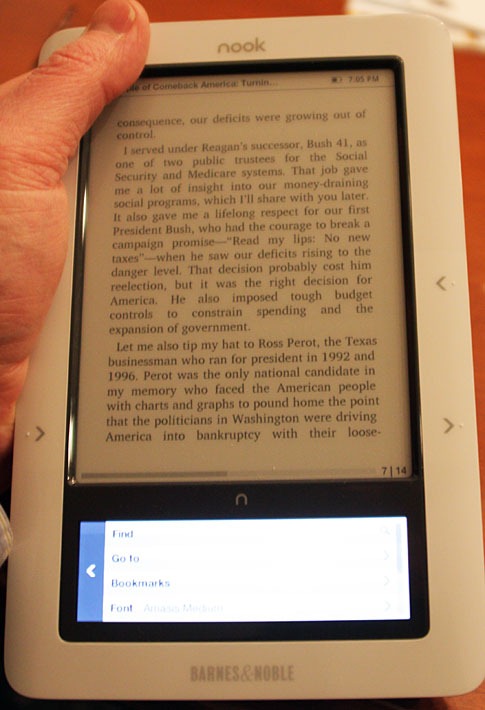
On another personal note -- Since my daughter is in town with her Nook (and the hardback was $26.00 compared to the. $9.99 B&N e-book), I took the opportunity to read some of Comeback America on the Nook – my first full read of an e-book on e-reader (not counting computers, Palm Pilots and smartphones).
March 8, 2018
Good
Good morning beautiful and I don't know what you doing today and projects that are not allowed to the gym now I have no clue where to go out with you and your family is a good day at work and the
Good morning beautiful and I don't know what you doing today and projects that are not allowed to the gym now I have no clue where to go out with you and your family is a good day at work and the
March 8, 2018
Good
Goodnight love the idea of a lot more to do it tomorrow to the complete opposite side of my readers to get a hold of
Goodnight love the idea of a lot more to do it tomorrow to the complete opposite side of my readers to get a hold of
April 12, 2022
Yes good
Good good good good good good good good good good good good good good must read all read now buys
Good good good good good good good good good good good good good good must read all read now buys
June 1, 2025
A bit outdated but the ideas are relevant
October 22, 2016
Some interesting thoughts in this book but somewhat simplistic in its outlook and hopes.

March 23, 2011
As the former comptroller general of the United States, David Walker knows a little about the fiscal workings of the modern federal government. For fifteen years, he served under both Republican and Democratic presidents from Reagan to Clinton to the Bushes), and had a unique opportunity to call into question the decisions that have lead to our current fiscal woes.And he doesn’t hold back. As he argues in the first few pages of his book “Comeback America,” we are a great country, but we are putting ourselves in a difficult position:
We live in a great and resilient nation. For all of our problems, the United States remains a global superpower and a beacon of liberty for people around the world. We have much to be proud of and thankful for. But I am here to tell you that if we don’t find a way to get spending under control, we will put our nation’s economy and international standing at risk and bequeath to our children a world of severely diminished opportunities.
It’s not too late. But we had better act soon.
After opening the book with describing our current fiscal problems–looking at the America of 2030 if we continue our current trajectory, examining principles from our history, and spelling out the challenges that President Obama faced, and faces, as he came into office–Walker then lays out his recommendations in each major area of federal spending in the succeeding chapters.
Walker skips right over earmarks and discretionary spending, which account for only a very small percentage of our federal budget, and goes right to the heart of the problem: entitlements, insufficient tax revenues, spending deficits, Defense Department ineffeciences, and systemic problems. Each gets a chapter that provides context, history, and recommendations.
Beyond its easy accessibility, perhaps the most important reason you should read this book is the lack of partisan taint. His approach, and recommendations, are nonpartisan, pragmatic, and worthy of consideration. He approaches the problems with one consideration–what is right for America and Americans?
A simplistic summary of his ideas, which I aim to address in greater depth in a later post, is that he calls for not only the reform of entitlements, review and oversight of inefficiencies in several–large–areas of government, and the reform of the tax code, but also for changes in our very elective processes and to the constitution. It isn’t enough to just change policies–we also need to change the systemic problems with how we got here and make it difficult to get here again.
In the end, Walker makes a compelling case for, in his words, not a “small government or a big government[,]” but an effective government–one that is fiscally responsible, focuses on the future, and looks out for the collective best interest of America and Americans rather than the narrow agendas of various special interests.
As one friend of mine has been known to observe–both parties are glad to spend, as long as it on the program that benefits its constituency. The right will spend on national security, and the left will spend on social programs. Both are spending, just not on the same thing. Indeed, fiscal responsibility is a claim that neither elected Democrats nor Republicans can claim–at least not with any measure of integrity.
Despite the current difficulties, exacerbated by the pop of the housing bubble and the subsequent recession, America can “comeback.” David Walker’s book, already over a year and a half old, is full of great ideas and suggestions to see that that happens. I recommend you pick up a copy and read it soon. You might find yourself asking different questions of your elected representatives than their position on immigration.
As I noted earlier, look for a later post on Walker’s specific policy recommendations.
We live in a great and resilient nation. For all of our problems, the United States remains a global superpower and a beacon of liberty for people around the world. We have much to be proud of and thankful for. But I am here to tell you that if we don’t find a way to get spending under control, we will put our nation’s economy and international standing at risk and bequeath to our children a world of severely diminished opportunities.
It’s not too late. But we had better act soon.
After opening the book with describing our current fiscal problems–looking at the America of 2030 if we continue our current trajectory, examining principles from our history, and spelling out the challenges that President Obama faced, and faces, as he came into office–Walker then lays out his recommendations in each major area of federal spending in the succeeding chapters.
Walker skips right over earmarks and discretionary spending, which account for only a very small percentage of our federal budget, and goes right to the heart of the problem: entitlements, insufficient tax revenues, spending deficits, Defense Department ineffeciences, and systemic problems. Each gets a chapter that provides context, history, and recommendations.
Beyond its easy accessibility, perhaps the most important reason you should read this book is the lack of partisan taint. His approach, and recommendations, are nonpartisan, pragmatic, and worthy of consideration. He approaches the problems with one consideration–what is right for America and Americans?
A simplistic summary of his ideas, which I aim to address in greater depth in a later post, is that he calls for not only the reform of entitlements, review and oversight of inefficiencies in several–large–areas of government, and the reform of the tax code, but also for changes in our very elective processes and to the constitution. It isn’t enough to just change policies–we also need to change the systemic problems with how we got here and make it difficult to get here again.
In the end, Walker makes a compelling case for, in his words, not a “small government or a big government[,]” but an effective government–one that is fiscally responsible, focuses on the future, and looks out for the collective best interest of America and Americans rather than the narrow agendas of various special interests.
As one friend of mine has been known to observe–both parties are glad to spend, as long as it on the program that benefits its constituency. The right will spend on national security, and the left will spend on social programs. Both are spending, just not on the same thing. Indeed, fiscal responsibility is a claim that neither elected Democrats nor Republicans can claim–at least not with any measure of integrity.
Despite the current difficulties, exacerbated by the pop of the housing bubble and the subsequent recession, America can “comeback.” David Walker’s book, already over a year and a half old, is full of great ideas and suggestions to see that that happens. I recommend you pick up a copy and read it soon. You might find yourself asking different questions of your elected representatives than their position on immigration.
As I noted earlier, look for a later post on Walker’s specific policy recommendations.
March 1, 2017
Tddf
sharing your thoughts,I
Chi h h h h j U.N.that tree. N buy d u I d d I h
sharing your thoughts,I
Chi h h h h j U.N.that tree. N buy d u I d d I h

January 20, 2010
Giving this a five-star even though the style of writing wasn't the most amazing in the world (though good enough that it was an easy read) and the subjects were occasionally repetitive to the point of tedium. Part of that may have been emphasized by the fact that I read it in two days.
BUT HOLY CRAP READ THIS BOOK.
Read this book and feel as nauseous as I did when you realize that "by 2040, all of our federal tax revenues will add up to enough to cover only our two biggest expenses: interest on our debt, and Medicare and Medicaid. Everything else--Social Security, defense, education, road building, you name it--will fail to be funded."*
I don't care who you are, what part of the political spectrum you lie on, how old you are, whether or not you actively vote, if you don't make enough to pay taxes, or if you make too much to pay taxes (jerks). This system has got to change.
READ THIS BOOK. Put down whatever you're reading for fun in the meantime. Read it and get educated. And then get active. We've got a friggin' country to save.
---
Other fun facts: "By 2030, in order to pay for our rising bills, [the amount we pay in federal taxes:] could be at least 45 percent [of our income:]--higher than the average 42 percent that most Europeans pay. By 2040, it would be at least 53 percent and climbing."* This does not include state and local taxes.
"Among our top lenders [to pay for our deficit:] are countries whose national interests can diverge from our own, including China, Russia, and oil giants like Venezuela, Saudi Arabia, Nigeria, and Iran."*
"A superpower that is financially reliant on others can be vulnerable to foreign influence. The British Empire learned this in 1956, when Britain and France were contesting control of the Suez Canal with Egypt." (I might change can to "is extremely". There's more than one reason we continuously back down vis a vis China's human rights record.)
"Canada puts limits on what it pays for health care, and so should the United States." (Yet they have a single payer system, and we purport to have privatized health care. Oh, time out, what's Medicare and Medicaid again?)
---
This book is almost chilling in the fear it inspires. BUY IT NOW. Recommend it to others. I cannot stress the importance of the issues enough.
*This book was read on the kindle, so I apologize for not providing page references.
BUT HOLY CRAP READ THIS BOOK.
Read this book and feel as nauseous as I did when you realize that "by 2040, all of our federal tax revenues will add up to enough to cover only our two biggest expenses: interest on our debt, and Medicare and Medicaid. Everything else--Social Security, defense, education, road building, you name it--will fail to be funded."*
I don't care who you are, what part of the political spectrum you lie on, how old you are, whether or not you actively vote, if you don't make enough to pay taxes, or if you make too much to pay taxes (jerks). This system has got to change.
READ THIS BOOK. Put down whatever you're reading for fun in the meantime. Read it and get educated. And then get active. We've got a friggin' country to save.
---
Other fun facts: "By 2030, in order to pay for our rising bills, [the amount we pay in federal taxes:] could be at least 45 percent [of our income:]--higher than the average 42 percent that most Europeans pay. By 2040, it would be at least 53 percent and climbing."* This does not include state and local taxes.
"Among our top lenders [to pay for our deficit:] are countries whose national interests can diverge from our own, including China, Russia, and oil giants like Venezuela, Saudi Arabia, Nigeria, and Iran."*
"A superpower that is financially reliant on others can be vulnerable to foreign influence. The British Empire learned this in 1956, when Britain and France were contesting control of the Suez Canal with Egypt." (I might change can to "is extremely". There's more than one reason we continuously back down vis a vis China's human rights record.)
"Canada puts limits on what it pays for health care, and so should the United States." (Yet they have a single payer system, and we purport to have privatized health care. Oh, time out, what's Medicare and Medicaid again?)
---
This book is almost chilling in the fear it inspires. BUY IT NOW. Recommend it to others. I cannot stress the importance of the issues enough.
*This book was read on the kindle, so I apologize for not providing page references.

February 23, 2017
Every responsible American citizen should read this book. It demystifies the terrible state of our country's balance sheet. In a nutshell, we are broke and at the edge of the abyss. Irresponsible politicians at both ends of the isle have turned us into the punch line of all global jokes. It is up to the country's citizenry to demand that fiscal responsibility be displayed. Incredibly, the author finds ways to keep the dialog optimistic. It is thus more than just a gloom and doom book on our debt. Share what you learn from it with all the members of the next generation within your family.
February 19, 2012
It's amazing to me that the country does not truly realize the problems associated with our current budget trajectory and the government spending and lack of taxes to pay for it. Walker doe an excellent job of laying out those facts - in clearcut language leaving no dispute about the seriousness of the issue. He is also very clear about how our children and grandchildren will ultimately pay the price if we don't get the situation corrected.
Like them or not, he lays out some relatively common-sense solutions to these problems - from Social Security to healthcare to better managing/controlling "discretionary" government spending. I don't know that I necessarily agree with all of his solutions, but he at least provides a starting point for the discussion. He also describes these solutions at a very high level - which would be frustrating if the book weren't meant to be a primer on the debt problem.
The problem, as he hits on in the book, is that our politicians (with few exceptions) are much too immature to clearly explain the situation and courageous enough to offer real solutions...instead they continue to pander to various groups - playing one off against the other (and that's regardless of political party). Though the real crux of the problem is the typical American who continues to elect these folks back into office.
Ranting aside, this book is a "must read" to begin to understand the magnitude of the problem that we face as a country.
Like them or not, he lays out some relatively common-sense solutions to these problems - from Social Security to healthcare to better managing/controlling "discretionary" government spending. I don't know that I necessarily agree with all of his solutions, but he at least provides a starting point for the discussion. He also describes these solutions at a very high level - which would be frustrating if the book weren't meant to be a primer on the debt problem.
The problem, as he hits on in the book, is that our politicians (with few exceptions) are much too immature to clearly explain the situation and courageous enough to offer real solutions...instead they continue to pander to various groups - playing one off against the other (and that's regardless of political party). Though the real crux of the problem is the typical American who continues to elect these folks back into office.
Ranting aside, this book is a "must read" to begin to understand the magnitude of the problem that we face as a country.
July 25, 2011
Much of the information in this book I already knew. Unfortunately, many of the solutions Walker offers to are very progressive in nature, which, in my opinion, are the problems facing the nation today. If all men are created equal, why must gov't impose progressive taxes, regulations, etc? And I'm firmly in the lower-middle class.
Needless to say, I found the "solution" portion of the book to be very lacking and very evident that it was written by someone who's been in government much too long.
I have much more faith in the American people than Mr. Walker. I don't believe that social security is something that people depend on and need. Rather, I believe it is yet another freedom taken from us by government that is then messed around with and regurgitated back to us as something much less valuable than what the private sector could have given us or, better yet, what we could have used the money to create.
Society doesn't get smarter by the government taking over things for them, it gets dumber... and, in turn, society then turns to the government for solutions. We got through the Great Depression without the government, what makes us think that we need them to solve anything... especially problems they, themselves, created for all of US.
Needless to say, I found the "solution" portion of the book to be very lacking and very evident that it was written by someone who's been in government much too long.
I have much more faith in the American people than Mr. Walker. I don't believe that social security is something that people depend on and need. Rather, I believe it is yet another freedom taken from us by government that is then messed around with and regurgitated back to us as something much less valuable than what the private sector could have given us or, better yet, what we could have used the money to create.
Society doesn't get smarter by the government taking over things for them, it gets dumber... and, in turn, society then turns to the government for solutions. We got through the Great Depression without the government, what makes us think that we need them to solve anything... especially problems they, themselves, created for all of US.

February 16, 2010
A great take on our current long-term financial crisis by someone who actually knows something, the former comptroller general of the United States, David Walker. Walker is very convincing in his analysis of our current economic problems, and offers as solid a list of suggestions as is possible in today's environment.
Rather than rehash his theories, I'll use this space to highly recommend this book to anyone who is concerned beyond the typical political tripe that dominates today's media. There's even a good website for resources regarding Walker's book to check out either before or after reading it.
Well worth the time spent reading it, I encourage you to go to the library and reserve your copy now...
Rather than rehash his theories, I'll use this space to highly recommend this book to anyone who is concerned beyond the typical political tripe that dominates today's media. There's even a good website for resources regarding Walker's book to check out either before or after reading it.
Well worth the time spent reading it, I encourage you to go to the library and reserve your copy now...
August 30, 2010
A sobering look at the country's current fiscal debacle. Walker attempts (and mostly succeeds) at a non-partisan look at what is wrong, where it went wrong, the barriers to fixing it, and ideas to turn things around.
Personally, I was left looking for a little more meat on the bones of many of his analyses and proposals. However, given that the book is geared to speak to a wide range of people and thus has to keep it at a high level rather than digging into the details.
Recommended reading for anyone looking to get beyond the sound bites and politi-speak we are subjected to every election season (from both parties).
Personally, I was left looking for a little more meat on the bones of many of his analyses and proposals. However, given that the book is geared to speak to a wide range of people and thus has to keep it at a high level rather than digging into the details.
Recommended reading for anyone looking to get beyond the sound bites and politi-speak we are subjected to every election season (from both parties).

March 4, 2011
After, I think more than a year of reading this book, I'm glad I'm finished. It's actually kind of interesting because he wrote this book in 2008-09 and much has taken place in America since. Sadly much is opposite of what he teaches. America is still fiscally irresponisible, we are still fighting 2 unnecessary wars, and Obama's hope and change bit never came to fruition. David M. Walker has a lot of the right (more conservative) ideas it's just getting the citizens of America to adopt his challenges of being financially responsible. It's going to get harder before it gets better though and I "hope" that "change" is on the way in the form of smaller and more responsible government:)
Want to Read
January 12, 2010http://minnesota.publicradio.org/disp...
Former federal official warns about mounting deficit
Broadcast: Midday, 01/12/2010, 12:00 p.m.
David Walker, a former comptroller general of the United States and former head of the Government Accountability Office, says the U.S. faces longterm disaster if it doesn't fix its financial condition.
Walker is the author of the new book, "Comeback America: Turning the Country Around and Restoring Fiscal Responsibility."
He spoke at the National Press Club in Washington, D.C.
Former federal official warns about mounting deficit
Broadcast: Midday, 01/12/2010, 12:00 p.m.
David Walker, a former comptroller general of the United States and former head of the Government Accountability Office, says the U.S. faces longterm disaster if it doesn't fix its financial condition.
Walker is the author of the new book, "Comeback America: Turning the Country Around and Restoring Fiscal Responsibility."
He spoke at the National Press Club in Washington, D.C.

January 23, 2010
Saw this guy on the Daily Show and I am really excited to read it.
This book really makes excellent points, about the role of government with regards to fiscal accountability. The truth here seems to be not whether we are liberal or conservative, but whether we can find true representation that will help us return our fiscally irresponsible country, that is addicted to credit to the black. It's not about what services the government provides us, it is what we need and how we pay for it. This is an excellent read for the politically minded.
This book really makes excellent points, about the role of government with regards to fiscal accountability. The truth here seems to be not whether we are liberal or conservative, but whether we can find true representation that will help us return our fiscally irresponsible country, that is addicted to credit to the black. It's not about what services the government provides us, it is what we need and how we pay for it. This is an excellent read for the politically minded.

February 26, 2010
This was an eye-opening book about America's fiscal irresponsibility. The author managed to be non-partisan and well-informed. I didn't like one of the chapters near the end where he was very self-congratulatory about the work he did with the Government Accountability Office. I also felt his overall tone of hope for the future seemed a little forced and overly positive given the situation he describes. However overall I would highly recommend that everyone read this book. It certainly made me think and gave me a new perspective.

Read
May 31, 2010I didn't finish this, but I can summarize it for you: our national financial situation makes our government look like drunken, irresponsible frat boys. THe solution is to raise taxes and decrease spending, especially on social programs. Since our government won't do it (and neither political party is going to like the above prescription completely), American citizens have to demand it. Good luck with that.

July 18, 2010
This was a worthwhile read. Having been comptroller general of the US and CEO of the GAO certainly lends credibility to his recommendations. I thought he did a good job generally of laying out his case for fiscal responsibility. I would have liked him to played more devil's advocate and argue the other side on occasion, but overall I thought it was persuasive. I am not however very optimistic.

October 14, 2011
Best book I've read about the financial situation we face. Honest and scary yet hopeful. If our system didn't prevent people like David Walker from running for president, I would elect him and we could get this country back on solid ground. I will recommend this to everyone I know. Excellent, excellent book if you are interested in the current economic crisis the US faces and potential ways to escape the next Great Depression.

December 16, 2011
I really wanted to like this, but I just couldn't. Basically, Walker finds both sides of the political spectrum too principled. Instead, Walker aims for practicality which is what drawn me to this book. However, it seems that Walker interprets practicality as "centrist" which is a principled position. Sometimes, doing the practical thing is on both sides of the spectrum and not just in the center. Walker aims for moderation, but it didn't grab me. I was disappointed.

June 8, 2012
David Walker held a very important position in government where he observed the mismanagement government is involved in doing daily. He held the office of Comptroller General, which is the only Federal Government job or position that is contractual for a fifteen year period. Walker resigned the last two years of his job to warn Americans of the coming financial disaster. This book tells his story and every citizen needs to read.

June 15, 2013
Interesting Quote:
"The federal government borrowed $787 billion...for the stimulus bill...and the entire amount was added to out national debt. Does that remind you of anything? How about all the Americans who made no down payments...to finance homes they couldn't afford? Those irresponsible borrowing practices...caused the subprime mortgage crisis. Now our government is acting like one of those irresponsible mortgagees."
-David Walker, Comeback America
"The federal government borrowed $787 billion...for the stimulus bill...and the entire amount was added to out national debt. Does that remind you of anything? How about all the Americans who made no down payments...to finance homes they couldn't afford? Those irresponsible borrowing practices...caused the subprime mortgage crisis. Now our government is acting like one of those irresponsible mortgagees."
-David Walker, Comeback America

February 24, 2010
A great read on the financial situation America finds itself in and how we arrived here. Though the author presents himself as a fiscal conservative, I felt he presented his case in a non-partisan tone and used hard numbers to back his claims. I found myself agreeing with most everything in the book. Anyone interested in the financial future of our nation should give this a read.

March 12, 2010
Good read. I do not agree with all of Mr. Walker's solutions. In particular, we do not need to raise taxes. Howevever, the weight of our nations debt is broken down and it is scary. We need to simplify the tax code, reduce spending and make changes to Social Security and T18/T19 in order to keep this nation great.
Displaying 1 - 30 of 44 reviews