I was fortunate enough to see Alcestis at the Greek Theatre of Syracuse. It was a wonderful experience: to watch a tragedy by Euripides in a place built, more than two thousand years ago, precisely for performances of this kind. In the warm light of the setting sun, the shadows of Greek culture seem to come back to life—the roots of everything we call, not without a certain arrogance, “the West.”
The story of Alcestis is a story of love and sacrifice.
Admetus, king of Pherae, has obtained, with the help of Apollo, who tricked the Fates, the chance to escape death on condition that someone else agrees to die in his place. When the time comes, however, neither his elderly parents nor his friends are willing to sacrifice themselves for him.
Only Alcestis, his wife, chooses to give up her own life to save her husband’s.
On the day Alcestis must leave this world and descend into Hades, Thanatos, Death himself, comes to the house of Admetus to claim her. That very same day, Heracles also arrives in Pherae, passing through while performing the Twelve Labours imposed upon him by Eurystheus, king of Mycenae.
Despite his grief, Admetus decides to honour the sacred duties of hospitality, xenia, and conceals his wife’s death from Heracles. He does not want his own mourning to prevent his guest from being welcomed as divine law requires.
Heracles, unaware of what has happened, eats, drinks, and feasts merrily, until a servant, no longer able to endure his behaviour in a house plunged into mourning, finds the courage to confront him and tells him the truth.
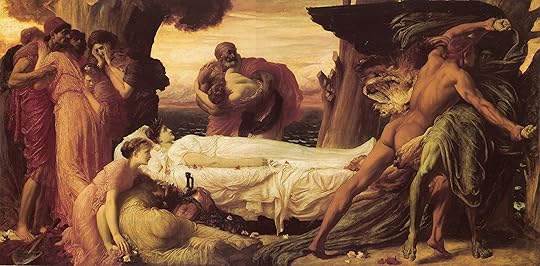
When Heracles realizes that Admetus, on the very day of Alcestis’ death, has placed the duties of hospitality above even his own grief, he decides to repay this extraordinary act. He goes to Alcestis’ tomb, confronts Thanatos, wrests the woman from him, and brings her back to the world of the living.
The son of Zeus returns to Admetus with a veiled woman. He pretends that she was given to him as a prize for a victory and asks his friend to keep her in his house until his return.
Admetus refuses. He has promised Alcestis that no other woman will take her place, and he fears that even the presence of a young woman in his house might betray his wife’s memory. Heracles insists. In the end, Admetus gives in and agrees to take the mysterious woman by the hand.
It is then that Heracles reveals the truth.
The veiled woman is Alcestis.
The tragedy ends happily, and this brief summary of mine is obviously no match for Euripides. The story may seem far removed from our own times. Yet I believe that, as in Aeschylus’ Oresteia, Alcestis conceals a profound message: the revolt of a new world against an old one dominated by fear, sacrifice, and superstition.
As in Aeschylus, Apollo sets the overturning of the old rules in motion: here, he does so by tricking the Fates and rescuing Admetus from the inexorability of his destiny. And, as in the Oresteia, it is a divine figure belonging to the new Olympian order who brings this reversal to completion. There it is Athena; here it is Heracles, son of Zeus, who confronts Thanatos and restores Alcestis to life.
But perhaps there is something even more interesting.
Alcestis is the only surviving play from the tetralogy staged by Euripides in 438 BC, which also included Cretans, Alcmaeon in Psophis, and Telephus. Of the entire cycle, therefore, we possess only the final play and fragments of the other three.
My idea—I hardly dare even call it a hypothesis, given the scarcity of our sources—is that the central theme of the tetralogy may have been xenia: the sacred law of hospitality placed under the protection of Zeus himself. The myths chosen by Euripides can be read as variations on the consequences of violating the obligations imposed upon the host, the guest, or both.
In my reading, Alcestis represents the synthesis of the entire tetralogy.
Here, in fact, xenia is not violated: it is observed to its most extreme consequences. Admetus has just lost his wife, and yet he welcomes Heracles into his home, because personal grief cannot erase the sacred duty owed to a guest. And when Heracles discovers what Admetus has done for him, he responds to that gift with an even greater gift.
Against the terrible exchange imposed by the old order—one life must be paid for with another—Euripides thus seems to set another form of reciprocity: one founded on hospitality, gratitude, and the gift.
Alcestis, placed by Euripides fourth in the tetralogy, in the position normally occupied by the satyr play, may therefore tell us something far more profound than its surprising happy ending suggests: how an order founded on reciprocity among human beings can succeed in overcoming an order founded on fear, suffering, and the inexorability of death.