

What do you think?

Eliogabalo o l'anarchico incoronato
Imperatore-dio a quattordici anni, ucciso e gettato nelle fogne a diciotto, sacerdote e depravato, amministratore consapevole della disgregazione e dell’anarchia in seno all’ordine politico più grandioso che il mondo classico abbia creato, tutto ciò che sappiamo della vita di Eliogabalo si presenta già di per sé sotto il segno della esasperazione di tutti i contrasti, come se soltanto Antonin Artaud potesse essere eletto a scrivere la sua biografia, fatta solo di eccessi. Eliogabalo apparve nel 1934.
205 pages, Paperback
First published April 1, 1934
About the author
Antonin Artaud
260 books830 followersFrench surrealist poet and playwright Antonin Artaud advocated a deliberately shocking and confrontational style of drama that he called "theater of cruelty."
People better knew Antoine Marie Joseph Artaud, an essayist, actor, and director.
Considered among the most influential figures in the evolution of modern theory, Antonin Artaud associated with artists and experimental groups in Paris during the 1920s.
Political differences then resulted in him breaking and founding the theatre Alfred Jarry with Roger Vitrac and Robert Aron. Together, they expected to create a forum for works to change radically. Artaud especially expressed disdain for west of the day, panned the ordered plot and scripted language that his contemporaries typically employed to convey ideas, and recorded his ideas in such works as Le Theatre de la cruaute and The Theatre and Its Double .
Artaud thought to represent reality and to affect the much possible audience and therefore used a mixture of strange and disturbing forms of lighting, sound, and other performance elements.
Artaud wanted that the "spectacle" that "engulfed and physically affected" this audience, put in the middle. He referred to this layout like a "vortex," a "trapped and powerless" constantly shifting shape.
People better knew Antoine Marie Joseph Artaud, an essayist, actor, and director.
Considered among the most influential figures in the evolution of modern theory, Antonin Artaud associated with artists and experimental groups in Paris during the 1920s.
Political differences then resulted in him breaking and founding the theatre Alfred Jarry with Roger Vitrac and Robert Aron. Together, they expected to create a forum for works to change radically. Artaud especially expressed disdain for west of the day, panned the ordered plot and scripted language that his contemporaries typically employed to convey ideas, and recorded his ideas in such works as Le Theatre de la cruaute and The Theatre and Its Double .
Artaud thought to represent reality and to affect the much possible audience and therefore used a mixture of strange and disturbing forms of lighting, sound, and other performance elements.
Artaud wanted that the "spectacle" that "engulfed and physically affected" this audience, put in the middle. He referred to this layout like a "vortex," a "trapped and powerless" constantly shifting shape.
Ratings & Reviews
Friends & Following
Create a free account to discover what your friends think of this book!
Community Reviews
Displaying 1 - 30 of 137 reviews

February 21, 2016
Heliogabalus is a tale about a madman told by another madman – a fantastic ejaculation of the poetical mind.
Antonin Artaud tells the story of Heliogabalus as though he writes an alchemical treatise and in the first section: The Cradle of Sperm he depicts the transformation of sperm into a human being as if he is describing a transmutation of lead into gold… For him all metamorphoses are possible – the matter turns into spirit, the form becomes content.
In the world and in the universe everything is interlocked: stars and fates, witchery and science, paganism and collective unconscious, divinity and Freudianism, astrology and Christianity, history and the present, life and death.
And Antonin Artaud boldly follows this trail, transmuting salaciousness into divine language.
Any imaginable thing can be compared with any other thing and one may draw parallels between any mythologems and any phenomena…
A thing named is a dead thing, and it’s dead because it is set apart.
Antonin Artaud tells the story of Heliogabalus as though he writes an alchemical treatise and in the first section: The Cradle of Sperm he depicts the transformation of sperm into a human being as if he is describing a transmutation of lead into gold… For him all metamorphoses are possible – the matter turns into spirit, the form becomes content.
Principles are only of value to the mind, and to the thinking mind; but outside the mind that thinks, a principle is reduced to nothing.
In the world and in the universe everything is interlocked: stars and fates, witchery and science, paganism and collective unconscious, divinity and Freudianism, astrology and Christianity, history and the present, life and death.
And Antonin Artaud boldly follows this trail, transmuting salaciousness into divine language.
Any imaginable thing can be compared with any other thing and one may draw parallels between any mythologems and any phenomena…
November 28, 2014
This bitch was punk as fuck

June 21, 2025
I once again encounter the fiery pen of Antonin Artaud. I must admit that it is not my favorite of his. It is an essay, now poorly sourced, on an almost forgotten emperor-priest: Heliogabalus. It is not a particularly striking story, but one that its author himself saves.

June 22, 2020
Artaud, who three years after the book’s publication was incarcerated in a lunatic asylum, emerging only shortly before his death in 1948, anatomises and recreates the sexual and blood-constellated life of the infamous Roman emperor who was assassinated by his own guards at the age of 18 after four years spent relentlessly deriding and disintegrating the empire’s power. Artaud asserts that the whole life of Heliogabalus was basically anarchy in action and presents the book in three parts - 'The Cradle of Sperm', 'The War of Principles' and 'Anarchy'. We go from myth and pagan iconography to the conceit of Roman decadence before finally getting to the ascent and subsequent assassination of the young emperor. While Artaud does provide historical background to Heliogabalus' story the book as a whole is not story-telling in the traditional sense. Explicitly he wrote his account of Heliogabalus’s acts as an embodiment of himself and of his own insurgency in art.

May 3, 2024
Eliogabalo è Antonin Artaud, l’anarchico.
E’ un libro di stile surrealista, quindi un po’ incasinato: frammentato, ripetitivo, con flussi di pensiero in libertà. L’introduzione non aiuta, molto ostica.
Il quadro che ne viene fuori è però magnifico.
E’ innanzitutto un libro avvicente, potendola considerare una fiction storica. Probabilmente meno fiction di quel che si può pensare perchè si capisce che AA ha faticato sulle fonti storiche, comunque poche e labili. Avvicenti sono gli eventi raccontati, le location ed i loro protagonisti.
Il periodo è quello dei primi 2 secoli dopo Cristo. Siamo in medio oriente, nell’attuale Siria, e nello specifico nella piccola cittadina-regno di Emesa (l’atuale Homs), che ha subito le influenze fenice e seleucidi, e poi diviene stato vassallo di Roma. A Emesa regnano i Bassianidi, gran sacederdoti di El-Gabal, il Dio sole, a cui è lì dedicato un grande tempio. Tra i Bassianidi abbiamo quelli che saranno imperatori di Roma, Caracalla e Eliogabalo, e le quattro Giulie - Giulia Mesa, Giulia Domna, Giulia Somnia, Giulia Mamea - madri, figlie e sorelle che formano, si direbbe, un matriarcato che arriverà a prendere il potere e governare sull’impero romano.
Al centro della narrazione c’è chiaramente Eliogabalo. Il ragazzino a 14 anni sconfigge, diretto e supportato dalle Giulie (Mesa, la nonna, e Somnia, la mamma) le truppe dell’imperatore Macrino che a sua volta aveva detronizzato (ucciso) Caracalla (figlio di Giulia Domna e dell’imperatore di Roma Settimio Severo), zio e forse padre (!) di Eliogabalo. Eliogabalo diviene cosè imperatore di Roma, su cui regnerà per appena 4 anni.
AA, grande autore-attore di teatro, ci lascia delle scene grandiose: le descrizioni del tempio di El Gabal di Emesa, il rave di legittimazione di Eliogabalo quale imperatore da parte dei legionari, il convoglio che, con un viaggio che durerà due anni, porta Eliogabalo fino al trono in Roma, con al seguito la fallica pietra nero-meteorica del Dio Sole su un carro trainato da tori, la tensione ed il dramma della morte di Eliogabalo e di Giulia Somnia.
La chiave di lettura è invece di tipo metafisico. Eliogabalo è il grande anarchico, l’anarchico incoronato appunto. Quello che porterà caos e sovvertimento a Roma, nelle istituzioni e nei costumi. Metterà in posti di potere le Giulie e altri suoi supposti amanti, un ballerino a capo dei pretoriani, sceglierà i ministri in base alle dimensioni del membro, diede libero sfogo ad impulsi sessuali, suoi e dei romani, in un tripudio di musiche esotiche, profumi, animali, pelli ferine, piume d’uccelli. Eliogabalo è anarchico su un piano superiore: rappresentante del Dio Sole, di un Dio quindi maschile, è bisessuale e si sente nel profondo anche androgino, tanto che pensò di evirarsi, realizza in sé il perfetto complemento tra Sole e Luna, tra i principi maschile e femminile, raggiungendo il tutto, l'assoluto universale.

Eliogabalo, musei Capitolini Roma
“Aver il senso dell'unità profonda delle cose, è aver il senso dell'anarchia, - e dello sforzo da compiere per ridurre le cose riconducendole alla unità. Chi ha il senso dell'unità ha il senso della molteplicità delle cose, di quella polvere d'aspetti attraverso cui occorre passare per ridurle e distruggerle.”
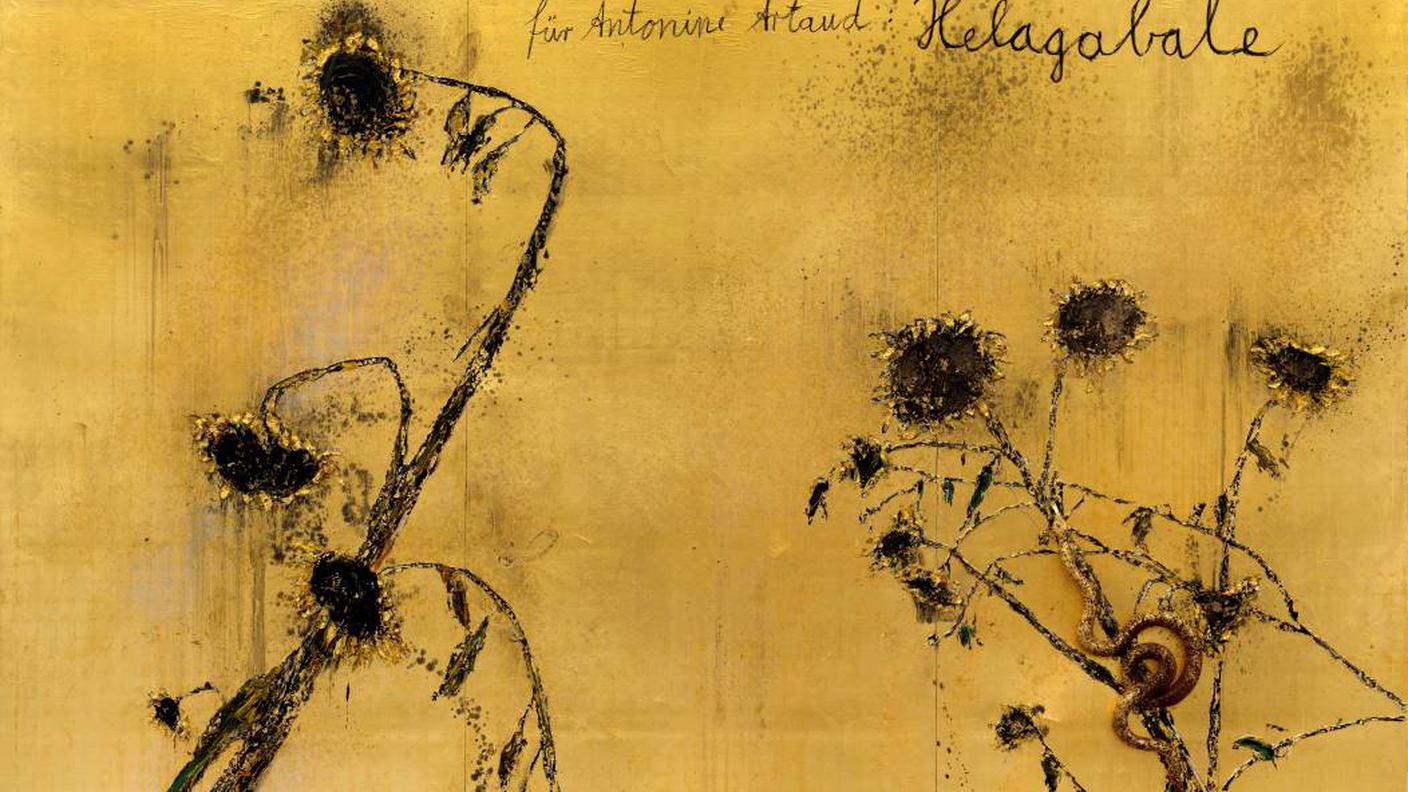
Anselm Kiefer, fur Antonin Artaud Heliogabal
Resta il fatto ch'Eliogabalo, il re pederasta e che si vuole donna, è un sacerdote del Maschile. Egli realizza in se stesso l'identità dei contrari, ma non la realizza senza fatica, e la sua pederastia religiosa non ha altra origine che una lotta ostinata e astratta tra il Maschile e il Femminile.

Anselm Kiefer, Antonin Artaud
Questo Dio, Elagabalus, o Sorto dalla Montagna, Vetta Raggiante, viene da molto lontano. E forse è chiamato il Desiderio nell'antica cosmogonia fenicia; - e questo desiderio, come Elagabalus stesso, non è semplice, poiché risulta dalla mescolanza lenta e moltiplicata dei princìpi che irradiavano al fondo del Soffio del Caos. Di tutti questi princìpi il Sole non è che la figura ridotta, un aspetto buono per adoratori stanchi e decaduti.
E’ un libro di stile surrealista, quindi un po’ incasinato: frammentato, ripetitivo, con flussi di pensiero in libertà. L’introduzione non aiuta, molto ostica.
Il quadro che ne viene fuori è però magnifico.
E’ innanzitutto un libro avvicente, potendola considerare una fiction storica. Probabilmente meno fiction di quel che si può pensare perchè si capisce che AA ha faticato sulle fonti storiche, comunque poche e labili. Avvicenti sono gli eventi raccontati, le location ed i loro protagonisti.
Il periodo è quello dei primi 2 secoli dopo Cristo. Siamo in medio oriente, nell’attuale Siria, e nello specifico nella piccola cittadina-regno di Emesa (l’atuale Homs), che ha subito le influenze fenice e seleucidi, e poi diviene stato vassallo di Roma. A Emesa regnano i Bassianidi, gran sacederdoti di El-Gabal, il Dio sole, a cui è lì dedicato un grande tempio. Tra i Bassianidi abbiamo quelli che saranno imperatori di Roma, Caracalla e Eliogabalo, e le quattro Giulie - Giulia Mesa, Giulia Domna, Giulia Somnia, Giulia Mamea - madri, figlie e sorelle che formano, si direbbe, un matriarcato che arriverà a prendere il potere e governare sull’impero romano.
Al centro della narrazione c’è chiaramente Eliogabalo. Il ragazzino a 14 anni sconfigge, diretto e supportato dalle Giulie (Mesa, la nonna, e Somnia, la mamma) le truppe dell’imperatore Macrino che a sua volta aveva detronizzato (ucciso) Caracalla (figlio di Giulia Domna e dell’imperatore di Roma Settimio Severo), zio e forse padre (!) di Eliogabalo. Eliogabalo diviene cosè imperatore di Roma, su cui regnerà per appena 4 anni.
AA, grande autore-attore di teatro, ci lascia delle scene grandiose: le descrizioni del tempio di El Gabal di Emesa, il rave di legittimazione di Eliogabalo quale imperatore da parte dei legionari, il convoglio che, con un viaggio che durerà due anni, porta Eliogabalo fino al trono in Roma, con al seguito la fallica pietra nero-meteorica del Dio Sole su un carro trainato da tori, la tensione ed il dramma della morte di Eliogabalo e di Giulia Somnia.
La chiave di lettura è invece di tipo metafisico. Eliogabalo è il grande anarchico, l’anarchico incoronato appunto. Quello che porterà caos e sovvertimento a Roma, nelle istituzioni e nei costumi. Metterà in posti di potere le Giulie e altri suoi supposti amanti, un ballerino a capo dei pretoriani, sceglierà i ministri in base alle dimensioni del membro, diede libero sfogo ad impulsi sessuali, suoi e dei romani, in un tripudio di musiche esotiche, profumi, animali, pelli ferine, piume d’uccelli. Eliogabalo è anarchico su un piano superiore: rappresentante del Dio Sole, di un Dio quindi maschile, è bisessuale e si sente nel profondo anche androgino, tanto che pensò di evirarsi, realizza in sé il perfetto complemento tra Sole e Luna, tra i principi maschile e femminile, raggiungendo il tutto, l'assoluto universale.
Eliogabalo, musei Capitolini Roma
“Aver il senso dell'unità profonda delle cose, è aver il senso dell'anarchia, - e dello sforzo da compiere per ridurre le cose riconducendole alla unità. Chi ha il senso dell'unità ha il senso della molteplicità delle cose, di quella polvere d'aspetti attraverso cui occorre passare per ridurle e distruggerle.”
Anselm Kiefer, fur Antonin Artaud Heliogabal
Resta il fatto ch'Eliogabalo, il re pederasta e che si vuole donna, è un sacerdote del Maschile. Egli realizza in se stesso l'identità dei contrari, ma non la realizza senza fatica, e la sua pederastia religiosa non ha altra origine che una lotta ostinata e astratta tra il Maschile e il Femminile.
Anselm Kiefer, Antonin Artaud
Questo Dio, Elagabalus, o Sorto dalla Montagna, Vetta Raggiante, viene da molto lontano. E forse è chiamato il Desiderio nell'antica cosmogonia fenicia; - e questo desiderio, come Elagabalus stesso, non è semplice, poiché risulta dalla mescolanza lenta e moltiplicata dei princìpi che irradiavano al fondo del Soffio del Caos. Di tutti questi princìpi il Sole non è che la figura ridotta, un aspetto buono per adoratori stanchi e decaduti.

October 17, 2023
I bought Burning From the Inside in my 11th summer, having no idea that “Antonin Artaud” meant anything beyond ‘fucking AMAZING Bauhaus song.’ I didn’t know the man, or if the name was really just a song character and title. Hey, I was 11 in Southern California in the 1980s. Don’t scoff! You found stuff by word of mouth, cover art, labels, buying 45s and albums that weren’t great, ones that still amaze, and became an addicted liner note sniffer. Be nice.
Anyway: a few years go by, I’m eating acid like it’s Pez. 1991. High school library. Bam: AMAZING Bauhaus jam guy is turned into book on the shelf in front of me. Ehhh? I was so young and so thoroughly American that I was perplexed—I’d yet to meet anyone that had known or shown me any medium of Artaud’s multidisciplinary work. ‘You’re a Bauhaus song!’ says I to no one, and take the book home. Once there, I proceed to understand zilch; recognize he’s obviously brilliant and mentally ill (having recognized, ahem, both traits in my lionization), and know that I am DEFINITELY adding this SongMan/Thing’s totem to my tactical cool girth. ‘Do you…know Artaud?’ I will then be able to ask the girls that smoke cloves and wear Monkey Boots, leaning in my trembling hand with a debonaire (extinguished) match. That collection was stapled and tagged onto my put-upon pseudo-n, louche, actually scared-of-everything Self and Identity alike (having not yet the understanding that those aren’t the same thing). Youth: fantastic bassist in Killing Joke; also wasted blahblahblurt…
Ah, fuck it—gist: it’s 32-years later and this, Artaud’s meditation, is legitimately brilliant WHEN he lets his own narrative push the subject onto the sidelines. Heliogabalus is actually LESS interesting than Artaud. That’s a pretty tall order, and it’s served hot. It’s the middle bit, what begins with a thread of thought taken from skein to a taut flat line. Artaud grapples with articulating his conception of the godhead, existence, pleasure, Pythagorean theory, mercy; otherwise—the whole thing. And the bastard, now that I’m old and in the way, makes sense with the clarity of better bells than most I’ve ever known. Turns out you just have to, sorta, waste your life for several decades to get his literary-art-historical-socio-cthonic references as a common shorthand, and to also, like Artaud, recognize that discontinuity is its own continuity in the Overarching Absurdity of Existence. Conversance in general ‘occult’ stuff helps, too. Know thy holy texts; Koran, Catholic Bible, Torah, Gita, et. al. are constants. Gibbon as well, and Rabelais’ repeated use of Heliogabalus gets an odd twisting of juice toward the Dark One’s Ale by reading this. No one needs to bleed for it when both Artaud—as so brilliantly evidenced here—as well as Peter F’n Murphy already did…for They loved us so.
Come on! Everyone loves BAUHAUS:
“The young man held a gun to the head of God
Stick this holy cow
Put the audience in action
Let the slaughtered take a bow
The old man's words, white hot knives
Slicing through warm butter
The butter is the heart
The rancid peeling soul
Scratch pictures on asylum walls
Broken nails and matchsticks
hypodermic hypodermic hypodermic
RED FIX
One man's poison another man's meat
One man's agony another man's treat
Artaud lived with his neck placed firmly in the noose
Eyes black with pain,
Limbs in cramps contorted
The theatre and its double
The void and the aborted
THOSE INDIANS WANK ON HIS BONES!”
Anyway: a few years go by, I’m eating acid like it’s Pez. 1991. High school library. Bam: AMAZING Bauhaus jam guy is turned into book on the shelf in front of me. Ehhh? I was so young and so thoroughly American that I was perplexed—I’d yet to meet anyone that had known or shown me any medium of Artaud’s multidisciplinary work. ‘You’re a Bauhaus song!’ says I to no one, and take the book home. Once there, I proceed to understand zilch; recognize he’s obviously brilliant and mentally ill (having recognized, ahem, both traits in my lionization), and know that I am DEFINITELY adding this SongMan/Thing’s totem to my tactical cool girth. ‘Do you…know Artaud?’ I will then be able to ask the girls that smoke cloves and wear Monkey Boots, leaning in my trembling hand with a debonaire (extinguished) match. That collection was stapled and tagged onto my put-upon pseudo-n, louche, actually scared-of-everything Self and Identity alike (having not yet the understanding that those aren’t the same thing). Youth: fantastic bassist in Killing Joke; also wasted blahblahblurt…
Ah, fuck it—gist: it’s 32-years later and this, Artaud’s meditation, is legitimately brilliant WHEN he lets his own narrative push the subject onto the sidelines. Heliogabalus is actually LESS interesting than Artaud. That’s a pretty tall order, and it’s served hot. It’s the middle bit, what begins with a thread of thought taken from skein to a taut flat line. Artaud grapples with articulating his conception of the godhead, existence, pleasure, Pythagorean theory, mercy; otherwise—the whole thing. And the bastard, now that I’m old and in the way, makes sense with the clarity of better bells than most I’ve ever known. Turns out you just have to, sorta, waste your life for several decades to get his literary-art-historical-socio-cthonic references as a common shorthand, and to also, like Artaud, recognize that discontinuity is its own continuity in the Overarching Absurdity of Existence. Conversance in general ‘occult’ stuff helps, too. Know thy holy texts; Koran, Catholic Bible, Torah, Gita, et. al. are constants. Gibbon as well, and Rabelais’ repeated use of Heliogabalus gets an odd twisting of juice toward the Dark One’s Ale by reading this. No one needs to bleed for it when both Artaud—as so brilliantly evidenced here—as well as Peter F’n Murphy already did…for They loved us so.
Come on! Everyone loves BAUHAUS:
“The young man held a gun to the head of God
Stick this holy cow
Put the audience in action
Let the slaughtered take a bow
The old man's words, white hot knives
Slicing through warm butter
The butter is the heart
The rancid peeling soul
Scratch pictures on asylum walls
Broken nails and matchsticks
hypodermic hypodermic hypodermic
RED FIX
One man's poison another man's meat
One man's agony another man's treat
Artaud lived with his neck placed firmly in the noose
Eyes black with pain,
Limbs in cramps contorted
The theatre and its double
The void and the aborted
THOSE INDIANS WANK ON HIS BONES!”

June 7, 2008
Now this is a curiosity - one part flummery, one part insanity and one part genius. It is an account of sorts of the decadent teenage androgynous Emperor Heliogabalus.
Not that the average reader (in which category I include myself) will have an earthly idea what this is all about (given the limits of a modern education) until you remember that it is best not read but DECLAIMED out loud in a theatrical manner and that it has to be seen as the last flowering (written in the 1930s) of a forty year cycle of French decadent writing (and part of a much longer cycle of French artistic sensuality).
Surrealism, orientalism, obscenity (though not quite as outrageous as the publisher might like us to think), an incipient fascist mentality - it's all in there. It helps to know something of the Anatolian cult of self-castration and of Cybele but you can look that up in Wikipedia.
There are insights in the text about extreme anarchy but the book is part of a political-cultural death cult which re-emerges periodically amongst artistic types as a response to the mundane and the modern in many cultures and at many times - it is the type of thing you might write if you were suffering from radical ennui and raging hormones. It is no accident that Artaud's circle included the High Priestess of French sexuality, Anais Nin.
The publisher refers to it as the 'most accessible' of Artaud's books - the mind boggles at what the others must be like ...
Not that the average reader (in which category I include myself) will have an earthly idea what this is all about (given the limits of a modern education) until you remember that it is best not read but DECLAIMED out loud in a theatrical manner and that it has to be seen as the last flowering (written in the 1930s) of a forty year cycle of French decadent writing (and part of a much longer cycle of French artistic sensuality).
Surrealism, orientalism, obscenity (though not quite as outrageous as the publisher might like us to think), an incipient fascist mentality - it's all in there. It helps to know something of the Anatolian cult of self-castration and of Cybele but you can look that up in Wikipedia.
There are insights in the text about extreme anarchy but the book is part of a political-cultural death cult which re-emerges periodically amongst artistic types as a response to the mundane and the modern in many cultures and at many times - it is the type of thing you might write if you were suffering from radical ennui and raging hormones. It is no accident that Artaud's circle included the High Priestess of French sexuality, Anais Nin.
The publisher refers to it as the 'most accessible' of Artaud's books - the mind boggles at what the others must be like ...

January 30, 2021
Bu bir tarihi araştırma-anlatım kitabı. MS 218 - 222 arası Roma İmparatoru olan, ünlü imparator Septimus Severius’un sülalesinden, annesi fahişe J. Soemia, babası net belli olmayan, Emesa (şimdiki Humus) krallığında yaşıyorken İmparator Caracalla’nın öldürülmesinin ardından düzenlenen bir isyan ve sonrasında Antiokhiea (Antakya) civarında rakiplerini savaşta yenerek başa geçen,204 Antiokhiea doğumlu Heliogabolos’un hikayesi.
A. Artaud deyişiyle tarihi utandırıp irkilten bu çılgın, ekzantrik (TDK) adamı incelemek için kitabın sonunda verdiği çok farklı kaynaklar kullanmış, bu durum ise zaten Roma İmparatorluk tarihinin karışık ve şüpheli dönemini daha da karışık hale getirmiş. Kullandığı önemli kaynaklardan birisi de Tyana’lı (Niğde) Apolloinus’un yazdıklarıdır. İsa’dan 200 yıl sonra o bölgelerde Paganizm yaygındır ve kendisini güneş tanrısı kabul eden bir yeniyetmenin adı buradan gelmektedir: Heliogabalos.
Roma yasa ve geleneklerine göre skandal uygulamaları olmuş, çok yakışıklı (erkek güzeli) ve transseksüel olması, dini törenlere tüm senatörleri zorla sokması, hatta sonraları senatörlerin yerine kadınları koyması, ensest ilişkilerde bulunmadı, niteliksiz veya alt tabakadan insanları önemli mevkilere getirmesi, kısa süren hükümranlığında şaşkınlık yaratsa da yüzyıllar sonra bu davranışları statükoya karşı bireysel karşı koyuşlar, bireysel özgürlük adına yapılan davranışlar, anarşist uygulamalar olarak Antonin Artaud gibi gerçeküstücü yazar ve sanatçılarca adeta kutsanmıştır.
Kitapta aslında Roma İmparatorluğu yönetimine ilişkin çok ilginç bilgiler var, başta Humus olmak üzere imparatorluğa bağlı bölgelerin anlatımı da ilgi çekici. Ne var ki yazarın savruk ve cinsellik saplantılı ve bazen rahatsız edici sert uslubu kötü bir çeviri ile birleşince okurken zorlayıcı bir metin ortaya çıkarmış. Herşeyi cinselliğe dayanarak açıklayan, fallus takıntılı bir anlatım.
Genelinde Bassisanus Sülalesinin tarihini anlatsa da tanrılar ve yaratılış hakkında çok ilgi çekici felsefi değerlendirmeler de kitabın bonusu olmuş. Bu tip gerçek ve kurgu içiçe tarih kitaplarını severim, çevirmen faktörüne rağmen öneririm.
A. Artaud deyişiyle tarihi utandırıp irkilten bu çılgın, ekzantrik (TDK) adamı incelemek için kitabın sonunda verdiği çok farklı kaynaklar kullanmış, bu durum ise zaten Roma İmparatorluk tarihinin karışık ve şüpheli dönemini daha da karışık hale getirmiş. Kullandığı önemli kaynaklardan birisi de Tyana’lı (Niğde) Apolloinus’un yazdıklarıdır. İsa’dan 200 yıl sonra o bölgelerde Paganizm yaygındır ve kendisini güneş tanrısı kabul eden bir yeniyetmenin adı buradan gelmektedir: Heliogabalos.
Roma yasa ve geleneklerine göre skandal uygulamaları olmuş, çok yakışıklı (erkek güzeli) ve transseksüel olması, dini törenlere tüm senatörleri zorla sokması, hatta sonraları senatörlerin yerine kadınları koyması, ensest ilişkilerde bulunmadı, niteliksiz veya alt tabakadan insanları önemli mevkilere getirmesi, kısa süren hükümranlığında şaşkınlık yaratsa da yüzyıllar sonra bu davranışları statükoya karşı bireysel karşı koyuşlar, bireysel özgürlük adına yapılan davranışlar, anarşist uygulamalar olarak Antonin Artaud gibi gerçeküstücü yazar ve sanatçılarca adeta kutsanmıştır.
Kitapta aslında Roma İmparatorluğu yönetimine ilişkin çok ilginç bilgiler var, başta Humus olmak üzere imparatorluğa bağlı bölgelerin anlatımı da ilgi çekici. Ne var ki yazarın savruk ve cinsellik saplantılı ve bazen rahatsız edici sert uslubu kötü bir çeviri ile birleşince okurken zorlayıcı bir metin ortaya çıkarmış. Herşeyi cinselliğe dayanarak açıklayan, fallus takıntılı bir anlatım.
Genelinde Bassisanus Sülalesinin tarihini anlatsa da tanrılar ve yaratılış hakkında çok ilgi çekici felsefi değerlendirmeler de kitabın bonusu olmuş. Bu tip gerçek ve kurgu içiçe tarih kitaplarını severim, çevirmen faktörüne rağmen öneririm.

September 8, 2022
qué lectura más chula me han entrado ganas de leer más cosas de artaud

January 23, 2021
this book is pretty cool if you'd like to read artaud spend quite a few pages rambling about the differing nature of divinity in pagan religions and the related symbolism, and then giving a mini biography of heliogabalus where he says that having orgies in the imperial palace was a deliberate subversion of the roman imperial institution. all in all heliogabalus sounds like a pretty fun guy and should probably be higher in your rankings of decadent roman emperors.

June 1, 2011
Voice Claudia also describes the history of a potential, and probable, active-trait male in her territory. He declared himself a living god-emperor, and through marriage to Bene Gesserat Livia produced several generations of active-trait males. One appears to have been the first known Abomination, a man who heard “voices” and claimed to be both male and female, but whose actions were so perverse that Voice Claudia refuses to describe them. (“Bene Gesserit History,” Dune Encyclopedia Tr, p. 121)*
I begin this short note on Antonin Artaud’s Heliogabalus with a quote from a fictional encyclopedia of a fictional future history because this novel puts me most in mind of the Bene Gesserit’s obsessive search for the kwisatz haderach, the person who would bridge the gap between Male and Female. Especially based on this quote:
All the same, Heliogabalus the pederast king who wanted to be a woman, was a priest of the Masculine. He achieved in himself the identity of opposites, but did not achieve it without harm, and his devout pederasty had no origin other than an obstinate and abstract conflict between Masculine and Feminine. (p. 72)
Having now read Artaud’s version of The Monk and this, I feel confident in writing that I am not a fan of French Surrealism. I fear that I am far too bourgeois to feel much except distate in the author’s worldview. That said, I understand why Artaud feels such rage and why he responds as he does. I don’t think it’s a compelling response but there are nuggets of interest (like the aforementioned conflict between Male and Female principles).**
* The reference here is to Caligula (AD 37-41), of course, and not to the hapless child elevated to the throne by his grandmother and mother in AD 212 but I think the characterization applies equally.
** I emphasize that this is entirely a personal opinion. If some – and from the reviews, there are – find meaning in Artaud, that’s fine, and I would recommend Heliogabalus to them.

October 29, 2011
While reading this book at a grocery store bench I overheard a 13 year old defend himself to his mom by saying "Pubic hair is not a swear."
My favorite quote from the book:
The written numeral is a symbol for what one cant manage to add up or measure.
The written letter is a symbol for what one can't think - the limit of thought, where thinking ends and has to rely on an object, like a lilypad in order to progress (this is how the linguistic-centric people think: language is a necessary lilypad for thinking, but actually no: it's simply the shorthand for those who can't think in other ways.
My favorite quote from the book:
The written numeral is a symbol for what one cant manage to add up or measure.
The written letter is a symbol for what one can't think - the limit of thought, where thinking ends and has to rely on an object, like a lilypad in order to progress (this is how the linguistic-centric people think: language is a necessary lilypad for thinking, but actually no: it's simply the shorthand for those who can't think in other ways.

March 7, 2020
From what I understand of them I appreciate Artaud's messages here, but I didn't find his delivery to generate particularly compelling reading.

March 10, 2009
This is one of I believe two novels that Artaud wrote. It's about the Roman emperor Heliogabalus, whose reign was noted for degeneracy and excess to the point where his generals eventually murdered him for it. Artaud makes the argument that his corruption and excess were so extensive and pure that in themselves they constituted a work of art transposed into the real world.

March 29, 2023
Bundan daha tuhaf bir kitap okuyacağımı uzun bir süre zannetmiyorum.
Roma'nın bütün düzenini aşırılığa kaçarak yıkan transseksüel imparatoru Heliogabalos'un hikayesi. Roma tanrısı Jupiter'in tapınağını yıkıp yerine Pagan bir tanrının tapınağını yaptırması, 5 kez evlenip boşanması ve bunların arasında inançlara göre bakire kalması gereken bir rahibenin de olması. Din adamlarıyla dalga geçip, saray bakanlıklarına en nitelikli olanların değil, cinsel uzvu en büyük olanların seçilmesi, erkeklerin hadım ettirilip, kutlamalarda her yere çuval çuval erkek cinsel organı saçılması ve başından sonuna kadar Roma sarayını eli açıklıkla, bol altın harcama ve abartılarla tiyatro sahnesine çevirmesi.
Hikayeden, çılgınlıklardan aşırı keyif aldım. Heliogabalos ve Antonin Artaud bir deli ve ben bu deliliğin hastası oldum.
«Heliogabalos da bir kez tahta çıkınca hiçbir yasa tanımaz; efendi odur çünkü. Dolayısıyla, onun kişisel yasası herkesin yasası olacaktır. Tiranlığını insanlara dayatır. Aslında her tiran, tacı ele geçirmiş olup dünyayı kendisiyle uygun adım gitmeye zorlayan birer anarşisttir.»
Roma'nın bütün düzenini aşırılığa kaçarak yıkan transseksüel imparatoru Heliogabalos'un hikayesi. Roma tanrısı Jupiter'in tapınağını yıkıp yerine Pagan bir tanrının tapınağını yaptırması, 5 kez evlenip boşanması ve bunların arasında inançlara göre bakire kalması gereken bir rahibenin de olması. Din adamlarıyla dalga geçip, saray bakanlıklarına en nitelikli olanların değil, cinsel uzvu en büyük olanların seçilmesi, erkeklerin hadım ettirilip, kutlamalarda her yere çuval çuval erkek cinsel organı saçılması ve başından sonuna kadar Roma sarayını eli açıklıkla, bol altın harcama ve abartılarla tiyatro sahnesine çevirmesi.
Hikayeden, çılgınlıklardan aşırı keyif aldım. Heliogabalos ve Antonin Artaud bir deli ve ben bu deliliğin hastası oldum.
«Heliogabalos da bir kez tahta çıkınca hiçbir yasa tanımaz; efendi odur çünkü. Dolayısıyla, onun kişisel yasası herkesin yasası olacaktır. Tiranlığını insanlara dayatır. Aslında her tiran, tacı ele geçirmiş olup dünyayı kendisiyle uygun adım gitmeye zorlayan birer anarşisttir.»
This entire review has been hidden because of spoilers.

November 27, 2022
Molt divertit👍🏼

April 9, 2010
This book alternates between turgid/dense and fast/insane. I read it because I recently read Deleuze's
The Logic of Sense
and in that book Deleuze consistently talks about Lewis Carroll, the Stoics, and Artaud. I haven't read Artaud since I read
The Theater and Its Double
which I honestly don't remember very well, even though I remember I loved it. Anyway, I see why Deleuze loves this book; a lot of Deleuze's thought, and a lot of writing style, is encapsulated by Artaud.
The first part of this book sets up Artaud's thoughts on Heliogabalus, the utterly debauched teen Roman Emperor. The second book dives deep into Artuad's world-view, and the book at this point slows down to frozen latex. It's here that Artaud prefigures Deleuze with his talk of levels, the reality of principles, Love, the Will, religion, numerology, etc. But the last section of the book sings. It's here that we get a sense of why Artaud thinks the debauched emperor Heliogabalus was an anarchist. Artaud explains how the boy was both an anarchist and creating poetry and theater. He was an anarchist because he was out to destroy the stratification of Roman society and the plurality of Roman religion. According to Artuad, he attempted to do that through destruction of what is sacred, and one of his prime weapons was sex.
It's not a perfect book, and some of it is both boring and deeply slow going, but the end is worth it. The end is a brilliant take on art, anarchism, destruction, and creation.
The first part of this book sets up Artaud's thoughts on Heliogabalus, the utterly debauched teen Roman Emperor. The second book dives deep into Artuad's world-view, and the book at this point slows down to frozen latex. It's here that Artaud prefigures Deleuze with his talk of levels, the reality of principles, Love, the Will, religion, numerology, etc. But the last section of the book sings. It's here that we get a sense of why Artaud thinks the debauched emperor Heliogabalus was an anarchist. Artaud explains how the boy was both an anarchist and creating poetry and theater. He was an anarchist because he was out to destroy the stratification of Roman society and the plurality of Roman religion. According to Artuad, he attempted to do that through destruction of what is sacred, and one of his prime weapons was sex.
It's not a perfect book, and some of it is both boring and deeply slow going, but the end is worth it. The end is a brilliant take on art, anarchism, destruction, and creation.

May 7, 2020
“Onu görmüş olan askerler hemen oraya üşüşür; kendi Prsetorium erleri bir anda onu saçlarından yakalayıverirler. Burada tam bir kasap tezgâhı olayı, antik dünyaya özgü iğrenç bir mezbaha sahnesi yaşanır
Fışkıran kana karışan dışkılar Heliogabalos'la annesinin etlerine dalıp çıkmakta olan kılıçların üzerine sıçrar.
Sonra cesetler çukurdan çıkarılır, meşalelerin ışığında kente taşınır ve dehşete düşen halk yığınlarının ve pencerelerini açıp alkışlayan soyluların evlerinin önünde, bütün kentte gezdirilir. Kanı tükenmiş ama dışkıya bulanmış bu acıklı et yığınlarının ardı sıra büyük bir kalabalık Tiber kıyısındaki rıhtımlara iner.
Heliogabalos'un eliaçıklığından bol bol yararlanmış, fakat bunları fazlasıyla sindirmiş olan ayaktakımı şimdi ‘Lağıma!’ diye bağırmaktadır. ‘Lağıma atalım!’
Kana ve en gizli organlarına varıncaya dek her yerlerini açıkça gösteren bu iki paramparça ve çıplak cesedin seyrine iyice doymuş olan askerler, Heliogabalos'un cesedini önlerine çıkan ilk lağım deliğinden içeri atmak isterler. Fakat ne kadar ince yapılı olsa da yine deliğe büyük gelir. Başka çare bulmak gerekir.
Daha önce Elagabalus Bassianus Avitus'un, namıdiğer Heliogabalos'un adına Varius (‘Çeşitli’) lakabı takılmıştı, çünkü çeşitli tohumlardan olma ve bir fahişeden doğma idi.”(s.128)
Fışkıran kana karışan dışkılar Heliogabalos'la annesinin etlerine dalıp çıkmakta olan kılıçların üzerine sıçrar.
Sonra cesetler çukurdan çıkarılır, meşalelerin ışığında kente taşınır ve dehşete düşen halk yığınlarının ve pencerelerini açıp alkışlayan soyluların evlerinin önünde, bütün kentte gezdirilir. Kanı tükenmiş ama dışkıya bulanmış bu acıklı et yığınlarının ardı sıra büyük bir kalabalık Tiber kıyısındaki rıhtımlara iner.
Heliogabalos'un eliaçıklığından bol bol yararlanmış, fakat bunları fazlasıyla sindirmiş olan ayaktakımı şimdi ‘Lağıma!’ diye bağırmaktadır. ‘Lağıma atalım!’
Kana ve en gizli organlarına varıncaya dek her yerlerini açıkça gösteren bu iki paramparça ve çıplak cesedin seyrine iyice doymuş olan askerler, Heliogabalos'un cesedini önlerine çıkan ilk lağım deliğinden içeri atmak isterler. Fakat ne kadar ince yapılı olsa da yine deliğe büyük gelir. Başka çare bulmak gerekir.
Daha önce Elagabalus Bassianus Avitus'un, namıdiğer Heliogabalos'un adına Varius (‘Çeşitli’) lakabı takılmıştı, çünkü çeşitli tohumlardan olma ve bir fahişeden doğma idi.”(s.128)

November 16, 2010
Per la precisione si tratta della biografia più estrema vomitata su carta. Dalla torbida concezione del futuro imperatore romano alla sua entrata sodomitica nell'urbe, fino ad arrivare alla miserabile morte nella cloaca massima: dallo sperma agli escrementi, tutto è liquidamente imbrattante ed eccessivo, nella prosa di un genio. Un capolavoro. Non scherzo.

November 6, 2012
La disorganizzazione dell’ordine, le urgenze del caos e la demoralizzazione sistematica del potere: Artaud e l’allegra fuga verso il nulla di Eliogabalo, l’imperatore vissuto e morto “in stato di aperta ribellione”.

January 10, 2023
Un ibrido tra biografia, romanzo ed esegesi della teologia antica; così come Eliogabalo è un ibrido di principi, tra Uomo e Donna, Divinità e Umanità, Imperatore e Sacerdote, Ordine e Anarchia, un'entità che bramò con tutto sé stesso lo sperma e per questo venne trucidato nella merda. Un testo inaccessibile (molto oscura soprattutto la parte dell'esoterismo e delle iniziazioni siriache) la cui incomprensione assomiglia alla sensazione di un coito interrotto coattamente; un testo che ti affoga l'animo in tutte le secrezioni umane, da quella più farinosa a quella più densa; un testo in cui gli istinti più primitivi vengono elevati a quelli più sublimi (Eliogabalo appena 14enne che mette in atto la tragedia di Paride per potersi far fottere vestito e truccato da Venere) e che ti rende compagno di corruzione nel momento in cui visualizzi queste immagini.
Purtroppo mi mancano le conoscenze e gli strumenti per comprendere appieno le analisi di Artaud, credo che in futuro lo riprenderó. Ciononostante, pensavo fosse più scabroso, probabilmente le dissertazioni diluiscono il tutto.
Lunga vita ad Artaud, Eliogabalo e al Dio Fallo.
Purtroppo mi mancano le conoscenze e gli strumenti per comprendere appieno le analisi di Artaud, credo che in futuro lo riprenderó. Ciononostante, pensavo fosse più scabroso, probabilmente le dissertazioni diluiscono il tutto.
Lunga vita ad Artaud, Eliogabalo e al Dio Fallo.

March 13, 2025
Literary madness, a flux of demented torrential prose, prodigious and obscure.
Artaud wants us to believe Heliogabalus was the embodiment of poetic anarchy, the implosion of multitudes into the single principle, the perfect product of a taurobolium ritual for Cybele, the Sun and the Baetyl, Man and Woman combined, but in reality he was just a pesky brat.
Artaud wants us to believe Heliogabalus was the embodiment of poetic anarchy, the implosion of multitudes into the single principle, the perfect product of a taurobolium ritual for Cybele, the Sun and the Baetyl, Man and Woman combined, but in reality he was just a pesky brat.

February 24, 2025
"O anarquista diz:
Nem Deus nem senhor, apenas eu.
Uma vez no trono não aceita nenhuma lei; é o senhor. A sua própria lei pessoal será portanto a lei de todos. Impõe a sua tirania. No fundo, todo o tirano só é um anaarquista que se apoderou da coroa e põe o mundo a andar pelo seu passo."
"Heliogábalo teve desde cedo o sentido da unidade que está na base de todos os mitos e todos os nomes [...] E é a este monoteísmo, a esta unidade de tudo que incomoda o capricho e a multiplicidae das coisas, que eu chamo anarquia.
Ter o sentido da unidade profunda das coisas é ter o sentido da anarquia."

February 23, 2024
Não conheço o suficiente sobre história romana para me pronunciar com certezas, e do que a internet não precisa é de mais um opinador que conhece mal aquilo sobre o que opina. Mas fico com a sensação que este infame imperador romano, apontado como um marco de decadência, vício e lascividade excessiva, ficou imortalizado na história pela visão dos seus inimigos. Quando aqueles que escrevem as crónicas e as histórias são os que beneficiam com a queda do imperador cujos feitos e comportamentos registam, não é difícil perceber que a história contada pelos vencedores talvez não seja a história total.
Não que preocupações com rigor histórico sejam fundamentais para este texto. É típico Artaud, um dos grandes escritores malditos do século XX, e a sua visão de Heliogabalo compraz-se na decadência, isso nota-se logo nos primeiros parágrafos encharcados de sémen, que traçam a origem da dinastia que o decadente rapaz imperador cessou. Este não é uma crónica rigorosa, mas sim um ensaio entre o místico e o surreal, com muitas incursões aos lados negros da ambição humana, das vontades desmedidas e dos choques misticistas das religiões solares.
O texto compraz-se num certo chafurdar na lenda e na decadência, como seria de esperar de um escritor maldito. É essa a função surreal, de agitar, inqueitar e chocar.
Fazer esta leitura, que encontrei nos acasos dos alfarrabistas, em pleno século XXI deixou-me a pensar noutras ideias. Não consigo afastar a sensação da impossibilidade de edição de um livro destes, hoje. Suspeito que se um escritor com tendências surrealistas apresentasse um texto desta jaez a uma editora, seria rejeitado por ser demasiado polémico, chocante, ou por não se adequar ao que os conselheiros culturais dos editores apontam como o correto. E, caso encontrasse edição, seria crucificado pela linguagem que usa, tão arredada quer do comercialismo acessível e do conveci0nalismo progressista que se tornou a norma aparente.
Isto soa muito a boomer rant, embora não o pretenda ser. Apenas me questiono se os grandes escritores transgressivos do século XX, se os Artauds, Henry Millers, William Burroughs ou outros cuja prosa não tem contemplações teriam, hoje, o espaço que tiveram (e note-se que sempre foram considerados malditos, a evitar, escorraçados da sociedade digna e conservadora). Seria simplista entrar no discurso boomer/woke de censuras culturais, há outros factores em jogo. A excessiva comercialização da cultura implica que as obras sejam desenhadas para agradar aos compradores, e o que choca profundamente, não vende (embora o que choque noutros sentidos seja um chamariz). A extremação das ideias, trazida em parte pela cultura digital, entre a vociferidade dos trolls e dos aspirtantes a influenciadores que buscam o absoluto, mesmo que falso, para atrair o máximo de atenção também diminui a tolerância social para visões incómodas.
Quando as culturas de transgressividade sáo cooptadas como mercado comercial, ou extremadas em guerras culturais intelectualmente pobres e degradadoras da abrangência de ideias, que espaço resta para quem se sente inquieto e procura visões além das normalidades, convenções, conservadorismos e pressões grupais?
Não que preocupações com rigor histórico sejam fundamentais para este texto. É típico Artaud, um dos grandes escritores malditos do século XX, e a sua visão de Heliogabalo compraz-se na decadência, isso nota-se logo nos primeiros parágrafos encharcados de sémen, que traçam a origem da dinastia que o decadente rapaz imperador cessou. Este não é uma crónica rigorosa, mas sim um ensaio entre o místico e o surreal, com muitas incursões aos lados negros da ambição humana, das vontades desmedidas e dos choques misticistas das religiões solares.
O texto compraz-se num certo chafurdar na lenda e na decadência, como seria de esperar de um escritor maldito. É essa a função surreal, de agitar, inqueitar e chocar.
Fazer esta leitura, que encontrei nos acasos dos alfarrabistas, em pleno século XXI deixou-me a pensar noutras ideias. Não consigo afastar a sensação da impossibilidade de edição de um livro destes, hoje. Suspeito que se um escritor com tendências surrealistas apresentasse um texto desta jaez a uma editora, seria rejeitado por ser demasiado polémico, chocante, ou por não se adequar ao que os conselheiros culturais dos editores apontam como o correto. E, caso encontrasse edição, seria crucificado pela linguagem que usa, tão arredada quer do comercialismo acessível e do conveci0nalismo progressista que se tornou a norma aparente.
Isto soa muito a boomer rant, embora não o pretenda ser. Apenas me questiono se os grandes escritores transgressivos do século XX, se os Artauds, Henry Millers, William Burroughs ou outros cuja prosa não tem contemplações teriam, hoje, o espaço que tiveram (e note-se que sempre foram considerados malditos, a evitar, escorraçados da sociedade digna e conservadora). Seria simplista entrar no discurso boomer/woke de censuras culturais, há outros factores em jogo. A excessiva comercialização da cultura implica que as obras sejam desenhadas para agradar aos compradores, e o que choca profundamente, não vende (embora o que choque noutros sentidos seja um chamariz). A extremação das ideias, trazida em parte pela cultura digital, entre a vociferidade dos trolls e dos aspirtantes a influenciadores que buscam o absoluto, mesmo que falso, para atrair o máximo de atenção também diminui a tolerância social para visões incómodas.
Quando as culturas de transgressividade sáo cooptadas como mercado comercial, ou extremadas em guerras culturais intelectualmente pobres e degradadoras da abrangência de ideias, que espaço resta para quem se sente inquieto e procura visões além das normalidades, convenções, conservadorismos e pressões grupais?

Read
February 17, 2019Pensieri e Recensione: https://vitedalettore.wordpress.com/2...
La vita di Antonin Artaud è così traboccante di esperienze che sembrano esserci innumerevoli approcci su ciò che si può esprimere sul suo ruolo di scrittore nonché attore e regista di un’arte immanente che si rivolge al mondo come un’entità intera, liberata da qualsiasi esteriorità, divinità o altra figura trascendentale, il cui tutto è incluso nei processi di interazione all’interno della materia stessa. Attenendosi a tale visione d’insieme, la nozione di moralità appare obsoleta; tuttavia, ciò che è estremamente interessante è osservarne l’applicazione nel libro dimostratosi il più illustrativo in tal merito: Héliogabale ou l’anarchiste couronné pubblicato nel 1934, fonde i mezzi tradizionali di documentazione alla narrativa per raccontare la storia di Eliogabalo, imperatore romano che salito potere quattordicenne, venne assassinato quattro anni dopo.
Per scrivere questo romanzo storico, Artaud, si avvalse d’opere di erudizione varie e della volontà di mettere in luce in maniera preponderante una rievocazione storica dal forte impatto religioso idolatrico, giungendo a mostrare che al di sopra di tutti i princìpi spirituali vi fossero quello Maschile e quello Femminile, dai quali dipende l’interezza della vita cosmica. Per l’autore, considerare solo la contrapposizione fra le parti, insistendo nel separarle nettamente, non può che ricondurle ad un antagonismo loro intrinseco per poi controbilanciarsi, provocandone una fusione. Egli riconosce nella figura di questo imperatore la realizzazione in se stesso dell’identità dei contrari, attraverso un diverbio ostinato ed indeterminato fra le essenze Maschili e il Femminili.
In rivolta, critico contro l’istituzionalismo imperiale romano, abitato perennemente da una profonda inquietudine, dalla ricerca dell’assoluto della decadenza e della catastrofe, Sesto Vario Avito Bassiano, nasce a Roma nel 204 d.C. dalla nobile Giulia Soemia della famiglia del sacerdote Bassiano, durante l’imperato di Caracalla. Il giovane cresce in Siria attorniato da donne, impegnate ad educarlo al gusto della lussuria ed alla devozione della divinità solare. A cinque anni, assume il ruolo di alto sacerdote del Sole El-Gabal di Emesa (oggi Homs, Siria), culto praticato nel regno d’Emath e basato sulla deificazione del principio virile, mutando così il proprio nome in Eliogabalo. Il suo acume e bellezza aggraziata si dimostrano ben presto singolari, di pari passo con lo sviluppo precoce di un ideale che lo porta ad identificarsi col dio a cui è dedito, con l’impegno di ricondurre per mezzo del conflitto, la molteplicità umana al sentimento d’unità fisica e trascendentale.
Nel 217, l’efebo Eliogabalo, succede col nome di Marco Aurelio Severo Alessandro Augusto all’imperatore Macrino grazie al piano escogitato da Giulia Mesa, madre di Giulia Soemia, per far tornare sul trono i Bassianidi. A parer degli storici, la battaglia contro la coorte del predecessore è l’unica occasione della vita in cui Eliogabalo dia prova di vigore militare, ma Artaud sottolinea come egli utilizzi la sua forza perché sedotto dall’intensità dei contrari che percepisce propri: da un lato il dio solare, dall’altro l’uomo che orienta il potere esercitato, verso e contro se stesso.
Sebbene incoronato, Eliogabalo trascorre i primi mesi invernali del suo governato a Nicomedia (oggi Izmit, Turchia), dove, come affermato dallo storico Lampridio, si dedica al vizio e alla lussuria. Acclamato, entra in Roma solo nel marzo del 218; preceduto da trecento fanciulle ed altrettanti tori trascinanti in una gabbia monumentale il Fallo Sacro del tempio solare di Emesa.
Da imperatore si comporta in modo irriverente tant’è che nella prima riunione cólle figure più rappresentative dello stato, chiede loro minuziose delucidazioni sulle personali abitudini sessuali. Eliogabalo continua la sua impresa di “conversione” dei valori pubblici, trasforma l’oscenità in abitudine atta a dimostrare il suo spregio per l’ordine precostituito ma d’altra parte piange le miserie del suo popolo, che non viene mai sfiorato dalla sua tirannia sanguinaria; sono bensì gli aristocratici che rimproveratigli gli eccessi, ne vengono colpiti. Caccia dal Senato gli uomini ed invita donne a prendere il loro posto perché generatrici di vita e sapienza. Sfida le convenzioni sposandosi numerose volte, di cui una con la vergine vestale guardiana del fuoco sacro pur rimanendo appassionatamente fedele sino allo morte all’auriga Ierocle, con cui decide di congiungersi secondo il rito romano. L’imperatore, incessantemente assetato di emozioni, diviene artefice e vittima di una febbre dello spirito, che lo conducono verso le file della zia Giulia Mamea, la quale cospira preparando il futuro al proprio figlio Alessandro Severo perché diventi il prossimo regnante.
Ogni gesto compiuto dall’adolescente regnante viene confrontato dall’autore con le vicissitudini formative passate. È il caso della descrizione della vita nella città di Emesa, e della decisione del soffermarsi sul tempio sotterraneo e sullo spazio vuoto che ne delimita le porte oltre il muro più esterno. Il brulicare di uomini, animali, oggetti, provenienti da vari angoli della città commerciale converge verso il luogo descritto, creando attorno alle sue stanze di rifornimento un’immensa tela di ragno sulla quale corre un parossismo, un disperdersi di lamentele e di rumori instabile. L’uomo, nato dalle fatiche della terra, emerge dalle profondità del tempio rovistando tra le vie in modo da rifornire il dio Apollo compiaciuto dei suoi altari cruenti, impastati di cenere, sangue e umori nel giorno profetico degli Helia Pythia o Giochi Pitici.
Che sia l’umano od il divino ciò che viene offerto alla lettura non può essere compreso in modo esclusivamente sovrasensibile, perché manifestazione concreta di un’energia il cui aspetto più emblematico è la gravità della forza solare posatasi sulla materialità del corpo nonché sulla materia prodotta dal corpo, espulsa da esso per nutrire il mondo. Il sangue umano sacrificale si ricongiunge a quello di certi animali, attraverso fogne cocenti che scendono nelle profondità terrestre, trovando la via per ricondursi al respiro purificante del dio infernale nell’Erebo. I corpi stessi diventano sacri dopo che la vita smette di animarli e l’autore insiste molto sull’aspetto ritualistico della morte di Eliogabalo, avvenuta l’11 marzo del 222 d.C.: pugnalato dopo essersi disperatamente immerso tra le deiezioni della cloaca romana, il suo cadavere viene poi gettato nel fiume Tevere dal ponte Emilio, tra il Foro Boario e l’isola Tiberina.
L’inversione di ciò che è normalmente inteso come sacro e ciò che descrive Artaud, tocca qui il suo culmine, coniugando il ruolo del deus romano all’agire fisico dell’arcaico numen nella figura dell’anarchico imperatore condannato alla damnatio memoriae, in un’epoca di passaggio ad una religiosità filosofica e teologica intrisa di devozione tipica della cultura orientale.
La vita di Antonin Artaud è così traboccante di esperienze che sembrano esserci innumerevoli approcci su ciò che si può esprimere sul suo ruolo di scrittore nonché attore e regista di un’arte immanente che si rivolge al mondo come un’entità intera, liberata da qualsiasi esteriorità, divinità o altra figura trascendentale, il cui tutto è incluso nei processi di interazione all’interno della materia stessa. Attenendosi a tale visione d’insieme, la nozione di moralità appare obsoleta; tuttavia, ciò che è estremamente interessante è osservarne l’applicazione nel libro dimostratosi il più illustrativo in tal merito: Héliogabale ou l’anarchiste couronné pubblicato nel 1934, fonde i mezzi tradizionali di documentazione alla narrativa per raccontare la storia di Eliogabalo, imperatore romano che salito potere quattordicenne, venne assassinato quattro anni dopo.
Per scrivere questo romanzo storico, Artaud, si avvalse d’opere di erudizione varie e della volontà di mettere in luce in maniera preponderante una rievocazione storica dal forte impatto religioso idolatrico, giungendo a mostrare che al di sopra di tutti i princìpi spirituali vi fossero quello Maschile e quello Femminile, dai quali dipende l’interezza della vita cosmica. Per l’autore, considerare solo la contrapposizione fra le parti, insistendo nel separarle nettamente, non può che ricondurle ad un antagonismo loro intrinseco per poi controbilanciarsi, provocandone una fusione. Egli riconosce nella figura di questo imperatore la realizzazione in se stesso dell’identità dei contrari, attraverso un diverbio ostinato ed indeterminato fra le essenze Maschili e il Femminili.
In rivolta, critico contro l’istituzionalismo imperiale romano, abitato perennemente da una profonda inquietudine, dalla ricerca dell’assoluto della decadenza e della catastrofe, Sesto Vario Avito Bassiano, nasce a Roma nel 204 d.C. dalla nobile Giulia Soemia della famiglia del sacerdote Bassiano, durante l’imperato di Caracalla. Il giovane cresce in Siria attorniato da donne, impegnate ad educarlo al gusto della lussuria ed alla devozione della divinità solare. A cinque anni, assume il ruolo di alto sacerdote del Sole El-Gabal di Emesa (oggi Homs, Siria), culto praticato nel regno d’Emath e basato sulla deificazione del principio virile, mutando così il proprio nome in Eliogabalo. Il suo acume e bellezza aggraziata si dimostrano ben presto singolari, di pari passo con lo sviluppo precoce di un ideale che lo porta ad identificarsi col dio a cui è dedito, con l’impegno di ricondurre per mezzo del conflitto, la molteplicità umana al sentimento d’unità fisica e trascendentale.
Nel 217, l’efebo Eliogabalo, succede col nome di Marco Aurelio Severo Alessandro Augusto all’imperatore Macrino grazie al piano escogitato da Giulia Mesa, madre di Giulia Soemia, per far tornare sul trono i Bassianidi. A parer degli storici, la battaglia contro la coorte del predecessore è l’unica occasione della vita in cui Eliogabalo dia prova di vigore militare, ma Artaud sottolinea come egli utilizzi la sua forza perché sedotto dall’intensità dei contrari che percepisce propri: da un lato il dio solare, dall’altro l’uomo che orienta il potere esercitato, verso e contro se stesso.
Sebbene incoronato, Eliogabalo trascorre i primi mesi invernali del suo governato a Nicomedia (oggi Izmit, Turchia), dove, come affermato dallo storico Lampridio, si dedica al vizio e alla lussuria. Acclamato, entra in Roma solo nel marzo del 218; preceduto da trecento fanciulle ed altrettanti tori trascinanti in una gabbia monumentale il Fallo Sacro del tempio solare di Emesa.
Da imperatore si comporta in modo irriverente tant’è che nella prima riunione cólle figure più rappresentative dello stato, chiede loro minuziose delucidazioni sulle personali abitudini sessuali. Eliogabalo continua la sua impresa di “conversione” dei valori pubblici, trasforma l’oscenità in abitudine atta a dimostrare il suo spregio per l’ordine precostituito ma d’altra parte piange le miserie del suo popolo, che non viene mai sfiorato dalla sua tirannia sanguinaria; sono bensì gli aristocratici che rimproveratigli gli eccessi, ne vengono colpiti. Caccia dal Senato gli uomini ed invita donne a prendere il loro posto perché generatrici di vita e sapienza. Sfida le convenzioni sposandosi numerose volte, di cui una con la vergine vestale guardiana del fuoco sacro pur rimanendo appassionatamente fedele sino allo morte all’auriga Ierocle, con cui decide di congiungersi secondo il rito romano. L’imperatore, incessantemente assetato di emozioni, diviene artefice e vittima di una febbre dello spirito, che lo conducono verso le file della zia Giulia Mamea, la quale cospira preparando il futuro al proprio figlio Alessandro Severo perché diventi il prossimo regnante.
Ogni gesto compiuto dall’adolescente regnante viene confrontato dall’autore con le vicissitudini formative passate. È il caso della descrizione della vita nella città di Emesa, e della decisione del soffermarsi sul tempio sotterraneo e sullo spazio vuoto che ne delimita le porte oltre il muro più esterno. Il brulicare di uomini, animali, oggetti, provenienti da vari angoli della città commerciale converge verso il luogo descritto, creando attorno alle sue stanze di rifornimento un’immensa tela di ragno sulla quale corre un parossismo, un disperdersi di lamentele e di rumori instabile. L’uomo, nato dalle fatiche della terra, emerge dalle profondità del tempio rovistando tra le vie in modo da rifornire il dio Apollo compiaciuto dei suoi altari cruenti, impastati di cenere, sangue e umori nel giorno profetico degli Helia Pythia o Giochi Pitici.
Che sia l’umano od il divino ciò che viene offerto alla lettura non può essere compreso in modo esclusivamente sovrasensibile, perché manifestazione concreta di un’energia il cui aspetto più emblematico è la gravità della forza solare posatasi sulla materialità del corpo nonché sulla materia prodotta dal corpo, espulsa da esso per nutrire il mondo. Il sangue umano sacrificale si ricongiunge a quello di certi animali, attraverso fogne cocenti che scendono nelle profondità terrestre, trovando la via per ricondursi al respiro purificante del dio infernale nell’Erebo. I corpi stessi diventano sacri dopo che la vita smette di animarli e l’autore insiste molto sull’aspetto ritualistico della morte di Eliogabalo, avvenuta l’11 marzo del 222 d.C.: pugnalato dopo essersi disperatamente immerso tra le deiezioni della cloaca romana, il suo cadavere viene poi gettato nel fiume Tevere dal ponte Emilio, tra il Foro Boario e l’isola Tiberina.
L’inversione di ciò che è normalmente inteso come sacro e ciò che descrive Artaud, tocca qui il suo culmine, coniugando il ruolo del deus romano all’agire fisico dell’arcaico numen nella figura dell’anarchico imperatore condannato alla damnatio memoriae, in un’epoca di passaggio ad una religiosità filosofica e teologica intrisa di devozione tipica della cultura orientale.

December 2, 2023
(A word of caution: the English translation by Alexis Lykland seems prone to mistakes, and should most likely be avoided. Artaud's style is difficult as it is, and it most certainly does not help to have odd cock-ups obfuscate the nebulous fabulations of our mad frog. For those who are interested, I'll list some mistakes at the end of this review.*)
I read Hans Johansson's Swedish translation, and I must say I was not expecting such a difficult read. The terminology is not abstruse, but the writing style makes use of very expressive language—which shows that I still have a lot to learn with Swedish. But what made this extra difficult wasn't simply my lacking Swedish skills; it was Artaud's own style, coupled with my own expectations.
What I expected was a graphic and piquantly mad depiction of the degenerate life of Elagabalus. However, this is not a biography. It consists largely of Artaud's original commixing of mythological interpretations with historical data and long passages of mystical self-identification with the character of Elagabalus. It's only in the third and final part of the book that Artaud finally focuses on the crowned anarchist; before that, he waxes eloquent on the solar cult in Emesa, its rituals and their significances for himself, and the nature of the various principles that are mentioned in the work, such as the masculine and the feminine. Since I had to take in a lot of new vocabulary, it was obviously too Herculean of a task for me to decipher Artaud's inconsistent narration about Aries, the significance of colours and races of man in conjunction with various principles (whose essence Artaud seems to dispute and confirm contemporaneously), strange metaphysics and lopped-off cocks.
Yet this does not mean I didn't get anything out of the book. What struck me strongly was that Artaud seemed to lament how Apollonian the view of the historians are when it comes to the religious rites of eld (that's Swedish for "fire" as well—thought it had a nice double meaning to it). What we mostly have is a catalogue of names and their domains, yet what Artaud seems to be yearning for is the Dionysian reality behind those superficialities; the blood-chilling shrieks of complex rituals that confuse and elate the mind of those present.
He rued the fact that we have set the earth apart from the heavens, while for the "pagans", they were one—this theme of oneness and division runs throughout the text, and one could say, that Artaud is all for destroying the traditional onenesses that are upheld in the society, and replacing them, through division, with a new oneness. This is accomplished through anarchy and poetry, which create chaos in the midst of order, and let us see hidden structures of reality, which we can then unify through grand designs.
While the way Artaud depicts Elagabalus is far from a reliable account (not sure if there can ever be one), there definitely is a feeling of deep truth in it, a deep general truth. When one hears a long list of the emperor's atrocities, one is either aghast or sniggering with gusto—yet whichever reaction takes place, what nonetheless is very easy for anyone to assume is that Elagabalus was simply mad with power and lost the handle altogether in his excesses. Artaud's approach to the life of the emperor is to try to understand him through his native and religious background and through a complex religious metaphysics, wherein commingled lie fire, ithyphallics and menstrual blood, on top of which the masculine and the feminine wage their eternal war. He is also trying to understand him through his spirit: in Elagabalus, he sees a true mischievous spirit of anarchy, but also a deeply sensitive poet, who, due to his precociousness, knew how to both follow his vision of religion and to exploit his mighty position to this end. While any one of us could easily see Elagabalus as simply a foolish adolescent, whose anal glands mastered the voice of his faint reason, Artaud saw in him a battlefield of his native, Emesan principles, and a grand poet, who wanted to wage the war of anarchy in order to unify or uphold the principles he stood for. In breve, Artaud stopped short of a scandalous and sensational interpretation of Elagabalus and made him flesh.
Though inconsistent, digressive and sometimes simply incomprehensible, Artaud does manage to intimate a lot of things that seem to make sense in a vague way. His greatest feat, however, is in reminding us of the possible realities behind the dead letters of history, and of the soul-soaring qualities that religions and rites can have for those, who have the wherewithal and the mindset for them.
*****************
Unfortunately, I could not find the original French version online. Obviously, one cannot confidently state that something's a mistake by a simply comparison to another translation. That's why I used a random Spanish translation I found online as a third source. I don't know any Spanish, but it's pretty easy to determine whether a certain word is wrong or a certain section is missing through other means.
Here are some of the mistakes I've found:
P. 50:
EN: "I must say forthwith that the same name would never apply to two forms, made, apparently, so that one might devour the other."
However, in the other versions we also have something that could be translated to "but the same names were often a summary of two forms, which were apparently created to devour each other."
P. 53:
EN: "In love, formerly, there was knowledge."
SE: "However, in love there is knowledge."
P. 57:
EN: "And be it not said that Number, in the sense in which Pythagoras meant it, doesn't take us back to quantity but on the contrary, to the absence of quantity. For in its highest sense the written numeral is a symbol for what one can't manage to add up or measure."
SE: The second sentence begins with: "Or be it not said either that, in the highest sense, the written numeral..."
PP. 89–90
EN: "Let men gone astray here and there -priests, unimportant Galli -subject themselves to a gesture which finishes them off; certainly in that gesture there's something which intensifies the ritual's value, but Elagabalus, the Sun on earth, cannot lose the solar symbol, he mustn't function only in the abstract."
This one doesn't need a comparison. It's simply nonsensical: first there is a description of something concrete, which is then juxtaposed with an obvious abstract example. Yet the translator adds a gratuitous negation, which destroys the entire meaning of the section.
I read Hans Johansson's Swedish translation, and I must say I was not expecting such a difficult read. The terminology is not abstruse, but the writing style makes use of very expressive language—which shows that I still have a lot to learn with Swedish. But what made this extra difficult wasn't simply my lacking Swedish skills; it was Artaud's own style, coupled with my own expectations.
What I expected was a graphic and piquantly mad depiction of the degenerate life of Elagabalus. However, this is not a biography. It consists largely of Artaud's original commixing of mythological interpretations with historical data and long passages of mystical self-identification with the character of Elagabalus. It's only in the third and final part of the book that Artaud finally focuses on the crowned anarchist; before that, he waxes eloquent on the solar cult in Emesa, its rituals and their significances for himself, and the nature of the various principles that are mentioned in the work, such as the masculine and the feminine. Since I had to take in a lot of new vocabulary, it was obviously too Herculean of a task for me to decipher Artaud's inconsistent narration about Aries, the significance of colours and races of man in conjunction with various principles (whose essence Artaud seems to dispute and confirm contemporaneously), strange metaphysics and lopped-off cocks.
Yet this does not mean I didn't get anything out of the book. What struck me strongly was that Artaud seemed to lament how Apollonian the view of the historians are when it comes to the religious rites of eld (that's Swedish for "fire" as well—thought it had a nice double meaning to it). What we mostly have is a catalogue of names and their domains, yet what Artaud seems to be yearning for is the Dionysian reality behind those superficialities; the blood-chilling shrieks of complex rituals that confuse and elate the mind of those present.
He rued the fact that we have set the earth apart from the heavens, while for the "pagans", they were one—this theme of oneness and division runs throughout the text, and one could say, that Artaud is all for destroying the traditional onenesses that are upheld in the society, and replacing them, through division, with a new oneness. This is accomplished through anarchy and poetry, which create chaos in the midst of order, and let us see hidden structures of reality, which we can then unify through grand designs.
While the way Artaud depicts Elagabalus is far from a reliable account (not sure if there can ever be one), there definitely is a feeling of deep truth in it, a deep general truth. When one hears a long list of the emperor's atrocities, one is either aghast or sniggering with gusto—yet whichever reaction takes place, what nonetheless is very easy for anyone to assume is that Elagabalus was simply mad with power and lost the handle altogether in his excesses. Artaud's approach to the life of the emperor is to try to understand him through his native and religious background and through a complex religious metaphysics, wherein commingled lie fire, ithyphallics and menstrual blood, on top of which the masculine and the feminine wage their eternal war. He is also trying to understand him through his spirit: in Elagabalus, he sees a true mischievous spirit of anarchy, but also a deeply sensitive poet, who, due to his precociousness, knew how to both follow his vision of religion and to exploit his mighty position to this end. While any one of us could easily see Elagabalus as simply a foolish adolescent, whose anal glands mastered the voice of his faint reason, Artaud saw in him a battlefield of his native, Emesan principles, and a grand poet, who wanted to wage the war of anarchy in order to unify or uphold the principles he stood for. In breve, Artaud stopped short of a scandalous and sensational interpretation of Elagabalus and made him flesh.
Though inconsistent, digressive and sometimes simply incomprehensible, Artaud does manage to intimate a lot of things that seem to make sense in a vague way. His greatest feat, however, is in reminding us of the possible realities behind the dead letters of history, and of the soul-soaring qualities that religions and rites can have for those, who have the wherewithal and the mindset for them.
*****************
Unfortunately, I could not find the original French version online. Obviously, one cannot confidently state that something's a mistake by a simply comparison to another translation. That's why I used a random Spanish translation I found online as a third source. I don't know any Spanish, but it's pretty easy to determine whether a certain word is wrong or a certain section is missing through other means.
Here are some of the mistakes I've found:
P. 50:
EN: "I must say forthwith that the same name would never apply to two forms, made, apparently, so that one might devour the other."
However, in the other versions we also have something that could be translated to "but the same names were often a summary of two forms, which were apparently created to devour each other."
P. 53:
EN: "In love, formerly, there was knowledge."
SE: "However, in love there is knowledge."
P. 57:
EN: "And be it not said that Number, in the sense in which Pythagoras meant it, doesn't take us back to quantity but on the contrary, to the absence of quantity. For in its highest sense the written numeral is a symbol for what one can't manage to add up or measure."
SE: The second sentence begins with: "Or be it not said either that, in the highest sense, the written numeral..."
PP. 89–90
EN: "Let men gone astray here and there -priests, unimportant Galli -subject themselves to a gesture which finishes them off; certainly in that gesture there's something which intensifies the ritual's value, but Elagabalus, the Sun on earth, cannot lose the solar symbol, he mustn't function only in the abstract."
This one doesn't need a comparison. It's simply nonsensical: first there is a description of something concrete, which is then juxtaposed with an obvious abstract example. Yet the translator adds a gratuitous negation, which destroys the entire meaning of the section.

April 9, 2019
the most accurate biography of Heliogabalus, factual or not..!

August 14, 2021
Positively insane
September 10, 2025
Heliogabal - jasnowidzące szaleństwo.
Autor odnajdujący w nim siebie tworzy potężną narrację, której magii nie sposób się oprzeć. Chaos przemawia przez niego, kiedy interpretuje dzieje syryjskiego rodu i skandaliczne czyny nastoletniego cesarza oddanego religijno seksualnej ekstazie.
Kosmiczna mowa nierozumu. Prawda historyczna traci znaczenie. Tekst często trzyma się prawd historycznych i porusza arcyciekawe motywy, ale dąży w innym kierunku. Artaud odnajduje w tej historii magiczne znaczenia, których nikt inny nie mógłby ujrzeć. Drugi, filozoficzny rozdział dobitnie to pokazuje.
Anarchia - tekst jest bardzo trudny, ale Artaud mnie nim po prostu opętał. Czy to bełkot szaleńca? Może, ale takiego z tych świętych, obłąkanych, będących medium pomiędzy światami.
Oddaję hołd śmiałemu twórcy i jego tekstowi, bo zmienił moje pojmowanie, a na najwyższą ocenę zasługuje właśnie za wysoki poziom mistycyzmu i kompletny quasi historyczny odlot, sięgający głębin i podstaw świata antycznego.
Artaud pokazał mi, czym jest świadomość chaosu.
Autor odnajdujący w nim siebie tworzy potężną narrację, której magii nie sposób się oprzeć. Chaos przemawia przez niego, kiedy interpretuje dzieje syryjskiego rodu i skandaliczne czyny nastoletniego cesarza oddanego religijno seksualnej ekstazie.
Kosmiczna mowa nierozumu. Prawda historyczna traci znaczenie. Tekst często trzyma się prawd historycznych i porusza arcyciekawe motywy, ale dąży w innym kierunku. Artaud odnajduje w tej historii magiczne znaczenia, których nikt inny nie mógłby ujrzeć. Drugi, filozoficzny rozdział dobitnie to pokazuje.
Anarchia - tekst jest bardzo trudny, ale Artaud mnie nim po prostu opętał. Czy to bełkot szaleńca? Może, ale takiego z tych świętych, obłąkanych, będących medium pomiędzy światami.
Oddaję hołd śmiałemu twórcy i jego tekstowi, bo zmienił moje pojmowanie, a na najwyższą ocenę zasługuje właśnie za wysoki poziom mistycyzmu i kompletny quasi historyczny odlot, sięgający głębin i podstaw świata antycznego.
Artaud pokazał mi, czym jest świadomość chaosu.

April 21, 2022
Uma deriva apaixonada, e algo louca, do fervor surrealista de Artaud é o que temos neste "Heliogábalo ou o anarquista coroado".
Artaud escreve este livro em 1933 num registo de violência extrema e excesso sexual e corpóreo nos obriga a repensar e re-equacionar alguns das mais prementes questões do tempo em que o autor viveu, em especial o poder inquisitivo e impositivo das religiões.
Por isso mesmo é algures entre o excesso corpóreo - sangue e esperma como expressões - e o esoterismo religioso que se prende e plasma esta obra biográfica de um imperador romano desalinhado da historiografia oficial.
A beleza da escrita de Artaud, o seu protesto lírico e transgressivo em torno da loucura de outros tempos é quase uma reação visceral à modernidade vigente - mas em rápida e crescente crise - dos anos 30.
Sim. Ler Artaud foi bom, foi bom voltar à crítica surreal, ao desmontar sem pudor dos tempos da modernidade.
Artaud escreve este livro em 1933 num registo de violência extrema e excesso sexual e corpóreo nos obriga a repensar e re-equacionar alguns das mais prementes questões do tempo em que o autor viveu, em especial o poder inquisitivo e impositivo das religiões.
Por isso mesmo é algures entre o excesso corpóreo - sangue e esperma como expressões - e o esoterismo religioso que se prende e plasma esta obra biográfica de um imperador romano desalinhado da historiografia oficial.
A beleza da escrita de Artaud, o seu protesto lírico e transgressivo em torno da loucura de outros tempos é quase uma reação visceral à modernidade vigente - mas em rápida e crescente crise - dos anos 30.
Sim. Ler Artaud foi bom, foi bom voltar à crítica surreal, ao desmontar sem pudor dos tempos da modernidade.
Displaying 1 - 30 of 137 reviews