This is the only book available on the legendary American photographer Francesca Woodman (1958-1981), an artist who has attracted a devoted worldwide following, despite a career of less than a decade, cut short by her tragically early death at the age of 23. With over 250 photographs, some of which have never been exhibited or published before, this is the only comprehensive monograph on Woodman. Original research by Dr. Chris Townsend relates Woodman's work to its American and European influences, from post-minimal sculptors such as Richard Serra to American 'gothic' photographers such as Ralph Eugene Meatyard. Included are extracts and facsimile pages from Woodman's journals, illuminating her thought processes and giving a unique insight into her methods of working.
I found this book highly disturbing, for a few reasons. It’s an art book but I felt as though this artist was creating her autobiography through her photographs. I am not at all surprised she committed suicide less than a decade into her career, which started at age thirteen, and it’s very sad that she died at the young age of twenty-two. Most of her photographs are various versions of self-portraits and I felt upset looking at many of them because I could only imagine that she’d been in emotional pain because that’s what many of the photos seemed to express. She does show a sense of humor and seeing that in her work was a pleasure. What I found most uncomfortable about is contemplating whether nude photos of a thirteen year old girl and other nude and often self mutilating photos of the next few years of her life constitutes child pornography, even though she was the artist and apparently chose to make her work public. I have to say that most of the photographs are extremely creative and very unusual, and I think that many are beautiful.
The book contains essays about art, the art and artist, a note by her father, another by a best friend, and some of her journal entries, which were simultaneously boring and mildly interesting. The photographic work is presented in chronological order. For me the photographs told the story the best and were my favorite part of the book, albeit distressing at times.
Reading and looking at this book left me feeling sad and a bit confused, but I have to say some of the photos will stick with me, probably because they’re so personal and so unusual. If art is supposed to make the viewer think, Woodman’s photographs certainly succeed.
If Sylvia Plath and Emily Dickinson collaborated on moody self portraits and those of their friends, the photographs would look like this. Wonderful and at times creepy and sad.
As a photographer I feel like Francesca Woodman is very underrated. The photographs in this book are quite extraordinary and displays the talent of an artist who's life and career ended too soon.
Incredibly detailed and haunting (as anything to do with Francesca woodman is) I really appreciated the letters and the sketches, they made it feel so personal. Such a beautiful book and you learn so much about her life and death. I was thinking about this book for months after reading it. Would definitely recommend if you’re a fan of her photography or interested in art.🤍
Beautiful, haunting, and disturbing. These words can be used to describe both the artist and the work she has left to us. Francesca Woodman was a great talent who died far too young. The truly unique photography she created in her short life is a window into her soul.
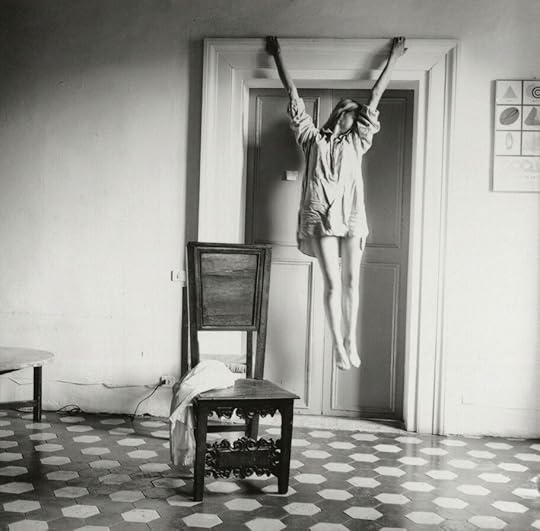
[Image: Untitled, Rome, Italy, 1977-8]
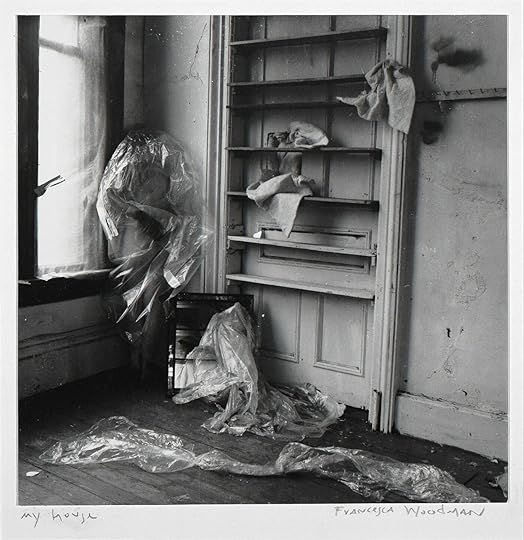
[Image: My House, Providence, Rhode Island, 1976]
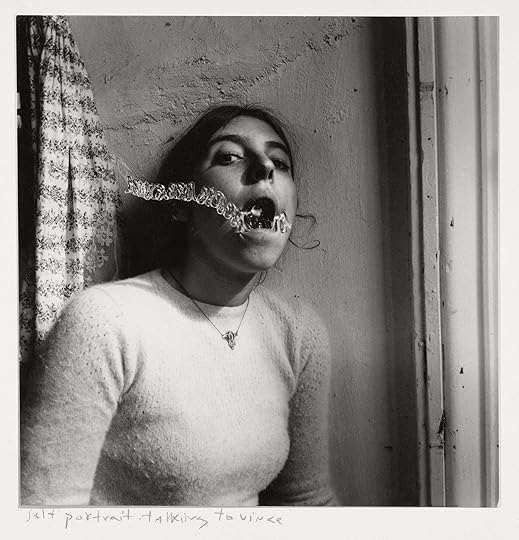
[Image: Self-portrait talking to Vince, Providence, Rhode Island, 1977]
*************************************************************************** [image error] [Image: Book Cover]
Citation: Townsend, C. (2006). Francesca Woodman. Phaidon.
Title:Francesca Woodman Author(s): Francesca Woodman (works, 1958-1981), Chris Townsend (editor, essay) Year: 2006 Genre: Nonfiction - Photography, art history, & biography Page count: 258 pages Date(s) read: 2/10/25 - 2/12/25 Book 31 in 2025 ***************************************************************************
Le nu n’est pas une recherche esthétique (et surtout pas érotique) sur le corps mais une volonté de se dépeindre de la façon la plus crue possible. Impression bizarre, malaise qui ressort de ses photographies.
Because I apparently am a philistine, I did not learn of Francesca Woodman until Thanksgiving evening of 2011, when my wife & I thought we'd accompany our feast with a depressing documentary about "some photographer who killed herself back in the '80s." Well . . . that, she did, but she was more than "some photographer who . . ." The documentary was made all the more wonderful by the fact there was an exhibition of her work at the San Francisco Museum of Modern Art. I was smitten. For a while, Francesca was the visual muse of my writing.
Townsend's in particular is a tremendous collection of her work. Here you'll find work after work that is austere, haunting, and above all filled with so much confidence that you want never so much as to hug her and say "It'll be okay," because we know that it won't, but rather create something with her. Get this, and then go make something.
Francesca Woodman is one of the more interesting portraitists of the human body, partially in how she portrays others but most compellingly in how she portrays herself. She inhabits the frame like a ghost, materializing in between planes stuck in an infinitely preserved loop of time, a soul stuck in vitrine. She passes through walls, seems to exist within them. Her presence is spectral, often possessing the bodies of her models (as so brilliantly illustrated on the cover's photo of models insuring their faces with an 8x10 of Francesca). Inspiring stuff. One star docked for the nigh-incomprehensible opening essay (that, admittedly, did have some interesting sections in it, much like needles in a haystack of six-dollar words).
Chronicles the large archive left behind by the young artist, who ended her life at 22. Townsend's analysis of this extremely abiguous body of photograhpy explores multiple points of entry; surrealist, feminist, formalist ect.. to this stunning but unsettling work. The book also contains excerpts from the artist's journal.
i was lucky to snag a copy of this from B&N before last year's go at "teaching" (for lack of a better word). francesca woodman is a breathtaking self-portrait artist--was way before her time. i like to compare her taking advantage of space to emily dickinson's and would actually like to officialy write on such a topic one day. if you haven't already, check her out. ...if you can find her
the van gogh (or is it supposed to be emily dickinson) of photos. like van gogh, touches on something essential about a being an emotional human being. She gives the human body its day in court, gives it a fair trial, free of judgement and typical American sensationalism. if you think you're not one of her peers, you should feel guilt.
As another reviewer noted, 5 stars for the photographs, but the author was too academic in his interpretation of her work. The interesting text found in the book are extracts from Francesca's journals that were curated by her father and a piece written by one of her friends. Unfortunately none of the text gave an indication on why she cut short her promising career as an artist.
This gorgeous book provided insight into the life of Francesca Woodman, but more importantly changed my views on photography and composition, on gradation and light, on velvety blacks and stone greys. I never knew photography could have such an amazing palette. And I haven't even gotten into her compositions.
This book should be in every art lovers library, and every academic library.