This companion to the History Channel documentary is a survey of Arctic explorers including Robert Peary, Frederick Cook, John Ross, John Franklin, William Edward Parry, Roald Amundsen, Lincoln Ellsworth, Umberto Nobile, and Gino Watkins.
In Saint Petersburg, the icebreaker ship Krasin still survives. That sentence may not mean much to most folks, but for anyone interested in Arctic exploration, it's very important. It was the Krasin which came to the rescue of the survivors of the famous Italia airship crash. As the world flies by, an old ship remains a connection to the madness of the men who attempted feats of craziness in their quests to conquer the Arctic.
The book opens with the story of the doomed Franklin Expedition, a tale which never fails to amaze me. Setting forth from England in 1845, Sir John Franklin was a bit old in the tooth for such a strenuous voyage. He and his men vanished. After nine years of fruitless searching, the admiralty struck the missing men's names from the books, as though they were ghosts who had simply left for another country. When clues were finally found, it was revealed that Franklin's men had struggled to find their way south while dying from scurvy, lead poisoning, starvation, and frostbite. Most likely, the lead-poisoned food made the men insane, and murder and cannibalism can never be ruled out of the final struggle. So not cool.
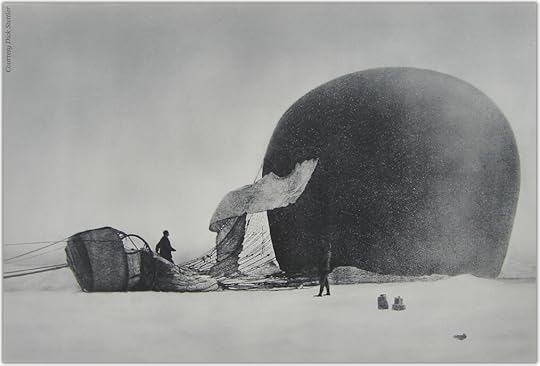
Yet the fierce rush to conquer the North Pole and to find the Northwest passage meant more men were to risk and lose their lives. Now that Commander Byrd's flight over the Pole is considered to be fraudulent, Umberto Nobile is possibly the very first man to have flown over Santa's home. When his blimp crashed, the stranded passengers were rescued by an airplane...which then crashed. The Russian icebreaker finally came along to pick up the survivors. There was also the story of Andrée's balloon. This Swedish expedition left for the North Pole in 1897 and they, too, vanished. When the bodies were finally found, thirty-three years later in 1930, the final days of these 'icemen' became revealed. It is now known that as they struggled to live, they lived almost exclusively by killing and eating polar bear meat. That meat harbored trichonosis, tiny parasitic worms which ate away at the starving men's muscles from within. Their film negatives survived the decades and show the crash of the balloon which would lead to their deaths.
The Arctic craze is always fascinating, yet some authors have made it incredibly boring. Not so Mick Conefrey, who describes the explorers, their travails, their tragedies, and their results with flair which makes for fast reading. Ironically enough, as climate change hits, the Arctic Ocean is more of a true ocean now, with less of the deadly ice. Those daring men in their daring air machines and sea ships would have had a much easier time of it. But then, we wouldn't have these memorable stories of courage and bizarre risk-taking.
Brief thoughts originally posted 16 May 2017 at Falling Letters.
Icemen: A History of the Arctic and its Explorers is a great introduction to the topic of Arctic exploration. Originally published as a companion to a series on The History Channel, the book describes a number of incredible historical incidents in an intriguing and accessible manner. Ten chapters focus on either a particular explorer or expedition/historical incident, beginning with the lost Franklin expedition and concluding with the forced relocation of Inuit to the Arctic Circle. (I braced myself for a poor depiction of the Inuit, but Conefrey and Jordan have written respectfully about them, particularly in that final chapter.) The book could be used as a jumping off point for any number of topics you may wish to explore further. Icemen contains 29 black and white photos in the center of the book. Published in 1998, this book is a wee bit dated but there are still many fascinating tales to be found within. Check out my blog to read about five events (with photos) that I learnt about for the first time while reading this book.
Companion to a BBC series , Icemen is a history of the Arctic and its explorers. From Franklin to nuclear submarines , with balloons and icebreakers added for interest. WW2, the Cold War and Canadian sovereignty are all covered. Interesting and entertaining a really good read. Fact polar bear tastes like fishy liver - mmm.
This book does a good job covering quite a history of arctic exploration. Not only does the author go into depth on some of the motivations and personal difficulties of these explores but also talks about the connections it has to the world at the time.