Set in the same universe as The Parafaith War (but two centuries later, and intended to be read independently), The Ethos Factor is the story of Commander Van C. Albert of the Republic Space Force of Taran, a brave and resourceful officer who once defeated a larger enemy ship but indirectly caused the loss of a civilian liner in the process. Cleared by the board of inquiry, but an embarrassment to the high command, he retains his commission but is given only dead-end assignments. For a time, he must watch helplessly as cold war among economic, religious and political rivals evolves toward interstellar open warfare.
Assigned as a military attaché at the Taran embassy on Scandya, Van is seriously wounded foiling an assassination. Decorated, promoted and summarily retired while still in a coma, he wakes to find himself honorably but intolerably unemployed. Then the harmless sounding Integrated Information Systems foundation of the Eco-Tech Coalition recruits him to fly a starship, Van finds he now has a powerful new vantage point not just for observation, but for action. The IIS has interests everywhere and Van is not just a pilot, but their point man in a conflict that will shake the worlds.
Modesitt uses a distinctive blend of space battles, political and economic intrigue, and issues of race and religion to address deep questions of good and evil, ethics and self-interest. Van Albert makes his decisions; it is for you to decide if he is a hero.
L. E. (Leland Exton) Modesitt, Jr. is an author of science fiction and fantasy novels. He is best known for the fantasy series The Saga of Recluce. He graduated from Williams College in Massachusetts, lived in Washington, D.C. for 20 years, then moved to New Hampshire in 1989 where he met his wife. They relocated to Cedar City, Utah in 1993.
He has worked as a Navy pilot, lifeguard, delivery boy, unpaid radio disc jockey, real estate agent, market research analyst, director of research for a political campaign, legislative assistant for a Congressman, Director of Legislation and Congressional Relations for the United States Environmental Protection Agency, a consultant on environmental, regulatory, and communications issues, and a college lecturer and writer in residence. In addition to his novels, Mr. Modesitt has published technical studies and articles, columns, poetry, and a number of science fiction stories. His first short story, "The Great American Economy", was published in 1973 in Analog Science Fiction and Science Fact.
Notes & progress report: While I enjoyed the first half of this, I'm now finding out why I never read it: http://www.sfsite.com/04a/ee173.htm -- I had her review on file, as it turns out. I'm a big fan of Modesitt's SF but there are limits, and I'm afraid I'm hitting them. Likely won't finish it. I think my old colleaguue Donna McMahon at SF Site called it right. Abandoned as DNF. Dammit.
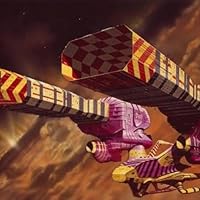
Instead of reading this one, I recommend the similar-themed (and far superior!) Ecolitan Enigma: //www.goodreads.com/review/show/1687128952 Jeez, such cheesy cover art! 🤨
Very absorbing and intriguing until the last few pages when basically the author justifies pre-emptive genocide (there are two instances of genocide in the novel, but one is arguable as the ones who are subject to it have been doing evil things and killing people on a mass scale for centuries, but in the second case it is done to prevent possible such and for example just airing the provable misdeeds of the government that is suspected of planning such for the next few centuries, while noting what happened to the other bad guys so to speak, can start a process to avoid the assumed repetition of misdeeds in centuries to come).
I will close this with one my favorite quotes that shows that sff authors can go off the rails occasionally:
“A realist writer might break his protagonist's leg, or kill his fiancee; but a science fiction writer will immolate whole planets, and whilst doing so he will be more concerned with the placement of commas than the screams of the dying.” Adam Roberts, Yellow Blue Tibia
A treatise on and/or exploration of ethics wrapped in a scifi novel. An excellent read - thought-provoking and entertaining. The pacing was slower than the Parafaith War, but I felt that both the characters and world(s) were more thoroughly developed.
After destroying an unknown enemy ship that attacked his ship, Commander Van Albert is suddenly transferred to become a military attache. Wounded while preventing an assassination, Albert is promoted and medically retired. Getting a job with an interstellar foundation, he will encounter societies attempting to annex weaker systems and will have to make some hard decisions. Modeaitt incorporates several social issues. While not up to the Imager and Reclue series, the The Ethos Effect is a good science fiction read.
Easily one of the worst science fiction novels I have read in the recent past. This is not strictly speaking a dig against Modesitt, as I have read much of the Saga of Recluse and a number of his other works, and although that was many years ago, the taste left behind was hardly bitter. This book...this book was different. Clunky. It's far too long for what actually happens in it. The characters are ciphers, mostly personality free except in the most broad of outlines. The protagonist, Van, has at least some fire in his belly; given the thick political focus of this novel, however, so much of what makes him him is a ridiculous stacking of the deck: a black commander, best in the fleet, who is raised by two gay men?
The dialogue is bad: it feels forced and unnatural, whether it is casual chit-chat or grand rhetoric. There is so little energy in what people say or do: the whole novel feels lethargic, with minutiae and daily routine consuming far more page numbers then the incredible space battles and acts of genocide. Indeed, one of the key events of the novel happens with almost no build-up and with so little consequence, aside from what the author tells us are the consequences, that it felt almost off-hand or unimportant. The main threat, the Revenants, are just not very threatening, and so much of the bad things that make them, you know, bad, always happen off stage and out of sight. Even the massive space wars are rushed and are almost comically simplistic. The lacklustre mystery that takes up almost half the book is barely a mystery at all, and though we are told it is a presaging of things to come, it never pans out that way.
These are crimes of structure, plot and characterization. They might be forgivable in isolation, especially because so often we readers of science fiction give a pass for these faults if the ideas, the science fictioney stuff, is strong. But it isn't in this novel. I appreciate the spaceship combat and how minimalist and 'realistic' it seems, at least. But everything else is so unimaginative, a damning thing to have to write of a science fiction novel. All the galactic powers are anaemic analogues for contemporary states and civilizations: can anyone take seriously a book where the Keltyr are Celts, the Argentis are Latin Americans, there is a planet whose capital is 'Marsay' and they are called Franks...This painful literalness is directly connected to Modesitt's desire to make his novel a grand ethical treatise, of a sort: to demonstrate the way in which societies should behave, and their inevitable fate should they fail to adopt the never clearly outlined but painfully, frequently, directly told to the reader's 'philosophy'. I have no problem with politics in my science fiction: Heinlein was a master practitioner, and much of the most interesting new science fiction I've enjoyed has been political: Banks, MacLeod, Mieville. But even Mieville is capable of making his villains sympathetic, and whatever the polemical nature of these authors, there is a real sense of energy, enthusiasm, ambiguity and 'lived' experience to the politics. Their characters argue, and it feels 'authentic'; their societies have some thought to them.
Not in 'The Ethos Effect.' The politics are simplistic at best, and seem drawn from introductory ethics and poli-sci textbooks; characters speak as if they are citing directly from an encyclopedia. Though I don't really care if there is 'ambiguity' to a novel's politics, it makes for dull reading when most political conversations are really lectures, between a genius and his disciple, or between a hero and a strawman: characters don't argue, they don't seem to have fundamental disagreements, because if they did, that might introduce some real discord into this novel. Instead, a recurrent pattern is established that supposedly leads to the fall of all civilizations, and wealthy upper class professionals sit around agonizing over ethical quandaries. Worse, the foundation ISS is supposedly the leading information gatherers and forecasters in the galaxy, and of course all their information (the nittygritties of how it is collected jettisoned to ensure we, the reader, know it is not flawed) suggests exactly the political philosophy Modesitt has built this rusty vessel 'round. Worse, it isn't even a political philosophy I find objectionable! If you can't even preach to the choir well, maybe you should give up preaching.
This entire review has been hidden because of spoilers.
Political scifi told in classic Modesitt style, which involves lots of conversations over simple food (I could not count the number of times Van eats in a restaurant--once a chapter?) and a simple hero travelling through the world, surrounded on all sides by hard choices and grey areas. I didn't find the main character all that compelling, but there are some good conversations about ethics scattered throughout the novel.
http://nhw.livejournal.com/281847.html[return][return]I did indeed find it an interesting read, enough to make this more of a meta-review than I usually do. Our hero, Van C Albert, is a military officer posted unexpectedly as an embassy attach
“Some aspects of human nature and some cultures can never truly be changed. There are trees that need to be uprooted so that better trees can grow…”
In many ways a retread of the first book, especially regarding the main character’s personality and development, The Ethos Effect focuses more narrowly on social ethics and interrogates the decisions and consequences of its prequel.
It poses interesting ethical dilemmas, especially regarding the responsibility of the individual within a society to ACT, but the chief characters’ conclusions seem ridiculous to me, at least based on their prior demonstrated values.
It’s more “big question” sci-fi than its predecessor but worth reading, analogous to Dune Messiah’s relationship with Dune.
I enjoyed the book. I like his Recluse series much better but I like his diving into science fiction as well as fantasy. I was amused by the overall "Mormons are evil" theme in this as well as the Parafaith War.
Its not surprising the discussion of ethics in the book - especially based on the title. However it is an empty discussion as there is no closure. He decides that any supernatural cause of ethics can't work and is by nature faulty because it will somehow create an exclusive society where not all are viewed as equal. You can't count on a godless ethic either because it is based on nothing and is changable at any time. He wonders if the ends justify the means, is genocide sometimes a better answer than letting an evil group continue? He seems to lead toward the idea that all religions lead to fundamentalist extremism. He adds in an alien species and they are always discussing ethics but don't have a real solution either. They don't have the moral fortitude to stop evil with force because in their view that would be just as evil. The reader is left feeling like the author sees ethics as vital but impossible and hopelessly empty upon examination. Yet, he doesn't really seem the pragmatist either.
Great book! Like most of Modesitts' books it makes you think, in this one it's hard to decide whether the right choices were made in the end but it made for an enthralling read. Some of the background to the book can be found in the Parafaith War, which is set a few hundred years prior to this in the same universe.
This book is the last in the series. This could have more prequels, unfortunately it doesn't. While, this story is thick and has a degree of depth that is needed. I really didn't like the abuse/overuse of certain words or phrases. For example, "IIA" and "system multi's" where thrown around without enough qualifiers for context. On the flip side of that, that does allow for a more timeless interpretation of these concepts. This short series ended up being more about the journey and less about the destination. From my experience this was missing from Sci-Fi. Now, that it has been years since L.E.M. wrote this series, I think if he highered a ghost writer he could put out a few prequels for more world building. Thus, the effect of these two books can still remain timeless and he can still offer more material for future TV/movies. This book deserves just 5 stars, but that again may change over time. Maybe this will age more like fine wine or maybe it will conflict with family values. Hard to say.
This entire review has been hidden because of spoilers.
L. E. Modesitt is a prolific and accomplished writer. His Tangible Ghost and Imager series break new ground in their respective genres. When he misses the mark, as he does in The Ethos Effect, it is not for lack of complex world-building and a well-wrought plot. The hero, Van Albert, is a decorated starship captain who is forced into retirement when he is injured preventing an assassination. He takes a job with Integrated Intelligence Systems, a secretive interstellar company that sends him into conflicts that challenge his ethics. The Ethos Effect is an ambitious novel of ideas that interrogates military and political ethics systems. It suffers, as many such novels do, from talky self-indulgence. The ideas subsume the characters, action scenes are rushed. The story elements never quite mesh—four stars with reservations.
This is slower than The Parafaith Wars, and it's far more somber. In the first book, Trystan changes the course of history. Hopefully, for the better. Van sees the aftermath of Trystan's work; the long-term aftermath, and he works with Trystan to try to fix it. Not with the kind of success they would like. The discussion of ethics continues, though of course, not with the kind of resolution we might like, and with the kind of nuance that seriously questions the ethical alignment of our heroes.
Modesitt is masterful with his usual attention to detail and rhythm. Fantastic, but definitely more somber.
Enjoyable plot and action but once again the true story value is the thoughts and questions it provokes on ethics and the question of whether change is possible-and what if it's not. I've found Mr. Modesitt's books to be of great value over the years as they've taught me some tips, navigating life and work. One example is to be aware of what is not said. I generally read his books once for the plot and then again for more subtle insights. Hope you take the time to enjoy the book and the questions that come afterwards.
This book was plot twist after plot twist. I really enjoyed it and wish there was more. Modesitt has always been good at building a galaxy and talking about politics. In this book he dives deep into bureaucracy and ethics in this one which can be hard to get through at times but adds a great level throughout this book. Side note I read this whole book before I realized this was a sequel. I haven't read the first book and still enjoyed it but it might have made the first part easier. It's still totally able to be enjoyed without reading the first one though
There is a lot to like about the book, but it ultimately fell a bit short. It has a well developed science fiction universe, diverse characters, and deals with questions of ethics that are timely. However, I overall felt it slow paced and too long. It would have benefited from being shortened significantly.
This book begins well and really cranks through its first three acts. However, it runs out of steam in the last act and its climax is, well, anticlimactic. The book wants to work both as space opera and investigation of popular ethics, but the ethical dilemmas faced by the protagonist strike this reader as easily resolved and not worth the buildup given them by the story.
At times, the story gets bogged down in economics or politics. The 'ethics' discussion is central to this series - and I'm not confident that the right decisions were made by the main characters. . . If indeed there are any 'right' decisions.
The first two halves are a really fun mix of intrigue and politics which is supposed to build up to the 3rd half but it loses it's steam and doesn't quite live up to what was promised. Also, the book has two instances where people commit planetary genocide and everyone kinda just rolls with it.
A fun, solid sci fi book by Modesitt with a lot of his trademark pieces. Spoiled somewhat by the conclusion that mass destruction and death is the ethical choice (in what seems to be analogous to the arguments about using nuclear weapons to end WW2).
DNF halfway through when one of the leads moral compass went off on an Ayn Rand rant. First half of the book was a good drama. Almost quit at the start because the audiobook narration is over dramatic noir.
One of my favorites. Does go deep into ethics and moral reasoning. I do agree that the plot rushes along and then does a sharp segue. Would have been better as a trilogy.
A very well told story, characters I could feel for and some thought provoking ideas about ethics, cultures, the development of societies (and their inherent challenges.)
Quite possibly the worst book ever written, if you ever want inspiration to write, read this and you'll feel more confident than ever before. I'm sure Modesitt can write, but this novel was terrible. Essentially, what could have been an interesting five page article on ethics is stretched into a novel length ethical dilemma where you don't even care about the characters by the end because it drags on for so long, not to mention the hammy dialogue. By the end of the novel billions of people have died and billions more could die depending on the decision of this fleet commander character, now Modesitt turns around and asks you dear reader: what would you do? So, the whole story has been building to this moment just so he can flush the ending of his novel? Even choose-your-adventure novels have endings, SEVERAL of them! This book is a bad attempt to end on a philosophical flourish (a la Camus/Sartre/Kafka). It felt like Modesitt simply stopped writing, then went outside and setup a lawnchair next to the mailbox waiting for his cheque from Tor publishing. Awful read, burn with fire if you encounter this book, there's plenty of great fantasy out there, move along.
This book fails so hard. What starts as a competently written space opera/conspiracy plot turns into a lengthy essay on ethics and what it means to be ethical. Which would be ok, if the author had any idea what he was talking about, and if he didn't force the words ethics and ethical into any longer conversation the characters have. Because sure, why not spend a romantic date with the main character gushing about how ethical he is? But even that would be alright, if it wasn't for the fact that the ethical solution the author goes for is to genocide the hell out of a planet. Twice. So the main character is a really, really ethical hyper-competent dudley-do-good wrecked by guilt over things he couldn't control, until the author decides that he needs to end the book and hey, he still has this backup doomsday weapon lying around and the bad guys are all on that one planet...
This entire review has been hidden because of spoilers.