Jump to ratings and reviews
Rate this book

Gormenghast #4

Titus Awakes: The Lost Book of Gormenghast

Rate this book
When Peake died in 1968, he left behind the start of a fourth Gormenghast book, Titus Awakes. His wife, the writer and artist Maeve Gilmore, completed the manuscript. The book continues the story of the Titus, the 77th Earl of Groan, as he wanders in the modern world and finds his final resting place in Sark.

288 pages, Paperback

First published January 1, 2011

35 people are currently reading
2023 people want to read

About the author

Maeve Gilmore

14 books10 followers
Maeve Patricia Mary Theresa Gilmore (1917-1983). Painter, sculpter and writer. Wife and biographer of Mervyn Peake, author of the Gormenghast novels, and editor and continuer of her husband's works.

Ratings & Reviews

What do you think?
Rate this book

Friends & Following

Create a free account to discover what your friends think of this book!

Community Reviews

5 stars
80 (13%)
4 stars
151 (26%)
3 stars
201 (34%)
2 stars
115 (19%)
1 star
32 (5%)
Displaying 1 - 30 of 99 reviews
Profile Image for Cecily.
1,325 reviews5,359 followers
March 15, 2021
Maeve Gilmore, Peake's widow wrote this Titus story, based on a few short pages of very brief notes, initially as a homage to him, rather than with the intention of publishing it. It has the distinct air of making peace and laying ghosts. I hadn't expected (or wanted) to like this, but I read it for completeness. But joy of joys, and to my great surprise, it is wonderful.


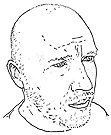
Picture of young Maeve, by Peake

Titus Alone, Awakes

Reading this made me appreciate "Titus Alone" more than I had previously (see my review HERE).

This brings things together rather well, and unexpectedly. Although it opens with Gertrude back at Gormenghast, it feels like a very natural continuation of Titus Alone, and ultimately, a natural, satisfying end.
"There was an aura of something he knew: something from the past; something that surrounded his whole being. Was it a caul or a shroud?" (birth or death?).

Gormenghast and its characters still loom large ("The withdrawn magnitude of his mother who he could not love, but whose mental elegance chastened him" and Flay who "wore faithfulness like a garment"): no matter where he goes, as his mother previously told him in the second book:
There is nowhere else... you will only tread a circle... everything comes to Gormenghast.

Presence and Absence

Whereas Gormenghast is all about structure, ritual and meaning, those elements are now absent from Titus' life.

The descriptions are still very visual and Titus is still a vagrant, relying on the kindness of strangers and very rudimentary survival skills. He is disoriented (suffering "haunted sleep"), wandering aimlessly, surviving dangers and friendships along the way, emphasising the themes of isolation, reinforced by incomprehension and inability to communicate. He is lonely, but doesn't want attachments: "I want other company and when it comes I shall want it to go. I shall want to flee from it. I am no longer, or perhaps never was, a part of the human race". Yet even when he lives in a small hamlet for nearly a year, he never learns the language - or is that purely a metaphor for his isolation and incomprehension? "Am I an onlooker or am I a catalyst?" He is searching, for he knows not what; "I must not live in the past, but how else can I live?". There is constant uncertainty about whether people are friend or foe: if the former, he is in their debt, and if the latter, he is in danger.

Art Imitating Life

In the later parts of the book, the echoes of Peake's own life become more obvious: when Ruth Saxon explains her love of painting and how it brings serenity; Herbert's very physical, balletic way of applying paint to paper; the descriptions of life in a unit for the mentally ill where "Each man was an island. Each island was too remote to link with any other."; the frustration of being physically unable to draw when "drawings were the sustenance of life"

Fittingly, this book ends with a paraphrase of Gertrude's earlier message:
"There's not a road, not a track, but will lead him home."

Quotes

• "The bells continued to plague him, making sounds he should understand, but could not."
• "There was an echo of something familiar, but it was hidden beneath the layers of memory as delicately poised as mille-feuilles."
• Of his sister, Fuchsia, "I'll never know again the ardour of a love that knows no physical desire."
• "He ploughed into life, as though was water, diving and coming up again into the air, breathing life, new and rare."
• "There is always a hope, hidden subterraneaously. Hope keeps man alive amidst all horrors." But what does Titus hope for?
• "Let him sleep away the past and present, until his stirring would lead him into a future."
• Regarding girls who cover their breasts, "What he had always thought of as a coy and provocative gesture in then was actually a wish to belong to themselves until they succumbed to a sensation of which they were no longer mistress."
• "A dizziness both spiritual and temporal... a supernatural ice immobilized Titus."
• "Titus has a strong feeling that he would forever be an onlooker in life and death."
• "He gathered experiences as a child might pick daisies, yet his daisy-chain was destined for no one's necklace or crown" People who knew him concluded "he was not there... In whatever company he found himself, he adapted to it, but he was no chameleon, and he remained an outsider."

All My Peake Reviews

All my Peake/Gormenghast reviews (including biographies/memoirs and books about his art) are on a shelf,
HERE.

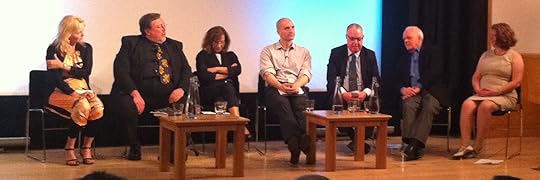
"Mervyn Peake's Gormenghast" at the British Library, 11th July '11


Image: "Mervyn Peake's Gormenghast" at the British Library, 11th July '11. L to R: Miranda Richardson, Brian Sibley, Zoe Wannamaker, China Miéville, John Sessions, Sebastian Peake, Farah Mendlesohn

Around the time this was published, the BL put on a ticketed event, with people speaking about and reading from Peake's works. It also coincided with the publication of The Illustrated Gormenghast, for which China Miéville wrote a passionate introduction, which I've quoted in my review, HERE.


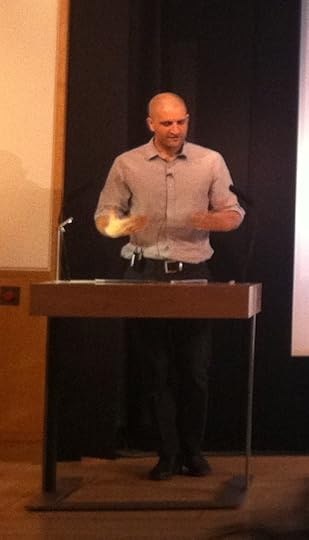
Image: China Miéville in animated mode as he discussed the rich beauty of Gormenghast. He was brilliant, even picking out one of my favourite images, that Titus was "Suckled on shadows; weaned, as it were, on webs of ritual". I also liked this: Peake's "names are so overburdened with semiotic freight, stagger under such a profusion of meanings, that they end up as opaque as if they had none". This was at "Mervyn Peake's Gormenghast" at the British Library, 11th July '11.
Profile Image for Fuchsia  Groan.
173 reviews243 followers
March 19, 2018
Poco o nada se puede "criticar" de una obra escrita por alguien tras la muerte de su marido y que al terminar guardó en una caja y no intentó publicar. En la introducción Brian Sibley explica que Maeve lo escribió como un intento de negar que el hombre, igual que la historia que había creado, estaban perdidos para siempre; ella muere en 1983, y es después cuando su nieta encuentra el manuscrito en una caja (Sibley sí sabía que existía, eran amigos y hablaban de ello).

Lo único que Peake dejó de lo que iba a ser la cuarta novela de Los Libros de Titus fue un fragmento, datado de julio de 1960, que constituye el primer capítulo de este libro, y una lista de las posibles tramas para cada capítulo, en la que Maeve se inspiró para crear la historia, además de en los tres libros anteriores y en la vida del propio Mervyn.
El libro iba a titularse Search without end (que es como se titula el último capítulo), pero al final Maeve lo cambió por el título que Mervyn tenía planeado: Titus Awakes.

En el primer capítulo, escrito por Peake, por un lado tenemos Gormenghast, a Lady Gertrude y a Prunescualo, ¿quizás iba a retomarlos? Por el otro, a Titus, exactamente en el mismo punto en el que quedó en el anterior libro.
A partir de ahí, Maeve sigue con la obra, al principio ciñéndose más o menos al esquema de Peake, para ir alejándose poco a poco (tanto en temas como en estilo), juntando al autor con su obra, convirtiéndose más en un homenaje que en una continuación.

Creo que este libro se disfruta muchísimo más si se lee antes A World Away, un libro de memorias de Maeve sobre Mervyn y su vida juntos.
Profile Image for Wreade1872.
815 reviews229 followers
August 26, 2022
Its hard to know what to say about this one. The writing is good in places but can also be a bit monotonous or at least repetitious. It does resemble Titus Alone to a degree, although not to its credit being almost as random and fragmentary as that work.
However i enjoyed it more than my score might belie. My score is based on the quality of the writing but there is another level to it.

This is a work that was clearly written to be written, not written to be read. It must have been quite a cathartic experience for the author. This is a love-letter or a prayer and while i understood the ending i’m sure there where more allusions and reference points that i would have gotten more out of with a better knowledge of Peakes life.

While it was a bit of chore in places i do think it deserves a place as the final piece of the Gormenghast puzzle and i plan on buying a copy to reread along with the trilogy.
Profile Image for Simon Mcleish.
Author 2 books142 followers
April 28, 2012
Also published on my blog here

The Gormenghast trilogy, by far Mervyn Peake's best known work as a writer, has many fans, including myself. And fans always want more, so we were intrigued when the publication of Titus Awakes was announced last year. Maeve Gilmore was Peake's widow (and, like her husband, an artist), who edited the fascinating but uneven compilation of Peake's less well known work, Peake's Progress. One of the items included there was the sketchy plan which eventually became Titus Awakes: a list of single words which form the themes of each of the chapters. There was also a draft of the first chapter, which I don't think was included (my copy of Peake's Progress being packed in a cardboard box in the garage, I can't easily check). Ironically, this completion of a lost novel was itself lost on Gilmmore's death in the eighties, only to be found in 2011.

The end of Titus Alone found Titus wandering in the vicinity of his ancestral home, Gormenghast Castle, before deciding to leave again. Titus Awakes begins at this point, with a brief scene between the Countess, Titus' mother, and Doctor Prunesquallor, also a character in the earlier books and fellow inhabitant of the castle. After these couple of pages, the rest of the chapter follows Titus closely, as he descends from the mountain on which the castle is built and sets off again. This is the end of the material that Peake wrote, and Gilmore then continues in the same vein.

The story consists of a series of bizarre adventures, much like those in Titus Alone, until the young man ends up in Sark, a plan which Peake divulged to his wife. Once this happens, the story has much more life; Maeve Gilmore was pretty clearly more comfortable writing about a real place familiar to her. Parts are clearly based on the writer's own life (and acknowledged as such in the introduction). This includes a sombre episode in which Titus, working temporarily at a mental hospital, meets Mervyn Peake as a patient visited by his wife Maeve Gilmore. Though all three do leave the hospital - Peake being misdiagnosed - its unending grey hopelessness is portrayed in what is probably the best written and certainly the most striking section of the novel.

The intention of the story, as in Titus Alone, is to use some of the external details of the situations in which Titus finds himself as allegorical mirrors of his growth as an individual. This means that the narrative is again heavily focused on the protagonist. I find this something of a problem with both books, as to me, and, I suspect, to many other readers, the most interesting aspect of Titus Groan and Gormenghast is the castle and the strange, ritualised lives of the grotesques who live there. While Titus psychologically needs to escape, and never quite manages to do so, the young man at the end is not as interesting as he is as the Earl of Groan, centre of the castle's culture, and the people he meets, no matter how strange, are never as interesting as the inhabitants of the castle. It must be said, too, that Peake's imagination for the bizarre is better than Gilmore's, making Titus Alone a more interesting read than Titus Awakes.

Titus Awakes is no masterpiece, no stunning new addition to the Peake canon. Few readers will have been expecting it to be, especially if Titus Alone seems less than stellar to them already. What it does offer is a glimpse at the intentions which Peake had for the later adventures of his best known character, and a measure of resolution to a story which was lacking it. My overall rating is 3/5 mainly because it is most like my least favourite novel in the original trilogy.
Profile Image for Brian Yatman.
75 reviews
March 5, 2012
To appreciate 'Titus Awakes' it's not enough to have read the Gormenghast trilogy: you'll need to read 'A World Away', Gilmore's account of her relationship with Mervyn Peake and his tragic decline. Gilmore lacks her husband's knack for byzantine wordplay and eye for the grotesque, but her spare (if uneven) style and rambling plot reward the attentive reader with moments of real poignancy and gentle humour. The ending is just beautiful.
Profile Image for Linda.
498 reviews1 follower
February 5, 2017
I almost waffled between 1 and 2 stars because 1 star seems so harsh. But if 2 means "it was OK", most of the time while reading I did not think this to be the case. So, I have to settle on 1 star, which is rare for me to hand out. The only reason I read through the entire book is because it is a very quick read, and for the sake of completion. In retrospect though, I would have felt complete after reading the three books that Mervyn Peake himself actually wrote.

I was not expecting much going into this book being that it was based on a mere four pages of Mervyn's writing and was written by his widow, but I expected to like it at least a little bit. But sadly, no, I did not.

I did not feel any of the magic that was present in the first three books, the sense of wonder and beauty of the writing, the interesting interactions and dialogue between the characters. Instead, the writing felt choppy, the episodes contained in each chapter were short and sparse, and Titus did not feel like the Titus I had come to know and love. Titus felt like a leaf, no personality, simply tumbling on his way and going along with what other individuals and situations he happened to come upon. In addition, these situations became all so repetitive.

On top of that, the beginning fragment that Mervyn wrote teased me into thinking that we would be rewarded with some scenes of Gormenghast with the Countess, Prunesquallor, and others. But that not being the case, I felt even more let down.

Well, the good thing is that this was a library book so I can return it and forget that I ever read it. And I own the first three books which I actually look forward to rereading someday.
Profile Image for Raghav Bhatia.
327 reviews100 followers
January 7, 2022
There are many instances in literary history where the authorial mantle has been passed. Tolkien's son broadened our knowledge of Middle-Earth from his father's notes; Frank Herbert's prodigy did the same, scribing altogether fresh Dune novels. In each such case the successor tries to at least emulate the originator.

With Mervyn Peake's work this was not possible. There's not a huge mythos to his world. Only a story he wanted to tell, and a penmanship he wanted to employ in telling it.

Maeve Gilmore, the man's widow, is a wonderful writer in her own right. She could not possibly emulate her husband, who was taken away too soon. His craft was unique to him. All he had left behind was 4 pages and presumably some ideas as to how he wanted Titus's story to proceed.

Titus Awakes is a version of that story. A great, concise, culminatory variation of the story we would otherwise have gotten. I have no qualms with the story, I think it dug graves and filled them, too. I think it has an ad hoc melancholy to it. I think that, while not crucial or monumental as Gormeghast was, this is a very good book.

Just without the soul of language and the tender texture of words that Peake and Peake alone could have brought to the table.

But who am I to grumble, grouch and cavil when I got to read a book which made me sigh more frequently than a Jane Austen-novel protagonist?
Profile Image for Sam.
3,464 reviews265 followers
September 11, 2015
This is kind of an odd read as it deviates from the heavier style of the rest of the series, unsurprising since it was written by Maeve Gilmore, Peake's wife, but this does make it an easier to read so is a bit of a double edged sword. It follows a similar pattern as Titus Alone with the title character going on a series of mini adventures, including finding himself in a metnal institution where he meets Peake and Gilmore(!), although Gormenghast is still very much at the forefront of his mind. It is well written and the shorter chapters lend themselves to a faster pace of both story and reading which is refreshing for this series but I did miss the heavy brooding that dominated the previous books. I'm still not a fan of Titus as a character but Dog, his ever faithful companion, managed to bring out his more compassionate side, which was great to see. I am glad I read this but, much like Titus, it is overshadowed by Gormenghast.
Profile Image for Janelle.
1,633 reviews347 followers
July 14, 2022
Based on a fragment written by Mervyn Peake, his widow has completed this fourth Gormenghast novel. I found it disappointing though there were moments that were sad, or entertaining or colourful, it never really got into my imagination like the original works and at times it just meanders. Interesting I guess, but not essential.
Profile Image for Octavia Cade.
Author 94 books136 followers
August 17, 2022
Mervyn Peake may be my favourite author. His "Gormenghast" series is outstanding, and if Peake hadn't succumbed to neurological disease he would have continued to write. "Titus Awakes" is the work of his wife, Maeve Gilmore, extrapolating from the thinnest of fragments left behind, and it is proof positive that one can marry a genius but not continue on for them.

I wanted to love it. But the characteristic grotesquerie of Peake, the Baroque prose you can drown in, just isn't there. Gilmore tries, and the mimicry of style is in some places clever, but compared to the immensity of Gormenghast castle she has produced a scaffolding at best - the same sense of shape, with none of the depth. "Titus Awakes" feels like stepping stones, an episodic skipping of here-to-there that doesn't have the cohesion, the interconnection, of Peake's previous works.

This isn't surprising. Gilmore isn't so much writing a continuation as she is an exploration - what life is like without her husband. It is hard to read the final parts of the book and not recognise Peake himself as the patient in the sanatorium, his mind and intelligence failing as his wife sits beside him and waits for the end. It's not just the patient, of course - Peake appears in the book, unnamed, a couple more times after that and it is unutterably sad - but sad because of context, and not because of text. One can't blame Gilmore for reaching out, for trying to reconcile her husband's greatest work with the ending of his life - but it's not "Gormenghast", not even close, and I wonder if the fragment should have been left well enough alone.
Profile Image for Alex O'Connor.
Author 1 book86 followers
May 20, 2022
I was deeply moved by this book, with its reflections on grief, grieving, and the "search without end" for purpose and meaning despite that grief. The grief for a childhood long past; homes, people, and companionship all unfulfilled or lost in some other way. The language was not what Peake's was, but it was evocative in its own way - similar to Anna Kavan, remarkably. I grieve the fact that Peake died before he could finish telling this wonderful, unique story - the world is so rich, full and lived in, that it is tragic that it was never finished.

I find great solace in Titus's awakening - that the world, broad and cruel as it is, can be filled with hope as well.
Profile Image for John.
531 reviews
February 13, 2013
Oh dear - some things should just be left alone. In the spirit of Titus Alone (rather than the first two books) but without most of its redeeming features. Bitty (a kinder word would be episodic)and rather pointless. The only real interest lies in the last few pages where Titus journeys to what is clearly Sark -Peake's home. Just as it starts to get interesting, it stops. Less than 24 hours after finishing reading I'd be hard pressed to remember any narrative details. Nice trybut it should have been a short story
Profile Image for Eden Prosper.
63 reviews44 followers
October 12, 2025
Titus Awakes stands as a posthumous coda to the Gormenghast saga, envisioned as its fourth and final chapter. Though Mervyn Peake left behind only tantalizing fragments and skeletal outlines before his death, the spirit of his creation lingered; unresolved, yet unforgotten.

Years later, his widow, (artist and writer Maeve Gilmore), undertook the delicate task of reanimating that vision. Composed decades after the original works and drawn not from a fully realized manuscript but from notes, sketches, and interpretive reconstruction, the book feels disjointed; less a resurrection than a reverie, not so much a continuation of Peake’s world as a kind of mourning for it.

Gilmore’s prose, although suffused with a sincere and contemplative spirit, lacks the baroque luxuriance, phantasmagoric dread, and eccentric ingenuity that once imbued the Gormenghast trilogy with its singular, almost operatic intensity. It’s nearly juvenile in its storytelling and lack of depth. And that’s okay; because Maeve Gilmore is not Mervyn Peake.

I don’t believe she made any attempt to inhabit Peake’s singular voice (a decision I find not only judicious but deeply respectful.) Rather than echo the baroque density and gothic strangeness of Gormenghast, it moves in quieter registers, offering a narrative shaped more by elegy moreso than exuberance. It’s more attuned to the rhythms of grief and remembrance than to the fevered architecture of myth and madness.

Not for the first time in his life Titus felt the void that parting opens up so violently, but in this case it was not he who had left. He could feel a little of the sense of loss he had inflicted on so many people. An emptiness when he awoke, and when he went to bed, and all during the day when he was working. An ache he had only once before felt. He had lost something irreplaceable, but no rational explanation came to him as to why he should have such strong feelings for a man who had not spoken, whose outer life was destroyed, but whose eyes and inner life haunted him. -page 207


Unlike conventional moral tales that march toward tidy conclusions and prescriptive truths, this novel unfolds along more contemplative lines, its meaning more of atmosphere and feeling than a matter of lesson. What it offers is a philosophical and emotional resonance drawn from inward reflection rather than outward event. It privileges the landscape of the mind over the mechanics of plot, and in doing so, reveals a quieter, more enduring kind of truth.

Titus Awakes does not seek to climax the trilogy, but to close it: gently, reflectively, almost as a whispered farewell. For me it felt like a sense of emotional resolution, a final benediction over a world that will never quite be finished, but need no longer be continued.
Profile Image for Tim Regan.
362 reviews12 followers
February 25, 2021
I'm glad I listened to this, but it is not the same as the rest of the series.

The end of the first, Titus Groan, is more of a caesura than an ending because, although Titus becomes the boy-earl, Steerpike, the real heart of the narative, is still at large and intent on havock and gain.

The second book (Gormenghast) does have a real ending, and I think perhaps that's where I should have stopped.

The third book, Titus Alone, is a good read, but without the oppressive castle framing every event and thought the novel is not as tight, and like the ending is a real anti-climax.

So this last work is necessary, to lead to a better (if still very open-ended) finale. But I think my recommendation to new readers would be to stop after book two, Gormenghast.

I also had to change narrator for this one, from Saul Reichlin to Rupert Degas. You can get all four read by Degas, but I didn't realise that until I got to the end of book three, the last that Reichlin narrates. I thought it would be very strange, swapping narrator and thus character voicing, but it was fine. Degas narration is gentler (and slower?) and I loved the classical music played between each chapter.
This entire review has been hidden because of spoilers.
Profile Image for Marianne.
425 reviews56 followers
August 26, 2024
4 stars!

Titus Awakes is not an official continuation of Mervyn Peake's Titus Alone and if you expect that coming into this book you will be disappointed. Written by Peake's widow, Maeve Gilmore, Titus Awakes begins as an homage to the literary legacy of the Gormenghast trilogy, but transforms into a poignant, cathartic love letter to its author.
Peake would begin to display early signs of dementia throughout the 1950's. We are lucky to even have Titus Alone, which he managed to publish in 1959. In the 1960's his physical and mental health would only further deteriorate until his death in 1968. His complete vision of the Gormenghast series would never come into fruition. Within the pages of Titus Awakes you can feel Gilmore wrestling with these strong, conflicting emotions she no doubt experienced as she witnessed her husband's declining state. And she makes Titus, his creation, witness it too.
While I would argue that this is a good book viewed on its own, it offers a somber yet beautiful richness when you understand the context it was written in.
We will never know what Peake truly had in store for Titus Groan, but Gilmore offers a touching sense of closure for the both of them.


"Titus no longer felt alone, but a part of someone who would shape his life to come. There's not a road, not a track, but it will lead him home."
Profile Image for Sol.
700 reviews35 followers
Read
July 31, 2022
Summary:

I had an uneasy feeling reading this case of literary therapy/necromancy, of intruding where I wasn't meant to be. I'm not one to respect the wishes of authors, but the fact that Gilmore wrote this in the 70s, never attempted to publish it, and it went unknown until its discovery in 2010, tells me it was never intended to be public. Well, now it is.

Opening with a fragment by Peake, the rest is written by his wife based only on a fragmentary list of locations/people. She makes little attempt to mimic his ornate style or absurd humour. The early events of the story are fragmentary and staccato, only attaining a sense of structure as Titus meets Ruth and later the sick artist (who clearly represents Peake suffering from Parkinson's disease). Though her style is more plain than Peake, Gilmore achieves moments of poetry, especially in the depiction of Peake's illness. What did she feel writing this? Do the women Titus meets have anything of herself in them? These things are beyond knowing. All I know is that it momentarily achieves a solemn beauty, in a widow trying to give her husband's work an ending.
Profile Image for midnightfaerie.
2,272 reviews132 followers
December 12, 2013
Although very short, this book is a nice look into where Peake was going with this story when he died. Some of our favorite characters are brought back and/or briefly mentioned, so we know Peake was hesitant to leave them behind. Our beloved Gormenghast castle is also mentioned in the "Preadventure" and so we can only hope that it will once again become the setting of at least part of our story. It's truly a shame Peake died when he did and couldn't finish this wonderful series. Although we know Titus has to separate from Gormenghast at the end of Titus Alone for the sake of his identity, I can't help but hope that he will one day be drawn back to his forcible home. It is there we fell in love with Peakes writing, his atmosphere, with Titus's story. And in my heart, I know, that one day he (and I) will return there.

ClassicsDefined.com
Profile Image for midnightfaerie.
2,272 reviews132 followers
December 12, 2013
Although very short, this book is a nice look into where Peake was going with this story when he died. Some of our favorite characters are brought back and/or briefly mentioned, so we know Peake was hesitant to leave them behind. Our beloved Gormenghast castle is also mentioned in the "Preadventure" and so we can only hope that it will once again become the setting of at least part of our story. It's truly a shame Peake died when he did and couldn't finish this wonderful series. Although we know Titus has to separate from Gormenghast at the end of Titus Alone for the sake of his identity, I can't help but hope that he will one day be drawn back to his forcible home. It is there we fell in love with Peakes writing, his atmosphere, with Titus's story. And in my heart, I know, that one day he (and I) will return there.

ClassicsDefined.com
Profile Image for Andrew.
702 reviews6 followers
July 4, 2024
Probably the biggest criticism and the greatest praise I can give this very very odd book is that it feels of a piece with Titus Alone in many ways. I'm glad that Gilmore wrote it, I'm not 100% sure it needed to be published.
Profile Image for Steve Shilstone.
Author 12 books25 followers
August 30, 2021
A 5 rating only for all who have read and loved the three titles in the Gormenghast Trilogy and know the tragic facts of author Mervyn Peake's early onset dementia. His widow, Maeve Gilmore, took scraps of notes and filled them out to make an episodic journey for Titus Groan. People unfamiliar with Peake or his works will miss 75% of what Titus Awakes offers.
Profile Image for Corey.
Author 85 books280 followers
October 22, 2011
It makes me sad how bad this is. Better to think about re-reading the magisterial Gormenghast trilogy.
Profile Image for Richard Pierce.
Author 5 books42 followers
August 27, 2012
I loved Peake's Gormenghast trilogy. This did not disappoint. I found the tone lighter, and room for hope in a desperate world.
Profile Image for Ben .
42 reviews
August 5, 2021
Like many, I gave this book a shot largely for the sake of completion. I can't really decide what to make of it but it's certainly food for thought.
Profile Image for Sydney Cernek.
64 reviews2 followers
November 26, 2024
Last book in the Gormenghast series—did not disappoint. So confused how the author’s wife was able to write this last book in a way that felt like Mervyn was writing it; it literally sounded like the other three books even though it wasn’t him….nLove this series and I’m so sad I’m done, but happy I get to start again with the first book aka the best one…
Profile Image for Joy.
603 reviews33 followers
October 23, 2020
This struck me as having a sort of melancholy that the previous books didn't have. Maeve Gilmore, widow of Mervyn Peake, wrote Titus Awakes a few years after her husband's death, based on two pages he's written before he died. The story begins with those two pages, and then continues Titus' journeys through the modern world. He continues to be a wanderer, eschewing human company for the most part, instead staying briefly with whomever he happens to come across. He seems to have accepted a life as a drifter and an outsider. He has very little connection with his fellow humans; only a dog who takes a liking for him gives him consistent companionship, until he leaves him with the latest of his many flings. The dog, only ever called Dog, seems to understand he is to stay with this woman.

He meets painters, vagrants, criminals, a very terrible poet, and many other unique characters throughout his adventures. Much of the time, he is surrounded by those to whom he cannot communicate, either through lack of knowledge of the local language, or through the inability of those around him to speak, as when he briefly works in a mental hospital and makes a strange connection with a patient who is clearly Titus' creator, Mervyn Peake.

Maeve Gilmore never wrote with the intention to publish her particular story. It seems to be her way of grieving her husband and the end of his creation, which he'd intended to continue in a series of books exploring the entire life of Titus Groan. The concept of the Gormenghast novels was to depict the entirety of the main character's life from birth to death in a strange and sometimes wonderful world.

Sadly deteriorating health cut the author's life short (Mervyn Peake suffered from Parkinson's Disease, which, judging from his time spent in a mental hospital, was ill treated). One wonders where Titus would have gone, had Peake remained at the wheel of his character's life, and whether Titus had returned to Gormenghast to overhaul it's stifling traditions, or if he would've found peace and happiness somewhere else. Instead, we leave Titus, having ended one adventure, and embarking on another.

Maeve writes a bit less densely than her husband, but still with an artist's eye for detail, color, and composition. The world remains a bit hallucinatory and meaningless without the structure of Gormenghast and it's endless archaic laws, yet free with possibility and a grain of hope, with the world open to the bohemian Titus.
Profile Image for Max Nemtsov.
Author 187 books578 followers
May 12, 2014
Это tru fanfic из той эпохи, когда и слов-то таких не знали. Единственное отличие — ударение здесь имеет смысл ставить на tru. Мэв Гилмор искренне пыталась продлить жизнь покойного мужа — Мервина Пика — хотя бы в собственной памяти. В этом-то и разница — для нее он был отнюдь не «полюбившимся персонажем» романа.

Такой литературный экзорцизм, который она предприняла, не всякому по плечу. Она действительно возвращает его к жизни в не называемом по имени Художнике — мало того, ведет от болезни к счастливой жизни, откручивает время назад. И делает это посредством единственного, что было для него важно, — с помощью бумаги и туши (которой и была написана книга) и при содействии любимого его творения, Титуса. Упрекнуть ее в том, что супруг вряд ли писал бы таким языком (сложно представить, что он бы употребил оборот «in normal circumstances», к примеру, хотя кто знает), как-то рука не подымается.

Титус, кстати сказать, выступает в романе совершенно уже экзистенциальным героем-одиночкой, полностью перпендикулярным окружающему миру, тотально вне его. Идеалистическое представление Мэв ведет его к принятию мира, где он все же сходится с Художником. По иронии — на острове, и это важный оттенок смысла, примиряющий нас с недостатками романа. Можно было бы сказать, что такой образ — лет на двадцать как устарел, но если вдуматься, Титус и не мог бы оказаться иным, если отталкиваться от того, каким писал его Мервин Пик (за те же 20 лет до этой книги, когда идеи Камю и Сартра были передним краем представлений о романтическом изгойстве интеллектуала в западном мире).

Да и не литературу творила Мэв — этой книгой она лечилась, гоняла собственных бесов любви, тоски, одиночества и скорби. Как такую попытку эту книгу и стоит читать.
Profile Image for Dave.
130 reviews4 followers
March 19, 2020
Something of a curiosity. This isn't really a fourth book in the series. It opens with Titus waking up in the snow, apparently having just left Gormenghast Castle. In spite of the previous book, Titus Alone being about his experience outside Gormenghast.
Only the first five pages are by Peake, the novel itself leads off from this fragment, and takes Titus through a somewhat disconnected dreamscape populated by characters in that don't really capture the glorious grotesquery of Peake's. On its own, the book offers little. However, with the knowledge of Peake's life, and it is clear that Titus is Peake in his later years and at least one character is Gilmore, Peake's widow, as Peake struggled with a neurodegenerative illness. The two appear as other characters as well, particularly the dying artist and his wife.
This is not really a Gormenghast book, and certainly lacks the tone and gothic feel of the trilogy. It is, in context, a touching attempt to to come to terms with the loss of a life partner.
Profile Image for Simon.
928 reviews24 followers
September 2, 2011
I was always wary of the idea of a sequel to some of my all-time favourite books, written by another writer, even if based on notes by the original author. And it turns out I was right. Titus Awakes continues the wanderings abroad started in Titus Alone, but whereas in the previous book Titus' discovery of the outside world was invigorating and involving, here it's tedious and astonishingly repetitive. Titus happens to meet someone who takes pity on him and offers him shelter, food, love, work or whatever. He stays for a day or two and then leaves, as he doesn't want to be tied down. Titus himself comes across as passive, affectless, ungrateful, self-involed and frankly boring.
I struggled through 260 pages until the vaguely mystical, decontructionist ending which I won't spoil here, but which I only understood having read the book's introduction.
I'll be reading Gormenghast again, but this one was a waste of time.
Profile Image for Samuel Nakat.
Author 0 books7 followers
March 10, 2018
Titus Awakes, the "lost book of Gormenghast" was a nice book
It didn't have Peake's wonderful prose, but Gilmore writes with a tenderness, and her love for the material and for Mervyn Peake himself is emotionally apparent within every chapter of the book. It was originally written by Gilmore, based on fragments that Peake had written, although she had no intention of using it. She wrote more out of unconditional love, and anguish that he loved one was lost forever, as a means of catharsis.

I felt that the book dragged a little in the middle, as Titus met Ruth, and strangely, became a model.

The inclusion of Peake and Gilmore as nameless characters was very beautiful, especially how it handled the character of Peake and his illness.
The ending was beautiful, and Maeve Gilmore's anguish for the loss of her beloved is apparent here. It makes for a poignant end to Titus' journey.

4/5
Profile Image for Astir.
268 reviews9 followers
April 24, 2021
I wish I could say that a work in which the author's widow takes the author's character to meet the dying author was a poignant farewell, but this book is just unnecessary. It addresses none of the problems of the previous book: Titus is still appallingly dull compared with Steerpike, the world outside Gormenghast shows none of the imagination and grotesque charm of the world of the castle, and everything is still fragmentary and weightless. Titus gets a dog, a girlfriend or two, does some modelling work, has an interlede in a mental hospital, and absolutely nothing of substance occurs. Maeve wrote this for herself and not for publication; there's a sense that the plot is unfolding with some ties to Peake's life, but the reader who doesn't know Peake intimately is blind to any meaning. This isn't a novel, it's private art therapy and should have remained unpublished.
Displaying 1 - 30 of 99 reviews

Can't find what you're looking for?

Get help and learn more about the design.