

What do you think?
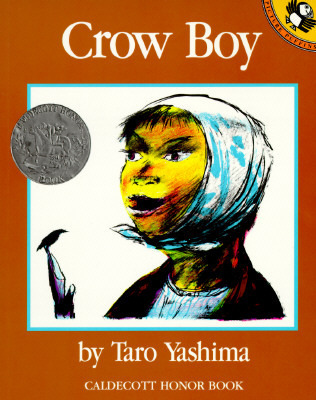
Crow Boy
"A shy mountain boy in Japan leaves his home at dawn and returns at sunset to go to the village school. Pictures and text of moving and harmonious simplicity". - Saturday Review.
40 pages, Paperback
First published September 30, 1955
Ratings & Reviews
Friends & Following
Create a free account to discover what your friends think of this book!
Community Reviews
Displaying 1 - 30 of 264 reviews

September 25, 2018
At first, I really did not like the artwork in this book. It's fuzzy and the colors are dull and makes me feel it's messy. As the story went on, I think it is part of the story to explain the Tiny boy in this book. At least, I think that is what it's doing.
Chibi who becomes Crow Boy is not from the village with the other children. He comes to school and he is scared. He hides under the building. Instead of listening to the teacher he examines the world around him. The ceiling fascinates him for hours or his desk or the little window. This boy sees the world through much different eyes. He does not learn in a straight forward way. He lets the world around him teach him. He didn't speak to the children or play with them. Everyone thinks he's stupid.
A new teacher comes and begins to talk to the boy. The teacher is quiet and does his best to understand the boy. The ending is lovely and touching. We come to have a respect for the boy and understand that he has a different kind of intelligence. Isn't that what artist give the world, is a new perspective on life, many times from an outsider perspective.
This is such a unique and different book. It is such an example of minimalism, I think. He uses simple images with simple sentences to tell this complex story. It was very well handled. Is this my favorite book - no. I do think there is a brilliance in this book that I greatly appreciate.
The kids did not like this book which doesn't surprise me. It's not a book you love easily. It's like the boy, you have to be patient and let him show you something beautiful inside you never expected.
Chibi who becomes Crow Boy is not from the village with the other children. He comes to school and he is scared. He hides under the building. Instead of listening to the teacher he examines the world around him. The ceiling fascinates him for hours or his desk or the little window. This boy sees the world through much different eyes. He does not learn in a straight forward way. He lets the world around him teach him. He didn't speak to the children or play with them. Everyone thinks he's stupid.
A new teacher comes and begins to talk to the boy. The teacher is quiet and does his best to understand the boy. The ending is lovely and touching. We come to have a respect for the boy and understand that he has a different kind of intelligence. Isn't that what artist give the world, is a new perspective on life, many times from an outsider perspective.
This is such a unique and different book. It is such an example of minimalism, I think. He uses simple images with simple sentences to tell this complex story. It was very well handled. Is this my favorite book - no. I do think there is a brilliance in this book that I greatly appreciate.
The kids did not like this book which doesn't surprise me. It's not a book you love easily. It's like the boy, you have to be patient and let him show you something beautiful inside you never expected.

December 12, 2019
Read for my daughter. A good book for kids. Don’t judge when someone is different because they will surprise you of their unique talent.

August 24, 2009
Crow Boy is a memorable story, apparently drawn from the author's childhood memories of Japan. On the first day of school in a small village, a young boy is found hidden beneath the schoolhouse floor. The boy comes to be called "Chibi" for his small stature, and is ostracized by his classmates. After six years, a new teacher notices that Chibi's knowledge and skills distinguish him from the other children. He displays Chibi's artwork and writing on the wall, and admires his knowledge of the natural world. On the day of the school talent show, this teacher introduces Chibi's talent: imitating the voices of crows. Chibi amazes the crowd with many crow calls: baby crows, older crows, alarms, happy calls, and finally a crow on an old tree, near his far-off mountain home. When the teacher explains that Chibi learned this talent during his daily walk from the far side of the mountain, everyone comes to respect and appreciate him.
The loneliness of the excluded child is very well drawn, and the other children's cruel oblivion is believably portrayed as Chibi quietly occupies himself watching the planks of the ceiling and staring out the window. When the children realize their wrong, they weep for their six years of unkindness. But, unlike The Hundred Dresses, this moral lesson comes with an opportunity to make amends: Whenever Chibi returns to the village, carrying his homemade charcoal for sale and buying the small items his family can afford, the children greet him by his new name, "Crow Boy." Crow Boy responds to their overtures with happiness and pride. He has won his place in the community, and he returns home with dignity.
Yashima's evocative drawings complement his spare text beautifully, and while the story's emphasis is on relational dynamics among the children, there is a vivid sense of the outdoors as well as an experience of the cultural environment in this small village. The book is pleasing on many levels and should appeal to younger and older readers.
The loneliness of the excluded child is very well drawn, and the other children's cruel oblivion is believably portrayed as Chibi quietly occupies himself watching the planks of the ceiling and staring out the window. When the children realize their wrong, they weep for their six years of unkindness. But, unlike The Hundred Dresses, this moral lesson comes with an opportunity to make amends: Whenever Chibi returns to the village, carrying his homemade charcoal for sale and buying the small items his family can afford, the children greet him by his new name, "Crow Boy." Crow Boy responds to their overtures with happiness and pride. He has won his place in the community, and he returns home with dignity.
Yashima's evocative drawings complement his spare text beautifully, and while the story's emphasis is on relational dynamics among the children, there is a vivid sense of the outdoors as well as an experience of the cultural environment in this small village. The book is pleasing on many levels and should appeal to younger and older readers.

February 1, 2011
Crow Boy
Taro Yashima
Viking: New York 1955
This book is a great way to introduce the topic of bullying through a multicultural lens. This story centers around a boy that does not fit with the social and cultural norms of his classmates throughout his school career. He continually is bullied and made fun of until the sixth grade when a teacher takes interest in him and creates opportunities for him to show his talents and knowledge. This account of prolonged bullying and the resilience of a single student who does not fit in the social norm uses what seems to be colored pencil illustrations that allow for shading, multiple color use, and abstraction within each illustration. Each classmate's face along with the main character's face are somewhat blurred and allow for a greater audience for this story, since it is not esoterically identified with Japan and Japanese culture. The theme truly carries this story of an outcast boy who is later admired for his crow calls and becomes called "Crow Boy".
The Japanese culture is portrayed sparsely in this account, but it is clear, from the illustrations and some parts of the language, that this story takes place in Japan. The colors that are used, such as yellow, bright blue, pink, and green, are not typical to Japanese traditional arts, but bring a great vibrancy to the story and a lighthearted nature to parts of the story that are more optimistic. The faces are somewhat abstracted so the characters are not expressly Japanese, but the cultural elements, such as a lunch of a rice ball wrapped in a radish leaf and a raincoat made from dried zebra grass, show Japanese elements are included in this story.
I would definitely recommend this story to grades 2-4. This is a short picture book with bright illustrations that covers an interesting theme that is extremely applicable and relevant to American students today. Although this book was written some time ago, the topic of bullying, respecting multiple intelligences, and encouraging unknown talents in students are still truly important for students to understand. Overall, I think that this book shows some authentic cultural details with vibrant illustrations and a terrific theme.
Taro Yashima
Viking: New York 1955
This book is a great way to introduce the topic of bullying through a multicultural lens. This story centers around a boy that does not fit with the social and cultural norms of his classmates throughout his school career. He continually is bullied and made fun of until the sixth grade when a teacher takes interest in him and creates opportunities for him to show his talents and knowledge. This account of prolonged bullying and the resilience of a single student who does not fit in the social norm uses what seems to be colored pencil illustrations that allow for shading, multiple color use, and abstraction within each illustration. Each classmate's face along with the main character's face are somewhat blurred and allow for a greater audience for this story, since it is not esoterically identified with Japan and Japanese culture. The theme truly carries this story of an outcast boy who is later admired for his crow calls and becomes called "Crow Boy".
The Japanese culture is portrayed sparsely in this account, but it is clear, from the illustrations and some parts of the language, that this story takes place in Japan. The colors that are used, such as yellow, bright blue, pink, and green, are not typical to Japanese traditional arts, but bring a great vibrancy to the story and a lighthearted nature to parts of the story that are more optimistic. The faces are somewhat abstracted so the characters are not expressly Japanese, but the cultural elements, such as a lunch of a rice ball wrapped in a radish leaf and a raincoat made from dried zebra grass, show Japanese elements are included in this story.
I would definitely recommend this story to grades 2-4. This is a short picture book with bright illustrations that covers an interesting theme that is extremely applicable and relevant to American students today. Although this book was written some time ago, the topic of bullying, respecting multiple intelligences, and encouraging unknown talents in students are still truly important for students to understand. Overall, I think that this book shows some authentic cultural details with vibrant illustrations and a terrific theme.

March 7, 2021
Great story, terrible art.

September 12, 2014
Crow Boy is a realistic fiction book that shows the perfect example of "We should never judge a book by its cover". It also shows that teachers could be the ones to discriminate children along with their students. In the beginning of the story, Crow Boy was judged by his teacher and his classmates, and he was always alone. Things went well towards the end of the story because of another teacher's positive perspective on Crow Boy. This story made me realize that teachers' actions will greatly influence the students' actions, and it taught me to be aware of my actions and to give every student an equal opportunity to learn. This book is very appropriate for elementary students; I can use this book to explain to children that bullying is not a good thing to do and no child should ever go through it. I'm glad that I found this book because the story was engaging, the illustrations had me staring at the pages for long periods of time, and there was a rich cultural consideration.
October 26, 2017
SPOILER ALERT!
"Crow Boy",written and illustrated by Taro Yashima, is a fictional book that has an inspirational message. The story follows a young Japanese boy named Chibi who arrives at this school, and for years he is seen as odd for being so small and for all of the things he would do to pass the time being that nobody interacted with him. Then, after several years pass by he's in his last year of grade school and he gets a new teacher. This teacher believes in him and sees the good in him, and interacted with him, helped him believe in himself. Near the end of the year, the teacher encourages him to partake in a school talent show where Chibi performs various bird calls he learned. After the performance, the teacher explains the importance of these bird calls. They are calls that he learned as Chibi took the long journey to school and back home each day for 5 years. It is after hearing this that students and teachers alike become emotional now that they understood his struggles and his life and thought about how unfairly they treated him. This story, in my opinion, is beautifully told and plays into my main goal as a future educator of acceptance of all cultures and diversity. I feel that the message instills in kids the idea of not judging someone before you get to know them, and that is something I would want to carryover in the classroom--students should not judge people because of how they look or act or their background but should get to know them and understand them. Message aside, I feel that the book is also great for younger audience with its word choice and images. The images go perfectly with the picture and aid in effectively telling the story. Therefore, it can help students who have trouble grasping words but successfully grasp images follow along in the story. The word choice is simple and uses words that are easy to understand and that are not complex. It would not require further breaking down.

August 24, 2011
Julia and I read both Umbrella and Crow Boy this past week and we didn't end up very find of the first. I remember it now with annoyance I'm sorry to say.
This was exactly the opposite although I was surprised that Julia liked it as much as did. The Caldecott helped because she has an intense interest in books with that honor all of a sudden.
The illustrations were similar Umbrella but neither of us liked the pictures as much in Crow Boy, especially Crow Boy's face. The angles are too sharp and the vertical lines make the boy look all wrong IMO.
The story really is an important one and the subject is a fantastic conversation starter. How people and things aren't always what we seem, how we can go on for so, so long comfortably thinking one thing while it's in fact all wrong. How Crow Boy reacted to his classmates and the treatment he received, how mature and responsible he was at such a young age, the difference between his young life and the children reading the story, there's just so, so much to talk about and Yashima executed this damn near perfectly.
This was exactly the opposite although I was surprised that Julia liked it as much as did. The Caldecott helped because she has an intense interest in books with that honor all of a sudden.
The illustrations were similar Umbrella but neither of us liked the pictures as much in Crow Boy, especially Crow Boy's face. The angles are too sharp and the vertical lines make the boy look all wrong IMO.
The story really is an important one and the subject is a fantastic conversation starter. How people and things aren't always what we seem, how we can go on for so, so long comfortably thinking one thing while it's in fact all wrong. How Crow Boy reacted to his classmates and the treatment he received, how mature and responsible he was at such a young age, the difference between his young life and the children reading the story, there's just so, so much to talk about and Yashima executed this damn near perfectly.

August 20, 2018
This is a story about a boy in Japan who goes to school. From there, I'm not sure where the message is suppose to go. Is it that he eventually has friends? Or that he's awarded at school for attendance? Was he mentally challenged?
Because it seems like he could have tried to play with the children and not stared at the ceiling for those six years at school and tried to learn something - if he wasn't mentally challenged. If he was, than I get the story and it's a nice one.
Ages: 4 - 8
Cleanliness: a boy gets called "stupid and slowpoke." There is a picture of a child's behind.
**Like my reviews? Then you should follow me! Because I have hundreds more just like this one. With each review, I provide a Cleanliness Report, mentioning any objectionable content I come across so that parents and/or conscientious readers (like me) can determine beforehand whether they want to read a book or not. Content surprises are super annoying, especially when you’re 100+ pages in, so here’s my attempt to help you avoid that!
So Follow or Friend me here on GoodReads! And be sure to check out my bio page to learn a little about me and the Picture Book/Chapter Book Calendars I sell on Etsy!
Because it seems like he could have tried to play with the children and not stared at the ceiling for those six years at school and tried to learn something - if he wasn't mentally challenged. If he was, than I get the story and it's a nice one.
Ages: 4 - 8
Cleanliness: a boy gets called "stupid and slowpoke." There is a picture of a child's behind.
**Like my reviews? Then you should follow me! Because I have hundreds more just like this one. With each review, I provide a Cleanliness Report, mentioning any objectionable content I come across so that parents and/or conscientious readers (like me) can determine beforehand whether they want to read a book or not. Content surprises are super annoying, especially when you’re 100+ pages in, so here’s my attempt to help you avoid that!
So Follow or Friend me here on GoodReads! And be sure to check out my bio page to learn a little about me and the Picture Book/Chapter Book Calendars I sell on Etsy!

February 24, 2012
although this book would be great to teach kids the importance of accepting others, that all kids have something to offer, i was not interesting in my opinion. the pictures were also very oddly drawn so i couldn't get into the book. it does teach some great concepts as far as not teasing kids though. could also teach urban kids to think about the stryggles of rural children.

March 27, 2014
**** Caldecott Honor (1956) ****
I love the colorful illustrations and the message of understanding, although I doubt that imitating crows is going to make any boy popular in todays culture. If anything, it would alienate a child and subject him to even greater ridicule. But, the message of finding hidden talent and human worth is important.
I love the colorful illustrations and the message of understanding, although I doubt that imitating crows is going to make any boy popular in todays culture. If anything, it would alienate a child and subject him to even greater ridicule. But, the message of finding hidden talent and human worth is important.

February 1, 2014
I believe this story was more about the children and adults who interacted with Crow Boy than it was about Crow Boy. It took one special teacher to see Crow Boy for what he was, and that teacher taught everyone else.

March 27, 2015
A young boy, from far out in the country, endures five years of ridicule to get an education. Just before graduation, everyone discovers his different talents and abilities, and they regret the way that they treated him.
October 26, 2015
Listened to the audio while looking at the book.

August 24, 2019
This lovely picture book illustrates a touching story. Chibi, which means "small boy" is a "strange" boy who "was afraid of our teacher and could not learn a thing. He was afraid of the children and could not make friends with them at all." What struck me about this story was that despite his fears he came every day to school, for six years, and managed to absorb sights and sounds that the other children missed.
When the new teacher, Mr. Isobe, comes to the school, he observes the differences in Chibi, but instead of dismissing Chibi's introspection and unusual characteristics Mr. Isobe enables him to bring his talent in front of the rest of the class. Chibi vocalizes the varied voices of crows in different circumstances, showing how observant he has been on his long daily trek to the school. Chibi is now called Crow Boy. The class has a changed attitude.
It is a powerful and moving story that I'm grateful to have read.
When the new teacher, Mr. Isobe, comes to the school, he observes the differences in Chibi, but instead of dismissing Chibi's introspection and unusual characteristics Mr. Isobe enables him to bring his talent in front of the rest of the class. Chibi vocalizes the varied voices of crows in different circumstances, showing how observant he has been on his long daily trek to the school. Chibi is now called Crow Boy. The class has a changed attitude.
It is a powerful and moving story that I'm grateful to have read.

September 27, 2025
Honestly kind of distressing. It took me until the end to realize that this was written for kids identifying with the bullies, not the outcast. No one ever learns his real name?? "He smiled as if he liked it" but did he actually like it? Did anyone ask? Or is it only okay to accept a weird kid if he can make cool sounds and has a sad story?

March 14, 2019
A Caldecott Honoree from 1956, this picture book tells the story of Chibi, a young boy who travels from a far distance each day to attend school. The illustrations remind me of those in Madeline and 100 Dresses.
September 6, 2018
Summary:
This book is about a little boy named Chibi “tiny boy” who goes to school in Japan. Chibi was made fun of and called “stupid” and “slowpoke” and was afraid of many things, including his teacher. He would find things to look at or do to make his time more enjoyable such as looking at the ceiling, or patches on clothes. One day Chibi had a new teacher named Mr. Isobe. Mr. Isobe changed Chibi’s life by hanging his artwork on the wall and encouraging him. There was a talent show at the end, where Chibi imitated crow sounds, which helped students visualize what the
mountain side”looked like. His classmates finally realized they were wrong and and instead of calling him Chibi they called him Crow Boy in a matter of respect.
Evaluation:
This book made me feel all sorts of emotions. I felt very sad when I read it. However, I love how Chibi was accepted by his peers at the end of the story. Some of the problems that Chibi faced can be relatable to the students. I think this book allows students, as well as myself, to reflect on how we have treated others.
Teaching Idea:
This book would be a good introduction to some of other countries. Students could spend time finding information about Japan. They could create a powerpoint to present their research. Some artifacts that might be good for the students to include are the Japanese flag, culture, food, animals, etc. The teacher may want to research information about what school is like. In the book, it mentions that Crow Boy graduated school in 6th grade. The teacher may want to find information about that to present to the students. The students would then be asked to compare and contrast life in Japan with life in America.
This book is about a little boy named Chibi “tiny boy” who goes to school in Japan. Chibi was made fun of and called “stupid” and “slowpoke” and was afraid of many things, including his teacher. He would find things to look at or do to make his time more enjoyable such as looking at the ceiling, or patches on clothes. One day Chibi had a new teacher named Mr. Isobe. Mr. Isobe changed Chibi’s life by hanging his artwork on the wall and encouraging him. There was a talent show at the end, where Chibi imitated crow sounds, which helped students visualize what the
mountain side”looked like. His classmates finally realized they were wrong and and instead of calling him Chibi they called him Crow Boy in a matter of respect.
Evaluation:
This book made me feel all sorts of emotions. I felt very sad when I read it. However, I love how Chibi was accepted by his peers at the end of the story. Some of the problems that Chibi faced can be relatable to the students. I think this book allows students, as well as myself, to reflect on how we have treated others.
Teaching Idea:
This book would be a good introduction to some of other countries. Students could spend time finding information about Japan. They could create a powerpoint to present their research. Some artifacts that might be good for the students to include are the Japanese flag, culture, food, animals, etc. The teacher may want to research information about what school is like. In the book, it mentions that Crow Boy graduated school in 6th grade. The teacher may want to find information about that to present to the students. The students would then be asked to compare and contrast life in Japan with life in America.

May 18, 2021
I love love these illustrations

September 4, 2018
Summary:
This story is about a young boy who lives in Japan that doesn't quite fit in with the others kids at his school. He isn't a very good student, per say, mostly because he just stares out the window. But one day, his teacher notices that the boy isn't just staring emptily - he's observing the birds outside. The teacher encourages the boy to join the talent show, which he does, and imitate crow calls. When he does this, his peers no longer see him as weird, but as a wonderful artist.
Evaluation:
This was a great multi-cultural story, and it modeled the social queues we wish to see in the classroom very well. However, I think it would make more sense, and therefore be more applicable i a classroom setting if we had prior knowledge or exposure to Japanese culture. The overall concepts seemed rather culture-biased, to the point where the conclusion the students came to because of the young boy's actions didn't quite make sense, at least not to me.
Teaching Application:
I would use this book as a guided reading tool, because it uses lots of figurative language and abstract concepts that would be great to discuss in small reading groups. I would use this text as an emotional reflection for my students, tapping into the idea of empathy and how we should treat others. To make it more interactive, I could also use a cause and effect chart (using pictures if working with younger grades) to map out why the story ended the way it did, and how it could have changed if one factor of the story were different.
This story is about a young boy who lives in Japan that doesn't quite fit in with the others kids at his school. He isn't a very good student, per say, mostly because he just stares out the window. But one day, his teacher notices that the boy isn't just staring emptily - he's observing the birds outside. The teacher encourages the boy to join the talent show, which he does, and imitate crow calls. When he does this, his peers no longer see him as weird, but as a wonderful artist.
Evaluation:
This was a great multi-cultural story, and it modeled the social queues we wish to see in the classroom very well. However, I think it would make more sense, and therefore be more applicable i a classroom setting if we had prior knowledge or exposure to Japanese culture. The overall concepts seemed rather culture-biased, to the point where the conclusion the students came to because of the young boy's actions didn't quite make sense, at least not to me.
Teaching Application:
I would use this book as a guided reading tool, because it uses lots of figurative language and abstract concepts that would be great to discuss in small reading groups. I would use this text as an emotional reflection for my students, tapping into the idea of empathy and how we should treat others. To make it more interactive, I could also use a cause and effect chart (using pictures if working with younger grades) to map out why the story ended the way it did, and how it could have changed if one factor of the story were different.

September 5, 2018
Summary
This is a short story that takes place in a rural Japanese village. Chibi is frequently bullied for being different. He often kept to himself until one day he got a new teacher. His teacher expressed great interest in him. Crow Boy by Taro Yashima tells the story of a young boy who lives in a rural Japanese village and stands out from his peers. Other students describe him as strange, and he often sinks into the background. However, Chibi, the young boy, attends school every day. For many years, students and teachers alike fail to notice Chibi, until Mr. Isobe, his sixth-grade teacher, takes the time to get to know him. Because of Mr. Isobe, Chibi is able to open up to his peers, and they begin to appreciate him for who he truly is. Chibi is a young boy so dedicated to school, that he travels for miles to get there. He leaves at dawn each day and returns home by sunset each night, listening to the calls of the crows.
Evaluation
I would definitely recommend this story to grades 2-8. This is a short picture book with amazing illustrations that covers immigration in a great way. Although this book was written some time ago, the topic of bullying, diversity, and encouraging unknown talents in students are still truly important for students to understand.
Teaching Ideas
I would use this book to highlight bullying, cultural differences and to show how much it can mean for just one person to believe in someone.
October 11, 2015
‘This is my third challenged picture book.’
“Crow Boy” by Taro Yashima is full of gruesome illustrations that are fascinating and compelling at the same time. It contains a strong art element, like the color, size and the structure of each page. The colors are vivid despite the frightening feel they create and the clothing portrayed in the story is very colorful along with the village and how the people are represented. The picture on the cover page is very distinct in that it shows a boy wearing a head covering, which elicits many questions.
The tiny boy, Chibi, is afraid of his teacher and cannot make any friends. He is left alone in the study time and the play time, and is not interested in academics. Instead, he looks out the window, and admires what is out there, he likes to hold and watch insects and listen to many different sounds outside the window. Finally, with Mr. Isobe, Chibi is able to learn and show his talent for imitating the voices of crows during the school talent show and steal the crowd’s hearts. Furthermore, Chibi is honored for the perfect attendance through all the six years of school.
Not every child learns the same and everyone is special in their own way, but specifically cherishing the differences in kids is the overarching theme of this selection. This text can certainly be used to show how kids learn differently and how important it is to cultivate their talent. “Thank you, Mr. Falker” is a great paired selection to use with “Crow Boy,” because it depicts alienation due to one’s differences, and shows the journey of the main character to a positive ending. I can see this book work for the intermediate students, specifically, grades 3 to 5 with the reading level grade equivalent of about 2.9. I think that those ages could read the book on their own, think about the message and describe the transition Chibi goes through from someone very timid and disinterested in school to a talented boy who works hard to support his family. Furthermore, the students can discuss the commonalities and differences between “Crow Boy” and “Thank you, Mr. Falker.” In my eye’s this is a great selection, and I see how it is an award winner. While it was challenged because it “denigrates white American culture and discourages assimilation,” I feel that “Crow Boy” is a very strong read, which teaches about embracing differences, stopping bullying, and cultivating one’s talent.
“Crow Boy” by Taro Yashima is full of gruesome illustrations that are fascinating and compelling at the same time. It contains a strong art element, like the color, size and the structure of each page. The colors are vivid despite the frightening feel they create and the clothing portrayed in the story is very colorful along with the village and how the people are represented. The picture on the cover page is very distinct in that it shows a boy wearing a head covering, which elicits many questions.
The tiny boy, Chibi, is afraid of his teacher and cannot make any friends. He is left alone in the study time and the play time, and is not interested in academics. Instead, he looks out the window, and admires what is out there, he likes to hold and watch insects and listen to many different sounds outside the window. Finally, with Mr. Isobe, Chibi is able to learn and show his talent for imitating the voices of crows during the school talent show and steal the crowd’s hearts. Furthermore, Chibi is honored for the perfect attendance through all the six years of school.
Not every child learns the same and everyone is special in their own way, but specifically cherishing the differences in kids is the overarching theme of this selection. This text can certainly be used to show how kids learn differently and how important it is to cultivate their talent. “Thank you, Mr. Falker” is a great paired selection to use with “Crow Boy,” because it depicts alienation due to one’s differences, and shows the journey of the main character to a positive ending. I can see this book work for the intermediate students, specifically, grades 3 to 5 with the reading level grade equivalent of about 2.9. I think that those ages could read the book on their own, think about the message and describe the transition Chibi goes through from someone very timid and disinterested in school to a talented boy who works hard to support his family. Furthermore, the students can discuss the commonalities and differences between “Crow Boy” and “Thank you, Mr. Falker.” In my eye’s this is a great selection, and I see how it is an award winner. While it was challenged because it “denigrates white American culture and discourages assimilation,” I feel that “Crow Boy” is a very strong read, which teaches about embracing differences, stopping bullying, and cultivating one’s talent.

July 19, 2017
This book was challenged by a school board member in Queens (NY) in 1994 because it "denigrates white American culture, promotes racial separation and discourages assimilation.” The rest of the school board voted to retain the book.
So…this is a book written and illustrated by a Japanese writer/artist, it’s setting an unnamed village in rural Japan, peopled only by Japanese – and it denigrates American white culture? Promotes racial separation and discourages assimilation? Really? Was the American school board member so egotistical that he (or she) felt the American white culture is so superior to anything else in the world that all other cultures pale by comparison? Thank the Lord for the other board members who voted to retain this book. Were they not more broadly minded, this precious story would’ve been consigned to the book graveyard.
Chibi is a little boy who is bullied and ignored by kids his own age. He grows from the first year of school to the final 6th year and never makes a childhood friend. But he seems happy with himself and in his final school year he blossoms under the attention of a caring teacher. Even his fellow classmates admit their wrong in how they treated him.
The lessons in acceptance and tolerance of those who don’t follow the main stream is subtle but clear. It would be nice to think that, like in the book, the bullies of our lives would come to the realization that every cat and kitten are important – regardless of who they are or what they look like. The illustrations are colorful and crudely drawn. I don’t mind this type of illustration every once in a while, but I wouldn’t want a steady diet of it; it’s too abstract for my tastes. But don’t let the illustrations keep you from reading this book to yourself and your kittens. We all need a lesson in acceptance - it seems to be a skill lacking in many toms, queens and felines of all ages.
So…this is a book written and illustrated by a Japanese writer/artist, it’s setting an unnamed village in rural Japan, peopled only by Japanese – and it denigrates American white culture? Promotes racial separation and discourages assimilation? Really? Was the American school board member so egotistical that he (or she) felt the American white culture is so superior to anything else in the world that all other cultures pale by comparison? Thank the Lord for the other board members who voted to retain this book. Were they not more broadly minded, this precious story would’ve been consigned to the book graveyard.
Chibi is a little boy who is bullied and ignored by kids his own age. He grows from the first year of school to the final 6th year and never makes a childhood friend. But he seems happy with himself and in his final school year he blossoms under the attention of a caring teacher. Even his fellow classmates admit their wrong in how they treated him.
The lessons in acceptance and tolerance of those who don’t follow the main stream is subtle but clear. It would be nice to think that, like in the book, the bullies of our lives would come to the realization that every cat and kitten are important – regardless of who they are or what they look like. The illustrations are colorful and crudely drawn. I don’t mind this type of illustration every once in a while, but I wouldn’t want a steady diet of it; it’s too abstract for my tastes. But don’t let the illustrations keep you from reading this book to yourself and your kittens. We all need a lesson in acceptance - it seems to be a skill lacking in many toms, queens and felines of all ages.
October 3, 2017
Crow Boy by Taro Yashima tells the story of a young boy who stands out from his peers. Other students describe him as strange, and he 0ften sinks into the background. However, Chibi, the young boy, attends school every day. For many years, students and teachers alike fail to notice Chibi, until Mr. Isobe, his sixth-grade teacher, takes the time to get to know him. Because of Mr. Isobe, Chibi is able to open up to his peers, and they begin to appreciate him for who he truly is. Chibi is a young boy so dedicated to school, that he travels for miles to get there. He leaves at dawn each day and returns home by sunset each night, listening to the calls of the crows.
Two major themes in this book are perception and the influence of teachers. Crow Boy presents the importance of being slow to make judgments on others by the loneliness and isolation of Chibi for so many years. Many students will be able to relate to either Chibi or the other students in the story. Another important message and theme in the text is the importance of teachers. As a future Educator, this book really showed me how influential I can be to students and how important it is to make every child feel special in the classroom.
I enjoyed this book because it was heartwarming at the end. It appealed to me as a future teacher because the growth of Chibi into "Crow Boy" really began once his teacher took the time to get to know him and show him his true value. Mr. Isobe played such a pivotal role in the turning point of the story and emphasized the importance of being slow to judge and not creating perceptions of people before you get to know their story.
I recommend this book for any grade K-6. This book tells a story that can be influential to all ages. It portrays such an important lesson for all students to learn as they grow and meet new people, whether in the classroom or elsewhere.
Two major themes in this book are perception and the influence of teachers. Crow Boy presents the importance of being slow to make judgments on others by the loneliness and isolation of Chibi for so many years. Many students will be able to relate to either Chibi or the other students in the story. Another important message and theme in the text is the importance of teachers. As a future Educator, this book really showed me how influential I can be to students and how important it is to make every child feel special in the classroom.
I enjoyed this book because it was heartwarming at the end. It appealed to me as a future teacher because the growth of Chibi into "Crow Boy" really began once his teacher took the time to get to know him and show him his true value. Mr. Isobe played such a pivotal role in the turning point of the story and emphasized the importance of being slow to judge and not creating perceptions of people before you get to know their story.
I recommend this book for any grade K-6. This book tells a story that can be influential to all ages. It portrays such an important lesson for all students to learn as they grow and meet new people, whether in the classroom or elsewhere.

May 1, 2016
Crow Boy by Taro Yashima is a story of a boy who is an outcast at his school in Japan. He is afraid of the teacher and other children, so he keeps to himself. His peers nickname him Chibi, which translates into tiny boy in Japanese. Chibi, as he is called, remains an outcast until sixth grade when his new teacher Mr. Isobe arrives at the school. Mr. Isobe sees all of Chibi's talents and spends much time with him. At the talent show, Mr. Isobe introduces Chibi and his talent of imitating the crow language. You must read the book to see how his talent fairs with the other children!
The illustrations in Crow Boy won the book the Caldecott Honor award in 1956. The pictures look as if they were drawn in pencil with a splash of color. They add the perfect touch to the story for transporting readers to the little Japanese village in the 1950s (the setting). Taro Yashima is an accomplished artist who studied at the Imperial Art Academy of Tokyo and at the Art Students' League in New York City.
I love this story because crows (ravens, and crackles) are my favorite birds! They are often depicted in literature as scary or bad omens. The folktale Crow Boy shows these beautiful birds in a happy and good natured light.
The suggested ages are 3 to 8, but people of all ages can relate to bullying, fear, and being different than other people. The genre is modern fiction and picture book. There are many activities (depending on the age group) that can teach about crows, Japanese culture, and even rice dishes. We can teach children the power and importance of diversity and acceptance. We can explain the beauty and celebration of culture.
The illustrations in Crow Boy won the book the Caldecott Honor award in 1956. The pictures look as if they were drawn in pencil with a splash of color. They add the perfect touch to the story for transporting readers to the little Japanese village in the 1950s (the setting). Taro Yashima is an accomplished artist who studied at the Imperial Art Academy of Tokyo and at the Art Students' League in New York City.
I love this story because crows (ravens, and crackles) are my favorite birds! They are often depicted in literature as scary or bad omens. The folktale Crow Boy shows these beautiful birds in a happy and good natured light.
The suggested ages are 3 to 8, but people of all ages can relate to bullying, fear, and being different than other people. The genre is modern fiction and picture book. There are many activities (depending on the age group) that can teach about crows, Japanese culture, and even rice dishes. We can teach children the power and importance of diversity and acceptance. We can explain the beauty and celebration of culture.

September 23, 2013
It is banned book week and this was on a list of banned books. It is a Caldecott Honor, but I do not like the pictures. I think the story is go, so maybe someone can go back and make the pictures better. We have had this book in our library for awhile and honestly, when I shelved it, I figured it was a Crow Indian.
Nope, this is about a Japanese boy. He is the loner in the class, no one talks to him, and he doesn't say a thing, until a teacher gets to know him and find out his talent. The ability to mimic all sorts of crow calls.
This is a nice story about bullying, and accepting people for who they are. As to why it was banned...it confuses me. It makes me wonder if the person trying to ban the book ever even read the book.
"A school board member in the Queens, N.Y. school libraries (1994) because it "denigrates white American culture, 'promotes racial separation, and discourages assimilation."' The rest of the school board voted to retain the book as the claim had no merit. "
Huh? denigrates white American Culture?? Is this the right book?...Is it because it is about Japanese people? I saw no reference to Americans in the whole book..good, bad or other wise! As to promotes racially separation, um they are all Japanese? I kind of sees the
'discourages assimilation' because the class does leave out this boy.
Anyways I liked it. Didn't love it...but I think we need to chose what books we choose to read. We have to decide for our own, not be guided by a group of people who don't know anything about anything.
Nope, this is about a Japanese boy. He is the loner in the class, no one talks to him, and he doesn't say a thing, until a teacher gets to know him and find out his talent. The ability to mimic all sorts of crow calls.
This is a nice story about bullying, and accepting people for who they are. As to why it was banned...it confuses me. It makes me wonder if the person trying to ban the book ever even read the book.
"A school board member in the Queens, N.Y. school libraries (1994) because it "denigrates white American culture, 'promotes racial separation, and discourages assimilation."' The rest of the school board voted to retain the book as the claim had no merit. "
Huh? denigrates white American Culture?? Is this the right book?...Is it because it is about Japanese people? I saw no reference to Americans in the whole book..good, bad or other wise! As to promotes racially separation, um they are all Japanese? I kind of sees the
'discourages assimilation' because the class does leave out this boy.
Anyways I liked it. Didn't love it...but I think we need to chose what books we choose to read. We have to decide for our own, not be guided by a group of people who don't know anything about anything.

August 6, 2018
This is a beautiful tale that takes place in Japan. It is about a young boy, Chibi, who is afraid of school, and seemingly is incapable of learning. The students come to make fun of him, he stands out because he is different, dirty and never talks. He spends years staring out the window and always being last. In the 6th and final year of school, a new teacher arrives. This teacher approaches education differently and finally sees Chibi. It is because of this teacher and his different approach with Chibi that Chibi is finally able to come out of his shell and the other students finally see him too. The illustrations are beautiful and the book actually won a Caldecott Honor in 1955, as well as the Child Study Association of America/Wel-Met Children's Book Award in 1955. The illustrations are striking drawings that show stunning emotion. You truly come to feel for Chibi.
I would use this book in so many different ways and with every grade level through high school. The first use comes to mind in an anti-bullying unit. This book is powerful in that it shows that we do not always know the struggles of the people around us. I can see this book opening the eyes of students to their classmates that may have been previously invisible. This book would be an excellent conversation starter and it would also be good for activities like anonymous journal writing.
I would use this book in so many different ways and with every grade level through high school. The first use comes to mind in an anti-bullying unit. This book is powerful in that it shows that we do not always know the struggles of the people around us. I can see this book opening the eyes of students to their classmates that may have been previously invisible. This book would be an excellent conversation starter and it would also be good for activities like anonymous journal writing.

June 2, 2013
"Crow Boy" by Taro Yashima is a winner of the Caldecott Honor Book, but also is on the list of young children’s books that have been challenged. Taro Yashima created story about tiny boy name Chibi, who lives in small Japanese village, who is going to school and who is treated unkindly by his classmates. Chibi was kept to himself for long six years of school and only because the new teacher was hired Chibi’s life changed. The new teacher, Mr.Isobe, who was a “friendly man with a kind smile”, was amazed to find out about Chibi’s special talents. He displayed Chibi’s artwork and writing on the wall and admires his knowledge of the flora and fauna.
"Crow Boy" is a story with timeless, universal theme, about an acceptance and people’s differences, showing us that children are the same in the entire world. I only don’t understand why this book is on the list of Challenged Picture Books. Maybe because this book is reminding too much about our school system and that unique personalities mostly not appreciate?
"Crow Boy" is a story with timeless, universal theme, about an acceptance and people’s differences, showing us that children are the same in the entire world. I only don’t understand why this book is on the list of Challenged Picture Books. Maybe because this book is reminding too much about our school system and that unique personalities mostly not appreciate?

April 1, 2013
This book won a 1956 Caldecott Honor. I'd seen it in several children's collections, but had never picked it up. It was an unusual story, but a good one. Chibi, which means "tiny boy" is afraid of the teachers and students at his school, and is for the most part ignored by them, when he is not bullied. He does not do his lessons like the other children, but instead entertains himself by looking and watching things inside and outside the classroom. But he comes to school every day very faithfully for six years, never missing a day. The kids get a new teacher named Mr. Isobe, who befriends Chibi and is amazed by him. Every year the school puts on a talent show, and this year (for the first time) Chibi is performing the different voices of crows. He is able to do this because he observed the crows every day for six years while walking to and from his home in the mountains. The kids and parents love his impressions and realize how wrong they had been about the little boy. It is afterwards that he earns the name "Crow Boy" from the villagers, which he seems to enjoy. Recommended for ages 4-12, 3 stars.

October 29, 2013
Crow Boy is a book written and illustrated by Taro Yashima. It tells the story of a young boy (Chibi) in Japan who is very misunderstood by his classmates. After many years, he finally has a teacher who takes the time to get to know him and his story. Because of this teacher, Chibi is able to perform in the school talent show and everyone sees a different side to him. After, his classmates are more understanding and try to be nicer to him. Overall, this book was okay. It is not a book I would read to my future students. I thought this book was very odd, to be honest. Chibi was found underneath the school and was shunned by his classmates for five years. Then, a teacher named Mr. Isobe got to know him. Chibi performed crow calls for the talent show and suddenly everyone understood his story. To me it was just very unrealistic and didn't make sense. The thing I did like about this book was the illustrations. They were very colorful and done in a style that made it difficult to differentiate characters. I liked this because it gave the message that even though everyone is different, we all have things in common.
Displaying 1 - 30 of 264 reviews