Jump to ratings and reviews
Rate this book

Jerntrappen

Rate this book
Jerntrappen forbinder papirhandelens forretning med soveværelset på første sal. I soveværelset ligger Etienne syg, imens hans kone, Louise, passer forretningen. Men Etiennes sygdom er omgærdet af mystik, og lægerne tror ikke, at han er syg. Etiennes personlige teori er, at hans kone langsomt forsøger at forgive ham; alt imens hun selv overtager butikken og samtidig bedrager ham. Georges Simenon (1903-1989), belgisk forfatter. Kendt for sin enestående produktivitet, der medførte næsten 200 romaner og mere end 150 noveller. Serien om den franske kriminalkommissær Jules Maigret står imidlertid i dag som hans betydeligste værk - kendt og elsket verden over for bøgernes særlige atmosfære blandet med kommissær Maigrets unikke greb om opklaringsarbejdet.

184 pages, Paperback

First published January 1, 1953

3 people are currently reading
234 people want to read

About the author

Georges Simenon

2,751 books2,311 followers
Georges Joseph Christian Simenon (1903 – 1989) was a Belgian writer. A prolific author who published nearly 500 novels and numerous short works, Simenon is best known as the creator of the fictional detective Jules Maigret.
Although he never resided in Belgium after 1922, he remained a Belgian citizen throughout his life.

Simenon was one of the most prolific writers of the twentieth century, capable of writing 60 to 80 pages per day. His oeuvre includes nearly 200 novels, over 150 novellas, several autobiographical works, numerous articles, and scores of pulp novels written under more than two dozen pseudonyms. Altogether, about 550 million copies of his works have been printed.

He is best known, however, for his 75 novels and 28 short stories featuring Commissaire Maigret. The first novel in the series, Pietr-le-Letton, appeared in 1931; the last one, Maigret et M. Charles, was published in 1972. The Maigret novels were translated into all major languages and several of them were turned into films and radio plays. Two television series (1960-63 and 1992-93) have been made in Great Britain.

During his "American" period, Simenon reached the height of his creative powers, and several novels of those years were inspired by the context in which they were written (Trois chambres à Manhattan (1946), Maigret à New York (1947), Maigret se fâche (1947)).

Simenon also wrote a large number of "psychological novels", such as La neige était sale (1948) or Le fils (1957), as well as several autobiographical works, in particular Je me souviens (1945), Pedigree (1948), Mémoires intimes (1981).

In 1966, Simenon was given the MWA's highest honor, the Grand Master Award.

In 2005 he was nominated for the title of De Grootste Belg (The Greatest Belgian). In the Flemish version he ended 77th place. In the Walloon version he ended 10th place.

Ratings & Reviews

What do you think?
Rate this book

Friends & Following

Create a free account to discover what your friends think of this book!

Community Reviews

5 stars
68 (19%)
4 stars
154 (44%)
3 stars
98 (28%)
2 stars
21 (6%)
1 star
3 (<1%)
Displaying 1 - 30 of 53 reviews
Profile Image for Orsodimondo.
2,471 reviews2,450 followers
October 14, 2023
LE LUCI DELL’OSSESSIONE


Se la storia si ripete, e una si presenta dentro un’altra, l’immagine contenuta nella sua cornice, l’incastro delle scatole cinesi (o le matrioske) credo che si possa parlare di mise en abyme.

Forse aveva pietà di lui, come si ha pietà di un gatto che si è costretti ad annegare.
Non riusciva ad avercela con lei, intuiva che non era colpa sua.
Non era forse altrettanto colpevole, lui? Aveva mai trovato il coraggio di farle una domanda?
Aveva taciuto, e anche lei aveva taciuto. Per quindici anni. E per aggrapparsi a qualcosa, per darsi sicurezza, per dimostrare a se stessi che erano una coppia, facevano disperatamente l’amore.


Storia altamente hitchcockiana che forse il buon grande vecchio Alfred ignorò o scartò, non so quale delle due, perché carica di passione fisica, non solo mentale.
Anche se a dire il vero, il film che a me leggendo il romanzo di Simenon è tornato più spesso alla mente è Gaslight – Angoscia di George Cukor dove un marito più più agé della sua giovane consorte, Charles Boyer, vuole farla passare per pazza. Per nevrastenica che si inventa le cose.
Comunque, mi ha regalato un sorriso chiudere il libro e pensare a come Hitch avrebbe concluso il suo film, cambiando il finale di Simenon, se mai avesse deciso di portare sullo schermo questa storia.


E, nevrastenico, uno che immagina le cose, è proprio come si sente e crede di essere ritenuto Étienne, il protagonista di questo romanzo che sembra breve ma riesce a raccontare tanto (ah l’equilibrio e l’economia di parole di Georges Simenon…: non ne manca una, ma non ce ne è una di troppo). Pur se narrato da narratore extradiegetico, il punto di vista è sempre e sicuramente quello di lui. Mai quello di lei. Louise.


Ora, siccome la trama mi si è rivelata solo superata la metà, siccome fino ad allora mi chiedevo dove Simenon mi stesse portando, cosa volesse esattamente dirmi, cosa nascondessero certe brevi frasi, quale fosse il mistero sotteso, evito di entrare nel merito della trama se non per dire meno di quanto si legge nella quarta, e per dire proporre un paragone che mi è venuto in mente nel corso della lettura: qui si incontra forse una mantide religiosa? Il cui maschio si rifiuta di svolgere il ruolo che la natura gli attribuisce, rifiuto nato dall’amore. O più che di amore si dovrebbe discutere di passione fisica? Ma l’una e l’altra non coincidono, forse?


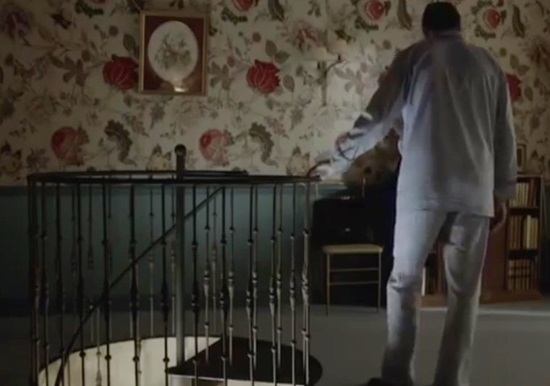
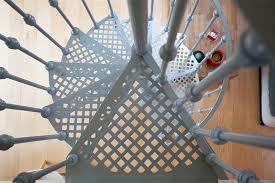
Per metà libro ci tiene serrati in uno spazio claustrofobico che si sviluppa intorno alla scala a chiocciola in ferro indicata dal titolo (anche quello francese), della quale impariamo a conoscere ogni svolta, altezza, ombra, colorando l’ossessione di Étienne – o quella che viene naturale definire tale – alla quale evita i colori più automatici, la gamma dei grigi, il nero, dando invece il riflesso acido dei neon del luna park di fronte all’appartamento (altezza mezzanino: negozio su strada, su per la scala a chiocciola direttamente nella stanza da letto).
Poi, nella seconda metà, ci porta fuori, per Parigi, i boulevard, le piazze, i quai, i cafè, l’ufficio postale, il mercato, lui segue lei, la pedina, la spia, le nasconde le sue visite dal medico, si nasconde in un portone…
Fino alla concisa soluzione finale che, arrivati a quel punto, ho trovato logica e rigorosa (ma, ripeto, Hitch si sarebbe divertito a concludere altrimenti. Anche se chi avrebbe senza ombra di dubbio scelto un finale più diabolico e gelido sarebbe stata Patricia Highsmith).

Profile Image for Glenn Russell.
1,525 reviews13.4k followers
Read
July 8, 2023


Georges Simenon - a born storyteller capable of typing 60 to 80 pages of well crafted prose in one day. "Some people collect stamps; I collect human beings."

From age 18 to 31 Georges used 17 different noms de plume to pump out over 350 novels and short stories. But this was merely the warm up. Georges then created famous Commissaire Jules Maigret and under his own name penned 75 novels and dozens of short stories featuring his legendary police detective. Upon reaching his early 50s, Georges turned serious and switched to authoring well over 100 novels he termed romans durs - and that's romans durs as in hard or harrowing or, what might be termed, existential.

I'm particularly drawn to existential novels by the likes of Jean-Paul Sartre and Albert Camus, thus I'm a huge fan of Maestro Simenon's romans durs - to date, 16 read and reviewed, 100 to go.

Georges set aside things like religion and politics to zero in on the details of human existence, most particularly the inner life and psychology of his characters. His language is simple; he wanted as many people as possible to read his books - deceptively simple, I might add, since he could compress so much in so few words and every single word counts.

Nowhere is the author's style more in evidence than in The Iron Staircase. The novel's first pages are vintage Simenon: 1953 Paris and we're in a second-floor bedroom apartment over a print/stationary shop where physically ill Etienne, age forty, makes a record of his most recent heart attack.

Piece by piece, we're then given the details of Etienne's living arrangement: for fifteen years he's been married to Louise, owner of the business, inherited from her father, a strong willed, earthy woman he married back when he was 25 and she 32, having lost her first husband due to illness. Etienne and Louise - she stands at the cash register, runs the store, attends to customers, taking frequent breaks to walk up the spiral iron staircase to check on Etienne's health; Etienne, in turn, keeps close track of Louise's every word and movement. "They had lived together for so long that they sometimes felt there was no need to speak." And since Etienne has been in bed with his lingering illness, it was "as though she were watching him from the outside, making a mental note of things of which he himself was unaware."

A tad oppressive and suffocating for certain, prompting us to ask: What brought the couple to this point? We're given the backstory: As a young man, before his marriage, Etienne worked as a traveling salesman for a paper/stationary company, As part of making his rounds in Paris, he met Louise running her store. Louise was married at the time, her husband's name was Guillaume Gatin, but then he became dreadfully ill, so much so that when Gatin died in the bedroom at the top of the iron staircase, he weighed no more than a child of ten.

The manner in which Georges Simenon builds Etienne's character is the work of master craft: Etienne must deal with his boredom, his loneliness, his mounting agitation. And his existential alienation: "He felt as though his face were no longer part of him, as though his features, hard and set, no longer reflected his emotions. His eyes were expressionless, fixed in a stupefied stare."

But then on top of everything else, Etienne reflects on Guillaume Gatin's death and starts to put two and two together - his distrust grows to the point where he suspects Louise has been poisoning him. Unbeknownst to his wife, he consults a doctor who conducts a test. And the results of the test are: yes! large quantities of arsenic. What's to be done? To find out, you will have to read this Simenon for yourself.


The young author at his typewriter. Georges Simenon, 1903-1989

"He was suddenly panic-stricken. If he had known how, he would have kept their guests from leaving. He knew that nothing would happen, nothing could happen. There would just be the two of them, shut in together, spying on each other." - Georges Simenon, The Iron Staircase
Profile Image for Sandra.
965 reviews341 followers
November 24, 2018
Claustrofobico, ossessivo, sorprendente, una storia a tinte forti.... inutile cercare tante definizioni: uno dei migliori Simenon, non riesci a staccarti fino alla fine, una fine per certi versi prevedibile, per altri inaspettata. Ancora una volta Simenon studia un rapporto di coppia, ancora una volta si tratta di una coppia patologica, lo scrittore guida il lettore a comprendere piano piano quanto sta accadendo e poi affonda come una lama tagliente nella psiche dei personaggi.
E tu lettore ti chiedi una volta di più come faccia a scrivere così quest'uomo.
Profile Image for Evi *.
399 reviews309 followers
December 6, 2018
Un titolo centrato perché senza l’escalier e con un'abitazione dalla pianta diversa forse la storia sarebbe stata un'altra storia.

Come quando apri il frigorifero ed è quasi vuoto e, con i soli quattro ingredienti che ti guardano tristemente dai ripiani, riesci a mettere insieme qualcosa, così Simenon ha bisogno di poco: due, al max tre personaggi - lui, lei, l'altro - cinque stanze, un bistrot, un cinema, un medico, una zuppa di legumi.

In mano ad altro autore un materiale così esiguo porterebbe alla solita geometria di triangoli o quadrilateri irregolari e invece Simenon, immancabilmente, crea variazioni su tema avviluppando il lettore nelle sue torbide spire.
Profile Image for Dagio_maya .
1,118 reviews354 followers
March 29, 2025

” Dopodiché, ancora un momento di silenzio, di vuoto.
Finalmente lui sentì vibrare il primo gradino della scala di ferro...”


Louise ed Étienne sono sposati da quindici anni.
Una coppia chiusa nelle proprie abitudini che ha stabilito un’intesa fatta di sguardi e comportamenti che non hanno bisogno di parole.

description

La scala di ferro, assieme ad un tubo acustico posto in cucina, collega la cartoleria del piano di sotto alla loro casa.

Tutto sembra procedere bene finché un giorno, dopo una serie di malesseri, Étienne comincia ad avere il sospetto che qualcosa sia cambiato.


Il dubbio si moltiplica e diventa una tormentosa ossessione che nutre le ore di quella vita che non è più così pacifica.
Il silenzio che prima era la rassicurante certezza d’intendersi si trasforma in qualcosa di doloroso e letale.

Le parole feriscono ma i silenzi, spesso, uccidono.

Torbido, perverso Simenon, maestro di drammi occultati tra le quattro mura di una qualsiasi casa borghese.

”Erano stati due solitari che, ansiosi solo di rendere sempre più profonda la loro solitudine, avevano ridotto l’universo al loro appartamento, alla loro camera, al loro letto,”
Profile Image for Toby.
861 reviews374 followers
December 20, 2012
Book #250 of my 250 book challenge in 2012 - not even Simenon could write fast enough to keep up with that!

My incredible year of reading an average of just under 5 books per week came to a bit of a damp squib ending with possibly my least favourite of the great Belgian's roman durs I've picked up to date. That's not to say that it is bad, it is very well written and a fascinating study of paranoia, it's just not as enjoyable as the others.

In the shop downstairs Louise telephones, as she had once telephoned him before Guillaume died....

In the room at the top of the iron staircase Etienne lies and listens, watching the fairground lights kaleidoscope across the ceiling - waiting...wondering....

Would he too die - as Guillaume had died - in this very room?


It's the story of Etienne, and his relationship with his wife Louise from his point of view. In true Simenon style it's not as straight forward as that, we are plunged in to the seemingly damaged mind of a weak and insecure man and as the story unfolds we are left wondering just how much of what occurs is only in his mind. Simenon's skill lies in putting you inside the minds of his protagonists and making them seem reasonable no matter how broken.

What is quite remarkable is that there is very little dialogue, most conversations being a collection of small talk and platitudes (but then aren't they mostly like this in the real world too?) and this is where the psychological questions are raised; the nature of the mind, relations between men and women, friends, lovers, colleagues, even the effect of isolation and religion are also touched on subtly by the text.

As with all other Simenon's this is worth a read and is a step above most other authors who write in the genre, if you see a Simenon read it.
Profile Image for Tittirossa.
1,062 reviews339 followers
July 14, 2021
E' orribile.
Simenon è un serial killer che ha trovato il modo di non andare in galera, anzi di lucrare sulle proprie fantasie omicide, generalmente legate a un vulnus sentimentale-famigliare-erotico-passionale.
Generalmente la vita degli autori mi lascia indifferente rispetto alla loro opera, cioè, sono una avida lettrice di biografie, ma se uno è un delinquente ma scrive divinamente la cosa non mi scompone più di tanto.

Nel caso di Simenon invece è successo il contrario, sono stata sempre abbastanza distante da questo autore, avevo letto qualcosa e il giudizio, sia per i Maigret che per i romanzi era si bello bravo però boh. Fino a quando ho letto Le Memorie Intime.
E ho avuto la rivelazione. Il sudiciume che si attacca a tutte le pagine (credo che S. non abbia mai descritto con tenerezza niente che non sia un tramonto o un'alba, pure i paesaggi sono sempre un po' cringe) è quello che Simenon si scrolla di dosso. Si gratta via dal cervello, dove le fantasie si susseguono e può dominarle - evidentemente - solo scrivendole. Sarebbe stato interessante provare a fare un esperimento: impedirgli di scrivere per un periodo prolungato, e vedere se sarebbe arrivato a uccidere qualcuno.

Da giovane aveva provato a fare una scommessa: farsi chiudere in una gabbia di vetro per tot ore, in cui avrebbe dovuto scrivere un romanzo. Non ci era riuscito, ma la gabbia era riuscito a costruirsela lo stesso.

La scala di ferro è la solita vertigine di solitudine, inutilità, soffocante corsa verso qualcosa di aberrante che succederà sicuramente. Scritto come sempre in modo eccellente.
Profile Image for JimZ.
1,306 reviews778 followers
January 22, 2020
This is the first book I have read by this acclaimed author. I have yet to read GR reviews so I can get a better grasp of the book (as soon as I post this I shall peruse the reviews). I know what the ending was…but I am not sure of the “why” of it (loose end #1)…and whether the wife was doing both things the husband suspected that she was doing (loose ends #2 and #3)… The book was suspenseful but for there to be 3 loose ends after I am done with a book….I can therefore say that for me it was only an OK read. But this could also mean that I am dense!

One quote that made me startle: "Perhaps she was sorry for him as one is sorry for a cat when one has no choice but to drown it." (I have not been in that sort of situation before where I had no choice but to drown a cat...which I guess I should be thankful for....)
Profile Image for Ubik 2.0.
1,080 reviews300 followers
March 30, 2019
La casa dei sospetti

“La scala di ferro” è un titolo ben appropriato per questo romanzo di Simenon: a caratterizzare il racconto infatti è proprio l’appartamento in Boulevard de Clichy con la sua conformazione particolare, la scala di ferro a chiocciola che lo collega al negozio sottostante, la stanza da letto dalle cui finestre penetrano le luci e le voci della fiera adiacente, la cucina a sua volta allacciata al negozio tramite una sorta di tubo acustico dal quale la padrona di casa impartisce disposizioni alla cameriera, il tutto accuratamente descritto dall’autore, col tipico acume nel delineare gli ambienti e imprimerli nella nostra mente proprio come se li avessimo frequentati.

All’interno di questo microcosmo, che per gran parte del romanzo ne costituisce l’unico teatro, si collocano i pochi personaggi e soprattutto Etienne, tipico protagonista “simenoniano”, dal carattere tormentato e ossessivo.
Tuttavia, a differenza di altre storie del maestro belga che iniziano in un tran-tran borghese nel quale penetra inatteso un fattore estraneo a sovvertirne l’equilibrio, il fulmineo incipit di “La scala di ferro” ci proietta immediatamente al centro di una storia già avviata, creando un effetto (*)di disagio e smarrimento, giacché a lungo non è dato comprendere cosa stia accadendo, ovvero se lo stesso Etienne sia ammalato, ipocondriaco o insano di mente, tanto il suo comportamento appare instabile e controverso.

La scala a chiocciola è l’elemento attraverso il quale Etienne e Louise si spiano e si controllano, si chiamano e ascoltano, in un confronto di caratteri di cui ci sfugge sempre qualcosa: cosa teme Etienne? Perché il disagio di Louise? E gli altri personaggi da che parte stanno? Tradiscono, compatiscono o si limitano al ruolo di testimoni? E perché l’ombra del primo marito di Louise, morto in circostanze poco chiare, torna ancora alla mente di Etienne?

Finché Simenon, ben oltre la metà del romanzo, riesce a sostenere questo raffinato gioco di specchi, dominato dal sospetto, dall’illusione, dal contrasto fra l’apparenza e la possibile realtà, l’atmosfera (*)carica di tensione costantemente repressa rende il racconto avvincente e magico, la pagina scotta, ogni dettaglio, ogni frase accennata, acquistano significati ambigui e variabili.

Non è un caso che il racconto, proprio quando nell’ultima parte esce dalla claustrofobia dell’appartamento di Clichy, smarrisca il delicato equilibrio sul quale si reggeva lasciando l’impressione di un finale non all’altezza, piuttosto affrettato e posticcio, anche se tutto quello che precede resta pressoché perfetto.

(*)Purtroppo questo effetto e questa atmosfera sono rovinate dallo spoiler dell’Adelphi che sbatte in retrocopertina, cioè subito, quello che Simenon aveva scelto di svelare molto più avanti. Ho fortuitamente evitato questo sabotaggio grazie al mio anonimo e-book…
Profile Image for Pino Sabatelli.
597 reviews70 followers
March 6, 2018
Una prova di incredibile virtuosismo narrativo di Simenon che, utilizzando pochissimi elementi, riesce a creare una storia di rara intensità psicologica ed emotiva.
Un testo che molti scrittori contemporanei, adusi a utilizzare centinaia di pagine per dire un bel nulla, dovrebbero studiare per cercare di carpire i segreti del grande belga ed, eventualmente, decidere di cambiare mestiere.
Profile Image for Adriana Moretti.
728 reviews7 followers
January 6, 2025
Un noir-thriller molto ben costruito. Un libro che scava nell'animo umano impietosamente, conducendo una narrazione con uno stile impeccabile, asciutto e nello stesso tempo denso di emozioni. Un libro che non riesci ad abbandonare, che non vedi l’ora di arrivare al finale.
Profile Image for Atticus_jem_scout Angela.
105 reviews19 followers
July 25, 2016
Il grande Simenon, lontano dai suoi Maigret, ci narra una storia di angoscia e disperato amore, con uno stile asciutto, immagini quasi fotografiche e dialoghi di pochissime parole. Un racconto che si legge in breve tempo seguendo le circonvoluzioni mentali del protagonista ed il suo sguardo di uomo segnato dal destino. Bello.
Profile Image for paper0r0ss0.
653 reviews58 followers
July 14, 2021
Vita di coppia in un interno. Opprimente, ripetitiva, soavemente ottundente ma in definitiva angosciante. Ma anche in un contesto cosi' apparentemente immobile puo' succedere di tutto. Scritto come sempre con maestria assoluta, risente tuttavia di una vaga sensazione di stallo. Beninteso siamo sempre a livelli simenoniani, ossia di assoluta qualita' narrativa e introspettiva.
Profile Image for Silvia.
306 reviews21 followers
February 26, 2023
Superba prova di scrittura (non letteratura, guai a nominarla con Simenon), ti costringe a girare le pagine senza sosta, un incedere ossessivo che ti toglie il respiro.
Profile Image for Takoneando entre libros.
773 reviews142 followers
February 16, 2025
Magnífica novela negra como casi todo lo de Simenon. No me ha gustado nada el desenlace y por eso no le doy máxima puntuación.
Profile Image for Jim.
2,431 reviews806 followers
May 13, 2009
Georges Simenon is an amazing writer. I can count on picking up a random mystery novel by him -- as I did this time -- and wind up with a winner. Although he is most famous for his detective stories involving Inspector Maigret, this is one of his non-Maigrets.

Picture to yourself a middle-aged couple: a salesman and his shopkeeper wife, some seven years older than him. Etienne Lomel appears to be ill and have his suspicions that he is being poisoned: He even keeps a diary of what he eats at home. The odd thing is that he actually loves his wife, though their relationship appears to be a quiet, understated one. On Thursdays, a couple who are old friends of the wife come over to play bélote, a popular French card game.

There is definitely a film noir quality to this novel as Etienne is of two minds on what to do about it. I won't spoil the plot for you. Suffice it to say that it would make for an interesting Claude Chabrol film.
Profile Image for Stephen Leary.
Author 13 books7 followers
February 12, 2019
Etienne Lomel believes his wife Louise might be poisoning him. Although he is only 40, he is in terrible physical condition. He is breathless after walking up stairs, visibly losing weight, and always tired and apathetic.

After eating meals, he often feels a burning sensation in his throat, dizziness, and a pain in his chest. The doctors aren't sure what the problem is and tell him to make a note of what happened just before each attack--what he ate, what he was doing.

Sometimes he feels ashamed of his "evil thoughts" that maybe Louise wants him dead. Perhaps it isn't really true. After 15 years of marriage, he still loves her and wants to continue their relationship. But is she having an affair?

They live above a stationery shop. It is his wife's business, having inherited it from her father. Everything belongs to her. Lomel owns nothing of his own and must ask her for money. He is totally dependent on her. She's the boss. The iron staircase of the title leads from the first floor up directly to their bedroom and the other rooms where they live.

Lomel often stands at the top of the staircase listening to what is said downstairs at the shop. He wonders about the men Louise meets there every day--perhaps she is serious about one of them? He spends his days fretting and speculating about his wife while trying to recover from his illness.

We learn how Etienne and Louise first met 15 years ago. She was married to her first husband at the time. Etienne came to her shop on business and they soon began an affair. Louise's callousness is seen when her sister-in-law died: all it meant to her was the chance for a long rendezvous with her lover, Etienne, since her husband had to go away for the funeral.

Etienne and Louise agree to marry, but what about her husband? During one of his visits, she tells Etienne that her husband has become seriously ill. After a few weeks, the husband dies. Etienne didn't question her about it.

He believes she poisoned her husband, as she might be poisoning him now, to get him out of the way and marry a younger man. Etienne has the same symptoms that her previous husband had immediately before he died: weight loss, tiredness, and heart trouble. For the 15 years of their marriage, he had never asked his wife how her former husband had died.

Part II opens with Etienne seeing a doctor and asking if it's possible to determine if he is the victim of arsenic poisoning. At first, the doctor isn't sure. Etienne resolves to stay with Louise in spite of her and not to die. He takes the blame for his poor attitude. He tells her and their friends that he is a new person.

Later he goes to the doctor again for more arsenic testing and the doctor finds positive results. Etienne finally has proof that Louise is trying to murder him. He tries to figure out what he will do. The doctor suggests he is obligated to go to the police but Etienne refuses to give him any information and leaves.

Etienne goes back home and acts naturally. Whenever he eats or drinks something he believes is spiked with poison, he leaves the house and throws it up. He decides to spy on his wife by following her and find out where she goes. Etienne sees her at the post office where she reads a letter that makes her very happy. He sees her receive additional letters in the following days, probably from the same person, her new lover.

Etienne follows his wife as she leaves the shop one day and sees her go to a restaurant. He waits and after an hour, he sees her leave arm-in-arm with a man. He sees them kiss as they part. He recognizes the man as Roger Cornu, son of a printer in their stationery shop.

Even now, knowing everything, Etienne still wants to keep Louise, and to keep living. He realizes he is as much to blame as his wife for the death of her former husband, since he agreed to marry her while she was still with him. Feelings of guilt over the death of the ex-husband often possess him. He wants their relationship to remain as it is, keeping to themselves with their silent secrets.

Etienne follows Cornu to his workplace and home, not finding him. But he is told the name of the restaurant where he usually hangs out. He then goes to a gun shop and buys a revolver. Afterward, Louise will understand, he believes, because he did the same thing she did before. He can't afford to lose her because he is completely dependent on her.

He goes to Cornu's favorite restaurant and sees him there, writing a letter, probably to Louise. Etienne then goes to Cornu's home and lies in wait for him during the night. When Cornu arrives, he notices Etienne standing outside, and calls to him. Etienne is surprised Cornu recognizes him so easily, but shouldn't have, since they are so similar, two steps on a staircase.

Simenon masterfully sets up the reader throughout the narrative for the strange, brutal resolution. Etienne hesitates to pull out his gun. He is unable to kill Cornu, as he is the same as himself and Louise's ex-husband. Unable to change from the kind of person he is to someone like his wife, he can't traverse the "iron staircase" that separates them. Cornu, knowing his own guilt, is stunned that Etienne doesn't pull out a gun and shoot him. He bids him goodnight and goes inside. Half an hour later, sitting outside, Etienne shoots himself.

Long out-of-print in English, The Iron Staircase, with its psychological drama and pervading existentialist atmosphere, echoes Simenon's French peers, such as Sartre and Camus. It is one of his finest efforts.
Profile Image for Andy Weston.
3,243 reviews229 followers
May 29, 2025
I’ll just start off by saying I am a big Simenon fan, more so of his stand-alones and romans- durs than his Maigret novels, though I do enjoy those as well.
I’m trying to get a copy of every English translation and still have a few to find.
This was a digital copy from the internet archive, and somewhat inexplicably only has 42 Goodreads reviews. Many of Simenon’s romans-durs are out of print, some get reissues, but the decision as to which often seems baffling, and not a whole lot to do with quality.

This is typical of the great author, vintage 1953 and a window into domestic relations that aren’t going terribly well, and ends, typically once more, with a rewarding twist.

Fifteen years ago Etienne became the second husband of stationary shop owner Louise, her first husband having conveniently withered away. In his 40s Etienne, who narrates, comes across as insipid, meek, paranoiac and a hypochondriac. Fortunately his doctor lives in an apartment two floors up, and barely a night goes by without a call to him. But Louise monitors his temperature, which is always fine, and cannot find any symptoms other than him not feeling well. Etienne becomes convinced she is out to get him, and each night sifts through his mashed potatoes for any trace of arsenic.

So, typical Simenon, but better than that, with more dark humour than usual. It really is a treat to read. Etienne’s situation may be one we have heard about many times over, but the atmosphere Simenon creates, from the shop and the iron staircase up to the apartment, to that implied eroticism he does so well, make it stand out. It comes down to passion, though an awkward and desperate variety of it that is quite compelling to read about.

It was adapted for a film in France in 2013, L’escalier de Fers, and strikes me that the book also is more in Europe than in the UK; it has had reprints in France and Italy in the last few years.
Profile Image for Ray.
156 reviews
August 19, 2018
Mystery writer Georges Simenon was someone I was aware of but had never read before, so I picked up this book as a lark thinking it would be fast read (and it was). The book is a mystery of sorts but not the usual Simenon (he has a detective series of novels, but that character is not in this book). Simenon looks at a marriage and a husband's paranoia that his wife is secretly poisoning him. As he reveals clues, the author examines their middle class marriage, the love they have for each other, their past, their future. I found the book interesting and suspenseful, even though it was a bit long for it's subject. It felt like a very long short story. In fact, the writing reminded me a great deal of John Cheever. I'm not sure I'm up for one of the detective mysteries but I'm glad I read this book.
Profile Image for Winston Smith.
41 reviews2 followers
August 8, 2017
I soliti pochi ingredienti sapientemente dosati.
A volte le vite degli individui escono dai loro solchi predefiniti, seguendo percorsi alternativi e tortuosi, per ripiombare inaspettatamente nei loro alvei originari, percorrendoli ineluttabilmente sino alla fine.
Profile Image for Fabio.
85 reviews123 followers
May 25, 2021
Angosciante, ossessivo, compulsivo.
Claustrofobico.
E' il primo romanzo che leggo di Simenon, e molto probabilmente non sarà l'ultimo. Il ritmo sincopato, a tratti snervante quanto riflessivo, ha saputo creare una costante tensione, la vera caratteristica principale di questo romanzo, un eterno duello della sfiducia.
Piccolo bemolle: il finale. Troppo affrettato, dopo tutto ciò che è trascorso, speravo in qualcosa di più elaborato, 50 pagine in più non avrebbero fatto male.
Per il resto, davvero consigliato!
Profile Image for Nadia Kebaier.
43 reviews
October 20, 2024
Jeg er ret late to the party, men jeg er så glad for, at jeg blev anbefalet at tjekke Georges Simenons forfatterskab ud. Han skriver intelligent og medrivende.
Profile Image for Ali.
20 reviews1 follower
August 10, 2025
Nice short read. I was never quite sure if it was meant to be unsettling or just miserable, but the little mysteries of the characters were revealed in good time and I finished it thinking nothing in particular beyond that the narrator seemed very understated in his desperation.
72 reviews
August 16, 2021
La scala di ferro che collega la cartoleria alla casa dei Lomel, non verrà più usata per li stesso scopo né da Louise né da Etienne: magistrale forse più del solito nel narrare e approfondire la relazione di coppia, Simenon mi ha fatto restare col fiato sospeso fino all ultima pagina. Louise ed Etienne sono uniti dal "non detto" in maniera sottile e tagliente, Louise sa che Etienne ha compreso ciò che era accaduto al suo precedente marito ed Etienne sa che sta per capitargli la stessa cosa. Le vicende si ripetono, i pensieri di entrambi diventano per il lettore tensione allo stato puro. UN SIMENON da divorare per poi rimanere increduli sul finale...
Profile Image for George.
46 reviews3 followers
August 15, 2018
A relentless illness rendered through words like a mop of tears being wrung out, each droplet a paragraph.

Although it’s not as moving as all that- it’s much more of a stream of consciousness with someone plagued by insecurity. It can be tiresome at times but the suspense over how the characters will handle the *perceived* situation is gripping enough to carry you through to the last gut wrenching page.
Profile Image for Marco Innamorati.
Author 18 books32 followers
April 24, 2021
Tra i migliori Simenon “americani”, anche se ambientato a Parigi. Un romanzo nero e crudele, in cui il protagonista si trova ad assumere decisioni, coscienti o inconsapevoli, sulla propria morte o la morte altrui. Trovarsi soli a confrontarsi col proprio destino è difficile e circostanze casuali finiscono per giocare un ruolo decisivo. Come spesso succede in Simenon, persino l’ultima pagina può proporre più di una sorpresa.
58 reviews
November 21, 2021
Superb pitch-black tale about the end of a love story. The background to the events become slowly clear like a black and white photo print developing in a dark room. A very, very dark room. The relationship between woman and man is based on a "original sin" that was never clearly identified, existed in a sort of mist and was constantly suppressed. Until things start to shift... Absolutely relentless pace towards a merciless ending.
132 reviews
July 21, 2010
This book starts off great: a list of what a man ate and how he feels. It isn't until about 50 pages later that you find out why. This novel is a little like "Rear Window"; a man mostly confined to bed gathers evidence to prove a crime. The ending was a little disappointing, though.
Profile Image for Marti Martinson.
342 reviews8 followers
November 7, 2016
Simenon set me up. I could tell from the start this book did not bode well. He did not let me down, but he set me up. Shocking and unequivocal ending. Finish this book at night or it will ruin your whole day.

I don't want to have BEEN Simenon; I just wish I wrote EXACTLY as he wrote, NOW.
Displaying 1 - 30 of 53 reviews

Can't find what you're looking for?

Get help and learn more about the design.