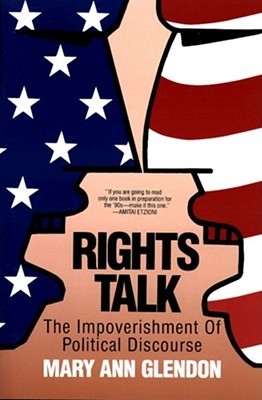
Political speech in the United States is undergoing a crisis. Glendon's acclaimed book traces the evolution of the strident language of rights in America and shows how it has captured the nation's devotion to individualism and liberty, but omitted the American traditions of hospitality and care for the community.
Mary Ann Glendon is the Learned Hand Professor of Law at Harvard Law School and a former United States Ambassador to the Holy See. She teaches and writes on bioethics, comparative constitutional law, property, and human rights in international law.
A very interesting and challenging critique, from about 1990, of hyper-individualism in the world of legal rights from a conservative leaning jurist and professor. This is a far more balanced critique than something likePatrick Deneen's Why LIberalism Failed, in large part because Glendon isn't really seeking to topple the basic modern liberal rights order but to balance it with greater recognition of the duties of the individual to society.
Glendon's main argument is that both conservatives and liberals conserve in only one political language: rights. Rights have become trumps to all other claims or goods. If it is my property/body/mind/whatever, I can do with it what I want. There are obviously both conservative and liberal versions of this, and Glendon shows how it had taken over juridprudence from the 60s to the 1990s. She levels a series of critiques: First, the law needs to take into greater account the interests of society, not in a society v. the individual sense, but because the individual can only thrive in a certain healthy public/social setting (think community, family, school), and too much individualism can undermine those efforts. The rights-bearer is considered to be an isolated individual whose interests conflict with society rather than someone who needs a broader social setting.
She makes a similar critique of the privacy doctrine, which I found less compelling. In this realm, I thought she overstepped the "Millian" harm paradigm, although she makes the insightful point that MIll is pretty vague on what harm constitutes (as in, he thinks about it mainly as harm to other individuals rather than to a family, community, or institution). Overall, I think this is a healthy way to look at the law and society and their relationships to the individual. It pushes back on right-wing free marketism that ignores or explains away the cost of much market activity to communities, families, etc, but it pushes back equally effectively on the left's emphasis on radical identity politics and individual choice. Ultimately, a mature political discourse has to be more than a battle of rights-claims. We must incorporate responsibilities, social contexts, and the individual as both single and social. She also makes a great argument that the American legal community is incredibly insular, rarely seriously investigating societies like Germany where rights are more openly balanced with duties in things like the Basic Law.
Overall, I found this book concise and refreshing. Glendon is certainly more conservative than me, and I did not agree with her fairly moderate critique of Roe. However, I think the general spirit of her argument is really important, and in a society where left and right continue to make absolutist rights-claims, not absorbed well enough. Good book for people interested in rights and the law, which may be a small-ish audience.
Portentous subtleties of modern American language and law
Harvard’s Mary Ann Glendon provides one of those rare insights into why we are the way we are, exposing what is patently aberrant when externally viewed, axiomatic by force of habit, and an educational system catering to consumerism. Central is our language, that way to the soul of how we view our world and us in it, through rights talk. American rights talk is stark, simple, polarizing, legalistic, excessively bestowing the rights label with exaggerated insular absoluteness of hyper-individualism expressed as unbounded wants and desires with utter silence on personal, civic or collective responsibilities (that's a mouthful). Nearly every social controversy is now framed as a clash of absolute rights with self-correction denied and compromise unlikely in our winner take all arrangement. What Hamilton said would happen, happened, and with a vengeance. While the Bill Of Rights (he opposed) was to clarify what the federal government would not do, it has been transformed as a route to governmental expansion via what government must do for us. “Rights” are now paramount and the touchstone of legitimacy. (Just listen to the list of rights we never knew we had in our current political debates.)
Glendon illuminates a turn taking place in the 50’s when the principle focus of the Court was not personal liberty but the division of authority and allocation of power between States and the national government. Congressional legislation (subject to the people’s will) during the New Deal shifted to the Supreme Court (protected from the people’s will) and their creation of new or expanded rights with the stroke of a pen – a fundamental swing away from the people, and in the process of our governance. The “test case” became a replacement for time consuming political engagement. The results of which might go either way depending on the Court’s composition – liberal or conservative - a tyranny of nine instead of one that Madison warned against as a tyranny nonetheless.
Glendon elucidates our legal system’s inability to extrapolate long-term effects of their decisions, or recognizing entities other than individuals, corporations and States, i.e. communities are invisible. Not infrequently, opinions of justices sound as if from another galaxy not bothered by common sense. America’s emphasis of Locke’s property language is contrasted with Europe’s Rousseauian (though equally idyllic) perspective (Rousseau wasn’t any more complete than Locke), making all the difference, with Europe often appearing a good deal more rationally conditional than absolutist America. Interestingly, ideas in political philosophy can be seen to display creative inventiveness not unlike that found in science and technology, allowing new results from old principles or discoveries of alternate ways to interpret them. And like technology’s creation of penicillin or the atomic bomb, outcomes are not always positive. To this reader it was a shock to find rights do not deserve the altitude they’ve acquired in America. An excellent book every politician and lawyer should take intravenously, before they bury us all.
At one point in my life I took a concealed carry class. There were two youngish men in the class who always phrased their questions "But don't I have the right to...?" And the instructor, at one point, said "There are no rights. There are only laws. And I'm telling you what the laws say."
Lots of people, like these two, flaunt "rights talk" these days. But I was particularly fascinated by her subtitle and her first few chapters. No right is absolute. Her examples were dated and I expected that. What I didn't expect was the intense legal focus--- it seems like it was written for attorneys. I did find the comparisons between Canadian and European laws quite interesting, though I got lost in her argument at the end.
A decent discussion of what types of relationships can and do structure politics other than rights-relationships. In particular, the book is critical of defining almost all politics in terms of rights, when rights are most useful in a fairly small number of cases.
"Unfortunately, American political discourse has become vacuous, hard-edged, and inflexible just when it is called upon to encompass economic, social, and environmental problems of unparalleled difficulty and complexity."
The core claim of this book is that Americans are obsessed with notions of absolute rights which lead to political dysfunction. "A tendency to frame nearly every social controversy in terms of a clash of rights ... impedes compromise, mutual understanding, and the discovery of common ground.” This is explored in relation to various issues (abortion, family law, duties to aid) and comparison is made with how those same issues have been handled in Western European nations.
One of the things I find most frustrating about American politics is the way in which abortion can be exploited as a wedge issue; I know many people I have come into contact with could never be persuaded to vote against the GOP due solely to this. As the author notes, “[p]rolife and prochoice advocates alike have overwhelmingly opted for rights talk, a choice that has forced the debate into a seemingly nonnegotiable deadlock between the fetus’s 'right to life' and the pregnant woman’s 'right to choose.’” I don’t know whether or not a change in discourse would be fruitful (or desirable) towards resolving the impasse, but I found the discussion interesting.
Another idea I found especially interesting was that a tendency to have courts decide controversial issues by deducing the answer from constitutional rights leads to a reduced public involvement in the political process. Have liberals jeopardized parts of our agenda by relying too heavily on the courts to protect it? It’s concerning that victories such as the legalization of gay marriage rest only on judicial pronouncement, given that the party opposed to them now controls the presidency, Congress, and most state governments.
This is a legal academic text, but it addresses--and should be read by--a broader audience. The book's argument is that American political discourse is too narrowly fixated on the concept of legal rights, which state of affairs shortens and embrittles our ways political thinking, speaking, and acting. Mary Ann Glendon isn't shy about setting out to be the next Tocqueville, and she damn well succeeds; however, like Tocqueville, she's almost too precise of an observer to offer any meaningful path forward. Tocqueville's Democracy in America, written in the 1830s, is in large part about the inevitability of some terrible, potentially state-collapsing conflagration over slavery. His analysis is insightful because he gets at that ~inevitability so clearly: slavery was too terrible and too deeply rooted not to end in disaster. Glendon here has a similarly prophetic tone. Despite her optimistic gestures to the contrary, her analysis of American rights talk--and how it is rotting our political culture from the inside--has the flair of a doctor telling us of a terminal illness. It's too late.
I thought this was a good book that gave voice to much of what is frustrating about American politics that I don't always have words to describe. It's particularly interesting to think about how the trends Glendon describes have changed compared to 1991--much is the same or worse, of course but the fact that 35 years have passed since the book is written is always an important piece of context to consider. I thought it was a bit dense and could have been more accessible to a general audience (a bit ironic since Glendon aims to critique the point of our difficulty in dealing with arguments of complexity), but other than that I do recommend.
This book was written around the time of the collapse of the postwar bipartisan establishment and its replacement with two coalitions of partisan interests (also, confusingly, called "establishments"). The agreement on Judeo-Christian and liberal values that had produced Presidents like JFK, Carter, and Reagan was being laid to rest; instead the liberals were beginning to speak in the language of rights as a form of virtue signaling while their true life ideals went unspoken, and the Republicans were building the groundwork for an infernal coalition of pro-business and culture war language. Prof. Glendon offers a good-natured attempt to analyze how the system might be put back together.
The essence of the problem is the difference between America as a community and America as a legal ideal. The function of the liberal ideal on which the country was founded has been to eliminate the communal aspect, with the result being that “law is now regarded by many Americans as the principal character of one of those few moral understandings that are widely shared by our diverse citizenry." (87)
As legality became the only clear way to judge issues, it became more difficult for outsiders like journalists to report on the moral quandaries of working class families with whom they did not share a common language of values.
But legalism leaves out the moral imperatives that are necessary to building a functioning society: “If history teaches us anything … it is that a liberal democracy is not just a given; that there seem to be conditions that are more, or less, favorable to its maintenance, and that these conditions importantly involve character--the character of individual citizens, and the character of those who serve the public in legislative, executive, judicial, or administrative capacities. Character, too, has conditions--residing to no small degree in nurture and education. Thus one can hardly escape from acknowledging the political importance of the family. ...
"Social historians of the future will no doubt be bemused by the fact that we late-twentieth-century Americans found it acceptable to discuss publicly in detail the most intimate aspects of personal life, while maintaining an almost prudish reserve concerning the political significance of family life. There are many plausible explanations for our reticence. One, no doubt, is the defect of our liberal virtues. Most of us aspire seriously to tolerance and broad-mindedness, with the consequence that it is hard to talk about certain matters that involve character. The word 'judgmental' has become an epithet in some circles." (126-7)
The problem is that this contradiction was truly irreconcilable in the American context. If value judgments are un-liberal, and America is liberal, then Americans cannot judge anyone without the language of legality and rights, which the author herself eventually descends into.
There are no real policy recommendations in this book, and I can't see how it could have helped contemporary readers. But reading it in 2016, it is obvious that Prof. Glendon identified real problems which only became more severe with time.
Rights talk is ubiquitous in American culture; from the highest political office holder to the lowest convenience store clerk, people invoke rights, often in absurdly stark and overbroad forms, as a way of expressing their desires, interests, and moral and political views. Often such rights claims lead people to say things that are clearly false and/or absurd, such as that they have the right, without qualification, to do whatever they want whenever they want. This custom is made all the more curious by the fact that people seem to know so little about rights themselves. What are rights? Where do they come from? Who has what rights, and how can you tell? When posed with such questions even some rights theorists fall silent.
The curious nature of American rights talk has led an increasing number of people to reject the existence of rights altogether. Rights have, of late, come under serious sustained attack from a variety of quaters, and it's hard not to feel a little sympathy with such critiques. Talk to a guy who thinks you have an absolute sui generis right to own a sub-machine gun a few times, and you will begin to understand why Bentham called rights "nonsense on stilts." Still, rights, and rights talk, lay at the heart of our republic, as well as of the recent attempts to hold foreign dictators to universal moral standards. It would be most unfortunate if a concept that has done so much good in the world turned out to be incoherent.
According to Glendon's book, the problem it not with rights themselves, but with what she calls the "American rights dialect," the particular way in which we speak of rights here and now. She argues that contemporary American rights talk is separated both from the European tradition, and from the tradition of the founding fathers, not only in its simplicity, but also in its extreme individualism, absoluteness, insularity, and inarguability. American rights talk ignores the connections (logical and moral) that rights have with duties, it denies the social and communal aspects of people, and it rejects the need for rights to be limited according to various circumstances. In effect American rights discourse has become a parody of itself, leaving it vulnerable to attack from those who would deny rights altogether.
It's clear from Glendon's other works (e.g. A World Made New) that she does believe in rights. While this book is largely critical of rights talk in its current form, it should be viewed, I think, fundamentally as an attempt to restore rights to their proper place in our political framework, lest we get fed up with the whole thing and throw out baby with bathwater. For this reason I would recommend this book both to advocates and opponents of rights. The former will emerge from it with a fuller, deeper understanding of how rights work, while the later may discover that there is more to rights than they had previously thought.
While recognizing the importance of individual rights, author questions the American tendency--if anything amplified in the years since publication--to cast any political issue as a contest of rights. In an erudite but accessible discussion, she articulates what we lose: a sense of greater responsibility, a sense of community, and mostly the ability to have a conversation about the society we want to be.
Brilliant seminal work. Shows the differences between American and European legal traditions, how the concept of individual rights influences application of justice in unexpected and unintended ways.
A must read for thinking lawyers and students of culture.