Jump to ratings and reviews
Rate this book

Sister Ursula #2

Rocket to the Morgue

Rate this book
1st IPL edition paperback fine as new

176 pages, Mass Market Paperback

First published January 1, 1942

78 people are currently reading
286 people want to read

About the author

Anthony Boucher

645 books43 followers
William Anthony Parker White, better known by his pen name Anthony Boucher, was an American author, critic, and editor who wrote several classic mystery novels, short stories, science fiction, and radio dramas. Between 1942 and 1947, he acted as reviewer of mostly mystery fiction for the San Francisco Chronicle. In addition to "Anthony Boucher", White also employed the pseudonym "H. H. Holmes", which was the pseudonym of a late-19th-century American serial killer; Boucher would also write light verse and sign it " Herman W. Mudgett" (the murderer's real name).
In a 1981 poll of 17 detective story writers and reviewers, his novel Nine Times Nine was voted as the ninth best locked room mystery of all time.

Ratings & Reviews

What do you think?
Rate this book

Friends & Following

Create a free account to discover what your friends think of this book!

Community Reviews

5 stars
46 (14%)
4 stars
114 (37%)
3 stars
119 (38%)
2 stars
22 (7%)
1 star
6 (1%)
Displaying 1 - 30 of 67 reviews
Profile Image for Craig.
6,389 reviews180 followers
April 6, 2022
Rocket to the Morgue is a locked-room mystery, a police procedural set just prior to the entry of the U.S. into the Second World War. (The story concludes on Saturday, December 6, 1941.) It was first published in 1942 under Boucher's pseudonym of H.H. Holmes. It's a very good mystery, with a large cast of quirky suspects and a very unlikely amateur detective, Sister Ursula, who aids the detective. Her involvement seems rather implausible, but it's a lot of fun and she's quite likable. The backdrop to the story is Boucher's fictionalized view of the vibrant science fiction community in Los Angeles of the time. The characters include many well-known writers in various levels of thinly disguised incarnation, including Cleve Cartmill, Henry Kuttner, C.L. Moore, Edmond Hamilton, Jack Williamson, L. Ron Hubbard, Julius Schwartz, and several others, most prominently Robert A. Heinlein. "Holmes" even includes Anthony Boucher as a character, and there are many in-jokes, such as including the pennames of Heinlein and John W. Campbell as personages. The story hasn't aged too much, in my opinion; several of the female characters are described as long-legged or bosomy (though never Ursula, of course!), but on the other hand they're all presented as being capable and intelligent, something the genre wasn't known for at the time. The game isn't afoot, it's counting down to blast off!
I read the Dell paperback which appeared in 1951 with Boucher's name on it, and a fascinating afterword from him included. Wow, they sure made them to last in those days; it's over seventy years old and in better condition than many of my current books. I also note that there is no price anywhere on the book. They didn't have to put a price on it, because in 1951 paperbacks cost a quarter and everybody just knew it... Good old days indeed.
Profile Image for Alan (the Lone Librarian rides again) Teder.
2,717 reviews257 followers
June 2, 2024
A Roman à clef* of Sci-Fi Writers
Review of the Penzler Publishers American Mystery Classics eBook edition (July 23, 2019) of the Duell, Sloan and Pearce hardcover original (1942).

This is the way it was in Southern California just before the war, when science fiction was being given its present form by such authors as Robert A. Heinlein (still the undisputed Master), Cleve Cartmill, Jack Williamson, Edmond Hamilton, Henry Kuttner, C. L. Moore, and many others. (And this is as wise a place as any to add hastily that no character in this novel is based specifically on any actual writer—nor is any character quite devoid of some factual basis.) - from the Afterword by author Antony Boucher.

Although Antony Boucher's Afterword tries to distance him from direct 1-to-1 correlations between his fictional characters in Rocket to the Morgue and the real-life science fiction authors they were based on, F. Paul Wilson's Introduction to this 2019 AMC edition states them explicitly. You can also read them in a section of the Wikipedia entry for the book.

So the fun of this is primarily the fictional depictions of authors such as Robert A. Heinlein and L. Ron Hubbard as murder suspects Austin Carter and D. Vance Wimpole in the book. The Wimpole character is already portrayed as a shifty, lecherous and unlikeable character, and this is well before the time when Hubbard invented his Scientology grift in 1953.


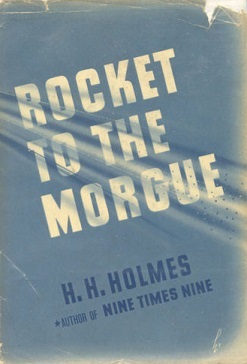
Cover of the original first edition published under the pseudonym H.H. Holmes by Duell, Sloan and Pearce in 1942. Image sourced from Wikipedia.

The detective Terry Marshal and his consultant Sister Ursula play rather minor roles throughout. It is a bit of a locked room mystery with various murder attempts on Hilary Foulkes, the son and literary executor of (fictional) sci-fi author Fowler Foulkes. Foulkes Jr. is despised by the rest of the literary community for exorbitant fees charged for the use of his father's copyright material. That scenario reminded me of the story of Stephen Joyce, the grandson of James Joyce, who held a similar iron hand over his grandfather's estate until the works entered the public domain in 2012. However, the situation in Rocket to the Morgue (1942) pre-dates the litigations and bans of the Joyce estate, which were mostly in the late 20th century.

Overall, this was goofy fun with most of the drama and interest coming from its real-world parallels.

Footnote
* From French: a novel with a key. Usually a novel where pseudonyms are used for the names of real life people. Sometimes the plot is a fictionalized version of events which actually happened. One therefore needs a "key" i.e. the secret code to identify who or what someone or something is based on.

Trivia and Links
There is a short section in this book devoted to a listing of "What If" speculative or alternate history literature, a sub-genre of fantasy and sci-fi. It was especially interesting to learn that Winston S. Churchill once wrote a speculative fiction piece If Lee Had Not Won the Battle of Gettysburg, written as if by a future historian in a world where the North had lost the American Civil War. The piece originally appeared in Scribner's Magazine in 1930 and was later collected in the anthology If It Had Happened Otherwise (1931).

This edition of Rocket to the Morgue is part of the Otto Penzler American Mystery Classics series (2018-ongoing). There is a related Goodreads Listopia here with 57 books listed as of early June 2024. There are currently 72 titles listed at the Mysterious Press online bookshop. The official website for the series at Penzler Publishers seems to show only the most recent and upcoming titles.
4,392 reviews56 followers
November 16, 2019
A solid mystery that is a bit rough in places but I really liked the look at the science fiction writers' scene at this time and the characters based on real writers. Lt. Marshall was cute forward for his time: changing his daughter's diapers and trying to help out his wife around the house. Unusual in deed during the 1940s.
Profile Image for Carla Remy.
1,066 reviews116 followers
Read
February 21, 2023
1941
DNF
This is giving me a headache.
Combines mystery, pulps, science fiction... Different timelines.
Profile Image for John Defrog: global citizen, local gadfly.
714 reviews20 followers
June 18, 2025
Never read Anthony Boucher before, but came across this 1942 novel as a Kindle deal that sounded interesting, as the central mystery (written under his pen name H.H. Holmes) revolves around the Mañana Literary Society, a real group of pulp science-fiction writers which Boucher was a member that held informal meetings hosted by Robert A. Heinlein. So the novel serves as both a murder mystery and a fictionalised snapshot of the community of pre-WW2 Golden Age SF when it was still relatively obscure. The book is also the second Boucher/Holmes novel to feature police detective Terry Marshall and Sister Ursula, a nun and amateur sleuth.

The premise: the murder of a drifter named Tarbell leads Marshall to Hilary Foulkes (son of the late great Fowler Foulkes, author of the popular Dr Derringer mysteries), who thinks someone is trying to kill him – Marshall thinks so too, not least because someone mails a bomb to Foulkes during their first meeting. It turns out Foulkes has a long list of enemies in the pulp publishing field due to being notoriously ruthless about his management of his father’s intellectual property. And one attempt on Foulkes’ life results in the arrest of Marshall’s friend (and aspiring SF pulp writer) Matt Duncan.

Boucher evidently intended this book in part as an attempt to capture the community of the early pre-WW2 Golden Age SF authors before SF became more of a mainstream pop culture staple. Supposedly this is one reason it’s one of the few Boucher novels still in print. The actual mystery is beside the point – which is as well, since it’s underwhelming as mysteries go, and the dialogue shoots for Hammett-style Nick and Nora banter and misses more often than not. That said, even the Golden Age SF only really works if you are obsessively familiar with even the most famous writers (Heinlein, Campbell, Hubbard, etc) outside of their actual stories. The target audience might like it, but the odds of me reading more Boucher seem pretty low.
Profile Image for David Agranoff.
Author 31 books211 followers
June 13, 2020
I took an interesting route to this book. Anthony Boucher whose real name was William Anthony Parker White wrote books and edited magazines in more than one genre. It is one thing to have had such an impact in one genre that awards and conventions are named after you, but amazing to have impacted two genres. Boucher is known for being a godfather of American mystery novels but it was his impact on Science Fiction that got my attention. I will admit a few years ago Boucher was not a name I knew. Then when my friends and I started the Dickheads Philip K Dick podcast a running joke grew over the episodes. Shout out to Tony, because his influence on the life of Philip K Dick was profound.

We constantly saw evidence of influence. Two editors had the biggest impact on PKD. Don Wollheim published most of Phil's novels and when talking about his career and the genre Phil always gave Don the credit for being not just one of but the MOST important person in Science fiction. Boucher, on the other hand, was more important to Phil on a personal as well as professional level. It is not just that he bought Phil's first short story Roog, but Tony inspired Phil to write Science Fiction in the first place. The two met and became friends in Berkley when this novel was already a re-printed classic. Philip Dick was working in a record store and Boucher was a regular, picking up vinal to play on his local opera radio show. Phil had dismissed the idea of writing sci-fi as kid stuff and it was Boucher that showed him that you could be a smart reader/ writer of the genre. It wasn't just pulpy kids stuff like Buck Rodgers. As a long time fan of A.E. Van Vogt Phil knew that but needed Boucher's encouragement to write. Boucher also hosted a bay area writers group that included Dick, Marian Zimmer Bradley, and Ray Nelson among others.

This group of friends would gather and talk about writing and critique each others work. Boucher of course had experience with a group like this and they were the basis of the novel Rocket To the Morgue. In 1940 Boucher and his wife were living in LA, and Boucher became a member of a writers group called the Minana literary society. This was a real writer's group that at the time was hosted by Robert Heinlein, and included L. Ron Hubbard, Henry Kutter and his wife C.L. Moore to name a few. Boucher used this group and real-life Science fiction figures like Forrest J Ackerman and John W. Campbell as characters in this murder mystery.

Keep in mind this novel was released under the name HH Holmes (yes the same name as the less famous at the time first American serial killer) Boucher made himself a character in the book as well. The details of the group are thinly veiled indeed Austin Carter is clearly Heinlein, D. Vance Wimpole is Hubbard, Halstad Pyn is likely the future founder of Famous Monsters Fores J Ackerman who in 1940 was an agent. Don Stuart who is mentioned but not in the action is John W. Campbell.

So you see This book is a work of genius and super important to the history of two genres. It is important because:

1. Boucher tells a fascinating locked room mystery with interesting characters.

2. Boucher comments on a meta-level about the personalities of important figures in the history of science fiction. It is a chance to get to know these figures.

3. Boucher tells a great story and still manages to comment on the Science Fiction genre at a time that it was in infancy. Confined to pulp magazines and tiny convention halls. Science fiction novels didn't get hardcover books so he was also introducing the world to the genre. Just two years before he approached a major mystery magazine to open his own SF magazine that still publishes today 50 plus years after his death.

4. A mystery novel sure but the most recent edition which features a great addition in the form of an excellent introduction by F.Paul Wilson makes sense to be shelved next to classic non-fiction books on the genre. Why because you'll learn levels of the history reading it.

So the actual story is a fun one. The heir to the literary estate of a writer who wrote popular supernatural detective novels Hilary Foulkes has several enemies. In 1941 Hollywood wants to make his father's stories into movies, and famous Science Fiction writers want to continue his work, but he has refused their efforts, after several attempts at his life the suspicions are directed at the sci-fi group. The action follows a Detective Terrance Marshall and Sister Mary Ursula, a nun of the Sisters of Martha of Bethany who has always dreamed of being a cop. This is the second Sister Ursula book but I have no idea if I am missing out on background about her.

The Mystery at the heart of the novel is fun, but it was not what interested me. The commentary and history of the Sci-fi genre were enough for me to make this a great read. The fun story was just a great bonus. As F.Paul Wilson author of The Keep and the Repairmen Jack Series said in his introduction "It made me want to run up to every science fiction fan I know and shove a copy at them, shouting "you have to read this!" I agree this book is a must-read for scholars of the genre.

Check out our Tony Boucher tribute episode:

On Youtube:
https://youtu.be/Fsz67cLwmuI

On Soundcloud:
https://soundcloud.com/dickheadspodca...

5,966 reviews67 followers
March 8, 2021
No-one much likes Hilary Foulkes. As literary executor for his famous father, he thwarts many science fiction projects by demanding high rates, and as a person he's pompous, self-important, and anything but charming. So when he calls the police to complain about attempts on his life, Lieutenant Marshall has to take it seriously--especially when Foulkes' phone number is found on the body of a recently dead Skid Row drifter. Unfortunately, clues point to Matt Duncan, a sci fi writer and one of Marshall's best friends. Who can solve the locked room mystery if not Sister Ursula, a nun who loves to solve mysteries?
5,305 reviews62 followers
August 25, 2019
#2 in the Sister Ursula series. This 1942 locked room mystery was written by author Anthony Boucher, writing as H.H. Holmes. Boucher is a name familiar to both the mystery and science fiction genres and here he manages to combine them both. Would-be police officer Sister Ursula is called upon by LAPD Lt. Marshall when a most unusual rosary if found among the effects of a murdered man. Also found was a phone number that led to Hilary Foulkes, the son of a science fiction icon. Hilary's life is being threatened and becomes another case for Marshall. The intersection of the two cases leads to the science fiction writers community of pre-war L.A. I doubt that the gimmick used to solve the locked room mystery is as prevalent as Boucher presents it, but this is still an entertaining read.

A locked-room mystery preoccupies Boucher's brilliant clerical sleuth, Sister Ursula, in this stellar entry. Lt. Terence Marshall of the LAPD asks for Ursula's advice when an unusual rosary, with seven sets of beads, is found in the pants pocket of a homeless man who was shot through the heart in a rooming house, though the killer didn't make off with the dead man's cash. The rosary and a slip of paper with the phone number to a fancy apartment hotel hidden amid the money are the only clues. When Marshall visits the building, he meets Hilary Foulkes, who insists that someone has tried to kill him several times, most recently by sending a package of poisoned chocolates. Marshall learns from a woman employed by the delivery service that accepted the package that the sender was disguised as Dr. Derringer, a character created by Foulkes's renowned sci-fi author father.
Profile Image for Frederick Heimbach.
Author 12 books21 followers
Read
November 8, 2023
Unfinished, unrated. One of the characters is based on Jack Parsons. This book didn't really shed light on Parsons and it is not well-written enough to justify continuing. It's poorly organized and hard to follow at the beginning. Later it simply turns dull. Not recommended.
Profile Image for Stacy.
1,951 reviews
December 31, 2019
A locked door murder mystery involving sci-fi writers was a hoot. Anthony Boucher while being the name behind the mystery convention of Bouchercon was also a sci-fi writer. The characters in the books are loosely based on his fellow writers and he even makes an appearance in the story.
Profile Image for Rafeeq O..
Author 11 books10 followers
November 19, 2023
Anthony Boucher's Rocket to the Morgue is an ingenious mystery and also a particular delight to anyone interested in the "pulp" era of science fiction.

The novel opens in prewar Los Angeles with Lieutenant Terrance Marshall, amiable family man and homicide detective, feeding the baby and answering his wife's question of "Anything interesting happen today?" Nothing interesting, of course--just a ho-hum corpse dead of low-caliber lead poisoning in a flophouse...only the murderer has not bothered to take the $300 of 1941 cash from the room, while the dead man's jacket holds an oddly distinctive rosary and the telephone number to a "[v]eddy veddy swank" apartment hotel. While Marshall's mystery-minded friend, Sister Ursula, looks into the singular religious artifact, the Lieutenant's investigation of the apartment hotel leads by complete happenstance to the plump, pretentious Hilary Foulkes, heir to his very famous father's literary estate, and a man thoroughly disliked by several science fiction writers. Now, Foulkes just happens to have had a couple of odd close calls recently--a falling brick, then a box of poisoned chocolates--and during Marshall's interview there arrives a package that ticks loudly, so...

Well, as one can see, pleasant tangles and red herrings abound. There are professional jealousies and monopolistic squeezings, a glamorous Mrs. Foulkes with little love lost, a brother-in-law who is next in line as literary executor of the lucrative "Dr. Derringer" series, a deferential cousin/typist, and a classic locked room mystery. For amusement we have sentences of the droll "She crossed her legs (she knew they were good) and leaned forward (she knew they were good too)" variety, a promotion-seeking flatfoot from Pasadena, installments of an exquisitely awful space opera being hacked out at a penny a word, and the wry wit and wisdom of the Manana Literary Society.

Boucher's depiction of this real-life group of California fantasy and science fiction writers, with its scarcely disguised members such as Robert A. Heinlein and others, is a particular joy. Each of these fellers, of course, has a perfectly acceptable reason for not necessarily relishing the continued corporeal existence of the vain and penny-pinching Hilary Foulkes, but it is the combination of pontificating about the history, future, and meaning of speculative fiction, plus numerous in-jokes, that make them doubly worthwhile. Austin Carter, for example, the Heinlein character, is suave and talkative and completely unflappable; when he says to Lieutenant Marshall something that it seems only the attempted murderer could have known, he then shrugs to the sputtering man, "'I believe I am supposed at this point to light a cigaret nonchalantly? Very well, I hereby do so.' The flame of the match was steady in his hand." This is hard not to adore.

Even if one were not already familiar with the lovable cranks of the quirky real-world Manana Literary Society--and I confess to knowing exceedingly little about anyone except Heinlein--all of these factors add up to a very enjoyable 5-star mystery from the pulp era of science fiction. In addition to the occasional wisecracks and the literary history and the in-jokes, there really is a mystery here, and its unexpected solving is definitely worth the wait.
Profile Image for Bev.
3,277 reviews349 followers
September 26, 2011
Rocket to the Morgue by Anthony Boucher (originally published in 1942 under his pseudonym H. H. Holmes). This is another vintage mystery find in that small, heavily-loaded-with-mysteries library in small town Indiana.

It revolves around the science fiction writer's world. The now-dead author Fowler Foulkes has reigned over the science fiction world in much the same way as Sir Arthur Conan Doyle and Holmes have presided over mysteries. His son, Hilary, fiercely protects the intellectual property of his father and does everything he can to keep that property producing the money to go along with the popularity. Hilary's attitude of inflexibility and greed has also earned him many enemies--especially among his father's science fiction colleagues. There are a couple of "accidents" that make him think that his life is in danger...and then a man named Jonathan Tarbell is murdered. Tarbell's death is connected to the Foulkes family by a rosary found in his pocket. The police are called in and Detective Inspector Terry Marshall arrives at the Foulkes home at the same time as a box of chocolates...a box of chocolates that seems to be ticking. And then there's a locked room mystery to be solved.

This was the first Boucher mystery I read. I didn't find the earlier work Nine Times Nine (to which this is a sequel) until much later. It isn't the all-time best mystery. It's a competent mystery and a fairly competent locked room mystery--but having read John Dickson Carr first spoiled me for greatness. What was so great about this book was that I read it during my transition period back to mysteries from science fiction. And the book revolves around the science fiction world. Authors of the Golden Age of SF are represented here...and those who know their SF lore will recognize them--and will catch all the in-jokes. It has been said that this book was Boucher's attempt to introduce SF to the mystery loving crowd. I would say that it might work just as well the other way around.
Profile Image for Judah Kosterman.
189 reviews1 follower
November 27, 2020
Published in 1942, this is a locked-room mystery which also features multiple attempted murders and one actual death by rocket (which is a great novelty, though annoyingly written in a future-past tense). It’s also a glimpse at what a then-fringe area of the writing community looked like.

On the plus side are multiple motives and candidates for the murderer and an unabashedly unlikeable victim whose role in all this gets an unexpected twist at the end. Other pluses are the strong female characters. There’s a possible murderess; an insightful relative; the investigating police lieutenant’s former-burlesque-dancer, mystery-mad, mother-of-my-two-children wife; and the should-have-been-a-cop nun who ultimately cracks the case.

On the minus side are the myriad in-jokes that come from setting this story in a semi-fictionalized group of early science fiction writers (though if the reader is a classic sci-fi fan, this will be a plus), the sameness of those characters, neon-lit clues which are so vague as to disrupt the reading flow, the relegation of strong female characters to the background, and the author turning himself into a minor, named character.

Stylistically something that wouldn’t be published today, this love-letter to fanboys and certain writer-friends of the author is a diverting read if found lying on a bookshelf this holiday season. It is not something to be sought out on purpose.
Profile Image for Kenneth.
1,145 reviews65 followers
May 6, 2021
This book is a whodunit first published in 1942 under one of the author's other pseudonyms, H.H. Holmes. It revolves around the heir of a late writer of Science Fiction & Detective stories who is being targeted for murder. Someone named Jonathan Tarbell has already been murdered, which is how Lt. Terence Marshall, detective, of the Los Angeles Police Department homicide division comes into the story at the beginning. seemingly with no connection to the heir, Hilary St. John Foulkes. Various clues and developments lead to meetings of SF writers, their association's meetings, and various SF fans. And one of the de facto detectives is Sister Ursula of the Order of St. Martha of Bethany. This book is the second book Boucher wrote involving her. In an afterword to the Dell paperback edition of 1951 (the one I read), Boucher says that the portraits of the SF groups are an accurate description of those groups as they actually were in the LA area on the eve of World War II.
Profile Image for Martin.
1,192 reviews24 followers
July 7, 2022
I chose this book because Boucher based several characters on SF luminaries of the early Astounding era. While the characters are in there, they are flat. Like many characters in puzzle mysteries, they are cutouts. All that's important is where they are when, and their motives as described by observers. They aren't written as people, but as pieces in a game. Boucher is like most classic mystery writers in this regard. I hoped to learn more about the characters as people, because they are based on people known to Boucher, but the writer doesn't offer that.

I did like the mystery, and I solved about 3/5's of it. I thought the inclusion of the nun as a detective hurt the book. It would have been better written with just the police detective as the focus of the action.

I love the book's design, but the introduction is weak sauce.
Profile Image for Daniel Marvello.
Author 9 books36 followers
November 29, 2011
I hate giving 1-star reviews, but "I didn't like it" is the truthful selection. This is a vintage mystery (published 1942) written in a style that didn't hold up very well over the years, in my opinion.

The choice of using a narrative voice for background information pulled me out of the story too much, and the over-the-top banter between the characters quickly became annoying. I had to give up on the book after a few chapters.
7 reviews1 follower
January 23, 2017
I need to be honest, I've never read this book. However, I thought you would be interested in a bit of Trivia

James Griffin, in his work "Robert A. Heinlein: A Reader's Companion" states that Boucher (under the pen name of H.H. Holmes) closely modeled the primary character 'Austin Carter' on the personna of Heinlein.
- page 252, A Selected Heinlein Bibliography
Profile Image for Steven.
31 reviews3 followers
July 10, 2008
Wonderful portrait of a skiffy community, the MLS (Mañana Literary Society) in the early 1940s. Fans of PKD's Man In The High Castle will also find a very intriguing reference to said work, 20 years before it was published!
Profile Image for John Carter.
361 reviews25 followers
January 10, 2012
Sister Ursula is one of detective literature's greatest proofs, along with Father Brown and Brother Cadfael, that being a devout Catholic and employing a very sharp intelligence are an ideal match and not a contradiction. It's a terrible shame that Boucher didn't write many more of her cases.
Profile Image for Liquidlasagna.
2,990 reviews109 followers
May 15, 2024

Hey look it's Howard Hughes on the cover, no wait it's Jack Parsons, what no it can't be John Waters
148 reviews
June 1, 2021
I enjoyed the locked room mystery but the writing is stilted, characters not well developed and doesn't hold up as well as other writings from the 1940s.
Profile Image for EuroHackie.
969 reviews22 followers
March 11, 2022
A fun little mystery with so many winks at SF/F and fandom that the author develops an eye tick.

As with any book wrapped in the name "Otto Penzler," you can't read the introduction as the introduction unless you want the entire story spoiled for you. I always read the intros as afterwards, and that definitely helped here. Because I don't have as much familiarity with the "golden age" of science fiction as I do with mystery, half the fun was trying to guess who these thinly-disguised characters were supposed to be stand-ins for. (Don't bother guessing the author - he inserted himself as a minor character in the background, which is a bit too much meta, even for me.)

The plot is centered around Hilary Foukes, an absolutely insufferable man who takes his position as heir to his father's literary estate way too seriously. He makes enemies everywhere he goes, including within his own household. It appears that someone is trying to kill him, and when Lt. Marshall stumbles into the attempts on his life whilst investigating a different case, he's suddenly roped in to finding a killer who could literally be anybody.

Marshall's original case involves a transient man who was murdered at a rundown hotel, with only a curious rosary as any sort of clue. He takes the rosary to Sister Ursula, a local nun with natural detective instincts, to ask about its origin and why it has seven stations instead of the usual five. These are apparently series characters, and while we see a great deal of Marshall (he is the investigating officer), Sister Ursula is much further in the background. This was a disappointment after the book jacket promised a more prominent role, but there was just enough of her there to make me want to read the rest of the series. I liked her and Marshall a lot.

The mystery itself takes a few twists and turns (and the author can't resist one post-script twist that is one twist too many), but the SF/F wrapping paper is a lot of fun and assists with the suspension of disbelief.

Anybody in fandom will delight in Marshall's absolute bafflement at confronting fandom's role in this mystery, and SF/F nerds will also delight in the real-life writers that are apparently very thinly disguised as main characters in the mystery. If, like me, you aren't sure who's who, the intro will tell you. Let me just say, L. Ron was suitably sleazy and gross.
39 reviews
April 3, 2025
Whilst investigating a murder of a floater, LA Homicide Lieutenant Terence Marshall finds a link to a posh apartment hotel. Once there, he encounters Hilary Foulkes, zealous guardian of his father’s literary estate, who has been waiting for the police to answer his call because he believes his life is under threat. A bomb arrives shortly afterwards.
The bomb is made safe, but the detective soon finds that Mr Foulkes has made many enemies, most of them in the local literary society. Foulkes’ father created the legendary Dr Derringer, a classic figure of early science fiction, and the literary society itself contains major science fiction authors of the time; this is set in 1941, before the US entered WW2, but written in 1942. Boucher was in the society and gives himself a walk-on part under his real name.
It is not long before Foulkes is stabbed in a locked room with no apparent means for a murderer to get in or out, or for Foulkes to stab himself. Foulkes survives, and the mystery becomes more involved as the possible suspects gather and all are invited to an experimental rocket test.
As F Paul Wilson describes in his introduction, and the author in his afterword, the characters in the literary society, together with others in the science fiction magazine trade, contain substantial elements of the real people, representing Californian science fiction at the time; they identify the authors involved, an agent, the editor, and the magazines involved. Wilson misses that the character Joe Henderson, although writing Edmond Hamilton-like fiction, resembles Jack Williamson more, and the novel cited as The Time Tunnel in the text is clearly Williamson’s pulp classic The Legion of Time, although the novel has the woman representing Virtue as dark-haired whereas Vice is blonde.
This is Boucher’s second novel with Marshall as protagonist, and still a good read as a murder mystery; in some respects I wasn’t fooled, but I had difficulty in finding the motive in among the possibles. The characters and their society give the novel life, and also make it an interesting historical snapshot, earning it an extra star from me.
Profile Image for Gabriele Crescenzi.
Author 2 books13 followers
January 30, 2020
Anthony Boucher è un autore noto agli amanti dei mystery e anche nel campo fantascientifico, essendo uno dei critici letterari più brillanti in tali ambiti.
"Rocket to the morgue" è il secondo romanzo giallo, nonché l'ultimo (ahimé), con protagonista suor Ursula. È un peccato che l'autore si sia limitato a scrivere solo queste due opere, perché non solo dimostra una grande inventiva nella costruzione degli intrecci gialli, ma ha anche fatto vita ad un investigatore peculiare e molto interessante. Il suo capolavoro è sicuramente la prima opera "Nine times nine", che considero una grandiosa camera chiusa. Purtroppo questa lettura si è rilevata meno soddisfacente, forse anche per le alte aspettative che avevo.

"Rocket to the morgue" è un giallo ambientato nell'ambiente letterario del neonato genere fantascientifico: Hilary St. John Faulkes, figlio di uno dei pionieri della sci-fi, nonché erede dei diritti dei suoi libri, è vittima di numerosi tentati omicidi. Uno di questi si rivelerà un tipico caso della camera chiusa. Il luogotenente Marshall dovrà districarsi tra altri casi apparentemente sconnessi, rosari particolari e bizzarri ed eccentrici scrittori fantascientifici prima di arrivare alla verità, grazie alla pervicacia di Suor Ursula. La soluzione è alquanto banale, in quanto ogni lettore avvezzo al genere capisce subito l'inghippo. È un classico del genere, utilizzato molte volte anche dalla Christie. Per cui se non altro il "chi" non giunge alla fine con grande sorpresa. Sul "come" invece del tentato omicidio nella camera chiusa sono un po' perplesso: da un lato è originale , ma dall'altro detesto questo tipo di risoluzione.
Dunque un'opera che vuole mostrare l'amore dell'autore per il genere fantascientifico, che però non riesce a raggiungere vette elevate in materia puramente poliziesca.
Profile Image for Melody.
1,355 reviews11 followers
January 28, 2023
Hilary Foulkes is the executor of his late father’s literary estate and his father was a quite popular author of the Dr. Derringer series (think Sherlock Holmes popular). He is also a skin flint and since he derives his income from his father’s labor he is happy to charge fro every re print, even a nun who wants to put one of the books into braille for the benefit of the blind in LA County. And he is also just not very nice. So when he starts having attempts on his life there are plenty of suspects. Enter the murder of a man named Tarbell, a man little known,m living in a rooming house and dying with a seven decade rosary and the phone number to Faoulkes apartment . Lt Marshall has recently solved a sensational locked room mystery and he goes to the Foulkes apartment to interview the household just as a bomb is delivered. So he also begins looking into the threats. The main suspects are a group of science fiction writers Foulkes has had run ins with before and of course all those who would benefit from his death, including his wife, his brother in law who will take over executor duties of the literary estate. A further attempt is made when Foulkes is found in his locked study with a letter opener in his back, but he survives. The nuns happen to be there at the time and make excellent witnesses that no one when in or out of the study. This book was written in the early 40’s and some of the attitudes etc reflect that time. Interestingly the author is one of the science fiction greats from the golden age but he does an excellent job at mystery. I’m going to see if I can find any others in this series.

E
Profile Image for Jameson.
1,034 reviews14 followers
March 15, 2021
Not by favorite Boucher mystery but still pretty good. It’s been quite a number of years since I read the first Sister Ursula book, but I can’t think why. I like her. And I like how her faith isn’t just a prop. You can tell Boucher has really thought about this stuff and that’s all the more interesting to me when you consider he made his living writing logical whodunits and science fiction.

The mystery, and the locked room, were clever. For my money Boucher let’s the air out of the bag too early for the thunder to really clap, to mix metaphors. For that matter: for the rocket to really... rocket.

As for his prose: AB’s such a wordsmith and his writing is always so “hip” and “now” (meaning “then”), that it’s a little difficult to get on his wavelength. In fact, some of the dated slang may as well be from an SF book! But that’s also the charm of Boucher. I’ll have to check out some of his SF work, finally. So far, my favorite Bouchers are his Ferguson O’Breen stuff (including one of my favorite pieces of Sherlockia: The Case of the Baker Street Irregulars.)

For the book itself—at least the Kindle version—2 stars. There were so many typos. I expect better from American Mystery Classics.

Fun Fact #1: one of the characters here is inspired by L Ron Hubbard, he of made-up-religion fame. And it’s not very favorable. Other characters are also based on other SF writers from the era.

Fun Fact #2: OTR fans will be very happy to listen to “The Derringer Society” episode of “The Casebook of Gregory Hood.”
Profile Image for Thomas.
2,698 reviews
July 4, 2025
Anthony Boucher was one of the founders of the Mystery Writers of America and a Golden Age editor of The Magazine of Fantasy and Science Fiction. He wrote solid fiction in both genres. He was also a lifelong denizen of southern California who knew all the players in the SoCal science fiction scene of the 1930s and ‘40s. Who better, then, to write a closed-door mystery set around the Manana Club, the informal group that included sci-fi luminaries Robert Heinlein, L. Ron Hubbard, and occultist rocketeer Jack Parsons?

Boucher loved pen names. Boucher is one, but he wrote Rocket to the Morgue under the name H. H. Holmes, a pen name used by a nineteenth-century serial killer. He also conceals the real names of Manana Club members and other real people with pseudonyms. Fellow editor John W. Campbell, for instance, appears under one of the pen names he used in his fiction. To add to the fun, Boucher has himself—as Anthony Boucher, not H. H. Holmes—written into the plot. Wikipedia identifies Austin Carter as Heinlein, D. Vance Wimpole as Hubbard, and Dr. Hugo Chantrelle as Parsons. Other characters are less easy to identify, and it is fun to speculate, but watch out if you want to include an AI app in the game—it may invent connections with no evidence.

If you like Golden Age science fiction and how-did-they-do-it-who-done-its, you could do worse than dust off Rocket to the Morgue.
Profile Image for Joelle Egan.
269 reviews4 followers
July 18, 2019
Rocket to the Morgue by Anthony Boucher is one of the classic mysteries re-printed by Penzler Publishers under their American Mystery Classics imprint. Writing in the 1940s, Boucher was known for his versatile talents within Science Fiction, Fantasy and Mystery fiction. A prolific contributor to each of these genres, Boucher utilized his familiarity with the publishing world to add depth and humor to his work. Rocket to the Morgue is a classic detective novel representative of its time with all the requisite elements: an insightful and quirky detective, a plethora of potential suspects from all levels of society, and a seemingly unsolvable locked door case to confound the police. What distinguishes this novel, however, is its setting within the incestuous and often cut-throat world of Los Angeles pulp fiction. Boucher provides his inside view of the experience of a writer in the pressurized atmosphere that he himself inhabited. Along the way, he does not neglect to provide a charming, fast-paced and well-plotted mystery to challenge any armchair sleuth. Delightful for its reflection of a revered era of detective fiction, and surprising for its unexpectedly modern approaches to class/gender stereotypes, Penzler Press has done a favor to modern mystery fans by introducing Rocket to the Morgue and Boucher to a new crop of readers.

Thanks to NetGalley and Penzler Press for an ARC of this book in return for an unbiased review.
Profile Image for Dan Trefethen.
1,214 reviews75 followers
August 30, 2019
This locked-room murder mystery is particularly targeted to fans of the early days of science fiction. It is set in 1941 and revolves around the early SF writing community in Los Angeles just before we entered the war.

While the author, in an afterword, says that no character is based on an actual person, it is clear that a few characters are based on some of the leading authors of the day, such as Robert Heinlein. It's fun to play “who is this based on?”, as the introducer F. Paul Wilson attempts to do. It's also fun to see the characters discuss different forms of SF of the day, and the nature of the writing business.

I found the actual mystery to be not too compelling and the solution somewhat contrived (if not a bit silly), but the police lieutenant and nun are both well drawn characters.

The author, Anthony Boucher, had strong credentials in both the SF and mystery fields (having edited one of the premier SF magazines, and having the preeminent mystery convention named after him). I give this book 3 stars for the plot, but fans of early SF will enjoy it more. It's a guilty pleasure for them.
Profile Image for Brett Bydairk.
289 reviews5 followers
February 28, 2020
Anthony Boucher is a revered name among mystery and science fiction enthusiasts; in fact, an award is named for him (the Anthony), as well as an annual convention (Bouchercon). This book reinforces that rep.
In this one, an heir to the late creator of an iconic Sci-Fi character is stabbed stabbed nearly to death in a room with only one door, which nobody was seen entering or exiting, the heir suspects a writer. Fearing that the assailant will return, he asks for police protection, and when more potentially-fatal encounters follow, it becomes clear to Detective Terry Marshall and his assistant, the inquisitive nun, Sister Ursula, that death awaits Mr. Foulkes around every corner. Now, they’ll have to work overtime to thwart the would-be murderer―a task that requires a deep dive into the strange, idiosyncratic world of science fiction in its early days.

Originally published in 1942, with characters based heavily on Anthony Boucher’s friends at the Manana Literary Society, including Robert Heinlein, L. Ron Hubbard, and Jack Parsons, Rocket to the Morgue is both a classic locked room mystery and an enduring portrait of a real-life writing community.
Displaying 1 - 30 of 67 reviews

Can't find what you're looking for?

Get help and learn more about the design.