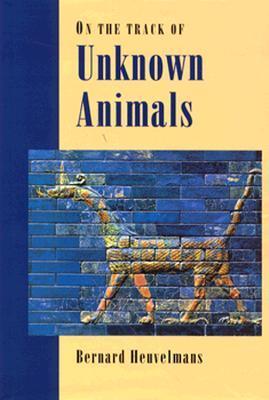
This is a book on recently discovered large animals -- such as the Pleistocene Peccary (the largest of all hogs, believed to have been extinct since the last age but recently discovered in Paraguay) -- to various possibly soon-to-be discovered megafauna such as Yetis, Sasquatchs -- and maybe even Mammoths.
Belgian-French scientist, explorer, researcher, and a considered to be the father of cryptozoology. Heuvelmans held an degree in zoology.
His 1958 work "On the track of unknown animals" is considered to be an standard work in cryptozoology. Later he also published books on more specific topics like sea serpents.
In 1975 he founded the "International Society of Cryptozoology" and served as its first president. He also served as the first president of the Centre for Fortean Zoology. In 1999 he donated about 50.000 documents and photos to the zoology museum in Switzerland.
I found a reference to this text while looking up the "kerit" mentioned in one of Lavie Tidhar's HebrewPunk stories; it turns out to be the Nandi Bear, a crypid which may be/have been a type of hyena, extinct* Atlas bear, or chalicothere (although that last is not carnivorous).
*But only in the 1870s! I had not realized there were African bears so recently. Down the wikihole I go: "Where the Atlas bear actually originated from is unknown, one genetic study was unable to link it to any brown bear, but it had weak but significant mtDNA links to the polar bear.[1] Polar bears appear in Paleolithic cave paintings in Andalucia Spain, which is a very short swim to the Atlas Mountains for a polar bear." And "The Cantabrian brown bear likely was introduced to Africa from Spain by the Romans who imported Iberian bears for spectacles."
Fairly annoyed that I spent $50 on this book - it's hard to come by - without realizing that it's an abridged edition. I hate to think what I missed, from the original publication.
That annoyance aside, this is a great book. Heuvelmans' scholarship is impressive, his writing is good, his reasoning is lucid - I was preconditioned, coming into it, to expect moth-men, yetis, Nessie - I shouldn't have, because both his feet are solidly on the ground. The paranormal need not apply; only the solidly physical, complete with droppings, tracks, and skeletal remains, are featured in this book.
Once I came to terms with that, and settled down to reading about giant lizards, elusive high-altitude cats, and pygmy elephants, I enjoyed it immensely.
My favorite bits are when Heuvelmans sits down with several conflicting accounts about a single cryptid, fans them out on the table in front of him - so to speak - and begins sorting and compiling them into different piles, saying these go together, these go together, these are inexplicable, this should be discounted. In the end he has a neat stack of facts. He makes it look terribly easy.
He makes research as exciting as a magic show. Recommend this book highly, but preferably in the unabridged version. Which I shall now be looking for.
Classic volume charting the whole repertoire of animals that may exist. Heuvelmans judiciously weighs evidence on all of them most of which is eye-witness testimony. Especially enjoyed chapters on the abominable snowman, mammoths of the Russian taiga, and anacondas of the Amazon. The author calmly despatches rumours of a rogue bear in eastern Africa but leaves the door open to the possibility that australopithecines still live. Pictures are excellent too. The photo of the ape Ameranthropoides loysi is apparently the only good photo of an unknown animal.
The set text and launching point for cryptozoology, that much-maligned discipline.
'On The Track of Unknown Animals' has dated a bit and Heuvelmans' eagerness to believe in creatures with more than a faint smell of bullshit damages his credibility (he's convinced of the existence of the de Loys Ape, for example, later revealed as an insipid hoax). Having said that, Heuvelmans clearly sets out, in layman's terms, his reasons for his willingness to entertain the possibility of real creatures behind the mythic beasts and challenges naturalists to do the same. I can overlook the occasional misfire or wacky conclusion given he was essentially trying to blaze a new trail here.
Classic cryptozoological book by Belgian naturalist Bernard Heuvelmans from the 1950s when the small world was a little larger; Heuvelmans traveled the world investigating stories of unknown animals never "discovered" by western science, researching whether known extinct animals, (such as the moa in New Zealand) could still exist and chronicling how known species of animals were "proven" to exist by various explorers over the centuries. A great book.
Badly in need of revision (I first read it 18 years ago), this thick tome is the bible of cryptozoology by one of the giants in the field. Thankfully, it is back in print after a long absence. Extremely comprehensive.
He makes a lot of good points, and a lot of bad points, which makes for an interesting read.
I went into this with the belief that none of the creatures discussed are real, but that from a 1955 perspective, they don't know that yet. And while I've not been convinced of anything different to what I originally thought, everything posited seems either correct (even from today's perspective), or incorrect (to a point that should probably be clear to even a 1955er).
There are some pretty unrealistic extant animals suggested, particularly dinosaurs. Not everything discussed is implied by Heuvelmans to be real; a few very obvious fakes are explained to be obvious fakes (though it's usually already obvious that they are fake), and quite a few of the cryptids are just a matter of pairing up an indigenous-described animal with its more generally known identity. Furthermore, a high proportion of those that are absolutely not any already-classified animal, such as the marozi, are very similar to confirmed animals (in the marozi's case, the lion), so are much more genuinely plausible from an evolutionary perspective than alien stories etc. Of course, this also means that they're more likely to just be the animal that they look like.
Outside of discussing the possible current existence of unconfirmed animals, there's also discussion of relatively recently extinct animals, passed down through oral history. This all sounds a lot more believable too, and trying to scrape together evidence squeeze the year of extinction to as recent as possible isn't entirely unscientific (there's also a bit of squeezing done around the maximum possible size of some animals), though there's obvious bias.
Cryptozoology is obviously filled with bias, and I guess Heuvelmans stays relatively fair, compared to a plain conspiracy theorist or something. He does often refer to (technically not confirmedly) fake animals, in minor lists. Usually saying something like "most people know this is real even if science doesn't accept it yet" or cites the one authority that does consider its existence likely.
A notable factor prevalent throughout is that 1955 was a time when attitudes to race throughout the world were certainly different. It's never hateful, but the global exploration and anthropology stuff does lead to remarks that reflect the explorer kind of attitude. Skin colour is used to describe which people are indigenous and who are the explorers. The white people are those with encyclopedias of all the animals, and are typically suggested to be a bit like Scotland Yard in the Holmes stories; over eager to pursue false leads, under eager to pursue real leads, and also a bit trigger happy. This of course means that Heuvelmans is the heroic Sherlock Holmes who knows better than them. On the other hand, black (indigenous) people are said to be worth listening to on cryptozoology matters, and there's a sort of positive sentiment, but it's quite condescending and words like "primitive" come into play very frequently.
Overall, it's structured well, and covers a good variety of topics. I've been wanting a copy for most of my life, and it's expensive to get one of the original editions (and there is an out of print abridged version about, also selling for a very high price). But it's in print again now, in physical form and as an ebook. Both quite expensive but that's how these kinds of non-fiction books are, I think? The printing is of a not-great quality, though it's readable. Included diagrams are fine for viewing, photos not-so-much (but you can usually find them online, or you can just think to yourself "you know, I don't really need a photo of a kangaroo, because I actually know what those look like"). There also seemed to be quite a few typos, and I think they increased further on into the book. I feel like they weren't in the original edition, but I have no way of knowing. It's all readable though, and the translation seems fine too.
The place to start when it comes to cryptozoology, though it is a product of it's time when it comes to some of the viewpoints and language used. Heuvelmans examines the evidence with an open mind and critical eye, so he doesn't assume everything is a cryptid nor does he necessarily take descriptions at face value. This approach is part of the reason the book is so long. He gets a bit verbose and piles on a lot of similar stories, but in doing so reinforces and attempts to validate his conclusions. One thing I really appreciated was his heartfelt and repeated concern that his research put forward in this book will lead to hunters seeking out these potential new species.
This revised third edition (1962/1995) has quite a few more photographs and several updates since the first edition.
My edition was owned (and signed) by a former US ambassador to Ceylon (AKA Sri Lanka). Must have been fun reading for him to ponder all these allegations of crypto-creatures, even possible dinosaur survivals, lurking there in the tropics, and know he was right on the edge of the territories. And this guy pasted in the back of the book breaking-news clippings about a supposed "Bigfoot" discovery (that turned out to amount to nothing, the infamous Minnesota Iceman affair). I would have loved to have a copy signed by Heuvelmans himself, of course, but this was next best thing. I did not know that Heuvelmans' soon-to-be-ex-wife was a noted artist who did all the illustrating for him.
The leading book for anyone with an interest in cryptozoology. Heuvelmans does some great work investigating tales of cryptic species looking at both sides of witnesses. The book is slightly outdated and some of the language used is very old fashioned.
Massive book, but fun to go through. I read this front to back because Cryptozoology was a passion of mine as a teenager and I wanted to know about every creature that may or may not exist. Here's to you Heuvelmans
lots of information I liked it like I can like a non-fiction book had a lot of my favorite cryptozoologist animals plus some I didn't know existed. Excellent research.