

What do you think?
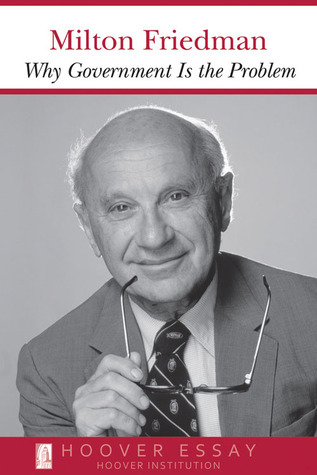
Why Government Is the Problem (Essays in Public Policy)
The major social problems of the United States—deteriorating education, lawlessness and crime, homelessness, the collapse of family values, the crisis in medical care—have been produced by well-intended actions of government. That is easy to document. The difficult task is understanding why government is the problem. The power of special interests arising from the concentrated benefits of most government actions and their dispersed costs is only part of the answer. A more fundamental part is the difference between the self-interest of individuals when they are engaged in the private sector and the self-interest of the same individuals when they are engaged in the government sector. The result is a government system that is no longer controlled by "we, the people." Instead of Lincoln's government "of the people, by the people, and for the people," we now have a government "of the people, by the bureaucrats, for the bureaucrats," including the elected representatives who have become bureaucrats. At the moment, term limits apear to be the reform that promises to be most effective in curbing Leviathan.
18 pages, Paperback
First published February 1, 1993
About the author
Milton Friedman
209 books1,766 followersMilton Friedman was an American economist who became one of the most influential and controversial figures of the twentieth century, widely recognized for his profound contributions to monetary economics, consumption theory, and the defense of classical liberalism. A leading figure of the Chicago School of Economics, Friedman challenged the prevailing Keynesian consensus that dominated mid-century policy and instead placed monetary policy at the center of economic stability, arguing that changes in the money supply were the primary drivers of inflation and fluctuations in output. His groundbreaking permanent income hypothesis reshaped the study of consumer behavior by suggesting that individuals make spending decisions based on long-term expected income rather than current earnings, a theory that profoundly influenced both academic research and practical policymaking. Alongside Anna Schwartz, Friedman coauthored A Monetary History of the United States, 1867–1960, a monumental work that emphasized the role of Federal Reserve mismanagement in deepening the Great Depression, a thesis that redefined historical understanding of the period and helped establish monetarism as a major school of thought. His broader philosophy was articulated in works such as Capitalism and Freedom, where he argued that political and economic liberty are interdependent and advanced ideas like educational vouchers, voluntary military service, deregulation, floating exchange rates, and the negative income tax, each reflecting his conviction that society functions best when individuals are free to choose. Together with his wife Rose Friedman, he later brought these ideas to a global audience through the bestselling book and television series Free to Choose, which made complex economic principles accessible to millions and expanded his influence beyond academia. Awarded the Nobel Prize in Economic Sciences in 1976 for his achievements in consumption analysis, monetary history, and stabilization policy, Friedman became a prominent public intellectual, sought after by policymakers and leaders around the world. His ideas strongly influenced U.S. policy in the late twentieth century, particularly during the administration of Ronald Reagan, and found resonance in the economic reforms of Margaret Thatcher in the United Kingdom, both of whom embraced aspects of his prescriptions for free markets and limited government intervention. Friedman’s policy recommendations consistently opposed measures he regarded as distortions of market efficiency, including rent control, agricultural subsidies, and occupational licensing, while he proposed alternatives such as direct cash transfers through a negative income tax to replace complex welfare bureaucracies. His teaching career at the University of Chicago shaped generations of economists, many of whom extended his research and helped institutionalize the Chicago School as a major force in global economic thought, while his later role at the Hoover Institution at Stanford University provided him with a platform to continue his scholarship and public advocacy. Beyond technical economics, Friedman’s clarity of expression and ability to frame debates in terms of individual freedom versus state control made him one of the most recognizable intellectuals of his era, admired by supporters for his defense of personal liberty and market efficiency, and criticized by detractors who accused him of underestimating inequality, social costs, and the complexities of government responsibility. Despite the controversies, his impact on the development of modern economics was immense, reshaping debates about inflation, unemployment, fiscal policy, and the role of the central bank. His writings, lectures, and media appearances consistently reinforced his belief that competitive markets, voluntary exchange, and limited government intervention offer the most effective means of promoting prosperit
Ratings & Reviews
Friends & Following
Create a free account to discover what your friends think of this book!
Community Reviews
Displaying 1 - 30 of 80 reviews

January 21, 2017
With the encouragement of a friend, and the questions raised by the recent US election, I’ve concluded that I need to increase my understanding of world economics as well as the role of government in its regulation. Having read some on the mortgage crisis of 2008, my inclination is that it was the removal of at least one regulation (the Glass-Steagal law) that was a root cause. My other confession is that I once voted Republican on the ideals and salesmanship of Ronald Reagan, but within four years I had reversed my views and continue my bias against trusting big business to act ethically. Having lived through the final stages of the cold war (is it over?), my views are tempered by fears of collectivism and anarchism. My political tendencies are therefore slightly on the libertarian side of the line, yet my economic views are a little more to the left.
Friedman is a nobel prize winning economic theorist from Yale, and a fervent believer in free market economies and lack of government involvement in its workings. He seems like an earnest person without political ambitions, but his views (along with Hayek) are powerful and have underwritten policies of the leaders of free worlds (Reagan, Thatcher). He is a believer in the influential Adam Smith. This book is really just a pamphlet, and only touches on a thin slice of Friedman’s views, namely that governments usually do more harm than good with respect to economic growth and (implied) the overall good of the populace. I found myself sympathetic with many of his libertarian views on social issues, for the most part, although his “anything goes” theory frightens me to some extent. He points out the failures of prohibition, and the costs to society when this liberty was temporarily removed, and likens it to the criminalization of drug use and its current cost (crime due to black markets). However, I don’t think he estimates correctly the increases in use that could happen if use increases when controls are removed (and then, the cost to society in the death of innocent victims due to the carelessness induced in users, as well as the cost of treatment if use increases). But, in fairness, I generally believe that more liberty in most matters to individuals is generally good, and prohibitions often do more harm than good.
The main premise of the book is that governmental power leads to “bureaucrats” gaining and sustaining unchecked power whereas businesses that are incompetent simply cease to exist when they become incompetent. Friedman also notes that those government officials are less incentivized to do what is best for others, whereas the self-interest of free enterprise drives a higher quality of excellence. That observation is hard to dispute. Friedman also notes that industry owes its success on government regulations (often achieved via lobbying, recently emboldened by the SCOTUS ruling on the constitutionality of Citizens United). He does not acknowledge this paradox, where the free exercise of speech is what creates the government regulations which favor business interests. In fairness, this book was written in 1992, and a lot has changed in the last 25 years.
A main premise is that if only government could be pared back to its core obligations to “defend the nation, prevent coercion of individuals by others, to enact laws, and adjudicate disputes”. There is no discussion of the interplay of the private military industry that is sustained by government funding – i.e. the means to defense could be argued as necessary to what he claims is a rightful function of government). He mentions that the government actions to release mental patients from (government funded) facilities as an over-reach, yet this action was driven in part by a desire to cease this government funding (i.e. less government). Friedman is against regulations, but I can’t see how the excesses of business (e.g. pollution) are prevented without laws holding them accountable. Mostly he is talking about governmental agencies (e.g. EPA, FDA) – I have only experience with FDA who I believe is properly funded and provides a critical role is assuring safety from producers (if anything they are over-matched by industry). Much of Friedman’s arguments are anecdotal (e.g. licenses for taxis in NYC), and for those examples his logic about this excess (vs more competition) seemed fair, although I don’t live in a city and have no knowledge of things like rent control, etc. A humorous aside is that he felt Bush sr really “botched” Reaganomics.
I found this pamphlet interesting, and it challenged me to think more deeply about what I believe and know. I think it was too general to be truly satisfying, and I realize if I’m serious about educating myself, I need to do more work. Throughout this journey I hope to stay open-minded and global in my thinking. I will certainly become less ignorant (more educated) if I can read the right books and avoid the tugs and seductions of ideologues. Friedman is far right on the neo-liberalist scale, so could be considered and ideologue, but I believe he is honest and mostly non-political (but of course an aging ideologue who has won a nobel prize has a lot of ego tied into his positions at this stage in life, and power is a seductive siren). For the next stage in my development, I won’t go deeper into his views, nor will I go deep into the views of ideologues on the other end of the spectrum (there are eloquent adherents on the other extreme). First I will read more broadly on the history of economic theory development and try to gain some context. I want to understand not only the theories, but the results, and to tie that together with my firsthand experiences in the world. My next book will be “Masters of the Universe” by Daniel Stedman Jones, who discusses the historical development and outcomes created by the neo-liberal thinkers Hayek and Friedman, as well as how they played out in the policies and practices of Margaret Thatcher and Ronald Reagan. If anyone has better sources for someone in my state, I will consider those readings.
Friedman is a nobel prize winning economic theorist from Yale, and a fervent believer in free market economies and lack of government involvement in its workings. He seems like an earnest person without political ambitions, but his views (along with Hayek) are powerful and have underwritten policies of the leaders of free worlds (Reagan, Thatcher). He is a believer in the influential Adam Smith. This book is really just a pamphlet, and only touches on a thin slice of Friedman’s views, namely that governments usually do more harm than good with respect to economic growth and (implied) the overall good of the populace. I found myself sympathetic with many of his libertarian views on social issues, for the most part, although his “anything goes” theory frightens me to some extent. He points out the failures of prohibition, and the costs to society when this liberty was temporarily removed, and likens it to the criminalization of drug use and its current cost (crime due to black markets). However, I don’t think he estimates correctly the increases in use that could happen if use increases when controls are removed (and then, the cost to society in the death of innocent victims due to the carelessness induced in users, as well as the cost of treatment if use increases). But, in fairness, I generally believe that more liberty in most matters to individuals is generally good, and prohibitions often do more harm than good.
The main premise of the book is that governmental power leads to “bureaucrats” gaining and sustaining unchecked power whereas businesses that are incompetent simply cease to exist when they become incompetent. Friedman also notes that those government officials are less incentivized to do what is best for others, whereas the self-interest of free enterprise drives a higher quality of excellence. That observation is hard to dispute. Friedman also notes that industry owes its success on government regulations (often achieved via lobbying, recently emboldened by the SCOTUS ruling on the constitutionality of Citizens United). He does not acknowledge this paradox, where the free exercise of speech is what creates the government regulations which favor business interests. In fairness, this book was written in 1992, and a lot has changed in the last 25 years.
A main premise is that if only government could be pared back to its core obligations to “defend the nation, prevent coercion of individuals by others, to enact laws, and adjudicate disputes”. There is no discussion of the interplay of the private military industry that is sustained by government funding – i.e. the means to defense could be argued as necessary to what he claims is a rightful function of government). He mentions that the government actions to release mental patients from (government funded) facilities as an over-reach, yet this action was driven in part by a desire to cease this government funding (i.e. less government). Friedman is against regulations, but I can’t see how the excesses of business (e.g. pollution) are prevented without laws holding them accountable. Mostly he is talking about governmental agencies (e.g. EPA, FDA) – I have only experience with FDA who I believe is properly funded and provides a critical role is assuring safety from producers (if anything they are over-matched by industry). Much of Friedman’s arguments are anecdotal (e.g. licenses for taxis in NYC), and for those examples his logic about this excess (vs more competition) seemed fair, although I don’t live in a city and have no knowledge of things like rent control, etc. A humorous aside is that he felt Bush sr really “botched” Reaganomics.
I found this pamphlet interesting, and it challenged me to think more deeply about what I believe and know. I think it was too general to be truly satisfying, and I realize if I’m serious about educating myself, I need to do more work. Throughout this journey I hope to stay open-minded and global in my thinking. I will certainly become less ignorant (more educated) if I can read the right books and avoid the tugs and seductions of ideologues. Friedman is far right on the neo-liberalist scale, so could be considered and ideologue, but I believe he is honest and mostly non-political (but of course an aging ideologue who has won a nobel prize has a lot of ego tied into his positions at this stage in life, and power is a seductive siren). For the next stage in my development, I won’t go deeper into his views, nor will I go deep into the views of ideologues on the other end of the spectrum (there are eloquent adherents on the other extreme). First I will read more broadly on the history of economic theory development and try to gain some context. I want to understand not only the theories, but the results, and to tie that together with my firsthand experiences in the world. My next book will be “Masters of the Universe” by Daniel Stedman Jones, who discusses the historical development and outcomes created by the neo-liberal thinkers Hayek and Friedman, as well as how they played out in the policies and practices of Margaret Thatcher and Ronald Reagan. If anyone has better sources for someone in my state, I will consider those readings.

January 14, 2015
I am really tempted to give this essay to my English 102 students as a negative example because it is riddled with logical fallacies and unsupported claims. I would hope that in his books Friedman does a better job providing actual evidence to support his arguments, but here there are so many logical problems and claims made as though they are self evident that the argument is logically unsound--and Friedman won a Nobel prize! For instance, the entire opening section is dedicated to cataloging the failures of government, but Friedman often just assumes that his readers will identify the same things as 1) problematic and 2) the government's fault. For instance, he identifies homelessness as a result of government policies but offers no evidence to support this claim.
The second half of this essay seems to me entirely premised on a logical fallacy--the false equivalency. Friedman discusses filed government enterprises and failed private enterprises as though they are the same thing, but his implicit definition of success seems to be whether or not the enterprise turns a profit. While this may be a fine criterion for a free market private business, it isn't necessarily a great criterion for public services. Take, for instance, public universities. Now the US has one of if not the top higher education system in the world (pity our elementary and high schools can't make the same claim), and until very recently universities were allowed to run at public expense because education was seen as a public good. The purpose of public universities is (or should be, though this doesn't always seem to be the case in practice) to provide a service to the public, not to make a profit. Or, to take a comparison Friedman makes: he asks why the US Postal Service isn't as efficient as UPS, but ultimately UPS provides a different though similar service. UPS primarily deals with packages and larger deliveries, but if a private company had to ship as many individual letters as the USPS does , there's no way that company could afford to charge the current rates for stamps, it simply wouldn't be economically viable--but USPS can afford to deliver letters for the cost of a stamp because they are government subsidized to provide a public service. So the idea that government services must compete on an equal footing and produce equal profits with private enterprise is logically unsound.
The second half of this essay seems to me entirely premised on a logical fallacy--the false equivalency. Friedman discusses filed government enterprises and failed private enterprises as though they are the same thing, but his implicit definition of success seems to be whether or not the enterprise turns a profit. While this may be a fine criterion for a free market private business, it isn't necessarily a great criterion for public services. Take, for instance, public universities. Now the US has one of if not the top higher education system in the world (pity our elementary and high schools can't make the same claim), and until very recently universities were allowed to run at public expense because education was seen as a public good. The purpose of public universities is (or should be, though this doesn't always seem to be the case in practice) to provide a service to the public, not to make a profit. Or, to take a comparison Friedman makes: he asks why the US Postal Service isn't as efficient as UPS, but ultimately UPS provides a different though similar service. UPS primarily deals with packages and larger deliveries, but if a private company had to ship as many individual letters as the USPS does , there's no way that company could afford to charge the current rates for stamps, it simply wouldn't be economically viable--but USPS can afford to deliver letters for the cost of a stamp because they are government subsidized to provide a public service. So the idea that government services must compete on an equal footing and produce equal profits with private enterprise is logically unsound.

March 14, 2016
I love watching Friedman destroy socialists and lefties on youtube so I figured I'd finally read something of his. He rightly believes that the government only should serve a few purposes and because it oversteps its bounds constantly, it is almost destined to fail. This quote sums it up nicely:
"the tragedy is that because government is doing so many things it ought not to be doing, it performs the functions it ought to be performing badly. The basic functions of government are to defend the nation against foreign enemies, to prevent coercion of some individuals by others within the country, to provide a means of deciding on our rules, and to adjudicate disputes."
I also liked this:
"I wonder if any of the liberal pundits who go around saying that the private market and capitalism, not government, is the problem can name any corresponding set of major problems that afflict our society that derive from private enterprise.
Their knee-jerk answer is clear: pollution. Private enterprise, they will say, is responsible for polluting the air, for polluting the water, for destroying the earth. I suggest to them that they compare the pollution in countries that have been run by the government, such as Poland or the Soviet Union or Romania, with the pollution in this country. The difference is not that our government has been more efficient in avoiding pollution; it is that private enterprise finds that it is not profitable to pollute; it is more profitable to avoid pollution. There is a real function for government in respect to pollution: to set conditions and, in particular, define property rights to make sure that the costs are borne by the parties responsible. Actual government policy, however, has been neither efficient nor effective. An example is the recently passed Clean Air Bill. It will clean the pockets of industry far more effectively than it will clean the air."
Sounds a lot likeglobal warming wait climate change? We are still using that one right?
"The problem in schooling is that government is spending too much on the wrong things. The problem in health care is that government is spending too much on the wrong things. The end result has been that government has become a self-generating monstrosity."
"the tragedy is that because government is doing so many things it ought not to be doing, it performs the functions it ought to be performing badly. The basic functions of government are to defend the nation against foreign enemies, to prevent coercion of some individuals by others within the country, to provide a means of deciding on our rules, and to adjudicate disputes."
I also liked this:
"I wonder if any of the liberal pundits who go around saying that the private market and capitalism, not government, is the problem can name any corresponding set of major problems that afflict our society that derive from private enterprise.
Their knee-jerk answer is clear: pollution. Private enterprise, they will say, is responsible for polluting the air, for polluting the water, for destroying the earth. I suggest to them that they compare the pollution in countries that have been run by the government, such as Poland or the Soviet Union or Romania, with the pollution in this country. The difference is not that our government has been more efficient in avoiding pollution; it is that private enterprise finds that it is not profitable to pollute; it is more profitable to avoid pollution. There is a real function for government in respect to pollution: to set conditions and, in particular, define property rights to make sure that the costs are borne by the parties responsible. Actual government policy, however, has been neither efficient nor effective. An example is the recently passed Clean Air Bill. It will clean the pockets of industry far more effectively than it will clean the air."
Sounds a lot like
"The problem in schooling is that government is spending too much on the wrong things. The problem in health care is that government is spending too much on the wrong things. The end result has been that government has become a self-generating monstrosity."
August 1, 2017
This is really more of a pamphlet than a book, and as such, only has so much in it. If it were a book, I would expect more substance and detail to its arguments, but as it is, it's a good pamphlet. It serves the role of opening the idea to the reader, who will hopefully seek out more information on their own.
I haven't read much Milton Friedman, but I do feel he's addressing real problems in this essay, and they are ones that impact many, many groups to this day in this country. This would likely be a decent start for someone interested in what Milton Friedman has to say.
I haven't read much Milton Friedman, but I do feel he's addressing real problems in this essay, and they are ones that impact many, many groups to this day in this country. This would likely be a decent start for someone interested in what Milton Friedman has to say.

November 12, 2017
Short and clear argument against bureaucracy
This is a short essay in which Friedman makes the standard libertarian case against the size of government — that bureaucracy has several drivers which push it inevitably to grow, and that government misallocates resources, even when the people in the government are themselves good.
This is a short essay in which Friedman makes the standard libertarian case against the size of government — that bureaucracy has several drivers which push it inevitably to grow, and that government misallocates resources, even when the people in the government are themselves good.

March 27, 2016
Brilliant lecture and Q&A given by Dr. Friedman in the early 1990s. It is absolutely spot on in its analysis of the growth of government.
May 10, 2016
Admirable clarity. Great summary of economic pitfalls of massive centralized bureaucracy and the federal Leviathan

March 21, 2017
A precise and straightforward read, Friedman’s essay defines two tasks: one easy, one difficult. The easy task is to demonstrate that the government is the problem. By utilizing major social problems such as deteriorating education, lawlessness and crime, homelessness, the collapse of family values, and the medical care crisis have all been produced by the actions of government. The hard task is to understand why government is the problem. Friedman presents two answers to the exhibition of why the government is the problem. First, he describes the power of special interests which arises from the concentrated benefits of most government actions and their dispersed costs. Second and more fundamental is the difference between the self-interest of individuals when they are engaged in the government sector. The result is a government system that is no longer controlled by “we, the people.” Instead of Lincoln’s government “of the people, by the people, and for the people, “we now have a government “of the people, by the bureaucrats, for the bureaucrats, “including the elected representatives who according to Friedman have become the bureaucrats.

November 23, 2014
One of Friedman's later pieces it reads in the vein of most of his work. Directly and easy to consume. This is a very general essay which is not that comprehensive just as it does not reveal anything new.
It is instead a piece which is best suited for the new reader of Friedman or Free Market economics.
Most recommended to those who are unitiated to economic or political writings but is very much lacking for those who are well versed in the subject of Governance.
70 %
April 16, 2010
More of an essay than a book (I was a little mad for paying $6 bucks for it on amazon), but it was still an excellent read in which Friedman advocates the first step towards turning our country BACK towards capitalism is Education Reform.
Very well written - a must read for libertarians. It is short and sweet.
Very well written - a must read for libertarians. It is short and sweet.

April 17, 2021
Holy shit, to think this was printed by a serious academic publication.. If you brought something like this to any social sciences or policy class, you would be laughed out of the classroom. Zero rigor, ridiculous, braindead demagoguery that serves as stark reminder of the poor state of academic institutions in the US during the apex of the neoliberal era.
Good for: a few hearty chuckles.
Good for: a few hearty chuckles.

January 12, 2015
Good, short essay I read to whet my appetite for some economics reading of the book-length variety. I plan to read Friedman's Free to Choose at the urging of a friend and I'm already looking forward to hearing more from this author.

May 19, 2013
Pretty spot. Short easy read but not very shocking or life changing.
November 9, 2014
Average essay. Not truly worth the read. Nothing new even for the early 90s. His other works are far more significant to economics
July 31, 2016
Simply put common sense
Non political yet timely explanation of something most already know to be true, government never performs as well as the private sector.
Non political yet timely explanation of something most already know to be true, government never performs as well as the private sector.

May 22, 2017
'Mito' Friedman ('Mithon' Friedman)

April 7, 2018
The major social problems of the United States—deteriorating education, lawlessness and crime, homelessness, the collapse of family values, the crisis in medical care—have been produced by well-intended actions of government.
That is easy to document. The difficult task is understanding why government is the problem.
The power of special interests arising from the concentrated benefits of most government actions and their dispersed ...
A more fundamental part is the difference between the self-interest of individuals when they are engaged in the private sector and the self-interest of the same individuals ...
The result is a government system that is no longer controlled by "we, the people." Instead of Lincoln's government "of the people, by the people, and for the people," we now have a government "of the people, by the bureaucrats, for the bureaucrats,"
At the moment, term limits appear to be the reform that promises to be most effective.
The hard task is to understand why government is the problem. Why is it that able, public-spirited people produce such different results according to whether they operate in the political or the economic market? Why is it that if a random sample of the people who read this essay and are not at present in Washington were to replace those who are in Washington, our policies would very likely not be improved? That is the real puzzle for me.
One major social problem is clearly the deterioration of our educational system.
Next to the military, education is the largest socialist industry in the United States.
The amount spent per pupil in the past thirty years has tripled in real terms after allowing for inflation. Although input has tripled, output has been going down.
Schools have been deteriorating. That problem is unquestionably produced by government.
You can rigidly enforce only those laws that most people believe to be good laws, that is, laws that proscribe actions that they would avoid even in the absence of laws.
Personally, I would add another misdirected governmental policy, which he does not consider, that I believe played a key role in the breakdown of social and cultural values—though by a rather indirect route—namely, military conscription. But that is an argument for a different day.
You are all fully aware of the weakness of our financial system. Is there any doubt that that weakness owes much to Washington?
A similar contrast exists with respect to airlines and airports. The private aircraft industry has been able to build all the aircraft that the commercial airlines wanted to buy, and the airlines have been able to recruit the necessary pilots, attendants, mechanics, and so on. Where is the bottleneck? In airports, in air control facilities. Why? Because those are run by the government.
I wonder if any of the liberal pundits who go around saying that the private market and capitalism, not government, is the problem can name any corresponding set of major problems that afflict our society that derive from private enterprise.
One common explanation of why government is the problem, and one that I have often stressed, is the influence of special interests.
Government actions often provide substantial benefits to a few while imposing small costs on many.
The phenomenon of concentrated benefits and dispersed costs is a valid explanation for many governmental programs.
One answer is that the incentive of profit is stronger than the incentive of public service.
My old friend Armen Alchian, who is a professor at the University of California at Los Angeles, put the point this way: There is one thing, he said, that you can trust everybody to do and that is to put his interest above yours.
The point is that self-interest is served by different actions in the private sphere than in the public sphere. The bottom line is different.
If a private enterprise is a failure, it closes down—unless it can get a government subsidy to keep it going; if a government enterprise fails, it is expanded. I challenge you to find exceptions.
The general rule is that government undertakes an activity that seems desirable at the time. Once the activity begins, whether it proves desirable or not, people in both the government and the private sector acquire a vested interest in it. If the initial reason for undertaking the activity disappears, they have a strong incentive to find another justification for its continued existence.
The problem is not that government is spending too little but that it is spending too much.
Abraham Lincoln talked about a government of the people, by the people, for the people. What we now have is a government of the people, by the bureaucrats, including the legislators who have become bureaucrats, for the bureaucrats.
The self-interest of people in government leads them to behave in a way that is against the self-interest of the rest of us. You remember Adam Smith's famous law of the invisible hand: People who intend only to seek their own benefit are "led by an invisible hand to serve a public interest which was no part of" their intention. I say that there is a reverse invisible hand: People who intend to serve only the public interest are led by an invisible hand to serve private interests which was no part of their intention.
The problem of concentrated benefits and diffused costs is a real problem. However, I do not believe that at the moment it is the key problem. The key problem is that we are unable to practice what we preach because of what has happened to the governmental structure.
The one movement that I see on the horizon that offers promise is the movement toward term limits, a move that would ...
In the 1930s, it went the other way. It is ironic that the Great Depression was produced by government but was blamed on private sector.
The great virtue of a free market system is that it does not care what color people are; it does not care what their religion is; it only cares whether they can produce something you want to buy. It is the most effective system we have discovered...
That is easy to document. The difficult task is understanding why government is the problem.
The power of special interests arising from the concentrated benefits of most government actions and their dispersed ...
A more fundamental part is the difference between the self-interest of individuals when they are engaged in the private sector and the self-interest of the same individuals ...
The result is a government system that is no longer controlled by "we, the people." Instead of Lincoln's government "of the people, by the people, and for the people," we now have a government "of the people, by the bureaucrats, for the bureaucrats,"
At the moment, term limits appear to be the reform that promises to be most effective.
The hard task is to understand why government is the problem. Why is it that able, public-spirited people produce such different results according to whether they operate in the political or the economic market? Why is it that if a random sample of the people who read this essay and are not at present in Washington were to replace those who are in Washington, our policies would very likely not be improved? That is the real puzzle for me.
One major social problem is clearly the deterioration of our educational system.
Next to the military, education is the largest socialist industry in the United States.
The amount spent per pupil in the past thirty years has tripled in real terms after allowing for inflation. Although input has tripled, output has been going down.
Schools have been deteriorating. That problem is unquestionably produced by government.
You can rigidly enforce only those laws that most people believe to be good laws, that is, laws that proscribe actions that they would avoid even in the absence of laws.
Personally, I would add another misdirected governmental policy, which he does not consider, that I believe played a key role in the breakdown of social and cultural values—though by a rather indirect route—namely, military conscription. But that is an argument for a different day.
You are all fully aware of the weakness of our financial system. Is there any doubt that that weakness owes much to Washington?
A similar contrast exists with respect to airlines and airports. The private aircraft industry has been able to build all the aircraft that the commercial airlines wanted to buy, and the airlines have been able to recruit the necessary pilots, attendants, mechanics, and so on. Where is the bottleneck? In airports, in air control facilities. Why? Because those are run by the government.
I wonder if any of the liberal pundits who go around saying that the private market and capitalism, not government, is the problem can name any corresponding set of major problems that afflict our society that derive from private enterprise.
One common explanation of why government is the problem, and one that I have often stressed, is the influence of special interests.
Government actions often provide substantial benefits to a few while imposing small costs on many.
The phenomenon of concentrated benefits and dispersed costs is a valid explanation for many governmental programs.
One answer is that the incentive of profit is stronger than the incentive of public service.
My old friend Armen Alchian, who is a professor at the University of California at Los Angeles, put the point this way: There is one thing, he said, that you can trust everybody to do and that is to put his interest above yours.
The point is that self-interest is served by different actions in the private sphere than in the public sphere. The bottom line is different.
If a private enterprise is a failure, it closes down—unless it can get a government subsidy to keep it going; if a government enterprise fails, it is expanded. I challenge you to find exceptions.
The general rule is that government undertakes an activity that seems desirable at the time. Once the activity begins, whether it proves desirable or not, people in both the government and the private sector acquire a vested interest in it. If the initial reason for undertaking the activity disappears, they have a strong incentive to find another justification for its continued existence.
The problem is not that government is spending too little but that it is spending too much.
Abraham Lincoln talked about a government of the people, by the people, for the people. What we now have is a government of the people, by the bureaucrats, including the legislators who have become bureaucrats, for the bureaucrats.
The self-interest of people in government leads them to behave in a way that is against the self-interest of the rest of us. You remember Adam Smith's famous law of the invisible hand: People who intend only to seek their own benefit are "led by an invisible hand to serve a public interest which was no part of" their intention. I say that there is a reverse invisible hand: People who intend to serve only the public interest are led by an invisible hand to serve private interests which was no part of their intention.
The problem of concentrated benefits and diffused costs is a real problem. However, I do not believe that at the moment it is the key problem. The key problem is that we are unable to practice what we preach because of what has happened to the governmental structure.
The one movement that I see on the horizon that offers promise is the movement toward term limits, a move that would ...
In the 1930s, it went the other way. It is ironic that the Great Depression was produced by government but was blamed on private sector.
The great virtue of a free market system is that it does not care what color people are; it does not care what their religion is; it only cares whether they can produce something you want to buy. It is the most effective system we have discovered...

August 10, 2020
Nothing beats Milton Friedman's philosophy on government. This guy pushes neither Democratic or Republican politics. His doctrine is just less government and more free enterprise.
If only America could get back to the basics and limit the big government of today. Would be impossible though because all the bureaucracies that have been created over the years through government policies would prevent their disbandment at all costs. So they will remain and others will be developed and socialism will be pushed as the only solution, when it's not, less government is.
If only America could get back to the basics and limit the big government of today. Would be impossible though because all the bureaucracies that have been created over the years through government policies would prevent their disbandment at all costs. So they will remain and others will be developed and socialism will be pushed as the only solution, when it's not, less government is.
August 18, 2024
An interesting short primer to get one reflecting on why too much government is bad and harmful to the free market economy, written by once of the most influential thinker on economics in modern history.

March 28, 2024
Oh my gosh. Well, first, he discusses the role socialism has played in the us since the 1890s and I don't see that fact referred to very often.
Second, he discusses The Moon is a Harsh Mistress, so obviously he gets a thumbs up on that one.
Of course, these are just side issues. I think Friedman should be read by far more people today, but alas, nobody wants to hear it.
Second, he discusses The Moon is a Harsh Mistress, so obviously he gets a thumbs up on that one.
Of course, these are just side issues. I think Friedman should be read by far more people today, but alas, nobody wants to hear it.
July 15, 2017
Quick Read - Little Light
I enjoyed the essay, but wish it had a bit more substance. The Q&A at the end was interesting. Worth the time.
I enjoyed the essay, but wish it had a bit more substance. The Q&A at the end was interesting. Worth the time.

July 9, 2017
This is short and simple, but it's written under the assumption that readers already agree with Friedman or at least has a background in econ. But still a very good read.
June 20, 2017
If you only read the last page
And understand it, this book will have been worth it. So common sense in that book. Probably the only ones who understand the beauty of America are the legal immigrants or their parents or grandparents. All working to make one great country.
And understand it, this book will have been worth it. So common sense in that book. Probably the only ones who understand the beauty of America are the legal immigrants or their parents or grandparents. All working to make one great country.
August 29, 2018
This is a concise work containing basic information to the Austrian school of economics that is fairly libertarian in tone. He provides a number of examples demonstrating why government involvement can make things worse instead of better. This is not an encouraging book given how significantly the government has grown over the past 100 years, and his conclusions that less government involvement means more freedom and prosperity.
While this is by no means a definitive work, it is a good very brief overview to many of the issues connected to Austrian economics. The fact it is so short means someone could easily read it in one sitting so would be a good work for beginners.
While this is by no means a definitive work, it is a good very brief overview to many of the issues connected to Austrian economics. The fact it is so short means someone could easily read it in one sitting so would be a good work for beginners.

May 3, 2020
Well if there wasn't government provision of g&s we wouldn't have utilities, roads, water, the internet (surprise, a federal supported R&D in the US) and other public goods that are all, to no surprise, essential to any modern civilisation. While it is hard to disagree with his argument that in certain spheres, private enterprises are more efficient than the public in the provision of goods & services, we can't eliminate the government altogether as they prove to be necessary in the provision of public goods + upholding the rule of law + more.
Ideological differences aside, arguments were not substantiated hence the low rating.
Ideological differences aside, arguments were not substantiated hence the low rating.
December 28, 2014
Essentially one of Friedman's lectures turned into essay form with a Q&A session at the end. Despite only being a 20 page booklet, it is an extremely enlightening piece of work and is important to either solidify the knowledge/views of some libertarians or to introduce others to Friedman's philosophy. Many good historical examples are also used to illustrate the problem of government and the systematic dissection of why it is that government is THE problem is simply profound.

December 20, 2016
At 18 pages this pamphlet was never going to deliver anything deep, but I was hoping for something new. Alas, it wasn't there. To be sure, Friedman is a paragon of libertarian thought and this was an enjoyable read, but the material is a condensed version of what you'd expect to find as a chapter in a book by Friedman himself or Thomas Sowell.

August 7, 2022
Aside from his take on drugs, this was pretty rough. On some of the issues brought up in this text, Friedman makes somewhat valid criticisms of government before putting forward terrible solutions. On many other issues, particularly the American highway system and healthcare, he is unable to even do that.

December 26, 2014
Short essay on Friedman's observations and thoughts on smaller government. Given originally as a lecture I think this would have benefited from a bit more meat and some additional references. However it seems like a good primer on Friedman's philosophy.
January 1, 2016
I Could Only Wish For More
While these essays were informative, I wish they were longer and went into greater detail on why government is the problem on each issue discussed. Now I must find another book to satisfy my need.
While these essays were informative, I wish they were longer and went into greater detail on why government is the problem on each issue discussed. Now I must find another book to satisfy my need.
Displaying 1 - 30 of 80 reviews