

What do you think?

Inspector Wexford #23
The Vault
The twenty-fourth book to feature the classic crime-solving detective, Chief Inspector Wexford.
The impossible has happened. Chief Inspector Reg Wexford has retired from the crime force. He and his wife, Dora, now divide their time between Kingsmarkham and a coachhouse in Hampstead, belonging to their actress daughter, Sheila.
Wexford takes great pleasure in his books, but, for all the benefits of a more relaxed lifestyle, he misses being the hand of the law.
But a chance meeting in a London street, with someone he had known briefly as a very young police constable, changes everything. Tom Ede is now a Detective Superintendent, and is very keen to recruit Wexford as an adviser on a mysterious murder case.
The bodies of two women and a man have been discovered in the old coal hole of an attractive house in St John's Wood. None of the corpses carry identification. But the man's jacket pockets contain a string of pearls, a diamond and a sapphire necklace as well as other jewellery valued in the region of £40,000.
To Wexford, this is definitely a case worth coming out of retirement for. He is intrigued and excited by the challenge, but unaware that this new investigative role will bring him into extreme physical danger...
The impossible has happened. Chief Inspector Reg Wexford has retired from the crime force. He and his wife, Dora, now divide their time between Kingsmarkham and a coachhouse in Hampstead, belonging to their actress daughter, Sheila.
Wexford takes great pleasure in his books, but, for all the benefits of a more relaxed lifestyle, he misses being the hand of the law.
But a chance meeting in a London street, with someone he had known briefly as a very young police constable, changes everything. Tom Ede is now a Detective Superintendent, and is very keen to recruit Wexford as an adviser on a mysterious murder case.
The bodies of two women and a man have been discovered in the old coal hole of an attractive house in St John's Wood. None of the corpses carry identification. But the man's jacket pockets contain a string of pearls, a diamond and a sapphire necklace as well as other jewellery valued in the region of £40,000.
To Wexford, this is definitely a case worth coming out of retirement for. He is intrigued and excited by the challenge, but unaware that this new investigative role will bring him into extreme physical danger...
272 pages, Hardcover
First published August 1, 2011
About the author
Ruth Rendell
491 books1,671 followersA.K.A. Barbara Vine
Ruth Barbara Rendell, Baroness Rendell of Babergh, CBE, who also wrote under the pseudonym Barbara Vine, was an acclaimed English crime writer, known for her many psychological thrillers and murder mysteries and above all for Inspector Wexford.
Ruth Barbara Rendell, Baroness Rendell of Babergh, CBE, who also wrote under the pseudonym Barbara Vine, was an acclaimed English crime writer, known for her many psychological thrillers and murder mysteries and above all for Inspector Wexford.
Ratings & Reviews
Friends & Following
Create a free account to discover what your friends think of this book!
Community Reviews
Displaying 1 - 30 of 548 reviews
October 10, 2011
I don't think those who gave this a 5 star rating really read it or have read her earlier books. The story line is convoluted, the many, many characters are confusing though the writing, for the most part, is fine.
However, I spotted 3 mistakes in the first few chapters which is offputting:
1. Wexford has to buy a bus ticket from a machine on his way to a meeting but a hour later uses his senior pass on the return trip.
2. A neighbor, when initially interviewed about a 'murder house' talks quite clearly about the wet leaves that someone slipped on during her initial interview, then when Wexford & the Scotland Yard Supt. return to talk to her a few days later she repeats the same information and they receive it as news.
3. The Superintendent takes a crumpled red and blue tie out of his pocket and puts it on when he and Wexford arrive at the murder house. A hour or so later, they go to visit the first witness and as they arrive at her house the Supt does the exact same thing to the very same crumpled tie.
I suspect in #3 that the first time was supposed to be deleted because Rendell preferred the placement of the second - why put on his tie to tromp around the house - whereas you would for an interview. The same could be said for #2.
Heavens, does she have any editors or proofreaders? Other story line oddities include Wexford's daughter getting stabbed by her dumped young lover then going home [alone] to her house when he was loose somewhere in the country. Don't think so, I doubt the police would allow it.
All in all, Wexford has become rather dull himself, always criticizing for the sake of criticizing, and not a particularly interesting character. Even the house, which is often the focus of her books, is described in a contradictory fashion. Only 2 bedrooms yet called large - with a patio in the back - a patio, in England? The wife of the current owner morphs into a really nasty woman for absolutely no reason.
All of this reflects an older writer whose skills aren't what they used to be and who really needs a better editor. With some attention to detail and a few gentle suggestions, the book could be so much better.
However, I spotted 3 mistakes in the first few chapters which is offputting:
1. Wexford has to buy a bus ticket from a machine on his way to a meeting but a hour later uses his senior pass on the return trip.
2. A neighbor, when initially interviewed about a 'murder house' talks quite clearly about the wet leaves that someone slipped on during her initial interview, then when Wexford & the Scotland Yard Supt. return to talk to her a few days later she repeats the same information and they receive it as news.
3. The Superintendent takes a crumpled red and blue tie out of his pocket and puts it on when he and Wexford arrive at the murder house. A hour or so later, they go to visit the first witness and as they arrive at her house the Supt does the exact same thing to the very same crumpled tie.
I suspect in #3 that the first time was supposed to be deleted because Rendell preferred the placement of the second - why put on his tie to tromp around the house - whereas you would for an interview. The same could be said for #2.
Heavens, does she have any editors or proofreaders? Other story line oddities include Wexford's daughter getting stabbed by her dumped young lover then going home [alone] to her house when he was loose somewhere in the country. Don't think so, I doubt the police would allow it.
All in all, Wexford has become rather dull himself, always criticizing for the sake of criticizing, and not a particularly interesting character. Even the house, which is often the focus of her books, is described in a contradictory fashion. Only 2 bedrooms yet called large - with a patio in the back - a patio, in England? The wife of the current owner morphs into a really nasty woman for absolutely no reason.
All of this reflects an older writer whose skills aren't what they used to be and who really needs a better editor. With some attention to detail and a few gentle suggestions, the book could be so much better.
January 10, 2024
Wexford Retired & Losing Count of Wexford’s Laws
Review of the Doubleday Canada Kindle eBook edition (September 13, 2011) of the original Hutchinson (UK) hardcover (August 1, 2011).
Chief Inspector Wexford has finally retired and is at loose ends until he is called upon to be a consultant on a mysterious case where several aged skeletons from decades before are found in the bottom of a vault under a manhole cover in a back patio of a house. The house has had several owners over the years and the manhole had been forgotten and covered up with a large planter. The current owner's renovation plans bring the skeletons to light.
The seemingly impossible to solve cold case is solved of course by the dogged investigations of the retired Wexford. Along the way he is also dealing with the issue of a physical attack on one of his daughters. I thought this was a strong entry for the series as it approaches its conclusion.
The Vault continues my 2023/24 binge read / re-read of Ruth Rendell's Inspector Wexford series and this is the 23rd out of a total 24 books. I’m going to hold off on reading the 24th & final book until I have sourced Wexfords #15 to #18 which I had to skip over. For some reason no Kindle editions exist for those books and due to the current ransomware cyberattack on the Toronto Public Library online system it is impossible to source library copies in Toronto.
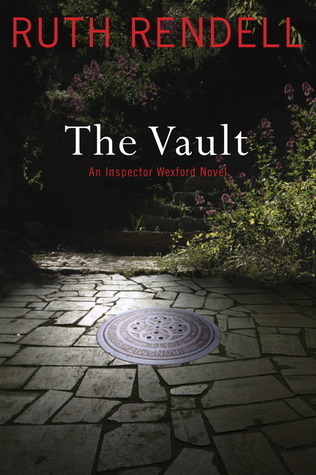
Cover image for the original Scribner (US) hardcover edition from 2011. Image sourced from Goodreads..
Wexford's Laws
There was a profusion of Wexford’s Laws in this book, so many that it seems Wexford (or author Rendell) have lost count. These are quirky observations or opinions made by the Chief Inspector. Some statements are made which seem to be unnumbered Laws.
Trivia and no Link
The Vault was not adapted for television as part of the Ruth Rendell / Inspector Wexford Mysteries TV series (1987-2000) as the novel was published after the series had ended.
Review of the Doubleday Canada Kindle eBook edition (September 13, 2011) of the original Hutchinson (UK) hardcover (August 1, 2011).
Wexford thought of Auden’s poem, the one called ‘Musée des Beaux Arts’, about life going quietly on regardless of terrible happenings. ‘The torturer’s horse,’ he remembered, ‘scratches its innocent behind on a tree.’
Chief Inspector Wexford has finally retired and is at loose ends until he is called upon to be a consultant on a mysterious case where several aged skeletons from decades before are found in the bottom of a vault under a manhole cover in a back patio of a house. The house has had several owners over the years and the manhole had been forgotten and covered up with a large planter. The current owner's renovation plans bring the skeletons to light.
The seemingly impossible to solve cold case is solved of course by the dogged investigations of the retired Wexford. Along the way he is also dealing with the issue of a physical attack on one of his daughters. I thought this was a strong entry for the series as it approaches its conclusion.
The Vault continues my 2023/24 binge read / re-read of Ruth Rendell's Inspector Wexford series and this is the 23rd out of a total 24 books. I’m going to hold off on reading the 24th & final book until I have sourced Wexfords #15 to #18 which I had to skip over. For some reason no Kindle editions exist for those books and due to the current ransomware cyberattack on the Toronto Public Library online system it is impossible to source library copies in Toronto.
Cover image for the original Scribner (US) hardcover edition from 2011. Image sourced from Goodreads..
Wexford's Laws
There was a profusion of Wexford’s Laws in this book, so many that it seems Wexford (or author Rendell) have lost count. These are quirky observations or opinions made by the Chief Inspector. Some statements are made which seem to be unnumbered Laws.
’It’s one of my laws: half the people in the world prefer showers and the other half baths.’
Some women are very much affected, Wexford thought, by whether they think they are looking good or are dissatisfied with their appearance or are having, for instance, a ‘bad hair day’, while men are influenced by the state of their car – he thought of that Edsel – or a bad back or a cold coming on.
Children of any age never take advice from their parents. It was a rule of life and perhaps might stand as Wexford’s fifteenth law or something like that.
Perhaps it was this story which prompted his decision to go by car. That and because he was a man and choosing a car was what men almost always did. Women might not or might choose a taxi if they could afford it. Could that be another of Wexford’s laws, must be the seventeenth or eighteenth by now?
Trivia and no Link
The Vault was not adapted for television as part of the Ruth Rendell / Inspector Wexford Mysteries TV series (1987-2000) as the novel was published after the series had ended.

February 12, 2016
A bloody complex puzzle this one and I read it in a day!
I love Ruth Rendell's Inspector Wexford mysteries and this one is marvelous. Reginald - Reg - Wexford has finally retired and is busying himself as best he can with reading and moving between two properties - his own snug house in Kingsmarkham, and the coach house on his actress daughter's 'estate' in London. Trying to be happy with circumstances, he is actually quite glum, as many a formerly well-occupied man is upon retirement. Then an offer comes in from a police superintendent in London, will Reg 'assist' in a puzzling murder mystery? No payment of course, just act as consultant.
Wexford leaps at the chance and works to figure out who put four bodies into a 'coal-hole' outside a London cottage. There are clues a-plenty, reluctant witnesses, witnesses who know and say too much, and of course, the whole range of those who seem to relish the chance to insult the police at every opportunity. (This is an ongoing theme in Rendell's Wexford series; so many just ordinary people actively work to divert, confuse and 'lord it over' anyone in authority. I know we Americans have a back-and-forth relationship with authority, too. Many of us can be damn arrogant, but the English - oh my! Why say hello when 'what the hell you want?' will do better? Hah!)
Anyhow there is a subplot involving Reg's elder daughter who gets herself knifed and then settles down in Reg's country home and is one arrogant, selfish hussy herself. It's a diversion in the book and gives poor old Reg just one more thing to worry about.
The storyline, the characters, the dialogue - often witty and urbane - makes this one a treat. I loved it and am sorry I only have ONE more Wexford mystery left in this long and outstanding series.
I love Ruth Rendell's Inspector Wexford mysteries and this one is marvelous. Reginald - Reg - Wexford has finally retired and is busying himself as best he can with reading and moving between two properties - his own snug house in Kingsmarkham, and the coach house on his actress daughter's 'estate' in London. Trying to be happy with circumstances, he is actually quite glum, as many a formerly well-occupied man is upon retirement. Then an offer comes in from a police superintendent in London, will Reg 'assist' in a puzzling murder mystery? No payment of course, just act as consultant.
Wexford leaps at the chance and works to figure out who put four bodies into a 'coal-hole' outside a London cottage. There are clues a-plenty, reluctant witnesses, witnesses who know and say too much, and of course, the whole range of those who seem to relish the chance to insult the police at every opportunity. (This is an ongoing theme in Rendell's Wexford series; so many just ordinary people actively work to divert, confuse and 'lord it over' anyone in authority. I know we Americans have a back-and-forth relationship with authority, too. Many of us can be damn arrogant, but the English - oh my! Why say hello when 'what the hell you want?' will do better? Hah!)
Anyhow there is a subplot involving Reg's elder daughter who gets herself knifed and then settles down in Reg's country home and is one arrogant, selfish hussy herself. It's a diversion in the book and gives poor old Reg just one more thing to worry about.
The storyline, the characters, the dialogue - often witty and urbane - makes this one a treat. I loved it and am sorry I only have ONE more Wexford mystery left in this long and outstanding series.

September 5, 2019
Wexford now a pensioner is asked by an old colleague to investigate four bodies found in a coal hole at Orcadia House. I enjoyed the story but do agree with other reviewers that in parts there is repetition and a few mistakes. Strange they were not picked up by an editor such as buying a single ticket to travel in London and when he returns to use his freedom pass?
The subplot of Sylvia the wayward daughter who is stabbed by her toy boy lover is odd. Then Wexford finding his hanging body in her house bizarre.
The description of London and Wexford’s walking journeys is entertaining. The nice again today s long suffering wife Dora puts up with his eccentricities. I liked how he hates puns and then finds himself using them himself much to his chagrin.
The switch to his overcrowded home in Kingdmarkham and his daughters coach house in Hempstead is done well. A little soap opera like with Sylvia’s gate crashing with her kids. Overall I now want to read the prequel to this story ‘A Sight for Sore Eyes’.
The subplot of Sylvia the wayward daughter who is stabbed by her toy boy lover is odd. Then Wexford finding his hanging body in her house bizarre.
The description of London and Wexford’s walking journeys is entertaining. The nice again today s long suffering wife Dora puts up with his eccentricities. I liked how he hates puns and then finds himself using them himself much to his chagrin.
The switch to his overcrowded home in Kingdmarkham and his daughters coach house in Hempstead is done well. A little soap opera like with Sylvia’s gate crashing with her kids. Overall I now want to read the prequel to this story ‘A Sight for Sore Eyes’.
This entire review has been hidden because of spoilers.

March 10, 2015
1.5 ★s
This book represents the epitome of mediocrity. There was a time, in the 1980s and 1990s, when Ruth Rendell was one of the Grandes Dames of British crime writing. Alas, no more.
Wexford has lost all his influence now that he is retired, and must constantly beg permission from others to do any detecting. It becomes tedious.
There is a really weird sub-plot with his daughter Sylvia and her family, whose home becomes the scene of a suicide. There's just no rhyme or reason to this minor diversion from the main story.
The core of a good story does exist, particularly if you, like me, have read the prequel book, A Sight for Sore Eyes, which explains the reason for three bodies in the cellar. Four bodies are uncovered, so there is an additional plot line to explore.
Unfortunately, Rendell's development of any plot lines is woeful. There is a whole lot of secondhand reportage of issues, many passages written in the passive voice, and, sadly, not much in the way of lively, intriguing dialogue, which is what you want with a good detective novel.
The execution of the story is particularly lacklustre. Rendell's character development is shallow as a toddler's paddling pool, and the story development lacks verve or any frisson of possible danger, or even any intrigue. The sentence structure is dreadful and most of the dialogue is wooden.
This book needed a thorough sub-editing job done by the publisher. It did not get any, and the text is riddled with repetitions of sentences, paragraphs and ideas from page to page.
This book, so late in Rendell's illustrious career, does her no justice, and does not repay the attention of her loyal, mystery-loving readership.
This book represents the epitome of mediocrity. There was a time, in the 1980s and 1990s, when Ruth Rendell was one of the Grandes Dames of British crime writing. Alas, no more.
Wexford has lost all his influence now that he is retired, and must constantly beg permission from others to do any detecting. It becomes tedious.
There is a really weird sub-plot with his daughter Sylvia and her family, whose home becomes the scene of a suicide. There's just no rhyme or reason to this minor diversion from the main story.
The core of a good story does exist, particularly if you, like me, have read the prequel book, A Sight for Sore Eyes, which explains the reason for three bodies in the cellar. Four bodies are uncovered, so there is an additional plot line to explore.
Unfortunately, Rendell's development of any plot lines is woeful. There is a whole lot of secondhand reportage of issues, many passages written in the passive voice, and, sadly, not much in the way of lively, intriguing dialogue, which is what you want with a good detective novel.
The execution of the story is particularly lacklustre. Rendell's character development is shallow as a toddler's paddling pool, and the story development lacks verve or any frisson of possible danger, or even any intrigue. The sentence structure is dreadful and most of the dialogue is wooden.
This book needed a thorough sub-editing job done by the publisher. It did not get any, and the text is riddled with repetitions of sentences, paragraphs and ideas from page to page.
This book, so late in Rendell's illustrious career, does her no justice, and does not repay the attention of her loyal, mystery-loving readership.

June 19, 2011
Wexford returns!
For the first time, Ruth Rendell has written a sequel to a previous stand-alone novel (A SIGHT FOR SORE EYES), and added now-retired, former Chief-Inspector Wexford (now living part-time in London) to the proceedings as an 'adviser.' At the end of A SIGHT FOR SORE EYES there were three bodies - one living, two dead - trapped in an unused 'coal-hole' - now, more than a dozen years later, a gruesome discovery has been made: in addition to the three bodies, there is a fourth, placed there not longer than two or three years ago . . .
One of the great pleasures of the novel is that Wexford does a lot of walking around London, which he has never had much chance to explore on his past visits. And there are Rendell’s little ‘social commentaries’: because of the proliferation of mobile phones, one can no longer tell by the 3-digit prefix of a phone number whether the locale is upscale or downscale, and there’s mention of the posh and less posh parts of Maida Vale: “Maida Vale sounds charming and parts of it are, but not St. Mary’s Grove, its tall, shabby, late-Victorian houses almost pressing against the Westway flyover.”
It’s interesting reading about Wexford’s adjustment to civilian life, that he’s no longer a policeman with a policeman’s privileges – technically, he’s only an ‘adviser’ in the case, and can’t even officially interview anyone involved, only ‘consult’ when they’re interviewed by officials. I also enjoyed the continuing peeks into the marriage of Wexford and the ever-patient Dora, which is also on new ground – now that he’s retired they’re spending a lot more time together, and though this has spelled disaster for many such marriages, that isn’t the case here – these are two people who really enjoy each other’s company. Wexford also interacts a good bit with his various grandchildren – Sylvia’s boys are off at school now, apparently 16 and 18, but they put in appearances.
Loyal Rendell readers concerned that Rendell's comments after the publication of THE MONSTER IN THE that Wexford would eventual return but in a 'different capacity,' need have no fear that Wexford has been reduced to a 'cameo appearance', like Christie's Poirot (whom the author found it harder and harder to logically introduce to her plots, thus making him seem like an after-thought in some novels) - he's front and center here, and when he's not conducting his own investigation into the mysterious events at Orcadia Cottage, he's dealing with a very stressful family situation.
For the first time, Ruth Rendell has written a sequel to a previous stand-alone novel (A SIGHT FOR SORE EYES), and added now-retired, former Chief-Inspector Wexford (now living part-time in London) to the proceedings as an 'adviser.' At the end of A SIGHT FOR SORE EYES there were three bodies - one living, two dead - trapped in an unused 'coal-hole' - now, more than a dozen years later, a gruesome discovery has been made: in addition to the three bodies, there is a fourth, placed there not longer than two or three years ago . . .
One of the great pleasures of the novel is that Wexford does a lot of walking around London, which he has never had much chance to explore on his past visits. And there are Rendell’s little ‘social commentaries’: because of the proliferation of mobile phones, one can no longer tell by the 3-digit prefix of a phone number whether the locale is upscale or downscale, and there’s mention of the posh and less posh parts of Maida Vale: “Maida Vale sounds charming and parts of it are, but not St. Mary’s Grove, its tall, shabby, late-Victorian houses almost pressing against the Westway flyover.”
It’s interesting reading about Wexford’s adjustment to civilian life, that he’s no longer a policeman with a policeman’s privileges – technically, he’s only an ‘adviser’ in the case, and can’t even officially interview anyone involved, only ‘consult’ when they’re interviewed by officials. I also enjoyed the continuing peeks into the marriage of Wexford and the ever-patient Dora, which is also on new ground – now that he’s retired they’re spending a lot more time together, and though this has spelled disaster for many such marriages, that isn’t the case here – these are two people who really enjoy each other’s company. Wexford also interacts a good bit with his various grandchildren – Sylvia’s boys are off at school now, apparently 16 and 18, but they put in appearances.
Loyal Rendell readers concerned that Rendell's comments after the publication of THE MONSTER IN THE that Wexford would eventual return but in a 'different capacity,' need have no fear that Wexford has been reduced to a 'cameo appearance', like Christie's Poirot (whom the author found it harder and harder to logically introduce to her plots, thus making him seem like an after-thought in some novels) - he's front and center here, and when he's not conducting his own investigation into the mysterious events at Orcadia Cottage, he's dealing with a very stressful family situation.

May 8, 2020
Disappointing ... an uninteresting case with uninteresting characters poorly told ... I only kept reading because of Rendell's excellent reputation and the fact that I had liked one of her earlier books ... I kept expecting more and it was never delivered

February 21, 2012
This book is a sequel to the author's "A Sight For Sore Eyes". Having just finished that, I snapped up The Vault next.
The Vault offers a final chapter to the events of A Sight For Sore Eyes. Orcadia Cottage is once again the scene of a mystery--twelve years after the events that took place there previously. This time, police are trying to decipher the mystery with no knowledge of who Orcadia Cottage's "secret cellar" holds or what happened to them.
I'd recommend reading the previous book before this sequel--I'm not sure a person reading The Vault without reading its "prequel" would be able to understand the story.
The unsuspecting current owner of Orcadia Cottage, considering a basement addition to the house, looks down into a manhole-covered opening in his back patio, and sees a sight that will change his life.
What he finds offers a partial closure to the last book's mystery, but also deepens the mystery in a very unexpected way. Police are forced to look for leads in a cold case they know nothing about--not even the identity of the victims. Most of the neighbors have moved, the previous owner has died, and the police discover they have not one but two mysteries to solve. Following only the most cryptic clues, many of them leading to dead ends, will they ever find the answers?
Their efforts make interesting reading, but the astute reader can spot a flaw or two in the plot. These are minor, however, and do nothing to spoil the mystery.
The Vault offers a final chapter to the events of A Sight For Sore Eyes. Orcadia Cottage is once again the scene of a mystery--twelve years after the events that took place there previously. This time, police are trying to decipher the mystery with no knowledge of who Orcadia Cottage's "secret cellar" holds or what happened to them.
I'd recommend reading the previous book before this sequel--I'm not sure a person reading The Vault without reading its "prequel" would be able to understand the story.
The unsuspecting current owner of Orcadia Cottage, considering a basement addition to the house, looks down into a manhole-covered opening in his back patio, and sees a sight that will change his life.
What he finds offers a partial closure to the last book's mystery, but also deepens the mystery in a very unexpected way. Police are forced to look for leads in a cold case they know nothing about--not even the identity of the victims. Most of the neighbors have moved, the previous owner has died, and the police discover they have not one but two mysteries to solve. Following only the most cryptic clues, many of them leading to dead ends, will they ever find the answers?
Their efforts make interesting reading, but the astute reader can spot a flaw or two in the plot. These are minor, however, and do nothing to spoil the mystery.

August 25, 2011
I'm a big Ruth Rendell fan and have read every novel she has written and that's probably the only reason I finished this one. If anybody else had written this book I would have given up. The pace is pedestrian, the plotting weak and the book is full of errors - not only typos and grammatical mistakes but, most annoyingly, ones of continuity. I've noticed small errors in most of her recent work but this one is full of them. It's time her publisher took more care with the proofreading and editing of her work.
December 22, 2011
The Vault: Ruth Rendell’s sequel to A Sight for Sore Eyes
A Sight for Sore Eyes came out in 1999. It is a novel of psychological suspense, not a police procedural – Reg Wexford does not appear in the narrative. Sight features one of the most genuinely frightening characters I’ve ever encountered in a work of fiction. In the more than ten years since I read it, I have not forgotten his name: Teddy Brex.
The Vault opens with Franklin Merton commenting that although he could afford to buy a particular house, he could not afford to purchase a painting of it. The painting he’s referring to is entitled Marc and Harriet in Orcadia Place. The painter was Simon Alpheton, an artist of considerable note at the time, that time being 1973.
A Sight for Sore Eyes opens with Simon Alpheton in the act of painting Marc Syre, star of the rock band Come Hither, and his girlfriend Harriet Oxenholme as they stand before a house – their house, Orcadia Cottage.
The house they stood in front of was described by those who knew about such things as a Georgian cottage and built of the kind of red bricks usually called mellow. But at this time of year, midsummer, almost all the brickwork was hidden under a dense drapery of Virginia creeper, its leaves green, glossy and quivering in the light breeze. The whole surface of the house seemed to shiver and rustle, a vertical sea of green ruffled into wavelets by the wind.
I often feel that Ruth Rendell is not given sufficient credit for the vivid beauty of her writing. One is particularly likely to encounter prose of this caliber when she is describing dwelling places. Orcadia Cottage is of central importance in A Sight for Sore Eyes, just as it is in The Vault.
While Marc and Harriet are posing for him, Simon tells them about a painting by Rembrandt called The Jewish Bride:
‘It’s a very tender painting, it expresses the protective love of the man for his young submissive bride. They’re obviously wealthy, they’re very richly dressed, but you can see that they’re sensitive, thoughtful people and they’re in love.’
The graceful image, not to mention the subtle implication conjured by these words is well nigh lost on the rock musician and his preening girlfriend. Her response to Simon’s words is to crow: “Like us. Rich and in love.”
No, not much like them at all, actually….
The action of The Vault takes place in the present, almost forty years after Simon Alpheton created his iconic image. Marc Syre is dead. Franklin Merton has recently passed away. No one knows what’s become of Harriet Oxenholme. Meanwhile, a terrible secret concealed in the bowels of Orcadia cottage has just come to light.
At the time of these events, Reg Wexford, newly retired, is living with his wife Dora in London, in accommodation provided by their loving (and happily very well to do) daughter Sheila. Wexford is just starting to adjust to his new life when Superintendent Tom Ede of the Met asks for his help. A gruesome discovery has been made in a house in Orcadia Place. Could Wexford assist with the investigation, as a civilian consultant? Wexford could. And does, although working for law enforcement in this singular capacity makes him somewhat uneasy. In conversation with Dora, he can’t help likening himself to some of the great fictional consulting detectives of the past:
‘Every detective-story writer had an amateur detective who was cleverer than the police. Sherlock Holmes, of course. Poirot, Lord Peter Wimsey…’
‘Albert Campion.’
Roderick Alleyn.’
‘Alan Grant.’
‘Who on earth was he?’
‘Josephine Tey’s detective. But no, Reg, I forgot. He was a bona fide policeman.’
(In fact, Roderick Alleyn was also a law enforcement professional. His creator Ngaio Marsh was among the pioneers of the British police procedural, beginning with the first Roderick Alleyn novel called A Man Lay Dead, published in 1934.)
Wexford’s peregrinations throughout London are recounted in fascinating detail. I felt as though I were walking along side him. At one point in the investigation, as he checks in via cell phone with Tom Ede, the latter asks if he is anywhere near the West Hampstead cemetery. If so, he should seek out the tomb of Grand Duke Michael of Russia. In 1891, the Grand Duke made a marriage that not only displeased his cousin Czar Alexander III but was also illegal according to Imperial Law. He was sent to live in exile, and after some wandering on the continent chose England as the new dwelling place for his family. That’s where they were – the Grand Duke, his wife Countess Sophie of Merenberg, and their three children – when revolution overtook Russia in 1917. One wonders how they felt, watching from a safe distance, as the imperial regime that had spawned them was annihilated.
This story has nothing to do with the main narrative of the novel. It is yet another instance of Ruth Rendell in digressive mode. As a lesson in the vagaries of history, the story of the Grand Duke and his family is worth pondering.
I love Rendell’s digressions, and as you’ve probably already gathered, I loved this book.
A Sight for Sore Eyes came out in 1999. It is a novel of psychological suspense, not a police procedural – Reg Wexford does not appear in the narrative. Sight features one of the most genuinely frightening characters I’ve ever encountered in a work of fiction. In the more than ten years since I read it, I have not forgotten his name: Teddy Brex.
The Vault opens with Franklin Merton commenting that although he could afford to buy a particular house, he could not afford to purchase a painting of it. The painting he’s referring to is entitled Marc and Harriet in Orcadia Place. The painter was Simon Alpheton, an artist of considerable note at the time, that time being 1973.
A Sight for Sore Eyes opens with Simon Alpheton in the act of painting Marc Syre, star of the rock band Come Hither, and his girlfriend Harriet Oxenholme as they stand before a house – their house, Orcadia Cottage.
The house they stood in front of was described by those who knew about such things as a Georgian cottage and built of the kind of red bricks usually called mellow. But at this time of year, midsummer, almost all the brickwork was hidden under a dense drapery of Virginia creeper, its leaves green, glossy and quivering in the light breeze. The whole surface of the house seemed to shiver and rustle, a vertical sea of green ruffled into wavelets by the wind.
I often feel that Ruth Rendell is not given sufficient credit for the vivid beauty of her writing. One is particularly likely to encounter prose of this caliber when she is describing dwelling places. Orcadia Cottage is of central importance in A Sight for Sore Eyes, just as it is in The Vault.
While Marc and Harriet are posing for him, Simon tells them about a painting by Rembrandt called The Jewish Bride:
‘It’s a very tender painting, it expresses the protective love of the man for his young submissive bride. They’re obviously wealthy, they’re very richly dressed, but you can see that they’re sensitive, thoughtful people and they’re in love.’
The graceful image, not to mention the subtle implication conjured by these words is well nigh lost on the rock musician and his preening girlfriend. Her response to Simon’s words is to crow: “Like us. Rich and in love.”
No, not much like them at all, actually….
The action of The Vault takes place in the present, almost forty years after Simon Alpheton created his iconic image. Marc Syre is dead. Franklin Merton has recently passed away. No one knows what’s become of Harriet Oxenholme. Meanwhile, a terrible secret concealed in the bowels of Orcadia cottage has just come to light.
At the time of these events, Reg Wexford, newly retired, is living with his wife Dora in London, in accommodation provided by their loving (and happily very well to do) daughter Sheila. Wexford is just starting to adjust to his new life when Superintendent Tom Ede of the Met asks for his help. A gruesome discovery has been made in a house in Orcadia Place. Could Wexford assist with the investigation, as a civilian consultant? Wexford could. And does, although working for law enforcement in this singular capacity makes him somewhat uneasy. In conversation with Dora, he can’t help likening himself to some of the great fictional consulting detectives of the past:
‘Every detective-story writer had an amateur detective who was cleverer than the police. Sherlock Holmes, of course. Poirot, Lord Peter Wimsey…’
‘Albert Campion.’
Roderick Alleyn.’
‘Alan Grant.’
‘Who on earth was he?’
‘Josephine Tey’s detective. But no, Reg, I forgot. He was a bona fide policeman.’
(In fact, Roderick Alleyn was also a law enforcement professional. His creator Ngaio Marsh was among the pioneers of the British police procedural, beginning with the first Roderick Alleyn novel called A Man Lay Dead, published in 1934.)
Wexford’s peregrinations throughout London are recounted in fascinating detail. I felt as though I were walking along side him. At one point in the investigation, as he checks in via cell phone with Tom Ede, the latter asks if he is anywhere near the West Hampstead cemetery. If so, he should seek out the tomb of Grand Duke Michael of Russia. In 1891, the Grand Duke made a marriage that not only displeased his cousin Czar Alexander III but was also illegal according to Imperial Law. He was sent to live in exile, and after some wandering on the continent chose England as the new dwelling place for his family. That’s where they were – the Grand Duke, his wife Countess Sophie of Merenberg, and their three children – when revolution overtook Russia in 1917. One wonders how they felt, watching from a safe distance, as the imperial regime that had spawned them was annihilated.
This story has nothing to do with the main narrative of the novel. It is yet another instance of Ruth Rendell in digressive mode. As a lesson in the vagaries of history, the story of the Grand Duke and his family is worth pondering.
I love Rendell’s digressions, and as you’ve probably already gathered, I loved this book.

September 28, 2011
I have great affection for Inspector Wexford, and the way his personal life intertwines with his professional life, and his patient sorting of facts and following procedures. This is the newest Inspector Wexford story, and now that he's retired he has some restrictions on his ability to interview people at will -- he is now a volunteer consultant for this case. I didn't read the book, Sight for Sore Eyes, that this book is a sort of sequel to. It wasn't a Wexford novel, but one of Rendell's more psychological suspense novels. The deaths being investigated happened in that book, and a long time before, so it doesn't really matter. But it was kind of odd. Maybe I'm wrong, but I don't think she's done this sort of sequel before.
Ruth Rendell is so good, and she's written so many novels (and won so many awards), but I had just a hint of a feeling that maybe she's starting to call it in, it's so familiar to her. Or maybe that it's familiar to me. In any event, as usual, I enjoyed the read.
Ruth Rendell is so good, and she's written so many novels (and won so many awards), but I had just a hint of a feeling that maybe she's starting to call it in, it's so familiar to her. Or maybe that it's familiar to me. In any event, as usual, I enjoyed the read.

April 2, 2013
This entire review is a spoiler, so don't read on if you haven't finished the book. I found this book to be oddly incomplete, almost as if Rendell got tired in the telling. And maybe it was because I was reading it at 3 am when I was unable to sleep, but it seems like there are a few plot mistakes. For example, when Sylvia is stabbed, how did anyone know to come? It made sense when Mary was there and she supposedly ran to get help, but take away Mary and I think Sylvia is left to bleed out. Also, if Teddy really did slip and fall into the coalhole, who put the cover back on? And just why did Teddy kill the other two people in the first place? Finally, when Wexford is accosted by Jason Wardle's parents at the inquest, I can understand his feeling of guilt. But where was his anger? After all Jason had nearly killed Wexford's daughter. As a parent, I don't think this is something I would have so quickly forgotten.
All in all, not up to Rendell's usual high quality.
All in all, not up to Rendell's usual high quality.

Read
June 1, 2013Seduced by the blurb on the back cover, I bought 'The Vault' at Hong Kong airport, keen to read it on an overnight flight to Australia. The opening sentence created a good hook, and I read quite a lot of the book while sitting patiently at the departure gate. But we'd scarcely taken off (at 8.30pm) when my yawning reaction to this book indicated that attempting to sleep with my eyes shut was preferable.
I don't recall reading any of Ruth Rendell's other titles, but if this is meant to be 'one of Rendell's very, very best novels' (that back-cover blurb again) then I'd hate to read any of her also-rans. I found the book tedious and boring, even though I'm very familiar with the area of London in which 'The Vault' is set. Describing the intricate details of every street's twists and turns and intersections with other streets was completely superfluous to the plot of this particular story. As well, in a relatively short book, there were far too many characters for my liking.
There was also too much 'tell', not enough 'show'. For example - The day began badly with Martin Rokeby emerging from his front door and shouting at Lucy not to park the car in front of his house. She moved it a few feet, explaining that they had calls to make in the neighbourhood and there was nowhere else to put it. Rokeby began on a long peevish complaint, the gist of which was that the police had been investigating this case for months and still had got nowhere. I might have enjoyed the book more had Rendell used more actual conversation to carry this kind of narrative and speed up its sleepy nature.
All in all, for me this was no page-turner. Although I'm a fast reader, it took me another four days of desultory attention to be bothered finishing this book.
I don't recall reading any of Ruth Rendell's other titles, but if this is meant to be 'one of Rendell's very, very best novels' (that back-cover blurb again) then I'd hate to read any of her also-rans. I found the book tedious and boring, even though I'm very familiar with the area of London in which 'The Vault' is set. Describing the intricate details of every street's twists and turns and intersections with other streets was completely superfluous to the plot of this particular story. As well, in a relatively short book, there were far too many characters for my liking.
There was also too much 'tell', not enough 'show'. For example - The day began badly with Martin Rokeby emerging from his front door and shouting at Lucy not to park the car in front of his house. She moved it a few feet, explaining that they had calls to make in the neighbourhood and there was nowhere else to put it. Rokeby began on a long peevish complaint, the gist of which was that the police had been investigating this case for months and still had got nowhere. I might have enjoyed the book more had Rendell used more actual conversation to carry this kind of narrative and speed up its sleepy nature.
All in all, for me this was no page-turner. Although I'm a fast reader, it took me another four days of desultory attention to be bothered finishing this book.

June 2, 2013
A disappointing book. Not that The Saint Zita Society hadn't plumbed the depths a once-loved author could sink to. The disappointment here was that to begin with I felt reassured that Rendall, back with Wexford, on safe ground once more. It started strongly and seemed set to However, eventually the book unravelled and I closed the book barely knowing whodunnit, how and who to (even though I've read A Sight for Sore Eyes to which I now realise this is a sequel with added Wexford, a clever idea if it comes off)
There were some very weird things in this book... Wexford frequently muses on the datedness of various expressions that don't seem dated to me - 'nowadays'? 'fair enough'? Yet he is recently retired from the police force as a senior detective and reckons never to have sent an email? Meanwhile, he laboriously explains the most banal of cockney rhyming slang eg 'taking a butcher's' to the young black London detective he is working alongside and she seems to need it (possibly because like all the London police characters bar the Tom who calls on Wexford's informal help, she is made of cardboard)
The additional story of his daughter Sylvia's stabbing and its sequelae (and antecedents) also failed to stand up although I liked the start of it. The IPCC are involved in the other case when someone makes a malicious complaint but boy have the Kingsmarkham police got a case to answer on this one failing to find her attacker or her car.
I liked walking round London with Wexford looking at vernacular architecture - it was like Street View.
There was enough good in this book for enough of it to call it OK.
There were some very weird things in this book... Wexford frequently muses on the datedness of various expressions that don't seem dated to me - 'nowadays'? 'fair enough'? Yet he is recently retired from the police force as a senior detective and reckons never to have sent an email? Meanwhile, he laboriously explains the most banal of cockney rhyming slang eg 'taking a butcher's' to the young black London detective he is working alongside and she seems to need it (possibly because like all the London police characters bar the Tom who calls on Wexford's informal help, she is made of cardboard)
The additional story of his daughter Sylvia's stabbing and its sequelae (and antecedents) also failed to stand up although I liked the start of it. The IPCC are involved in the other case when someone makes a malicious complaint but boy have the Kingsmarkham police got a case to answer on this one failing to find her attacker or her car.
I liked walking round London with Wexford looking at vernacular architecture - it was like Street View.
There was enough good in this book for enough of it to call it OK.

March 15, 2012
I so hate to give anything by Ruth Rendell such a bad rating, but this book has several problems. First: It's not Rendell's fault, but I prefer her dark and twisty non-Wexford books (although I love the character), so I was not predisposed to like this book as much as one of those.
Second: This novel seems to have more than the usual questioning of (almost always) truculent potential witnesses; several times, I had to try to find first references when Wexford and Tom Ede would pay a character a follow-up visit because I had completely forgotten what they'd said during the preceding visit. I thought this was just me growing dim, but others have mentioned it, too.
Third: There are mistakes that should have been caught by an editor. (One glaring example is Tom Ede either putting his tie on or taking it off twice in a row -- one or the other, but in any case an impossibility.)
I should mention that this is a sequel of sorts to "A Sight for Sore Eyes." I didn't know that when I read The Vault, and it would have been nice to know. Upon reading a plot summary for the earlier book, I recalled that I liked it very much.
Second: This novel seems to have more than the usual questioning of (almost always) truculent potential witnesses; several times, I had to try to find first references when Wexford and Tom Ede would pay a character a follow-up visit because I had completely forgotten what they'd said during the preceding visit. I thought this was just me growing dim, but others have mentioned it, too.
Third: There are mistakes that should have been caught by an editor. (One glaring example is Tom Ede either putting his tie on or taking it off twice in a row -- one or the other, but in any case an impossibility.)
I should mention that this is a sequel of sorts to "A Sight for Sore Eyes." I didn't know that when I read The Vault, and it would have been nice to know. Upon reading a plot summary for the earlier book, I recalled that I liked it very much.

October 20, 2011
I loved this book. It felt comfortable, like a conversation with an old friend. I've read all of the previous Wexford books, and liked some more than others, but I really liked this one. I didn't think it was convoluted at all. I enjoyed reading about Wexford in his semi-retirement, and enjoyed the story. I kind of resent other reviewers saying that those who rated the book highly must not have read it. People have different likes and dislikes and different ways of judging books. I rate books highly that I enjoy, that keep me interested and keep me engaged, and this one did. In my book, and on my terms, that rates as five stars.

December 1, 2017
Review to come

July 15, 2019
This was rather complex mystery with a few different story lines. It held my interest and I finished it rather quickly so it was indeed a page turner.
Favorite moment: When Wexford finally gives his grown daughter Sylvia a piece of his mind after holding back for so long (she needed to hear how selfish she was).
Favorite moment: When Wexford finally gives his grown daughter Sylvia a piece of his mind after holding back for so long (she needed to hear how selfish she was).

August 12, 2011
I've written about my adoration of Ruth Rendell before, and it's still hard to explain why I love her so much, because I get all swoony (and afraid I won't be able to do her justice). So, the swoony bit: she is by far my favorite contemporary writer in one of my favorite genres (mystery), and truly one of my favorite writers, period. I know it's a cliche to say someone's work "transcends the genre," but it's actually true about Ruth Rendell, whose books, to me, seem far more intelligent and intuitive about the deep recesses of the human soul than most non-mystery literary fiction I read. That's the case with her portrayal of the criminals/villains in her books; it's even true regarding her most peripheral characters, the "ordinary people" (though in Rendell's world there is no such thing) who are witnesses and bystanders and family members. And it's especially true about Wexford, her detective, who becomes realer, more complicated, and more compelling with each book.
For example, here's this quote, which I loved as as a window into Wexford's complex and lovable heart and mind:
"Burden was already there. Wexford sometimes thought how awkward it was for Englishmen to greet each other, even in the case of close friends. Continental Europeans would have shaken hands or even embraced. Arabs and many Asians would have embraced and kissed , even to that extraordinary fashion he had only seen on the screen, of kissing on one cheek, then the other, then the first again. Secretly, in those wakeful, vaguely mad times of the night, he thought that he would quite like to embrace Burden when they met after an absence, though he drew the line at that triple kissing. Thinking of telling Burden this and his reaction, a kind of incredulous but well-veiled horror, made Wexford laugh out loud."
And there is so much more like that.
Ruth Rendell's books always present me with a funny dilemma: I want to read fast (because they're mysteries, with fascinating intricate startling plots) and to read as slowly as possible (because they're beautifully and wisely written, because each scene is rich and telling). The good thing about the fact that my memory is getting worse is being able to reread her earlier work and to love it as much (without remembering who did it) all over again.
For example, here's this quote, which I loved as as a window into Wexford's complex and lovable heart and mind:
"Burden was already there. Wexford sometimes thought how awkward it was for Englishmen to greet each other, even in the case of close friends. Continental Europeans would have shaken hands or even embraced. Arabs and many Asians would have embraced and kissed , even to that extraordinary fashion he had only seen on the screen, of kissing on one cheek, then the other, then the first again. Secretly, in those wakeful, vaguely mad times of the night, he thought that he would quite like to embrace Burden when they met after an absence, though he drew the line at that triple kissing. Thinking of telling Burden this and his reaction, a kind of incredulous but well-veiled horror, made Wexford laugh out loud."
And there is so much more like that.
Ruth Rendell's books always present me with a funny dilemma: I want to read fast (because they're mysteries, with fascinating intricate startling plots) and to read as slowly as possible (because they're beautifully and wisely written, because each scene is rich and telling). The good thing about the fact that my memory is getting worse is being able to reread her earlier work and to love it as much (without remembering who did it) all over again.

November 3, 2011
ector Wexford Novel (Hardcover)
I enjoyed this Wexford novel immensely. He has been my favorite character of Rendell so I was pleased that she had written a new one. It's not a long book but hers never are and she says more in one sentence than many do in a page.
Wexford is retired now and living in London for part of the time and part of the time in Kingsmarham. Throughly enjoying his time in London, Wexford is walking, reading and playing with his grandchildren. Then an old acquaintance asks him to consult on a case- four dead bodies found in an abadoned coalhole. There's no pay but Wexford is happy to flex his police muscles again. The case goes in unexpected directions and slowly unfolds in different ways. There are many suspects so it becomes a little complicated to keep track of all of them. I had to flip back several times to make sure who a character was. There was a secondary story line involving Wexford's daughter, Sylvia, that added nothing to the book.
Still, I enjoyed my time with Wexford again and you can't ask for more than that.
I enjoyed this Wexford novel immensely. He has been my favorite character of Rendell so I was pleased that she had written a new one. It's not a long book but hers never are and she says more in one sentence than many do in a page.
Wexford is retired now and living in London for part of the time and part of the time in Kingsmarham. Throughly enjoying his time in London, Wexford is walking, reading and playing with his grandchildren. Then an old acquaintance asks him to consult on a case- four dead bodies found in an abadoned coalhole. There's no pay but Wexford is happy to flex his police muscles again. The case goes in unexpected directions and slowly unfolds in different ways. There are many suspects so it becomes a little complicated to keep track of all of them. I had to flip back several times to make sure who a character was. There was a secondary story line involving Wexford's daughter, Sylvia, that added nothing to the book.
Still, I enjoyed my time with Wexford again and you can't ask for more than that.

December 1, 2012
Did she have to bring Wexford into this sequel to A Sight for Sore Eyes? Did she? I had expected a tale similar to the prequel, where the reader is drawn into the sociopathic world of Teddy Brex. Wexford adds nothing to the novel and should have solved the case in 50 pages. In fact, there are huge holes in the plot- for example, the Edsel could have been traced easily through DMV registration, even after 12 years. And what mechanic works on a car like this without remembering the name of the owner? Does Wexford have to interview people so many times? Sorry, but the first book could have --and should have-- been the end of the story.

May 14, 2013
Not a good come back. Ruth constantly reminded us that Wexford was no longer a police officer and gave the impression that he was a has-been desperately trying to hang on to his past glory, anything he 'discovered' was done with such ridiculous implausibility that the whole story felt shoddy and lazy.
Rather than suspend the likeliness of reality in his explorations and allowing him to conveniently wander past places to discover people she would have done better in using her creative licence to allow us to believe he still carried some weight in the force and made him work for his discoveries.
Rather than suspend the likeliness of reality in his explorations and allowing him to conveniently wander past places to discover people she would have done better in using her creative licence to allow us to believe he still carried some weight in the force and made him work for his discoveries.
August 5, 2015
Poor even by Rendell's standards.
In a house in London bodies are found in a hidden basement, unknown by the owners despite two surveys undertaken for that very purpose. In the first survey, architects draw up plans for the basement but the owner claims he knows nothing of it. In the second, one of the workers dumps a body even though he knows it is going to be developed.
Inspector Wexford comes out of retirement, has no idea what a Ford Edsel is, how to use the internet, or that VIN and engine numbers are recorded on cars.
He also forgets repeatedly what he said just a few pages before.
In a house in London bodies are found in a hidden basement, unknown by the owners despite two surveys undertaken for that very purpose. In the first survey, architects draw up plans for the basement but the owner claims he knows nothing of it. In the second, one of the workers dumps a body even though he knows it is going to be developed.
Inspector Wexford comes out of retirement, has no idea what a Ford Edsel is, how to use the internet, or that VIN and engine numbers are recorded on cars.
He also forgets repeatedly what he said just a few pages before.
October 23, 2015
The writing was okay. But what drives me crazy, is that the author keeps mixing things up. One moment she writes one of the previous owners cut down a tree and a chapter later the people currently living there cut the tree? She keeps mixing up facts.
Also the police can't seem to do the simples searches or checks. They have a car that possiply belonged to a suspect and they can't find out his name? Ok the licence plate is missing, but its a very rare car, in a terrible color, so checking all registerd cars of the same make and color is definitly a short list!
So i'm sorry to say but I won't finish this book.
Also the police can't seem to do the simples searches or checks. They have a car that possiply belonged to a suspect and they can't find out his name? Ok the licence plate is missing, but its a very rare car, in a terrible color, so checking all registerd cars of the same make and color is definitly a short list!
So i'm sorry to say but I won't finish this book.

November 7, 2017
Well. For most of the book nothing much was happening, and then it was all over quite fast. I might have been spoiled by past mystery picks, but I really didn't think that this book was well-written (not even in a grammatical sense or as far as proofreading is concerned). And I got quite mad about some horrible stereotypes and an elaborate bit of slut-shaming (especially since the character in question had really not done anything wrong).

March 9, 2016
I have been reading Ruth Rendell for over 50 years - so I was sorry to read she died last year. She was one of the very best - as was this book. I have followed Reg Wexford from day one and still love him. Even retired, he still "gets his man"! Now I have to go back and read the few of her books I might have missed. RIP!!

September 14, 2018
Took half a day to read. Badly written, badly edited. The sub plot padded it out to 360 pages of which 200 were not required. The only reason I finished it was to find out if the story actually had a believable ending. It didn’t!

September 1, 2013
I enjoyed the mystery but my enjoyment was spoiled by the fact that both the Sussex and Metropolitan Police seemed incapable of running the most basic murder (attempted murder) inquiry.

October 12, 2014
It was so confusing and so uninteresting, I couldn't finish it. I didn't care to even learn the truth about the mystery. I literally hated this book.

August 6, 2020
"Wexford glanced around the big room, thinking to himself that no interior can be uglier than that which was designed to be grand and sumptuous but was rendered mean by cheap carpeting and chain store chairs and tables."
It's this sort of thing that makes Rendell my favorite comfort writer, always entertaining and thought-provoking. THE VAULT is most notable for being a sequel to her horrific fantasy A SIGHT FOR SORE EYES, which was even more concerned with interiors both grand and squalid. In the earlier book we saw how three bodies wound up in the makeshift tomb, and in this one Inspector Wexford must identify the victims. Reading this as a sequel, I was disappointed that Teddy's final victim goes completely unnoticed here and we don't get to see his grandmother learn what happened to him.
However, I do think linking the stories works thematically because both stories are concerned with what men demand from women. Recall that aesthete Teddy is so repulsed by Harriet's advances that he pushes her down stairs to her death. He feels entitled to her money and home. Later Teddy could only physically consummate his relationship with physically perfect Francine when she described her mother's murder. In THE VAULT these three are joined by five more women assaulted by men. One of them is Wexford's daughter which leads to some uncomfortable scenes of "slut shaming". It goes without saying that none of the men in the story are berated for their attitudes toward women.
It's this sort of thing that makes Rendell my favorite comfort writer, always entertaining and thought-provoking. THE VAULT is most notable for being a sequel to her horrific fantasy A SIGHT FOR SORE EYES, which was even more concerned with interiors both grand and squalid. In the earlier book we saw how three bodies wound up in the makeshift tomb, and in this one Inspector Wexford must identify the victims. Reading this as a sequel, I was disappointed that Teddy's final victim goes completely unnoticed here and we don't get to see his grandmother learn what happened to him.
However, I do think linking the stories works thematically because both stories are concerned with what men demand from women. Recall that aesthete Teddy is so repulsed by Harriet's advances that he pushes her down stairs to her death. He feels entitled to her money and home. Later Teddy could only physically consummate his relationship with physically perfect Francine when she described her mother's murder. In THE VAULT these three are joined by five more women assaulted by men. One of them is Wexford's daughter which leads to some uncomfortable scenes of "slut shaming". It goes without saying that none of the men in the story are berated for their attitudes toward women.
Displaying 1 - 30 of 548 reviews