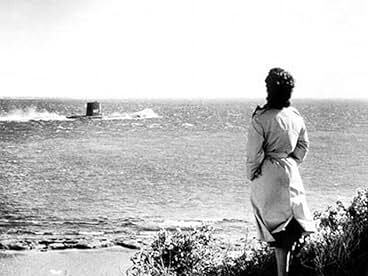
“It seemed to [Commander Dwight Towers] that the best thing he could do would be to go south. He went back round the north of Luzon and set course for Yap Island, a cable station under the control of the United States. He got there three days later. Here the radioactive level was so low as to be practically normal; he surfaced in a moderate sea, blew out the ship with clean air, charged his tanks, and let the crew up on the bridge in batches. On entering the roads he was relieved to find an American cruiser there…Here he learned for the first time of the Russo-Chinese war that had flared up out of the Russo-N.A.T.O. war, that had in turn been born of the Israeli-Arab war…He learned of the use of cobalt bombs…”
- Nevil Shute, On the Beach
Nevil Shute’s On the Beach must rank among the most depressing novels ever written. Even for post-apocalyptic fiction, it is grim. Most end-of-the-world books, no matter how dark, allow at least a sliver of hope to shine through, as the characters attempt to survive on a planet that has drastically changed.
There is no such sliver in On the Beach. When the book opens, a widescale nuclear war has taken place, irradiating the globe. Only Australia remains, though its time is very short. The poisonous cloud is already on the way, meaning death to all. There is nothing to be done to stop it. There is no reason to attempt to rebuild society. “It’s not the end of the world at all,” a character famously says. “It’s only the end for us. The world will go on just the same, only we shan’t be in it.”
In the years since its 1957 publication, On the Beach has become a classic of the genre. Its lethal high-concept hook is what gets your attention. But it is the ruthlessly unsentimental execution of its conceit that lingers long after the last page has been read.
***
When the curtain rises, we are in Melbourne, Australia, with roughly six months to go before humanity’s final bow. Shute quickly introduces us to a handful of characters, and through their quotidian day-to-day, we gradually learn about what has happened, and the way that individuals react differently to the inevitable.
We meet, for instance, Peter Holmes, a young Australian naval officer with a wife and baby at home. He has accepted what is going to happen, while his wife Mary is in utter denial, planting flowers she will never live to see bloom. There is also scientist John Osborne, who treats his doom as a license to indulge a passion for race car driving.
At the center of the tale is Dwight Towers, the commander of the American nuclear submarine U.S.S. Scorpion. He knows full well what has happened to his hometown, yet he also carries on as though his wife and children in Connecticut are alive and waiting for him. During a visit with the Holmes family, he meets Moira Davidson, a party girl who regrets that she must die before having experienced very much of life. Their chaste love affair forms On the Beach’s surprisingly effective emotional core.
***
Beginning well after World War III has concluded, all the big action in On the Beach has already happened by the first lines. In other words, there is no combat. Instead, we are given small-scale moments: dinner parties; drinks at a club; a day sailing in the ocean; and the most mournful fishing trip conceivable. Shute manages to convey a lot with simple scenes. Much of On the Beach is just two or three people talking to each other.
With that said, there is some movement in this slim volume. In particular, there is an extended set piece in which Towers’s sub makes a foray to the United States in search of a mysterious wireless signal. Shute handles this really well, with his restrained prose conjuring haunting images of depopulated cities.
***
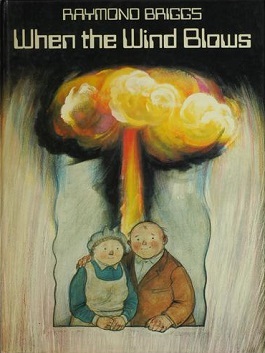
On the Beach arrived in the midst of the Cold War nuclear arms race, with both the United States and the Soviet Union developing ever-growing arsenals of ever-more powerful weapons. Almost at once it engendered quite a bit of controversy. Indeed, professional physicist and amateur psychopath Herman Kahn went so far as to write On Thermonuclear War as a riposte. Kahn’s position – and that of other atom-smashing gunslingers – was that one could fight, win, and survive a full-scale nuclear exchange.
Two points are worth making in response.
First, Kahn is absolutely correct that Shute’s scenario is scientifically implausible. Given the still-early state of research, this is not wholly astonishing. In some ways, Shute is actually too cheerful, with the prospect of nuclear winter not yet understood. Nevertheless, he goes beyond the realm of possibility in his contention that every single human would fall victim.
Second, the first point does not matter at all. The problem with men like Herman Kahn and Edward Teller is that they deeply believed that nukes should be integrated into a standard military planning. Their whole purpose was to make Armageddon palatable, as though this represented a rational response to one’s dislike of another nation’s political-economic system. This is a proposition that borders on a mental illness. Wars are seldom fought for good reasons, and it is hard to come up with a justification for unleashing the cancerous hell of fission weapons upon hundreds of millions of innocent men, women, and children.
If you really, really have an itch to press the button, books like On the Beach are incredibly dangerous. Fortunately, despite its lack of scientific rigor, Shute’s moral position has prevailed, and the nuclear taboo has – despite some very close calls – been maintained.
I guess what I’m trying to say is that being terrified by nuclear weapons is an appropriate response. Trying to normalize them is mindbogglingly dangerous and more than a little sick. Of course, instead of sending Kahn and Teller to psychotherapy, they were given top-secret clearances and prime seats at the policymaking table. But I digress.
***
Perhaps a more trenchant criticism of On the Beach is that its portrayal of the societal response to a calamity of truly biblical proportion is unrealistic. In Shute’s hands, the good folk of Melbourne have fully imbibed the stiff-upper-lip stoicism of their English forebears. To be sure, there is some indication of minor breakdowns – an uptick in drunkenness for one – but nothing like a wholesale communal collapse. There are shortages, but not of basic necessities. There are no refugee crises. People still go to their jobs and exchange goods and services for money. The electricity and phones still work. Most are resigned to their fate. The government functions up to the last, handing out L-pills to a quiescent citizenry.
Extrapolating from what we have seen of real-life catastrophes, this is delusionally optimistic. If a disaster like this took place, there would be mass looting, rampant hoarding, and a thriving black market. Violence would replace law and order. Critical services would fail as employees stopped reporting for duty. Viral conspiracies would lay false blame and promise false salvation. Everyone able would be running, willing to do anything for an extra day. Meanwhile, our tech overlords would be blasting themselves into space on private rockets, leaving the rest of us to wonder why we thought they were our friends.
This critique is fair. It also does not matter. Shute’s point is not to deconstruct the frail bonds of community. If you want that, Pat Frank’s underappreciated Alas, Babylon still slaps.
Rather, Shute is working on a more intimate scale.
***
For good reason, On the Beach has long been hailed as a warning. It is an undiluted imploration for sanity in international affairs. In this way, Shute’s work is of a certain time and place, when such a cry was badly needed to drown out those clamoring to make atomic arms a conventional response. But On the Beach is also a sharp exploration of humans facing the inescapable fact of death. In this way, Shute’s work is universal, and belongs to every time and every place.
It is this aspect that struck me most powerfully. Due to Shute’s skillful evocations, the atmosphere is often one of oppressive sadness. This is a rare book that legitimately affected my mood. At the same time, there are glimmers of grace and beauty throughout: in Osborne shuffling off his petty workaday anxieties to do what he loves; in Moira learning a skill she will never use; in Dwight’s belief that things will go on, only differently than before.
We are all infinitesimally tiny motes on an unimaginably short voyage through eternity. Oftentimes the daily drudgery makes us forget that we are always in transition. It sometimes requires the prospect of imminent death to remind us to make good use of what time we have.


 come to my blog!