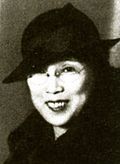
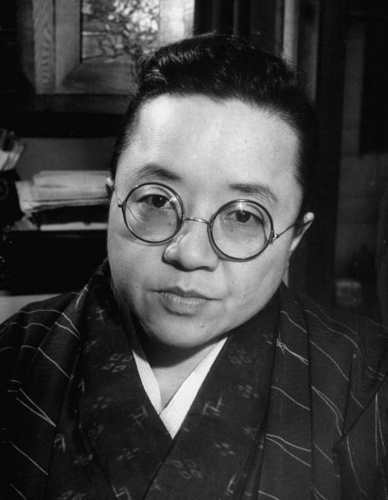
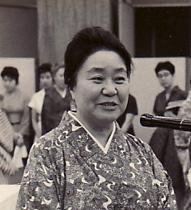
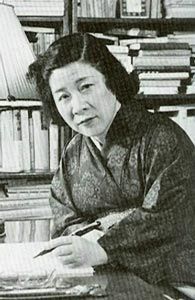
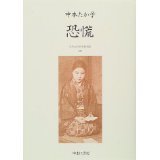
Little by little like stinging currents, streams of piercing pain scurried all over my back. Sullen fingers cringing at the mere sight of fluttering pages, drowsy eyelids succumbing to the warpath of the recurring prose and the poor chair cumbersome under my weight. I wasn't yet ready to let go the book. The faint sound of a nib impregnated by flowing ink scribbling over the coarseness of paper filled the clammy air in my room; women writing to emancipate their souls, women writing to feed their stomachs,women writing to mend their broken hearts, women writing to find their mislaid voice, to challenge the codes of patriarchy, to unshackle the literary seclusion, to silence their social critics and male counterparts; women writing to live. The stray voices in my head tumbled to several teary yawns, my eyes still locked on the repetition of prose embellishing every word with eternal imagery. Yukiko Tanaka’s marvellous assembly of nine remarkable women authors captivated my acumen with an addictive indulgence akin to unearthing of infinite treasure.
“These writers , many who came from impoverished families in rural regions, showed a tenacity and honesty rarely seen among male writers; they observed and wrote about a society run by men and recorded their personal battles against traditional mores with unprecedented candour.”
TO EAT and TO WRITE are the two reasons for living.
Nine courageous women, each trouncing the obstacles of a domineering society and personal regressions whilst overpowering the prevalent chauvinistic supremacy with their astounding vigour for creativity. The path to freedom through writing charted by the political vestiges of anarchist ideologies and communism revealed the creative aptitudes of the women flaunting a boundless imagination revolutionizing social and family mores. The romanticism of proletarian prose,the nationalistic march for the “pen squadron”(Pen Butai – writers as war correspondents) , the congenial narcissistic conflicts,overwhelming bourgeois conventions, cannibalism of self-confessions,the rationalization of literary realism and above all the everlasting ambition to publish the written work in a liberal socio-cultural milieu; celebrated the embarked rigorous path where the productivity of living and writing were problematic entities to separate for these modern Japanese women writers. Thus, the resounding reciprocation of Hayashi Fumiko’s words enunciating the magnitude of ‘eating’ and ‘writing’ for the humanity of their livelihood.
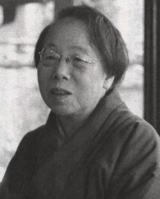
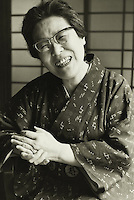
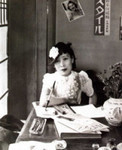
The powdery masquerades of Tamura Toshiko’s Woman writer consciously enveloping her distressing vulnerabilities under pale layers of face powder equates the woman’s addiction of her snowy make-up as a mask for her ailing vulnerabilities. The Glory of a single mother misplaced between the diminished luxurious past and a prevalent impoverished present. The strokes of runny watercolours sketch the diaries of a young woman and her audacious resistance to the drudgery of a non-creative life tinting the melancholic tunes of Hayashi Fumiko’s Vagabond Song. "The way we live is precisely like selling mourning bands”, the deepening cynicism indulging in Self-mockery envisioning Hirabayashi Taiko’s nonchalant bravado. Comprehending the mistreatment of the workers from the Caramel Factory and Sata Ineko’s exhilarating Crimson shades, brings immense appreciation when delved on the prosaic style sensual ‘The Female Bell-Cricket’, Nakamoto Takako's fantastical depiction of a wilful woman who takes advantage of her feeble idealistic lover. From the kitschy manoeuvre of Kanoko’s A Floral Pageant, Nobuko’s retaliation to overbearing matrimonial suffocation and openly embracing sexuality, paralleling Miyamoto Yuriko’s personal predicament to the paradox of Yaeko’s A Story of Missing Leg, depicts a conscious effort promoting artistic maturity in women who were until then narrowly defined as “good wives and wise mothers”. The literary art of these contemporary women writers who were drawn towards fiction to seek self-discovery and self-expression found its solidarity in the very first publication and enterprise of Japanese women’s magazine – ‘Seito-sha’(Bluestocking) founded by Hiratsuka Raicho in 1911. Socio-political debates ranging from abortion to prostitution found a refuge in the pages of Seitō until 1916 when it crumbled under bureaucratic pressure.
“Even the tiniest of flowers expresses the life and character of all of its kind. How vigorous is the force that enables a flower to bloom under the sun, transforming all earthly filth into nutrients for itself. Mighty is the flower.”
Like a wildflower it blossoms emitting an anonymous fragrance, the tiniest of expressions, the tiniest molecule of an overwhelming life, the tiniest poignant hue ,the budding strings of words clenching the elegiac appendages of a dormant power hidden within these women, sweetening the elusive feminist nectar reciting the fierce zeal of the encircling literary whorls and transforming the earthly bedlam into an inspiring celestial inflorescence blooming under the autonomous luminosity defining new rising horizons. Mighty is the pen. Mighty are the women who own it.
This was a great anthology and selection of writers with sample works from this period. My notes from this text are at: https://www.goodreads.com/topic/show/...
This book was incredible. Each story spoke of the writers' strength and endurance through supremely difficult times, and I ate it up. These women conquered poverty, hunger, censorship, and patriarchy to write beautiful, destructive, and soul-punching words. Simply put: these ladies are SO FREAKING HARDCORE, DUDE.
I read this book to research for a short story, and I wasn't disappointed. Each short story is preceded with a mini-biography of the author, so now I have pages of notes in my notebook about Japanese women writers during the period. I admire them so much, and I scribbled down titles of their full works to read later. Awesome read!
This is an amazing jewel of a book. I don't even remember how I found it, but I've recommended it broadly ever since. The stories about these Japanese women writers suffering for the art will break your heart, and make you feel foolish for ever complaining about your writing life. They're not particularly joyous stories, instead they are heartbreakingly real, and unforgettable.
Like any collection of short stories, essays, etc by various authors some of these were better than others. All were at least interesting, if not better. And the breadth of the collection meant that one came away with a very good sense of what it was like to be a woman in Japan in those times. Many of the stories were about women writers trying to pursue a career in that field. Not only were they poor, they often had husbands/lovers who treated them badly, and parents who were not sympathetic or supportive of their career choices. Most importantly, they had to try to cope with a government which was dead set against their rights to express themselves about social or political issues of the day. To say it was VERY challenging would be an understatement.
Tanaka provides a biographical intro to each of the nine writers she included in this collection. While some of the info was useful, sometimes she referred to a story or novel with just enough detail to leave me frustrated that she did not provide more. That plus the fact that she chose some chapters of a novella/novel to represent the author's work left me wanting on occasion. For those reasons I did not give the book a 5 star rating. Rather than a 4 perhaps a 4.5 would be better.
I would recommend this book for those who want a sampling of Japanese women writers from this period. I came away with a list of writers whose work (in English) I will look for in the coming months. Other readers might as well.
I wanted to read this book because I was interested in learning more about the Taisho period in Japan, which is post world war I and pre world war II. It also is a time where there was a lot of social change and questioning of women's roles. Of course, many of the authors in this novel who wrote these short stories were ostracized for their unique voices that questioned their societal role, were attracted to marxism, often had a few lovers and had to fight to support themselves alone with their writing. Because these women were on the fringes of society, they often faced poverty and didn't make enough to support themselves. They encountered men who often tried to take their success from them monetarily or emotionally. These are the main themes of the short stories, but I liked getting a glimpse of life in Japan during this historical period because some of these stories felt like a day in the life of women writers. They showed how westernization, whether literature or politics, impacted their ideals and decisions concerning change. It was very clear that many of them were dissatisfied with their relationships, yet they were stuck in a society that often didn't listen to them. There were a few women that were successful writers during this time and I'm glad the editor compiled this collection to translate and showcase women's issues in Japan.
A must-read collection of short stories for women and those who love period books. Also, If you're an aspiring short story writer, this is a good place to start. I love how before each story starts, the book shares the biography of the writer. It gives you context and understanding of their protagonists' frustrations and aspirations.
what an amazing selection of authors and stories. the story selections leaned more into spousal relationships and writing as a job. The translations were excellent and the biography sections were well researched and interesting. I wish this had been a big enough hit when it was published so I'd have more to read of these authors by now!
This was an interesting read for me. I think the best part was seeing literary trends from a time before I was born written for a culture I'm not part of. These women writers became prominent in a time when each and every one of them were unlikely to succeed just because they were women. Seeing the themes they wrote about and many of the stories being at least semi-autobiographical makes me feel like I've learned at least a little bit more about both what it meant to be a Japanese women in this time as well as what it means to be a woman today. Many of the things these writers struggled with are still current issues today.