

What do you think?
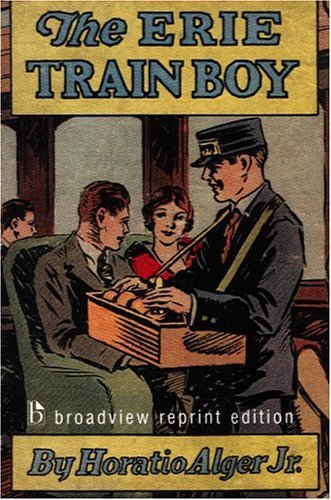
The Erie Train Boy
From the publication of Ragged Dick in 1867 through to the 1930s, Horatio Alger’s tales of young boys overcoming adversity were part of the mainstream of American culture. The phrase “a Horatio Alger story” remains synonymous with the American ideal of struggling against adversity and finally achieving success, financial and otherwise―but especially financial. As Michael Moore says in Dude, Where’s My Country? , “Alger was one of the most popular American writers of the late 1800s. … Alger’s stories featured characters from impoverished backgrounds who, through pluck and determination and hard work, were able to make huge successes of themselves in this land of boundless opportunity. The message was that ‘anyone can make it in America, and make it big .’” Ironically, however, it is typically chance and good luck that is most instrumental in bringing success to the typical Horatio Alger hero, hardworking and deserving though he may be. And often the ideal of egalitarianism features just as prominently as that of rugged individualism. In all these respects, The Erie Train Boy (1890) is typical of the genre. For a number of reasons, however, it is among the most interesting of Alger’s many novels. Fred Fenton is the Erie train boy, a young lad selling sundries on the trains traveling north from New York and through this work supporting his mother and siblings as the family struggles to survive in a New York tenement house. The story eventually unfolds in a more or less mechanical fashion, but along the way we are shown a world of confidence men and pickpockets, of cheap boarding houses and railway hotels, and of a good deal of the grit of life in late nineteenth-century America. We are given sensation―from Fenton rescuing a young woman whose dress has caught fire from the footlights in the midst of a performance, to a saga of stolen bonds secreted near a Quebec village, to an episode of thievery at Niagara Falls, and finally to a scheming uncle and a parcel of land in Colorado. We are given as well a great deal of detail about the social and economic life of the times; Alger pays attention to wages and prices perhaps more than any other writer of the period. All in all, The Erie Train Boy is among the most far-reaching and most interesting of Horatio Alger novels. The different editions of Alger’s novels reflected as much as they shaped American culture in the late nineteenth and early twentieth centuries. Later editions of the novels were often shortened. This made them more of a “quick read,” but in many cases the material selected for excision was ideologically charged; descriptions explicitly or implicitly critical of the privileged classes were disproportionately likely to be cut. In this respect, too, The Erie Train Boy is an interesting example of the genre; later editions cut a considerable amount of material from the original. In addition to providing the text itself, this Broadview reissue endeavors to make something of its cultural history available for readers. The copy text is that of the early edition published by M.A. Donahue & Company, collated against the A.L Burt Company edition from the 1890s; both of these include the complete Alger text. The text has also been collated, however, against the edition published by the Whitman Publishing Co. circa 1920―an edition that was considerably abridged, though no acknowledgment of this was made in the volume itself―and an appendix provides full information on the changes made for this later edition. Readers will thus be able to trace the ways in which the text was altered through abridgement. Also included as an appendix to the volume are cover illustrations and advertisements from all three editions.
163 pages, Paperback
First published January 1, 1890
About the author
Horatio Alger Jr.
540 books98 followersHoratio Alger, Jr. (January 13, 1832 – July 18, 1899) was a prolific 19th-century American author, most famous for his novels following the adventures of bootblacks, newsboys, peddlers, buskers, and other impoverished children in their rise from humble backgrounds to lives of respectable middle-class security and comfort. His novels about boys who succeed under the tutelage of older mentors were hugely popular in their day.
Born in Chelsea, Massachusetts, the son of a Unitarian minister, Alger entered Harvard University at the age of sixteen. Following graduation, he briefly worked in education before touring Europe for almost a year. He then entered the Harvard Divinity School, and, in 1864, took a position at a Unitarian church in Brewster, Massachusetts. Two years later, he resigned following allegations he had sexual relations with two teenage boys.[1] He retired from the ministry and moved to New York City where he formed an association with the Newsboys Lodging House and other agencies offering aid to impoverished children. His sympathy for the working boys of the city, coupled with the moral values learned at home, were the basis of his many juvenile rags to riches novels illustrating how down-and-out boys might be able to achieve the American Dream of wealth and success through hard work, courage, determination, and concern for others. This widely held view involves Alger's characters achieving extreme wealth and the subsequent remediation of their "old ghosts." Alger is noted as a significant figure in the history of American cultural and social ideals. He died in 1899.
The first full-length Alger biography was commissioned in 1927 and published in 1928, and along with many others that borrowed from it later proved to be heavily fictionalized parodies perpetuating hoaxes and made up anecdotes that "would resemble the tell-all scandal biographies of the time."[2] Other biographies followed, sometimes citing the 1928 hoax as fact. In the last decades of the twentieth century a few more reliable biographies were published that attempt to correct the errors and fictionalizations of the past.
Born in Chelsea, Massachusetts, the son of a Unitarian minister, Alger entered Harvard University at the age of sixteen. Following graduation, he briefly worked in education before touring Europe for almost a year. He then entered the Harvard Divinity School, and, in 1864, took a position at a Unitarian church in Brewster, Massachusetts. Two years later, he resigned following allegations he had sexual relations with two teenage boys.[1] He retired from the ministry and moved to New York City where he formed an association with the Newsboys Lodging House and other agencies offering aid to impoverished children. His sympathy for the working boys of the city, coupled with the moral values learned at home, were the basis of his many juvenile rags to riches novels illustrating how down-and-out boys might be able to achieve the American Dream of wealth and success through hard work, courage, determination, and concern for others. This widely held view involves Alger's characters achieving extreme wealth and the subsequent remediation of their "old ghosts." Alger is noted as a significant figure in the history of American cultural and social ideals. He died in 1899.
The first full-length Alger biography was commissioned in 1927 and published in 1928, and along with many others that borrowed from it later proved to be heavily fictionalized parodies perpetuating hoaxes and made up anecdotes that "would resemble the tell-all scandal biographies of the time."[2] Other biographies followed, sometimes citing the 1928 hoax as fact. In the last decades of the twentieth century a few more reliable biographies were published that attempt to correct the errors and fictionalizations of the past.
Ratings & Reviews
Friends & Following
Create a free account to discover what your friends think of this book!
Community Reviews
Displaying 1 - 7 of 7 reviews
May 23, 2018
I got this book from my mother. Not in the way you might be thinking. When I was a kid, I heard Mom say something like "Oh wow, we have these Horatio Alger books, isn't that something!" I took note of that, and asked her what was the significance. She had said that Alger wrote books for children in her day and that they were pretty good. So at that time I thought I should read them. About thirty years later I asked her if I could have the books and she gave them to me. They were very old. The pages were drying and actually breaking apart in some spots. I took them to an antiquarian to see if they were worth anything and he said they were worthless. He was even rude about it. He thought I was trying to sell them to him. Anyway, now, about twenty years after I got the books, I have read the first one. (There are three) The book was published in 1890. I must say, I enjoyed the book. I see in the book the hero always wins and politeness and kindness always pays off and good character always advances a person. I think I got a lot of my life expectations from stories like this except the ones I refer to are things like The Lone ranger. The tales and conflicts in the book are typical, and as I said, written for children. (Maybe age 13 to 18) Situations of adventure or danger are often resolved in half a page. I liked it though. I also seem to be reading a lot of books the last couple months from this early nineteen hundreds back to late eighteen hundreds and it is kind of cool to be reading along and realize that horse travel was the way, and when the story says you got in a cab, not even mentioning horses, you are in a horse drawn vehicle. So there is that whole change of society thing. The book has a happy ending. The characters in the story start off impoverished and end up at least somewhat well off with a nice path to more happy times as far as economic situations go. As I said, the good guy wins. It is all stuff I like from my gut. I intend to read the other two soon.
Read
November 16, 2024The edition I read has a different cover and no copyright date. After a little research we decided the publishing date of this edition is 1928. The image on the cover depicts a young man standing on a spar (?) held by ropes. He appears to be waving his hat; there is a shaded backdrop behind him on the left side of the cover. The story of Fred Fenton, the Erie Train Boy, is improbable but engaging, being the chronicle of about one year of the 17-year-old's life, a rags-to-riches tale of luck, hard work, and cleverness. The lack of bad language, violence, and gore was a respite from what I usually read.

November 29, 2024
This was an interesting histori read
Inita time this was probably a great book. But it was one I struggled with. The outdated way of talking. And the blind trust people had in others. Just didn't fit in the world I live in. This is more like lots of mini stories wrapped together. The erie train boy being the common denominator in each.
Inita time this was probably a great book. But it was one I struggled with. The outdated way of talking. And the blind trust people had in others. Just didn't fit in the world I live in. This is more like lots of mini stories wrapped together. The erie train boy being the common denominator in each.
August 4, 2017
WOW! What a great read! Just my kind of story. Perfect adventure story for children who are into reading chapter books. Or even middle-aged 12 year olds like myself.

December 10, 2014
OLD TIME (PRE-1920) CATEGORY
I must admit that I have never really read a story quite like this one. The style is so different from anything that I have read before in young adult literature. The story is about a young 17 year old named Fred Fenton who works on a train selling food, magazines, and books. Despite his youth acts as the provider of his family, providing for his widowed mother and his younger brother. The story details what life was like for the youth of the time, as they faced homelessness as families were often unable to pay the rent. Despite his family's poverty, Fred has a number of adventures in New York City as well as abroad. While the beginning of the story felt like a time piece detailing the events of city life, the latter half became a rag to riches story, which upon further research, I found to be quite common to works by Horatio Alger. Fred's fortunes are turned around as he begins working for a wealthy man, and finds a way to support his family. The language of the story was quite different than anything you might see in young adult literature today, and it was almost difficult for me, simply because I was not accustomed to the style. The story was interesting though, and fun at times as well.
I must admit that I have never really read a story quite like this one. The style is so different from anything that I have read before in young adult literature. The story is about a young 17 year old named Fred Fenton who works on a train selling food, magazines, and books. Despite his youth acts as the provider of his family, providing for his widowed mother and his younger brother. The story details what life was like for the youth of the time, as they faced homelessness as families were often unable to pay the rent. Despite his family's poverty, Fred has a number of adventures in New York City as well as abroad. While the beginning of the story felt like a time piece detailing the events of city life, the latter half became a rag to riches story, which upon further research, I found to be quite common to works by Horatio Alger. Fred's fortunes are turned around as he begins working for a wealthy man, and finds a way to support his family. The language of the story was quite different than anything you might see in young adult literature today, and it was almost difficult for me, simply because I was not accustomed to the style. The story was interesting though, and fun at times as well.

October 25, 2010
This was an very thick book but still was very goodit was a book about a child who meets another kid who is very rich a supposedly related to the mayor and is worth alot of money. the 1st child was from a very poor family who could barely make rent and though he was only a child he was the families only income of money
whi;le i was reading this book i thought to myself that it was a runoff of the classic book Oliver Twist i willcontinue this review lATER if you want to read on read the book
whi;le i was reading this book i thought to myself that it was a runoff of the classic book Oliver Twist i willcontinue this review lATER if you want to read on read the book

October 9, 2008
this is such a fun book to read, it combines alot of what i like in a story.
Displaying 1 - 7 of 7 reviews