

What do you think?
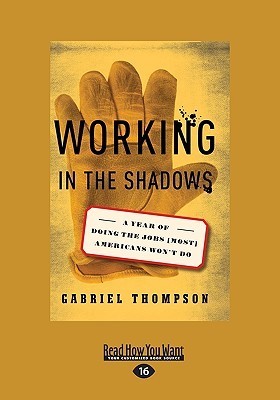
Working in the Shadows: A Year of Doing the Jobs (Most) Americans Won't Do: Easyread Large Edition
What is it like to do the back-breaking work of immigrants? To find out, Gabriel Thompson spent a year working alongside Latino immigrants, who initially thought he was either crazy or an undercover immigration agent. He stooped over lettuce fields in Arizona, and worked the graveyard shift at a chicken slaughterhouse in rural Alabama. He dodged taxis - not always successfully - as a bicycle delivery ''boy'' for an upscale Manhattan restaurant, and was fired from a flower shop by a boss who, he quickly realized, was nuts. As one coworker explained, ''These jobs make you old quick.'' Back spasms occasionally keep Thompson in bed, where he suffers recurring nightmares involving iceberg lettuce and chicken carcasses. Combining personal narrative with investigative reporting, Thompson shines a bright light on the underside of the American economy, exposing harsh working conditions, union busting, and lax government enforcement - while telling the stories of workers, undocumented immigrants, and desperate US citizens alike, forced to live with chronic pain in the pursuit of $8 an hour.
432 pages, Paperback
First published January 1, 2009
About the author
Gabriel Thompson
17 books45 followersI have spent most of the past decade working as an independent journalist, writing feature articles about immigration, labor, and organizing for a variety of publications that include the New York Times, Harper’s, Slate, Virginia Quarterly Review, New York, Mother Jones, and The Nation. Most of my magazine writing can be found at https://gabrielthompson.org/
I'm the author of four books, each with deal in some way with the same themes. My newest, out in March 2016, is America's Social Arsonist: Fred Ross and Grassroots Organizing in the Twentieth Century. The book is the first biography of one of the most influential--but little known--community organizers in American history, who mentored both Cesar Chavez and Dolores Huerta.
I'm currently a Steinbeck Fellow at San Jose State University.
I'm the author of four books, each with deal in some way with the same themes. My newest, out in March 2016, is America's Social Arsonist: Fred Ross and Grassroots Organizing in the Twentieth Century. The book is the first biography of one of the most influential--but little known--community organizers in American history, who mentored both Cesar Chavez and Dolores Huerta.
I'm currently a Steinbeck Fellow at San Jose State University.
Ratings & Reviews
Friends & Following
Create a free account to discover what your friends think of this book!
Community Reviews
Displaying 1 - 30 of 137 reviews

February 23, 2010
This book, as the title suggests, is the story of the author spending a year working in jobs generally dominated by immigrant laborers. He harvests lettuce on the border, works in a chicken plant in Alabama, and delivers meals in New York City. I found the section in the chicken plant especially interesting because of the fact that in my job, we put many refugee clients to work in meat processing plants. These jobs are among some of the best jobs we are able to find for people in terms of pay, steady hours, and benefits, but it was a little heart breaking to read about the difficulty of the work, the dehumanization the workers face, and the long term health problems people face from doing such difficult work. However, like the immigratns profiled in this book, the refugees whom I place to work in these plants have very rarely come back to complain about these jobs and every day I have more and more refugees coming to me asking for a job in "the chicken." I hope that the factories where my clients work are better since they are both unionized, which was not true at the plant where Thompson worked. There were no refugee employees mentioned in this book, it focused on mainly Latino immigrants, but I know in the past several years refugee employees, especially from Burma and Somalia have come in to many chicken plants to fill the labor void created by immigration raids and I wonder if this has happened in the plant where Thompson worked and how it would affect the workplace there.
I'm really glad I read this book. While I have been able to take a partial tour of a chicken plant, this helps me to have a deeper understanding of what a typical workday is really like for many of my clients.
I'm really glad I read this book. While I have been able to take a partial tour of a chicken plant, this helps me to have a deeper understanding of what a typical workday is really like for many of my clients.

September 28, 2019
Back in 2008, Mr. Thompson, who was thirty years old, decided to spend a year investigating jobs most Americans would not do. He was undercover doing something called immersion journalism. The three jobs he selected were harvesting lettuce, working in a poultry plant, and also being employed in the back room of a restaurant. The author focused on industries that rely heavily on Latino immigrants. His plan was to physically work two months at each place and write a book about his experiences. Wow, his commitment was far more intense than when I picked potatoes in Northern Maine for three weeks in the early Fall. It was during the 1970s and I was in my early teens. We’d rise at 4:30 AM and usually were home around 6 PM. In that three-week period, you went to bed dead tired, muscles aching, and when you closed your eyes in an effort to fall asleep you could hear the tractor’s squeaky potato digger that haunted your workday. A bath was mandatory because you were coated in a day’s worth of dirt and dust. Your boogers were globs of muddy mucus and, when you broke wind, they smelled exactly like godawful rotten potatoes. It was piece work and we made a lot of money from a kid’s perspective, but after three weeks we were thrilled it was done for another year. Picking potatoes as a full-time job was unthinkable. The same cannot be said for the people who inhabit ‘Working in the Shadows.’ Latino immigrants do it for years or decades.
The book was published in 2010. Besides describing the difficult work involved in each career, the author explains immigration policy, poor pay, nonpayment of wages, unsafe working conditions, unsanitary housing, and the seizure of their passports as well as work visas by the employers. Beyond the punishing nature of the work, the immigrants are exposed to harmful pesticides, and have poor access to medical care. By describing his own experiences as well as telling the stories of some immigrant workers, Mr. Thompson keeps the book very well grounded. Surprisingly, ‘Working in the Shadows’ is not gloomy journalism. There is humor and a sense of decency about the people who the author works alongside. Some of the material is quite shocking. Beyond the low pay and “grinding, deadening work,” the author also shows most have frequent health emergencies, a complete lack of savings, and premature aging is endemic. In the poultry industry, Mr. Thompson noticed that anyone over forty had front teeth missing. New York City’s underground economy is teeming with exploitation of legal and illegal immigrants AND U.S. citizens. Shaving a worker’s hours is rampant in the city’s restaurant industry. Systemic racism factors into the various pay levels used by businesses. Mr. Thompson’s descriptions are not only found in the jobs he did. It is a national issue found in both rural and urban areas. The book is not preachy until the author’s Conclusion and Afterword chapters.
If you read Mr. Thompson’s book and still believe immigrants are taking jobs away from Americans and sucking extravagantly off the government teat, then you, my dear friend, have less critical-thinking skills than what the author was harvesting in those lettuce fields or you likely have the empathy of Hannibal Lecter. The Latinos, African-Americans, and poor whites depicted have an amazing work ethic and are an important component to our society. However, exploitation of them for corporate or shareholder greed lingers throughout ‘Working in the Shadows.’ Mr. Thompson is not patronizing to either the workers or the reader. The author has done a huge public service by documenting his experiences. I hope the book is widely read.
The book was published in 2010. Besides describing the difficult work involved in each career, the author explains immigration policy, poor pay, nonpayment of wages, unsafe working conditions, unsanitary housing, and the seizure of their passports as well as work visas by the employers. Beyond the punishing nature of the work, the immigrants are exposed to harmful pesticides, and have poor access to medical care. By describing his own experiences as well as telling the stories of some immigrant workers, Mr. Thompson keeps the book very well grounded. Surprisingly, ‘Working in the Shadows’ is not gloomy journalism. There is humor and a sense of decency about the people who the author works alongside. Some of the material is quite shocking. Beyond the low pay and “grinding, deadening work,” the author also shows most have frequent health emergencies, a complete lack of savings, and premature aging is endemic. In the poultry industry, Mr. Thompson noticed that anyone over forty had front teeth missing. New York City’s underground economy is teeming with exploitation of legal and illegal immigrants AND U.S. citizens. Shaving a worker’s hours is rampant in the city’s restaurant industry. Systemic racism factors into the various pay levels used by businesses. Mr. Thompson’s descriptions are not only found in the jobs he did. It is a national issue found in both rural and urban areas. The book is not preachy until the author’s Conclusion and Afterword chapters.
If you read Mr. Thompson’s book and still believe immigrants are taking jobs away from Americans and sucking extravagantly off the government teat, then you, my dear friend, have less critical-thinking skills than what the author was harvesting in those lettuce fields or you likely have the empathy of Hannibal Lecter. The Latinos, African-Americans, and poor whites depicted have an amazing work ethic and are an important component to our society. However, exploitation of them for corporate or shareholder greed lingers throughout ‘Working in the Shadows.’ Mr. Thompson is not patronizing to either the workers or the reader. The author has done a huge public service by documenting his experiences. I hope the book is widely read.

May 17, 2013
An interesting look at one man's journey to work like many of the immigrants who do. Thompson spends about two months at various jobs around the US: his book focuses working on a lettuce farm, a meat processing plant and a restaurant. He also mentions a couple of jobs where he got fired--notably a flower shop.
It was a very interesting read that gave me pause and made me think about a lot of various topics: where does our food come from? Who cares/picks/processes it? What do they do when things go wrong? How do they find other jobs? What if they become ill? Thompson describes the working conditions and his fellow workers. Some aren't as bad as he thought it might be, and in some places he was surprised. He was in a lot of pain in the lettuce fields and the meat factories. Workers there are often subject to boredom (which might not seem so bad, but standing around for 12 hours is not fun), repetitive stress injuries, no time off and long hours.
Yet he found that the despite conditions the workers seemed relatively happy and got along with each other. The reasons why people come are various: family, hopes for a better life, sending money to relatives back home. No surprises there.
In his last jobs it takes a different turn: Thompson gets fired after about 2 weeks at a flower shop, much to his surprise. His last section is working as a delivery man for a restaurant in NY. I probably mostly identified with him there, dodging cars and bikes and pedestrians, navigating traffic and dealing with events like the Halloween holidays, not to mention crappy tippers. I admit I like getting food delivered and made me feel sorry for the people who do delivery.
I think it's a good read overall for those interested at all in the immigration debate as well as those who are curious about factory conditions, labor unions and the restaurant industry. As a caveat, it's clear that as a white male Thompson is often considered for more advanced positions right when he walks in. Doesn't he want to be the lead X? Wouldn't he want to work inside instead of in the fields instead? Why does this white male want to work in a meat factory? He describes some of the dark side of the industry, such as the exhaustion and pain as well as the low pay. But he doesn't really touch upon what someone who is not a citizen goes through, with literally living from paycheck to paycheck. Thompson also can't really discuss the long term affects of work on the body and mind. He describes a few veterans of the jobs and the ailments they face as well as the lower life expectancy for some. But again, this was just a project and not a reflection of the real thing.
I do recommend it though. It will definitely give you food for thought.
It was a very interesting read that gave me pause and made me think about a lot of various topics: where does our food come from? Who cares/picks/processes it? What do they do when things go wrong? How do they find other jobs? What if they become ill? Thompson describes the working conditions and his fellow workers. Some aren't as bad as he thought it might be, and in some places he was surprised. He was in a lot of pain in the lettuce fields and the meat factories. Workers there are often subject to boredom (which might not seem so bad, but standing around for 12 hours is not fun), repetitive stress injuries, no time off and long hours.
Yet he found that the despite conditions the workers seemed relatively happy and got along with each other. The reasons why people come are various: family, hopes for a better life, sending money to relatives back home. No surprises there.
In his last jobs it takes a different turn: Thompson gets fired after about 2 weeks at a flower shop, much to his surprise. His last section is working as a delivery man for a restaurant in NY. I probably mostly identified with him there, dodging cars and bikes and pedestrians, navigating traffic and dealing with events like the Halloween holidays, not to mention crappy tippers. I admit I like getting food delivered and made me feel sorry for the people who do delivery.
I think it's a good read overall for those interested at all in the immigration debate as well as those who are curious about factory conditions, labor unions and the restaurant industry. As a caveat, it's clear that as a white male Thompson is often considered for more advanced positions right when he walks in. Doesn't he want to be the lead X? Wouldn't he want to work inside instead of in the fields instead? Why does this white male want to work in a meat factory? He describes some of the dark side of the industry, such as the exhaustion and pain as well as the low pay. But he doesn't really touch upon what someone who is not a citizen goes through, with literally living from paycheck to paycheck. Thompson also can't really discuss the long term affects of work on the body and mind. He describes a few veterans of the jobs and the ailments they face as well as the lower life expectancy for some. But again, this was just a project and not a reflection of the real thing.
I do recommend it though. It will definitely give you food for thought.

July 6, 2012
In this feat of 'immersion journalism' writer Gabriel Thompson puts himself through back-breaking labor to relate the lives of workers across the country. For two months at a time he works as a lettuce farmer in Arizona, a poultry processor in rural Alabama, and a delivery boy in New York City. Disparate though those three stints may seem, they have much in common: they are physically exhausting and often dangerous jobs largely performed by migrant workers for little pay. The fruits of this labor are regularly consumed by the general population with little thought about the labor entailed. One of Thompson's more powerful observations is that even with all the steps in the process between the cutting of a head of lettuce and our purchase of it at the grocery store, it is likely that the last hand that touched it before our own was that of the lettuce cutter.
Thompson's detailed accounts of the work itself are vivid and often painful. But he also illustrates the larger context in each situation, here providing some of the most interesting insights for the reader. For example, one learns about the migrant workers who commute to and from Mexico everyday into Arizona, a dynamic that seems to satisfy employers, immigration officials, and the workers themselves and which transcends the polarizing debates over illegal immigration. In another instance, the reader learns about disparities in the restaurant industry, such as the minimum and actual wages of delivery men and the way tips are distributed (or not) to the hardest workers in the back of the kitchen. Thompson also shows us a white American community that paid immigrant workers little attention until the day they became politicized.
This is a quick and enjoyable read - Thompson's writing style is accessible and flows easily from humor to rage, keeping it interesting throughout.
Thompson's detailed accounts of the work itself are vivid and often painful. But he also illustrates the larger context in each situation, here providing some of the most interesting insights for the reader. For example, one learns about the migrant workers who commute to and from Mexico everyday into Arizona, a dynamic that seems to satisfy employers, immigration officials, and the workers themselves and which transcends the polarizing debates over illegal immigration. In another instance, the reader learns about disparities in the restaurant industry, such as the minimum and actual wages of delivery men and the way tips are distributed (or not) to the hardest workers in the back of the kitchen. Thompson also shows us a white American community that paid immigrant workers little attention until the day they became politicized.
This is a quick and enjoyable read - Thompson's writing style is accessible and flows easily from humor to rage, keeping it interesting throughout.

May 22, 2011
I love Gabriel Thompson's work, and I have so much admiration for him as an activist journalist. In this book, he explores where the issues of labor, poverty, and undocumented immigration overlap as he works, over the course of the year in three different, primarily immigrant-reliant industries: cutting lettuce in Yuma, Arizona; working at a poultry plant in Russellville, Alabama; and doing restaurant delivery in New York City. While uninformed loudmouths proclaim, "Immigrants are stealing American jobs!", Thompson ventures into the field (literally) to uncover what's really going on and why Americans actually won't take those very same jobs.
This is a really easy read, and it's a great discussion-starter. Thompson does good, solid research, and his tone strikes an objective balance. This is a book that I would love to teach in a class along with "Nickel and Dimed" by Barbara Ehrenreich, "Food Inc.", and "The Omnivore's Dilemma," just for starters.
What I love about Thompson is that he understands how hard it is to get the real story from the outside or the sidelines, and he knows that the only way to really understand what's happening is to enter into the realm of these workers... to live with them, to work alongside them, to befriend them. What is also terrific about Thompson is that he is funny. He's not sarcastic or disrespectful in any way, but he has the right turn with words to capture some of the ordinary humor that is present in any work situation. In the midst of back-breaking drudgery, he can describe a scene with just the right words to force a guffaw to escape which underlines even more strongly the absurdity of the inhumanity of excessive industrialization.
The most interesting part of the book to me was the part about cutting lettuce, probably because I knew nothing about this kind of work. Something that really stuck in my mind from the lettuce-cutting section is this: "On most crews, each cutter harvests six heads of lettuce each minute, or 360 an hour. At this pace, a farmworker earning an hourly wage of $8.37 is paid just over 2 cents per head; these heads are then sold in stores for about $1 a piece. Although total farm labor costs are less than 1/3 of grower revenue, companies argue that low wages are necessary in an industry forced to deal with unpredictable weather and shifting market demands. But Philip L. Martin, professor of agricultural economics at the UC-Davis, has shown that even a dramatic increase in labor costs - passed fully to the consumer - would have a very modest impact on the typical American household budget, which spent $322 on fresh fruits and vegetables in 2000. Martin's detailed analysis of the agricultural industry found that a 40 percent increase in farmworker wages would increase a household's annual spending on fruits and vegetables by only $8, to $330. A single head of iceberg lettuce, selling for $1, would increase by just two to three cents." (pp. 14-15)
What is going on here????? It is clear to me that there is a kind of slavery going on here where workers' wages are kept far below anything that is actually livable. This does not make sense. Americans could easily stomach an 80% increase in farmworker wages based on these calculations. The way that the US addresses food and labor needs to drastically change.
I was also shocked to learn that the life expectancy of a farmworker is 49 years!!!! This is crazy and unacceptable.
I feel like, because of this book, I think even more than I did before about the connection between the food that I put into my mouth and the people who harvested that food. I think about the choices that I can make about which food industries I support (the chicken plant section made me literally sick to my stomach, and I think that Thompson's descriptions were fairly tame compared to other things that I've read about chicken plants).
I hope that this book will reach a wider audience. I feel like it is a very accessible book for high school students, and I feel like it would be so beneficial for younger people to read this and to start advocating now for changes in the working conditions for all people in this country -- immigrant and non-immigrant alike.
This is a really easy read, and it's a great discussion-starter. Thompson does good, solid research, and his tone strikes an objective balance. This is a book that I would love to teach in a class along with "Nickel and Dimed" by Barbara Ehrenreich, "Food Inc.", and "The Omnivore's Dilemma," just for starters.
What I love about Thompson is that he understands how hard it is to get the real story from the outside or the sidelines, and he knows that the only way to really understand what's happening is to enter into the realm of these workers... to live with them, to work alongside them, to befriend them. What is also terrific about Thompson is that he is funny. He's not sarcastic or disrespectful in any way, but he has the right turn with words to capture some of the ordinary humor that is present in any work situation. In the midst of back-breaking drudgery, he can describe a scene with just the right words to force a guffaw to escape which underlines even more strongly the absurdity of the inhumanity of excessive industrialization.
The most interesting part of the book to me was the part about cutting lettuce, probably because I knew nothing about this kind of work. Something that really stuck in my mind from the lettuce-cutting section is this: "On most crews, each cutter harvests six heads of lettuce each minute, or 360 an hour. At this pace, a farmworker earning an hourly wage of $8.37 is paid just over 2 cents per head; these heads are then sold in stores for about $1 a piece. Although total farm labor costs are less than 1/3 of grower revenue, companies argue that low wages are necessary in an industry forced to deal with unpredictable weather and shifting market demands. But Philip L. Martin, professor of agricultural economics at the UC-Davis, has shown that even a dramatic increase in labor costs - passed fully to the consumer - would have a very modest impact on the typical American household budget, which spent $322 on fresh fruits and vegetables in 2000. Martin's detailed analysis of the agricultural industry found that a 40 percent increase in farmworker wages would increase a household's annual spending on fruits and vegetables by only $8, to $330. A single head of iceberg lettuce, selling for $1, would increase by just two to three cents." (pp. 14-15)
What is going on here????? It is clear to me that there is a kind of slavery going on here where workers' wages are kept far below anything that is actually livable. This does not make sense. Americans could easily stomach an 80% increase in farmworker wages based on these calculations. The way that the US addresses food and labor needs to drastically change.
I was also shocked to learn that the life expectancy of a farmworker is 49 years!!!! This is crazy and unacceptable.
I feel like, because of this book, I think even more than I did before about the connection between the food that I put into my mouth and the people who harvested that food. I think about the choices that I can make about which food industries I support (the chicken plant section made me literally sick to my stomach, and I think that Thompson's descriptions were fairly tame compared to other things that I've read about chicken plants).
I hope that this book will reach a wider audience. I feel like it is a very accessible book for high school students, and I feel like it would be so beneficial for younger people to read this and to start advocating now for changes in the working conditions for all people in this country -- immigrant and non-immigrant alike.

February 2, 2010
I found this book to be an enlightening look at low-wage jobs most often done by immigrants. The author simply wants to shed light on jobs that most Americans don't even realize are necessary for products and services we use every day. Before reading this book I never thought about where the lettuce I eat comes from or who harvests it. I liked this book better than Nickeled and Dimed because the author doesn't try to live on the wages he's paid and then doesn't need to cheat like I felt Barbara did all the time in Nickled and Dimed. My favorite part of both books was learning about the lives of the people both authors encountered. Most people in both books are just trying to make things better for their families. I will look twice at a head of lettuce and a chicken strip after reading this book.
July 17, 2010
A fascinating, gripping and disturbing look at four industries: lettuce cutting, poultry processing, flower distributors, and restaurant delivery. An inside look that should make most Americans ashamed of the way immigrants and citizens are treated in the workforce. The author spends (a mere) two months in three of the four industries, gets to know the workers, their life, and the working conditions they work in every day. After reading this book, I should stop eating vegetables and poultry; however, after reading Food, Inc. I should also give up beef. When will Americans wake up and realize the low cost of food and goods they want come at a horrific cost to those workers who toil daily in the field and in processing plants?

January 17, 2013
Another interesting non-fiction written first-hand by an author with an intense interest and passion for his subject. I've learned that it's called "immersion journalism". Thompson goes into the unseen world of low-paid and immigrant labor with an open-mindedness and compassion that I really respected. Again, my eyes were opened to things that I rarely think about; How does my lettuce get to my table? Where has this chicken been? Do I need to tip the delivery guy? I've also always been interested in the lives of the people who do these jobs. How do they live? What are their hopes and dreams? What do they do when they're not at work?
Quick, easy, informative read, but thought provoking and eye-opening. Thompson keeps it lighthearted and humorous enough to not get you completely down.
Quick, easy, informative read, but thought provoking and eye-opening. Thompson keeps it lighthearted and humorous enough to not get you completely down.

May 30, 2017
Aptly named, this book explores three exhausting jobs done for minimal pay (notice I didn't say wage, as not all of the individuals profiled always made minimal wage). Author Gabriel Thompson does an excellent job of taking the reader into the mentality and physicality required to do the jobs and to provide a glimpse at the lives of the individuals toiling in them.
It is an illuminating and often disheartening look at a world of which most Americans are likely unaware. After reading about the conditions of these workers as they were a decade ago, one wonders if conditions have changed in the intervening years or if conditions are still just as rotten. And one wonders how those of us in more fortunate situations can affect change for those toiling unseen for the "luxuries" that many of us enjoy.
It is an illuminating and often disheartening look at a world of which most Americans are likely unaware. After reading about the conditions of these workers as they were a decade ago, one wonders if conditions have changed in the intervening years or if conditions are still just as rotten. And one wonders how those of us in more fortunate situations can affect change for those toiling unseen for the "luxuries" that many of us enjoy.
December 16, 2019
I think that this book was very good with the authors descriptions and how he made his experiences connect to real world issues. However I would only give this book a 4 star because it was similar for the authors experiences and how he worded them but the long was different but it took me a bit to realize it.

June 12, 2017
I would have given it 5 stars due to the high interest material but I found it an upsetting read. It reminded me that I live in a country where people are exploited to such an extent and sometimes, I don't want to be reminded. Not that I shouldn't, you understand.

February 28, 2010
Investigative reporter (some would call him a stunt journalist) Gabriel Thompson decided to investigate immigration reform by diving right in the middle of things. He wanted to find out about the lives of hard-working immigrants, both legal and illegal. So he decided to spend a few months doing jobs typically done by immigrants, spending two months in each job to make sure he got a proper feel for things. He chose three jobs: cutting lettuce in Arizona, working in a chicken plant in Alabama, and delivering meals by bicycle in NYC.
Thompson and I were both educated and humbled through his experiences. I knew from my brief work at temp jobs in college that the life of an unskilled minimum wage worker was grim, but I didn't expect it to be so taxing. Thompson's description of cutting lettuce was intense, especially since the work had to be done at top speed to keep up the daily quotas. Working a five-day week, his body never had time to recover. Thompson points out that the average life expectancy for a migrant farmworker is 49 years. 49 years! In America! And of course, the chance of job-related injury is astronomically high.
After the lettuce picking, the other two jobs were almost anticlimactic. Thompson battled boredom, lack of training, and sleep deprivation in the chicken processing plant. His journalist background was finally discovered and he was fired about a week before he would have quit anyway. And the chicken plant itself...we've all heard horror stories about what goes on in those places and this book does nothing to reassure the squeamish. After grinding up chicken skeletons all day, one of Thompson's coworkers couldn't face eating the hot dogs his wife packed in his lunch.
And the delivery bike...no surprises there. I expected to hear about low tips, unsafe riding conditions, and a frantic schedule, and that's exactly what Thompson wrote about. But it's one thing to take such a job as a university student home for the summer, and something else entirely to be stuck at the job for life because you're undocumented and are struggling to work your way through American immigration bureaucracy.
This book will inevitably be compared to Barbara Ehrenreich's Nickel and Dimed, but I thought Working in the Shadows was more honest. Thompson doesn't claim to share the immigrant experience the way Enrenreich claimed that she was experiencing the same things as her coworkers. Instead Thompson takes the point of view of one of the Americans who is supposedly being robbed of a job by an immigrant.
I found the book engrossing and enlightening.
Thompson and I were both educated and humbled through his experiences. I knew from my brief work at temp jobs in college that the life of an unskilled minimum wage worker was grim, but I didn't expect it to be so taxing. Thompson's description of cutting lettuce was intense, especially since the work had to be done at top speed to keep up the daily quotas. Working a five-day week, his body never had time to recover. Thompson points out that the average life expectancy for a migrant farmworker is 49 years. 49 years! In America! And of course, the chance of job-related injury is astronomically high.
After the lettuce picking, the other two jobs were almost anticlimactic. Thompson battled boredom, lack of training, and sleep deprivation in the chicken processing plant. His journalist background was finally discovered and he was fired about a week before he would have quit anyway. And the chicken plant itself...we've all heard horror stories about what goes on in those places and this book does nothing to reassure the squeamish. After grinding up chicken skeletons all day, one of Thompson's coworkers couldn't face eating the hot dogs his wife packed in his lunch.
And the delivery bike...no surprises there. I expected to hear about low tips, unsafe riding conditions, and a frantic schedule, and that's exactly what Thompson wrote about. But it's one thing to take such a job as a university student home for the summer, and something else entirely to be stuck at the job for life because you're undocumented and are struggling to work your way through American immigration bureaucracy.
This book will inevitably be compared to Barbara Ehrenreich's Nickel and Dimed, but I thought Working in the Shadows was more honest. Thompson doesn't claim to share the immigrant experience the way Enrenreich claimed that she was experiencing the same things as her coworkers. Instead Thompson takes the point of view of one of the Americans who is supposedly being robbed of a job by an immigrant.
I found the book engrossing and enlightening.

July 26, 2016
Lessons from this book…
Lesson 1: When you look at produce in the grocery store, imagine all the workers, their hands that cut it, shipped it, and sweated to get it to you.
Lesson 2: Never, ever, EVER, work in a chicken processing plant! EVER!
Of the three sections it comes out that while cutting lettuce is the most physically demanding, it is also the most psychologically rewarding. And the most interesting, where he discovers there is a complexity to the task and the lettuce itself.
The descriptions of the jobs themselves are interesting and he isn’t too heavy handed in his message. But there is a message. At the end of the book he concludes (although I bet he felt this way before he started any work) that it is only by paying people poverty wages the rest of us get to have some much stuff so cheaply.
"An order of twenty hot-wings for less than $10 might seem like a great deal, but the hidden costs are borne by workers in places like Russellville." Pg. 291
I agree with the message. Of course it feeds into my Grand Theory of Everything, that the world we live in is “designed” bass-ackwards if not outright crazy. Meaning, we don’t really pay what things are worth OR the reverse in that we pay way more than a reasonable markup*
*OK, I admit this is a weak point. Who decides reasonable? And the correct price is what the market will bear…yadda, yadda, yadda. You know who says that? Not somebody working below minimum wage.
I guess his point is my point, WHAT IF we arranged our society as if people mattered, everybody from top to bottom. I don’t know how that would work, but it might start by admitting the really, really hard disgusting work should be at the top of the pay scale and not below the bottom.
It almost seems to be that the less people are paid the more the bosses feel they can abuse the workers.
But I am not ready or equipped to write a book on how society should be constructed, so I’ll shut up now.
"The punishing nature of the work, along with exposure to pesticides and poor access to medical care, help explain why farm-workers don’t live very long; the National Migrant Resources Program puts their life expectancy at forty-nine years." Pg. 74
"One way to envision what happens in evisceration is the read through the job titles, which range from neck breaker and oil sack cutter to giblet harvester and lung vacuumer." Pg. 138
"Although the many of his immigrant parishioners are earning poverty wages, they usually have large support systems of friends and relatives. “The majority of people coming to the church for financial assistance are whites,” he says. “They are the ones who can feel very alone”" Pg. 199
Lesson 1: When you look at produce in the grocery store, imagine all the workers, their hands that cut it, shipped it, and sweated to get it to you.
Lesson 2: Never, ever, EVER, work in a chicken processing plant! EVER!
Of the three sections it comes out that while cutting lettuce is the most physically demanding, it is also the most psychologically rewarding. And the most interesting, where he discovers there is a complexity to the task and the lettuce itself.
The descriptions of the jobs themselves are interesting and he isn’t too heavy handed in his message. But there is a message. At the end of the book he concludes (although I bet he felt this way before he started any work) that it is only by paying people poverty wages the rest of us get to have some much stuff so cheaply.
"An order of twenty hot-wings for less than $10 might seem like a great deal, but the hidden costs are borne by workers in places like Russellville." Pg. 291
I agree with the message. Of course it feeds into my Grand Theory of Everything, that the world we live in is “designed” bass-ackwards if not outright crazy. Meaning, we don’t really pay what things are worth OR the reverse in that we pay way more than a reasonable markup*
*OK, I admit this is a weak point. Who decides reasonable? And the correct price is what the market will bear…yadda, yadda, yadda. You know who says that? Not somebody working below minimum wage.
I guess his point is my point, WHAT IF we arranged our society as if people mattered, everybody from top to bottom. I don’t know how that would work, but it might start by admitting the really, really hard disgusting work should be at the top of the pay scale and not below the bottom.
It almost seems to be that the less people are paid the more the bosses feel they can abuse the workers.
But I am not ready or equipped to write a book on how society should be constructed, so I’ll shut up now.
"The punishing nature of the work, along with exposure to pesticides and poor access to medical care, help explain why farm-workers don’t live very long; the National Migrant Resources Program puts their life expectancy at forty-nine years." Pg. 74
"One way to envision what happens in evisceration is the read through the job titles, which range from neck breaker and oil sack cutter to giblet harvester and lung vacuumer." Pg. 138
"Although the many of his immigrant parishioners are earning poverty wages, they usually have large support systems of friends and relatives. “The majority of people coming to the church for financial assistance are whites,” he says. “They are the ones who can feel very alone”" Pg. 199

September 3, 2011
This book succeeds at its mission--convincing the reader that low-paid jobs in the U.S are incredibly unfair to workers--and resonates even more strongly in the "Occupy" era than in 2007, when the author conducted his experiment. The first two sections, in which he works as a lettuce picker in southern Arizona and at a poultry plant in rural Alabama, are especially strong. Although the book is framed as highlighting the role of immigrants in filling jobs that other Americans don't want, the lettuce pickers (who are universally immigrants or Mexicans with permission to work in the U.S.) seem better off than the workers in the chicken plant, many of whom are locals. The lettuce picking is backbreaking, but the supervisor is rational and so are the expectations. The poultry plant, meanwhile, is some kind of byzantine purgatory where the workers are treated as inanimate cogs, with debilitating and sickening jobs.
I'm a vegetarian who does not weigh in on others' eating choices, but I have started to feel more militant lately about people who choose to eat cheap meat without owning up to the conditions in which it is raised, slaughtered and processed. If you want to buy $2/lb chicken, that's your right, but you should fully accept that the birds are pumped full of chemicals that leave them unable to walk, packed together like sardines for their entire lives, and then electrocuted in water. The author makes a great point: Consciousness about the treatment of industrial meat has been rising lately, but awareness of the situation of workers who process them has not. These workers are on their feet in freezing conditions, defeathering, deboning, and ripping apart parts of chicken for 8-hour shifts with no chance of ever being paid more than $10 an hour. Sickening indeed.
I'm a vegetarian who does not weigh in on others' eating choices, but I have started to feel more militant lately about people who choose to eat cheap meat without owning up to the conditions in which it is raised, slaughtered and processed. If you want to buy $2/lb chicken, that's your right, but you should fully accept that the birds are pumped full of chemicals that leave them unable to walk, packed together like sardines for their entire lives, and then electrocuted in water. The author makes a great point: Consciousness about the treatment of industrial meat has been rising lately, but awareness of the situation of workers who process them has not. These workers are on their feet in freezing conditions, defeathering, deboning, and ripping apart parts of chicken for 8-hour shifts with no chance of ever being paid more than $10 an hour. Sickening indeed.

July 8, 2012
You’ll never complain about your job again after you read this admirable work of immersion journalism. For several months Thompson explores the (in)dignity of labor by toiling alongside undocumented Guatemalans, Mexican guest workers and the working poor of the South and West. He spends two back-breaking months working in the lettuce fields of Yuma, Arizona; two months working in a poultry-processing factory in Alabama, and delivering food in NYC. Formally a community organizer, and with command of Spanish and the cultures of Latin America, Thompson is well-equipped to reveal the hidden lives of Spanish-speaking workers. Sometimes his middle-class background got in the way, leading to naïve, poor decisions, raising suspicions and blowing his cover. Nevertheless, this is an excellent book that reminds us of the dangerous, repetitive and exploitative work that gets our produce from fields to stores, chickens from cages to nuggets and delivery orders from kitchen to doorstep (tip well!).
April 26, 2010
Gabriel Thompson goes undercover to take low-paying, disrespected jobs that most Americans feel are beneath them. He works besides immigrants in the lettuce fields, a chicken processing plant, and behind the scenes of an upscale Manhattan restaurant. Similar vein to Barbara Ehrenreich's book, "Nickel and Dimed," where she attempts to survive on minimum wage jobs. Also reminds me of the the movie, "A Day Without a Mexican," which examines (in mockumentary detail) how California's economy would crumble without undocumented workers contributing to the workforce. Although it seems Thompson is more interested in what the actual work entails, and why most Americans are unwilling to apply themselves to these fields. Steve Scher interviewed Thompson on KUOW http://www.kuow.org/program.php?id=19567

May 31, 2010
After reading Working in the Shadows, I came away with a greater appreciation of a few things. I never, ever considered the lengths people went to harvest lettuce. In fact, I'd assumed it was all machine automated now, and not manned by crews of laborers performing back-breaking work.
I felt the book started off with the most interesting job and gradually declined to the more boring (of course, maybe it's just me who finds lettuce farming fascinating). But, it was interesting and, in the end, I found myself just as grateful as the author that my job didn't involve tearing chicken breasts apart on an assembly line day after day.
I felt the book started off with the most interesting job and gradually declined to the more boring (of course, maybe it's just me who finds lettuce farming fascinating). But, it was interesting and, in the end, I found myself just as grateful as the author that my job didn't involve tearing chicken breasts apart on an assembly line day after day.

October 26, 2011
Gabriel Thompson did a great thing. A la Barbara Ehrenreich, he set out to see what these very hard jobs that immigrants do - almost entirely immigrants - are like. First he harvested lettuce in Arizona. He writes clearly about how hard that is. A gringo who had preceded him didn't last more than 2 weeks. Thompson toughs it out for (I'm forgetting now) whatever his goal was (either 2 or 3 months.) It sounds impossibly hard. Then he went and worked in a poultry plant in North Carolina. Also very hard, very tedious work. And finally, he was a bicycle delivery guy in Manhattan. This book is a quick read and opens your eyes to the very hard work that immigrants are doing.

February 15, 2010
This was an entertaining and informative read. I like reading about social issues dealing with workers or immigrants (or both) that tells the story of real people. Thompson is a great writer. I gave this book to my dad to read next. I think the only way to force companies to treat workers humanely is to have better labor laws and to stop the tax breaks given to these companies that leach the resources from communities and the health from their workers. But even then, Thompson shows how employers flout the laws, especially for undocumented workers.

June 25, 2013
A journalist with a DIY, activist background takes us along as he works alongside people doing some of the hardest, least rewarded jobs. Thompson is a genial, bright, and humble young man and provides just the right mix of personal writing, facts, research, history, and other people's stories. With self-deprecating humor, a hopeful yet realistic demeanor, and empathy, Thompson deftly illuminates conditions and economic realities that should outrage us all and motivate action.
November 1, 2013
This book was good in many ways. It shows how our economy can really effect the lives of people. Gabriel Thompson is a hard working man and he puts himself in the shoes of immigrant workers from cutting up lettuce, dumping tubs of chicken parts, and huffing through the streets of Manhattan. While he was writing this book he shows the backbone of this nations economy and while we still pay them less when their doing most of the work.

November 13, 2010
I really enjoyed this book. Learned a lot about Immigrant workers and the jobs they do. All I know is I'm very grateful I don't work in the fields...
August 28, 2019
Second time to read this book and found it to be more relevant than ever. Gabriel Thompson worked at jobs that most of us would or could not do. Considering the recent arrests of undocumented workers at chicken processing plants in Mississippi it is apparent that employers will continue to hire undocumented workers because let's face it, very few documented workers in the U.S. want these jobs. Look at the employee turnover rate at Pilgrim's Pride where Gabriel Thompson worked. I appreciated the author's comments at the end of the book and the research he did documenting OSHA's lack of interest in documenting worker's on the job injuries particularly musculo-skeletal repetitive injuries.

February 19, 2023
This was an interesting look into the world of the types of jobs that white Americans don't really understand/want to do while also calling to attention the need for us to understand our labor force and where food and service comes from. Overall it was interesting, but it didn't ever feel super tied together; it's more like a travel log. I still enjoyed it. I feel you get a good sense of what the immigrant workforce goes through, but there's no real direction on how to solve things, or a conclusion to the story. The lettuce cutting section is by far the best.

December 12, 2024
i like what he was trying to do but he mainly focused on the labor aspect which is only half of the imo. like he spend most of the book on WHAT they’re doing. which isn’t terrible i think it humanizes the workers a lot and gives insight into just how hard the labor is. but i think it lacks in its discussion of WHY illegal immigrants are the ones who are primarily doing this work and WHY certain systems are in place that keep it that way. an interesting read overall though.

June 11, 2025
I would have guessed lettuce was picked by machines! This book brings more visibility to the harsh working conditions of laborers within certain industries, dispelling a myth or two along the way, and we get to take the ride because the author immersed himself firsthand in those industries for a year. When I'm at the grocery store buying produce I'll be thinking of this book. Interesting and good read.

May 29, 2017
It is an unusual book. The author is a native English speaker, who writes about his job assignments I.e. Agriculture, chicken coops, backdoors of restaurants. Job almost always held by the undocumented and the English challenged speakers.
Interesting !!!!!!
Interesting !!!!!!

September 21, 2017
Makes you think about all those people who make your life easy. Easy read.

October 11, 2017
amazing read!
September 4, 2018
The book was interesting at points but the author most of the times would repeat the same thing over and over again. This got old quickly but the good parts are worth the read.
Displaying 1 - 30 of 137 reviews