"The Haunted Palace" originally issued in the Baltimore American Museum for April, 1888, was subsequently embodied in that much admired tale, "The Fall of the House of Usher," and published in it in Burton's Gentleman's Magazine for September, 1839. It reappeared in that as a separate poem in the 1845 edition of Poe's poems. (Note on The Haunted House from The Complete Poetical Works of Edgar Allan Poe)
The name Poe brings to mind images of murderers and madmen, premature burials, and mysterious women who return from the dead. His works have been in print since 1827 and include such literary classics as The Tell-Tale Heart, The Raven, and The Fall of the House of Usher. This versatile writer’s oeuvre includes short stories, poetry, a novel, a textbook, a book of scientific theory, and hundreds of essays and book reviews. He is widely acknowledged as the inventor of the modern detective story and an innovator in the science fiction genre, but he made his living as America’s first great literary critic and theoretician. Poe’s reputation today rests primarily on his tales of terror as well as on his haunting lyric poetry.
Just as the bizarre characters in Poe’s stories have captured the public imagination so too has Poe himself. He is seen as a morbid, mysterious figure lurking in the shadows of moonlit cemeteries or crumbling castles. This is the Poe of legend. But much of what we know about Poe is wrong, the product of a biography written by one of his enemies in an attempt to defame the author’s name.
The real Poe was born to traveling actors in Boston on January 19, 1809. Edgar was the second of three children. His other brother William Henry Leonard Poe would also become a poet before his early death, and Poe’s sister Rosalie Poe would grow up to teach penmanship at a Richmond girls’ school. Within three years of Poe’s birth both of his parents had died, and he was taken in by the wealthy tobacco merchant John Allan and his wife Frances Valentine Allan in Richmond, Virginia while Poe’s siblings went to live with other families. Mr. Allan would rear Poe to be a businessman and a Virginia gentleman, but Poe had dreams of being a writer in emulation of his childhood hero the British poet Lord Byron. Early poetic verses found written in a young Poe’s handwriting on the backs of Allan’s ledger sheets reveal how little interest Poe had in the tobacco business.
I didn't fully understand this one like I wanted to. How did the inhabitants of the palace die? Were they attacked and beaten? Was it some kind of sickness? Is it completely irrelevant and I'm thinking too hard? I even read it through twice trying to get it to sink in to no avail.
"And travellers, now, within the valley, Through the red-litten windows see Vast forms, that move fantastically To a discordant melody, [...]"
i find it funny that my copy has travelers spelled with two l's, when poe is american, but moving on. this one was meh. i'm sorry. there's not much for me to say about it. it's incorporated into "the fall of the house of usher" and much better in that than by its lonesome.
The Haunted Palace is another of Poe’s poems that I enjoyed more on my second reading. The first time, I found it somewhat enjoyable. The second time, however, I appreciated it a lot more. The ending certainly made it memorable, one that finishes with a creepy vibe that lingers.
One of my all time favourite poems. I have noticed though, when I am not reading slowly with the pourpose of analyzing the text for a class paper, I do not appreciate the poem as much. That is the beauty of poems I guess. I love the comparrison between the palace and a man's mind. I think it is done well and I can understand what Poe is trying to tell the reader. I can't quite say the same for some of his other works.
This poem is an excellent example of Poe's masterful use of allegory. The poem was originally published in 1839 and was later incorporated into Poe's short story ''The Fall of the House of Usher.'' as a song written by Roderick Usher. "Like the story, the poem depicts the progress of madness. Rufus Wilmot Griswold included the poem in his 1842 anthology POETS AND POETRY OF AMERICA. For the biographical sketch, Poe informed Griswold that 'by The Haunted Palace I meant to imply a mind haunted by phantoms-a disordered brain.' Sova, Dawn, B. (2001). Edgar Allan Poe, A to Z : the essential reference to his life and work. New York: Checkmark Books. (104) One of Poe's favorite or in modern day vernacular his go to subjects for his writings was the decent of one's mind into insanity. What I particularly liked about the poem and also found novel and really cool was that the palace compares the structure with a human head. For example, the golden banners on the roof represent blonde hair, the windows are eyes with the movement in the windows depicting his brain activity, its door representing a mouth pearls representing teeth and the rubies, lips. "The exterior represents physical features while the interior represents the mind engaged in imaginative thought." Wilbur, Richard. (1967) "The House of Poe," collected in Poe: A Collection of Critical Essays, edited by Robert Regan. Englewood Cliffs, NJ: Prentice-Hall, Inc. (104–105) As whatever invaded the king's thought processes ("evil things, in robes of sorrow") or as Poe explained to Griswold "phantoms" caused his brain to deteriorate into discordant thinking and insanity. At first through the windows (eyes) spirits moved t0 a well tuned law than later the windows were red lighted with discordant movement and through the doors (mouth) at first was wisdom than after the downfall of the mind came only a sort of meaningless noise of an hysterical laughter that contained no smiling.
This one was particularly disturbing. But I think it didn't just embody a palace, it embodied an entire system. And the last line. Aaah, that. Creepy in every beautiful way possible.
The fall of a palace from its days of glory to a haunted building avoided by everyone. The writer says that what escapes from the palace are laughs-like the laugh of the crazy people-and never smile,for smile is something only a contended spirit can do. It was a beautiful one,a horror-less horror story.
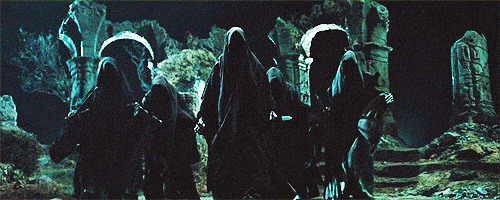
This is good read for the spooky season. It's a very eerie and atmospheric poem. The evil figures in robes that descended on the castle made think of the Ring Wraiths in The Lord of the Rings.
The Haunted Palace BY EDGAR ALLAN POE
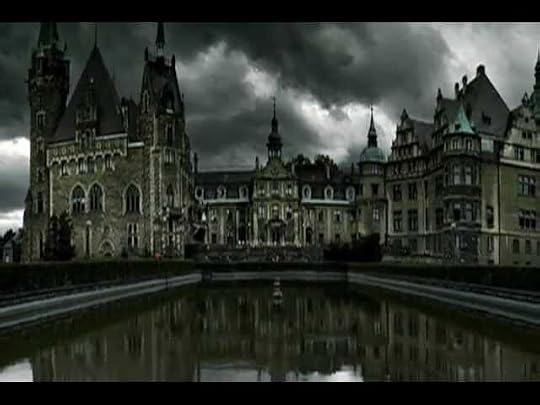
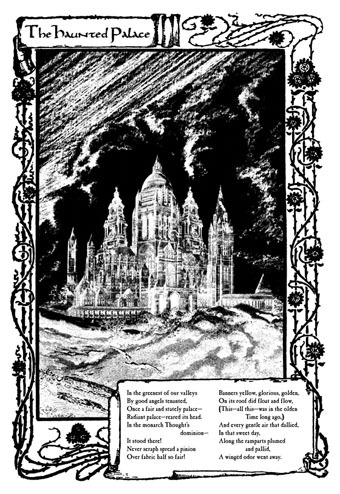
In the greenest of our valleys By good angels tenanted, Once a fair and stately palace— Radiant palace—reared its head. In the monarch Thought’s dominion, It stood there! Never seraph spread a pinion Over fabric half so fair!
Banners yellow, glorious, golden, On its roof did float and flow (This—all this—was in the olden Time long ago) And every gentle air that dallied, In that sweet day, Along the ramparts plumed and pallid, A wingèd odor went away.
Wanderers in that happy valley, Through two luminous windows, saw Spirits moving musically To a lute’s well-tunèd law, Round about a throne where, sitting, Porphyrogene! In state his glory well befitting, The ruler of the realm was seen.
And all with pearl and ruby glowing Was the fair palace door, Through which came flowing, flowing, flowing And sparkling evermore, A troop of Echoes, whose sweet duty Was but to sing, In voices of surpassing beauty, The wit and wisdom of their king.
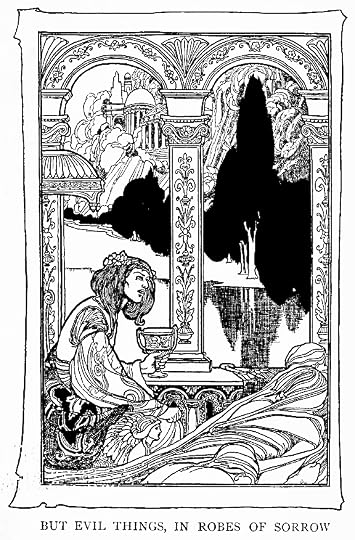
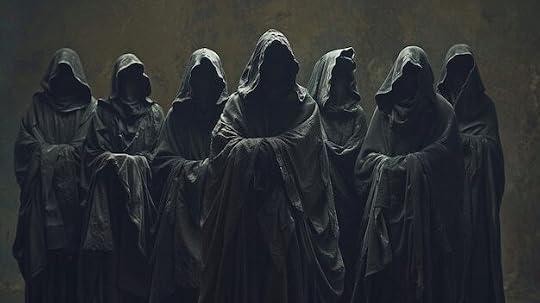
But evil things, in robes of sorrow, Assailed the monarch’s high estate; (Ah, let us mourn!—for never morrow Shall dawn upon him, desolate!) And round about his home the glory That blushed and bloomed Is but a dim-remembered story Of the old time entombed.
And travellers, now, within that valley, Through the red-litten windows see Vast forms that move fantastically To a discordant melody; While, like a ghastly rapid river, Through the pale door A hideous throng rush out forever, And laugh—but smile no more.
A lot of the wording sounds like a reference to literature or mythology that I'm unacquainted with. However, between all of that the poem sounded to me like a scene of heaven being taken over by something demonic. Others have said it's an earthly location with a real king and ruling a land of fairy tale-like happiness. After double-checking the poem's title this seems likely, but before I thought it wasn't because idyllic kingdoms don't seem like a setting Poe would use in a mundane world--it's too optimistic. Ultimately the interpretation depends on if you take the heaven and evil wording as literal and the king and land wording as symbols or the heaven and evil wording as symbols and the king and land wording as literal.
Either way, I didn't find the poem interesting or horrible; just OK.
You will enjoy it, and you will enjoy even more the second time when you read it. If you are like me, you will appreciated it a lot.
The ending is memorable and great. The ending have definitely a creepy vibe to it, which every horror fan will appreciated.
It is very short as a poem should be, the language is surprisingly easy. I said “surprisingly” because you know it was written in 1839 and since then the English language have changed a lot.
This poem is disturbing, as you may have guessed. But it is what makes it fun in the Edgar Allan Poe’s work. However now on days it is a typical haunted house story in a poem format
This is apparently the foundations for the later The Fall of the House of Usher, and you can see a lot of promise ion it, it just is too short to really grasp, and it is interesting to see he developed it further. I saw an opera version of Usher many years ago, and I will have to read it soon.
• The Haunted Palace (part of The Fall of House Usher) “.. But evil things, in robes of sorrow, / Assailed the monarch's high estate. / (Ah, let us mourn!- for never morrow / Shall dawn upon him desolate!)..”
The fall of the palace from what it once was to now. This is a sad and metaphoric poem.
I never understood how Edgar Allen Poe could write a whole story in a poem entry/form. It is beyond beautiful that I can vividly see what he is writing and in such a beautiful tongue.
Interesting, but too short. Found this while looking for tower-themed poems with at least a hint of creepiness. This one has some excellent lines (and I notice a similar rhythm scheme to The Raven), but is shorter than I want.
"In the greenest of our valleys By good angels tenanted, Once a fair and stately palace- Radiant palace- reared its head. In the monarch Thought's dominion- It stood there! Never seraph spread a pinion Over fabric half so fair!
Banners yellow, glorious, golden, On its roof did float and flow, (This- all this- was in the olden Time long ago,) And every gentle air that dallied, In that sweet day, Along the ramparts plumed and pallid, A winged odor went away.
Wanderers in that happy valley, Through two luminous windows, saw Spirits moving musically, To a lute's well-tuned law, Round about a throne where, sitting (Porphyrogene!) In state his glory well-befitting, The ruler of the realm was seen.
And all with pearl and ruby glowing Was the fair palace door, Through which came flowing, flowing, flowing, And sparkling evermore, A troop of Echoes, whose sweet duty Was but to sing, In voices of surpassing beauty, The wit and wisdom of their king.
But evil things, in robes of sorrow, Assailed the monarch's high estate. (Ah, let us mourn!- for never morrow Shall dawn upon him desolate!) And round about his home the glory That blushed and bloomed, Is but a dim-remembered story Of the old time entombed.
And travellers, now, within that valley, Through the red-litten windows see Vast forms, that move fantastically To a discordant melody, While, like a ghastly rapid river, Through the pale door A hideous throng rush out forever And laugh- but smile no more.
The poem takes you on a journey from 'spritis moving musically' to become 'vast forms that move fantastically'.
I love the main metaphor or symbol of the poem which is the palace in which the poem is set. Throughout the poem, you eventually get why the palace is 'haunted'.
So when reading the poem it has to become clear that the palace is a symbol for the human mind. This can be seen because there is the monarch 'thought' which rules the palace. We also have two windows (eyes) and a palace door (mouth) with pearl (teeth) and ruby (tongue / mouth). There are also yellow and golden banners on the roof (hair). Therefore we get the image of the human mind.
But then the palace (e.g. the human mind) gets corrupted by 'evil things, in robes of sorrow' which then transforms the glorious and grand palace into a decaying and haunted palace. The windows (eyes) are now 'red-litten' and the door (mouth) is pale. It is not the beautiful palace it was once.