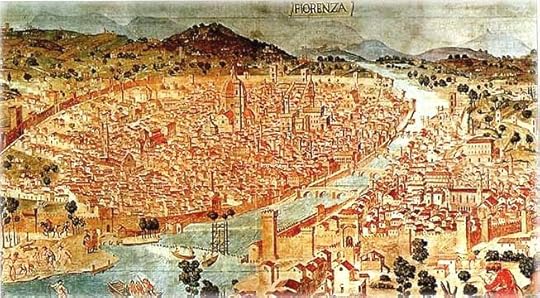
Nestled in the Apennines, cradle of the Renaissance, home of Dante, Michelangelo, and the Medici, Florence is unlike any other city in its extraordinary mingling of great art and literature, natural splendor, and remarkable history. Intimate and grand, learned and engaging, Michael Levey's Florence renders the city in all of its madness and magnificence.
Sir Michael Vincent Levey (8 June 1927 - 28 December 2008) was an English art historian and was the director of the National Gallery from 1973 to 1986.
This has been an exhilarating read and the updates below are the best indication on the contents of this book. This review will just complement the updates.
Michael Levey is an art historian very much associated with the London National Gallery, one of my favourite museums. He knows the material well, too well in fact. He is also very aware of the difficulties in approaching a city like Florence. The whole town is a museum and within its walls the first formal museum, in the modern sense, is to be found: the Uffizi. As a pilgrimage site for modern tourism it is difficult to approach the town and its treasures. The arguments that Walter Benjamin used when he analyzed reproductions are at play also here.
Modern tourism in Florence is rather old. It forms part of the Grand Tour phenomenon and I see Michael Levey as part of that, mostly British, tradition. We put on British glasses when reading this book. But this is not a criticism.
As an art historian, the focus is mostly on the art, meaning painting, sculpture and architecture with a bit of urban planning. The political side of history is included in so far as it helps the representation of the art production. There is very little on social aspects, on economy, on trade, etc. For that one would need to turn elsewhere. And in following the art paths there is also very little on the modes of art production, with their materials, patronage, emplacement of art, etc . For that the best would be to turn to Painting and Experience in Fifteenth-Century Italy: A Primer in the Social History of Pictorial Style and Art in Renaissance Italy: 1350-1500
Nonetheless this is, as I said, an exhilarating read, because there is so much that can be said, and looked at, even if one just follows a more traditional approach to art history. And Levey talks about the art and artists so very well.
I am also grateful to Levey for the very solid history he provides of the Medici family, the clan that shaped the city. He starts at their beginnings, with Bicci, and portrays intelligently the astute personality of the first Cosimo (1389-1464), who without assuming a commanding role controlled the city. He also brings to the fore the second Cosimo, the Grand Duke (1519-1574), an excellent ruler but who has not acquired for posterity the imposing presence of his great grandfather Lorenzo il Magnifico (1449-1492), may be because he was just an excellent ruler. After reading this I have a very different notion of this extraordinary family and realize that there is some Medici blood in all monarchical rulers in Europe.
Levey is also very daring to proceed into the anticlimactic phase of post-Renaissance Florence. Most people picking up this book would just want to hear about the period in which the Republic reigned supreme. And yet, this was a fascinating part because there was so much to learn. We see then how Florence, once the Medici disappear, becomes a pawn for the Austro-Hungarian empire, then falls under the tentacles, the covetousness and the family members of Napoleon, and finally joins the new Italy in 1861.
If I withheld the fifth star is because Levey knows his subject so well that sometimes he jumps forwards and backward in his presentation of the facts, disconcerting or enervating the reader. But I have to admit that my occasional loss of balance could have been avoided had I a broader and deeper knowledge of Italian history.
I was sorry to reach the end of the book. As compensation I have in my horizon the prospect of a trip to Florence, even if it will not quite be in a Grand Tour style. I just hope that when I join the throngs of visitors this read will help me see through the blinding veils of the tourist packaging industry, danger that Benjamin so adroitly foresaw.
Ok, I did finish reading this ages ago, but never reviewed. There's lots of wonderful information in this book, written by a celebrated historian of Renaissance art. But his method leaves one chronologically quite confused. It's already hard enough with all those Lorenzos and Cosimos, etc. etc. but when he discards chronological order - well, you're fascinated by what he has to say but you end up wanting to go back and make a timeline of everything, and golly, who has time or motivation to do that? If you don't mind that, though, it's a lovely book with much information that you will not find elsewhere.