The name Poe brings to mind images of murderers and madmen, premature burials, and mysterious women who return from the dead. His works have been in print since 1827 and include such literary classics as The Tell-Tale Heart, The Raven, and The Fall of the House of Usher. This versatile writer’s oeuvre includes short stories, poetry, a novel, a textbook, a book of scientific theory, and hundreds of essays and book reviews. He is widely acknowledged as the inventor of the modern detective story and an innovator in the science fiction genre, but he made his living as America’s first great literary critic and theoretician. Poe’s reputation today rests primarily on his tales of terror as well as on his haunting lyric poetry.
Just as the bizarre characters in Poe’s stories have captured the public imagination so too has Poe himself. He is seen as a morbid, mysterious figure lurking in the shadows of moonlit cemeteries or crumbling castles. This is the Poe of legend. But much of what we know about Poe is wrong, the product of a biography written by one of his enemies in an attempt to defame the author’s name.
The real Poe was born to traveling actors in Boston on January 19, 1809. Edgar was the second of three children. His other brother William Henry Leonard Poe would also become a poet before his early death, and Poe’s sister Rosalie Poe would grow up to teach penmanship at a Richmond girls’ school. Within three years of Poe’s birth both of his parents had died, and he was taken in by the wealthy tobacco merchant John Allan and his wife Frances Valentine Allan in Richmond, Virginia while Poe’s siblings went to live with other families. Mr. Allan would rear Poe to be a businessman and a Virginia gentleman, but Poe had dreams of being a writer in emulation of his childhood hero the British poet Lord Byron. Early poetic verses found written in a young Poe’s handwriting on the backs of Allan’s ledger sheets reveal how little interest Poe had in the tobacco business.
Eulalie is another example of a Poe poem where I wasn’t quite as wowed as I could have been. Now that I’ve read a few of his poems, I’ve come to the conclusion I prefer it when he is writing about certain topics – and in the case of Eulalie, we are not dealing with one of the topics about which I enjoy his work.
As ever, though, I can easily see why many enjoy Eulalie.
I think this is one of the most beautiful works by Edgar Allan Poe. Although maybe it's just because of the romantic in me. Published in 1845, the story is about how a sad man became happy when he married a lady named "Eulalie". I'm a little confused though since based on some articles on the Internet, it's main theme was also "the death of a beautiful woman" seen in the author's other works (Annabel Lee, The Raven and Lenore). But based on my understanding, Eulalie didn't died. So, yep. Let's celebrate cos maybe this is the only Poe piece that have a happy ending. Hehehe.
This is a beautiful love poem to a woman who marries a man and brings nothing but joy and sunshine into his life as a result. I almost forgot that Poe new how to write happy stories.
Eulalie is a bridal song that describes the speaker's salvation from loneliness, despair, and a 'world of moan' through marriage to 'the yellow-haired young Eulalie.' The speaker feels secure in his love for 'Now doubt-now pain/ Come never again,' he has found a soulmate who derives her strength from the celestial goddess Astarte. Sova, Dawn B. (2001). Edgar Allan Poe, A to Z : the essential reference to his life and work. New York: Checkmark Books. (82)
“Eulalie” seems like a more uplifting work of Poe’s. The narrator led a dark and dreary life until he met his young bride and she became his beacon of light. She was his source of joy. I still felt a sense of sadness when reading the poem because Poe’s wife died at a young age of tuberculosis.
“Eulalie” By:Edgar Allan Poe
I dwelt alone In a world of moan And my soul was a stagnant tide Till the fair and gentle Eulalie became my blushing bride- Till the yellow-haired young Eulalie became my smiling bride.
Ah, less– less bright Are the stars of night Than the eyes of the radiant girl! And never a flake That the vapor can make With the moon-tints of purple and pearl, Can vie with the modest Eulalie’s most unregarded curl- Can compare with the bright-eyed Eulalie’s most humble and careless curl.
Now Doubt– now Pain Come never again, For her soul gives me sigh for sigh And all day long Shines, bright and strong, Astarte within the sky, While ever to her dear Eulalie upturns her matron eye- While ever to her young Eulalie upturns her violet eye.
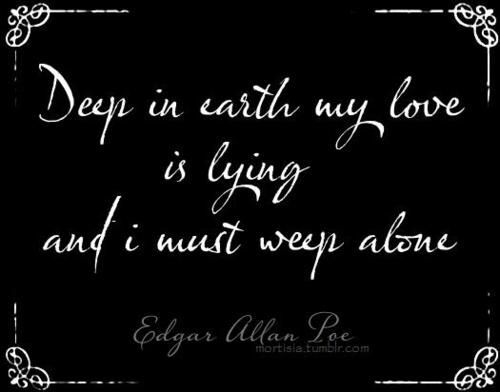
I read that Poe wrote a fragment of possibly another poem on the manuscript for “Eulalie”. The couplet is known as “Deep in the Earth”.
“Deep in the Earth” By: Edgar Allan Poe
“Deep in the Earth my love is lying and I must weep alone”~Edgar Allan Poe
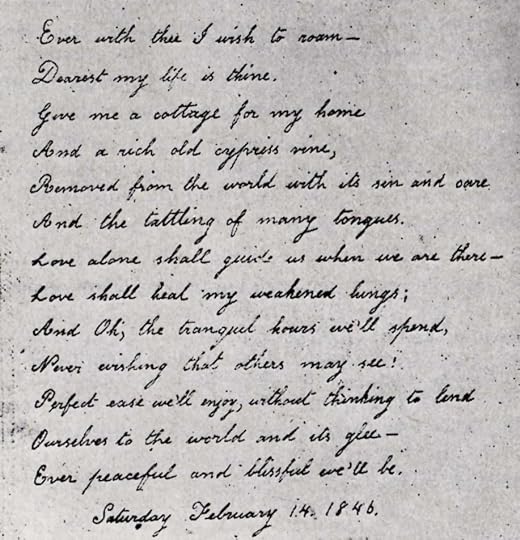
On Valentine’s Day in 1846, Poe’s wife Virginia wrote a Valentine poem to her husband. This would have been her last Valentine’s Day with her husband. Virginia died on January 30, 1847. She was only 24.
I thought thought the Valentine poem was lovely. Virginia sounded like a sweet girl. It’s just sad that her life was cut short and she suffered so much in her final years.
Virginia Clemm Poe’s Valentine to her Husband Edgar Allan Poe: If you down the left side, the first letter of each line is a letter from her husband’s name.
Ever with thee I wish to roam— Dearest my life is thine. Give me a cottage for my home And a rich old cypress vine, Removed from the world with its sin and care And the tattling of many tongues. Love alone shall guide us when we are there— Love shall heal my weakened lungs; And Oh, the tranquil hours we’ll spend, Never wishing that others may see! Perfect ease we’ll enjoy, without thinking to lend Ourselves to the world and its glee— Ever peaceful and blissful we’ll be.
"I dwelt alone In a world of moan, And my soul was a stagnant tide, Till the fair and gentle Eulalie became my blushing bride- Till the yellow-haired young Eulalie became my smiling bride.
Ah, less- less bright The stars of the night Than the eyes of the radiant girl! That the vapor can make With the moon-tints of purple and pearl, Can vie with the modest Eulalie's most unregarded curl- Can compare with the bright-eyed Eulalie's most humble and careless curl.
Now Doubt- now Pain Come never again, For her soul gives me sigh for sigh, And all day long Shines, bright and strong, Astarte within the sky, While ever to her dear Eulalie upturns her matron eye- While ever to her young Eulalie upturns her violet eye."
I respect his raw honesty and dream-like imagination
"Eulalie" By Edgar Allan Poe
"I dwelt alone In a world of moan, And my soul was a stagnant tide, Till the fair and gentle Eulalie became my blushing bride- Till the yellow-haired young Eulalie became my smiling bride.
Ah, less- less bright The stars of the night Than the eyes of the radiant girl! That the vapor can make With the moon-tints of purple and pearl, Can vie with the modest Eulalie's most unregarded curl- Can compare with the bright-eyed Eulalie's most humble and careless curl.
Now Doubt- now Pain Come never again, For her soul gives me sigh for sigh, And all day long Shines, bright and strong, Astarte within the sky, While ever to her dear Eulalie upturns her matron eye- While ever to her young Eulalie upturns her violet eye."
For the most part it was a decent poem from Edgar Allan Poe. However it is far from his best poems.
I had sort of hard time with connecting with the story in this poem, and with the poem as a whole thing.
As someone who have read almost every poem and short story written by Edgar Allan Poe I need to say that I prefer much more when he writing about specific topics.
In my opinion this poem didn’t have the gothic vibe which almost every poem and short story to Edgar Allan Poe has. Which really takes the wind out of this poem.
Such a beautiful poem! I came across a few lines of it in Erin A. Craig's "House of Salt and Sorrows" and looked up the whole poem. Such beautiful language.
Surprise, surprise! No dark terror, no hideous murders, no madmen (or ladies) no premature burials or fatal diseases, just a little innocent love song. As someone wisely said, we sometimes forget Poe's ability to write about happy events... Eulalie - A Song was published for the first time on July 1845, by American Review, a New York based magazine.