Jump to ratings and reviews
Rate this book

Palliser #3

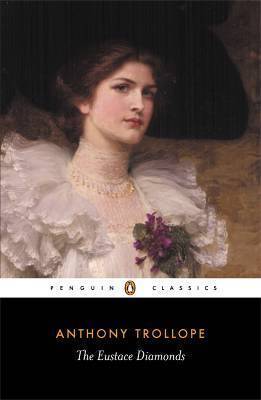
The Eustace Diamonds

Rate this book
The third in Trollope's six-volume Palliser series, The Eustace Diamonds boasts an extraordinary heroine in Lizzie Eustace, a lying schemer in the mould of Thackeray's Becky Sharp. A pompous Under-Secretary of State, an exploitative and acquisitive American and her unhappy niece, a shady
radical peer, and a brutal aristocrat are only some of the characters in this, one of Trollope's most engaging novels: part sensation fiction, part detective story, part political satire, and part ironic romance. It is also a highly revealing study of Victorian Britain, its colonial activities in
Ireland and India, its veneration of wealth, and its pervasive dishonesty. In her introduction, Helen Small explores the central themes of lying and truth-telling, placing the novel within contemporary political and social debates. An invaluable appendix outlines the political context of the
Palliser novels and establishes the internal chronology of the series and the relationship between fictional and actual political events, providing a unique understanding of the series as a linked narrative. In addition, the book includes a compact biography of Trollope and a wealth of explanatory
notes.

About the Series: For over 100 years Oxford World's Classics has made available the broadest spectrum of literature from around the globe. Each affordable volume reflects Oxford's commitment to scholarship, providing the most accurate text plus a wealth of other valuable features, including expert
introductions by leading authorities, voluminous notes to clarify the text, up-to-date bibliographies for further study, and much more.

637 pages, Paperback

First published January 1, 1873

308 people are currently reading
4722 people want to read

About the author

Anthony Trollope

2,284 books1,757 followers
Anthony Trollope became one of the most successful, prolific and respected English novelists of the Victorian era. Some of Trollope's best-loved works, known as the Chronicles of Barsetshire, revolve around the imaginary county of Barsetshire; he also wrote penetrating novels on political, social, and gender issues and conflicts of his day.

Trollope has always been a popular novelist. Noted fans have included Sir Alec Guinness (who never travelled without a Trollope novel), former British Prime Ministers Harold Macmillan and Sir John Major, economist John Kenneth Galbraith, American novelists Sue Grafton and Dominick Dunne and soap opera writer Harding Lemay. Trollope's literary reputation dipped somewhat during the last years of his life, but he regained the esteem of critics by the mid-twentieth century.
See also http://en.wikipedia.org/wiki/Anthony_...

Ratings & Reviews

What do you think?
Rate this book

Friends & Following

Create a free account to discover what your friends think of this book!

Community Reviews

5 stars
1,606 (31%)
4 stars
2,087 (40%)
3 stars
1,164 (22%)
2 stars
245 (4%)
1 star
57 (1%)
Displaying 1 - 30 of 553 reviews
Profile Image for Diane Barnes.
1,613 reviews446 followers
July 24, 2021
Lizzie Eustace is a vain, narcissistic, lying, manipulative, stupid, unfeeling harpy, who doesn't care who she destroys as long as she gets her way. But she's a beautiful widow with an income, and in Trollope's world, that makes her much sought after by men who should know better, but who decide to overlook those qualities, to their dismay. She ruins everything she touches. Now I know it sounds like Im describing a recent ex-president of the U.S., but all similarities are purely coincidental.

This is the third of the Palliser series, and just as enjoyable as the first two. Trollope understood how important gossip and innuendo are in the world, whether in private life or politics, he understood human nature and base motives, and he knew how to tell a good story, which is why he is still read and admired to this day.

Lizzie seems to get away with a lot in this novel, but she gets her just rewards in the end, by making another stupid decision, so I was completely satisfied.
Profile Image for Caroline.
910 reviews310 followers
December 9, 2015
Delicious.

Trollope said to Thackery: 'I’ll see your Becky Sharp, and raise you £10,000.’

As in the £10,000 necklace--the Eustace Diamonds--that drive Lizzie Graystock and the plot of this funny and sad and insightful novel.

I have read too many Trollope sweet young girls, and enjoyed his witty, strong (to a point) women Lady Glencora and Violet Effingham, and laughed with the earthy wealthy widow in the Barsetshire novels, but Lizzie is something else again. Trollope is really masterful in conveying the selective vision that is at the heart of some selfish and deceitful people but genuinely (to a point) leaves them feeling to be the wronged party in the end. She is wicked and yet not so wicked that we wish her ill--we watch fascinated as she maneuvers from crisis to crisis, man to man. As are all the other characters who know perfectly well she’s lying through her teeth. But Victorian manners and her title save her from almost all consequences. Among Trollope’s accomplishments here is we can be glad in her joy on the one day she is truly, genuinely happy, fox hunting in Scotland. In fact one of the saddest things about this novel is that someone so full of life as Lizzie Greystock has only this one happy day in her life, raised as she was and with a temperament like hers.

So the wrangling over the diamonds and their theft constitutes the plot, but at the heart of the novel, for me, is the story of three disastrous engagements. There are four characters forced to seek to marry for money by their genteel poverty and the mores that so closely define the permissable alliances and careers that will keep them genteel ( or, even, a respectable peer). That is the real story here, although Trollope drags it out and repeats himself so often on the subject that he almost undermines his own dramatic power. Certainly I groaned every time Lucy Morris entered the room, but watching the other characters play their roles in forwarding or thwarting events was evoked all kinds of reactions from hearty laughter to reaching for a poker.

I have read that Thackery was a reformer for the individual, but not in general. So he could portray the tragedy of a young woman forced to find a monied husband no matter how brutal or boorish he is (and with disastrous consequences) yet make fun of women’s rights reformers. I think he felt that the underlying attitudes of society about class would not be much affected by legislation, and my perception of English culture is that ihe was right even today.

And of course Trollope is so very, very, very funny. Just wonderful. To think that I almost passed this up in my hurry to find out what happens to Phineas Finn and Madame Max Goestler in Phineas Redux.
Profile Image for Lisa (NY).
2,138 reviews824 followers
March 31, 2022
Gossipy, long-winded and thoroughly enjoyable! I love the way the narrator (Trollope?) makes droll editorial comments about how odious our heroine Lizzie is. In fact, she doesn't even deserve the title of heroine according to him. But she is so much fun to read about! As are the other characters, who are preoccupied with whether to marry for love or money.
Profile Image for Katie Lumsden.
Author 3 books3,767 followers
March 21, 2019
Another Trollope triumph. Witty, fun, with wonderfully nasty characters.
Profile Image for Classic reverie.
1,834 reviews
December 20, 2018
Wow, how to start this review on Trollope's The Eustace Diamonds (Palliser 3), this series is centered on political life and there are little bits of it in here but for the most part, it is hardly political. In book 1, "Can You Forgive Her?", this story has politics to a lesser extent than book 2, "Phineas Finn". In book 1 & 2, they center on men wanting to be in Parliament with love affairs included but this story there are no elections but brief talks of an Indian King of sorts being treated badly in his own country but factions of Parliament helping him out of his distress; also Pallister looks to change the coin system to accommodate the times. These issues are not discussed in detail in the least but Trollope brings them for the reader to judge how government has control in some issues.

Once again, you can read each book and enjoy the story but certain circumstances will seem Greek and the full story is known if one reads in order. Lady Glencora becomes more visible whereas in previous books, I became a fan of Lady Glendora but in this story I found her too encroaching. Being a little bit of a rogue trying to force a man to marry when she should mind her business. Does she so soon forget her troubles in book 1, where she was dictated to by friends? Other characters from Barsetshire and Palliser's series appear but in scant roles but you do see how past romances are getting along. In this story we are introduced to a new set of characters but where Lord Fawn makes a brief appearance in Palliser 1, he is part of this story from beginning to end. We see The Duke of Omnium age and other characters of course grow older. Can you just read this book and understand it? Yes, but I feel you would be missing out in the Big Picture of Trollope's mind. This year I started to truly believe in reading serials in order and enjoyed doing so here and with other stories.


This story is more a mystery but the reader is privy before authorities, yet when all is said and done, the reader still does not know all and we wonder about certain things. I was quite confounded and surprised many times. Another thing brought up was why do people in charge and in power let a person who has done wrong, set free. Is it because the person is attractive and has a title? While the lesser must be punished to stand all the rigors of it all.


In these series Trollope really excels in human behavior and especially stating true to their characters. Marriage and romance are shown in vast degrees from happiness to despair. Women have to marry to have a better standing in society even when they are well to do. They can be without a husband but their social agendas are quite limited. Marrying for money is seen throughout these series and those who feel forced maybe in for a life of unhappiness. In this story that has a profound effect on a young girl. Of course there is prejudices against certain people which is not to my liking but these stories were written in a different day and age; I still love the stories nonetheless.

Trollope has both beautiful and plain women in his stories which depending on the characters, he will either give a beautiful woman and inner beauty or her inner ugliness seen. A plain or ugly girl can be made more beautiful with her inner beauty or she can be made worse. The most beautiful woman can fail when her inner beauty is nonexistent and all the acting in the world will not help.


The story in brief because I know some friends would like to be surprised!
Lizzie Eustace is a vixen who is beautiful and knows how to act her part. Diamonds, suitors and her quest for her idea of a poetic lover. The Diamonds are in question from beginning to the end, hence the title.


I did not read this version but Delphi Collection of his work, which if interested is in my Trollope shelf. I have an insane amount of highlights and notes, so you probably want to stay away! LOL. Reading to me is not just enjoyment but learning and journey which I want to remember and record my thoughts liken to a diary of journal but it is also my way to learn more about the human experience via books.


Did I love this book? Yes, I truly enjoy my visits to Trollope's world's and I plan to finish up this series early next year. 💖💞💟🌸💜💕


While reading Lizzie remarked on a female from Boccaccio's The Decameron story La Novella di Griselda. I reread and reviewed that story with quotes and highlights listed in that review if interested. Look at my Giovanni Boccaccio shelf.
I am now off to read a play that Trollope mentioned in this book that was not published until the 1920 based on Palliser 1. I will review and put my quotes from this book that mentions the play there.


Happy reading!
Profile Image for Roman Clodia.
2,895 reviews4,647 followers
October 13, 2023
DNF this at about 40%. Trollope's long-winded style is always a bit of an irritant to me but I can usually overcome my impatience as there's something socially interesting happening - but not in this book.

Lizzy Eustace treads that tiresome middle ground of not being vibrantly evil or as vividly and actively scheming as a Becky Sharp so we can't really get behind her cunning. Instead, she manages to purloin some family diamonds in a mildly shady way: she just refuses to return them to the lawyers and executors of her dead husband's estate and locks them away in her safe! Not exactly high-level wickedness. And then she wrings her hands and wants a man to sort out her troubles.

With the return of Lord Fawn, and Frank Greystock toggling between beautiful Lizzy and his wet but everlastingly loyal fiancée the characters are all typical Trollope people doing their usual middle-class things. And the repetition feels dampening - there simply isn't enough drama happening here to sustain nearly 800 pages - yawn!
Profile Image for Anne .
459 reviews468 followers
April 29, 2022
This is the third book in the Anthony Trollopes Palliser series. I'm reading them in order and having a great time. Each book is a long comfort read. Trollope always writes about the same subjects but his focus shifts a bit with each book. His take on human behavior in 1850s London society shifts with each book, just as a photographer will shift the angle of his lens a bit with each photograph of the same subject. The focus is on marrying for love vs. money with a good look at gossip and lying. Trollope explores human behavior at its best and its worst and makes the latter humorous at times and always compelling. There is much written about this novel in reviews on GR so all I will tell you is that one of the side characters notes that "Lizzie is a Becky Sharp type." This is very true. In fact, Vanity Fair and Becky Sharp often came to mind while listening to the audiobook (read incredibly well read by Timothy West).

One of my favorite "characters" is the narrator who makes witty, snarky comments about the main character, Lizzie Eustace, the anti-heroine of our story. His remarks about Lizzy never failed to make me laugh. Early on in the book he states " we will not dwell on (her) at great length as we might do if we loved her.". I had to laugh at that for two reasons. One, the page count of this novel is just as high as Trollopes other novels - 800 pages (25 hours). Trollope is never succinct, at least not in The Palliser series. Let's say he doesn't seem to be in a rush to get to the end of the story. He develops characters and plots slowly and thoroughly, perhaps a bit too thoroughly at times. As far as the narrator saying that he doesn't like Lizzie, that is the mildest criticism of Lizzie in the entire novel. Other characters call her evil, a liar, a harpy, false, dishonest, heartless, cruel, nasty, false, pretentious, ignorant, greedy and abominable and much worse. You get the idea.

I have many favorite lines in this book but one about Lizzie that I think my fellow book lovers will enjoy is this one:

she did like reading, and especially the reading of poetry – though even in this she was false and pretentious, skipping, pretending to have read, lying about books, and making up her market of literature for outside admiration at the easiest possible cost of trouble”..

The Duke of Omnium who we met in book 1 and got to know a bit better in book 2 makes brief appearances in this book. He is very old and probably dying but the stories about Lizzie and the diamonds keep him and the rest of London society thoroughly engaged and entertained. I felt the same way.
Profile Image for Andrew Stewart.
144 reviews9 followers
September 15, 2025
3.5 Trollope’s Palliser universe is filled with entertaining characters, and the story of the diamonds here was enough to tie it together. But is that worth 800 pages? Not for me. It’s brilliant writing and the story pulls you along but I’ll probably go to the BBC television series for the rest of the Palliser saga.
Profile Image for Kerri.
1,100 reviews462 followers
October 14, 2022
💎
"True love, true friendship, true benevolence, true tenderness, were beautiful to her,—qualities on which she could descant almost with eloquence; and therefore she was always shamming love and friendship and benevolence and tenderness."

Lizzie Eustace is a despicable yet hugely entertaining character - these days I think she would be a good celebrity (the kind they is famous for being famous, or being married to someone who is famous, not famous for any particular talent or achievement). I hated her, yet loved reading about her. The story was funny, probably the funniest of the series. Also, unfortunately, the one with the most blatant antisemitism.

Although I think the ending came together a little more rapidly than it ought to have done, I found the novel engaging and enjoyable. Unpleasant though she often was, Lizzie was perfectly written, as were the people around her.

"Lord Fawn did not immediately recognise the falseness of every word that the woman said to him, because he was slow and could not think and hear at the same time."
Profile Image for Vicky.
110 reviews14 followers
June 20, 2022
Superb!The Anthony Trollope Society are currently reading and discussing this book which drew it to my attention.Like lots of Trollope novels it's a real "chunkster" challenge but I rarely put it down-if a little melodramatic in parts,it certainly held my attention!
Profile Image for Justin Pickett.
557 reviews58 followers
October 10, 2025
“She’s false, dishonest, heartless, cruel, irreligious, ungrateful, mean, ignorant, greedy, and vile!”

She is also beautiful, wealthy, and clever. This novel has one of Trollope’s most memorable villains: a deceitful, vengeful, shameless widow. She thinks lies are “more beautiful than truth” and revels in the destruction of her enemies: “I would wish to do whatever would hurt him most—without hurting myself.” She is the focus of the main plot, a story about a stolen diamond necklace. She is obsessed with it, and her obsession is reminiscent of Gollum’s in the way that it affects her.

“They have been the misery of my life. Oh, how they have tormented me! Even when I am asleep I dream about them, and think that people steal them.”

Unfortunately, the stolen-diamond-necklace story drags on for far too long. The two subplots in this novel are the best part of it, in my view, but too few pages are devoted to either. One subplot will have you wondering whether a fiancée will murder her fiancé or kill herself to avoid marriage. Another subplot will have you in suspense about whether money will outweigh love on the marital scale. At hazard in second subplot, the better of the two (and the one that involves my favorite character), are honor and happiness. Love, truth, and marital bliss fall on one side of the marital scale, whereas wealth, deceit, and misery await on the other.

“He had not eyes clear enough to perceive that [she] was a witch whistling for a wind, and ready to take the first blast that would carry her and her broomstick somewhere into the sky.”

“She looks like a beautiful animal that you are afraid to caress for fear it should bite you; an animal that would be beautiful if its eyes were not so restless, and its teeth so sharp and so white.”

MEMORABLE QUOTES:

“The highest work of a lawyer can only be reached through political struggle.”

“But then a tower of strength may at any moment become a dungeon.”

“Beauty and cleverness won’t make a good wife.”

“If you carry yourself well—quietly and with dignity—the world will punish him.”

“I have sometimes fancied that I could marry for money and position … but when my mind has run away with me … you have always—always been the heroine of the tale, as the mistress of the happy castle in the air.”

“There are men who can walk about the streets with composed countenances, take their seats in Parliament if they happen to have seats, work in their offices, or their chambers, or their counting-houses with diligence, and go about the world serenely, even though everybody be saying evil of them behind their backs.”

“The true picture of life as it is, if it could be adequately painted, would show men what they are, and how they might rise, not, indeed, to perfection, but one step first, and then another on the ladder.”

“No girl should allow herself to depend on a man before she is married to him. By doing so she will be apt to lose even his respect.”

“The dishonest man almost doubts whether in him dishonesty is dishonest, let it be practiced ever so widely.”

“How much real love do we ever see among married people?”

“There’s nothing a pretty woman can’t do when she has got rid of all sense of shame.”

“Evil-doing will be spoke of with bated breath and soft words even by policemen, when the evil-doer comes in a carriage, and with a title.”
Profile Image for Ellery Adams.
Author 66 books5,219 followers
Read
December 28, 2022
This novel could've been half its length; such was its repetitive nature. I chuckled over many of Trollope's witticisms, but overall, this lacked the charm and clever characterization of an Austen novel.
Profile Image for Suzannah Rowntree.
Author 34 books595 followers
July 26, 2022
My Annual Trollope is late, but none the less appreciated for all that!

THE EUSTACE DIAMONDS is the story of an unscrupulous, clever but uneducated young woman, Lizzie Eustace, who having arranged to marry a wealthy but ailing man, embarks upon her widowhood with four thousand pounds a year, a castle in Scotland, and (most contentiously of all) ten thousand pounds' worth of diamonds, which she insists were given as a personal gift by her late husband, but which the estate lawyers claim to belong to the estate. What follows is an imbroglio in the inimitable Trollope manner, complete with twists that had me shouting, acidic satire, and an ending that left me awed by Trollope's social commentary. Like Wilkie Collins' THE MOONSTONE, the story revolves around a jewel theft, but it breaks the mould of the detective story much as Rian Johnson's KNIVES OUT does, by telling the story largely from the perspective of the main suspect. Like Dickens' BLEAK HOUSE, the story has much to do with legal matters, but Trollope is far more subtle in his social criticism, and the legal details are gloriously accurate and careful: there's none of this nonsense where the courtroom lawyers are the ones doing the deductive task of a detective, as seems to happen in every American film.

Many of Trollope's novels focus on women, and many of those women must negotiate the unique pitfalls and limitations of Victorian society: whether to marry for love or financial security (as Lady Laura does in PHINEAS FINN), how to find a meaningful vocation (as Alice and Lady Glencora do in CAN YOU FORGIVE HER?), or whether to marry an impecunious young man whose family or career desperately require him to marry money (Mary Thorne in DOCTOR THORNE, or Lucy Morris in this very novel). THE EUSTACE DIAMONDS focuses on an anti-heroine, Lizzie Eustace, who takes those social rules and gender roles, and manipulates them to her own nefarious ends.

I loved this aspect of the story - even accounting for the fact that Lizzie is genuinely a dreadful person. Some of the rules she breaks are moral rather than social directives - Thou Shalt Not Steal or Thou Shalt Not Lie. But there are merely social rules that she breaks, bends, or exploits as well. She pursues a man for marriage, even proposing to him at one point - something Trollope clearly expects to shock his audience deeply. It's always difficult to tell just how tongue-in-cheek Trollope is about things like this, but I was rather shocked that he expected it to be so controversial.

That said, when it comes down to it, this is an amazing picture of how Victorian social conventions could be exploited by an unscrupulous woman. An idea of women as passive, genteel, delicate and virtuous comes to spectacular grief when exploited by a woman who is deceitful and grasping. For a while I felt a little uncomfortable about what I thought the story was saying. It would be easy to see this as the simple cautionary tale of a woman breaking social rules and being penalised for it. Also, one of Lizzie's main weapons is emotion: she has no trouble turning on the tears if circumstances turn against her. Given how many men even today perceive any determined moral stance taken, or strong expression used, by a woman as being an appeal to emotion and by definition manipulative and deceitful, I was a little worried that this was where Trollope was taking the story. Yet, his heroines often express themselves with strong and honest emotion, and after finishing the book I'm delighted to say that once again Trollope comes through with flying colours.

Lizzie's besetting sin is lying - whether she's acting an emotional part, or outright perjuring herself. In this story Trollope pinpoints two different conventions to do with lying. There's the rule that you aren't supposed to lie, which Lizzie flouts. But there's also the rule that in Victorian times you weren't supposed to accuse people of lying, and it is this rule that Lizzie exploits, getting away with barefaced lies because she's too rich and pretty to be accused to her face. Right to the end people bend over backwards to save her face for her. Lucy Morris, on the other hand, Lizzie's foil and the book's most virtuous female character, is strictly truthful, but jeopardises her uncertain place in the world by accusing a nobleman of lying. Trollope's handling of the two different women makes it clear what he thought of the social convention - which I believe originated centuries earlier, when giving someone the lie was a duelling matter - and makes it quite clear that while he did not take the Ten Commandments as being optional, he was quite alive to how the arbitrary social conventions of the day were created to benefit the rich and powerful. In fact, throughout the story Trollope makes sure to point out that many of the men in the story are also guilty of lying to some degree, and get away with it for much the same reason - are in fact better protected against accusation and loss of reputation even than Lizzie Eustace.

If you find it difficult to enjoy stories about fundamentally terrible people, you may not enjoy THE EUSTACE DIAMONDS. I quite like to see a stupidly terrible person getting their just comeuppance, so I thoroughly enjoyed the story, especially with all Trollope's often laugh-out-loud funny, always thought-provoking commentary. I listened to big chunks of the book on Audible, which hosts a whole lot of Anthony Trollope books in the free catalogue as performed splendidly by Timothy West who really makes the humour shine. If you have Audible, run and download an Anthony Trollope book right now. You can thank me later.
Profile Image for Beth Bonini.
1,414 reviews326 followers
January 31, 2019
4.5 stars A sparkling Trollope novel, but 647 pages were not really needed to tell the tale of Lizzie Eustace (née Greystock) and her various dupes and associates.

This novel starts off with a bang - and a rather delicious description of the lovely Lizzie, whose feminine wiles bag a rich husband (who dies of tuberculosis and an overly self-indulgent lifestyle soon after discovering the depths of her duplicitous nature). Rich (with an income of £4000 a year and a castle in Scotland), lovely, young (only 22), and in possession of the male Eustace heir, Lizzie is presumably quite the catch on the marriage market. At one point, she has four ‘suitors’ (more or less) at her feet: Lord Fawn (poor but titled), her cousin Frank Greystock (poor but dashing), Lord George (poor but romantically Corsair-like) and the minister Mr. Emilius (poor but fawning). But the ‘catch’ is that Lizzie always wants to have her cake and eat it, too; or, in Lord George’s words, she is determined to be ‘clever’ when she doesn’t need to be.

Or perhaps the ‘catch’ is that Lizzie cannot tell the difference between right and wrong, the good and the bad.

At the very beginning of the novel, Trollope takes some pains to tell the reader exactly who and what Lizzie is: “as she was utterly devoid of true tenderness, so also was she devoid of conscience.” Lizzie, Trollope tells us, cannot tell the difference between appearance and reality; if the appearance is good, she prefers it to the reality. Diamonds are wasted on a woman who would be just as happy with ‘paste’. She playacts, she dramatises, she lies . . . and she does it all without any sense of conscience or remorse. At various points, her boldfaced lies gain her the ascendancy - and after a particularly shameless bit of playacting and effrontery, her brother-in-law says to the family lawyer: “She is a very great woman; and, if the sex could have its rights, would make an excellent lawyer.”

But having taken pains to expose Lizzie’s bad character, is it possible that Trollope would let her triumph in the matter of a diamond necklace? Or a husband, for that matter. Trollope takes nearly the entire 647 pages to settle that question - and he does it skilfully and humorously, if perhaps too lengthily.
663 reviews
August 19, 2011
This is the third book in Trollope's Palliser series and a huge disappointment compared to the previous volumes. There are a few interesting sections, but I had to force myself to get through it and skimmed the last 100 pages or so. Trollope tries to play on the foibles of human personalities and ambitions, but falls so flat with these characters that I just wanted to smack them all upside the head. Even Lizzie's lying and conniving got repetitive and uninspired and I lost interest in whether the story would end with either her redemption or her comeuppance. I understand the temptation to have a cast of flawed characters, but you need at least one with some redeeming characteristics and spunk to act as a valid foil for the rest. Even the girl who was held up as a paragon of niceness was more like a worshiping doormat and provided no reason for emotional investment by the reader.

Lucinda, a secondary character, must've had some back story or reason for her incredible anger toward her fiancee and her constant fights with him, but it was never explained, so it felt like we spent 1/4 of the book on and around her with no good reason for her being a) so bitchy all the time or b) part of Lizzie Eustace's life. I feel if we could've gotten some of the motivation for her extreme emotions & actions it would've at least redeemed part of the book. At almost 800 pages you'd think Trollope would've had time to make all of these characters less one-dimensional, but he fills up the pages with random details, hateful characters and uninspiring prose. It could easily have been half as long. Would not recommend wasting your time on this one; 2 stars is probably generous. I hope the rest of the series is better.
Profile Image for rachel.
831 reviews173 followers
January 14, 2016
Nearly 800 pages of mid and high society people deceiving each other, engaging in mercenary behavior, and writing hilariously snarky letters back and forth to each other. Needless to say, I loved this and can't wait to read more Trollope. Surprisingly modern and somewhat cynical about human nature, with not a hero in sight.
Profile Image for LiLi.
72 reviews
August 3, 2018
3.5...best of the series so far. A ripping yarn full of mystery and larger-than-life characters...but watch out for the sexism and anti-Semitism. It is a Victorian novel, and Trollope was not the most progressive of men...
Profile Image for Anastasia Fitzgerald-Beaumont.
113 reviews729 followers
August 1, 2011
I’ve now completed The Eustace Diamonds, the third in Anthony Trollope’s Palliser series of political novels; another milestone passed; another three to go! I enjoyed Can you Forgive Her? and Phineas Finn, the Irish Member though not nearly as much as the story of Lizzie Eustace and a legacy which brings more trouble than pleasure. It seems to me that the author is much more assured here in his treatment of themes, of plotting and of character, his style much more relaxed, perceptive and gently ironic.

The Eustace Diamonds is said to be the least political of the six. The Pallisers hardly feature at all – though Plantagenet’s obsession with decimalisation makes yet another appearance! -, apart from Lady Glencora's brief lobbying on behalf of Lizzie, taken in as is almost everyone else by this duplicitous woman, such a contrast to the earnest and po-faced Alice Vavasor of Can you Forgive Her?

Yes, Lizzie Eustace is an anti-hero. She reminds me in some ways of Becky Sharp from Thackeray’s Vanity Fair (was this the author’s intention?), though she doesn’t have the same kind of wit or native cunning. Becky makes things happen; things tend to happen to Lizzie, though she is not averse to scheming and lying to try and turn them her way.

It may not be a political novel as such – though the politics of property features highly – but it offers the most marvellous insight into Victorian mores, into contemporary attitudes to property, to wealth, to social relationships and to marriage. Like Vanity Fair, it’s essentially a comedy of manners or a social satire, though not quite as sweeping and as richly textured.

Lizzie Greystock, the daughter of an impecunious Admiral, is a social climber who has climbed quite effectively, making an advantageous marriage to a baronet, Sir Florian Eustace, who conveniently dies, leaving her - as Lady Eustace - with an income, a castle in Scotland and fabulously rich set of diamonds. However, that is not the end of her problems; it’s the beginning.

My, those diamonds; what a burden they are, and not just for the footman who is obliged to carry them from place to place in a strongbox! The problem is that the lawyer acting for the estate insists that the diamonds are not hers at all but an heirloom which should be held in trust, in the face of Lizzie’s insistence that they were a personal gift from her late husband.

I think a Victorian audience would have been more sympathetic to the legal nuances arising here, which now seems all so refined and perhaps rather pointless, especially as the jewels will eventually pass to Lizzie’s young son, the heir of the Eustace estate. I confess I did not quite understand the motives of Camperdown, the family lawyer, in his relentless pursuit of Lizzie, yea, even so far as the Court of Chancery (Dickens’ Bleak House should be sufficient warning to those who want to take matters there!), especially as John Eustace, her brother-in-law and the nominal head of the family, does not show the same determination. Of course the more legal time the greater the costs, sufficient motive in itself, I suppose.

It’s Lizzie’s misfortune to alienate just about everyone around her, including Lord Fawn, her fiancé, a rather tepid individual and ineffectual member of the Liberal government (her final letter rejecting his already withdrawn marriage proposal had me in stitches!), though her cousin Frank Greystock, whom she deceives without scruple, remains loyal almost to the end.

Abandoned by most decent society, she cultivates her own déclassé and ever so slightly disreputable set, including one Lord George de Bruce Caruthers (one can just picture the twirling moustaches!), a potential suitor and a ‘Corsair’ (Lizzie is an admirer of the poetry of Byron), the grasping Mrs Carbuncle and Lucinda, her self-centred niece, and Sir Griffin Tewett, a man with little in the way of grace or finesse, recalling for me Sir Percival Glyde, the villain of Willkie Collins' The Woman in White. There is also the oleaginous Mister Emilius, the clergyman, who is playing his own disreputable game. All are destined to dance an amusing and wholly mercenary quadrille!

As always some of Trollope’s descriptive passages are quite brilliant, particularly the hunting scenes in which he excels, something I discovered from the two previous novels. The pursuit of the fox is fascinating but not nearly as fascinating as the pursuit of Lizzie the vixen, the most elusive quarry of all.

There are a few things that puzzled me. I’m thinking specifically of Frank Greystock’s treatment of Lucy Morris, the penniless governess he falls in love with and promises to marry, only to neglect her, leaving his conduct, particularly with regard to Lizzie, who has her own designs on him, open to speculation.

It all comes good in the end, though the action here seems to take place ‘off stage,’ so to speak. Was it simply Frank’s insistence that made Lucy acceptable to his family? Was he having second thoughts? He couldn’t visit her while she was a guest of Lady Linlithgow because of her disapproval, but why did he not write?

Sorry; this is Trollope’s novel, not mine, and even with such lacunae it’s a jolly good read, an everyday story of upper class, and shady, Victorian folk. I was completely beguiled, no sooner finished than moving into the foothills of Phineas Redux, my next stage in the journey.
Profile Image for Miriam .
286 reviews36 followers
September 19, 2025
If I had had to rate only the second half of this book, it should have been a 5 stars, but with the first part I really struggled and so it's only a 4.
My mistake had been to think that "The Eustace diamonds" was a mystery about a theft and the following detection. There really was a theft, but only in the middle of this very long book, and it's not the core of the novel.
The main plot is about Lady Eustace, a wealthy widow, who's looking for a second husband, and the things that happen to her linked to a diamond necklace that she claims her late husband gave her as a gift, but that the husband's family want back...
Trollope's pen, as usual, is sharp and witty in portraying the society of his times.
Profile Image for Elizabeth (Alaska).
1,569 reviews553 followers
November 16, 2013
Another fun story from Mr. Trollope. His opening lines:
It was admitted by all her friends, and also by her enemies, -- who were in truth the more numerous and active body of the two, -- that Lizzie Greystock had done very well with herself. We will tell the story of Lizzie Greystock from the beginning, but we will not dwell over it at great length, as we might do if we loved her.
Perhaps Mr. Trollope forgot himself, for the majority of the novel is about Lizzie Greystock, but he was right in that only his first chapter was about her before he introduced other characters. He needed to also introduce Lucy Morris and Frank Greystock, Lizzie's cousin, before he could continue his story. As always, there is a large cast of minor and supporting characters.
Lizzie is the more well-developed character. Fortunately, while "we don't love her," she is a very interesting one. As described by one of the minor characters, this woman is a nasty, low, scheming, ill-conducted, dishonest little wretch, but, to be fair, the woman who described her so had her own bias. As the novel gets into the latter pages, Trollope begins to draw Lizzie more broadly, providing a great comedic finale.

It is third of the Palliser series, and if you weren't interested in reading the entire series, it stands well by itself. While there are some cameo appearances by characters in the two previous novels, the reader isn't required to have fore-knowledge (nor have remembered details of them). I may be exaggerating it's worth by giving it 5 stars, but I enjoyed it as much or more than the first 2 of the series.
Profile Image for K..
888 reviews126 followers
November 26, 2010
Funny, after finishing the first 2 chapters I was thinking Lizzie Eustace was very like Becky Sharp. I rolled that around in my mind for a bit until the next time I had a chance to pick up the book. What do I read at the beginning of chapter three but that Trollope assures us that she won't be exactly a Becky Sharp and that such a character doesn't deserve heroine status anyway. :)

Liked that there was less politics in this one than the last in the series, but it also lacked totally sympathetic characters. Lizzie wasn't as good to hate as Becky Sharp. There were things that bugged me about Mr. Greystock and Lucy Morris, and I just kept hoping that Greystock and Lizzie would get what their conduct deserved. However, the point has been made that if we all got what we truly deserved we'd be in a sorry state.

So far, I'm not enjoying the Palliser series as much as the Barchester one, but there is much to be said for an author who can still keep you reading an 850 page book while not absolutely loving it. And because I know I'll be revisiting some characters now from "Can You Forgive Her?" and because Trollope always has something worth saying, I'll keep on reading happily!
Profile Image for Nigeyb.
1,475 reviews405 followers
October 28, 2023
I am working my way through the Palliser series and so it is that I came to this, the third in the series, The Eustace Diamonds (1873)

The story centres around Lizzie Greystock, aka Lady Eustace, to whom the narrator consistently gives short shrift, leaving the reader in no doubt about her shortcomings. Despite her beauty and cleverness she is the ultimate harpy.

This book focuses primarily on the theft of the eponymous diamonds and most of the characters are new to the series. I was however gratified by the brief appearances of Lady Glencora, Lady Chiltern, Barrington Erle, the Duke of Omnium, and Mrs Max Goesler.

The story of the diamonds means there's far less politics in this instalment. This book is more concerned with love, greed, honesty, and virtue.

In common with his other books there are sections when Trollope uses a paragraph or three when a sentence would suffice but, also in common with the previous instalments, the pay off makes the meandering and repetitive set up all worthwhile and, by the final third, I was enthralled as usual.

Next up it's Phineas Redux (1874).

4/5


The third novel in Trollope’s Palliser series, The Eustace Diamonds bears all the hallmarks of his later works, blending dark cynicism with humor and a keen perception of human nature. Following the death of her husband, Sir Florian, beautiful Lizzie Eustace mysteriously comes into possession of a hugely expensive diamond necklace. She maintains it was a gift from her husband, but the Eustace lawyers insist she give it up, and while her cousin Frank takes her side, her new lover, Lord Fawn, declares that he will only marry her if the necklace is surrendered. As gossip and scandal intensify, Lizzie’s truthfulness is thrown into doubt, and, in her desire to keep the jewels, she is driven to increasingly desperate acts. This revised edition of The Eustace Diamonds includes an updated introduction which explores Trollope's depiction of a society that worships money and highlights his concerns with truth, honesty, and honor, as well as new explanatory notes and suggestions for further reading.

For more than seventy years, Penguin has been the leading publisher of classic literature in the English-speaking world. With more than 1,700 titles, Penguin Classics represents a global bookshelf of the best works throughout history and across genres and disciplines. Readers trust the series to provide authoritative texts enhanced by introductions and notes by distinguished scholars and contemporary authors, as well as up-to-date translations by award-winning translators.


Profile Image for Emma.
2,677 reviews1,085 followers
January 2, 2021
What an auspicious start to the New Year! ( for me and NOT Lady Eustace). This is only my third Trollope. I really enjoyed the first two (The Warden, Rachael Rae) but this one I adored. Lizzie Eustace was absolutely shameless, a character I really did love to hate.
Profile Image for The Cruciverbalistic Bookworm.
349 reviews47 followers
Read
February 3, 2023
3.5⭐
Trollope's subtle wit was mostly missing in this book, but not his broad and colourful characterization of female characters (especially Lizzie, needless to say). However, this novel is so unnecessarily long and often gets boringly repetitive. The pace doesn't pick up until a good two-thirds into the story, even then the narration becomes sluggish with nitty-gritty details. Anyways, pretty much everyone (however tediously) got what they deserved at the end.
I still think his best work was 'The Way We Live Now'; his series don't seem that appealing to me and I may not continue with them.
Profile Image for John.
2,154 reviews196 followers
January 3, 2017
Having loved The Way We Live Now, I had high expectations for this Trollope novel, which is really a stand-alone with a Palliser connection shoe-horned in. My usual fear of re-hashing the plot isn't a factor here as the book seemed all over the place, the various storylines more jumbled together than inter-connected . . . more stew than mosaic.

Lizzie Greystock Eustace has been a very naughty girl; even her family despairs of her. At the outset, I rolled my eyes a bit on her nabbing a noble, getting preggers pronto, and then his quick death. A bit convenient I thought. I wasn't really getting the "Diamonds" aspect as a concern, but back in bad old days of primogeniture, it was a big deal that they were considered a "family" asset rather than her own inheritance, as she asserted. They would be the property of the kid anyway 20 years later, so what's the big deal? A lot as it turned out, but that wasn't apparent until later in the book. I got the impression that she knew better at first, but came to believe her own lie by the end.

Anyway . . . my problem was that she's such a forceful character that the story really dragged whenever she was offscreen. Unfortunately, much of the other text concerned her cousin Frank's noble fiancée (the Victorians needed their fix on that, I don't), standing by him while he seems poised to jilt her. Breach of Promise plots are another that don't resonate with this modern reader. There is another subplot concerning a friend of Lizzie's, Mrs. Carbuncle, and her feverish plans to marry off her anti-social (perhaps even lesbian?) niece well. That angle proved mildly amusing, as did the appearances of a minor character, Lizzie's cranky old bat of an aunt .

When she is present, Lizzie is such a drama queen (to use a modern term) that she breathes life into the story, speaking forcefully and hatching plots. By the end I grew to like her as she seemed to be penalized as an example of what happens to nonconformists. She does, however, seem to use the kid as a convenient "prop" rather than actually caring about him, dumping him in her Scottish castle with a governess for long periods while she schemes in London.

The ending was, I believe, satisfying for its original readers, but not for me. I could only recommend the story for folks looking for a Trollope fix. Palliser series fans should be aware that the connection consists of Cora's befriending Lizzie with their meeting once, a time or two "offscreen" where Cora defends Lizzie (who has become notorious), and a very dull chapter on her husband's attempt at introducing decimal coinage.

Timothy West's narration, while excellent, still relied on the material he had with which to work.
Profile Image for Laura.
7,132 reviews606 followers
August 12, 2021
From BBC Radio 4 - Classical Serial:
Anthony Trollope's enthralling novel about beautiful but deceitful widow Lizzie Eustace.


This is the third book of the Palliser series where the characters of Plantagenet Palliser, his wife Lady Glencora and their uncle the ailing Duke of Omnium are in the background.

The plot describes the life of a fortune-hunter, Lizzie Greystock who marries Sir Florian Eustace. One month later of their marriage, Sir Florian dies and leaves his fortune to Lizzie and his son.

Before his death, Sir Eustace gave to Lizzie a 10.000 pounds diamond's necklace to wear.

Though these diamonds belong to her husband's estate, Lizzie refuses to relinquish them. She lies about the terms under which they were given to her, leaving their ownership unclear. The indignant Eustace family lawyer, Mr Camperdown, strives to retrieve the necklace, putting the Eustaces in an awkward position.

In the meantime, Lizzie, after her mourning, spend her time searching for another husband: her suitors are Lord Fawn and her cousin Frank Greystock.

A police investigation is settled once the diamonds are supposed stolen....


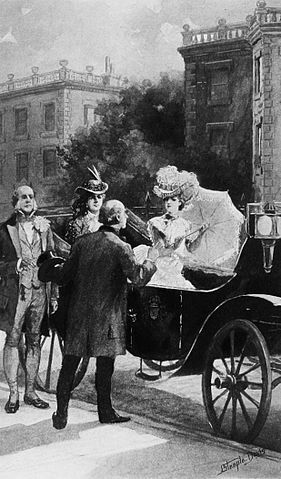
Mr. Camperdown asking Lizzie Eustace where the diamonds are.

This novel was first published in 1871 as a serial in the Fortnightly Review.

Free download available at Project Gutenberg.

And the audio version is available at LibriVox.


2* Miss Mackenzie
3* Orley Farm
3* The American Senator
3* Christmas at Kirkby Cottage

The Palliser series:
4* Can You Forgive Her?
3* Phineas Finn
3* The Eustace Diamonds
TR Phineas Redux
TR The Prime Minister
TR The Duke's Children

The Chronicles of Barsetshire series:
2* The Warden
TR The Barchester Towers
TR Dr. Thorne
TR Framley Parsonage
TR The Small House at Allington
TR The Last Chronicle of Barset
Profile Image for Lorna.
156 reviews89 followers
October 9, 2019
I loved it! Now I can't wait for the next one in the series hoping to hear a bit more about Lizzie Eustace - the flawed heroine of this story. I laughed a lot throughout this book - so many well-observed moments especially at the very transparent manipulations of Lady Eustace.
Portray Castle on the Ayrshire Coast appears to be Culzean Castle - where I spent many happy weeks collecting agates on the nearby beach and eating ice cream as a child. I can picture Lady Eustace there now - pretending to understand the Great Poets.
Profile Image for Stephen Harrigan.
Author 28 books195 followers
June 21, 2013
Probably should take off a star for repetitiveness, occasional windiness and bagginess, but Lizzie Eustace is an indelible character and this is one of the best marriages of a mystery and a novel of manners in fiction. Plus Trollope's dialogue is so startlingly direct and modern there's not the slightest taint of literary mustiness.
Profile Image for Rick Slane .
706 reviews72 followers
July 31, 2020
By today's standards it's longer than it needs to be and the plot seems awkwardly constructed at times. I don't know whether he was an antisemite or just reflecting a popular view of that time.
Profile Image for Lauren.
219 reviews56 followers
March 28, 2019
I always enjoy Trollope, who had a talent for getting nuanced, well-observed drama out of simple, realistic premises. I wouldn't say that The Eustace Diamonds is his best--its treatment of a secondary Jewish character is a little iffy, which mars it--but it's still intriguing and enjoyable. The novel centers on the amoral Lizzie Eustace, whose superficial cleverness and self-interested shrewdness never quite protect her from making horrible, criminal mistakes. She's a triumph for Trollope. She's almost entirely absent redeeming qualities--mostly the best thing you can say about her is that while she's awful, she's not cruel--but Trollope describes her and her so actions so thoroughly that she's perversely sympathetic even if she's never likable. Her actions might be disastrous or foolish, but there's always comprehensible.

Lizzie marries well and becomes Lady Eustace. Her husband lives just long enough to be disillusioned by her, but dies before changing the will in which he provided very well for his young bride, leaving her conditional ownership of a castle in Scotland and a very good income. The Eustace family is collectively nervous about Lizzie, who radiates trouble even when she's not actually doing anything, but she keeps reasonably far from any scandal... until the question arises of the family diamonds. Her husband borrowed the Eustace family diamonds from the jeweler's vault and briefly put them around her neck. She claims he gave them to her outright and meant for her to have them forever. (He didn't.) The family claims they're an heirloom that's meant to be passed down generation to generation, not claimed by any one person except in cases of dire necessity. They're worth ten thousand pounds and the family would like them back, thanks. Lizzie refuses to oblige.

And, in so doing, kickstarts a novel's worth of complications, as all of England takes sides in the matter of Lizzie Eustace's diamond necklace. Trollope throws in everything from geeky legal details about the technical definition of an heirloom to the way opinion on the diamonds begins to hew closely to one's political party. Lizzie's new engagement begins to collapse under the pressure as her fiance tries frantically to do the right thing in a situation where the "right thing" is entirely unclear. And Lizzie changes her story to suit her whim as she moves through life, worrying about the hassle over her jewels, associating with bad crowds, and possibly breaking up her favorite cousin's engagement to a sweet, penniless girl.

The supporting cast of the novel is rounded out well. Lizzie has two foils--Lucy Morris, a principled, goodhearted, and tough as nails governess desperately in love with a rising Parliamentary star, and Lucinda Roanoke, a darkly beautiful young woman of rank but no fortune who is starkly opposed to marriage but can't seem to stop herself from being maneuvered into it. She has a multitude of possible lovers--her cousin Frank, quick-witted and perceptive enough to see through her but fond of her all the same; Lord Fawn, a well-intentioned dope with just enough backbone to be trouble; Sir Griffin, a possible rogue and troublemaker who has the good sense to be a little bit afraid of her once all the truth comes out; and Mr. Emilius, a Jewish convert to Christianity, who is dubiously charismatic and considerably sketchy. (It's not a great portrayal, but, by Victorian standards, it's not a horrible one--Emilius does emerge as an actual character, with good points as well as bad, even if the way his bad points are written about undoubtedly owes something to a strain of anti-Semitism.) There's an enterprising, principled lawyer who comes to loathe Lizzie and all she stands for and a very English, agreeable, honorable brother-in-law who just hates all the hassle. And still more. It's a great, crowded cast that lets Trollope easily demonstrate multiple kinds of virtue and self-interest and show the power of gossip and reputation.

And Lizzie's end is nicely believable--neither too bad nor too good. For all the stains on her character, she's protected by money and position and beauty, and Trollope knows that and handles her fate deftly.
Displaying 1 - 30 of 553 reviews

Can't find what you're looking for?

Get help and learn more about the design.