

What do you think?

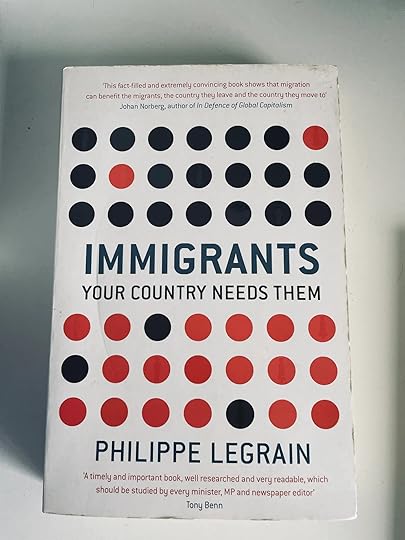
Immigrants: Your Country Needs Them
This volume looks at why people emigrate, how they choose where to go, what difference it makes to the economies they leave and the ones they join, and how we are all affected for good and ill.
Paperback
First published January 1, 2007
Ratings & Reviews
Friends & Following
Create a free account to discover what your friends think of this book!
Community Reviews
Displaying 1 - 19 of 19 reviews

April 24, 2020
Very, very dated.
I'm also not sure Philippe Legrain understood the concept of anti-racism back in the day because racism keeps showing up throughout this book - sometimes glaringly so. He also refers to reverse discrimination which just doesn't exist, so it was at times hard to get through.
Overall, I'm a big fan of immigration and just general human rights and not being awful to each other, yet somehow the arguments he made for the first ~half of the book left me confused as to why his arguments were so weak that I was countering them.
Maybe it's just that the discussion was new then, but I honestly didn't enjoy this book and normally I am really into anything that is pro human rights, but this one was just lacking. I didn't learn much useful from it and I wish that somebody who had anti-racism training had written this instead.
I'm also not sure Philippe Legrain understood the concept of anti-racism back in the day because racism keeps showing up throughout this book - sometimes glaringly so. He also refers to reverse discrimination which just doesn't exist, so it was at times hard to get through.
Overall, I'm a big fan of immigration and just general human rights and not being awful to each other, yet somehow the arguments he made for the first ~half of the book left me confused as to why his arguments were so weak that I was countering them.
Maybe it's just that the discussion was new then, but I honestly didn't enjoy this book and normally I am really into anything that is pro human rights, but this one was just lacking. I didn't learn much useful from it and I wish that somebody who had anti-racism training had written this instead.

September 27, 2024
No issue is as contentious to national identity as immigration. This was true then and it remains true now, especially now that the world is becoming increasingly unstable, ever-precarious and more and more people are moving to another country out of necessity. Think Syria, Ukraine and Burma. These are just the countries from the top of my mind which would supply us multitudes of refugees to come.
But the book is not merely about asylum seekers. Legrain explores every crevice of the immigration question, from illegal migration, low-skilled migration and the arrival of high-skilled workers, to the impact on culture and the national identity. It is a comprehensive but not exhaustive book on the divisive subject, and one which offers suggestions, some which would make sense but some which may be considered extreme.
Take in mind that the book was written in 2006, when the world was fresh and recovering from 9/11 attacks, and the London bombing occurred during the time of writing. The author is a caucasian male, three generations down from his French grandfather, but he is impartial to the idea of migration. As the book argues in the title: Your country needs them. You, meaning the reader who I can assume is sitting comfortably in the sofa in a developed country.
The perennial question of where to draw the line?
Legrain argues that migration is necessary, within limits. But it is difficult to draw the line to how many, whom and how. Some of the models explored here include the Australian way, which is attune to micromanaging the shit out of the demand and supply of the labour market (at least on a best effort basis); or the American way, which blocks most everybody out and has a stringent border control, which barely stems the flow of illegal immigration.
Legrain argued that similar migrants will also be an impediment to the natives instead of complementing the needs of the host nation. This is where low skill migration can supplement the demands of high-skilled workers. Having a nanny, for example, would allow working parents to focus on their careers and be a stronger contributor to the economy. Until robots take over this vacuum, low-skilled migration is still the best answer. Legrain also proposed the idea of making the migrant visa short-term and within fixed dates. Most migrants will still want to return home in any case. This relationship will also be beneficial for the countries providing the labour, as they gain an extra source of revenues from remittance.
The Australian and American ways are barely two sides of the spectrum, and more like different approaches to the same question. Legrain argued that the American neighbours up north (yes, Canada) perhaps provided the best model at the time— reviewing the coming applicants based on the skill set and letting them find their own way once they’ve come in. There are no right answers, but so far the Canadian system has proven that it is possible for the new residents to adopt a new identity as Canadian, while being true to their roots.
Uprooted or planting new roots?
But the question of roots is also a canvas for conflict between the natives, of which the culture that they were born with are increasingly being encroached, and the new migrants, who are forced to adopt to the new ways. Legrain also addressed the arguments of a polarising book on this subject: Samuel Huntington’s Who Are We? Which, personally speaking has been the most xenophobic book I’ve ever read (and also one of the worst).
Huntington argues that the illegal immigration of Mexicans from the south of the border have slowly changed the cultural landscape to the point that the Hispanics have affected the Anglo-Protestant cultural heritage of Americans. A game of soccer between Americans and Mexicans would result in a hullabaloo of boos to the home team, Spanish is becoming a vital language for those near the border to communicate with each other. But yes, Huntington sounds like that racist crazy uncle you really don’t want to talk to in your Christmas dinner.
Yet, the battle lines of culture is not as simple as that. In Australia, where immigration has driven a plethora of new cultures and ethnicities to the humble island, more than a quarter of Australians residents were born overseas and almost half have parents from other countries. When we wind down the history books to early United States, the Irish and Scandinavian migrants arrived to the country and affected the culture some also, bringing with them new names, cuisines and perspectives. Culture is fluid and it is inevitable that overtime, the national identity changes with the coming of new migrants and vice versa.
I would know, as I’m a first generation migrant to Australia before now migrating to Malaysia. My identity is a battleground between new Australian ideals of hard yakka, sports and reckless drinking and the Indonesian roots of respect for elders and authority figures, being studious and seeing any form of drugs as a taboo. In some ways, these things are still at odds, but I am proud to wear my two identities equally — as an Australian and an Indonesian.
I imagine most migrants would have to balance the two and find a compromise, lest they wallow in misery or extremism. And for most, these process will take years. The recent phenomenon of migrant literature in the United Kingdom is reflective of this landscape, as first and second generation writers and writers of mixed backgrounds such as Elif Shafak, Monica Ali, Zadie Smith and a plethora of others have contributed to the voices for these experiences.
There is the question of radicalism, especially among Islamist fundamentals and it is still a difficult question to answer, even to this day. Legrain used plenty of grey rhetoric (for may of his arguments I find) that in all religions, there are pockets of extremism which might affect the rest. Of course, these are the tiny minorities who has a loud bite and bark in the sea of the peaceful majority. Legrain was free to admit that there are lines that need to be drawn, for example, being tolerant to the homosexual community.
The issue I have with the book is not the message, most of which is logical conclusions to the immigration problem, but the style which at times seem to me like a list of facts and numbers. It is hard to follow these numbers and their significance as you would staring at an Excel sheet. As I mentioned, Legrain also used plenty of grey rhetoric to make the arguments fuzzy. While some of this argument is legitimate (yes, Americans were mainly migrants from England before), it only weakens the whole question and leave everybody at loss.
And that’s where we are today. Nations must still battle the question of balancing the numbers of labours for the demands for them. Yet, as Australia is quickly finding out now, the new migrants also need homes. Have you read about the housing crisis in Australia? We still have not answered the problems of immigration and at this point, I doubt that we ever will. But it is always a process of give and take, and if we’re not open to the idea of migration, then at least we should be comfortable enough to talk about it.
But the book is not merely about asylum seekers. Legrain explores every crevice of the immigration question, from illegal migration, low-skilled migration and the arrival of high-skilled workers, to the impact on culture and the national identity. It is a comprehensive but not exhaustive book on the divisive subject, and one which offers suggestions, some which would make sense but some which may be considered extreme.
Take in mind that the book was written in 2006, when the world was fresh and recovering from 9/11 attacks, and the London bombing occurred during the time of writing. The author is a caucasian male, three generations down from his French grandfather, but he is impartial to the idea of migration. As the book argues in the title: Your country needs them. You, meaning the reader who I can assume is sitting comfortably in the sofa in a developed country.
The perennial question of where to draw the line?
Legrain argues that migration is necessary, within limits. But it is difficult to draw the line to how many, whom and how. Some of the models explored here include the Australian way, which is attune to micromanaging the shit out of the demand and supply of the labour market (at least on a best effort basis); or the American way, which blocks most everybody out and has a stringent border control, which barely stems the flow of illegal immigration.
Legrain argued that similar migrants will also be an impediment to the natives instead of complementing the needs of the host nation. This is where low skill migration can supplement the demands of high-skilled workers. Having a nanny, for example, would allow working parents to focus on their careers and be a stronger contributor to the economy. Until robots take over this vacuum, low-skilled migration is still the best answer. Legrain also proposed the idea of making the migrant visa short-term and within fixed dates. Most migrants will still want to return home in any case. This relationship will also be beneficial for the countries providing the labour, as they gain an extra source of revenues from remittance.
The Australian and American ways are barely two sides of the spectrum, and more like different approaches to the same question. Legrain argued that the American neighbours up north (yes, Canada) perhaps provided the best model at the time— reviewing the coming applicants based on the skill set and letting them find their own way once they’ve come in. There are no right answers, but so far the Canadian system has proven that it is possible for the new residents to adopt a new identity as Canadian, while being true to their roots.
Uprooted or planting new roots?
But the question of roots is also a canvas for conflict between the natives, of which the culture that they were born with are increasingly being encroached, and the new migrants, who are forced to adopt to the new ways. Legrain also addressed the arguments of a polarising book on this subject: Samuel Huntington’s Who Are We? Which, personally speaking has been the most xenophobic book I’ve ever read (and also one of the worst).
Huntington argues that the illegal immigration of Mexicans from the south of the border have slowly changed the cultural landscape to the point that the Hispanics have affected the Anglo-Protestant cultural heritage of Americans. A game of soccer between Americans and Mexicans would result in a hullabaloo of boos to the home team, Spanish is becoming a vital language for those near the border to communicate with each other. But yes, Huntington sounds like that racist crazy uncle you really don’t want to talk to in your Christmas dinner.
Yet, the battle lines of culture is not as simple as that. In Australia, where immigration has driven a plethora of new cultures and ethnicities to the humble island, more than a quarter of Australians residents were born overseas and almost half have parents from other countries. When we wind down the history books to early United States, the Irish and Scandinavian migrants arrived to the country and affected the culture some also, bringing with them new names, cuisines and perspectives. Culture is fluid and it is inevitable that overtime, the national identity changes with the coming of new migrants and vice versa.
I would know, as I’m a first generation migrant to Australia before now migrating to Malaysia. My identity is a battleground between new Australian ideals of hard yakka, sports and reckless drinking and the Indonesian roots of respect for elders and authority figures, being studious and seeing any form of drugs as a taboo. In some ways, these things are still at odds, but I am proud to wear my two identities equally — as an Australian and an Indonesian.
I imagine most migrants would have to balance the two and find a compromise, lest they wallow in misery or extremism. And for most, these process will take years. The recent phenomenon of migrant literature in the United Kingdom is reflective of this landscape, as first and second generation writers and writers of mixed backgrounds such as Elif Shafak, Monica Ali, Zadie Smith and a plethora of others have contributed to the voices for these experiences.
There is the question of radicalism, especially among Islamist fundamentals and it is still a difficult question to answer, even to this day. Legrain used plenty of grey rhetoric (for may of his arguments I find) that in all religions, there are pockets of extremism which might affect the rest. Of course, these are the tiny minorities who has a loud bite and bark in the sea of the peaceful majority. Legrain was free to admit that there are lines that need to be drawn, for example, being tolerant to the homosexual community.
The issue I have with the book is not the message, most of which is logical conclusions to the immigration problem, but the style which at times seem to me like a list of facts and numbers. It is hard to follow these numbers and their significance as you would staring at an Excel sheet. As I mentioned, Legrain also used plenty of grey rhetoric to make the arguments fuzzy. While some of this argument is legitimate (yes, Americans were mainly migrants from England before), it only weakens the whole question and leave everybody at loss.
And that’s where we are today. Nations must still battle the question of balancing the numbers of labours for the demands for them. Yet, as Australia is quickly finding out now, the new migrants also need homes. Have you read about the housing crisis in Australia? We still have not answered the problems of immigration and at this point, I doubt that we ever will. But it is always a process of give and take, and if we’re not open to the idea of migration, then at least we should be comfortable enough to talk about it.

October 22, 2015
Well-argued and well-written, but unfortunately all the praise for Israël at the end made my skin crawl.

March 25, 2021
Philippe Legrain makes a compelling argument for why countries should open their borders and allow immigrants to freely flow between countries. If not open the borders completely, at least allow more free flow of immigrants than what we currently have. He uses examples of how Israel took in a million immigrants in the 1990's and assimilated them into society without much of an issue. He also looks at models of multiculturalism that Canada has in accepting people from all over the world.
Much of what Philippe Legrain argues for has merits based on research and data given by researchers across the world. He has also provided stories and interviews of people who explain from their own personal views of the advantages of opening borders and breaking down the stereotypes and bigotry that is out there in our society. I really like that he tries to look at many different cultures and countries to see how they each handle immigration differently, from North America, Europe, to Australia.
There are good arguments that opening up borders will help the flow of immigration and raise the standard of living for many people around the world, both in rich and poor countries. Obviously, since this book has been written, there is a lot of additional data out there that would help continue the argument that is made in this book.
One of the main issues that Philippe Legrain does not expand on and that he admits himself that he's not an expert in, is the impact of religion clashing within western societies. He tries to do his best in the last couple chapters of the book to explain about Islam and make his case for how religions can co-exist in Western culture. This though, I believe requires a lot of additional research. One can make an argument for opening borders and that religion shouldn't be an issue, but how society reacts and handles these issues is a whole different story. There is still much debate on this topic that needs to be had if borders should be opened up and multiculturalism to succeed.
Much of what Philippe Legrain argues for has merits based on research and data given by researchers across the world. He has also provided stories and interviews of people who explain from their own personal views of the advantages of opening borders and breaking down the stereotypes and bigotry that is out there in our society. I really like that he tries to look at many different cultures and countries to see how they each handle immigration differently, from North America, Europe, to Australia.
There are good arguments that opening up borders will help the flow of immigration and raise the standard of living for many people around the world, both in rich and poor countries. Obviously, since this book has been written, there is a lot of additional data out there that would help continue the argument that is made in this book.
One of the main issues that Philippe Legrain does not expand on and that he admits himself that he's not an expert in, is the impact of religion clashing within western societies. He tries to do his best in the last couple chapters of the book to explain about Islam and make his case for how religions can co-exist in Western culture. This though, I believe requires a lot of additional research. One can make an argument for opening borders and that religion shouldn't be an issue, but how society reacts and handles these issues is a whole different story. There is still much debate on this topic that needs to be had if borders should be opened up and multiculturalism to succeed.

January 24, 2022
A great study of an incredibly hot topic issue. It should surprise no one that the fiery rhetoric over immigration has been blown out of all proportion in order to demonize the evil foreigners coming to steal our jobs. This book clearly gets to the reality of immigration to the world's most prosperous nations and if you have been getting your news from papers/internet/tv, the figures and arguments will prob be quite surprising to you. The author flirts with the common arguments against immigration and his argument is fully fleshed out and backed up with impressive sources. Must read for anybody with anti-immigration sentiments who fancies they know about what they preach.

October 9, 2019
A very good overview of the social, economic, and moral benefits of immigration. Because I have immigrant history twice over I wonder if I didn't get as much out of it as someone who may not identify with an immigrant minority group, but good discussion fodder to disprove anti-immigrant rumours with specific examples across the world.

May 8, 2023
Legrain ends this book with this sentence: "Opening our borders offers huge opportunities for all. Our rallying cry for a better world must be 'set people free.'" This should have been his first sentence and then gone from there. The very idea of immigration implies nations should have the right to limit where we study, marry, travel, work, live, do business, invest, hire people from, retire. Nations shouldn't have any such right. I've been to dozens of countries. I've never immigrated anywhere. In fact, as a globalist, I've never left home.

May 9, 2017
I read this book in 2017, eleven years after it was published. Most of it is irrelevant in current European context.

August 17, 2014
Philip Legrain’s book documents the case for immigration through cultural, economic and humanitarian necessity. Many myths are dispelled here including the supposed benefits culture that attracts lazy migrants and the “stealing” of jobs by economic migrants. Legrain’s polemic is very timely in an age of great uncertainty and propaganda from the right wing in politics to reach for a culture of blame and scapegoating those weaker than ourselves for our own problems. The benefits to developed nations quite clearly outweigh any negative points there may be when the cases are looked at rationally. This is not however, a far left wing look at things, merely sensible. Our economies will expand by letting in foreigners and capitalism will thrive. The money economic migrants send home to their poorer relatives already outweighs the paltry amounts given in aid by developed nations, and this money can be sure to reach its intended destination more effectively. Migration is good for our countries in the West and for developing nations and their populations overseas. This is a fantastic book that should be read by politicians the world over
December 18, 2013
In layman language, Legrain convincingly argues for loosening border control to allow more immigrants to work and live in well off countries. Compared to millions of dollars of foreign aid, immigration is not only more effective and practical in helping people improve their living standards in developing countries, it also benefits rich countries in meeting their labour needs, as well as creates a multicultural environment for ideas to flourish and materialise, and essentially raising living standards. A very good read that reminds me that it's a small world after all and everyone deserves a fair go.
May 7, 2011
An excellent argument for open borders. My only serious complaint is that Legrain still writes as though "us" and "them" exist and are clearly demarcated. True, he's talking to the people in power, the people who style themselves "us" and are capable of keeping a "them", however defined, out. But he hasn't quite made the imaginative leap to a place where this binary is irrelevant.
June 14, 2008
Gives the reasons to include immigrants in workforce policy, including stimulating the economy by having more consumers, having the benefit of well-educated people in entry-level jobs, having an infusion of people with good family values.
August 6, 2013
Interesting thesis. Well argued, illustrated with anecdotes and statistics and made Legrain's underlying philosophy clear. But I wasn't engaged for the full 16 chapters. Later chapters addressed objections I don't have/wasn't aware of.

Currently Reading
May 24, 2007He came in to give us a talk today. worth a read i reckon.

November 6, 2007
That freedom of movement shouldn't be the preserve of the wealthy. the world's poor need to overcome the tyranny of borders too - for all of our sakes.

November 13, 2008
He's far too generous with the empirics of the literature he reviews, as well as with the gigantic leaps in assumptions he makes at any given time which in some instances are contradictory.

January 19, 2013
Detailed Review here: http://www.anureviews.com/immigrants-...
March 13, 2013
As a software engineer looking for opportunities abroad, I read this book and found it quite inspirational, but unfortunately also shows the hardships of people that want to emigrate.

June 19, 2009
Anyone interested in the subject of migration should read this book.
Displaying 1 - 19 of 19 reviews