Jump to ratings and reviews
Rate this book

Underworld USA #2

The Cold Six Thousand

Rate this book
The Black Dahlia , The Big Nowhere , L.A. Confidential , White Jazz , American Tabloid ... James Ellroy's high-velocity, best-selling novels have redefined noir for our age, propelling us within inches of the dark realities of America's recent history. Now, in The Cold Six Thousand , his most ambitious and explosive novel yet, he puts the whole of the 1960s under his blistering lens. The result is a work of fierce, epic fiction, a speedball through our most tumultuous time.
It begins in Dallas. November 22, 1963. The heart of the American Dream detonated.

Wayne Tedrow Jr., a young Vegas cop, arrives with a loathsome job to do. He's got $6,000 in cash and no idea that he is about to plunge into the cover-up conspiracy already brewing around Kennedy's assassination, no idea that this will mark the beginning of a hellish five-year ride through the private underbelly of public policy.

Ellroy's furiously paced narrative tracks Tedrow's ride: Dallas back to Vegas, with the Mob and Howard Hughes, south with the Klan and J. Edgar Hoover, shipping out to Vietnam and returning home, the bearer of white powder, plotting new deaths as 1968 approaches ...
Tedrow stands witness, as the icons of an iconic era mingle with cops, killers, hoods, and provocateurs. His story is ground zero in Ellroy's stunning vision: historical confluence as American Nightmare.

The Cold Six Thousand is a masterpiece.

688 pages, Hardcover

First published March 1, 2001

380 people are currently reading
5049 people want to read

About the author

James Ellroy

137 books4,175 followers
Lee Earle "James" Ellroy is an American crime fiction writer and essayist. Ellroy has become known for a telegrammatic prose style in his most recent work, wherein he frequently omits connecting words and uses only short, staccato sentences, and in particular for the novels The Black Dahlia (1987) and L.A. Confidential (1990).

Ratings & Reviews

What do you think?
Rate this book

Friends & Following

Create a free account to discover what your friends think of this book!

Community Reviews

5 stars
2,987 (35%)
4 stars
3,301 (39%)
3 stars
1,576 (18%)
2 stars
373 (4%)
1 star
131 (1%)
Displaying 1 - 30 of 479 reviews
Profile Image for Jeffrey Keeten.
Author 5 books252k followers
April 21, 2020
”They brought him back.

Frankenstein came. Frankenstein went. Nuns fluttered and fussed. Don’t hurt me--I’m Protestant French.

Frank destapled him. Nuns shaved him. He dehazed. He saw razors and hands. He rehazed. He saw Japs and Betty.

Hands fed him soup. Hands touched his dick. Hands jabbed tubes in. The haze sputtered. Words filtered through. Decrease his dose--don’t addict him.
He dehazed. He saw faces:

Student nuns--the brides of Frankenstein. A slight man--Ivy League threads--John Stanton-like. Memory Lane: Miami/white horse/Outfit-Agency ops.

He squinted. He tried to talk. Nuns went ssshhh.”


Maybe if James Ellroy had been born in New York instead of Los Angeles, he might have been a hip-hop star instead of a writer. I’m personally glad he was born in LA because no one has come to define the underbelly of Los Angeles, or frankly the whole nation, like Ellroy.

In the Underworld USA Trilogy, he turns his attention on the Kennedy assassination. The Cold Six Thousand picks up where American Tabloid left off. Wayne Tedrow Jr., Las Vegas detective, is flown from Las Vegas to Dallas to murder Wendell Durfree, a black pimp who has run afoul of the casinos. Tedrow Sr. thinks it might be good for his son to be in Dallas in November of 1963.

He’ll be a witness to history.

How’s Senior know?

There is a lot of speculation regarding President John F. Kennedy’s assassination. There is, of course, the lone gunman theory, held by people who believe that Lee Harvey Oswald worked alone. There is a theory, one of the more speculative ones in my opinion, that the brothers Ngo Dihn Diem and Ngo Dihn Nhu in South Vietnam had ordered the hit. It would be a death activated contract, meaning if something happened to the brothers, then the contract would be triggered; the brothers were assassinated November 2nd, 1963. There is the theory that the mafia had Jack taken out. Bobby, from the Attorney General’s office, crusaded long and hard to destroy organized crime in America. The mafia had been approached by Jack and Bobby’s father to help get the boy wonder elected. If they were king makers, they certainly had every reason to feel fucked over. There is also the theory that the CIA had Jack murdered as payback for the Bay of Pigs debacle in Cuba. There are a plethora of other theories, but these are the ones that I find most interesting.

So what Ellroy is doing with this series is blending real life people with fictional people. The names he uses for his fictional characters are so well chosen and the characters are so well developed that I found myself googling some of the names to make sure I hadn’t forgotten someone who was actually a living breathing person from the 1960s. Even though he seems like a made up person, President Lyndon B. Johnson was actually real and really did say things like this: ”Then why is that cocksucker trying to cornhole me when I’ve bent over backwards to befriend him?”

The same people who are involved in the Kennedy assassination are moved right into operations in Saigon where they start manufacturing H to pay for more clandestined operations that are best not revealed to Congress. The germ freak Howard Hughes (how freaky does he look now?) tries to buy into the casino business in Vegas. A tide of Hughes money is flooding the desert dry streets, and how much of it is skimmed and how it is used is beyond Howard’s control. ”Mr. Hughes injects codeine in his arms, legs and penis. He eats only pizza pies and ice cream. He receives frequent transfusions of ‘germ-free’ Mormon blood. His employees routinely refer to him as ‘the count,’ ‘Count Dracula,’ and ‘Drac.’” Yeah, okay Howie has definitely gone batshit crazy.

The thing about the lone gunman theory is that you can’t just believe that Oswald acted alone. You would also have to believe that Bobby Kennedy’s assassin and Martin Luther King Jr.’s assassin worked alone. What seems like the most tidy of explanations when something happens once suddenly becomes more improbable with each occurrence.

Lee Harvey Oswald/James Earl Ray/Sirhan Sirhan.

”Time sluiced. Time slithered. Time slid.”

We meet true believers here, people who think men like JFK, RFK, and MLK are going to be allowed to make a difference, but unfortunately, there are people who believe that men like this are a threat to the American way of life...check that, the American white way of life. ”King’s dead. Bobby soon. Shit will peak and resettle. The Poor People’s March tanked. The riots upstaged it. Fools popped their rocks and resettled. Chaos is taxing. Fools tire quick. King’s death let them roar and resettle. Bobby will go. Dick Nixon will reign. The country will roar and resettle.

The fix will work. Peace will reign. His type will run things. He saw it. He felt it. He knew.”

His type? Yeah, equality feels like inequality. If the black man is standing on the same level as the white man, then things are not as they should be. Equal equates to whites feeling discriminated against. Ellroy does not shy away from the deep-seated racism that has been passed down from generation to generation in this country as if it were a part of the family DNA. The Civil Rights movement was an assault on the liberties of those who defined themselves by the people they feel superior to.

The left leaders were wiped out to make room for Tricky Dick Nixon.

Could Dick have beaten Bobby? He almost beat Jack. From hindsight, we think that Nixon would have no chance against Robert Kennedy, but Dick was Loki the trickster, a chameleon graced with feral intelligence. To support him, one has to ignore his shifty eyes, his fishbelly pallor, and the flickering image of the scared boy behind the mask. Maybe enough Americans would have believed that Bobby could restore the Camelot facade. That he could make us feel like anything is possible again. That he would represent the very best of what America could produce. Some would vote for the spectre of Jack. Some would feel that we owed the Kennedys for their sacrifices.

I would have liked to see a debate between Bobby and Dick.

This novel will take you behind the curtain, into the black cesspool of American politics. Ellroy will lay out some facts before you. He will speculate for you. He will show you the hidden face of the 1960s. The ”Cordite and blood. Cheap wine. Burned silencer threads. Brass knucks/a sash cord/a pachuco switchblade. Burned bone and vomit. Scented towelettes.”

I’ve always appreciated James Ellroy, but this is the first book where I really understand the genius that takes his writing beyond just storytelling. His staccato, slip slide, rapid-fire, rap battle style reflects a mind weighing and balancing thousands of pieces of information as he searches for the right words to express the complexity of his thoughts.

If you wish to see more of my most recent book and movie reviews, visit http://www.jeffreykeeten.com
I also have a Facebook blogger page at:https://www.facebook.com/JeffreyKeeten and an Instagram account https://www.instagram.com/jeffreykeeten/
Profile Image for brian   .
247 reviews3,894 followers
February 17, 2016
“There are times when an abortion is necessary. I know that. When you have a black and a white*” -- nixon was a racist, red-baiting bastard. nixon was a paranoid insecure fuck. nixon jacked off reminiscing about bugging offices and launching latin american juntas. nixon said "make their economy scream" to 'the jew' (his term of affection for kissinger) as a means to destabilize Chile in order to insert an american friendly right-wing dicktator.

LBJ was cheating on Ladybird, stealing elections, calling out political enemies as commies fags or anti-americans, Gulf of Tonkin'ing as a means to escalation, forcing reporters to conduct interviews in the bathroom while he's taking a shit as a means of intimidation: 'eat my ass fumes, cocksucker.'

JFK's banging whores, starlets, singers, and secretaries. he's colluding with the mob to take down foreign leaders. he's running so much CIA blackops he makes Bush look like a friday night regular at Unicorn Alley.

J. Edgar Hoover's wiretapping the fuck outta EVERYONE. he's got bagmen working for the FBI, mucho shakedown and extortion, and a closet full of clothes my grandmom'd love to get her hands on.


that's why mike davis' criticism that ellroy's world is too much a black hole of immorality doesn't hold. when we hear the words and catch wind of the actions we get some sense of what was happening. davis argues that when things are so dark, so black, there's no contrast and everything's flattened. not so. when things are so dark it's like driving drunk: we're being overly careful so we're better at it. in the dark we can see more.

JFK, RFK, and MLK all assassinated within 5 years. all by lone gunmen. make sense?

on the one hand. we feel that the cosmic balance is way off if a major figure such as JFK or MLK is taken down by some irrelevant asshole - it just feels wrong. history doesn't work that way -- some nothing, some peon, can't alter the stream like that, right? maybe. maybe the times created these assholes. maybe peons did and do alter the stream. maybe oswald worked alone but was really an agent of History. maybe oswald was our creation.

on the other hand. it just can't have happened like that. fuck no. as ellroy's j. edgar hoover makes clear in both books, it all seemed to be moving toward a common point. it was inevitable. and it wasn't some random peon influenced by some vague 'Tide of History'. check it: castro nationalizes the casinos and the mob is booted. they're in deep with the kennedys. joe's an ex-rum runner, joe bought w. virgina, joe's crooked and bought his boy the power. his boy: a humper, a stickman, a cuntman. 'get up on top, baby, i have a bad back' MLK incites the spooks, the shines, the smokes; RFK incites the kikes, pinkos, and the young. it's all happening and it's inevitable and it's growing and it's racist and hateful and brutal and hungry and never sated and devouring everything in service of what it is and what it knows and it keeps moving. it's still going.


ellroy's the great american writer of our time and this trilogy, his 'american' trilogy, is shaping up to match (surpass?) what dos passos did with his 'american' trilogy. that is: offer one hell of a fun time while saying something very profound and disturbing about what america is.

america? from american tabloid, the first volume of the trilogy:

'America was never innocent. We popped our cherry on the boat over and looked back with no regrets. You can't ascribe our fall from grace to any single event or set of circumstances. You can't lose what you lacked at conception.

Mass-market nostalgia gets you hopped up for a past that never existed. Hagiography sanctifies shuck-and-jive politicians and reinvents their expedient gestures as moments of great moral weight. Our continuing narrative line is blurred past truth and hindsight. Only a reckless verisimilitude can set that line straight.'


i first met james ellroy when i worked at the book store and he was doing a reading -- i asked if he wanted a drink and he told me rapid-fire that he'd been sober for years but could use six espressos. i laughed. he wasn't kidding: he wanted six espressos poured into one cup. i ran to Coffee Bean and got the order and ellroy gulped it down like water and launched into a tirade of alliterative and intellectual dementia focused mainly on the sleaziness of bill clinton and on his great love for pit bulls. words can't express. ellroy admitted he's upset he'll die in however many years only in that he won't have the time to gain proper distance from the clinton administration to write a book about it.

i love this man.

*a gem, but not even close to one of the best from the nixon tapes
Profile Image for Kemper.
1,389 reviews7,630 followers
September 24, 2009
American Tabloid was about criminals making history and culminated with the plot to kill Jack Kennedy. In The Cold Six Thousand, the characters aren't trying to make history, they're just trying to survive it.

American Tabloid is one of my all-time favorite books. The second part of this trilogy has always been a bit of a disappointment to me. I read both again to prep for the release of the final book, Blood's A Rover. With that one sitting here, just waiting for me to start reading, I'm feeling a bit more charitable to this one now.

I judged it harshly because after the mind blowing brilliance of American Tabloid's fictional re-telling of the JFK years from the perspective of a cop/criminal trio of Ellroy patented Bad White Men, anything was going to seem like a let down. Ellroy's crazy fragmented writing style works brilliantly when he keeps it on a leash like he did in L.A. Confidential or American Tabloid, but when it gets away from him, it slips into near self-parody, as I think it did in White Jazz. He comes dangerously close to that in this one, too.

And while American Tabloid felt like an epic re-telling of American history during the JFK era, The Cold Six Thousand has always had a slightly grungier and grimmer tone. That's understandable since American Tabloid mirrored the JFK administration. Even the guys trying to scam and steal their way to greatness felt like they were making history as they did it.

Here, with the fallout of the JFK assassination plot hanging over everything and coloring all the characters with varying degrees of paranoia and guilt, the schemes feel small-time and cheap, no matter how much money is involved or how grand the plot.

Howard Hughes wants to buy every casino in Vegas, and the Mob is selling, provided they keep their own people in place to run their skim operations and steal crazy Howard blind. Vietnam is ramping up and everyone in the book sees it as a business opportunity to start large scale heroin smuggling operations to fund their own pet causes.

An aging J. Edgar Hoover is obsessed with bringing down Martin Luther King Jr. for having the nerve to demand equal rights. All the players are worried about what Bobby Kennedy actually thinks about his brother's death and what he plans to do about it. Loose threads to the JFK plot are getting ruthlessly snipped and the only way to stay alive is to stay useful to the men in power which means that even the worst of them are being told to do things that push them to their limits and beyond.

Adding to the grimmer tone of this one is the new guy, Wayne Tedrow Jr. He starts out as a relatively clean Vegas cop being pushed towards contract murder by his rich asshole father, who wants him to join the family business of peddling hate against anyone but white Americans. When Wayne is given cause to start hating too, it makes him one of Ellroy's most uncomfortable characters to read about.

Wayne isn't an ignorant racist just hating for hate's own sake. He knows it's evil and wrong, but he's so committed to it that he practically creates his own purer form of racism that's scarier than the worst redneck rants. And he's one of the main characters so spending several hundred pages in his head isn't exactly a joy ride.

But reading this one now, after some time has gone by after my initial disappointment, I think I've gotten a better idea of what Ellroy was going for. Here's hoping that he can finish off the '60s and wrap this up in style.
Profile Image for Olethros.
2,724 reviews534 followers
April 19, 2019
-Muy Ellroy, pero mucho. Así que ya saben lo malo y lo muy bueno que les espera.-

Género. Novela.

Lo que nos cuenta. En el libro Seis de los grandes (publicación original: The Cold Six Thousand, 2001), Wayne Tedrow Junior aterriza en Dallas minutos después del asesinato del presidente J. F. Kennedy. Wayne fue soldado y ahora es policía en Las Vegas, y llega a la ciudad con el encargo de matar, por seis mil dólares, a un proxeneta negro que ha molestado al clan de los casinos. En Dallas contará con la ayuda de Maynard D. Moore, policía de la ciudad, relacionado con alguna de las víctimas colaterales del magnicidio. Casi a la vez aterriza en la misma ciudad Ward Littel, un antiguo agente del FBI, pero que mantiene lazos indirectos y férreos con la agencia, que ahora trabaja para la mafia aunque sigue los dictados de J. Edgar Hoover y, en esta ocasión, debe asegurar que toda la investigación sobre la muerte de Kennedy apunte a Lee Harvey Oswald. En la ciudad también está Pete Bondurant, operativo que igual trabaja para la CIA que para la mafia. Segundo libro de la trilogía America oculta pero que se puede leer de forma independiente.

¿Quiere saber más de este libro, sin spoilers? Visite:

http://librosdeolethros.blogspot.com/...
Profile Image for Hanneke.
395 reviews485 followers
October 26, 2019
Allow me to pat myself on the back a few times for finishing this novel. I made a firm decision to finish at least one of James Ellroy’s novels after I saw him giving a rather provoking speech here in Amsterdam a few years ago. I think that Ellroy likes to shoot sentences from his hip like a shotgun and he certainly succeeds in doing that. I cannot say that I find four words sentences very attractive and they are getting really tiresome after a few hundred pages, but I must admit that they do convey action. Well, Mr. Ellroy, if you are annoyed at me if you would happen to read this review, I would like to remind you of your really rude greeting of the Amsterdam audience. Not that I did not have to grin at your totally inappropriate address and acting like a provocateur throughout, but perhaps 98% of the audience could not appreciate it. I am sure that you have a big following of dedictated readers and I think I can understand that, but your books are not for me.
Profile Image for Richard.
1,062 reviews473 followers
August 17, 2016
*3.5 Stars*
"You never know when you might rub shoulders with history."
Well here it is, the book that ends my 5-star streak with James Ellroy's books. But it's definitely not a bad book, just not as impressively crafted as the others and much more difficult to read.

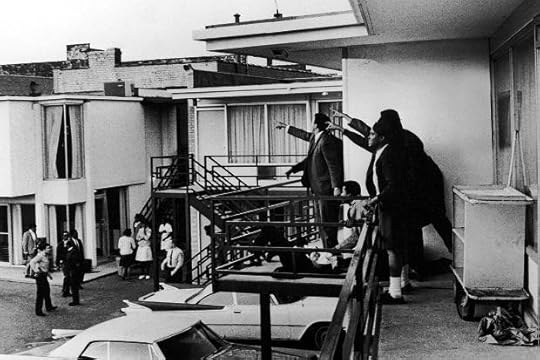
John F. Kennedy, Martin Luther King Jr., and Robert F. Kennedy, all assassinated within five years, all by lone gunmen who all claimed to not be the only ones involved. Coincidence? James Ellroy thinks not, and just as in the stellar American Tabloid , he deconstructs the turbulent 1960's and rewrites his own version of American history during that time, leading up to the deaths of RFK and MLK. Picking up immediately after the JFK assassination at the end of Tabloid, The Cold Six Thousand follows our characters cleaning up after the killing that has shaken the country to its core and they struggle to define their roles in the history being made. Pete Bondurant dedicates himself to staying useful and to mending his fraying relationship to the Mob and the CIA, dreaming of rekindling his Anti-Communist glory days that led up to the Cuban crisis, while Ward Littell uses all the skills he's learned from Kemper Boyd, dangerously juggling alliances with everyone from the Mob, Howard Hughes, the FBI, and the Civil Rights movement, and at the same time feeling increasing guilt with his role in a rising number of conspiracies. Debuting into this mess is Wayne Tedrow Jr., a Las Vegas cop struggling to avoid following in his racist father's footsteps, but tragic circumstances allow him to embrace the darkness within. And looming over everything is J. Edgar Hoover, the Emperor Palpatine of the Ellroy galaxy, increasingly unhinged, crafting conspiracies from behind a desk, wire-tapping every room in the country, struggling to make the country great again.

One of the things that made me fall in love with Ellroy's work is his ability to pull together an immense encyclopedia of material and, through the use of some black magic, craft these tight tales and characters that are engaging and fully memorable. And though his past five masterpieces that I've read haven't been short, this is the first of his work that I actually think is too long. And Ellroy takes his prose-style to the extreme here and that doesn't help. It's exhausting and many times tedious, and there are whole parts that I don't think were all that necessary; the Vietnam storyline in particular didn't really amount to much or affect much of anything. I wish that Ellroy spent less time on that and more time really fleshing out the character arcs, which weren't as finely tuned as in his previous novels. I wanted to feel the conflict in Ward Littell more as he feels the pull of the Left even though he tries so hard to be part of the Right. His story could've been the most fascinating. I wanted to further explore Wayne Junior's acceptance and rationalization of his racism. While all of these ideas were great, I just wish they were fleshed out more.

But the book is still an Ellroy book and like most of his work, it's an epic that stands out in a crowded field of fiction. There are times when the declarative sentence style really shines, as in a chapter where Littell witnesses firsthand the horrors that haunt the civil rights movement. It was also great catching up with old characters from previous books, or witnessing infamous history from a different perspective, like the JFK assassination clean-up, Sonny Liston's alleged Outfit ties, the plots to discredit Dr. King, or the recruitment of both Sirhan Sirhan and James Earl Ray. There were times when the book hovered around 4 and a half stars, but alas I have to settle on a 3.5. Hopefully the next book I read from him is back to the A-quality I've come to expect!
Profile Image for Dave Schaafsma.
Author 6 books32.1k followers
December 14, 2022
The Cold Six Thousand is part two of James Ellroy’s Underworld USA trilogy. The first book, American Tabloid, written in part in “tabloid” style, feels somewhat similar to Ellroy’s look at corruption in the LAPD of the forties and fifties, in his LA Quartet, when tabloids and a sort of "yellow journalism" dominated. In The Cold Six Thousand Ellroy says he developed a rather different style to fit his view of the sixties, short, punchy sentences:

“The style I developed for The Cold Six Thousand is a direct, shorter-rather-than-longer sentence style that's declarative and ugly and right there, punching you in the nards. It was appropriate for that book, and that book only, because it's the 1960s. It's largely the story of reactionaries in America during that time, largely a novel of racism and thus the racial invective, and the overall bluntness and ugliness of the language”--Ellroy

Here I adapt the opening of my American Tabloid review:

“America was never innocent.”

“It's time to demythologise an era and build a new myth from the gutter to the stars. It's time to embrace bad men and the price they paid to secretly define their time.”

American Tabloid, and now its part two, The Cold Six Thousand, are two of four big books by major authors I’ve read in the last twelve months or so focused on what they would all agree is a key event in twentieth-century American/world politics, the killing of JFK: 11/22/63 by Stephen King; Libra by Don DeLillo, and these 1995 and 2001 publishing and award-winning sensations by the author of The Black Dahlia and LA Confidential. A turning point in American history, they'd all agree.

The first two books of this trilogy feel like a combination of The People’s History of the United States and Fear and Loathing in Las Vegas, but far more propulsive, with a bit of Cormac McCathy’s Blood Meridian-style ultra violence thrown in, something like being body-punched with those tough, staccato sentences, but, I don't know, even standing here, beaten up, I’m still somehow admiring him for his pugilistic skills. Ellroy is maybe the most cynical writer I know this side of Celine, but he's also politically astute. Ultimately angry, not despairing. Anti-romantic, assuredly, on the issue of Making America Great Again.

So American Tabloid ends with the killing of JFK, and The Cold Six Thousand picks up just after that moment, and is about the five year aftermath, including the mopping up and cover-up of the assassination by the slimy FBI rogues that are the main (fictional) characters, led by J Edgar Hoover. Ellroy then takes us through the civil rights movement and its ever-attendant racist pushback, and the continued right wing focus on Commies/Commies/Commies, including the military build-up in Vietnam, and ending in the killing of MLK and RFK. It’s an ugly period, especially through the lens of Ellroy. I mean, most people, on the right and left, do not think the killing of JFK, MLK and RFK--three liberal activists-- were random acts committed by solo crazy people. Ellroy’s vision may be dark, and it's (historical) fiction, but it seems more reasonable than the Warren Commission report on the Assassination of JFK. This book comes ten years after Oliver Stone's JFK, and is just as ambitious but more credible to me.

From the publishers: “On November 22, 1963 three men converge in Dallas. Their job: to clean up the JFK hit’s loose ends and inconvenient witnesses. They are Wayne Tedrow, Jr., a Las Vegas cop with family ties to the lunatic right; Ward J. Littell, a defrocked FBI man turned underworld mouthpiece; and Pete Bondurant, a dope-runner and hit-man who serves as the mob’s emissary to the anti-Castro underground." The web they weave spreads to the (intended) take-over of Vegas by Howard Hughes (and Wayne Tedrow’s father, Wayne, Sr., a corrupt and violent Mormon). Plots get cooked up in connection to defaming and then killing MLK, who is over time seen as increasingly a Commie, looking at issues of economic injustice and not just racial equality. Jimmy Hoffa makes his way into it; he hated RFK’s anti-mob stance: Let's get rid of him. Hoover hated MLK’s focus on racial justice and King’s fomenting civil unrest and rioting: Let's get rid of him. There’s a solid anti-gay theme running through a lot of this narrative, too.

So this was the sixties, when racism was rampant and white nationalism (via the KKK and other orgs) reigned; anti-Communism reigned--America first! And gays were also hated. Hate proliferates, fomented by guys like Hoover. So glad we got over that and we no longer have any racism, homophobia and anti-communism/socialism anymore and we can all live without hate and divisiveness.

Anyway, it's one wild, at times exhilarating, sometimes exhausting ride. I kept imagining that if you listened to it at, say, +1.25 speed you might just have a stroke or begin having seizures. It’s so driven and angry. But it is a very very well-written trip through the most scary (and ridiculous) parts of the sixties. Real world horror.

Here’s an interview with Ellroy, who is sometimes referred to as a "demon dog" of literature:

https://crimereads.com/hungry-like-a-...

When I was reading this song ran through my head by Dion, “Abraham, Martin and John,”, which is way more sentimental than Ellroy has ever been, but I still like the song:

https://www.youtube.com/watch?v=rwn8h...
Profile Image for Greg.
1,128 reviews2,147 followers
September 3, 2009
American Tabloid ends with Pete Bourdant watching Barbara do a rendition of "Unchained Melody" in some Dallas lunchtime geek joint on a particularly historical November morning in 1963. The novel ends with Pete watching and waiting for the screams to start.

The Cold Six Thousand picks up earlier that morning with a new character Wayne Tedrow Jr. flying from Vegas to Dallas to hunt down a black (sorry I can't bring myself to use a more PC term nor can I bring myself to put the N word in the review, although it works better to capture the whole feeling of the book) pimp and kill him for shiving a mobbed up black jack dealer. He discovers on landing in Dallas that JFK is dead and by a series of collusions Wayne passes from being a cop being used for mob justice to an agent in capital H History.

The reader never sees Kennedy get it.

American Tabloid is a lot of things, but one could say that it's the story of why Kennedy gets it in Dallas. I'd say this is only a minor point to the book, and American Tabloid is really not a historical novel at all, but an American Tragedy in the classical sense of the term Tragedy. This Tragedy continues in The Cold Six Thousand.

The first novel is the killing of JFK. The second is dealing with the aftermath.

At the center of both novels are a bunch of morally suspect men. They are Right-Wingers, Hate Mongers, Conservatives, Dope Runners, Extortionists, they are Mobbed Up, Klanned Up, Feds and Mercenaries. None of them are nice people, or people one would want to have any sympathy for. On the surface they are all evil people, doing very awful and violent things, but in a murky gray area where one feels like they can't be flat out condemned. Like the characters on the TV show The Wire there are no real good guys and bad guys here, but an ever shifting landscape of personality, where the people transcend beyond a cookie cutter image and take on a complex reality.

These are some amazing characters.

At the heart of the first two novels (and probably the third), is a conservative presence trying to hold back the tide of progress. They are grasping for a time that maybe never even existed before the first book starts in the late 1950's. The Mob trying to reclaim their casinos in Cuba and harking back to a time when the government turned a blind eye to them, before RFK got a big fucking hard-on for them. Hoover and Howard Hughes trying to hold back the progress of equality, and dreaming of a white old boys country. The various actors in the drama, with their own pet projects, their own dreams and schemes that they are willing to do anything to see succeed. This assorted brand of reactionaries ironically can be seen as the agents of progress, the people who in their attempts to freeze the clock of time are pushing the hands forward faster.

How much of this story is true? I have no idea. Ellroy is convincing in his grand totalizing vision of the era, and while it's convincing to me, it's not necessarily a vision of history that one wants. If Ellroy is telling the truth, than what we know as contemporary America has been built on the grounds of a moral abyss and only the continued reactionary manufacturing of illusions of truth keep the whole fucking thing from collapsing upon itself.

I've rambled enough. If you want to read this as a review, then I recommend you read this fucking book.
Profile Image for Rob.
22 reviews1 follower
April 3, 2012
This one gets the full-on review because I wrote one up a few years back in an attempt to understand whether I liked the book. I'm a big Ellroy fan, but the moral stance he takes in this novel is complex, and I had to think it through. I end up siding with him, if you don't want the whole thing. Or, if you have a few minutes:

James Ellroy’s novel The Cold Six Thousand, is an addictively compelling story driven almost exclusively by morally repugnant characters. The characters in Ellroy’s police novels, particularly his Los Angeles quartet, often commit seemingly irredeemable deeds yet by book’s end somehow find redemption. In his more recent works Ellroy’s writing enters the world of big-time politics and redemption is no longer offered as a possibility. Ellroy once wrote about serial sex murderers and the obsessive cops who chased them, propelled by despair tinged with the tiniest drop of optimism; it is only now, writing of deeds sanctioned by the United States government, that Ellroy has written a tragedy of worldly proportions.

The Cold Six Thousand is Ellroy’s take on the assassinations of John Kennedy, Martin Luther King, and Robert Kennedy. The book’s primary characters are mercenaries motivated more by the action than by the money, men whose complexities are revealed in three and four word sentences, a spare style that delivers its brutal story sans adjective overkill.

Although it is a common theme in tragedy for the main character to be either an exemplification of evil or battling with that exemplification, Ellroy here stakes out ground in which the evil is all relative; none of his characters are “good,” and although some are better than others, the Nietzschean question is whether good is to be measured by power or by a morality less tangible.

The answer to this question is left to the reader. For the immorality—the danger—is not in Ellroy’s writing, which portrays brute, underground aspects of modern America. The danger is that his audience may be so numbed, so inured to cruelty and violence, that we fail to judge these characters. But people who live as though they are beyond morality are not simply amoral. They are immoral, misguided savages living by their own set of savage rules. Torture, after all, originated with ‘civilized’ man.

Ellroy’s is a fictionalized history, but it is a plausible fiction. His main characters are employed by the Mafia, the government, or both: agencies policed only by themselves and each other. Ellroy does not distinguish organized crime from the CIA and FBI; he puts them all out there, weaves them together, and dares us to disbelieve him. And because what the public knows of these organizations is shrouded in secrecy, knowledge often becoming public only when a cover-up fails, it is easy to accept Ellroy’s fictions as truths. We know that however horrible the assassinations of Martin Luther King and the Kennedys, the world contains people who hated those men, and some of those who hated may well have not only ordered but enjoyed and celebrated their murders.

Ellroy does not judge. He mires the reader in page after page of blood and torture and souls willingly lost, men who will give up whatever goodness they may have once possessed in order to do battle with their demons. Ellroy’s characters do not make conscious decisions, except regarding the achievement of their own desires. They are animals, oblivious to their capabilities for rational decisions. They live in fear, and the little humanity that remains for them is in the hate they use to defeat that fear. And in that they cannot succeed, for the means becomes the end, and it is here that indeed Ellroy appears finally to pass judgment. For his troubled characters cannot find peace, instead settling for revenge or their own violent ends. And if there are exceptions, and someone survives at the cost of his soul, it is probably due to nothing more than a profound belief that the world is an evil place. It is a world portrayed brilliantly in The Cold Six Thousand. It is a world that must be fought, but in Ellroy’s horrifying vision there is little hope of victory.
Profile Image for XenofoneX.
250 reviews354 followers
February 17, 2016
To be fair: 'American Tabloid' was Ellroy's best novel, and the sequels had little chance of topping it. With 'The Cold Six Thousand', he picks up right where he left off: the assassination of JFK, orchestrated by a group of gangsters, mercenaries, and CIA hardcases, pissed off over the bloody and embarrassing 'Bay of Pigs' fiasco.

description

This time the bullseye is on Martin Luther King, as he makes enemies that include a Mormon power-broker and 'Company' connected tough guys selling heroin smuggled in from the ready-to-blow jungles of Southeast Asia, to be sold exclusively to black ghettos. And it's all TRUE. Is it? No, of course not. It's fiction. But... there's truth at the heart of it. Even if Pete Bondurant never existed, someone a lot like him did. Hell, 'American Tabloid' felt like fucking non-fiction.

I'm not someone who buys into conspiracy theories, but nevertheless: Oswald was a CIA asset, Jack Ruby was connected to the mafia, and anyone who thinks otherwise hasn't looked closely enough, or they don't want to believe it. This is a story that requires entertaining some ugly possibilities about very important people. It's another dark excursion into the gutters of American history, with Ellroy once again displaying his mastery of stories so vast and complicated, he might be the only writer capable of pulling it off. He manages to beat his prose into something even leaner and denser; it's ugly as hell, and heavier than Osmium.

description

There are no 'good guys' in Ellroy's America. Even national icons like Kennedy and King are unable to avoid the ever-present cynicism, tainted by the poison Ellroy finds bubbling forth from every crack in the sidewalk. This time out, however, the pace begins to slow; Ellroy seems undaunted by the Osmium-heavy narrative, even as the repetition and pointlessness of the violence and hatred becomes exhausting. It certainly doesn't top 'American Tabloid', but it's still Ellroy in fine form, creating fiction that feels dangerous and true.

P.S.: I remember reading an interview with Ellroy after The Cold Six Thousand was released, and he said he was writing a novel set during the Civil War. I'm pretty sure I didn't dream that. I thought at the time that it seemed so unlikely it was almost ridiculous. And after the 'Underworld' trilogy wrapped up, he wrote 'Perfidia'... settling back in to the well-worn Ellroy beat of 1940's LA. No Civil War novel. Maybe he was joking. He'd have to abandon that style he's been using for the last quarter century, and I'm not sure he can.

Then again, Elmore Leonard used to move back and forth between Crime and Westerns. The two genres have a lot in common; tough men making hard choices, shooting each other and whatnot. I'll read that Civil War story if it ever turns up, just to gawk at the freak a while, and see what such a creature might look like; but I'm sick of that prose, and the poison dribbling from every sentence fragment. There was some ugly-ass shit going on in the 1960's, but I think a modern-day version of Underworld would be even uglier. As someone who's read most of Ellroy's oeuvre, I feel confident saying that many of the toxins in the Underworld trilogy are Ellroy's own brew. The 'dark places' being charted are indistinguishable from the author's. And... I like it when writers say pretty things, or even better, say nasty things in a pretty way. I haven't read anything by Ellroy in years, and his newest book hasn't made it onto my shelves. The thought of reading 'Perfidia' just doesn't appeal to me. He's still an author I like and respect, but at some point in the last few years, I unconsciously bumped him from 'the list'. That whittled down prose... 'Perfidia' might be nothing but bullet points. Or short hand.
Profile Image for Darwin8u.
1,835 reviews9,035 followers
February 24, 2016
"I'm seeing visions, Dwight. I'm seeing all the Latter-day Saints."
― James Ellroy, The Cold Six Thousand

description

I remember when I was 5, thinking: "if I just didn't screw up, I could have been Jesus". I remember when I was 8, thinking: "if I just killed myself when I was 7, I could have gone straight to Heaven." I remember when I was 12, thinking: "Mormons could make fantastic mobsters." I hadn't yet learned about the John Birch society. I hand't learned about Howard Hughes and his cabal of Mormon fix-it men. I was still fresh. I was still a long way from the darkness bred from hate, from money, from greed, from racism.

Pete said, "Shut Up." Pete Said, "Smile more and hate less."

Like American Tabloid, 'The Cold Six Thousands' deals intimately with the Mob, J. Edgar Hoover, Howard Hughes and the pornography of violence that was the 60s. Now, post JFK assassination, we are dropped into the clean-up, the rise of Las Vegas, the rise of Vietnam, RFK (I share a first and middle name with that man), and MLK. This is another dense novel where the story is told from the middle; from the dark, dank core of conspiracy. Two of the main protagonists traveled from 'American Tabloid'. One was left behind, buried. A new one was introduced. Mormons in Vegas and with Hughes take on a larger role.

description

I could write a whole book on the Oedipal implications of this novel too. The relationship between Wayne Tedrow, Jr and Sr., could fill an entire psychology textbook. It was a plum fermenting on the Tree of Life. There was some sick shit mixed into all of that. My favorite characters Ward Littell and Pete Bondurant find themselves firmly planted in this book. A trinity of femmes fatale (Jane, Barb, Janice) jump, jive, and swirl like olives jumping from Ward's martini to Pete's martini to Jr's martini.

"Hate Strong. Hate brave. Don't hate like Mr. Hoover."

Probably the only thing I didn't enjoy about this book as much as the last was the prose.* It was a bit too clipped, heavy and fugly for me. Like all of Ellroy's prose there is a bit of a madman, a bit of a savage, stuffed into every clipped, dense sentence, but after a while, I was dreaming of long sentences and sunshine; just a bit of variety. I somehow imagine Ellroy thinking that writing four word sentences was, perhaps, the only way he was going to trim this second novel down by 1000 pages. It is dense. It is rapid. It is rabid. It is almost too much. One more killing. One more spike. One more mike and I might drop dead before I find out who dies other than America. And like all the characters in this sick-mother of a novel, I want to be there to watch. I want to see it framed. I want to hear the crunch and the crack of the very last page.

* "The style I developed for The Cold Six Thousand is a direct, shorter-rather-than-longer sentence style that's declarative and ugly and right there, punching you in the nards. It was appropriate for that book, and that book only, because it's the 1960s. It's largely the story of reactionaries in America during that time, largely a novel of racism and thus the racial invective, and the overall bluntness and ugliness of the language."
― James Ellroy, The Onion A.V. Club
Profile Image for Jonfaith.
2,146 reviews1,747 followers
September 23, 2024
Our author and his genre vice, he can’t shake it. He fiends. Ellroy, oh boy.

I was pleased he avoided excessive hocus pocus here, well, outside of J Edgar Hoover pulling a ridiculous number of strings. Yeah the plot device of the female friends being daughters of the featured protagonists has long disappeared. The libidinal images of spouses and GFs asserts itself here instead.

The idea here that Dealey Plaza launched a wave of operations which shifted the course of history, replete with transcripts from Hoover advising the unwitting. There’s torture and narcotics, more slurs and epithets than one might want to. It just grew tired. There’s no need to connect events within a narrative arc by such threadbare characterization.

It went from Dallas to Vegas to Vietnam ringing in Sonny Liston, Jack Ruby and other assorted murderers and martyrs. Despite the last of those I don’t consider us witnesses. Perhaps just paroled from the slog by the turning of the final page.
Profile Image for Tim.
245 reviews119 followers
May 17, 2023
Not quite as compelling as part one of the trilogy which dealt with the JFK assassination. This follows the same characters in the years leading up to the Dr King and Bobby Kennedy assassinations, both of which the characters are involved with. Elroy though isn't as convincing that he knows the backstage logistics of these killings as he was with JFK. Once again we get an America governed by the Mafia and rogue CIA agents with Hoover as insane hate-filled puppet master.
Profile Image for AC.
2,214 reviews
December 20, 2013
This trilogy presents something like a postmodern (L.-F.) Céline. If L.-F. came back to life in contemporary America, this is the sort of thing he might have written (I am talking, of course, about 'late' Céline -- Castle to Castle, etc.). It is very intense. Perhaps one has to be obsessed with the period/events to 'dig it' -- as I am.

Céline, of course, is more authentic -- Ellroy is fictionalizing far more. I'm sure Fred Otash (whom I now realize I sorta crossed paths with as a teenager -- so much for SIX degrees of separation...) surely didn't 'run' Sirhan or Jimmy Ray...

Nonetheless... this IS a postmodern epoch, and everything IS slightly inauthentic -- even... or *especially* what is billed as hyper-authentic.

Still -- a good (if not great -- it IS too long...) follow-up to American tabloid.

(Now on to 'Rover'....)
Profile Image for Lauren.
219 reviews56 followers
July 25, 2016
Retire me. I'm stretched thin. It hurts to sleep. My hate life's a mess.

(This review will assume you've read American Tabloid.)

The Cold Six Thousand is a jittery, ugly, brilliant, haunting, flawed, and unforgettable book, and the first thing you need to know about it is I used more commas writing this sentence than James Ellroy used in this entire novel. I just want to get that out of the way. I said that White Jazz's chopped-up style worked well as an expression of Dave Klein's paranoia and rapid consideration of all angles--it also worked well because White Jazz is comparatively short. The Cold Six Thousand is long, and Ellroy uses its style to indicate theme rather than characterization: the "declarative and ugly and right there" style and "bluntness and ugliness" of the reactionary movement he's writing about. I appreciate that and respect the thought that goes into it, but my admiration doesn't make it any easier to read it. It's a problem, but it's a problem you run into only when an artist is working at the edge of a literary form and therefore expanding it.

Our Ellroy trio: Wayne Tedrow, Jr., Las Vegas cop and son of right-wing hate-tract pamphleteer and all-around mover-and-shaker Wayne Tedrow, Sr. and returning guests Pete Bondurant and Ward Littell. There's no way for me to talk about our trio without talking about a structural weakness of the book, which is that only Wayne's story feels like a story.

At the start of the novel, Wayne is paid the titular "cold six thousand" to go to Dallas and kill Wendell Durfee, a pimp who stabbed a blackjack dealer. His father wants him to do it in part because Durfee is black and Wayne, despite growing up in his father's house, just doesn't hate the way he's supposed to. But Wayne finds himself rapidly entangled with a corrupt cop and the aftermath of the Kennedy assassination, and he chooses to let Durfee go, a decision which will shape the rest of his life, as he walks, eyes open, further and further into the Life of mobsters, CIA heroin manufacturing in Vietnam, and the not-technically-authorized murders of Bobby Kennedy and Martin Luther King Jr.

"You're going to do things that you won't be able to live with."
"Maybe I have already."
"It gets worse. And you'll do worse things, just to prove you can take it."


That's Wayne, who spends the novel discovering a lot of hate and a lot of violence within himself, and who it's impossible to look away from.

With all that going on, it's difficult to miss that Pete and Ward don't have that magnetic appeal here. With Pete, it's less of a problem, because Pete is a more static character. Loving and marrying Barb gave him something to lose in his pursuit of money and power, and it gave him a reason to maybe walk away, but it didn't change his nature: he's fundamentally an agreeable team-player willing to do evil if it benefits him. His story in The Cold Six Thousand is really the aftermath of a story: a long, long epilogue to American Tabloid. He's hungover on his dreams of Cuba. He's not sure if the Mob will forgive his theft. He's not sure Barb will stay with him now that she knows what he's capable of. He's tying up loose ends. You don't expect him to change, and he doesn't: he just gets older and tries to decide what he wants more, the corridors of illicit power or a stable life with Barb.

With Ward, the lack of story is a problem, because Ward's arc in American Tabloid from righteous, eager-to-prove-himself anti-Mob crusader to cold-blooded Mob lawyer to blackmailed and humbled Mob tool was flat-out brilliant. But Ellroy has nowhere new for him to go here, and so Ward ends up vacillating in a way that might be realistic but is definitely undramatic: he falls quickly in unmotivated love with a Kennedy assassination witness and renews his infatuation with Robert Kennedy and spends the whole novel spying on Martin Luther King and facilitating Howard Hughes's takeover of Vegas hotels (all as the Mob wishes) and having conflicting feelings about all of it that plunge him back into the same emotional territory he's already explored. He'd make a stunning supporting character, the way Ed Exley was in White Jazz: his best moments here are all like that, deft evocations of how much he changed over the course of the previous novel, from his early "frisky" rapport with J. Edgar Hoover (their phone calls are one of my favorite parts of the book) to him noting that his "best friend" gave him the scars on his face (not Kemper Boyd--RIP, favorite part of American Tabloid--but Pete Bondurant, the only real connection he has left, the man who once hated him so much he had to reluctantly settle for almost killing him rather than going all the way).

"We all went to school on Jack," Agent Dwight Holly observes at one point, and it's both a great line and an encapsulation of the problem with The Cold Six Thousand, which is that two-thirds of it are all the aftermath of Jack Kennedy's administration.

Nevertheless, this book has its own difficult charms. There may not be a better literary exploration of hatred around, and Ellroy's illumination of how hate underlines and supports so much of American political life is both awe-inspiring and unfortunately believable. It's not just Wayne going deeper and deeper into his newfound race hatred, it's also "hate smart," the KKK busts that target mail-fraud and let castrations slide, Chuck Rogers and his parents, Janice Tedrow and her cramps, the fake letter that goes out to MLK, and Hoover's rabid froth. It's hard to read, but it's also powerful, and equally powerful are the sections where Ellroy matter-of-factly shows that it's not even always hate: Vietnamese slaves work to process heroin for the CIA and the CIA lets them sell it, provided they're not selling it to whites, and the racism that keeps it all functioning isn't hate but sheer indifference and dehumanization.

So there you go: The Cold Six Thousand is a novel that's brilliant about some very ugly things, and that's brilliant about them in an ugly way. It's at its best when its plot is moving and its characters are acting ways that reveal the novel's themes, which unfortunately doesn't happen as much as it should. When it clicks, though, it makes for one of those spit-teeth-on-the-floor Ellroy-trademarked knockout punches.

On to Blood's a Rover.

(Bonus: I forgot to add a link to the Chuck Rogers episode of the excellent podcast Criminal.)
Profile Image for Nate.
481 reviews20 followers
August 18, 2015
The Cold Six Thousand starts like a rude slap in the face interrupting a deep sleep. We pick up where the preceding volume American Tabloid left off: November 22nd, 1963. JFK has just been shot in Dealey Plaza. We already know Pete Bondurant and Ward Littell and their involvement in the assassination, but a new man blows into town on the 22nd; Wayne Tedrow, Jr. Wayne works for the Las Vegas police department and is sent by the mob to Dallas to kill a pimp named Wendell Durfee for assaulting a dealer working at one of their Casinos. He's immediately sucked into the nightmarish criminal underworld of the '60s referred to by the characters as The Life and we follow him and the aforementioned Bondurant and Littell through the next five years and countless fucked up, labyrinthine criminal conspiracies.

The aforementioned conspiracies include but are not limited to Howard Hughes' takeover of Las Vegas and the mob's way of profiting from it, the start of a lucrative heroin trade in Vietnam using the war as cover, and the assassinations of public figures who threaten the Hughes-Mob-Hoover-CIA status quo like MLK and Bobby Kennedy. Of course, pulling these kinds of things off, in Ellroy's world at least, entails committing literally dozens of smaller accompanying crimes. B&Es, wiretapping, bugging and all types of coercion ranging from blackmail to gruesome torture are just tools of the trade. Fucked up murders are commonplace and dealt with cavalierly by characters who have become blasé about killing people. I know this sounds ridiculous when you're dealing with a dude like Ellroy but this has to be one of his heaviest, darkest books. The air of corruption and amorality is palpable and can become almost nauseating.

This is also notably longer than Tabloid at around 700 pages. The scope has expanded to a degree that whereas the first book in the trilogy felt more like a single globetrotting narrative this one almost feels like several separate but connected stories unfolding simultaneously; Dallas, Las Vegas, Vietnam, etc. I have to mention that I really loved the characters' exploits in Vietnam. The chaotic, destabilizing nature of the war really generates an awesome setting for the drug intrigue. That said, other than the major events of the time there is not a lot of period detail in the actual scenes in the book. Those looking for Ellroy's take on stuff like the architecture, fashion, music, etc. of the 60s will be sorely disappointed, which is understandable as he was really good with that shit in the L.A. Quartet stuff. This is mostly due to the incredibly blunt, staccato prose and focus on the propulsive plot.

I mentioned that prose thing earlier...and it has been the elephant in the room of the review so far. I'm sure I thought this about White Jazz, but this book is simultaneously the lofty zenith and self-parodic low point of Ellroy's style. The entire book (excepting the dialogue and the multiple inserts of bug transcriptions, newspaper headlines and communiques of all sorts) is written in an endless stream of clipped, blunt sentences that probably average three or four words. With regards to the style, the readers of this book probably fall into two groups: those who find the prose forced and over-the-top or a headache to read and those who dig it muchly. While I get those who are in the former group, I'm definitely in the latter (you probably guessed that from my rating, though.) Although it was incredibly challenging at first, soon I became kind of entranced by the prose and got sucked way into the story. I came to like the style so much it was actually hard to go back to non-psychotically obsessive styles of other writers.

For my money, this is probably the hardest, heaviest dose of Ellroy on the market. Even the Demon Dog himself admitted that he went too far out with the almost inaccessible style and apparently drew back on the reins for the following book. To me, that is a fucking amazing thing--James Ellroy out-Ellroy'd himself with the writing of The Cold Six Thousand. It's true that it's hard to become emotionally invested in a story about bad people doing bad shit and making history every step of the way, especially when that story is being told to you by a narrative voice that sounds like it's been up all night smoking meth--but why would you want to become emotionally invested in this shit? It's grippingly grim and callous enough without adding characters that AREN'T reprehensible human beings that you actually care for. That said, as dark as this is the moral of the story is clear as always; doing bad shit can get you places, but they're nowhere you'd really want to go.
Profile Image for Erik Graff.
5,167 reviews1,452 followers
August 16, 2016
This book, recommended by my roommate, is the second in a three-volume series reimagining some of the major events of the second half of the twentieth century in America: the Bay of Pigs, Vietnam, the assassinations of King and the Kennedy brothers--and, I suspect, events inclusive of Watergate in the third volume. The players are just the kind of CIA-, FBI-, Mafia-connected thugs often adduced (quite plausibly, I think) behind the aforementioned political assassinations. The atmosphere is dark, the action degenerate, often violent. The writing style is terse, few 'paragraphs' being longer than a couple of sentences.

I enjoyed both of the first two volumes because it was obvious that Ellroy had done some homework (although, oddly, he makes the Lebanese Christian Sirhan Sirhan an Arab Moslem) about matters of serious concern. However, they aren't for everyone. If you don't know about the world-historical background to his tale then you'll likely be confused. Hell, I know the material pretty well, lived through many of the events he describes, and I found parts of his narrative difficult. It is also rather difficult to believe in most of his main characters. Their immorality is absolutely stunning.
Profile Image for Chilly SavageMelon.
285 reviews32 followers
October 11, 2011
Ellroy writes. Short, clipped, fragment sentences. Guys do shit. Girls do shit. Many characters are similar. Style doesn't help. '63 -'68. The killing of John to the killing of Bobby. MLK, CIA, FBI. Hoover. Hughes. Vegas. 'Nam. The shit goes on for 670 pages. Is this a novel, or the notes for said novel? Ellroy did this to me with White Jazz. Didn't dig it as much as some of his other stuff. Lack of style. Or wrong style. Minimalism can lead to heavy hits. Big Impact. Or it can come off as absurd. Still I give three. Other Ellroy is better. Shit goes on for 670 pages. Still come away from all of this sketching with distinct impressions. Noir on meth. What's the point? There is a point but the style kills it.
Profile Image for aPriL does feral sometimes .
2,198 reviews541 followers
August 16, 2015
The first book in this Underworld series, 'American Tabloid', is a conspiracy theorist's wet-dream, and, arguably, an American Canon literary classic. However, 'The Cold Six Thousand', the second in the series, fell considerably short of my expectations, sort of a low-rent charmless Pulp Fiction movie.

The clipped sentences, which are like notes from some journalist's war diary, and the surviving characters from the first book, continue to tell all about the supposedly linked assassinations of John F. Kennedy, Martin Luther King and Robert Kennedy. If you have read the first book, and gentle reader, you should if you want to understand the convoluted twists and devious machinations which are knit into the followup plots and relationships, the sequel is a tale of much unraveling from whatever higher purpose these maniacs meant their actions to reflect. Meth and alcohol, anti-Castro and pro-Castro gun-running, Las Vegas Mob manipulations, CIA and FBI turf scuffles combined with the ramping up of the lucrative heroin production in Vietnam despite the ongoing war there turn motives inside out and upside down.

Profile Image for Joseph.
Author 4 books43 followers
December 28, 2015
If you want to try to get wise about politics, violence and crime, the easy way, then read this seminal book of history, secret history, historical fiction, and language. I think it's more interesting than AMERICAN TABLOID, the first in his "Underworld Trilogy," because events and figures like JFK/RFK(and their murders), Vietnam, civil rights, Martin Luther King (and his murder), are more dramatic than what happened during the time span of American Tabloid. The central event in American Tabloid was the Bay of Pigs, a crucial event that led to larger ones. AT conveys a potent image of violence, crime and their uses to political systems, but this book gets to the sick soul of power in America and power in general.

Nowhere have I read a more devastating exposure of the grip that racism and violence had on life and politics in America, and still does, though the racism is not as virulent. Ellroy does it all in the language of the streets: jive talk and jive turned back against the jive-talkers, Yiddish, goomba-talk, redneck hickoid hate talk, and country club hickoid hate talk - a chorus of demons.

Ellroy tags the Mafia as the origin for the Kennedy hit: revenge for not going after Castro, who took their casinos, and for Bobby's aggressive investigations. He tags Hoover and by extension, high level CIA types, as fully aware, presumably from wiretaps and snitches. They are complicit since they did nothing to stop it. Ellroy names three CIA-connected hit men, including Chuck Rogers, as the shooters, so you have to presume there could have been foreknowledge from top level CIA, but Ellroy keeps it pretty obscure, unlike later in the story, when he spells it out country simple that Hoover made the MLK hit happen.

He describes the rampant conservative and right wing hatred for the Kennedys, and Hoover and any police and intelligence agencies were and are right/extreme right wing. The shooters in this story, and in most credible accounts, are three pros, including a French national, who have been involved with the CIA for a long time, including anti-Castro activities. Not all historians agree on who the possible shooters were, but all serious writers agree that Oswald was the patsy. I don't believe that anyone who looks at the evidence can be considered serious if they still believe that Oswald killed JFK from the book depository.

Ellroy doesn't clear the CIA stench from the JFK hit, though he loses some intensity and impact by not tracing it to the top levels and exposing names: Dulles, Helms, Ted Shackley, et al; even Old Man Bush has been credibly implicated. He has no problem hanging the MLK hit on Hoover. He does explicitly call heroin smuggling in Vietnam a CIA job, though he calls it “unsanctioned,” or rogue. Heroin is all over American Tabloid and THE COLD SIX THOUSAND, and heroin, in those days, was Indochina-based with French intelligence/Corsican mob sources, later co-opted by the CIA, once they entered Vietnam. Calling the drug dealing unsanctioned is saying that the agency lacked the most basic form of control over it's agents, which I don't believe.

I recommend Douglas Valentine's great and crucial books: THE STRENGTH OF THE WOLF, and THE STRENGTH OF THE PACK: these books prove that the US government was involved in the drug trade for a long time, and essentially controlling it from Vietnam on. So the Mafia at it's highest levels, had CIA handlers who had the finger on them, and who controlled the raw material source and top level distribution. Drugs were money, extortion, control and power and that is CIA turf before it is Mafia turf. In other words, the mob works on their turf, as administrators, overseers and fall guys. Excluding this top level aspect of the origin of the Kennedy hit, diminishes the book's historical impact.

Ellroy focuses on Cuba as the source of Mafia rage, but Kennedy's reluctance to attack the island was the source of rage in the highest levels of large factions in the US government and military and their rage is far more deadly and long-reaching. The Mafia could provide cover and obscure the true source of any hit, including JFK and RFK. Also, Kennedy, though involved in Vietnam, was reluctant to escalate, and that was an even bigger source of rage than Cuba to the war profiteer scum and the anti-commie, religio-apocalyptic psychos, who would have annihilated the planet in a nuclear war if they had their way. That would have certainly stopped communism and those nuts thought Jesus would swoop them all up into paradise. Ellroy omits all this.

Ellroy has called the book too long, some of the more violent scenes could go, especially the scene on the boat where Pete Bondurant kills four men who double-crossed him. He kills them while he is having a "moderate" heart attack! It's just bad action movie stuff. Some other scenes are too heavy on the sadistic details, and could be nixed, which would also edit some of the individual character's, like Wayne Jr.'s story line, and let the book focus more on the big historical events. But, I don't think these are major problems – I was never bored.


I've heard Ellroy described as “right-wing,” probably from poison pen weenies, scandalized by the many racial slurs, while missing the point entirely. The slurs are part of the tone and all of the style, even if they're coming from the narrator or author's voice; this is the language of hatred and this is the language that people anywhere, who seek and get power, speak, just listen to the Nixon tapes. It can wear you down after 650 pages but that's the point, you're supposed to be exhausted by how relentless these shitbirds are.

From p.492:

Mr. Hoover spoke in D.C. Mr. Hoover wooed the American legion. He watched. He stood at the back of the hall.
The hall roared. Mr. Hoover sailed clichés. Mr. Hoover attacked Dr. King. Mr. Hoover looked old. Mr. Hoover looked frail. Mr. Hoover spewed HATE.
Littell watched.
Mr. Hoover ceded irony. Mr. Hoover ceded taste. Mr. Hoover relinquished control. Mr. Hoover spewed HATE.
It was unassailable/unvanquishable/unmediated.
Profile Image for Titus Burley.
57 reviews14 followers
May 17, 2014
Can a book trouble, offend, unsettle, blaspheme, and ultimately flagellate the senses of its readers and still be a five star book that upon completing you immediately place in your "I will read again" category of important titles? Welcome to the realm of James Ellroy books. The late Barbara Seranella, a wonderful author in her own right, once told me in a long one on one conversation at a book event about attending a particular group's meetings (ahem, I won't mention the two initials of the group) with a prepublished James Ellroy and how in his bold and brash way he informed everyone in group that he was going to be a great and famous writer. Talk about Babe Ruth pointing to where he was going to hit the ball and calling his shot; sometimes these mythological tales really happen. Because he is a great writer, but more importantly, an important writer. So it's ironic that I can't recommend his books to everyone. In a perfect world, the citizenry would be mature enough, curious enough, and desire truth enough to seek out books that expose the underbelly or in this case the ugly underpinnings of what goes on in the seats of power. THE COLD SIX THOUSAND, much like its predecessor, AMERICAN TABLOID, is like Game Of Thrones American style. It's James Michener on crack. It's bold, perverse, obscene, touching, poetic, tragic, heroic, and Shakespearean. Even Ellroy's literary styling is unique. The book often reads more as an epic poem than customary narrative. It is delivered in rhythmic but spare stanzas. It delivers cadenced choruses, reprises, crescendos. It is obscenely lyrical driven by a finger snapping back beat. Who else writes like this? Nobody I can think of. And yet the subject matter is so bold it can not but offend certain categories of readers. One of my favorite behind the scenes stories about Ellroy came from a bookseller who hosted a signing event. The store had a customer who couldn't come to the event who liked to have all her books inscribed "Dear Mystery Lover" by the visiting authors. Ellroy instead inscribed her book, "Lady, this ain't a fucking mystery!" That is vintage Ellroy and exactly why not everyone is ready to go down the Ellroy rabbit hole. But for those who do, the rewards are great. If you haven't read Ellroy and you have a strong stomach and genuine intellectual curiosity, maybe this will coax you into his world. If you have read him, you already know exactly what I'm talking about.
Profile Image for Daryl.
682 reviews20 followers
April 25, 2012
As excited as I was to read Ellroy's American Tabloid, I found this sequel a bit disappointing. The story continues to follow several mercenaries, politicos, and downright nasty criminal types, as it moves from the JFK assassination in '63, through the assassinations of MLK and RFK in '68. There's a lot of hard-boiled crime and political manipulation stuff that's pretty interesting, as the three main characters try to eliminate anyone in the know about the JFK assassination. However, there are some elements that seem more to be digressions. All of the stuff about heroin trade in Vietnam (in order to fund anti-Castro loyalists in Cuba -- apparently) kind of took away my interest. Probably my biggest problem with the novel was the way it was written. American Tabloid used a quick, noirish, clipped style that made it a fun read. In The Cold Six Thousand, Ellroy takes that style to another level. It's a jazz, scat vocal, written style. Every sentence is simple (as opposed to compound or complex) in the narrative sections. The dialogue and document inserts are a welcome relief from that style. It's a staccato beat that is fun and interesting at the start, but grows old over the course of 600+ pages. The story is quite enjoyable, but the style unfortunately takes away from that enjoyment.
Profile Image for Aprile.
123 reviews94 followers
November 11, 2013
superata la possibilità abbandono

E' dura questa quasi prima esperienza nel genere, immediatamente chiara è solo la collocazione spazio-temporale iniziale: Dallas, 22 novembre 1963. Ho già letto e riletto alcune decine di pagine che ora sono segnate a margine, sottolineate e già sciupate e inizio a capire che forse le figure principali, a parte i morti, sono Wayne Tedrow, Ward Littell e Pete Bondurant ma anche le loro (o non proprio loro) donne lo sono, forse, e inizio anche a capire che qui la normalità è essere sporchi, corrotti, ladri, mafiosi, assassini, drogati, spacciatori, papponi, puttane (uomini e donne) di professione o d'animo, mercenari, doppiogiochisti, ammazzati, insomma poliziotti, politici, consiglieri, 'bracci destri', imprenditori.
E' il complotto, è l'altro livello della realtà, quello che l'uomo comune può fingere di ignorare o credere che non sia così diffuso mentre anche lui sta arraffando. E' un alternarsi di dati storici e di finzione, e l'insieme è molto credibile. Pagine e pagine scritte come fossero promemoria o appunti presi a fine giornata sull'agenda di casa, frasi spezzettate, continui rimandi, eppure tutto torna, gli incastri funzionano
Profile Image for Axolotl.
106 reviews64 followers
February 7, 2016
Is it just me or is this the choppiest Ellroy novel yet? While that clipped style worked very well for me in White Jazz and--to my astonishment--even better in American Tabloid, I found Cold Six to be straddling almost Dick and Jane-like syntactical territory so often, it is almost sinful--makes Hemingway look like Henry James.
Despite this griping, I found myself mesmerized by longish passages in the book which give me pause to wonder if we do not have an epic poem in crime-novel disguise on our hands in this series. I suppose Blood's a Rover will help me to decide.
Profile Image for Janet.
Author 25 books89k followers
September 3, 2009
Another breathtaking, snarled novel by Ellroy, filled with phenomenally unlikeable people doing despicable things, and you can't stop reading it. Starts with the Kennedy assassination in Dallas and goes on to police corruption in Vegas, the mob, Cuba, the start of the war in Vietnam, sexual shenanigans, racism and the civil rights movement, Edgar Hoover and Howard Hughes, in other words, every damn thing that happened in 1963 and '64... I love this dirty poetry, so for an extra treat, I'm listening to it on tape.
Profile Image for Nigeyb.
1,475 reviews404 followers
February 17, 2016
Well I finally got around to reading this and what a blast. Great how the forward starts out talking about how people romanticise a golden era that never was and then *bang* it takes you right into this dark, amoral underbelly of America. Gratuitous violence, corruption, blackmail, all delivered with some snappy one liners - sounds like a an episode of The Sopranos, except it makes that lot look positively moral. Oh, and enough conspiracy theory to bring Fox Mulder out of retirement.
130 reviews226 followers
January 12, 2010
WARNING: reading more than 50 pages of this book after a six hour Marathon Final Fantasy Crisis Core, finishing The Catcher in the Rye and watching a crappy Bruce Willis movie may result in total and absolute psychological melt down… that being said I’ma go put on my aluminum foil hat and protect my cake flour cuz I know them aliens want it!!!
Profile Image for David.
2,571 reviews57 followers
May 3, 2013
Not quite halfway done with this, but I just can't bring myself to finish. I read all of Ellroy's L.A. Quartet (with The Big Nowhere and L.A. Confidential standing out as wonderful works). I read American Tabloid all the way through and, though I didn't love it, found it impossible to put down. This book suffers from too much for me to continue further. The three-to-five word sentences are assaultive and hardly informative after awhile. The action is more of the same from American Tabloid, and the characters don't have that grey love-hate quality; Mostly I just hate them. The bleakness and violence start to overwhelm after a while. So yeah, I get it. People are going to get rich, and RFK/MLK are going to die. The JFK conspiracy in American Tabloid was so much more interesting.
Displaying 1 - 30 of 479 reviews

Can't find what you're looking for?

Get help and learn more about the design.