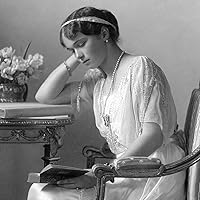
From the summer of 1907 on, Anna Vyroubova centered her life on the Empress Alexandra and became a part of the Tsar's family. In order to be closer to the family, Anna moved into a summer home at Tsarskoe Selo, just two hundred yards from the Alexander Palace, and her telephone was connected directly to the palace switchboard.
In 1920 Anna escaped to Finland and lived quietly at Vyborg. There she wrote these remarkable memoirs that offer a hagiographic recollection of the life and character of Empress Alexandra, Emperor Nicholas II and their five children. Viroubova describes a diverse array of incidents in the life of the Imperial family which collectively attest to the sincere and loving nature of the Empress. In the appendix, V.M. Roudneff reviews Vyroubova's relationship with Alexandra and Rasputin.
Due to her privileged position at the Court of the last Russian tsar and her close association to the Imperial Family, Anna Vyroubova's memoirs are highly regarded by those who share a special love for the family of Nicholas II.
Anna Vyrubova's memoir is a truly fascinating book. She gives you a good overview of what daily life was like in the Romanov court, and her perspective is one you're not likely to encounter elsewhere. According to Vyrubova, the atmosphere in Russia during the years of World War I, the Kerensky regime, and the early days of the Bolsheviks was so full of out-of-control paranoia, wild rumor, and myth deliberately created to help violent, conniving men claw their way into power, that much of what people believe--even today--about the Tsar, his wife, and Rasputin, is utter nonsense.
She portrays the Tsar and Tsaritsa as decent, likeable people unable to prevent or cope with Russia's great trainwreck of history, and she says Rasputin was not a monster at all, but a genuinely good man whose one fault was the typical Russian one of drinking too much from time to him. According to the author, Rasputin did not have a 'harem' of wealthy ladies, took no bribes, and gave so much of his own money away to the poor that he died in poverty himself. Everything about Rasputin, Vyrubova says, was well-known to the government because of the extremely thorough investigations of the Russian secret police, and their reports to the Tsar always gave Rasputin a clean record.
Surprisingly, Vyrubova does not blame the Bolsheviks or the Kerensky regime very much for the direction of events, but lays most of the censure on a scheming Russian aristocracy, especially the Grand Dukes. These self-interested individuals had been hostile to the Tsar and Tsaritsa for a very long time before World War I even started, and it was Russia's upper class that eventually pulled off the coup that forced the Tsar to abdicate during a low point in morale during the war. They were the main source of the wild rumors against Rasputin and the royal family, and these tales were deliberately spread to poison public opinion against the royal couple to destroy them, despite the fact that these tales smeared many innocent bystanders, including the author. Vyrubova notes that if Russia could have stayed in the war a little longer, the country would have enjoyed a victory under the Tsar's leadership, since Germany was nearing the collapse that resulted in its defeat.
Vyrubova's memoir ends with the gruesome story of her repeated imprisonments, despite investigations that always cleared her name. Neither Kerensky nor the Bolsheviks were pleased to be told she was innocent, and were so convinced by the lingering rumors planted by the aristocracy--rumors that could not be eradicated from the collective public memory no matter what--that they kept rearresting her under trumped-up charges. Eventually, Vyrubova escaped and lived on the run before she could finally make her way to Finland and freedom.
If you're a Romanov-disaster fan (a species somewhat akin to Custer fans and Titanic fans), then this is the book for you.
Memories of the Russian Court provided a perspective of the Romanof family missed by traditional Russian newspaper history stories. The author takes the reader through a personal relationship of royal traditions and family relationships to a very human friendship . AV shows the personalities of the Rominof family members and how her interests developed long lasting mutual care and concern. Personal stories of daily life and later letters present an honest representation of royal life. Not the gossipy one that discredited the family and Rasputin in newspapers. It was a refreshing and honest portrait of the family's love for the Russian people and how the women developed a hospital system and nursing staff to care for the less fortunate. The feeling was reciprocated wherever the royal family went by Russian people meeting and greeting them. This is a first hand perspective. The sorrow is hard to read as it captures the reality of Russia being taken over by the Bolsheviks during the early part of the 20th Century. Definately a must read for history lovers.
Fascinating insider's look at the last Russian Tsar and family and the Russian Revolution
The author was a very close associate of the Tsar and Tsarina, like a family member or daughter. She had no political or personal axe to grind or need for influence. She was a friend to all of them and as such, shared holidays, nightly read alouds by the Tsar and their innermost thoughts. She was greatly vilified by the press and most of the aristocracy including her sister and spent much time in filthy prisons during the Revolution as a result. Her aim with the book was to exonerate the reputation of the Tsarina particularly with regard to undue influence by Rasputin and being a spy for her German relatives during WWI. There were many misspelled words and editing problems throughout the book but it did not detract from the essential Informativeness of the story. Excellent read.
This book is, at the very least, a rose-tinted glasses accounting of the life of Vyrubova intertwined with that of the Romanov family, in the years before WWI, and ending with the end of the dynasty and revolution turning Russia inside out. I have to wonder if she was truly as naive as she appears in her own words in this book, but from other accounts, she really was an innocent in her dealings with royalty and politics in pre-revolutionary Russia, and wanted only to be a good friend to her Empress and family.
I enjoyed parts of this book especially the description of the last imperial court and Ms Viroubova's defense of the family provided an insght into the royal couple's insulation from the real world. Less captivating was the communication with the family after their capture. It was sad but somewhat pitiful considering their end and even a bit boring. Description of life "on the run" from the Bolsheviks was more engaging.
Empress Alexandra and Anna Vyrubova are so often painted in an unfavourable light, I’ve read many negative views on them both, so I found it refreshing to read about the Empress from the perspective of someone who loved her, and to form my own opinion on Anna. I found her to be intelligent and I appreciated how she clearly states what is conjecture. Her account of the court and the imperial family is invaluable.
Close friend of Nicholas and Alexandra, Anna Viroubova's memoir is intensely personal and unapologetic. The story of her imprisonment is harrowing. Unfortunately, the electronic edition is riddled with clumsy mis-types -- proof reading really is dead. But if you are into Russian history, this is worth wading thru.
Reading this autobiography helped me to gain a more through and factual insight into the Court of Nicholas II. I never had a moment of doubt about the author's integrity or honesty. She tells it like she believes and understands the actions of the Russian Court during the Russian Revolution and its aftermath.
Very biased point of view. Obviously. But I knew it would be going in and I enjoy firsthand accounts. I wouldn't call this book "Memories of the Russian Court" because it's more about what life was like leading up to the Russian Revolution and what it was like living through it. It's more about her survival story. Which is interesting in itself. Also interesting (and offensive) how she refers to people of different races. But it reflects the views of the times which I think is important to remember how things once were.
This entire review has been hidden because of spoilers.
Very interesting, but rendered almost unreadable by the incredible number of typos. A reasonably competent editor could have fixed the worst of it in a few hours.
Interesting to red Anna’s point of view on the demise of Imperial Russia. Rasputin hardly came up until halfway through the book. In the telling you’d think he was a bit player in the relationships between Anna, Alexandra and Nicholas…. Interesting.
Boken intresserar säker den som har intresse av kungliga öden i allmänhet och den sista ryska kejsarfamiljen i synnerhet. Bokens ram handlar om Virubovas liv som hovdam och närmsta vän till kejsarinnan och utspelar sig mellan 1903 och 1920-talet då hon flyr Ryssland och revolutionen.
Men den bakomliggande anledningen till att skriva boken, vars idé sägs ha kommit från Maxim Gorkij, var att klargöra kring och dementera de många rykten som florerade kring kejserliga familjen från deras vigsel och särskilt från Rasputins inträde i deras liv. Men likväl som Virubova dementerar många av ryktena (som även i senare forskning har avfärdats som ogrundat skvaller) så är hon heller ej sen att lägga till sina egna teorier om familjens undergång. Istället för att skylla på Rasputin och samarbete med Tyskland riktar Virubova siktet på resterande hovet och många av de höga ministrarna som hon säger aktivt ha stämplat mot Kejserliga familjen. Många av hennes kopplingar framstår som smått fantastiska och överdriva där hon både kopplar övriga Romanovfamiljen till allsköns girighet, maktlystenhet och samarbete med såväl revolutionärer som tyskar.
Likaledes är hennes skildringar av revolutionen starkt tendensiösa. Det finns dock många likartade berättelser från personer i samma situation som Virubova var i efter revolutionen vilket gör hennes berättelse trolig, även om detaljer säkerligen är överdrivna.
Utöver bokens tydliga ändamål så målar Virubova också ett tydligt porträtt över känslorna hos en person som har förlora sitt hemland. Ett öde Virubova delade med tusentals andra ryssar av fel klass eller ideologi.
"... Vi hade förlorat allt vi förr ägde, hem, vänner, ägodelar, ja t.o.m. vårt land, ty ryssarna har icke längre något land, ingen flagga, inget hem i hela vida världen. Det bästa någon av oss ännu kan hoppas på, är ett obemärkt hörn i något okänt land, där vi kunna arbeta nog för att köpa oss mat och ett lugnt ställe, där vi varje dag kan bedja: 'må Gud rädda Ryssland'."
This is a fascinating account and I quickly saw that this is a key source for much of the more formal historical writing about the last years of the Imperial government in Russia as is M. Giliard’s memoir which I am reading next.
That this true friend of the Empress Alexandra Feoderovna lived to tell the tale is nothing short of a miracle as she was on her way to being shot when she escaped from a stupid Red escort by the intervention of good people around her.
No matter the time or place - it is harsh to be among the vanquished. I truly felt sadness for this woman’s suffering, who clearly had a simple and abiding faith in the Russian Orthodox Church and also much love and affection for the Imperial family, both which almost cost her her life.
As expected, she does not acknowledge the role Rasputin played in bringing down the Tsar but I did not expect her to. I think history is clear on that point at this time. The official report of the Kerensky Provisional government attributed Rasputin’s access to the Imperial Family not to Annya, but to two official church bishops who approved of Rasputin at the time, whatever happened afterward, had not yet occurred. Hindsight is 20/20 vision as they say but I can see how the parties involved became deluded and refused to see the point of their enemies - call it arrogance or whatever you like - I can see how it happened.
Truly a fascinating and tragic time in the history of the 20th century. With the end of the Hapsburgs and Romanov’s dynasties from the world stage, the 19th century finally came to a close
I've read about Vyrubova for decades, knew about this book, but never read it until last week. I was thoroughly prepared to dislike it--since I am not her fangirl, but instead found it very enjoyable. and readable. And she did not come across as dumb as she has been portrayed. Of course Vyrubova had her own agenda, but still...Obviously her account of Romanov domestic life has been used repeatedly in countless other books. Nicky ad Alicky were obviously very bougie and those descriptions sound perfectly normal to me. Her contention that Alexandra had nothing to do with policy is dicey at best. Her descriptions of her time in various prisons is very worthwhile reading--and pretty awful. This is a weird thought, but her descriptions of revolutionary Petersburg reflected some of Trotsky's History of the Russian Revolution Vol 1. Hundreds of historians have written about the tremendous chaos (did anyone actually know what they were doing?) No!) but Vyrubova made it very personal. And boy, does Kerensky come off as a huge SOB, which is no surprise. Bonus: learned that Vyrobova escaped from the police on Zagorodsky , the street I used to live on. (Lenin once stayed my building.)
It is with a prayerful heart and memories deep and reverent that I begin to write the story of my long and intimate friendship with Alexandra Feodorovna, wife of Nicholas II, Empress of Russia, and of the tragedy of the Revolution, which brought on her and hers such undeserved misery, and on our unhappy country such a black night of oblivion. #history #europe #memoirs