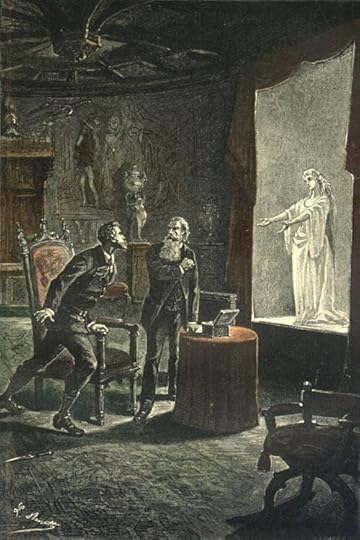
Mysterious entities take possession of a long deserted castle creating fear among the residents of the adjacent village of Werst, in Transylvania. The village sends two men to the castle to investigate, but they are repulsed by what the men feel are "supernatural" means. The heroes of the story, Count Franz de Telek and his man Rotzko learn of the mystery while passing through the village and become determined to solve it.
Verne wrote about space, air, and underwater travel before people invented navigable aircraft and practical submarines and devised any means of spacecraft. He ranks behind Dame Agatha Mary Clarissa Christie as the second most translated author of all time. People made his prominent films. People often refer to Verne alongside Herbert George Wells as the "father of science fiction."
A change of pace for the indomitable Monsieur Jules Verne...The Carpathian Castle is about things that bump in the night, images which cannot be there but are, weird noises heard yet unknown to the human ear, bravery or lack of; duty or madness the option... who prevails..The story published in 1892 five years before Bram Stoker immortal classic Dracula set in the heart of Transylvania, ( you can draw your own conclusion ) not adventures in remote corners of the world, or fantasy , science-fiction which the author is associated with , still superstitions dominate the people here living in the past little understanding the modern. Strangers they suspect, too many wars and upheavals experienced by them to trust. When the abandoned local castle begins to show disturbances, unexplained lights in the nocturnal dark, smoke arising above the edifice, creepy sounds from the direction of this structure, citizens living in the small village called Werst are concerned putting it mildly, since they keep away from the castle not getting nearer than two miles. So when two tourists arrive in their hamlet they take an interest. Count Franz de Telek and his servant and friend Rotzko, travelers from outside the region are questionable , why have they come deep into the formidable Carpathian Mountains for hikers, enemies probably. The recent "accidents" by two men from the village investigating the ominous commotions in the feared castle, the brave forester Nic Deck and the not quite so doctor Patak without a license, still recovering from the trauma both, one physically the other mentally , makes the atmosphere tense. The discovery this place has a connection to a tragic past love affair of the Count brings pain from bad memories and yet hope, he must go discover the truth. The very owner of the Carpathian Castle and rival for the love of an opera singer in Italy is the despised Baron Rodolphe de Gortz, the affections of the exquisite La Stilla though five years ago still stings. He the Count needs to go and find his destiny no matter what transpires, better death than a life of uncertainty. I never get tired of this writer for his striving to entertain the reader, the smooth style, the very eagerness to please while giving a preview to the world of the wonderful (maybe) future, and the fascinating quite exciting ( others say rather scary ) the strange new gadgets , their great potential, most of all his professionalism ..yes...the father of science-fiction, seller of tens of millions of books and still going strong...the obvious reason why is... he cared...so do the readers.
Jules Verne's The Castle of the Carpathians is an atmospheric Gothic novel that blends science fiction with eerie superstition. Set in the remote mountains of Transylvania, the story follows curious villagers and a brave traveler as they investigate the mysterious reappearance of a long-abandoned castle and the strange phenomena surrounding it.
While the premise is intriguing, the pacing often feels slow, and the buildup doesn't always deliver the tension one might expect from a Gothic mystery. The characters are serviceable, but not particularly memorable. However, Verne’s signature fascination with science and invention is present, adding a unique twist to an otherwise typical haunted castle tale.
In ‘The Castle of the Carpathians’, originally titled Le Château des Carpathes written in 1893, Jules Verne deviates sharply from the usual parameters of science fiction fantasy associated with his other tales of Extraordinary Voyages to create a romantic fairy tale shrouded in the mists of supernatural. Set in the mountainous regions of rural Transylvania, ‘The Castle of the Carpathians’ is a tale of mystery, with romantic counts, noble braves, love and longing bordering the realms of madness and slightly chilling elements of superstition, which is worthy for light reading.
The story of ‘The Castle of the Carpathians’ happens in a village named Werst in the Carpathian Mountains. The descriptions of the mountainous settings and the remoteness of the rural villages surrounded by the forests are pretty detailed and captivating. When the story begins, we see that the villagers of the Werst are under the shadow of fright over some strange happenings and sights – like mysterious smoke, extraordinary lights, strange sounds and bizarre warnings - occurring around a centuries old castle, – already rumored to be occupied by the devil himself - which is situated on a nearby mountain. A mission undertaken to prove the truth of these sights of terror led by a local hero results in him getting almost killed, which further increases the fear among the villagers. In to this crescendo of terror comes a pair of strange visitors – Count Franz de Telek and his companion – who soon decides to investigate the truth about the castle. The Count has his own personal motives for this quest as after hearing about it’s mysteries from the villagers it reopens his wounds of a lost love and brings to him the prospect of a face-to-face with the person whom he accuses for this loss. He braves warnings by his companion and the villagers to undertake the journey to the Castle, which sets the stage for the reader to understand the story behind The Count and to unwrap the layers of mystery surrounding the Castle and its occupants.
Like in his other works, Verne can be recognized as a trailblazer and visionary in ‘The Castle of the Carpathians’ too. After Verne chose Transylvania as the backdrop for his mystery novel, by design or by sheer coincidence Transylvania and surroundings soon became a favorite home ground for numerous tales of Gothic horror and intrigue.
The Castle of the Carpathians is a narration of extraordinary events happening in a Gothic setting, and even if these events are shrouded in mystery and supernatural, in true Verne form he crafts a story based on reason and science. The story is a bit slow in the beginning with lots of geographical and historical information and takes up pace once the descriptions of the surrounding of the village and the castle are over. This may not be the best book from Verne still it was a pleasant read. Being one of the most obscure titles from Verne procuring a copy of this in print was an arduous task in itself.
An Interesting Trivia: There are claims among some Verne fans that Bram Stoker took inspiration for his Gothic horror novel ‘Dracula’ – it was published four years later – from The Castle of Carpathians. Having read them both, apart from the common Transylvanian settings I sensed no similarity between the two books.
Este viernes por la noche no podía dormir; la fiebre y el dolor de cuerpo no me dejaban descansar hasta cierto punto. Mi primer pensamiento fue no pasar las siguientes horas mirando al techo mientras se bajaba la fiebre, pero tampoco me sentía capaz de ver alguna serie, o incluso tomar un libro físico y leerlo. Como algunos sabrán, soy muy asiduo a escuchar audiolibros, así que me encontré con este, El castillo de los Cárpatos, y lo puse con la intención de escuchar una hora a lo mucho e intentar dormir enseguida; spoiler alert: no dio resultado. Lo escuché, básicamente durante toda la noche, y disfruté en gran parte.
El castillo de los Cárpatos pretende ser una novela gótica, y digo pretende porque, a pesar de contar con elementos tales como la atmósfera, el lugar, la historia en sí misma que corresponden con el género gótico, se siente un libro demasiado descriptivo y repetitivo para alcanzar dicho género. El autor se pierde en las descripciones del pueblo, los personajes que viven en él, la función de cada uno de ellos, etc. y desafortunadamente, la historia tarda en arrancar. Sin embargo, sí disfruté leyendo tanto las descripciones del castillo, así como el misterio que lo rodeaba.
Confieso que me ha sorprendido encontrar una novela gótica entre las obras de Jules Verne, no porque piense que lo haya hecho del todo mal, sino porque siempre pensé que encontraría la típica historia de aventuras entre sus novelas. Ahora, en este caso me quedo en el medio en cuanto a mi experiencia; como dije antes, me gustó descubrir lo que sucedía en el castillo de los Cárpatos, así como la trama en sí misma que te invita a seguir leyendo. Por otro lado, no hay que esperar encontrarse con El monje de Matthew G. Lewis (la mejor novela gótica que he leído), porque está lejos de generar las mismas emociones e intrigas. En conclusión, recomendaría este libro si no te molestan las descripciones en exceso que se hacen innecesarias; fuera de eso, llegar al final de la historia y ver cómo el rompecabezas se arma completamente es muy satisfactorio.
“Todo puede suceder en la época en que vivimos; casi podemos decir que todo ha sucedido ya. Aunque a día de hoy nuestro relato no sea verosímil, quizá llegue a serlo mañana gracias a los recursos científicos del futuro, y llegado ese momento a nadie se le ocurrirá situarlo en el ámbito de la leyenda."
I've read a few of Verne's works before, and liked three of them (the rest were okay). He's not a writer I count among my favorites; but when I saw this novel on sale for a dime at a flea market a few years ago, I thought it might be worth the investment. :-) However, I didn't realize at the time that this particular edition is a stellar example of the outrages Verne has suffered at the hands of his English-language translators. Note: this review applies ONLY to this "Fitzroy" edition!
The Fitzroy editions (named for the original publisher's London address) of Verne's works (see http://www.julesverne.ca/vernebooks/f... for more information) were produced in the late 1950s and early 1960s under the editorship of one Idrisyn Oliver Evans, a science fiction buff who translated some of the books himself and for others used older, public domain translations, probably mostly pirated and unauthorized. Because the publisher insisted that each book be no more than 190 pages long, Evans' contribution was mostly to abridge them drastically; when you consider that the main edition Goodreads lists for this novel (The Castle of the Carpathians) has 292 pages, it will be apparent that the edition I read is "abridged" to the point of mutilation. Evans also took it upon himself to "modernize" the style, without indicating just what emendations he saw fit to make. So the usual caveat that, in reading older Verne translations, you have no clue to what degree you're reading what Verne actually wrote applies to the Fitzroy editions in spades (except that you can be pretty sure it's abridged about as much as a Reader's Digest "Condensed Version.")
Considering what we have here on its own terms, it justified the ten-cent investment --barely. I read it to fill in time while I was waiting for a review copy of a new novel that I'm expecting in the mail any time, and want to start on ASAP, and it did serve as a quick, non-demanding read to pass time. The Transylvanian setting is developed very well, with some obviously solid research into the topography, history, human geography, customs and folklore of the area. Verne depicts the villagers of Werst with obvious affection and tolerance of their foibles; the plot is marginally interesting (though a bit slow-starting), and there are some touches of humor. (Many readers will be outraged by his passing comment that, in that day, the land of the region's small farmers was rapidly passing into the hands of an exclusively Jewish class of moneylenders, through foreclosure on loans made at heavy interest. But some points are worth making in Verne's defense: a.) he's probably simply repeating here what he actually heard or read from his Gentile sources; b.) in the Balkans of that day, Jews would have been practically the only commercial moneylenders, not because they're particularly rapacious, but because the Catholic and Orthodox churches traditionally forbade their members to charge interest on loans, while the Jewish community had no such prohibition as far as loans to Gentiles were concerned; c.) that particular pattern of debtor-creditor relations was being duplicated between small farmers and mostly-Gentile owned banks in the U.S. and probably pretty much throughout the Western world during this period --it had nothing to do with Judaism as such and everything to do with the reigning economic philosophy; and d.) the only Jewish character here, Jonas, is treated sympathetically, and explicitly said to be fair and NOT rapacious in his own money-lending practices.)
That said, the main characters are not well-developed and I didn't care much about the hero; there's a lot more telling than showing going on in the narrative; the villain's motivation was a bit of a stretch; and the plotting is more melodramatic than genuinely dramatic, with characters' actions sometimes serving the plot more than seeming like something they'd genuinely do. Some of the fortuitous coincidences seemed too coincidental, and one aspect of the science here demanded a bit more suspension of disbelief than I could easily muster. (It should also be noted that the cover art largely follows the conventions of the paperback Gothic romances of the 50s-60s, though here the castle has two lighted windows rather than one; that's misleading, in that there's no such scene in the text, and the narrative isn't much like a Gothic romance.) This was never one of Verne's best-known or popular works, so I'm guessing that at least some of the deficiencies are in the original, not just in this translation/edition.
At the time I bought my copy, I'd theorized that Verne might have been influenced here by (and have been trying to copy the commercial success of) Bram Stoker's 1897 novel Dracula. In fact, however, Verne published the French version of this novel in 1892, and it first appeared in English in 1893. So any influence would have been exerted the other way; Stoker probably knew of this novel, and it may well have influenced his own portrayal of his Transylvanian setting.
"Medianoche, la hora más espantosa de todas, la hora de las apariciones, la hora de los maleficios."
En Werst, sus supersticiosos habitantes tienen, ubicado en plena región montañosa de Transilvania, la enorme presencia del El castillo de Los Cárpatos, lugar que ha estado deshabitado durante mucho años y al que lo rodean diferentes historias sobrenaturales. Cierto día ven humo salir de aquel alejado y misterioso lugar. No saben si ha sido habitado por personas o algún ser sobrenatural estará ahí, muchos rumores comienzan a circular, la incógnita e incertidumbre por saber que hay es tan grande que deciden ir a inspeccionar el lugar, en esta travesía, en la que nadie quería ir, salvo el guardabosques y el doctor, este último obligado, son los que se acercarán a este extraño, lúgubre e imponente lugar.
En el camino tendrán diferentes obstáculos y al acercarse serán testigos y presas de algo sin explicación aparente.
Una historia muy descriptiva, hay cada detalle señalado en la historia, cada escenario, el camino hacia el castillo esta completamente descrito, las situaciones, las conversaciones, los personajes, y eso me ha gustado, no se me ha hecho para nada tedioso, sentí que todo transportaba al lugar, y a las discusiones que se hacían en el albergue del lugar, llamada Rey Matías.
En cuanto a la trama, descubrir que es lo que se encontrarían en aquel castillo, no me esperaba el final, me ha sorprendido y no para bien, no me esperaba un giro de trama en esos términos, pero la historia en general la he disfrutado, aunque los dos primeros capítulos diría que son la excepción, haciendo un poco lento el arranque de la lectura.
Todo el desarrollo de los acontecimientos generan curiosidad por saber la causa de este miedo, la explicación a la luz y a una voz que alguien escucho en algún momento.
Una historia gótica, que a pesar de ese final inusual, he disfrutado mucho.
“Póngase el lector en una disposición de ánimo igual a la de las gentes de Werst, y no se asombrará de los hechos que van a ser referidos. No lo pido que crea en lo sobrenatural, sino únicamente que se ponga en el caso de aquella población, y de fe a este relato. A la desconfianza que inspiraba el castillo de los Cárpatos, que todo el mundo creía deshabitado, iba a añadirse ahora el espanto, pues parecía estar habitado… y ¡por qué seres, Dios mío!”
Pocos lectores saben que Adolfo Bioy Casares se inspiró en esta atrapante novela para escribir “La invención de Morel.” Tal vez esté haciendo spoiler para aquellos que aún no leyeron el libro de Bioy; el tema es que tienen que haber leído este libro y no el del autor argentino, cosa poco probable. “El castillo de los Cárpatos” fue escrito por Jules Verne en 1892 y tiene todos los elementos de aquellos relatos góticos que tanto atemorizaban a los lectores del siglo XVIII y que atraían a los de fines del siglo XIX. En la pequeña localidad de Werst, cerca de Transilvania, la famosa ciudad de Rumania, pasando la meseta de Orgall se encuentra erigido un misterioso, atemorizante y ominoso castillo, enclavado en los Cárpatos el cual, según los habitantes de esa aldea, dominados por la superstición, el miedo y la sugestión habitan seres sobrenaturales, mágicos o tal vez diabólicos que atormentan a la pobre gente. La novela tiene una extensísima introducción narrada por el autor que anticipará lo que pronto sucederá en el terrible y aterrador castillo. Un par de hombres intentarán infructuosamente acceder sin éxito y con potencial riesgo de muerte. Cuando en la posada del pueblo aparece el conde Franz de Telek con su asistente Rotzko, todo cambiará puesto que este noble hombre contará a los aldeanos su historia de vida y su enemistad con el barón de Gortz cuya familia fue antigua propietaria del castillo de los Cárpatos. Existe una vieja rivalidad de veinte años entre ellos: ambos se disputan el corazón de la hermosa Stilla, afamada y bella joven cantante de ópera y todo esto está emparentado con el castillo de los Cárpatos. Pero para descubrir cómo atar todos estos cabos es necesario leer las poco más de doscientas páginas de esta atractiva novela siendo las últimas cincuenta las que revelen todos los secretos que esconde este misterioso y aterrados castillo de los Cárpatos en el que Verne anticipa un par de adelantos tecnológicos que utilizamos hoy en día y que por respeto no develaré al lector que quiera leer esta intrigante novela. Con el spoiler del primer párrafo fue más que suficiente.
Τι ωραία να ξαναγίνεσαι έφηβος, παρέα με τον Ιούλιο Βερν! Ένα διαφορετικό βιβλίο του συγγραφέα αλλά πάντα με έναν κοινό παρονομαστή με τα υπόλοιπα έργα του. Αυτόν της επιστήμης... 4/5
Este livro foi começado numa sala de espera e não me cativou de início. Depois, à medida que ia avançando na leitura, já fui gostando mais um bocadinho.
Temos um castelo, óbvio, está no título, próximo de uma aldeia meia perdida e cheia de gente dada a acreditar em superstições, castelo esse que todos julgavam abandonado e assombrado, até ao dia em que, graças a um binóculo, se vê fumo a sair de um torreão. Entre os aldeões há um mais corajoso, que vai na companhia de outro menos corajoso, mas com a mania que tem coragem (há um desses em todas as aldeias, não é verdade?) espreitar o que lá se passa.
Aqui a história tomou um rumo que eu não esperava de todo, com a entrada em cena de outro personagem e do seu companheiro, um homem dado às coisas da ciência, e até um desgosto de amor, algo que não é muito comum na obra de Verne, parece-me. Mas o tio Jules não dá ponto sem nó, e esse desgosto serve para colocar na história algumas invenções recentes, como a eletricidade, os fios telefónicos, as gravações de voz e até escutas, e também algo que, na altura, terá sido percussor dos hologramas.
A trama ganha uns contornos de vingança e, no final, todos os fenómenos são devidamente explicados, apesar de o povo da aldeia preferir continuar a acreditar em crendices. Não será, para mim, o melhor livro do tio Jules, mas lê-se.
When reviewing a classic it is important to judge it in the context of the time that it was written. If we’re going to judge a classic, we need to be able to step away from our preconceptions of what good literature is and evaluate each work on its own merits. It isn’t fair to judge a work of art by contemporary expectations. We should consider the society and the times in which a particular work was written. What did the author set out to accomplish? What is the effect of the novel on the reader and on the larger reading public? What audience was the novel directed towards? Did the author teach us something about human nature, or about ourselves? Did the author teach us something about the period in which he was writing? How effective was the author in presenting his view of society? Are the themes the author has presented timeless and universal? Did the book spur conversation when it was written? Are people still talking about that novel now and are they still reading? Has the novel stood the test of time? A rich work will trigger the imagination. If we approach a piece of classical literature with humility, patience and without preconceptions, we can certainly learn something from that work. And lastly, reading the classics requires sometimes discipline and practice. Often the language used is archaic. Sentence structure and syntax can be difficult to wade through. Books weren’t written like movies in the past because there was no such thing as a 'moving picture.' This means that in the past, authors had a different conception of action and employed different methods of moving the story forward. We also need to remember that the novel is a unique invention that allows the author and the reader to meet one another. The novel isn't necessarily meant for continuous action or breathless narrative. Too often, I think, the modern reader looks at a novel's plot much like he views a roadmap. He sees the streets, and maybe even the sidewalks, and some of them veer to the left and to the right, twisting and turning, but rarely does the map show the houses and buildings that dot the blocks formed by the streets. The novelist is able to take us off the streets and guide us through the gothic mansions and abandoned factories not illustrated on the maps. For the inquisitive reader, it's these off-road explorations that make reading such a pleasure. Sure, sometimes an author goes a little bit far off the beaten path and takes a few more pages to get back to the narrative, but in the end, the best authors create a fuller work by painting on a more broad canvas. The work becomes three-dimensional. In other words, the greatest works of fiction aren't all about action and sensationalism. They give us insight into what it means to be human and they take us to places in time and space that we might not have been able to conceive on our own.
Our post-modern approaches to telling stories are vastly different than the pre-modern and modern approaches to narrative. We often rebel against the older style and because it is different, we think it is poor literature, boring and uninteresting. Older writing seems long-winded and ostentatious. It taxes our patience. Many modern readers are lazy and simply don’t want to invest the time to readjust their approach to reading. It takes a bit of work to relearn how to read a piece of classical literature, but once done, it’s worth it. You’ve solved the puzzle and you’ve exercises your cranial muscle, i.e., your brain.While I hesitate to assert that reading classical literature is a kind of discipline (because 'discipline' reminds me of work, and reading is certainly not that!), I do have to suggest that reading some literary works takes some effort. But no worries: By reading classical literature you are literally increasing not only your depth of knowledge, but also your intelligence.
I’ve read countless reviews on many, many books on Goodreads. Many of the reviews are well-thought out and many more are of the variety of ‘I-didn’t-like-this-book-because-it-sucks.’ Objective reviews are certainly more helpful. Critical analysis, rather than judgmental critique is not helpful. We all have different tastes in literature and we can’t force one another to cherish the same books that we personally hold dear. Dostoyevsky’s ‘The Brothers Karamazov’ is one of my favorite novels of all time, but I don’t expect everyone to enjoy it. Likewise, some readers fell in love with the ‘Twilight’ series even though I am clueless as to why. Now, I dislike ‘Twilight’ for what I believe are objective reasons. Likewise, some of the folks I know who’ve read Dostoyevsky dislike his novels for objective reasons. If true art is universal and timeless, there must be a fair way to judge that work of art. If you’re going to critique and bash a classic piece of literature, you at least owe it to those who are reading your review to explain yourself. Explain your criticism. Be fair to the work, though. If you read a novel from the late 18th century, a time when the novel had hardly been developed, it’s certainly not fair to judge it alongside a modern or post-modern author. The structure of the novel has evolved since then (the substance might be more banal, though). So, judge the substance, not the structure. Judge the universality of the themes discussed, not the dialogue used. Don’t judge the morals, values and norms of that time and don’t place them alongside post-modern conceptions of culture and existence. Our worlds are similar, but also profoundly different. The reader’s task is to place himself in the world of the novel he is reading. We have vastly different conceptions of scandal and outrage, for example. We might not understand why a scandal is scandalous in a classical work of fiction, but if we understand the historical context, we can more easily relate. In other words, it’s important to understand how society was organized in the past and novels help us to do this. Once we understand this, we can draw parallels to our world and this is where reading the classics bears fruit. In the end, understanding the societies that preceded us helps us to understand where we came from and helps to us understand who we are.
Now, let's move on to the ‘Castle of the Carpathians.’
Most of us have read Jules Verne’s science fiction novels. For those who have, beware: ‘Castle of the Carpathians’ is a completely different work, although there are some elements of science fiction in the book. As a gothic novel Verne creates tension by portraying occurrences and happenings that seem inexplicable. He populates the book with simple, rural characters who have no knowledge of science and who are not familiar with its rational methods of explanation. Superstition reigns and even when a ready is offered, tradition trumps explanation and rejects scientific explanation. Verne is careful to build on the tradition of superstition, but in the end he dispels those superstitions with rational explanations and illustrations of how visions of the supernatural were achieved. So, even though the psychic dispositions of his characters are gothic in outlook, by the end of the book we see that Verne refuses to allow his characters to define the way the world really works. Verne’s novel is a result of the Enlightenment, with its emphasis on the possibility of explaining the irrational and the superstitious. Rather than allowing his work to be chained to the superstitions represented by his characters, he seeks to liberate them, to bring them into the present.
'Castle of the Carpathians' takes place in the south of the present-day Transylvania. Part of the fun, and for me, I suppose, much of the fun I had while reading this novella resulted from trying to discover where exactly the castle was really located. It turns out, as far as I can tell, that it was a historical reality. The ruins, apparently, still stand on the mountainside. But the book was written during a time when the Germans and Hungarians still ruled Transylvania and because of this, most of the name places in the book are Hungarian and German. In order to locate them on a contemporary map, one need do a bit of translating work as just about all of the names in the book have been ‘Romanianized.’ Transylvania was firmly in the grips of the Austro-Hungarian Empire when the book was written and wouldn’t be until almost thirty-five years after the book’s publication that Transylvania became a part of Romania, when the names were all changed to their Romanian version. For example, the action in the book takes place mostly south of ‘Koloszvár County’ which today is ‘Judetul Cluj’, or Cluj county. The county seat of Koloszvár county was the city ‘Koloszvár,’ a.k.a., ‘Klausenberg’ (one of the Siebenbürgen ), a.k.a., the present-day ‘Cluj-Napoca,’ where I live. Cluj itself was built by the Romans almost 1900 years ago and was at that time known as ‘Claudiopolis.’ Quite a history. One of the cities mentioned in the book is ‘Thorda,’ but today this city goes by the name ‘Turda.’ The castle itself is located high on the hills above a small village called ‘Werst,’ but I couldn’t find its modern, Romanian name. It appears that Werst is located in the vicinity of Petroșani, Petrila and Lupeni, all of which are referenced in the book.This would place the castle around three hours south-southeast of present-day Cluj-Napoca and about one hour south of Hunedoara. The name of the small mountain range where the castle is located hasn’t changed, though, and goes by the name ‘Retyezat,’ which I have been told is a Hungarian moniker. Combine this with the location of the rivers in the novel that are mentioned, the Hungarian Syl and the Romanian Syl, and then combine those names with some of the villages named ( Livadzel, Lonyai, Petroseny, and Petrilla) and we can get a pretty good idea of where the castle would be presumably located. It sits on the ‘Orgall Plateau’ on the ‘Vulkan Range.’ So, after a bit of sleuthing and map gazing, it appears that the Castle of the Carpathians is actually Cetatea Colţ.
As fascinating as the geographical mysteries of the novel may be, we still need to look at the book itself. To many readers the first half will probably slow-going. Verne dedicates the first half of the book to a synopsis of Transylvanian history and social conditions (and in my view his assessment is basically fair, emphasizing as he does the oppressed state of the ethnic Romanians of Transylvania), a portrait of the countryside and mountain ranges, a semi-ethnography of the Romanian Transylvanians, and a fascinating overview of the superstitious nature of the Transylvanians. The first half of the story is really closer to an ethnography and geography lesson. For the lay reader looking for a scintillating Gothic page-turner, disappointment awaits. For the reader fascinated by ‘all-things-Romanian,’ the first half of the book is something like the DVD extras we crave after watching a movie that we want to be totally immersed in. Hang in there and I promise that by the time you reach the end of the story, you'll be pleased with the ending and glad that you persevered.
I anticipate that the book will be much-criticized, though, so I will come back to this review at a later date and show how Verne's short little work on Transylvania fits within the Gothic tradition and deserves to be read.
„Замъкът в Карпатите“ е много готин научнофантастичен трилър от края на 19-ти век! Централно място в сюжета заема доста напрегната загадка около тайнствен изоставен замък, който силно плаши населението на близко село. Двама от местните жители все пак тръгват към замъка, а впоследствие и други персонажи се въвличат в разплитането на мистерията...
Сладкодумно и с тънко чувство за хумор поднесена история, облегнала се на суеверията на румънците, овкусена с щипка мистерия, чието разплитане затвърди изключително приятните ми впечатления. Разбира се, отчитам и "данъка време", но това въбще не променя високата крайна оценка.
Μια ιστορία που δεν έχει πολλά επιστημονικά στοιχεία όπως συνηθίζει και κάποιες ο Βερν οπότε μπόρεσα να την ευχαριστηθώ. Δεν ήταν ακριβώς αυτό που περίμενα αλλά μου άρεσε αρκετά.
A story that didn't have many scientific elements which one encounters in many of Vern's stories so I enjoyed reading it. It wasn't what I actually expected but I liked it.
Me ha gustado muchísimo pese a que no la considero de terror. Verne nos acercará a las creencias de los habitantes de un pequeño pueblo de los Cárpatos. La superstición y la mitología campa a sus anchas entre una población que tiene unos conocimientos muy básicos y a los que no les llega la educación que podría haber en una gran ciudad. Siguen creyendo en las viejas leyendas que han oído a lo largo de los años y por eso cuando un día un pastor ve salir humo del viejo castillo creen que allí hay entes sobrenaturales.
Me ha recordado mucho a las historias de Gógol aunque Verne, a diferencia de Gógol, nos muestra el lado racional frente a la superstición.
A classic example of Radcliffean gothic although I do wish my version hadn’t been presented as a zombie text as it was unnecessarily misleading. This book is interesting enough without having to hitch itself to the tide of zombie stuff we’ve long been wading in.
Verne updates the role of electricity within a gothic narrative here. In much the same way that Mary Shelley used the emerging science of galvanism to great effect in ‘Frankenstein’, Verne amplifies the gothic capabilities of phonographic recording techniques and the telephone.
A sense of the disembodied voice pervades this narrative, which draws on popular gothic fiction in much the same way that Fulci’s 1979 film ‘Zombi 2’ implied links to previous zombie cinema hits.
As a stand alone text it may not be that interesting. But, as a gothic novel published two years before du Maurier’s ‘Trilby’ and over a decade before ‘The Phantom of the Opera’, it seems Verne was ahead of the curve when it came to exploiting the gothic potential of acoustics and recording. While Verne may have used the phenomena of acoustic science in his previous, more classic science fiction texts, I think his use of it here, in a gothic framework, is notable.
*i’ve just had to edit this as I noticed I kept saying Wells instead of Verne. Now I’m puzzled as to why my brain did this?!
Karpatlar Şatosu kitabı Jules Verne'den okumuş olduğum 29. kitap oldu. Okuduğum diğer kitaplarıyla kıyaslarsam bu kitabı çok beğenmediğimi itiraf edeyim. Karpatlar Şatosu alışılmış Verne tarzından uzaktı. Tam korku diyemesek de gotik atmosferde geçen gerilim, gizem unsurlarının olduğu bir roman diyebiliriz. Ayrıca Dracula eserinden de 5 yıl evvel yazıldığını belirtelim. Roman aslında iyi başlamıştı, şatodaki gizemli olaylar ve onları çözmeye çalışan çevre sakinleri. Tekinsiz bir ortam olmuştu. Fakat daha sonra karakter tanıtımları çok uzayıp roman sıkıcı bir hâle bürünüverdi. Tabii yine de yazar bu kitabında da bilim kurgu ögelerini kullanmış. Hologram ve telefonun gelişimi, görüntülerin bir nevi televizyon gibi belirmesi iyi öngörülerindendi. Jules Verne okumalarına devam...
Si bien la sinopsis alude que se trata de una historia sobre vampiros, no es así, suponía que en algún momento surgiría tal personaje, y no ha sucedido tal situación, más sin embargo, la historia es atrapante e intrigante, y no deja de ser una maravilla; como lo es siempre en sus historias, Verne nos manifiesta y presenta sus artilugios adelantados a su época.
Alejado un poco de sus viajes y narraciones, esta obra consta de misterio, suspenso, terror, amor y esperanza.
This 1892 novel is a relatively short Gothic horror/comedy, which tells the story of a small group of villagers in Transylvania who are quite shaken when smoke begins appearing from the ruins of the titular edifice which has been unoccupied for some time. The young forester, his blushingly devoted fiancé, her grasping father of a mayor, the ever-conscious-of-the-bottomline innkeeper, the largely unintelligent schoolteacher and especially, the big-talk/cowardly-action ‘doctor’ make for many a smile and the not infrequent laugh as one reads about their reactions.
The ‘Chort’ (devil), spirits, goblins, lemia, nyctalops, stryges, hopogryphs, dragons, kraken, vampires and staffi orstryges are all imagined. Then, several totally inexplicable phenomena affect the two villagers who do attempt to visit the ruins. In addition to the smoke, a voice warnis the forester against investigation, a sudden ringing of the castle’s bell is heard and a brief blinding light in the middle of the night seen which makes the two investigators appear as if they’ve become spectral corpses. All these all complicate matters. Newly arrived travellers wonder why none of the villagers come to the inn in the early evening and why the streets of the town are also deserted. And these events did not even occur on a Thursday, which everyone knows is the day when evil spirits make their presence known!
While keeping his tongue firmly in his cheek, Verne also manages to write a fairly good horror story, gradually weaving in the inexplicable phenomena while concentrating most of the time on the inexorably growing paranoia of the villagers. Unfortunately, the last half of the story veers off with a tragic romantic triangle, inexplicable feelings of remorse and revenge and hard to believe technological advancements. I wish he hadn’t brought in the new characters and had rather stayed with the quirky villagers whom he’d developed so well.
Jules Verne has a tendency to wax eloquent about whatever subject catches his fancy at the time, with a heavy dash of newly emerging and then current scientific discoveries or hypotheses. In 20 000 Leagues Under the Seas it was submarines and sea life; in Journey to the Centre of the Earth is was geology. In the Castle in Transylvania, Verne lovingly describes the remote, mountainous region around the small village of Werst in the Carpathians (with neighbouring, gothic castle rumoured to be home to the devil) and its superstitious inhabitants. Things get a bit more exciting when a local shepherd sees smoke coming out of the chimney of the supposedly deserted and abandoned castle. And then, two tourists arrive. This novel is something of an adventure story mixed with a mystery story, set in a suitably atmospheric/creepy setting, with a bit of horror-lite bits. It isn't Verne's best work, but it is entertaining. I would have liked it more if Verne has left the tourists out and let the villagers deal with whatever was going on at the castle.
PS: The only relation this novel has to Dracula is setting the respective castles in Transylvania. PPS: PPPS: Jules Verne could have written travel novels if the adventure novels didn't sell.
In his introduction, scholar Ace Pilkington points out Jules Verne wrote more about his travels and his discoveries along the way than he did about science. Verne chose the setting for this Gothic novel intentionally and for particular reasons.
The villagers of Werst, Transylvania, notice odd things happening one day at the dilapidated castle that sits atop the mountain adjoining the town. This novel tells the story of the attempts to learn (or fear) the cause. It features, among others, a brave young forester, his lovely betrothed, a cowardly physician, an enchanting Italian opera singer, and infatuated noblemen.
The book is oddly structured and not well paced. For those comfortable reading stories written for a different audience and expectations, The Castle of the Carpathians provides a satisfying story and conclusion. It includes themes common to the time and features Verne's interest in science and developing technology such as telephonic communication, light, and electricity.
I like Victorian novels and enjoyed reading this book very much. It was written in 1892 and has a steampunk feel to it. Many of today's readers will become impatient with the somewhat plodding beginning of the middle section of the book. The Critical Introduction really should be an afterward. The translation is easy to read.
Mysterious entities take possession of a long deserted castle creating fear among the residents of the adjacent village of Werst, in Transylvania. The village sends two men to the castle to investigate, but they are repulsed by seemingly supernatural means. The heroes of the story, Count Franz de Telek and his man Rotzko learn of the mystery while passing through the village and become determined to solve it.
Adaptare cinematografică realizată în 1981 se poate găsi aici: Castelul din Carpați.
It begins as a shaggy dog story, and very shaggy it is. After four chapters, only one thing has actually happened: smoke has been seen coming from the abandoned castle. At this point, I generally give up. But Verne's writing is so good that I persisted.
[Later] A crazed baron, a mad scientist and a dead lover? All the ingredients are here for a science-fiction horror. And so it is. Obsession + money + science = tragedy.
No es una novela como otras que hemos leído de Julio Verne; Mas bien se trata de una obra algo más fantasiosa y muy alejada de los temas científicos que nos tiene acostumbrados Verne, podría decir que el autor, en esta obra, nos traslada a un mundo muy exclusivo de él (misterioso, lúgubre) . Por momentos la obra se vuelve densa y pesada (cabeceé varias veces y tuve que retomar) pero ya en los capítulos finales vuelves a encontrarte con el Verne que todos conocemos, tratando de explicar como funcionan ciertas situaciones y artilugios.
Si me preguntan por una obra por la cual comenzar en el imaginario de este autor, definitivamente esta no es una de ellas.
Por otro lado la trama en el tercio final de la lectura encuentra realmente argumento en la fatalidad de su protagonista y a través de la respuesta emocional de encontrar la verdad y quizás su venganza.
Una novela atípica en la obra de Verne, con una atmósfera gótica y ambientada en Transilvania —publicada unos años antes que Drácula de Stoker—. El protagonista no aparece hasta bien avanzada la trama, ya que la obra está claramente dividida en dos partes: la primera actúa casi como un prólogo hasta la llegada del héroe.
Resulta curioso cómo Verne combina la burla hacia la superstición campesina con la creación de una atmósfera siniestra, a la que suma un elemento operístico que evoca el Fantasma de la Ópera de Leroux (¿lo habría leído este antes de escribir su obra?). Sin embargo, el ritmo se resiente en ocasiones por las típicas intervenciones explicativas del autor, que, aunque funcionan en otras novelas suyas, aquí rompen la tensión acumulada.
Aun así, es una obra entretenida, con una atmósfera bien construida y detalles que la hacen singular dentro de su bibliografía.
Cocukken Jules Verne okumaya bayilirdim ve sanirim butun kitaplarini okudum. Yalniz bu kitabi tam hatirlayamamistim. Kitaplikta gorunce okuyayim dedim. Son bolumunde hatirladim. Kitaplarin soyle buyulu bir yani var. Size hissettirdigi seyleri o anin atmosferiyle birlikte yeniden yasayabiliyorsunuz. Resmen kitabin sonunu cocukken odamda bataniyenin altinda okudugum zamana gittim. Birazdan geri donerim.
—
2025 Edit: Jule Verne serisini yeniden okurken pas geçmeyeyim dedim tekrar okudum. Nedense bu kitabı hep son bölümünde hatırlıyorum 🙂
*****1er libro terminado de mi reto personal donde leeré semanalmente libros de un país en específico, en este caso tocó de autoría francesa.*****
En el pueblo de Werst todos temen al castillo de Los Cárpatos y varias historias paranormales giran en torno a este. Un libro corto que nunca aburre y que ha sido maravilloso para comenzar con Julio Verne.
1892’de yazılan ve 1897’de Bram Stoker’in kaleme aldığı Dracula romanının ilham kaynağı olan roman edebi yönden çok güçlü olmasa da iyi vakit geçirmek adına okunabilir. Onca kelime oyunu, laf salatasına rağmen kesinlikle akıcı bir anlatımı var. Belki de yazarı efsanevi yapan budur. Hiç sıkılmadan okuyabiliyorsunuz. Tasvirlenen Rumen yayları, dağ köyleri, muhteşem manzara, el değmemiş tabiat gözlerinizin önüne prıl pırıl uzanıyor. Muaazzam bir kitap. Yazıldığı tarih itibari ile yazarın teknolojin alandaki gelişmeleri yakından takip ettiğini söylemek de pekâlâ mümkün. Yalnız kafamda bir soru işareti kaldı. http://ucalisan.blogspot.com/2020/12/...
Te acercas a una novela de este genio de la narrativa y piensas, ¿qué puede salir mal? Julio Verne, terror, castillos abandonados en países aislados de la civilización, llenos de superchería y leyendas estremecedoras...y por desgracia lo que te encuentras en una narración en la que nada es lo que parece y que termina por hacerse tediosa desde el primero de los capítulos. Y no es porque la historia que nos cuenta sea mala. Cuando eres consciente de lo tremendo que es su argumento, que esconde un potente drama que genera fascinación por el trágico destino que arrastran los personajes principales, piensas en que la historia podía dar mucho de sí. Pero es que toda la trama principal se encuentre escondida entre numerosas descripciones de cada una de las piedras que conforman Los Cárpatos, de lo difícil que supone caminar en medio de aquellos páramos, de lo inhóspito del paisaje...llega un momento en el que no sabes si estás leyendo una historia de terror o un catálogo turista de una región abandonada en medio de la nada. Entiendo que Verne no es precisamente un escritor que se caracterice por dominar los recursos de un género que requiere ambientación y atmósfera. Que lo suyo son más bien la creación de aventuras y que pocos como él son capaces de incluir los avances tecnológicos de la época para justificar todo tipo de argumentos, por muy inverosímiles que parezcan. De hecho, aquí también lo están y consigue adornar los hechos que ocurren con todo tipo de justificaciones coherentes, sin dejar de ser cuanto menos cuestionables. Pero aquí, la verdad, es que cuesta mucho mantener el interés. Empiezas leyendo un primer tercio de la trama en la que consigues acercarte a un misterio fantasmagórico que, cuando parece que empieza a cobrar sentido, queda en una mera introducción para lo que realmente te quiere contar. El problema es que cuando por fin parece que entras a saco en todo ese misterio, ya te da un poco igual. A esas alturas comienza a surgir el drama de la historia y tu ya estás contando el numero de páginas que te quedan para terminar, dándote igual si hay o no apariciones, fantasmas, demonios o lo que sea que ocupe ese castillo abandonado en el que nada es lo que parece. Y tiene virtudes el libro, como no. Lo escribe Julio Verne y ya solo por eso merece la pena darle una oportunidad. Su esfuerzo para justificar todo lo narrado y atar cada uno de los cabos de una historia sobrenatural como esta es todo un acierto. Pero lo que por regla general caracteriza al estilo de Verne, aquí termina por añadir un componente de indignación final al pensar que te han tomado el pelo. En definitiva, el Castillo de los Cárpatos es una obra que gustará a todo amante de la narrativa de Verne, pero decepcionará al resto que quiera una historia de terror como prometía. Una buena curiosidad que te quitará el tiempo para leer obras más importantes del genio de la literatura o del género del terror.
Among bibliophiles, I think there are fans of the orderly, rational, logical world & there are more loosey-goosey types who are fans of the unexplained or hard to believe. I got a real taste of that last year with Verne's An Antarctic Mystery (orderly, rational, logical) vs. Poe's The Narrative of Arthur Gordon Pym of Nantucket (loosey-goosey at best, lol).
So, in The Castle in Transylvania, we are heading into 'supernatural' territory with Jules Verne. Except, being the orderly, rational, logical author that he is, we're *not* really heading into supernatural territory at all. His characters thought they were in supernatural territory, but Verne consistently dismissed their concerns in little asides about their superstitious ways & other hints. Pshaw! Even though I'm not one to try to figure out the story ahead of time, I could see where he was going with this one from fairly early in the story. (Perhaps it helps that I live in a modern age? His scientific explanations might have been more unusual during the late 1800s, whereas they are not unusual now.) Mostly, I just had to chuckle at Verne's Felix Unger-ish, OCD-level behaviors in explaining everything through rational thought. And, as you might suspect, the story is brought to a complete, rational conclusion, with all story arcs neatly concluded at the end.
When I'm reading something supernatural, I guess I'm in the loosey-goosey camp. I want unbelievable things; I want the author to be fully invested in those unbelievable things; I like odd occurrences & strange happenings & things that can't easily be explained. Edgar Allan Poe does that well; Bram Stoker does that well; H.G. Wells successfully melds the scientific with the unbelievable. But, since Jules Verne doesn't seem to be a believer in the odd/unexplainable/supernatural, he's just not invested in that weird suspension of disbelief that goes along with a supernatural tale (imo). So, I would recommend The Castle in Transylvania for rational thinkers (perhaps Mr. Spock would be a fan) who want a non-supernatural supernatural tale. Lol!
This book is an interesting mix of themes related to both Dracula and Phantom of the Opera, with a bit of early sf thrown in. On the border of Transylvania (where else?) a shepherd sees smoke rising from the long-deserted castle of Baron Rodolphe (sic). He and the local doctor (a cowardly skeptic) investigate and are driven off by apparently supernatural forces. A curious traveler, Baron Franz von Telek, also investigates and sees what appears to be a beautiful opera singer he had almost married in Italy, before her sudden death in the midst of a performance. She had also been deeply admired by Baron Rodolphe... The ending actually is rather a neat surprise, and was probably more of a surprise in Verne's day when the technology involved was just being developed.