The sequel to Tina Connolly's stunning historical fantasy debut.
Helen Huntingdon is beautiful—so beautiful she has to wear an iron mask. Six months ago her sister Jane uncovered a fey plot to take over the city. Too late for Helen, who opted for fey beauty in her face—and now has to cover her face with iron so she won’t be taken over, her personality erased by the bodiless fey.
Not that Helen would mind that some days. Stuck in a marriage with the wealthy and controlling Alistair, she lives at the edges of her life, secretly helping Jane remove the dangerous fey beauty from the wealthy society women who paid for it. But when the chancy procedure turns deadly, Jane goes missing—and is implicated in the murder.
Meanwhile, Alistair’s influential clique Copperhead—whose emblem is the poisonous copperhead hydra—is out to restore humans to their “rightful” place, even to the point of destroying the dwarvven who have always been allies.
Helen is determined to find her missing sister, as well as continue the good fight against the fey. But when that pits her against her own husband—and when she meets an enigmatic young revolutionary—she’s pushed to discover how far she’ll bend society’s rules to do what’s right. It may be more than her beauty at stake. It may be her honor...and her heart.
Tina Connolly's books include the Ironskin trilogy (Tor), the Seriously Wicked series (Tor Teen), the collection On the Eyeball Floor (Fairwood Press), and the Choose Your Own Adventure Glitterpony Farm. She has been a finalist for the Hugo, Nebula, Norton, and World Fantasy awards. She co-hosts the science fiction podcast Escape Pod, runs the intermittent flash fiction podcast Toasted Cake, and is at tinaconnolly.com.
You know, it’s kind of funny, in a sad way, how the opinions of others can affect me. I really enjoyed Ironskin, but it wasn’t all that popular with most of my blogger friends. As such, I was a bit afraid that I wouldn’t like Copperhead, as though I had been in wrong in my own assessment. It’s sort of my natural state to doubt myself, though I wish it weren’t. Clearly, I should have trusted my opinion, because I really enjoyed Copperhead as well, marginally more than Ironskin in fact.
Four stars: Glitz, glamour and iron masks meet the Fey.
Helen before entering the party, stops to unfasten her iron mask. Helen is one of the elite one hundred who received a face transplant courtesy of the mysterious Rochart. Helen and the rest of the women after their surgeries are indeed stunningly beautiful, but they paid a steep price. Unbeknownst to the women at the time, Rochart was under the spell of the Fey Queen, and he was removing the women's real faces and replacing them with fey infused masks. Since the surgeries and the death of the fairy Queen, bits of bluish fey have settled all over the city. Every time the women go out, they run the risk of these bluish bits of fey attaching to the fey in their faces. To prevent the fey from snatching away their faces, the women must now wear protective iron masks when out on the streets. Jane is insisting that all the women allow her to remove their masks and return to their old faces, but the women aren't so easy to convince. On top of that, there is a new group in town known as the Copperhead, and they are determined to rid the world of Fey and Dwarven for once and for all, but their elitist ideas could end up causing a war. Can Jane and Helen save the women and prevent the Copperhead from starting another Great War?
What I Liked: *Helen was not my favorite character in Ironskin. She comes across as being selfish, a bit empty headed and focused on material things, and she is obsessed with her beauty. I was a bit hesitant going into this one knowing that this book was going to be Helen's story. I needn't have worried as I think this book excelled over its predecessor. Helen proves that she is much more than the shallow girl I thought she was. Once you dig deep and really see the true Helen, you will find a girl who is smart, capable and determined. Yes, she still suffers a bit from her own vanity, but that is forgivable. I liked that she showed such tremendous growth, courage and fortitude, and I loved really getting to know her. I appreciated that she was a girl caught under the thumb of her wealthy husband and a slave to the ideas of what a women should be, but she doesn't let that deter her. Even when her husband takes her mask to prevent her from going out, she defies him and does it anyway. It takes a lot of guts to go against your husband and society, and Helen does just that. At the end, I liked her even more than Jane, which was surprising. *One minor complaint I had with Ironskin was that the world building was a tiny bit shaky when it came to the Fey and the Great War. Ms. Connolly makes up for that in Copperhead. She takes the time to throughly explain the fey, and she provides numerous flashbacks of the Great War so I had a clearer understanding of the Fey. in fact, this time around, I didn't have any problems with the world building. Everything was clear and easy to understand. I was pleased to learn more about the masks. * I loved all the glitz and glamour. This feels like it takes place in an alternate 1930's period because of the fashions and the ideas of how a woman should live, demurring to her husband and at home. The rise of the Copperhead with their prejudice ideas on the fey and dwarven are reminiscent of the rise of the Nazis in our history. *Even though the women were trapped under the thumb of the men, and many were forced into getting the fey facelifts. Now they are kept at home because of the supposed fear of the fey, when in reality, it was just another way for the men to keep the women subservient. Throughout the book, you meet several women who refuse to bend to the societal ideas of women and instead they blaze their own trail and do what they want. I liked meeting all the various women and learning why they underwent the face surgery and how they were coping. I admired the strength and courage of these girls from Helen and Jane, to the flashy and funny Eglantine. At the end, I loved when the women took a stand. *The book wraps neatly at the end, and I thought this was the finale to the series. I was surprised to learn there will be one more installment next year set fifteen years into the future. You can pick this up without fear of a cliffhanger! And The Not So Much: *Jane is removed from the story for most of the book, and I was a bit disappointed. Even though I absolutely grew to love Helen, I was hoping for more of Jane's strong character. Even when Jane resurfaces, she remains in the background and her part is small. *There romance was a bit of a stumble for me. I just never felt the sparks and I didn't think it was going anywhere so I was rather surprised at the end to see the romance blossoming. I felt like a solid friendship, and there wasn't the heat or passion that we all love. *Like Jane, Rochart is pretty much a no show in this book. I was expecting him to appear and play a big part, but when he does arrive he does nothing. Furthermore, he and Jane are engaged but there is hardly any details on their relationship and what happened to them after the events of Ironskin. I thought it was strange that he was missing for almost the entire book and that he wasn't more attached to Jane. I wanted to know more about how they patched together their relationship and how they were planning on moving forward.
Copperhead is a stunning sequel. It has plenty of action, mystery and more. I loved getting to know Helen, and I admired her strength and tenacity as she fought back against the men who were determined to see her remain under their authority. If you are looking for an exciting book with fey and a 1930's feel, definitely check out this series. I am excited to read the third and final book in 2014. Favorite Quotations: "Promises were such cold, hard-hearted rigid things." "Well, you played the game or it played you." "She saw then that lies were sometimes useless, if others didn't care enough to look under their noses." "Strength was not something that happened in a moment, but a sustained note that you held over time."
I received a copy of this book from the publisher in exchange for an honest review. All opinions are my own and I was not compensated for this review. Posted@Rainy Day Ramblings.
When I read Ironskin, the companion novel to this one last year I thought it was a pretty unique retelling with fantasy elements that I not only enjoyed but really wanted more of. I didn't quite get the world building and a definite ending that I was hoping for so when this one came out I just knew that it was something I needed to read as well. If not to hopefully get more glimpses of Jane than to at least learn more about the world Jane and Helen lived in.
Where Ironskin was lacking in explanation and world building, this one excelled. The author really came through with wonderful descriptions about the fey, finally explaining the Great War in more length, and delving into the dwarvven beings as well. I was utterly satisfied with where the author took the story and ran with it.
While I wasn't a huge fan of the materialist and sometimes shallow Helen in Ironskin, this was her moment to shine. Her character not only went from a timid self centered young girl to a strong and capable woman but her character grew in all most every way imaginable. She stepped up and took control of a very out of control situation and came through splendidly. In fact her character really grew on me throughout the story and I found myself rooting for her the whole way through.
Once again the author managed to blend the old (historical) with the new (fantasy element) and pulled off a stunning setting fit for any lover of both genres.
My only regret is that Jane didn't have a bigger, stronger role in this installment. I really fell in love with her feisty strong willed character in the first book and I wanted more of her and Rochart. I didn't feel we got enough of their ending in the first book and was slightly disappointed that there wasn't more to their love story. And although there wasn't more to their story there was definitely an ending to it and for that I am grateful. In fact, I love how the whole story was told, how it ended and how it leaves it open for more adventures in the future.
Connolly did an amazing job creating something unique, dangerous, and utterly fun.
I really liked how this book took a character from the first novel who seemed shallow and a bit insipid and showed us how very strong she actually was - and yet also still the same character from before. I loved reading about Helen coming into her own, standing up for independence, and taking care of others. Plus figuring out what she wanted in life, and who was worthy of spending it with her. Really lovely.
I've read a number of series where the first book was based on a well-known story - a fairy tale, for example - that started out strong and then fizzled when the author had to figure out lives for people after the initial plot was finished. Not so here, happily - a strong second novel.
I like it. At first I wasn't sure if I would due to the switch in narrative viewpoint from Jane to her sister, Helen, but within a couple of chapters I got wrapped up in the story and didn't mind one bit. I'm disappointed that I have to wait for the next book to be released in paperback (I don't buy hardcover).
Neither spectacular nor bad, it's basically your usual 'victorian era woman who is smart but silly, has a dramatic/evil husband victoria character, and a mysterious sexy rogue man from the wrong side of the track, plus a bit of social issues/sci fi/fantasy elements.'
Copperhead by Tina Connolly is the second book in the Ironskin series, set in a Victorian-era world where fey definitely exist, traded with humans for a while and then decided to wage war against them. Copperhead focuses on a different main character than Ironskin: Helen, Jane’s sister. Copperhead has the feel of both a companion novel, since Helen’s perspective is so different from Jane’s, and a sequel, since it tells of the consequences of the fey masks that a hundred women wore at the end of Ironskin. While Ironskin was a loose retelling of Jane Eyre, Copperhead is not a retelling of any classic, which also gives it a bit of a different feel. Note: I received Copperhead from the publisher in exchange for an honest review.
Copperhead by Tina Connolly (Ironskin #2) Published by Tor Books on Oct 15th, 2013 Genres: Adult, Historical Fantasy Length: 304 pages How I got my copy: Publisher IndieBound - Book Depository - Goodreads Purchases made support this blog Helen Huntingdon is beautiful—so beautiful she has to wear an iron mask. Six months ago her sister Jane uncovered a fey plot to take over the city. Too late for Helen, who opted for fey beauty in her face—and now has to cover her face with iron so she won’t be taken over, her personality erased by the bodiless fey.
Not that Helen would mind that some days. Stuck in a marriage with the wealthy and controlling Alistair, she lives at the edges of her life, secretly helping Jane remove the dangerous fey beauty from the wealthy society women who paid for it. But when the chancy procedure turns deadly, Jane goes missing—and is implicated in the murder.
Meanwhile, Alistair’s influential clique Copperhead—whose emblem is the poisonous copperhead hydra—is out to restore humans to their “rightful” place, even to the point of destroying the dwarvven who have always been allies.
Helen is determined to find her missing sister, as well as continue the good fight against the fey. But when that pits her against her own husband—and when she meets an enigmatic young revolutionary—she’s pushed to discover how far she’ll bend society’s rules to do what’s right. It may be more than her beauty at stake. It may be her honor...and her heart.
Strengths: Copperhead has a large feminist movement element. Since it’s set in an alternative Victorian era, it starts with the same gender-role dynamics that you would expect, but the women of Copperhead develop a large amount of independence and confidence. They realize that they are capable of leaving the men that forced them into fey masks in the first place and that they don’t need to conform to traditional gender roles. There are also a couple of examples of women that were already breaking the gender role they were assigned by becoming actresses and wearing trousers! Helen seemed rather shallow in Ironskin, but we find out in Copperhead just how much of an act she was putting on. Helen is such a wonderfully deep character, pulled between the very real expectations of society to be a perfectly demure woman and the desire for freedom and happiness. The development that she goes through in Copperhead is a wonderful example of how a more feminine heroine can stay true to the real aspects of her character (such as loving fashion), while still becoming independent and strong. The writing of Copperhead very much fits the time setting. It is pleasant and very much got me in the right mindset for the Victorian world in which Copperhead takes place. I freaking love the alternative history that Connolly has created. She continues to drop in awesome little twists, such as Lady MacDeath instead of Lady MacBeth. It’s funny how many little things would likely change if fey made their presence known instead of only being fairytales! There are a couple of plot reveals that weren’t OMG PLOT TWIST, but were still unexpected and fun. This goes back to the feel of Copperhead; it wouldn’t have been appropriate for there to be a huge crazy plot twist, and so the subtle reveals fit just perfect. Weaknesses: While I generally enjoyed the writing of Copperhead, the pacing can be described as languid from time to time. There just isn’t all that much action in Copperhead, since much of the book relies on wheeling and dealing and scheming. Helen, while I adore her generally, at times frustrated me due to her lack of confidence. She makes these great leaps and then misplaces her backbone here and there and I felt like she needed someone to snap their fingers in her face and remind her just how much she had already accomplished. There is a bit of a love triangle, which at first didn’t seem like a big deal, and then Helen went and made it a real thing. This is another moment where I wanted her to snap out of it. I really enjoyed that Ironskin was a retelling of Jane Eyre and it feels weird for Copperhead not to be a retelling. They just don’t fit together as nicely in my brain ya know? Summary: If you enjoyed Ironskin, definitely pick up Copperhead. If you weren’t a fan of the retelling aspect of Ironskin but enjoyed the rest, definitely pick up Copperhead ;-). It was so cool getting another perspective (and Copperhead really couldn’t have been told from Jane’s perspective >.>) and getting to see a lot more of this world since Copperhead takes place completely in the city. I’m really curious now to see what perspective the third book is told from and if it goes back to the retelling roots. Also these covers are gorgeous and once again accurate! *pets*
Considerably more confused than Ironskin - perhaps without the structure taken from Jane Eyre? I liked a lot of the aspects of this book, including the resolution, but there was insta-love, and a great deal of stuff not properly explained.
I will still read the third book in the series, but this was not the breath of fresh air that Ironskin was…
I just had to read this book straight after the first one. I was not disappointed. The tale continues, with Helen this time, trying to deal with the fey in her skin and helping other women who had the "treatment" without knowing the consequences.
Took a little bit to go going but once I was into the book it was hard to put down. It is a different point of view from the first book but after getting into the new headspace it was a great story.
The first book has the structure of being a retelling of Jane Eyre and takes place mostly in one location. I hoped to enjoy this but the larger area, new characters, and lack of structure got me.
I don't use star ratings, so please read my reviews!
(Description nicked from B&N.com.)
“Helen Huntingdon is beautiful—so beautiful she has to wear an iron mask.
Six months ago her sister Jane uncovered a fey plot to take over the city. Too late for Helen, who opted for fey beauty in her face—and now has to cover her face with iron so she won’t be taken over, her personality erased by the bodiless fey.
Not that Helen would mind that some days. Stuck in a marriage with the wealthy and controlling Alistair, she lives at the edges of her life, secretly helping Jane remove the dangerous fey beauty from the wealthy society women who paid for it. But when the chancy procedure turns deadly, Jane goes missing—and is implicated in a murder.
Meanwhile, Alistair’s influential clique Copperhead—whose emblem is the poisonous copperhead hydra—is out to restore humans to their “rightful” place, even to the point of destroying the dwarvven who have always been allies.
Helen is determined to find her missing sister, as well as continue the good fight against the fey. But when that pits her against her own husband—and when she meets an enigmatic young revolutionary—she’s pushed to discover how far she’ll bend society’s rules to do what’s right. It may be more than her beauty at stake. It may be her honor...and her heart.”
When I heard that Connolly would be writing a sequel to Ironskin, I was a little concerned. After all, Ironskin was crafted as a fey-enhanced version of Jane Eyre, and I thought that much of the worldbuilding the author created was done in service of the original inspiration. Admittedly, that worldbuilding went pretty far afield of the Gothic tone and setting, but it did seem to have enough clout on its own to support another story if handled well.
Copperhead, unfortunately, didn’t quite manage to harness the promise of the first novel, at least in a few respects. I think this is due to the story opening up to the wider world, both by setting it in a large city and by focusing more on the political climate of the time. It’s a pretty tall order, having a novel cover Helen’s personal journey, human politics, fey machinations, and commentary on the status of women in Victorian times. Because human politics and the situation with the fey are fairly closely intertwined, when one suffers, so does the other. I didn’t get a good sense of why Parliament was doing what it did, and that’s a large part of what drives the novel’s conflict.
I did, however, like the characters. I missed Jane, Edward and Dorie, but Helen is given the chance to show her strength and resourcefulness in a grounded, believable way. Connolly writes Helen as a woman with hidden depths, a woman with intelligence and power who has had to hide what she is in order to get along in the world. I almost wish that the author hadn’t thrown in a love interest for Helen, because I was far more interested in watching her break away from her husband. At least the author let her do so for her own reasons, and not for pure emotion.
Helen has a good cast of women to play against, both those who are like her and embolden her, and those who are still locked into being what the men believe they ought to be. Of course, it’s those strong women who are the most intriguing, in my opinion. I think it’s because they are brave enough to be who they want to be even though they’re not likely to see any gain from it. They’re not putting on protests or marching for their rights. They’re simply not conforming to societal norms that stifle them, knowing that it’s a risk, and I really admired them.
Ultimately, I did like this book, although I freely admit to liking the first book better. There is definitely a lot to work with in this setting, and Connolly manages the difficult task of creating strong, believable female characters in a time when that wasn’t the accepted way to be. Copperhead succeeds on the strength of those characters, and it’s worth a read to become acquainted with them.
As you may remember, I loved Ironskin, and I listed Copperhead as one of the ten books I was dying to read this autumn. Given how impressed I was by Ironskin, Ms Connolly’s fantastic debut, I couldn’t wait to get my hands on Copperhead!
In Ironskin we followed the fey-cursed Jane, who I grew to love for her compassion and her stubborn nature. In Copperhead, we follow Jane’s sister Helen, who we’ve so far seen as a spoiled, materialistic socialite. I was anxious about Helen’s character, but I ended up loving her! Determined to prove she has a backbone underneath her glittering dresses, Helen resolves to help Jane in the fight against the fey using the skills she has that Jane doesn’t – charm, persuasion and influence. Helen’s job is to convince The Hundred (including herself), to undo Edward’s surgery, which will free them from danger but also mean losing their fey beauty.
Whilst attempting to reason with women reluctant to return to their normal faces, Helen must also cope with her husband Alistair, who has followed his friends to get embroiled in the Copperhead scheme. The Copperhead clique are an elitist group who would eliminate both fey and dwarvven, and live in a human-only world.
On the surface, Helen comes across as a very shallow individual. She married for money and ended up with a husband who treats her badly. She acknowledges to herself at least that it’s her own fault she ended up with Alistair, and doesn’t pretend her circumstances are anyone else’s fault. Despite her initial impression, she has hidden depths. She grows exponentially throughout the book, slowly learning to stand up for herself and others despite being surrounded by men who are largely of the opinion that women should keep quiet and do as they’re told!
The secondary characters are also excellent, with Eglantine Frye being an obvious favourite! The women that Helen gets involved with run from the meek to the bold, the shy to the determined, the crowd-followers to the trend-setters. The supporting characters in Copperhead ultimately drive Helen’s development further, helping and challenging her throughout the novel.
I didn’t honestly love the romance in Copperhead, which felt a bit rushed and forced to me. I liked both characters individually, and I even felt they had a good strong friendship, but the chemistry felt a bit sparse, like the first interest might be stirring but not much more. It was also great to watch Helen move away from Alistair, learning to be self-sufficient, and it would have been nice to see her keep up her independent streak a little longer, rather than getting involved with another romance.
Jane, Dorie and Edward don’t feature very much in this book. When Jane did feature, her relationship with Edward felt a little bit odd to me, which was never really cleared up. Obviously there wasn’t really much opportunity to explore Edward and Jane’s relationship in a book from Helen’s point of view so I was still left with unanswered questions regarding Edward and Jane which was a little disappointing. We do see more of the backstory behind the fey war, which was a fascinating twist that felt slightly underdeveloped in Ironskin.
Copperhead was absolutely riveting, with a plot that felt more complex and in-depth than Ironskin. Touching on war, racism, fear of the unknown, women’s rights and many many more topics, Copperhead makes you think without coming across as patronising or lecturing. It’s an ambitious plot, but Tina Connolly pulls it off well, and Copperhead certainly didn’t feel like a victim of second book syndrome! As well as fantastic characters and an engrossing plot, Copperhead is beautifully written. It took me a little time to warm up to Helen and get reoriented with the world, but once I did I couldn’t put it down. I can’t wait to get my hands on the third and final book!
I saw the first volume for its release on several blogs and I must say that I was immediately intrigued. Do you see the gorgeous covers used? Even without reading the synopsis, I wanted to throw myself in the novel to discover how it really was. Okay I admit it, I have not read the first book, but I was curious to read this second novel, even though I was a little anxious to get lost in a story of this type. Finally even if I think it should have been interesting to know all the facts, particularly in relation to Jane, I didn’t really have any problems with my reading.
Helen has a fey beauty that allows her to have some importance in the eyes of others, to have an extraordinary beauty and so change her life which was tasteless. Yet she still feels useless, and even if people notices her now, she is still dependent on others as she needs to hide and to avoid the fey so they couldn’t find her and erase her completely. But her life will change completely when she decides to help her sister who tries to convince all the women like her to carry out a procedure so that each can recover their old faces and live normally. All these women have different reasons for their change, some more important than others and seem unwilling to accept this proposal. Still others dream to come back as they were before, fearing of being kidnapped. Plus, having to hide behind a mask of iron in all circumstances wasn’t something they wanted. But when Helen decides to help her sister to convince all the women like her, her support will completely change this quest. A mission that will enable her to understand that she isn’t helpless and when it’s something dear to her heart, she is able to go through everything. She will realize that the world is more complex than she thought and despite the lack of love from her husband, she is worth more than her life. And when Jane disappears, accused of murder and to have an alliance with the fey, Helen is determined to understand what is happening and to clear her sister innocent.
I took great pleasure in discovering novel. Tina Connolly had a lot of ideas that I did not expect at all. Her world is very original and it’s true that it was very interesting to discover the subtleties in it. Indeed, the story takes place centuries ago, but this is not all, and many species also coexist throughout humans. Each one is different but fascinating to understand and discover. I also think that I must read the first book to understand the exact details but it was certainly a very very intriguing story. Regarding the characters, it is also a good discovery. Helen unfolds throughout the novel, from a submissive woman, helping her sister secretly, to a more independent and supported woman. She is able to convince many women to join her cause and it’s true that I did not expect to see how she took it all to heart. The danger is omnipresent for the women in her situation, but she does not hesitate to put her life in danger if she can help her sister. I loved to see the person she became and the insurance she took throughout the chapters. I also loved Frye, an actress who brings an undeniable touch of freshness and lightness to the story. She mocks the conventions and is determined to reclaim her former life as quickly as possible.
There are also some nice reversals of situations throughout the story, as well as many revelations and I was curious to see how everything would be solved. I was also very surprised at the end of the book. It was a very good novel even if it’s true that I sometimes wondered where the author wanted to take us. A discovery full of originality, but it may be easier for the reader to start with the first volume.
This is the second book in the Ironskin series by Connolly. There is an as yet untitled third book planned in this series which is scheduled for a fall 2014 release. This book was okay, I enjoy the world created here but did not enjoy the heroine.
The Fey are slowly taking over the city and a secret society called Copperhead is becoming more and more prominent. Helen (Jane’s sister) is deep in the middle of it all. Helen is one of The Hundred, the group of women who had their normal faces removed and replaced with Fey faces to become more beautiful. Her husband Alistair is one of the main members in Copperhead. When Jane contacts Helen in help returning women’s real faces back to them Helen is eager to help, especially since it sounds the the Fey are finally making a move to take over the city and it seems like they may try and use The Hundred to do so.
This was a decent book continuing the Ironskin story about Fey taking over the city. This book is from Jane's sister's (Helen's) point of view. It was a well done story and dealt with some interesting issues. But, unfortunately I just thought it was a bit boring. I didn't find Helen to be all that engaging of a character, and though I admire how she changed throughout the story, I just wasn't all that engaged with the story.
Helen is very into being beautiful and very selfish. She comes off as flighty and a bit self-centered. Even when she is trying to help she is mainly doing it to make herself look good, not because she really strongly believes something is right. This changes some as the book continues and she starts to take on some responsibility. I really didn’t enjoy her as a character at all and I was disappointed that Jane was in the story so little.
A main issue raised in this book is that of women being forced to comply to their husbands’ wishes. Many of The Hundred were forced into having their faces improved by their husbands. Some went through the face change to escape abusive husbands, or to win wealthy husbands. Much of this book talks about this and is focused on the theme of how women have to empower themselves if they want to escape from the tyranny of a patriarchal society. At times I felt like it got a bit preachy.
Another major issue is the prosecution of the dwarven people. Copperhead is a “humans only” society and they don’t care that the dwarven are also enemies of the Fey; they just prosecute all non-humans equally. Again, it gets a bit preachy about the importance of equality.
I do love this world that is threatened by Fey infestation. I love how the woman have to wear iron masks to protect themselves from Fey takeover. The secret society of Copperhead was also very well done.
There is a bit of romance here between Helen and a half-dwarven man named Rook. To be honest this romance felt-forced and was awkward. For one Helen is married, secondly Rook always seems more interested in inciting rebellion than anything else. They are more partners in a similar cause and then, bam, suddenly they are in love...it was weird.
The book ties up nicely and is very easy to read. There really isn’t anything left to resolve at the end of this book, so I am very curious to see what the third book will be about.
Overall there are some neat ideas in here and I enjoyed the world-building. I didn’t like Helen as a main character and missed Jane. The plot was interesting, but at times with all the social issues being addressed this got a bit boring and preachy. When I was finished I kind of just thought "Eh, well okay that's over with”. I liked Ironskin a lot better than this book, but if you read Ironskin and enjoyed it I would recommend reading this book to see how the open issues in Ironskin are tied up.
Pros: Helen’s a complex character, interesting plot
Cons: Alastair’s mistreatment of Helen is more told than shown
Helen Huntingdon’s husband is part of Copperhead, an organization that aims to rid the city of the fae - and the dwarvven. Under his direction she replaced her normal face with a fae one, an act that now leaves her in peril of being overtaken by the fae and having her own existence wiped out. She’s not alone, almost 100 other influential women in the city have had the same operation.
Helen brings her sister Jane to a Copperhead meeting in order to remove the fae mask of the host’s wife, but when the host turns on their new weapon against the fae, something goes horribly wrong. The wife is left in a fae trance while Jane, accused of murdering the woman, has disappeared. Helen must convince the rest of the 100 fae faced women to have the operation to return their original faces while she searches for her missing sister, because it sounds like the fae are gearing up for another attack.
Helen is a great character. While Jane, the protagonist of the first book, and her older sister, is direct and often tactless with her sense of right and wrong, Helen has learned to manipulate the people around her into thinking she’s a bit empty-headed and have them do things for her when she smiles and flirts. She feels guilty that she wasn’t brave enough to join the fae war like Jane, and resentful that Jane left her - at 13 - to watch their mother die of a slow illness afterwards. Helen doesn’t want to responsibility that’s left with her when Jane disappears. She wants to be shallow, discussing fashion with other socialite women, dancing, and flirting. She wants to find Jane so she can hand over the fate of the 100. But when push comes to shove - again and again and again - she knuckles down and does when she has to. Indeed, as the book progresses you discover how much of her flirtatious attitude masks insecurity and how capable she really is when she trusts herself. We learn what she actually did after the war - how she helped and what decisions she made that trapped her in the present, with a husband who isn’t who she thought he was. It’s fascinating seeing the different sides of her, and watching her decide who she wants to be moving forward. It’s a story about seeing yourself as you truly are and accepting the good and bad in you. It’s a story about growth.
The Copperhead plot was pretty interesting, as was the mystery of what happened to Jane and the danger facing the city. There’s a touch of romance that develops organically from the story. In addition to Helen there are a number of other interesting women who play a large part of the story. It’s cool to see female friendships and interactions in a fantasy setting.
I felt that Helen and Alastair’s relationship wasn’t as well defined in the book as it could have been. There’s more telling than showing to indicate that their relationship is bad. Early on he takes her mask - the only thing that keeps her safe from being taken over by the fae when outside. He sees it as a way of protecting her. She sees it as a way of controlling her. Without other interactions it’s hard to know if she is being unreasonably restricted by him (I’d argue she isn’t considering how easy it is for her to sneak out). Only later in the book do we see his darker side, but even then, some of the revelations about him at the climax still came as something of a shock to me.
As much as I enjoyed Ironskin I have to admit I liked Copperhead more. Perhaps it was because the story was more original, perhaps it was because Helen was such a delightful character to get to know. I’m really enjoying this series and look forward to finishing it off in Silverblind.
There's something fitting in me reviewing this story a day after the Oscars, where Patricia Arquette had some pointed words to say about gender equality. That is, the previous book, Ironskin, took Jane Eyre as something of its template: mysterious man and a governess, a (sort of) hidden (sort of) woman (the mysterious man's fey-touched daughter), and a romance (that felt--sorry, Tina!--a little perfunctory).
But at the center of Copperhead is less a template or reference to a previous book (I think), and more of a big issue: gender relations and the place of women.
Copperhead takes place a little after the events of Ironskin: Jane and the mysterious Mr. Rochart have helped uncover a plot by the Fey Queen involving Rochart's business of giving women magical, fey-involved facelifts. ("Feylift"?) Months later, after the Fey Queen has been defeated, we join Jane's more social, more flakey sister Helen, who married a well-connected man and got one of those facelifts. Jane's always been the one in charge--the one who would literally charge off with her brother to fight against the fey, while Helen has been the more conventional, more meek, more stay-at-home type. She's the caretaker. When her husband Alistair complains about something she did, which makes his social position more precarious, she doesn't tell him to get stuffed--she placates him with a joke and a wink. That's Helen: not a revolutionary, but an ameliorator.
And this is the story of how Helen learns to take both her independence and the outcomes of that independence. When her husband takes her iron mask--which keeps her safe from the fey outside--Helen doesn't sit at home waiting for him. Sure, that's what Alistair wants and thinks a good wife would do. But Helen has stuff to do.
Whereas the first book was sort of rural and isolated, this book is very urban and we can see the change coming to the world and the backlash against it: women wearing slacks! Women playing jazz! A curfew for women and children!
There's also a lot more focus in this book on the dwarvven, who play the role here of minority, with their ghetto and all the villains' talk about wiping them out. Still, while the first book had one dwarvven character and this book has several, it still feels like Helen's book. I'm hoping the next book moves us into an exploration of more types of social conflict in this alternate historical fantasy world.
I'll add, again, that the romance here felt perfunctory; but otherwise, I felt it was a very successful and interesting book. From a craft POV, I'm interested in Connolly's use of description and narration (or pace); so she might slow down to give us the dialogue between the Fay King and Helen, but then during a climactic fight, she might speed up the action by giving us an overview. It's interesting and a reminder to show what you think is important to show. The fighting scene, in a way, is less climactic than the scene where the women decide to fight for their freedom.
That said, man, I sure do love the visual of these mostly well-heeled--and well-dressed--women descending with hatpins and brooch pins and scissors and knives to fight for themselves and for each other.
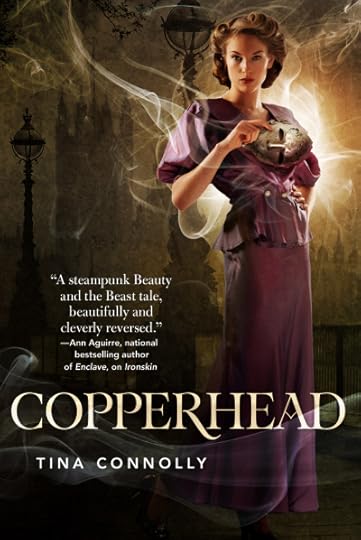
Today's post is on Copperhead by Tina Connolly. It is the second in her Ironskin trilogy. It is 316 pages long and is published by TOR. The cover has the main character on it with a iron mask in her hand looking at the reader. The intended reader is someone who has read the first book, likes steampunk, fae, and fast plots. Teens and adults would get the most out of this book. There is some mild language, no sex, and little violence. The story is told from the first person perspective of the main character. There Be Spoilers Ahead.
From the dust jacket- Helen Huntingdon is beautiful- so beautiful she has to wear an iron mask. Six months ago, her sister, Jane, uncovered a fey plot to take over the city. Too late for Helen, who opted for fey beauty- and now has to cover her face with iron so she won't be taken over, her personality erased by the bodiless fey. Not that Helen would mind that some days. Stuck in a marriage with the wealthy and controlling Alistair, she lives at the edges of her life, secretly helping Jane remove the dangerous fey beauty from the wealthy society women who paid for it. But when the chancy procedure turns deadly, Jane goes missing- and is implicated in a murder. Meanwhile, Alistair's influential clique Copperhead- whose emblem is the poisonous copperhead hydra-is out to restore humans to their 'rightful' place, even to the point of destroying the dwarvven who have always been allies. Helen is determined to find her missing sister, as well as continue the good fight against the fey. But when that pits her against her own husband- and when she meets an enigmatic young revolutionary-she's pushed to discover how far she'll bend society's rules to do what's right. It may be more than her beauty at stake. It may her honor... and her heart.
Review- This is a fast-paced sequel to Ironskin. Helen was seen as only a silly and thoughtless woman gets to redeem herself. Helen has to do more character growth than Jane did. Helen has to learn that she has power, a voice, and a will to use them. There is some tense moments when Alistair is drunk and angry but Connolly uses them to make Helen grow. Helen wants to please but learns that she has to take care of herself and those in need. There is not much more world building in this one. We see more of the dwarvven world, more of the fey plots, and that is about it. Connolly gets into the darker human world where people might make their wives get new faces. And she dives into how that would make someone feel. The women in this novel are not taken seriously and they are mad about it. I like that Connolly is not afraid to talk about that. The dialog is not bad but it really is the world and the mystery that makes you keep reading.
I give this book a Four out of Five stars. I get nothing for my review and I bought this book with my own money.
Copperhead complements and even exceeds the boldness of its prequel. Ironskin (where do these suggestive names come from?) took Jane Eyre as the model for its romance and family elements and then threw over that a thick layer of magic, faerie, and alternate timeline intrigue. This first time Jane had to come to terms with her stubborn and fairly insular nature.
Now the onus is on her sister Helen, the social butterfly, to prove she has a backbone and can be stubborn too. You see then how the two books come at their problems from different angles? Jane begins stubborn and must learn to accept help from people whereas Helen, already hedged in by such a great number of people, must learn to depend on herself and be a heroine.
It's difficult to pick a favorite. The clear advantage here is that all the action takes place in the city. Before we were mostly holed up in a mansion on the edge of a forest, so while it was scenic and packed with nature imagery, it did feel as if we were missing out on much of the social scene and scandalous gossip.
This time around we have a clear winner in the character known as Eglantine Frye. She's an actress who lives a ragamuffin lifestyle with uproarious parties and a house that never fully empties.
Much of this novel reminds me fondly of another steampunkish (emphasis on the punk) urban fantasy, one of my favorites, Soulless. Frye stands in for a more fashionably hip, Ivy Hisselpenny, and much of the cast of characters, especially the women, boast ridiculous names such as Agatha Flintwhistle, Louisa Mayhew, and Lady Dalrymple fairly in sync with Carriger's imagination.
What distinguishes this book even more favorably from an already excellent crowd is the strong characterizations and light symbolism. The way that the name copperhead doubles effectively as a reference to a hydra which grows back more heads than are cut off and just as much the continual masked nature of all the women in this city inspires one to sit back and connect the dots every now and again.
Not many urban fantasy books can lay claim to such suggestive construction. Might we very well see this taught in high school classrooms alongside something by Margaret Atwood? Such future syllabi would not be doing either author a disservice. I see a lot of potential and - just as much, if not more - real accomplishments, effected in this series. But where can it go from here? Underground? Ooo, please say underground.
Helen thinks she can't do anything right. Of course those realizations are all after the fact. Take, for example, the marriage to her husband Alastair six months ago. At the time it was the best possible thing for her, and she even thought she could grow to really love him. But lately she's discovered he's not who she thought he was.
A lot of that is due to his new involvement with Copperhead, a group of men who want to rid the city of fey and dwarvven. Completely. In IRONSKIN, Helen discovered the dangers of the fey personally, so her fear is genuine. But she's still of the "live and let life" philosophy and finds Copperhead's methods alarming.
In a desire to be useful, Helen agrees to help her sister Jane convince the fashionable ladies of society that keeping the fey faces that make them beautiful actually put them in danger. But will she mess this up, too?
Set in an alternative England of the early 1900s, you can jump into COPPERHEARD without having read IRONSKIN. It's a fun series with interesting characters and a well-plotted mystery. The first book was told from Helen's sister Jane's PoV, but here she takes a back seat. I especially enjoyed Helen's PoV voice, her wry observations, and her personal struggle to understand herself and the people around her. She's not as feisty as other heroines, but that doesn't make her contributions insignificant. Rather like Eff Rothmer in THE FAR WEST; but there Eff is thoughtful and conscientious, Helen is determined and competent...if rather vain. The secondary characters were well-drawn and fun to read, particularly the flamboyant Eglantine and her menagerie of hangers-on.
The one thing I wish I knew more about was the fey. There's more here about the Great War than in IRONSKIN, but the story doesn't expand much beyond talking about a Fey King (there used to be a queen) who punishes fey by ripping them apart and leaving blue vapor bits around town. Fey energy is used for lights and other devices. We do learn that fey can take over a person who has fey on their body...say a fey face like Helen and the society ladies. And how magic in her face gives her emphatic abilities. Fortunately there were enough details that the story made sense.
Connolly deals with themes of racism, women's rights in marriage/divorce, and suffrage with a subtle hand. She blends these issues in a story about women who are capable in a world that would pass them by. And by the end you will see Helen for the heroine she doesn't know she is.
Recommended Age: 14+ Language: None Violence: Some; one scene is more amusing than scary Sex: Vague references
***Find this and other reviews at Elitist Book Reviews.***
Copperhead is the sequel to Ironskin, and like its predecessor, it’s inspired by a Brontë novel. Ironskin was a steampunk-esque take on Charlotte’s Jane Eyre, while Copperhead is inspired by Anne’s The Tenant of Wildfell Hall. The name “Helen Huntingdon” is a dead giveaway for this, but I didn’t realise that when I first started reading.
After a while, certain elements of the story began to feel rather familiar. For starters, Helen marries a man she’s in love with and she thinks love her (his mileage may vary). When married, he turns out to be less than sympathetic, and his choice of friends is questionable, to say the least. There’s even a young boy whom Alistair and his friends ply with drink.
While some elements are similar, the actual story itself is completely different from Tenant.
We’re back in the world where the humans are at war with the fey. The Copperhead organisation are essentially Nazis (“one people, one race” sounds sort of familiar, doesn’t it?) and do their best to weasel themselves into power.
On the one hand, Helen is a society belle with a wealthy husband who’s a Copperhead member. On the other, she’s the sister of a woman trying to strip everyone of the beautiful, transplanted faces before they’re taken over by fey, and Helen is uncomfortable with Copperhead’s anti-dwarvven politics. Throughout the book, Helen struggles with these two identities: the shallow Mrs Huntingdon who only cares about looking beautiful and wearing the most fashionable clothes, and Helen, the resourceful but inexperienced freedom fighter.
As characters go, I found Jane more sympathetic than Helen, so reading a book where Helen takes centre stage is frustrating, at times. In a sort of “stop worrying about getting your skirt dirty and GET ON WITH IT!” kind of way.
On the other hand, the things I found frustrating about Ironskin, like the abrupt ending, didn’t feature here. When I had reached the end, if anything, I was wondering if there would be another part to the story, but I don’t know. On the one hand, it was resolved, but on the other … maybe not. I don’t know.
At any rate, I thought the book was well-written, I really like the world setting (it’s never specified by name what city it is, or even which country, but it has a British sort of feel to it), and Frye is a great character. Actually, let’s hope there’s a third book and that it stars her! :D
If you enjoyed Ironskin and wanted more, you should definitely read Copperhead, because it’s good fun.
I did not expect to like Copperhead when I first started reading it because I was peeved. I had been expecting a continuation of Jane’s story from her perspective. Instead I got Helen and her flighty voice which was not my favourite to start off with but I have to admit that she grew on me. I liked the trajectory of her growth in the novel. She starts off scared and ends up more actualized and assertive. True, she does make some rather questionable decisions before and during the course of this novel but it turns out well in the end.
Copperhead continues the story of the conflict between the fae and the humans. While the power was mostly with the fae in the first novel (them having fae magic that functioned in place of human technology and allowed them to gain leverage by withholding this magic), the power shifts to humans in this novel. Wow, sorry, unnecessarily convoluted sentence. Helen is married to a man more worried about what his buddies think than his wife. He is extremely conscious of what society thinks about him and treats his wife, Helen, badly. Thankfully, Helen is not the timid kind which is what makes the book readable for me. She understands why she married Alistair and she is not in denial over her failing relationship. The society of the Copperhead is made of men who treat women like they were born without brains, like they are hothouse flowers meant to be petted and coddled but never given liberty. It’s all a bit nauseating so the feminist themes in the novel are wonderfully welcome. Then there are the scary implications of the hatred being fostered between the dwarven folk and the humans. There are also questions of physical perfection – what is beauty and how does it affect a person’s sense of self-worth. I loved that.
The ending was a bit too rushed and a bit convoluted and, I have to say it, too neat but it did complete the arc quite story. I’m not sure how this novel will progress or if there will be a third book but I hope there is. Connolly has a wonderful way with words that is charming and engaging. If you haven’t checked out Ironskin, I urge you to do so.
My biggest gripe with the first book in this series, Ironskin, was that I liked a touch more romance in my Fantastical Bronte-esque fiction.
Not so with the second in this series, Copperhead.
In Ironskin we are introduced to a society where the fey and humans have had a big war and now the fey seemed to all but have disappeared back into the forest from whence they came. Except for the startling beautiful faces of the Hundred Society women Rochart made out of fey-infused clay in the first book, Ironskin.
Now Ironskin's main character, Jane, is trying to replace the fey faces with the Hundred's original faces-- including that of her sister, Helen.
Helen wants to help, but what's a girl whose fooled everyone into believing she's air-headed and ditzy to do when fey bits start appearing all over town, Jane disappears, and a secret society begins constructing strange apparatus, making curfews, and taking over the town?
And what about that strange man in black who keeps appearing when Helen needs him most?
Although you could plunge into Helen's story without reading Ironskin, first, I recommend reading the books in order. I think Helen's discovery of her own powers-- with or without her fey face-- are made more poignant by having learned of Jane's story in the first book.
While I did get a bit tangled up when it came to the climactic Helen vs. the Fey King scene at the end to who was doing what with which bits of fey, Helen herself is so much fun to hang along with as she tries to reconcile the role she's played as the dutiful wife and daughter with the desires to protect her sister and the city, that it doesn't matter. The understated, quiet building of feelings between her and the man in black also kept the romance lover in me reading on.
A lovely addition to the series featuring a heroine just as plucky as Jane, but in her own way. (and still a lovely Bronte-esque society without the major borrowings from Jane Eyre that Ironskin had)
This Book's Snack Rating: Garlic Parmesan Kettle Chips for the solid crunch of Helen's transformation flavored with yummy bits of fey, period society, and hijinks
I loved reading Ironskin last year, so I was pretty excited to start in on Copperhead. But, while it was a pretty good read, I just didn't feel it and it fell flat. The concept of Copperhead, while fascinating, was disappointing, although I can't pinpoint the exact reason why. I'm not exactly the biggest fan of steampunk and, with more tech than Ironskin, it's possible that that's the reason. But it could also be that there were so many little things that just made me feel...awkward.
While Helen was a fierce character (and I loved that she knew where her loyalties lay) it just irritated me that there didn't seem to be much difference otherwise between Jane's POV and Helen's, as far as I could remember. Jane was also written out as a bit of a boor compared to her own novel, and that was another little thing that went up against the book. Then again, Helen was a pretty badass character, so I'm trying to figure out if it balanced out or not.
The romance in the story was...hmm. There was honestly no need for it whatsoever and it was completely rushed. They only met each other a handful of times and yet, nearing the end, they were young and in love. Very very rushed, especially considering the fact that they don't really talk/meet until halfway through the book. Besides driving the plot on, but I really really felt like the story would've gone on a lot smoother without the romance (So honestly, it didn't even drive the plot on that much, so I'm not quite sure...why it was there? Except perhaps, to make the story more YA.)
I really do love the worldbuilding and all the secrets behind Copperhead was absolutely fascinating. The plot was completely unpredictable and I was shocked more than a few times. I have to hand it to Connolly for writing a thrilling plot that had me at the edge of my seat in the second half. It was a bit hard to get into at first, but after a while, I started to love it more! (Although some of the stuff I highlighted before did still irritate me.)