Jump to ratings and reviews
Rate this book

Jutland 1916: Death in the Grey Wastes

Rate this book
Dramatic, illustrated account of the biggest naval battle of the First World War.

On 31 May, 1916, the great battle fleets of Britain and Germany met off Jutland in the North Sea. It was a climactic encounter, the culmination of a fantastically expensive naval race between the two countries, and expectations on both sides were high. For the Royal Navy's Grand Fleet, there was the chance to win another Trafalgar. For the German High Seas Fleet, there was the opportunity to break the British blockade and so change the course of the war. But Jutland was a confused and controversial encounter. Tactically, it was a draw; strategically, it was a British victory.

Naval historians have pored over the minutiae of Jutland ever since. Yet they have largely ignored what the battle was actually like for its thousands of participants. Full of drama and pathos, of chaos and courage, JUTLAND, 1916 describes the sea battle in the dreadnought era from the point of view of those who were there.

480 pages, Paperback

First published January 1, 2003

57 people are currently reading
439 people want to read

About the author

Peter Hart

41 books194 followers
Peter Hart is a British military historian.

He has been an oral historian at Sound Archive of Imperial War Museum in London since 1981.

He has written mainly on British participation in the First World War. His books include; The Somme, Jutland 1916, Bloody April on the air war in 1917, Passchendaele, Aces Falling (on the air war in 1918), 1918 A Very British Victory and Gallipoli.

Librarian Note: There is more than one author in the Goodreads database with this name.


Ratings & Reviews

What do you think?
Rate this book

Friends & Following

Create a free account to discover what your friends think of this book!

Community Reviews

5 stars
104 (42%)
4 stars
100 (40%)
3 stars
37 (15%)
2 stars
2 (<1%)
1 star
1 (<1%)
Displaying 1 - 30 of 33 reviews
Profile Image for Manray9.
391 reviews122 followers
January 22, 2020
The Battle of Jutland shocked the British public. Expectations were high that the Royal Navy would sweep the Germans from the seas. The reality differed. Little went well for the British on 31 May and 1 June 1916. Again and again opportunities to punish the German High Seas Fleet were missed through poor communications, sloppy shiphandling, inadequate training, and tactical shortsightedness.

The battle exposed British naval technology as outdated or ineffective. Royal Navy large-caliber shells failed to penetrate German armor and often didn't explode when they did. Shipboard fire control systems where hamstrung by poor optical range finders -- many with a short base of only nine feet and incorporating a challenging measuring technique requiring the operator to align stereoscopic images while riding a careening and heavily vibrating warship. Overshooting by thousands of yards was common. Even relatively mundane equipment such as searchlights was notably inferior to the German. British searchlights lacked irises and were mounted too low on the ships. General quarters (action stations) discipline was slack permitting flash fires to devastate gun turrets, ammunition handling rooms and magazines. Poor wireless controls and signal flag procedures caused miscommunication between fleet elements. Arguably the most serious shortcoming was the repeated failure of British flag officers and ships' captains to transmit contact reports on enemy vessels. Lord Jellicoe was handicapped throughout the battle by a lack of contact data on the German High Seas Fleet – even while elements of the Royal Navy were engaged with the enemy. The tactical dominance of the German navy was evident in the battle's toll: 14 Royal Navy ships sunk – including three battlecruisers. 11 Imperial German High Seas Fleet ships sunk – only one battlecruiser. The Royal Navy's total killed in action: 6,945 (more than the total British killed in action during the Boer War). The German Navy's total killed in action: 3,058.

Despite the Royal Navy's many weaknesses at Jutland – a clear tactical setback – it gained a resounding strategic victory. The Imperial German High Seas Fleet never threatened British maritime supremacy again. The German fleet rode out most of its life in ports and anchorages until mutiny hastened the end of the war in 1918. As Steel and Hart wrote:

Whatever specious claims can be constructed from an analysis of (Royal Navy) losses or casualties it remains a fact that the British won the battle of Jutland. In the end the material successes of the High Seas Fleet fade into complete insignificance in comparison to the crushing strategic success that the Royal Navy secured for the British Empire. The great question of the naval war had been answered. Although the High Seas Fleet did re-emerge, it would never again seriously threaten the command of the seas possessed by the Grand Fleet.


Jutland 1916: Death in the Grey Wastes by Nigel Steel and Peter Hart was a solid chronological recapitulation of the events surrounding the epic sea battle of World War I. The authors laced their story with letters, diaries, official reports, and personal accounts of participants – both high and low. As a blow-by-blow recounting of the battle, it was very good, as a literary endeavor, it was wanting. The authors lacked narrative flair, which made the book tedious at times. While informative, it wasn't entertaining. It earned Three Stars in my library. 
Profile Image for Dimitri.
1,004 reviews256 followers
June 5, 2018
I finished reading this paperback around 3 a.m. in a hotel room with a couple next door fighting in German. Felt a bit like yelling "I've got enough Germans fighting in here, keep it down !"

When Peter Hart states "The Grand Fleet clearly outnumbered the High Seas Fleet in every aspect that mattered ...I note an all-capital OH YEAH ?? in crayon. Still, he impressed me on this one: come to him with a knowledgeable head & it's perfectly possible to enjoy his loose narration.

At his best, he is even poetic as he summarizes the feeling of disappointment on both sides:

While a few stranglers struggled to safety, the majority of the Hochseeflotte escaped smoothly under cover of the misty dawn, leaving the Grand Fleet in possession of a battlefield defined only by littered wreckage, shells, flat fish and silent seagulls. The worst remains were the corpses huddled on rafts, all tough some men survived their hypothermic ordeal in the nick of time.

vs.

The purpose of his sortie into the North Sea, the opportunity to entrap and destroy a significant portion of the British fleet that he had sought and worked hard to realize, had been presented to him, but, through the resilience of the British super-dreadnoughts, it had slipped through his fingers.

There was no such thing as a spin doctor in 1916. The Germans did the spinning, hailing victory which was uncritically picked up by the world press. The British public saw its expectations of a new Trafalgar shattered before the Navy could even lay anchor off Scapa Flow.

Nobody had expected anything out of the ordinary while sailing out except just another encounter like at Hegioland. "it was indeed a pleasant day for a cruise.. A grave error was made by Director of Naval Operations capt. Jackson, who despised the Boffins in Room 40. Sheer used different wireless call signs at sea, so his "DK" sign stayed moored at Wilhemshaven. Well... the Germans didn't see Jellicoe coming out in force, either.

The opening phase - the "Run to the South" had been an unmigated disaster for the British battlecruiser fleet. Alltough immeasurably stronger than German Scouting Group 1 they had failed to concentrate their forces at any time. The controversy surrounding the signal flags of HMS Lion which made Hugh-Evan Thomas' 5th Squadron of 15-inch Super Dreadnoughts lose touch with Beatty's battlecruisers remains to this day.

The Best the uninspired communiqués could do in the following days was to soften the blow to a draw. The dire question ”Why didn’t we just win?” was easy to hurl and hard to dodge. The German claim was measurable. More ships sunk, more tonnage lost. More men killed. But the Grand Fleet got back to its feet and could win another day, while the strategy of Mutually Assured Destruction clearly wasn’t working out. The slow strangulation by starvation was the name of the game now.

Hart tries to salvage the reputation of British gunnery: "iJutland showed it was possible to fire two salvos in quick succession without a full adjustment calculation in between and still not be hopelessly off the mark." but when you do the math, 6 hits from 31 salvos is not an inspiring statistic.
Profile Image for Jonny.
140 reviews85 followers
January 22, 2020
"Never had a battle been so eagerly craved for so long in advance."

Peter Hart turns his pen to the oft wished for but ultimate damp squib of the payoff pig nearly two decades of shipyard rivalry between Britain and Germany.

The origins of the growth of the two fleets are laid out, together with an appreciation of the driving theories behind the opposing naval strategies, although it rapidly becomes obvious that both fleets are attempting to force wildly different outcomes - the British to force a decisive fleet action while the German aim is for initially piecemeal actions too whittle away RN strength to a point where any naval victory will avoid being phyrric.

"Jellicoe aimed to defeat the High Seas Fleet if he could bring it to battle without exposing his fleet to the risk of serious losses from mines and torpedoes. He preferred the maintenance of the strategic status quo to fighting in anything but favourable circumstances. Scheer intended to draw detached elements of the Grand Fleet, most probably the Battlecruiser Fleet, into a trap, whereby he could achieve and exploit a local superiority. Only when the two fleets had been ‘equalized’ would he risk an out-and-out fleet action. His ambition as he left harbour was to take the first steps towards overturning the British naval hegemony slowly suffocating his country."

Once the two fleets are at sea, the German Navy hoping to draw out part of their counterparts by the tried and tested method of bombarding a British seaside town (in this case threatening to cause thousands of pounds worth of improvement to Sunderland)* that the book steps up a tempo, with Hart utilising his sources to describe the ill -fated "run to the South" that highlighted the design flaws of the Admiralty craftsmen and also cause a pause for thought - shining a different light on the most famous quote of the day:

"As Beatty and Chatfield stood on the bridge of the Lion, Beatty summed it all up in one pithy phrase that has since secured his place in popular history.

I was standing beside Sir David Beatty and we both turned round in time to see the unpleasant spectacle. The thought of my friends in her flashed through my mind; I thought also how lucky we had evidently been in the Lion. Beatty turned to me and said, “There seems to be something wrong with our bloody ships today!” A remark which needed neither comment nor answer. There was something wrong.
Flag Captain Alfred Chatfield, HMS Lion, 1st Battlecruiser Squadron

This remark, so simple, was later the subject of a protracted historical argument, but it is of little significance. One of the signal ratings present later claimed to have heard a slightly different phrasing.

On reaching the bridge on one occasion, I was almost pushed over the side by the Admiral Sir David Beatty, as he stormed up and down and actually heard him angrily exclaim, “What’s the matter with our bloody ships today?”
Boy Telegraphist Arthur Lewis, HMS Lion, 1st Battlecruiser Squadron

Another remembered it in almost exactly the same way.

I was standing alongside Admiral Beatty and the Captain A. E. Chatfield, when Queen Mary blew up. It was on that occasion that the Admiral made his famous remark, “What is the matter with our bloody ships today, Chatfield?”
Leading Signalman Alec Tempest, HMS Lion, 1st Battlecruiser Squadron
"

The story is well constructed around many first hand accounts, and if there is a criticism it is that, as I surmise like the actual battle itself, it's actually very hard to form a coherent "big picture". That gripe aside, the eyewitness accounts are by turns horrific, poignant and funny and have added a lot to my understanding of the Royal Navy in World War One. While not an out and out whitewash of RN performance (although the attempt at rescuing the Navy's marksmanship seems a bit pointless. - even if they had managed to hit a barn door, the shells may not have gotten through) but despite the salvaging given to the battlecruisers, and the timidity of the Fleet during the night actions) it was the British who were able to parade a force off Heligoland two days after their supposed defeat, and whom were ready for fleet action again within a week. While the Germans may have proved the old Medieval adage that he who reports first gets to decide the accepted strory, the German Fleet was a busted flush after 31st May 1916.

" The Grand Fleet was ready for action again by 21.45 on 2 June. At that point Jellicoe could deploy no fewer than twenty-four intact dreadnoughts and battlecruisers ready for immediate action. This stood in sharp contrast to the mere ten available to Scheer. The British ships receiving dockyard repairs rejoined the fleet by the end of July. The damaged ships of the High Seas Fleet trickled back and Scheer was able to consider renewed action by mid August. The battlecruisers Seydlitz and Derfflinger took much longer to repair and were not released until towards the end of the year. Time imbued the cacophony of German triumphalism with a hollow ring. "

Not Hart's best work (I'd save that for his trilogy on the air war between 1916 and 1918) and I'd suggest a bit of foreknowledge of the battle before you start, but taking that on board it's otherwise a good account.

*If you had to work there you might think that way too...
Profile Image for Jamie Smith.
521 reviews112 followers
March 6, 2019
Over the past century the battle of Jutland has been analyzed from every conceivable angle. There were enough misunderstandings, questionable decisions and outright blunders to fill many books with speculation about what might have been. Death in the Grey Wastes looks at the battle both from the top down, the strategy and tactical maneuvering, and the bottom up, with many first person accounts from diaries and letters telling the experiences of the men who were there in the thick of things. The two perspectives work well together to give the reader a good understanding of the battle.

The controversies started before the first gun spoke. The Germans were terrible at what is now known as signal discipline. When their ships got orders to sail, radio message traffic would increase by several times as last minute preparations were made. The British did not need to have cracked the German codes to know that some kind of operation was about to begin, so their own ships could put to sea to be ready.

Nevertheless, the British were in fact very good at breaking German naval codes. They had put together a group of linguists, crossword puzzle enthusiasts, and assorted oddballs who provided valuable intelligence. The regular Navy types, of course, despised oddballs and treated them with utmost contempt. After the information had been passed that the Germans were about to sail prior to Jutland, the watch commander, a Navy captain, went to the intelligence analyst on duty and asked if he knew the whereabouts of a specific call sign associated with the German Fleet admiral. The analyst did, and told him that it was in Wilhelmshaven, so the Captain left. The analysts were not allowed to address the officers unless spoken to, so he did not get to tell him that that call sign was always in Wilhelmshaven, and that the German admiral took a new one when he left port.

Both fleets had put to sea many times before, for training and sweeps through enemy waters, so there was no certainty of combat when they sailed out in the last days of May 1916. On their intended courses they would not have passed within forty miles of each other, and would have returned to port after yet another few boring days underway. Fate, however, intervened. A neutral Dutch merchant ship was spotted by German destroyers, who decided to stop it and search for contraband. The merchant complied, and in doing so blew down its boilers to come to a halt, sending up a large plume of smoke and steam. Far away, on the other side of the horizon, British destroyers just happened to catch sight of it and went to investigate. As they closed they spotted the Germans, and each side relayed the position of the other. The battle was on.

The German plan was to make contact with the British battlecruisers under Admiral David Beatty and lure them back to the battleship line. The Germans did not know that the entire British battlefleet was underway and so it was they who were surprised and almost destroyed as the British performed the classic “crossing the T” maneuver so that their full broadsides could be brought to bear against the Germans, who could only fire with their forward turrets. Only quick thinking, making a 180 degree turn and disappearing into the afternoon haze saved the German fleet, though both sides had lost ships and been thrown into confusion.

At that point the Germans decided to head for home, but the British fleet was between them and safety, so if the British could locate them they had a chance to win a decisive victory. Contact was made several times, but the fog of war results in some inexplicable moments, and the sightings were not reported. In one case it was not done because of standard wartime radio silence, with the officer in charge apparently not realizing that relaying the position of the entire enemy fleet would have been more important than maintaining routine radio silence. Eventually the Germans slipped through British lines and made it safely home. The chance had been lost.

The book’s diary and letter extracts were well chosen and provide vivid descriptions of the battle, some of them tragic. For instance, the gun shields on the British destroyers did not extend all the way down, in order to save weight, but it meant that shells hitting the deck sent deadly shrapnel underneath, and a number of gunners bled to death after their feet were cut off.

There is also the story of a British destroyer, separated from its flotilla and in great danger, having collided with a sister ship. As they were performing emergency damage control a lookout shouted that he saw a ship coming, and out of the mists loomed a heavy cruiser, five hundred feet long and on fire from stem to stern, headed straight for them. They just barely managed to twist their ship out of the way, and the mysterious ship sailed off over the horizon and disappeared forever. It was later determined to have been HMS Black Prince, which had got lost and stumbled upon the German battleship line, where it was pounded and set ablaze. The Germans had not bothered to sink it because they did not want to waste shells, not knowing if they would still need to engage the British battleships. There were no survivors from the Black Prince’s 800 man crew.

One of the battle’s biggest controversies involved the conduct of Admiral Beatty, who had a lot in common with Douglas MacArthur. He was supremely confident in himself, far more so that his abilities warranted. He was reckless to the point of hazarding his ships unnecessarily, and careless in his management of the battlecruisers under his command. He just wanted to close with the enemy and blast away, regardless of the consequences, certain that he would always win. This made him dangerous; if the British lost control of the seas they lost the war, and Beatty was a man who would have risked everything just to see how it all played out. After the battle the British needed heroes, so Beatty was promoted to command of the entire Fleet. It is probably a good thing that the Germans never sailed out to fight another grand battle, because Beatty might have tipped the odds in their favor.

Warships had changed enormously in the two decades before Jutland, greatly increasing in size, speed, and firepower. While serving as the Royal Navy’s First Sea Lord, Admiral Sir John Fisher had introduced two new kinds of ships which would have enormous influence in the first decades of the 20th century. In 1906 he commissioned the first all-big-gun battleship, which replaced the older type carrying a mix of guns of various calibers. HMS Dreadnought, the first of her class, carried ten 12” guns in five turrets and outgunned everything afloat, instantly making the world’s battle fleets obsolete. It also made the existing British fleet obsolete, and thus gave the Germans and other nations a chance to start from a level playing field in building up their own modern navies. The Dreadnought’s other innovation, often overlooked today, was its use of the new technology of steam turbines, which increased speed and endurance, instead of the older triple-expander reciprocating engines.

Fisher’s other innovation was the battlecruiser, which seemed like a brilliant idea but was disastrous when put to the test at Jutland. The idea was that it would be armed like a battleship but lightly armored, giving it great speed. It was to be able to outrun anything that could match it in firepower, and outfight anything fast enough to catch it. However, the first battlecruisers were laid down when fleets were expected to engage at 6000 yards, but by the time of Jutland larger guns and more advanced fire control (more advanced, that is, than the old method of the gunners looking through the barrels of their guns to estimate range and bearing) had more than doubled the range of action, putting the battlecruisers at great risk. Also, since a battlecruiser cost almost as much as a battleship, there was a tendency to employ them in formations they had not been designed to survive. At Jutland the British would lose three of them, each taking over a thousand men down with them, and a fourth, Beatty’s flagship HMS Lion survived only by flooding magazines at the last second, just moments before the ship would have exploded and taken its crew down as well.

British pre-war training emphasized firing speed over everything else, including accuracy. This seems odd, but it made sense to the Admiralty at the time. The idea was that the enemy would not know if you had a good firing solution, but would have to assume that you did, and so would need to react to your salvos, which would throw off their own aim. Not a terrible strategy in theory, but it overlooked the fact that one actual hit is better than twenty shells landing in the general vicinity. The Germans fired more slowly but with twice the accuracy: 4% hits against 2%. (Fire control was getting better, but the ability to reliably hit an enemy ship miles away, through haze and smoke, while both vessels were pitching, rolling, and maneuvering wildly, would have to wait for radar and computerized fire control systems.) This emphasis on rapid firing would have catastrophic consequences.

For safety reasons, official policy was that only three shells and their powder charges were to be placed in the Ready Service Rooms directly beneath the turrets, but in fact they were filled with powder and shells in order to help the guns fire as rapidly as possible. The armored hatches leading out of these spaces was also opened, and powder charges were lined up along the passageway down the side of the ship. A penetrating hit through a battlecruiser's thin armor would have fatal consequences, and indeed, eye witnesses to the destruction of HMS Invincible said that after the initial hit they saw the side of the ship glow dull red almost to the midships point, and then the vessel blew up and disintegrated.

The British admirals knew what had happened to their ships, but to keep up public morale they felt they could not reveal the truth, and so for decades the official story about the loss of the battlecruisers was that the cause was a defect in the ammo hoists which allowed flash from a hit on the turret to penetrate all the way down to the powder rooms. Without ever admitting the actual cause, safety regulations were quietly enforced to prevent the open storage of powder and shells even when it meant reduced firing speed. It was a lesson learned that cost the lives of thousands of British sailors.

Anyone with an interest in the battle of Jutland has a choice of many books old and new. I definitely recommend this one. Its combination of high level and deckplate descriptions of the battle bring alive those terrible twenty-four hours a century ago.
Profile Image for GoldGato.
1,302 reviews38 followers
October 18, 2020
World War I, The Great War, The War To End All Wars...was not a naval war. The image of trenches and mud and barbed wire fits it perfectly. Yet, there was one main maritime battle which took place 100 years ago (this review being written in 2016) and it was a dilly. The Battle of Jutland was the only fleet action during WWI and the results were to have repercussions for both the allies and the axis powers.

It started on the last day of May, 1916, as the Germans made a dashing attempt to break the British naval blockade. The British Navy was still the greatest in the world, but Jutland would tear that all apart. While the Germans failed to break the blockade, they caused massive damage to the Royal Navy, both in ships lost and in public confidence. As the big guns sounded, Great Britain lost ships and thousands of lives in a so-called 'victory' that seemed anything but (the basic WWI outcome). Hampered by captains who failed to inform Admiral Jellicoe of German whereabouts and poorly designed armaments, British ships were blown apart one after the other.

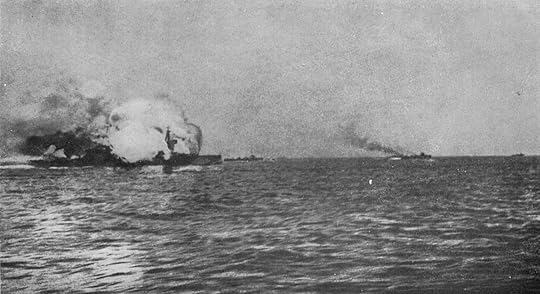
INVINCIBLE being blown apart - 1,026 lives lost
EmeOad.jpg


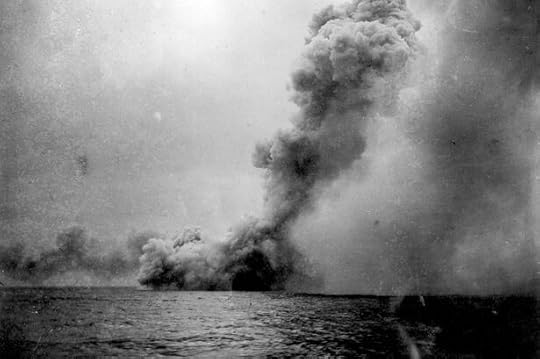
QUEEN MARY being blown apart - 1,266 lives lost
UsBGJr.jpg


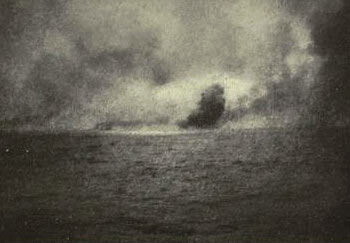
INDEFATIGABLE being blown apart - 1,017 lives lost
iqh77L.jpg


BLACK PRINCE - 857 lives lost
DEFENCE - 903 lives lost

Total casualties (killed, wounded, captive) for the British fleet were nearly 8,000.
Total casualties (killed, wounded, captive) for the German fleet were nearly 4,000.

Yet, the Battle of Jutland was considered a victory for Great Britain as the Germans were unable to break the blockade and had to retreat home. Realizing the uselessness of fighting on the high seas, the Germans put their efforts into the U-Boat. The submarine would become the true killer within the seas, ending the Nelson-esque ways of old.

There have been other books written about Jutland, but this one drills down into the loss of so many men over a 24-hour period. It brings the battle down to the seaman's level, with eyewitness accounts and stunning reality.

A whole ship's company not wounded, crippled or mentally scarred - just dead.

I had a hard time reading the first 100 pages, as the book is laid out with constant survivor tales, which required my eyes to adjust back and forth. Not exactly my preferred way to read a book, but it turned out to be effective, as the horror of the mistakes and lack of escape (where can one go?) brought the entire battle to full light. So many young men, so many boys...who never saw home again.

CF9CAr.jpg


Book Season - Spring (brave lads)
489 reviews2 followers
March 2, 2019
A very good comprehensive history of the battle of Jutland that covers a lot of ground. From a narrative standpoint, Hart and Steele do a nice job of laying out clearly the fleet movements and giving a sense for how the action unfolded. He weaves a number of first person accounts throughout the book, so you gain valuable insights into how the participants saw it - and the authors include the range of emotions and viewpoints (including some humor - an ongoing saga of one British ship's baker trying to save his freshly baked bread in the middle of the battle).
The authors also do a nice job laying out the strategic situation prior to and after the battle, including discussions of the naval theory that underlay the thinking of both Jellicoe and Scheer.
The authors also cover and address key factors that shaped the battle - doctrine and training, communications, intelligence, and the personalities of the leaders.
The authors further examine a number of important post-battle items including an evaluation of Jellicoe's performance, the PR battle over who won, and the treatment of the casualties following the battle.
Once again, a very good, comprehensive history that establishes a good understanding of the largest naval battle of World War I.
Profile Image for Bas Kreuger.
Author 3 books2 followers
May 27, 2013
Fantastic account of the (in itself) inconclusive naval battle of Jutland. Technically, the German navy might have a justified claim to victory, in a more strategic sense, the British Royal Navy gained more from this engagement.

This book doesn't just focus on the actions at sea and the command descisions of Jellicoe, Beatty, Scheer and Hipper, but gives the sailors of the Grand and High Seas Fleet a voice and a face.
Their observations, comming from diaries and biographies, bring to life this unique period in naval warfare where men fought in the biggest warmachines ever build, true bemoths of the waves.

The very brutal nature of naval warfare is presented to us as readers in a very convincing way, people living, working, fighting and dying in the same locations where they sleep, eat and live.
One moment a ship is peacefully sailing alomg, the next it is in a hail of shells killing half of its complement of men, wounding and disabeling others.

The perspective from both the British and German side is working well, painting a picture that is alike in human suffering and endurance and slightly different in the way each navy operated.

A pity that Hart has not followed the Hochseeflotte in its return to port as he did for the Royal Navy where the most moving parts of the book occur: burial at sea, the treatment of the wounded by doctors for 21 hours on a stretch and the way ships parties clean up the damaged parts onboard, with all the gruwsome details involved.

Finally, Hart goes into the lasting discussion concerning Beatty and Jellicoe and their fight over who was responsible for the way Jutland was fought. He doesn't offer this perspective for the German side and that is a pity.

Read this book together with Castles of Steel and Dreadnought by Robert Massie to get a broad view of naval strategy before and in WW1 and then play the best simulation wargame on WW1 naval warfare "Steam and Iron" (http://www.navalwarfare.net/steam&...) a review of which can be found here: http://www.wargamer.com/article/3177/...
This places you in the shoes of Jellicoe or Scheer.
Profile Image for Emerson Stokes.
107 reviews
August 12, 2024
Of great naval battles, there is quite no other like Jutland. Not only for its fantastic display of battleship firepower but also its aftermath that has had naval historians analyzing who won and who lost ever since. I think this book puts it best: statistically the Germans won by ships sunk and sailors lost, but strategically it was a British victory for they still had control of the seas and could put out more ships the next day. And for this conclusion I think the author is right to say that Jutland can be put to rest in this regard.

The book itself is a splendid account of the leadup, action and aftermath of the battle, with first-hand accounts from sailors of all rank and ship, including the few survivors that survived the horrific explosions on board the Indefatigable and others. The analyses in between accounts of the battle are nice and succinct so that you can experience the harrowing tales of the fight as much as you can learn of the strategic and nautical information guiding the actions behind the Battle of Jutland. Overall I might even say that this book deserves 4.5 stars for its writing and style.
Profile Image for Jeff Bryant.
48 reviews6 followers
May 21, 2018
One of the best military books I’ve ever read. The action reads like a screenplay with personal accounts from the survivors of both sides and is fast paced and highly detailed. A must read for military history buffs
Profile Image for Rebecca Bryn.
Author 31 books82 followers
November 7, 2020
Excellent account of the battle and the politics behind it. A great research tool.
Profile Image for Jeff Jellets.
390 reviews9 followers
May 21, 2016

My memory of the Battle of Jutland is centered on a gruesome task upon which I was engaged all through the night which followed the battle. I forgot the exact number but I believe we made about 200 coffins that night.

Jutland 1916 details the epic naval clash between the English Grand fleet and the German High Seas fleet in the cold North Sea on May 31, 1916. Historians Nigel Steel and Peter Hart deliver a superb military history, rich in tactics and chock full of first-hand accounts of the battle from admirals, officers, and common seamen who fought under both flags. Despite the complexity of the mêlée and the varied combatants, Steel and Hart make the combat refreshingly easy to follow, pushing aside the fog of war to straightforwardly describe the strategic steps (and missteps) of the fleet commanders while also providing front row seats to some of the most crucial moments of the conflict – from sinkings to rescues to night attacks – as seen through the eyes of the men that clashed.

While the scholarship is meticulous, the high point of this book is the accounts of the common sailors as Steel and Hart take the reader step-by-step though the battle, lingering on the major events – from the first contact duel of battlecruisers, the stubborn last stand of the German ship Wiesbaden, the suicidal charge of Arbuthnot’s 1st Cruiser Squadron, the sinking of the Invincible, the running fight between the English destroyers and the fleeing German fleet after dark, to the post-battle sinkings of several English destroyers and the scuttling of HMS Warrior, for the rookie historian Jutland 1916 is the grand tour of the battlefield and a book that will fully satisfy the curiosity of the casual reader.

Admittedly, the final two, post-battle chapters get a bit long in the tooth and the firsthand accounts of the combatants aren’t always smoothly placed into the text. Those quibbles aside, Jutland 1916 is must reading for the maritime, military history buff and for anyone trying to catch-up on “everything-they-missed-in-American-history-class.”
Profile Image for Emmanuel Gustin.
411 reviews24 followers
August 12, 2017
At one level, this is a straightforward, chronological account of the battle of Jutland. The event is best remembered for the momentous loss of three British battlecruisers, each of which was destroyed when their ammunition magazines exploded, each of which was lost with more than a thousand men aboard. But they were not the only casualties of this clash of two large fleets, a shocking, life-changing experience for the thousands of men of the Grand Fleet and Hochseeflotte.

And that is what makes this book interesting. The account of the battle serves a framework for the eyewitness testimony of those participating in it, on both sides, in every role from admiral to stoker, pilot to nurse, sailor to priest. Most of them are surprisingly eloquent, often very matter of factly in the descriptions of extreme death and destruction, but vivid. This is the battle as they lived through it. Hart and Steele do an excellent job at providing the right context for their words, fitting the pieces together in an account that is as lucid as can be expected despite the fog of war - very literal fog in this particular case.

Even so, frequent reference to the little battle maps is required to understand the position of the ships, and perhaps these maps should have been provided with a little more explanation. But that is a relatively minor detail. The authors go only superficially into the many controversies surrounding the battle, the claims and counterclaims, distortions and factionalism of later interpretation. Though they make a few comments, for the most part they let the witnesses speak for themselves.

Profile Image for Dylan.
246 reviews5 followers
April 7, 2025
This is quite a good read, I can imagine it easily being a 4* read for those who like naval warfare. I am not, so it's a bit lower for me but the work of Peter Hart and Nigel Steel of telling the story of Jutland is superb. It's a rather unique form for a history work where it's really an oral history with explanatory texts, as in the structure being segments of contemporary accounts intermixed with explanatory and guiding text from the authors (though maybe this shouldn't be that surprising given Hart's four decades as an oral historian for the IWM). It maintains a good writing and pace throughout and it's quite easy to follow, though I wish the maps had time ranges, and it gives a good account on what one of the few dreadnought era battles between capital ships resulted in. It's also admirable in not being too heavily reliant on British first hand accounts, something that can all too often happen in English language works on WW1. One of many standout transitory episodes of the evolution of fighting from the Victorian era into the modern era the first world war entailed.

Sandwiching this main section is an opening chapter setting up the battle, various thoughts defining the strategic and tactical inclinations of the commanders and a closing chapter on the aftermath and the ever-present question "who won?". On this last section, I think they do a good job bringing home the thesis they were setting up in the opening chapter (the academic in the authors bleeding through with that structure). I can see some maybe calling them too conciliatory and gentle but I found it mostly convincing and fair. War is not a sporting event with a clear final score. It's a chaotic, turbulent contest of flesh and metal that doesn't lend itself as easily to a clean narrative and winner as the public conscious often gets.

Again, to emphasize, it's a very good work of non-fiction in basically every facet and I can easily see it reaching 4 or 5 stars for someone with an interest in the subject matter. I just don't like boats that much and it probably put a cap on where my rating of it would end up. Still highly recommend.
127 reviews2 followers
October 13, 2021
An excellent read. Hart weaves a compelling narrative that manages to simultaneously show the grand picture of the strategy and thoughts of the men at the top with the experiences of the ordinary sailors on the ships. The heavy use of direct accounts of the many sailors present keeps the narrative grounded in the reality of warfare while demonstrating what it truly means when it talks of turrets taking hits and ships being abandoned. Each account chosen helps to understand the grander picture of what is happening.
While primarily focused on the British experience of the battle the book does a good job at showing the German side of the battle too with the grand picture always showing both sides and the experiences of German sailors interspersed which helps to illustrate how one sides disaster is anothers triumph.

Overall the book left me with a much greater opinion of Jellicoe, Scheer and the many sailors of the battle and has certainly given me a much better understanding of what an industrial naval battle actual felt like.
Profile Image for Dave Hunter.
32 reviews1 follower
January 30, 2018
Very solid narrative, detailed, and easy enough to follow. This book is focused on what happened, and it succeeds in telling that story well and without some of the anecdotal side stories that military histories are often guilty of. Mr Hart made clear to my mind the events of the days without it being dry y including just enough of the major actors thoughts and quotes to keep their personalities relevant. I thoroughly enjoyed the read, and only gave it less than five stars to preserve that rating for the very few truly stellar books out there.
32 reviews4 followers
January 12, 2019
A very interesting dive into probably the first and last large, all gun, clash between naval capital ships. The story of the battle is well told, mostly from the point of view of the British sailors who were present on that day. I would have liked some more from the point of view of the German High Seas Fleet but I can understand the focus given the author is British and was pulling a large deal of material from the Imperial War Museum. If you're interested in WW1 or Naval history I highly recommend this book.
220 reviews1 follower
June 26, 2022
This book helped me get a grasp on the overall battle pregession, which was a huge, complicated mess. So good points there. And I have always had a soft spot for a good naval history.

The use of original contemporary source materials was effective and well done.

I was disappointed by the limited scope of maps. I hoped for at least twice as many maps, with more detail in each. My main criteria for ordering this book was promotion for better maps than most other Jutland offerings. Hence four stars, rather than five. At the least, the maps presented could have included timestamps.
Profile Image for Benjamin.
153 reviews4 followers
November 16, 2024
Recently it seems like I'm reading more and more books that have great value as a historical record, i.e. getting lots of relevant information and primary sources in one place, but aren't the easiest of reads. This book definitely falls into that category. After a time I started to lose track of all of the maneuvers and the ins-and-outs of the Battle of Jutland. That i what this book is in essence - all the tactical details of the battle, albeit with some much appreciated technical and strategic background. I think this can be safely defined as a specialist interest book.
Profile Image for Hugh.
11 reviews
February 22, 2023
I've read several books about the Battle of Jutland, and this has to be the best. Using extracts from the journals and letters of the people who took part, it gives you a real feel for what it was like to be there, experiencing the thrills and the horrors of a naval battle. Excellent reading, I highly recommend this.
17 reviews
December 6, 2024
I love how from the very beginning, the authors mention how their going to narrate the battle based on what happened, and not what could’ve or should’ve happened had someone did this that or the other. Plus it gives very good insights into the sailors’ experiences of the battle. I recommend this to anyone who’s interested in this battle.
Profile Image for Rich.
139 reviews
March 7, 2025
The book has great background, lots of user accounts, and a good summary at the end.

The significant flaw is that it is hard to follow what is actually going on. The book has a number of maps, all rendered small and unreadable on Kindle (regardless of device).
Profile Image for Douglas.
72 reviews
May 31, 2018
Battle of Jutland in the words of those who fought it. Great read!
255 reviews
June 6, 2023
Well written account of the largest naval action of the Great War. Highly recommended
Profile Image for David Armstrong.
6 reviews
March 14, 2017
Good survey of the battle, both from the perspective of the key leaders (Jelicho, Beatty, Scheer and Hipper) as well as the sailors in the fight. Recommend as an initial read before more in depth accounts.
Profile Image for Simon.
870 reviews142 followers
March 13, 2014
The conceit employed resembles nothing so much as watching a documentary. On almost every page, Hart has gathered short "sound bites" from the men who were at Jutland, the men who planned Jutland, and even the nurses who care for the wounded after the battle when the fleets limped home. To judge from the variety of "voices", which include several common seamen, the past really was a different place. The men are uniformly patriotic, speak of their mates and even their enemies with respect, and seem to be proud of their participation in the battle. That being said, there is a heartbreaking letter from a seaman off one of the British ships sunk; the fleet swept past them in the water, and the remaining survivors were only picked up much later. He simply wants to ask the commander of a ship that left them, "did you not see us? Did you not hear us?" There is no bitterness, but it is incredibly moving (and he never received an answer).

My only caveat probably has more to do with my processing skills as opposed to Hart's methodology. He uses a lot of charts, with arrows delineating paths taken by the British and German fleets. To save my head from exploding, I concentrated on the text itself. The writing will carry you without the diagrams.
Profile Image for Indraroop.
40 reviews
April 11, 2015
Fantastic detailed depiction of the Battle of Jutland - has a lot of engaging primary sources that add color and depth to the story. My only criticisms are that the authors did not explicitly state the significance of Ralph Seymour's poor flag signals and did not have a very in depth focus on Jellicoe crossing Scheer's T (explicitly mentioned only after the fact). Both of these are skimmed over but have a high significance in the historical context of the battle; nonetheless, an excellent read.

Pair with Robert Massie's Castles of Steel for an excellent overview on the Battle of Jutland.
Profile Image for Mark A Simmons.
66 reviews3 followers
August 13, 2015
Hart and Steel successfully balance the big strategic picture with the smallest of numerous eyewitness details. The result is an atmospheric read that captures the experiences on both sides of the men who went through this inconclusive but vital sea battle. Recommended, especially to those who don't usually read military history.
Profile Image for Bob Duke.
116 reviews9 followers
August 2, 2015
The book gives a tactical and strategic account of the battle. It also gives personal views of those who took part. These include those of ordinary seamen and admirals. This is part of my reading for the centenary of the first world war. The book is important for understanding that the war was not only fought in the trenches of the Western Front.
Profile Image for Jim.
114 reviews1 follower
December 1, 2015
This book is short on analysis, but analysis isn't its focus. The authors bring together hundreds of firsthand accounts of those who fought at Jutland, mostly from the British side. Their passages define the bulk of the book. It's as close as anyone will ever get to sitting with veterans of the battle and hearing their stories.
Displaying 1 - 30 of 33 reviews

Can't find what you're looking for?

Get help and learn more about the design.