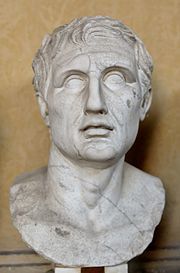
Tit Makcije Plaut (lat. Titus Maccius Plautus, oko 250.-184. st. e.), bio je najveći pisac komedija u rimskoj književnosti. Plaut je rođen oko 250. god. st. e. u gradu Sarsini u Umbriji, najvjerovatnije u prilično siromašnoj obitelji. Najprije je radio kao radnik na pozornici u Rimu, a zatim je dosta putovao i trgovao, ali u trgovini nije imao sreće. Kao siromašan vratio se u Rim i tu zarađivao za život radeći u mlinu. Tu je napisao tri komedije koje je publika dobro primila, pa je, ohrabren tim uspjehom, napustio mlin i potpuno se predao poeziji, na kojoj je radio sve do svoje smrti 184. godine st. e.
Titus Maccius Plautus (c. 254 – 184 BC), commonly known as Plautus, was a Roman playwright of the Old Latin period. His comedies are the earliest works in Latin literature to have survived in their entirety. He wrote Palliata comoedia, the genre devised by the innovator of Latin literature, Livius Andronicus. The word Plautine refers to both Plautus's own works and works similar to or influenced by his.
One can often lose much more than one hoped to preserve by wanting too much. Simple style punctuated by the small plot that will offer so many inspirations for centuries to come.
Probably the most popular of his plays, this one revels in its simplicity and farcical tone with which it explores greed and envy. I could find a distinctive impression of this play, on a play I read by Chekhov during high school, The Proposal. While slapstick humour is not necessarily my cup of tea, I was still quite taken aback by how ahead of his time Plautus was in analyzing the inherent nature of 'gossip'.
Sometimes I wonder why we have so few Roman plays, and that the plays that we do have are mostly comedies, and rather dull ones at that. Maybe it is because Rome was not the type of place where you could produce plays the likes of Aristophanes where the playwright is having a dig at the movers and shakers of the Republic, or maybe it is because the audience preferred New Comedy as opposed to Old Comedy. However I will leave this discussion until I review the collection of plays in The Pot of Gold and Other Plays. The Pot of Gold, otherwise known as the 'Aulularia' is a classic example of New Comedy, though I suspect that by this time it is simply seen as 'Roman Comedy'. The play is about a not so wealthy man named Euclio who obsesses about a pot of gold that he has in his house. In fact he is so obsessed with this gold that he is almost too scared to leave his house, and when he does he pretty much runs back inside almost instantly. Throw in a beautiful daughter and a suitor and you have all the ingredients of a, well, Roman play. The theme behind this play is the absurdity of holding onto wealth and the fact that in the end our wealth dominates us as opposed to us being able to be secure despite having wealth. This is the trap that a lot of people with wealth fall into (and I know it because I go through this as well) and that is that the wealth provides us not only with security, but also with identity, and because it gives us that sense of security and identity we begin to fret over what would happen if it was taken away from us. As such we literally go into a tail spin either trying to add to it so that we can then enjoy it without running out, or developing ever elaborate methods in protecting it so that we do not lose it. While Euclio may in some ways be an extreme example of this type of character, I sometimes wonder if that is really the case. I think of the story of the miser whom Jesus speaks off that saved up all of his wealth to live a comfortable life when he retires only to have it all taken away from him when he dies the day beforehand. Here we have the example of the person who goes without his entire life (though I suspect that Jesus was referring to a wealthy landowner as opposed to somebody who squirrels away their wealth, living a barebones existence so that they may have plenty in retirement) with the mistaken belief that he can enjoy his golden years of retirement. The play itself is incomplete, though we are able to reconstruct the ending using some outlines that have passed down to us. However I did notice that in the edition that I read there was a significant difference between the translated text and the reconstructed text. To me it felt as if a well rounded and animated character (who was threatening to sue everybody who even thought of stealing his gold) suddenly became little more than a cardboard cutout.
A pity this book only has 1 (now 2!) reviews. It's actually pretty funny and the language is easy to understand, unlike in so many other classics I had to read for school.
Funny little comedy, but it’s such a pity that a great deal of the original text is lost. The ending is though not quite good, since the character of the main character loses all verisimilitude. Another dark point is the inherent misogyny of the play, but one must watch with the eyes of the historical time in which it was written. Good point are the dialogues of the servants, with some funny double senses, and the depiction of avarice.
ESTRÓBILO: De él? Si le pidieras, prestada el hambre, no te la daría; pues si dias atrás le cortó su barbero las uñas, y se llevó las recortaduras, después de haberlas recogido con el mayor cuidado.
Una lectura muy entretenida que gira en torno a la codicia. Lo recomiendo encarecidamente para las personas interesadas en los clásicos. Las figuras de estilo, la descripción y el uso de un léxico muy rico permiten que esta obra teatral sea cada vez más interesante y divertida.
AL PUEBLO. Páginas son de tu vida las páginas que componen la Leyenda que te traigo, la Leyenda de esta noche.
No solo para los ricos, no solo para los pobres, mi leyenda es para todos, ora sufran, ora gocen.
Para el que habita palacios, para el pastor de los montes, para el que mora en la aldea ó en la soledad se esconde. Cantor de tus alegrías y cantor de tus dolores, vengo a llamar á las puertas de todos los corazones.
Llamaré con los recuerdos, que en lo hondo del alma se oyen mas que los gritos mas altos y las aldabas de bronce.
Los recogí por el mundo, en los mares, en los bosques, en las desiertas cabanas, en los dorados salones.
Y asi será mi Leyenda un eco de las mil voces, que vienen del mundo y hablan en la hora presente al hombre.
This is the earliest miser story in Western literature, but it remains fresh and funny. I enjoyed reading the source of one of my favorite plays by Moliere, who “borrowed" heavily from Plautus. It is a little disappointing that the conclusion of the play has been lost, but we all know exactly how the events will end, so that is less of a problem than is often the case with partial or unfinished literary works. I was most delighted by moments when characters broke the fourth wall and acknowledged the audience. We like to think of such meta-theater as a modern development, so I'm always amused when the ancients offer surprises like that, reminding us that there really isn't much new under the sun.
خمرهی طلا یا دفینهی طلا از پلوتوس نمایشنامهای که نصفه هست و ادامهاش از بین رفته و این جنبهی بد و خوب داره و امتیازم ۲/۵ هست !! نمیدونم واقعا دوستش داشتم یانه ولی بازهم میگم سلیقه من نیست و بیشتر ارزش و قدمت ادبی داره
(rilettura) immonda esecrabile tediosa squallida banale prevedibile stucchevole asettica insomma orrenda come la prima volta che fui costretto a leggerla.
Un sólido 4'5/5, qué divertida!! Le dan ganas a una de ser un senador romano del siglo III a.C. con una esperanza de vida no superior a los 45 años para ir al teatro a reírme con Plauto. P.D.: solo había leído de él "Pséudolo", en bachiller, y ha sido como volver a clase con mis humanitos :)
lmao this was actually pretty funny. specially the bit where licônidas is confessing that he slept with euclião's daughter and euclião thinks he's talking about stealing his secret treasure...... man, what? also, hopefully the whole sleeping together thing was an actual unplanned sex situation instead of a rape situation. because god knows these greek and roman writer dudes are about that life sometimes.....