

What do you think?

Onnazaka. Il sentiero nell'ombra
La vita di Tomo, moglie di un ambizioso e spregiudicato funzionario di governo del Giappone di fine Ottocento, si svolge inesorabilmente nel solco della tradizione feudale. All'aprirsi del romanzo, la giovane Tomo è incaricata dal marito Yukitomo di scegliere per lui una bella concubina, ancora adolescente, che possa soddisfare la sua passione erotica.
Per alcuni anni, Yukitomo è appagato dalla bellissima e malinconica Suga e trascura ogni forma di attenzione verso la moglie, ancora profondamente legata a lui. Ben presto, però, un'altra giovane cameriera viene ad affiancare Suga nel ruolo di amante del padrone. La situazione è tollerata da tutti, addirittura incoraggiata dai familiari delle due concubine, che ricevono laute somme dal ricco Yukitomo.
Educata a un rigido autocontrollo che le impone di soffocare ogmi impulso alla ribellione, Tomo riesce tuttavia a difendere con dignità il suo posto di moglie e di madre e a nascondere ogni dolore e ostilità. Una profonda crisi la colpisce, tuttavia, quando la prepotenza e la bramosia del marito lo spingono a sedurre la giovane nuora e a intrecciare con lei una lunga e appassionata relazione. Soltanto in punto di morte, dopo un'esistenza votata a comporre in un difficile equilibrio i conflitti che continuamente si creano nella famiglia, Tomo rivelerà al marito il proprio dolore e disprezzo. Ma Tomo non è l'unica a pagare col prezzo dell'umiliazione e del silenzio la sottomissione alla legge patriarcale: dall'intreccio di passione e miseria quotidiane, di rispetto per tradizioni secolari e sconvolgenti irruzioni della modernità, di poesia delicatissima e spietata violenza, vengono segnate tutte le figure femminili che Fumiko Enchi ha seguito lungo l'aspro 'sentiero dell'ombra'.
Per alcuni anni, Yukitomo è appagato dalla bellissima e malinconica Suga e trascura ogni forma di attenzione verso la moglie, ancora profondamente legata a lui. Ben presto, però, un'altra giovane cameriera viene ad affiancare Suga nel ruolo di amante del padrone. La situazione è tollerata da tutti, addirittura incoraggiata dai familiari delle due concubine, che ricevono laute somme dal ricco Yukitomo.
Educata a un rigido autocontrollo che le impone di soffocare ogmi impulso alla ribellione, Tomo riesce tuttavia a difendere con dignità il suo posto di moglie e di madre e a nascondere ogni dolore e ostilità. Una profonda crisi la colpisce, tuttavia, quando la prepotenza e la bramosia del marito lo spingono a sedurre la giovane nuora e a intrecciare con lei una lunga e appassionata relazione. Soltanto in punto di morte, dopo un'esistenza votata a comporre in un difficile equilibrio i conflitti che continuamente si creano nella famiglia, Tomo rivelerà al marito il proprio dolore e disprezzo. Ma Tomo non è l'unica a pagare col prezzo dell'umiliazione e del silenzio la sottomissione alla legge patriarcale: dall'intreccio di passione e miseria quotidiane, di rispetto per tradizioni secolari e sconvolgenti irruzioni della modernità, di poesia delicatissima e spietata violenza, vengono segnate tutte le figure femminili che Fumiko Enchi ha seguito lungo l'aspro 'sentiero dell'ombra'.
219 pages, Paperback
First published January 1, 1957
About the author
Fumiko Enchi
52 books228 followersSee author 円地文子.
Fumiko Enchi was the pen name of the late Japanese Shōwa period playwright and novelist Fumiko Ueda.
The daughter of a linguist, Fumiko learned a lot about French, English, Japanese and Chinese literature through private tutorage.
Fumiko suffered from poor health as a child and spent most of her time at home. She was introduced to literature by her grandmother, who showed her to the likes of The Tale of Genji, as well as to Edo period gesaku novels and to the kabuki and bunraku theater. By 13 years old her reading list had grown to include works of the lights of Oscar Wilde, Edgar Allan Poe, Kyōka Izumi, Nagai Kafū, Ryūnosuke Akutagawa. She discovered a special interest in the sadomasochistic aestheticism style of Jun'ichirō Tanizaki,
She was inspired to write plays after attended lectures by the founder of modern Japanese drama, Kaoru Osanai.
Fumiko Enchi was the pen name of the late Japanese Shōwa period playwright and novelist Fumiko Ueda.
The daughter of a linguist, Fumiko learned a lot about French, English, Japanese and Chinese literature through private tutorage.
Fumiko suffered from poor health as a child and spent most of her time at home. She was introduced to literature by her grandmother, who showed her to the likes of The Tale of Genji, as well as to Edo period gesaku novels and to the kabuki and bunraku theater. By 13 years old her reading list had grown to include works of the lights of Oscar Wilde, Edgar Allan Poe, Kyōka Izumi, Nagai Kafū, Ryūnosuke Akutagawa. She discovered a special interest in the sadomasochistic aestheticism style of Jun'ichirō Tanizaki,
She was inspired to write plays after attended lectures by the founder of modern Japanese drama, Kaoru Osanai.
Ratings & Reviews
Friends & Following
Create a free account to discover what your friends think of this book!
Community Reviews
Displaying 1 - 30 of 521 reviews

December 19, 2016
The author was a Grand Dame of Japanese literature (1905-1986). Although this book was published in 1957 it’s set at the end of the Meiji period in the very late 1800’s, still the horse and carriage era.
The main theme is the absolute domination by males in the patriarchal society of the time. When the story opens the patriarch is 40-ish; his wife is in her 30’s. He’s a high-level police administrator in a time of anti-republican sentiment. He’s cruel, aloof, self-centered and corrupt.
He’s tired of just having the maids on the side, so he sends his wife on a several month-long journey to Tokyo to find a concubine for him. She has no choice but to do his bidding. After interviewing many young women and negotiating with their families, she finds the perfect young woman – 15 years old. All works well for a while, so well that, without even consulting with her or even telling his wife (she learns through gossip) he adopts her as a formal daughter. (They have a biological daughter and a mentally deficient son.) Then he tires of her and wants another one. And then, horror of horrors, it gets worse.
After the first concubine is introduced into the household, the woman and her husband have no relations and not even any conversation other than talk about the household and budget. She starts to fight insanity by becoming the perfect “Stepford” wife. She lives with overwhelming anxiety and even terror that the neighbors and the town will learn of everything that is going on in the household. Her children’s lives will be ruined as well if that happens.
She also feels responsible to these young women she has engaged into service for her husband. When he tires of them, she tries to find them husbands even though they are “damaged goods.” The culture is so male-dominated, that when she becomes ill and wants to see a specialized doctor, she has to ask her daughter to talk to her husband (the woman’s son-in-law) to get him to ask permission of her husband. Good guy that he is, the head-of-household graciously agrees to let her see the doctor.
The “waiting years” comes to mean her whole life: waiting for him to die so she can be released from the anxiety and the fear of the damage he continues to cause. And, of course, there’s a twist at the end. A good story with a lot of local color and Japanese cultural customs of the time.
The main theme is the absolute domination by males in the patriarchal society of the time. When the story opens the patriarch is 40-ish; his wife is in her 30’s. He’s a high-level police administrator in a time of anti-republican sentiment. He’s cruel, aloof, self-centered and corrupt.
He’s tired of just having the maids on the side, so he sends his wife on a several month-long journey to Tokyo to find a concubine for him. She has no choice but to do his bidding. After interviewing many young women and negotiating with their families, she finds the perfect young woman – 15 years old. All works well for a while, so well that, without even consulting with her or even telling his wife (she learns through gossip) he adopts her as a formal daughter. (They have a biological daughter and a mentally deficient son.) Then he tires of her and wants another one. And then, horror of horrors, it gets worse.
After the first concubine is introduced into the household, the woman and her husband have no relations and not even any conversation other than talk about the household and budget. She starts to fight insanity by becoming the perfect “Stepford” wife. She lives with overwhelming anxiety and even terror that the neighbors and the town will learn of everything that is going on in the household. Her children’s lives will be ruined as well if that happens.
She also feels responsible to these young women she has engaged into service for her husband. When he tires of them, she tries to find them husbands even though they are “damaged goods.” The culture is so male-dominated, that when she becomes ill and wants to see a specialized doctor, she has to ask her daughter to talk to her husband (the woman’s son-in-law) to get him to ask permission of her husband. Good guy that he is, the head-of-household graciously agrees to let her see the doctor.
The “waiting years” comes to mean her whole life: waiting for him to die so she can be released from the anxiety and the fear of the damage he continues to cause. And, of course, there’s a twist at the end. A good story with a lot of local color and Japanese cultural customs of the time.

May 14, 2017
My Asian classic entry for the annual classics bingo is The Waiting Years by Fumiko Enchi. Considered the grand dame of Japanese literature with a life spanning most of the 20th century, The Waiting Years is Enchi's crowning achievement. The novel took her seven years to complete and won the prestigious Noma Prize in 1957. A story set in the colonial Meiji period, The Waiting Years is a tale about a man of prominence, his astute wife, and his unquenched lust for women that lands him multiple concubines. Deserving of this honor, The Waiting Years is indeed an Asian classic that should not be overlooked.
Yukitomo Shirikawa has risen in the political ranks over the course of his career. His position takes him all over Japan, and he desires women at each stop. Unable to control his urges, his political advisors suggest that he take a concubine. Married to Tomo, an extremely intelligent woman, for fifteen years, Yukitomo asks her to journey to Tokyo to find such an unspoiled girl for his conquests. Tomo selects fifteen year old Suga, who comes from a struggling family who can no longer afford to feed her. Suga becomes a personal assistant to Yukitomo as well as friend to their daughter Etsuko. A sweet girl, Tomo takes Suga under her wing, yet internally she harbors jealousies that last for the rest of her life.
Shirikawa does not stop with Suga. A few years later he brings a second concubine named Yumi into the house. Tomo has selected her as well to ensure that the girl has high character. Rather than becoming rivals, Suga and Yumi become the best of friends, like sisters from another life. This friendship lasts until the marriage of the Shirikawa's mentally disabled son named Michimasa. From the outset of this marriage, Shirikawa has his eye on his new daughter in law named Miya. His son being pea brained, Shirikawa is able to satisfy this conquest as well, and Tomo works swiftly to move the new couple and their growing family out of the house. The two concubines remain, however, and after years of marriage, Tomo and Yukitomo remain husband and wife in name only.
As the twentieth century moves past the First World War, the Japanese government begins to change. Colonial agents hand picked by their cronies make way for a National Assembly voted on by the people. Shirikawa realizes these changes are at hand and retires from political life to a large estate on the outskirts of Tokyo. His political career may have ended but not his lust for women. As a result he desires younger and younger women, young enough to be his daughter or even grand daughter, as he moves toward the twilight of his life. Tomo continues to run the home, concubines included, and does not speak ill will of her husband.
In the 1950s as Japan was still recovering from World War Two, Fumiko Enchi wrote a feminist take on colonialism in her country. While a man of prominence could take on concubines with no stain on his character, a woman had to remain legally married to him and live under the same roof as the said concubines. Having an affair of her own was unheard of an considered illicit and crude, even if her own needs were unmet by her husband and her feelings hurt beyond repair. Enchi also brings to light the fact that men brought concubines into service before they came of age, damaging their bodies, making it impossible for them to have children. Yet, unfortunately, this had been the norm for centuries in Japan. The country's modernity eventually brought the practice to an end.
Enchi's novel has earned inclusion in the book 500 Great Books by Women by Erica Bauermeister. The Waiting Years is worthy of inclusion as it features a strong female protagonist in Tomo, and brings to light the treatment of concubines and the place of women in a marriage in colonial Japan. I thought that Enchi has created memorable characters and spun an intricate web of emotions as the four main women fight for Yukitomo's attention and affections. I enjoyed The Waiting Years as a story and most likely would have read it even if did not check off a box in various challenges. A novel bringing outdated practices and human emotions to light, I rate The Waiting Years 4.5 quality stars.
Yukitomo Shirikawa has risen in the political ranks over the course of his career. His position takes him all over Japan, and he desires women at each stop. Unable to control his urges, his political advisors suggest that he take a concubine. Married to Tomo, an extremely intelligent woman, for fifteen years, Yukitomo asks her to journey to Tokyo to find such an unspoiled girl for his conquests. Tomo selects fifteen year old Suga, who comes from a struggling family who can no longer afford to feed her. Suga becomes a personal assistant to Yukitomo as well as friend to their daughter Etsuko. A sweet girl, Tomo takes Suga under her wing, yet internally she harbors jealousies that last for the rest of her life.
Shirikawa does not stop with Suga. A few years later he brings a second concubine named Yumi into the house. Tomo has selected her as well to ensure that the girl has high character. Rather than becoming rivals, Suga and Yumi become the best of friends, like sisters from another life. This friendship lasts until the marriage of the Shirikawa's mentally disabled son named Michimasa. From the outset of this marriage, Shirikawa has his eye on his new daughter in law named Miya. His son being pea brained, Shirikawa is able to satisfy this conquest as well, and Tomo works swiftly to move the new couple and their growing family out of the house. The two concubines remain, however, and after years of marriage, Tomo and Yukitomo remain husband and wife in name only.
As the twentieth century moves past the First World War, the Japanese government begins to change. Colonial agents hand picked by their cronies make way for a National Assembly voted on by the people. Shirikawa realizes these changes are at hand and retires from political life to a large estate on the outskirts of Tokyo. His political career may have ended but not his lust for women. As a result he desires younger and younger women, young enough to be his daughter or even grand daughter, as he moves toward the twilight of his life. Tomo continues to run the home, concubines included, and does not speak ill will of her husband.
In the 1950s as Japan was still recovering from World War Two, Fumiko Enchi wrote a feminist take on colonialism in her country. While a man of prominence could take on concubines with no stain on his character, a woman had to remain legally married to him and live under the same roof as the said concubines. Having an affair of her own was unheard of an considered illicit and crude, even if her own needs were unmet by her husband and her feelings hurt beyond repair. Enchi also brings to light the fact that men brought concubines into service before they came of age, damaging their bodies, making it impossible for them to have children. Yet, unfortunately, this had been the norm for centuries in Japan. The country's modernity eventually brought the practice to an end.
Enchi's novel has earned inclusion in the book 500 Great Books by Women by Erica Bauermeister. The Waiting Years is worthy of inclusion as it features a strong female protagonist in Tomo, and brings to light the treatment of concubines and the place of women in a marriage in colonial Japan. I thought that Enchi has created memorable characters and spun an intricate web of emotions as the four main women fight for Yukitomo's attention and affections. I enjoyed The Waiting Years as a story and most likely would have read it even if did not check off a box in various challenges. A novel bringing outdated practices and human emotions to light, I rate The Waiting Years 4.5 quality stars.

August 11, 2014
Not a single strand of hair loosened from the perfect coiffure, a fulsome smile tripping from the corners of her mouth putting a Noh mask to shame, confident in her posture, her heart being swept by violent sea of excruciating conflicts; there she sat gazing into the naivety of a girl-child untouched by the menstrual years. The woman in her fluttering between agony and envy, empathetic towards the fate of an adolescent girl whereas the wife in her scrupulously astute in the ongoing task, a “distinction acquired through suffering”. At that very moment, I sensed the societal asphyxiation of Tomo. At that very instance, I had compassion for Suga and consideration for Yumi.
To call the girl concubine would be making too much of it”, he said to Tomo. “She’ll be a maid for you, too....... That’s why I don’t want to lower the tone of the household by bringing in a geisha or some other woman of that type. I trust you, ...... to find a young and inexperienced girl.....
No more will the husband lovingly savour the naked flesh of his wife. No more will his body comfort the isolation of his wife’s heart. No more will his quilts be spread besides hers. The already small world had shrunk even smaller, the warmth erased by the frostiness of love that had now embraced the freshness of a trembling young supple body unaware of the pleasures and cruelty of the world. Love and sex maybe two entirely separate entities, but to a married woman, the institution of love and sex amalgamates into one solitary entity – her husband. The latter may forgo its trepidations, but it is the shaky foundation of the former that bring unpleasant repercussions in a familial world tighter and narrow than the ribbons in the shiny hair. Was the idea of sending Tomo to select a concubine, some kind of a bizarre trust bond conferred by Yukitomo to his wife, without recognizing the immense misery his callousness was causing and tormenting Tomo? Or was it that Yukitomo’s chauvinist upbringing in a feudal society overlooked the atrocity of such an act? Along with the dutiful obligation to the conformist cultural dogma, was it the fright of being cast off as “worn-out” slippers made Tomo take up such a dastard assignment?
"Objectively speaking, there were any number of prominent and distinguished men in society today who had cast off their wives of many years like worn-out slippers and sent them back to their homes in the country, taking as their recognized spouses attractive women risen from the ranks of apprentice geishas or geishas."
It took Fumiko Enchi , eight years to pen this book. For eight long years, Enchi lived with Yukitomo , his women and the intricate functioning of the Shirakawa family thriving in a dominant patriarchal society ; scripting every sentiment, every desperation that oozed from the festering wounds of humiliation, loneliness, agony, betrayal, the survival of powerless among the powerful, wretchedness of poverty , slavery, fallen desires, hopeful dreams , love , repulsion, adultery and the immense longing of freedom inescapable from the shackles of an authoritarian egotistical patriarchy. At times, out of the blue, from these poignant pages an emotion would escape, resting on my ink-stained fingers, quivering, as it relayed heart-wrenching episodes of cultural repression of women. Spanning over four decades, from the late 19th to the early 20th century, Enchi’s captivating words, spell a tumultuous journey of Tomo’s individuality searching for the legitimacy of her voice in a society where champions of civil rights and liberties were equated to the rank of criminals juxtaposing their acts with those of arsonist and robbers.
Born in the ending years of the feudal era in a low-ranking samurai family, barely able to read and write, Tomo was raised to obey the familial patriarchs: - father, brother and husband. Long before the winds of feminism came into the staunch patriarchal Japanese society, the destiny of the woman was to obey the hierarchical creed of serving her husband through her body and mind and to rebel against it would be outrageous with the possibility of being ostracized. To be raised with an embedded notion of being a “good” wife to the husband is commonplace in such societal mores. From the time I was made to drink turmeric laced milk to a mandatory ritual of using fairness cream, I was enlighten with similar wisdom of being a worthy and good wife to my husband. With all my elaborate education and liberalised lifestyle, the ultimate expectation was of being a dutiful wife. Are then the rights of suffrage, education, equal pay, enough for equality of women, at least in the patriarchal society? What would it take for men to finally not perceive women as a weaker sex? For a woman to achieve genuine equality in a man’s world, she should be foremost treated as a human being behind the closed doors of her martial abode. What fulfilment did the title of a “dutiful and respectable wife” bring Tomo, when her husband never understood or shared her innermost desires and heartfelt emotions? Even today, a womb is the measurement of social decree. A fertile womb makes a woman worthy whereas a barren womb brings social worthlessness. Shameful isn’t it? How would Konno feel if his worthiness was measured by the virility of his sperm? Does possessing pair of breast and a uterus make a woman feeble or a reproductive machine? It doesn't! The threshold of pain and resilience is far stronger in women than in men. Tomo in her lifetime, played varied roles with sheer grace and dignity. Not only was she a dutiful wife, but a wise mother, astute mistress of the household and a loving grandmother ,yet, in all these roles she misplaced her inner-self somewhere ; the woman in Tomo was lost amongst her societal obligations. 'Self-sacrifice' and 'compromise' were the two most muddled and feared words hovering my adolescent years. Why is it that only women are supposedly to be the sole owners of this terminology safeguarding the fortress called 'family’? Was it only Tomo’s responsibility to carry the burden of compromising and sacrificing for her familial happiness and her husband’s dignity? Were the children birthed by her womb were Tomo’s fated bind to the atrocities of Yukitomo? Do then children become an inescapable route from the burden of a tumultuous martial life? Or is the abundant love of mothering an escape from the societal degradation? In order to maintain the integrity of the family, why is it compulsory for the wife to abide complete obeisance to safeguard her husband’s lecherous and egoistical demeanour with venerable discretion? Keeping a concubine or being a benevolent patron of a geisha was the norm of a conventional man , then I wonder . What if, it was Tomo who was adulterous and humiliated Yukitomo? What if, it was Tomo who had betrayed the sanctity of marriage? Isn’t it obvious, Yukitomo would have had one of his shining swords piercing the circumference of Tomo’s neck? What if, it was Tomo who had the liberty to discard Yukitomo like worn-out slippers? Or even the docile Suga or the coquettish Miya had comparable liberties?
Most numerous among the trees were damsons whose fruits was not allowed to turn ripe and yellow but was shaken down and pickled in tubs while they were green The pickled damsons were carefully put in the jars and labelled each years. But, still there were old jars left whose contents grew more mature every year , the damsons softer with a special tart sweetness.
The omnipresent pickled damson on Yukitomo’s breakfast table becomes a cruel joke. The demanding urge of a conceited and lecherous middle-aged man for juvenile “maids” bordered on sexual slavery. The unripe damsons plucked resembled the young mistresses that had entered the Shirakawa household with an illusionary legitimacy in the family registry. The loneliness and the quest for legitimacy of the “other” women became a tangled mesh of struggle between the powerful and powerless. One woman’s burdensome marriage became another woman’s desirable source of emancipation. It is during this steady string of thoughts, that I realized the underlying lonesomeness and a longing for an empathetic companionship in Miya’s mischievous demeanour. Would she have been better off without Michimasa, then? Barren laps, fertile wombs and abandoned hearts all yearned for love and being loved. The titular legitimacy became a pokerfaced facade and the ranks of illegitimacy crumbled into an inevitable despondency. In a patriarchal society where divorce was non-existent, rebellion a blasphemous act and women the eternal submissive species, the happiness of a woman truly lay in the legitimacy of a voice that struggled to climb the rocky hill of individuality. If only the voices of women are heard, their heartache listened by a comforting patriarchy, the lives of the Shirakawa women and the words of Fumiko Enchi would not ring true even today with alarming realism, decades after the novel was written concerning the woes and the vulnerability of women in a patriarchal culture.
Happiness – a small scale, endearing, harmonious....... A small scale happiness and a modest harmony :- let a man cry, let him rage, let him howl with grief with all the power of which he was capable, what more than these could he ever hope to gain in his life?”
Here, I am , a woman having the ability and the sovereignty of not only selecting my men through their sexual capacities but to rebel against the inflexible cultural doctrines ; my voice is fortunate for never having to experience the trauma of its repression and resonates at its loudest decibel when my existence if demeaned on a societal scale. Yet, when it comes to my role of a reviewer, I shiver in apprehensions. How can I judge the Shirakawa women? Who am I to pass an opinion on their lives, when there are members of my species still enduring the oppression of a patriarchal society? Who am I to critic the arduous lives of my ancestral womenfolk? After all, I am their privileged progeny. So, all I did was accompanied Tomo, Suga, Yumi, Miya and the others as they resiliently endured a 40 year long journey ; conscientious to each of their afflictions amid varying images of my own ancestral women fleeting through my vision and with a fountain pen brimming with ink in my hand I lingered with a burning hope to see a light at the end of a colourless tunnel , wondering if ever Tomo might finally discover her rightful voice and I patiently observed the endless melancholic trail of the waiting years on which Tomo robustly walked. Because, at the end of it all a brighter world surely lay waiting, like the light when one finally emerges from a tunnel. If it were not there waiting, then nothing made sense.

March 27, 2020
Torn between her inviolable sense of duty as a wife and her intense passion as a lover, we meet the heroine of this tale, Tomo, during her quest to find a worthy concubine for her husband. From here we meet different women cast together by fate to become bound to one man and his sexual whims. A man who is able to do so because of his position, influence, and wealth. But this book is not a depiction of his strength. This is a testament to all the women who endured despite him, and a great woman who served as the solid pillar of her house and kept it from collapsing.

August 23, 2014
"The strength that was a fraction greater than his own made him feel ill at ease in her presence."
The quiet, abiding strength that a woman unknowingly (sometimes knowingly) possesses, a force that rests upon the floor of her instincts and lives within the crevice of her subconscious; a force sometimes never uncovered from the hidden spaces of her conscious, because it adheres to the lies of the community around her. It is the kind of strength that instills within her a calmness that jolts; the strength that has kept mothers, grandmothers, and daughters sane during slavery, wars (I'm remembering A Woman In Berlin as I write this), poverty, death, divorce, racial tensions, and more; it is the strength that causes a patriarchal mindset to cringe at the term, "women's rights."
Privately, he was wondering with disgust, just what part of the provinces had produced the kind of man who would have his legal wife search for a concubine for him. It confirmed his dislike for provincials in general, yet as he sat facing Tomo he sensed something in her manner that seemed somehow to match the pride in tradition still surviving in himself, something that was neither proud nor ingratiating, that was not in the slightest out of the ordinary yet suggested an old-fashioned formality that could not be sneered at or made fun of.
The gall of Yukitomo Shirakawa, Tomo's husband, is intrinsic of his society, the feared-and-revered bunch of government officials of the prefecture Fukushima. He is an official tasked with disarming the local civil rights movement, you know, those misfits who dare topple power because they care about that basic thing called humanity (in fact, he wears the ideology of quite a few officials we've read about around the world). He runs his household as he does his province, like a coward whose shield is the number of women, fine clothes, and jewelry he procures, whose authority is measured by how inhumane he treats the people around me.
Next to this kind of man, you'll sometimes find the woman of the quiet strength. She stands beside him at the podium, while he gives the "I apologize if I've shamed my family" speech. She stands next to him, a shadowed beauty, as of cherry blossoms on a cloudy day, even after he's punched and dragged her through an elevator on national TV. Maybe like Tomo, she's thinking, she must not let this thing that threatened to engulf her whole existence become a threat to her daughter as well. But it always does. And what of the psychological threat to the son?
To the people around her, Tomo's thoughts are ineffectual, her words almost nonexistent, but her strength reigns as mistress of a house that shelters three of her husband's lovers, one of them her own daughter-in-law. Enchi gave me a pathway into psychology through potent drama, through terse prose neatly handcrafted. I didn't like this as much as I did Masks, because here I sensed a writer struggling to taper the motive (for lack of a better word) lurking behind her words, hence it misses the lyrical subtleties and layered nuance of Masks, but the discussion and dissection of cultural attitude is one of discerning awareness that captivates.

January 14, 2022
This is the type of book I like to read; you feel as if you have entered the mind of a friend who thinks like you and shares similar values.
Enchi's novel, published in 1957, is set in the years after the Meiji Restoration, 1868 when the Emperor was restored to full power and the Samurai Lords were no longer in obeyance to the Shogun, Japan's military leader. The story follows the Shirakawa family over a period of approximately 40 years. We are introduced to our main narrator, Tomo, wife of Shirakawa, a high ranking government official, when she has been sent by her husband to Tokyo to find a concubine. She has been entrusted with a large amount of money to carry out his wishes. At this point in her life, Tomo, is 30 having been married to Shirakawa for 15 years - he is 12 years her senior. And at the end of the novel, when Tomo is dying - a passing reference informs us that the European war has been several years in progress - the First world war 1914 - 18. The dates are important because Enchi's novel is a personal and family story that reflects major social and economic changes happening in Japan as well as the rest of the world.
Tomo is a loyal wife who upholds the creed of family first; her whole life is dedicated to ensuring that the Shirakawa family name retains its reputation and high-status - and to this end we follow the difficult life that Tomo leads.
At the very end, she asks for a message to be conveyed to her husband - "Tell him to dump my body in the sea. Dump it..."
And we understand that all the sacrifices, all her work, all her suffering has amounted to absolutely nothing. This I understand as Enchi's absolute refutation of the creed of honour of a Japanese women to serve her husband and family first. In a wider sense it is also a refutation of the honour code of the Samurais.
As I was reading this book, I found it extraordinarily difficult to understand the character of Shirakawa because Tomo refuses to condemn her husband. The very last sentence of the book reads, "The shock was enough to split his arrogant ego in two." And that is the only time when Shirakawa is defined as egotistical.
Enchi was awarded the Noma Prize on the publication of her book - The Waiting Years. The prize is considered Japan's highest literary award.
The message of the book is clear - society can never prosper or become civilised when there is no equality between male and female. In a society where marriage is a stable agreement between a man and a woman then both must have equal rights.
Enchi's novel, published in 1957, is set in the years after the Meiji Restoration, 1868 when the Emperor was restored to full power and the Samurai Lords were no longer in obeyance to the Shogun, Japan's military leader. The story follows the Shirakawa family over a period of approximately 40 years. We are introduced to our main narrator, Tomo, wife of Shirakawa, a high ranking government official, when she has been sent by her husband to Tokyo to find a concubine. She has been entrusted with a large amount of money to carry out his wishes. At this point in her life, Tomo, is 30 having been married to Shirakawa for 15 years - he is 12 years her senior. And at the end of the novel, when Tomo is dying - a passing reference informs us that the European war has been several years in progress - the First world war 1914 - 18. The dates are important because Enchi's novel is a personal and family story that reflects major social and economic changes happening in Japan as well as the rest of the world.
Tomo is a loyal wife who upholds the creed of family first; her whole life is dedicated to ensuring that the Shirakawa family name retains its reputation and high-status - and to this end we follow the difficult life that Tomo leads.
At the very end, she asks for a message to be conveyed to her husband - "Tell him to dump my body in the sea. Dump it..."
And we understand that all the sacrifices, all her work, all her suffering has amounted to absolutely nothing. This I understand as Enchi's absolute refutation of the creed of honour of a Japanese women to serve her husband and family first. In a wider sense it is also a refutation of the honour code of the Samurais.
As I was reading this book, I found it extraordinarily difficult to understand the character of Shirakawa because Tomo refuses to condemn her husband. The very last sentence of the book reads, "The shock was enough to split his arrogant ego in two." And that is the only time when Shirakawa is defined as egotistical.
Enchi was awarded the Noma Prize on the publication of her book - The Waiting Years. The prize is considered Japan's highest literary award.
The message of the book is clear - society can never prosper or become civilised when there is no equality between male and female. In a society where marriage is a stable agreement between a man and a woman then both must have equal rights.
This entire review has been hidden because of spoilers.

April 6, 2021
I loved this. A really powerful, thought-provoking read, with a fascinating exploration of gender.

February 19, 2017
Me ha gustado mucho, incluso más que 'Máscaras femeninas'
¿Por qué no hay nada más traducido de esta gran autora al castellano? Con solo dos novelas se ha convertido en una de mis escritoras orientales preferidas :3
¿Por qué no hay nada más traducido de esta gran autora al castellano? Con solo dos novelas se ha convertido en una de mis escritoras orientales preferidas :3

May 4, 2022
There is a certain type of male character that reappears throughout Japanese fiction authored by men, across decades, with perhaps surprising persistence. Tanizaki, Kawabata, Dazai and more recently Murakami Haruki have all dabbled in variations on this type. I am talking of the male lead who is something of a pushover, who floats about life without quite impacting it, a man who is usually well educated but whose passions tend to be of a somewhat abortive nature. These are characters who become entangled in often consecutive sexual liaisons with gorgeous women in a weirdly passive manner: they just throw themselves at the male lead. Hovering in the upper to solid middle classes, money never seems to be much of a problem to them and while some do pursue professions, a lot are morassed all around in a kind of pensive quietism that can be self-destructive.
For all their flaws, these men do not control women. Instead, they are at their mercy from an emotional and sexual point of view: it's just their luck all the beautiful women they encounter live for the sake of sleeping with them but left entirely to their own devices, these are men likely to have no relationships at all.
Now, while the before mentioned authors have given their contribution to fleshing out this type of man, that does not mean this is the only type possible. Counterexamples abound, such as Jun'ichirō Tanizaki's Naomi, in which a male lead is extremely controlling of women in a most disturbing way. Dazai was nothing short of brutal in dissecting the self-destruction inherently latent in this type in No Longer Human.
The archetype, though, is productive enough that even a casual familiarity with Japanese literature will detect it. Urbane men with heightened sensibilities, often sporting a borderline encyclopedic knowledge of certain topics but isolated from the world so that most of the narrative concerns their quasi-love affairs with a succession of very beautiful women existing in a kind of detached reality.
This long consideration may seem entirely off-topic in this review but there is a point: Enchi Fumiko, like so many female writers in Japan, is working against this background and her perspective is absolutely vital for understanding the not always heard "other side".
In Enchi's fiction, women are virtual prisoners to the men who have economic and even legal rights over them. The novel starts with Tomo, the main character, a wife in an affluent household, being entrusted by her husband, Yukitomo, with the task of buying a young concubine for him. This was actually fairly common at the time, this being post-Meiji Japn- one of the reasons why Kiyoaki resents his father so deeply in Spring Snow is because of the kept woman that lives right next to the family's absurdly large grounds- but readers tend to encounter it, when they do, from the male writer's perspective.
And while several authors did explore this unfair subordination, and the degradation that it imposes on every woman involved is touched upon regularly, Enchi puts it front and center. She reveals an entire industry of procuring young girls from the poorer classes, instructing them on how to become as appealing to male buyers are possible, and the negotiations that follow these arrangements. More, unlike many authors who dwell on the tragedy of wasted lives but stop while the prospective victim is still beautiful and attractive, Enchi carries it out to the logical, mortifying conclusion that follows when a woman's entire existence- several women, in fact- are sacrificed to the whims of a man.
This is the core of this amazingly lucid, cruel and beautiful novel. It is extremely aware of what is expected of a woman but it also knows the anger, shame, and sense of confused alliance that follows. Both wife and concubine are deprived of full personhood. Not that Enchi is ever sappy. Hers is a cry of revolt that is all the more vitriolic because it is so often closed in silence. This is a tale of women who are forced into direct antagonism by a structure so firmly enshrined in society that, arguably, it is is society, and eventually come to realize complex ambiguities, truces and even pity.
It is also a tale of a lifetime of love and work rewarded with callousness. A daily grind made even more wearying by need to keep a pristine façade until pride in endurance becomes one's sense of dignity.
Next time you encounter one of Tanizaki and co.'s men, keep in mind that these literary creations are one side of the coin, if that. They are harmless compared to the Yukitomos but there is more of a continuum between the two than may be visible at first. The Tanizaki Man- for short, you could can him by whatever name you choose- takes advantage of female vulnerability as well and the apparent emancipation of his women is very often brittle and unreal as the supposed marvels of democracy brought about by the Meiji Revolution. In order for the Tanizaki Man to have his many escapades, an illusion of parity is often constructed, without our thinking too much that these women have little access to good paying jobs, are routinely deprived of rights and serve a narrative purpose that once fulfilled simply drops them entirely from written history. What will happen to Komako in Snow Country is not relevant to the story, the text concerns her only insofar as she is involved with Shimamura.
This tendency for women to be subjected to narrative drive is one that requires greater reflection on my part- then again, that does apply to virtually all things- but its insidious nature seems all too obvious. It is patent in much of Murakami Haruki's women who pop up and disappear according to the male character's needs and desires and, very importantly, almost no relation to one another. In fact, even when they have such a relation, the women they are in relation with are absent by default. More than Men Without Women (and the fact the title plays on an Hemingway book is quite relevant and telling), it is a case of Women Without Women. Women who talk to men, think of men, advise men, obsess about men, serve men, "heal" men, but have few- all too often absolutely none- ties to other women.
Enchi explodes this trend. Her women are deeply involved in the daily contact with other women, for better and most definitely for worse. They are a community, albeit one fraught with conflict. But arguably, the only community that affords women genuine affection. The lesbian undertones remain just that, undertones, to be read into or not, but regardless of what nature this affection takes, it exists. It does not exist untouched by contaminations of all kinds but it exists.
The Waiting Years is still all too relevant. These days women may no longer be bought in quite the same way- although they still are in many parts of the world- but we remain having to pay far too much for precious little. As an aside, I nearly wrote "they" in the above sentence and I am a woman; which I suspect has much to do with the way in which I depersonalize when reviewing, with possible deeper implications that are most unsavory (I am aware of slipping into "one this and one that" instead of employing the first person pronoun, even when it is more fitting but it has become a habit that is very hard to break).
Regardless of how much you may admire Murakami as an author- or not- here is a suggestion: Next time you encounter one of those magical Murakami women who float into view and then dissolve away, or who are impeccably dressed and great at their job, ask yourself: what happens to them once the text drops them and how much money do they actually make- and get to keep- in comparison to the male lead?
In other words, is late Showa/Heisei/Reiwa emancipation or a glittery illusion to soothe readers? Tomo and Suga are still alive, they are alive whenever you as much as glance at the wage gap that is one of the starkest in the industrialized world. They are alive in Enjo Kosai and they are alive as I type this and you read it: getting the short end of the stick, then as ever.
For all their flaws, these men do not control women. Instead, they are at their mercy from an emotional and sexual point of view: it's just their luck all the beautiful women they encounter live for the sake of sleeping with them but left entirely to their own devices, these are men likely to have no relationships at all.
Now, while the before mentioned authors have given their contribution to fleshing out this type of man, that does not mean this is the only type possible. Counterexamples abound, such as Jun'ichirō Tanizaki's Naomi, in which a male lead is extremely controlling of women in a most disturbing way. Dazai was nothing short of brutal in dissecting the self-destruction inherently latent in this type in No Longer Human.
The archetype, though, is productive enough that even a casual familiarity with Japanese literature will detect it. Urbane men with heightened sensibilities, often sporting a borderline encyclopedic knowledge of certain topics but isolated from the world so that most of the narrative concerns their quasi-love affairs with a succession of very beautiful women existing in a kind of detached reality.
This long consideration may seem entirely off-topic in this review but there is a point: Enchi Fumiko, like so many female writers in Japan, is working against this background and her perspective is absolutely vital for understanding the not always heard "other side".
In Enchi's fiction, women are virtual prisoners to the men who have economic and even legal rights over them. The novel starts with Tomo, the main character, a wife in an affluent household, being entrusted by her husband, Yukitomo, with the task of buying a young concubine for him. This was actually fairly common at the time, this being post-Meiji Japn- one of the reasons why Kiyoaki resents his father so deeply in Spring Snow is because of the kept woman that lives right next to the family's absurdly large grounds- but readers tend to encounter it, when they do, from the male writer's perspective.
And while several authors did explore this unfair subordination, and the degradation that it imposes on every woman involved is touched upon regularly, Enchi puts it front and center. She reveals an entire industry of procuring young girls from the poorer classes, instructing them on how to become as appealing to male buyers are possible, and the negotiations that follow these arrangements. More, unlike many authors who dwell on the tragedy of wasted lives but stop while the prospective victim is still beautiful and attractive, Enchi carries it out to the logical, mortifying conclusion that follows when a woman's entire existence- several women, in fact- are sacrificed to the whims of a man.
This is the core of this amazingly lucid, cruel and beautiful novel. It is extremely aware of what is expected of a woman but it also knows the anger, shame, and sense of confused alliance that follows. Both wife and concubine are deprived of full personhood. Not that Enchi is ever sappy. Hers is a cry of revolt that is all the more vitriolic because it is so often closed in silence. This is a tale of women who are forced into direct antagonism by a structure so firmly enshrined in society that, arguably, it is is society, and eventually come to realize complex ambiguities, truces and even pity.
It is also a tale of a lifetime of love and work rewarded with callousness. A daily grind made even more wearying by need to keep a pristine façade until pride in endurance becomes one's sense of dignity.
Next time you encounter one of Tanizaki and co.'s men, keep in mind that these literary creations are one side of the coin, if that. They are harmless compared to the Yukitomos but there is more of a continuum between the two than may be visible at first. The Tanizaki Man- for short, you could can him by whatever name you choose- takes advantage of female vulnerability as well and the apparent emancipation of his women is very often brittle and unreal as the supposed marvels of democracy brought about by the Meiji Revolution. In order for the Tanizaki Man to have his many escapades, an illusion of parity is often constructed, without our thinking too much that these women have little access to good paying jobs, are routinely deprived of rights and serve a narrative purpose that once fulfilled simply drops them entirely from written history. What will happen to Komako in Snow Country is not relevant to the story, the text concerns her only insofar as she is involved with Shimamura.
This tendency for women to be subjected to narrative drive is one that requires greater reflection on my part- then again, that does apply to virtually all things- but its insidious nature seems all too obvious. It is patent in much of Murakami Haruki's women who pop up and disappear according to the male character's needs and desires and, very importantly, almost no relation to one another. In fact, even when they have such a relation, the women they are in relation with are absent by default. More than Men Without Women (and the fact the title plays on an Hemingway book is quite relevant and telling), it is a case of Women Without Women. Women who talk to men, think of men, advise men, obsess about men, serve men, "heal" men, but have few- all too often absolutely none- ties to other women.
Enchi explodes this trend. Her women are deeply involved in the daily contact with other women, for better and most definitely for worse. They are a community, albeit one fraught with conflict. But arguably, the only community that affords women genuine affection. The lesbian undertones remain just that, undertones, to be read into or not, but regardless of what nature this affection takes, it exists. It does not exist untouched by contaminations of all kinds but it exists.
The Waiting Years is still all too relevant. These days women may no longer be bought in quite the same way- although they still are in many parts of the world- but we remain having to pay far too much for precious little. As an aside, I nearly wrote "they" in the above sentence and I am a woman; which I suspect has much to do with the way in which I depersonalize when reviewing, with possible deeper implications that are most unsavory (I am aware of slipping into "one this and one that" instead of employing the first person pronoun, even when it is more fitting but it has become a habit that is very hard to break).
Regardless of how much you may admire Murakami as an author- or not- here is a suggestion: Next time you encounter one of those magical Murakami women who float into view and then dissolve away, or who are impeccably dressed and great at their job, ask yourself: what happens to them once the text drops them and how much money do they actually make- and get to keep- in comparison to the male lead?
In other words, is late Showa/Heisei/Reiwa emancipation or a glittery illusion to soothe readers? Tomo and Suga are still alive, they are alive whenever you as much as glance at the wage gap that is one of the starkest in the industrialized world. They are alive in Enjo Kosai and they are alive as I type this and you read it: getting the short end of the stick, then as ever.
July 28, 2014
4.5/5
"Jailbait", "got herself pregnant", "frigid", some of these used, some of these implied, and some of these a modern inheritance, all transmuting penises into a sensory organ of paramount sociocultural weight. It amazes me, how people take these for granted with one hand while shunning the form of pedophilia with the other. It's as if the molding of the young and susceptible into creatures of receptive, docile, idealistic flexibility can only be denigrated under certain names, certain crimes, certain temperaments. The problem is that, under the right circumstances of keeping them proud, ignorant, and sexually chained, the young will rise to the challenge. They will grow in as desecrated a soil as provided and inflict their nightmares beyond the reach of any physical succor. For those unfamiliar with The Tale of Genji, here's another way of putting it: when one is young and coupled to an older partner and the only thing with more appeal than fucking said partner is beating the living shit out of them, things get complicated. Add in a dash of first priority self-control, a tad of socially encouraged gynephobia, a hint of the mythos of a vengeful afterlife, and you're good to go.
She felt like laughing at Michimasa and the other husband, Iwamoto–laughing with the utterly cold and beautiful laugh of the harpy who rips open the bellies of pregnant women...It is peculiar, how one is expected to react to the codifications of lust. The age of consent in the US may no longer be seven, as it was around the time Tomo was growing through her prime, but the tenterhooks upon which the sexual impulses of young females are put are still a marvel to behold. Of course, Japan is a very different place with its geishas and its samurai and its concubines, but I have no interest in mystifying myself with conjectures of a world I've never known. Those who've grown to expect a further fetish along the lines of Memoirs of a Geisha would be much better off breaking themselves on Enchi and her lot. My piddling thoughts are no match for her insight of knives.
"Jailbait", "got herself pregnant", "frigid", some of these used, some of these implied, and some of these a modern inheritance, all transmuting penises into a sensory organ of paramount sociocultural weight. It amazes me, how people take these for granted with one hand while shunning the form of pedophilia with the other. It's as if the molding of the young and susceptible into creatures of receptive, docile, idealistic flexibility can only be denigrated under certain names, certain crimes, certain temperaments. The problem is that, under the right circumstances of keeping them proud, ignorant, and sexually chained, the young will rise to the challenge. They will grow in as desecrated a soil as provided and inflict their nightmares beyond the reach of any physical succor. For those unfamiliar with The Tale of Genji, here's another way of putting it: when one is young and coupled to an older partner and the only thing with more appeal than fucking said partner is beating the living shit out of them, things get complicated. Add in a dash of first priority self-control, a tad of socially encouraged gynephobia, a hint of the mythos of a vengeful afterlife, and you're good to go.
...boundless pity as for a charming animal that was about to be led to the slaughter, and fixed hatred at the thought that eventually this innocent girl might turn into a devil...The first word that comes to mind when I think of this book is "sexy" cause, really, this book has a lot going for it with all the appealing descriptions of youth and lust and absolute power. Just goes to show how much of the male gaze I've yet to burn.
Sweet dreams are made of this
Who am I to disagree?

February 25, 2015
The Waiting Years by Fumiko Enchi brings an in-depth look at the lives of four women in a male-dominated Japanese society. Originally published in 1957, this is a beautifully written story of Tomo, Suga, Yumi, and Miya. With heart-wrenching prose, we experience their loneliness and struggles through their long waiting years.
Fumiko Enchi has a simple style of writing and develops her characters in a subtle lovely way. This is not a book to be rushed through. The novel starts out slow but progresses nicely and draws you in.
A truly beautifully written feminist novel.
4 out of 5 stars.
Fumiko Enchi has a simple style of writing and develops her characters in a subtle lovely way. This is not a book to be rushed through. The novel starts out slow but progresses nicely and draws you in.
A truly beautifully written feminist novel.
4 out of 5 stars.

March 19, 2021
Fumiko Enchi es una autora poco conocida en nuestro país, pero en Japón recibió numerosos premios y distinciones. En esta gran novela nos lleva a conocer la vida de las mujeres japonesas al final del siglo XIX, a través de la historia de una familia de clase media-alta que ejemplifica las costumbres de la época.
El arranque es traumático: Tomo es la encargada de buscarle una concubina a su marido, ya que después de años de matrimonio, aunque ella sigue enamorada, él necesita nuevos alicientes. La elegida ha de ser joven – muy joven – y sumisa, ya que se integrará en la familia como una especie de sirvienta y con el tiempo será adoptada como ‘hija’. Suga es una chica de 15 años, bella e inocente pero de una familia desfavorecida, que no dudará en cederla a cambio de una compensación económica.
Lo que más me ha gustado es que la narradora se centra en los sentimientos de las mujeres, tanto la señora como la concubina sufren con la situación y sus pensamientos están llenos de amargura, aunque nunca los expresen en voz alta. Esa impasibilidad, esa armonía, tan esenciales a la cultura japonesa, contrastan con el mundo interior de esas mujeres, lleno de frustración y dolor.
Las reflexiones de Tomo la llevan incluso a rebelarse contra las enseñanzas de su madre, contra la pasividad que la religión budista inculca frente al sufrimiento:
La recomendación de su madre de que lo dejara todo en manos del Buda no hacía más que irritarla: ¿qué era lo que debía dejarle y cómo? Si existía algún ser noble, algún dios o Buda, que podía ver cuanto sucedía en el mundo de los seres humanos, ¿por qué no hacía la vida más amable para una persona como ella, que ponía tanto empeño en vivir honestamente?
Tampoco la concubina, Suga, es feliz en esta situación:
Pese a que Shirakawa demostraba apreciarla como si fuera una joya singular, la sensación de que la habían robado, de que era una cautiva, embargaba todavía el corazón de Suga, por lo que su belleza, aunque a ella le pasara desapercibida, era una belleza ensombrecida, como la de las flores del cerezo en un día nublado.
La historia sigue el devenir de la familia, los hijos se hacen mayores y se casan a su vez, pero la felicidad parece esquivar a este grupo de personas cuyo cabeza de familia vive sólo pendiente de satisfacer sus apetitos - eso sí, dentro del ámbito familiar, lo que crea continuos conflictos. En general, las mujeres son moneda de cambio en matrimonios interesados o cedidas como geishas o concubinas.
Es un libro muy valiente para estar escrito en 1957, ya que representa una crítica frontal a los valores de la sociedad japonesa de la época y a la familia concebida como estructura patriarcal.
Está muy bien escrita con un estilo bello de rasgos orientales, pero al mismo tiempo con un ritmo narrativo que mantiene el interés.
Todo aquello por lo que había sufrido y trabajado, todo aquello que había conseguido dentro de la esfera restringida de una vida cuya llave ella había confiado durante décadas a su descarriado marido Yukitomo, se hallaba confinado en aquella fortaleza insensible, dura e inexpugnable resumida en la palabra ‘familia’.
El arranque es traumático: Tomo es la encargada de buscarle una concubina a su marido, ya que después de años de matrimonio, aunque ella sigue enamorada, él necesita nuevos alicientes. La elegida ha de ser joven – muy joven – y sumisa, ya que se integrará en la familia como una especie de sirvienta y con el tiempo será adoptada como ‘hija’. Suga es una chica de 15 años, bella e inocente pero de una familia desfavorecida, que no dudará en cederla a cambio de una compensación económica.
Lo que más me ha gustado es que la narradora se centra en los sentimientos de las mujeres, tanto la señora como la concubina sufren con la situación y sus pensamientos están llenos de amargura, aunque nunca los expresen en voz alta. Esa impasibilidad, esa armonía, tan esenciales a la cultura japonesa, contrastan con el mundo interior de esas mujeres, lleno de frustración y dolor.
Las reflexiones de Tomo la llevan incluso a rebelarse contra las enseñanzas de su madre, contra la pasividad que la religión budista inculca frente al sufrimiento:
La recomendación de su madre de que lo dejara todo en manos del Buda no hacía más que irritarla: ¿qué era lo que debía dejarle y cómo? Si existía algún ser noble, algún dios o Buda, que podía ver cuanto sucedía en el mundo de los seres humanos, ¿por qué no hacía la vida más amable para una persona como ella, que ponía tanto empeño en vivir honestamente?
Tampoco la concubina, Suga, es feliz en esta situación:
Pese a que Shirakawa demostraba apreciarla como si fuera una joya singular, la sensación de que la habían robado, de que era una cautiva, embargaba todavía el corazón de Suga, por lo que su belleza, aunque a ella le pasara desapercibida, era una belleza ensombrecida, como la de las flores del cerezo en un día nublado.
La historia sigue el devenir de la familia, los hijos se hacen mayores y se casan a su vez, pero la felicidad parece esquivar a este grupo de personas cuyo cabeza de familia vive sólo pendiente de satisfacer sus apetitos - eso sí, dentro del ámbito familiar, lo que crea continuos conflictos. En general, las mujeres son moneda de cambio en matrimonios interesados o cedidas como geishas o concubinas.
Es un libro muy valiente para estar escrito en 1957, ya que representa una crítica frontal a los valores de la sociedad japonesa de la época y a la familia concebida como estructura patriarcal.
Está muy bien escrita con un estilo bello de rasgos orientales, pero al mismo tiempo con un ritmo narrativo que mantiene el interés.
Todo aquello por lo que había sufrido y trabajado, todo aquello que había conseguido dentro de la esfera restringida de una vida cuya llave ella había confiado durante décadas a su descarriado marido Yukitomo, se hallaba confinado en aquella fortaleza insensible, dura e inexpugnable resumida en la palabra ‘familia’.
March 14, 2015
What this slim volume lacks in pages it makes up in power & beautiful, careful writing. There is not a word wasted. In one case, too much so as I found the introduction of their son into the story quite jarring.
I originally thought that husband Yukitomo was as much a victim of late 19th century customs as the unfortunate women who he controls, but now I think he was just a self centred, not very bright jerk, who never realised what a treasure he had in his wife, Tomo.
I've thought about what I know about Japanese customs & the importance of saving face & now realise
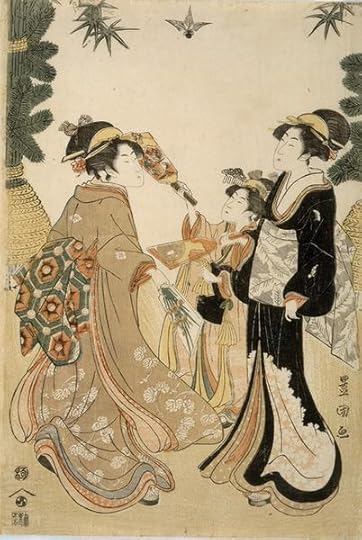
Many of the female characters play battledore & shuttlecock (an early form of badminton) My whole family used to play badminton. I love Japanese art. Good enough reason for a picture!
I originally thought that husband Yukitomo was as much a victim of late 19th century customs as the unfortunate women who he controls, but now I think he was just a self centred, not very bright jerk, who never realised what a treasure he had in his wife, Tomo.
I've thought about what I know about Japanese customs & the importance of saving face & now realise
Many of the female characters play battledore & shuttlecock (an early form of badminton) My whole family used to play badminton. I love Japanese art. Good enough reason for a picture!
This book is most highly recommended.

March 10, 2021
"Era una adolescente de quince años sacrificada por el bienestar de su familia, y lo único que le habían dicho era que entraría al servicio de la familia Shirakawa de Fukushima y que sería para siempre. Tenía que atender al señor como su servidora, pero nada le habían dicho sobre la naturaleza del servicio."
Lo primero que se me ocurre al comentar esta novela es lo valiente que fue Fumiko Enchi al escribirla y publicarla en 1957. Tengo entendido que fue un trabajo de ocho años y que está directamente inspirada en su abuela, pero así y todo, que en esa época y en Japón viera la luz una historia que hacia referencia directa al trato que se veían obligadas a soportar las mujeres entre las cuatro paredes de la vida doméstica, con una figura masculina que era quién tomaba las decisiones y disponía de ellas a su antojo, imagino que debió levantar ampollas. Fumiko Enchi da voz a esas mujeres, siempre silenciadas y convierte su historia en una novela eminentemente feminista aunque en aquella época, no creo que ni siquiera se la considerara como tal.
Los Años de Espera está ambientada entre finales del s.XIX y principios del XX en plena era Meiji, que fue el periodo en el que Japón empezó a modernizarse y a occidentalizarse. El hilo conductor es el personaje de Tomo, la esposa de un alto funcionario descendiente de samurais, Yukitomo Shirakawa, y la novela empieza justo cuando su marido le cuenta que ha decidido tomar una concubina y le pide a Tomo que le encuentra una jóven adecuada, claro que el pretexto es no hacerlo frente a la galeria (aunque era una costumbre muy extendida) sino bajo la excusa de que buscara una sirvienta. Tomo se enfrenta a un dilema pero como esposa sumisa que es, se pone manos a la obra y encuentra a Suga, una jovencita de quince años, cuyos padres están medio arruinados y de esta forma la compra. Desde este momento y durante los siguientes treinta años de su matrimonio, Tomo se enfrenta a situaciones complicadas, y que quizás ahora con nuestra mentalidad occidental nos resulte difícil entender, pero Fumiko Enchi nos demuestra que no era algo inusual en aquella época. Tomo ha sido educada como la mayoría de las mujeres de su generación, para mantener el hogar unido y tener a su marido contento y si entre las decisiones del hombre de la casa, era tener concubinas, ella no podía negarse porque si no, hubiera peligrado la seguridad suya y la de sus hijos.
“Pese a que Shirakawa demostraba apreciarla como si fuera una joya singular, la sensación de que la habían robado, de que era una cautiva, embargaba todavía el corazón de Suga, por lo que su belleza, aunque a ella le pasara desapercibida, era una belleza ensombrecida, como la de las flores de cerezo en un día nublado.”
La novela aunque apenas tiene doscientas páginas, cubre los últimos treinta años del matrimonio de Tomo y Yukitomo, y somos testigos cómo a lo largo de la novela se suman a la historia, concubinas, hijos y nietos, todos formando un universo doméstico que aunque en apariencia son una familia respetable, en su fondo algo huele a podrido. Tomo se ve obligada a renunciar a su propia dignidad para mantener las apariencias de una sociedad que aunque es verdad que estaba cambiando, ciertos cánones sociales antiguos se mantenían aférrados al código feudal para mantener los privilegios de ciertos hombres.
Dentro de la dureza de algunas escenas a mí me ha parecido una novela fascinante y totalmente necesaria que pone sobre el tapete el sacrificio de muchas mujeres a lo largo de la historia, no solo en Japón: a ellas siempre les tocaba la peor parte. Es una novela dura por cómo la autora te hace enfrentarte al hecho de que las mujeres, niñas de esta historia, eran una simple moneda de compraventa, de uso y destierro, pero al mismo tiempo Fumiko Enchi también te enfrenta a un personaje como Tomo sin juzgarla, haciéndonos comprender que la supervivencia es un hecho insustancial del ser humano.
“En este sentido, ya había dejado de ser la esposa que obedece a su marido con una fe incondicional en el criterio de éste, y poco a poco estaba adquiriendo la capacidad de verle con imparcialidad, como si fuese una persona ajena. Carecía de estudios, nunca le habían enseñado a comprender a otro ser humano desde un punto de vista intelectual y por naturaleza era incapaz de actuar dejándose llevar por el instinto. Este rasgo era el único que le había permitido mantener una férrea fidelidad al código feudal de moralidad femenina y considerar como su ideal a la esposa casta a la que no le disgusta ningún sacrificio por su marido y su familia. Pero ahora experimentaba una inequívoca desconfianza hacia el código que había sido su credo indiscutido”.
https://kansasbooks.blogspot.com/2021...
Lo primero que se me ocurre al comentar esta novela es lo valiente que fue Fumiko Enchi al escribirla y publicarla en 1957. Tengo entendido que fue un trabajo de ocho años y que está directamente inspirada en su abuela, pero así y todo, que en esa época y en Japón viera la luz una historia que hacia referencia directa al trato que se veían obligadas a soportar las mujeres entre las cuatro paredes de la vida doméstica, con una figura masculina que era quién tomaba las decisiones y disponía de ellas a su antojo, imagino que debió levantar ampollas. Fumiko Enchi da voz a esas mujeres, siempre silenciadas y convierte su historia en una novela eminentemente feminista aunque en aquella época, no creo que ni siquiera se la considerara como tal.
Los Años de Espera está ambientada entre finales del s.XIX y principios del XX en plena era Meiji, que fue el periodo en el que Japón empezó a modernizarse y a occidentalizarse. El hilo conductor es el personaje de Tomo, la esposa de un alto funcionario descendiente de samurais, Yukitomo Shirakawa, y la novela empieza justo cuando su marido le cuenta que ha decidido tomar una concubina y le pide a Tomo que le encuentra una jóven adecuada, claro que el pretexto es no hacerlo frente a la galeria (aunque era una costumbre muy extendida) sino bajo la excusa de que buscara una sirvienta. Tomo se enfrenta a un dilema pero como esposa sumisa que es, se pone manos a la obra y encuentra a Suga, una jovencita de quince años, cuyos padres están medio arruinados y de esta forma la compra. Desde este momento y durante los siguientes treinta años de su matrimonio, Tomo se enfrenta a situaciones complicadas, y que quizás ahora con nuestra mentalidad occidental nos resulte difícil entender, pero Fumiko Enchi nos demuestra que no era algo inusual en aquella época. Tomo ha sido educada como la mayoría de las mujeres de su generación, para mantener el hogar unido y tener a su marido contento y si entre las decisiones del hombre de la casa, era tener concubinas, ella no podía negarse porque si no, hubiera peligrado la seguridad suya y la de sus hijos.
“Pese a que Shirakawa demostraba apreciarla como si fuera una joya singular, la sensación de que la habían robado, de que era una cautiva, embargaba todavía el corazón de Suga, por lo que su belleza, aunque a ella le pasara desapercibida, era una belleza ensombrecida, como la de las flores de cerezo en un día nublado.”
La novela aunque apenas tiene doscientas páginas, cubre los últimos treinta años del matrimonio de Tomo y Yukitomo, y somos testigos cómo a lo largo de la novela se suman a la historia, concubinas, hijos y nietos, todos formando un universo doméstico que aunque en apariencia son una familia respetable, en su fondo algo huele a podrido. Tomo se ve obligada a renunciar a su propia dignidad para mantener las apariencias de una sociedad que aunque es verdad que estaba cambiando, ciertos cánones sociales antiguos se mantenían aférrados al código feudal para mantener los privilegios de ciertos hombres.
Dentro de la dureza de algunas escenas a mí me ha parecido una novela fascinante y totalmente necesaria que pone sobre el tapete el sacrificio de muchas mujeres a lo largo de la historia, no solo en Japón: a ellas siempre les tocaba la peor parte. Es una novela dura por cómo la autora te hace enfrentarte al hecho de que las mujeres, niñas de esta historia, eran una simple moneda de compraventa, de uso y destierro, pero al mismo tiempo Fumiko Enchi también te enfrenta a un personaje como Tomo sin juzgarla, haciéndonos comprender que la supervivencia es un hecho insustancial del ser humano.
“En este sentido, ya había dejado de ser la esposa que obedece a su marido con una fe incondicional en el criterio de éste, y poco a poco estaba adquiriendo la capacidad de verle con imparcialidad, como si fuese una persona ajena. Carecía de estudios, nunca le habían enseñado a comprender a otro ser humano desde un punto de vista intelectual y por naturaleza era incapaz de actuar dejándose llevar por el instinto. Este rasgo era el único que le había permitido mantener una férrea fidelidad al código feudal de moralidad femenina y considerar como su ideal a la esposa casta a la que no le disgusta ningún sacrificio por su marido y su familia. Pero ahora experimentaba una inequívoca desconfianza hacia el código que había sido su credo indiscutido”.
https://kansasbooks.blogspot.com/2021...

June 9, 2025
3,5 ⭐
-----
Una novela que retrata con fidelidad y crudeza cómo vivían las mujeres japonesas durante la segunda mitad del siglo XIX. Mujeres devotas, sumisas, sin voz que tenían la obligación de obedecer a sus padres y luego a sus esposos. Y entre esas obligaciones, muchas veces, debían agachar la cabeza y aceptar la llegada de las concubinas. Incluso, y muy a su pesar, algunas se dedicaban a elegir cuál era la mejor opción para agradar a sus esposos.
Tomo es esa mujer que dejó a un lado sus propios deseos para convertirse en una buena esposa, una compañera supeditada a la voluntad del hombre, una madre devota y una señora de su casa.
En un círculo donde muchas veces se competía por la atención del señor, surge también la amistad y la lealtad entre mujeres.
Una obra que hay que leer con pausa, dejándose llevar por la prosa de la autora, gran referente de la literatura japonesa y, sobre todo, de las historias protagonizadas por esas mujeres niponas que muchas veces se quedaban sin voz.
Cruda, realista y emotiva.
-----
Una novela que retrata con fidelidad y crudeza cómo vivían las mujeres japonesas durante la segunda mitad del siglo XIX. Mujeres devotas, sumisas, sin voz que tenían la obligación de obedecer a sus padres y luego a sus esposos. Y entre esas obligaciones, muchas veces, debían agachar la cabeza y aceptar la llegada de las concubinas. Incluso, y muy a su pesar, algunas se dedicaban a elegir cuál era la mejor opción para agradar a sus esposos.
Tomo es esa mujer que dejó a un lado sus propios deseos para convertirse en una buena esposa, una compañera supeditada a la voluntad del hombre, una madre devota y una señora de su casa.
En un círculo donde muchas veces se competía por la atención del señor, surge también la amistad y la lealtad entre mujeres.
Una obra que hay que leer con pausa, dejándose llevar por la prosa de la autora, gran referente de la literatura japonesa y, sobre todo, de las historias protagonizadas por esas mujeres niponas que muchas veces se quedaban sin voz.
Cruda, realista y emotiva.

July 27, 2015
First published at: http://www.meexia.com/bookie/2016/01/...
Continuing my Japanese book strikes, my first book of 2016 is The Waiting Years by Fumiko Enchi. I read this together with the Japanese Literature book group. It won the most votes out of the 5 books I proposed, and coincidentally it was probably the one I wanted to read the most, so it worked out nicely :).
Just a couple of dozens pages in, I was already surprised how quickly the plot was laid out. Somehow I was expecting it to be a slow read. The book is set in the early Meiji Era (1868-1912). It starts with Tomo - wife of a high Japanese official - looking for a young girl to be brought home. For what purpose, it was clear to the reader: to be a second woman, or a concubine, but it was never said out loud among the characters. Unlike some other cultures, there was not an official concubine role in this society, as the man does not marry the girl. And I mean it when I said "girl", because they were looking for a 15 year-old, inexperienced girl. The fact that the girl is underage made a very uncomfortable read to my modern eyes, probably more than any other issues that appear throughout the book.
The book kept surprising me throughout. I anticipated it to concentrate on catty rivalries between Tomo and the new girl, Suga, in the style of Rivalry: A Geisha's Tale (which I have not read, so I may be totally off, however Wikipedia mentions that Nagai Kafu was in young Enchi's reading list). But it's not. There would be more women coming into the house later on, but all the female characters get along with each other, for the most parts. How they behave felt very realistic, and to me showed how women behave in real life more than TV dramas. Hint: I'm not a fan of Asian TV dramas. I don't like how in them people behave in such outrageous, outlandish, exaggerated manners.
In this book, the women are dignified and logical in handling what life gives them. I loved that we get very close into the heads of the women, offering insights that I never felt I got when I read the other big name Japanese authors - who happen to be mostly male. As far as I remember, the female characters in books written by Kawabata, Tanizaki, Soseki, Kobo Abe, or Mishima even, are all very distant and aloof, and we never really get into their heads. It's hard to see them pass their outwardly submissive demeanour.
In the Waiting Years, though the women may still look to be submissive, there's a lot of internal conflicts and struggles, and there's anger that bubbles up in the characters, which is obviously Enchi's own feminist views of the system. And that brought me to conclude, that this book I think could only be written by a woman, and I'm thankful Fumiko Enchi gave voices to these women and made them real. It's an interesting portrait of Japanese culture at a particular time from a point of view that we rarely get.
I was wavering between 4.5 and 5 stars, but the ending pushed it over the edge. It's incredibly powerful, and so sad that I shed some tears.
During the reading, I coincidentally found a beautiful second hand copy of Masks - another popular book by Enchi, which I look forward to reading sometime. Finally, a favorite Japanese female author! (I really don't like Banana Yoshimoto. I couldn't stand her books.)
Continuing my Japanese book strikes, my first book of 2016 is The Waiting Years by Fumiko Enchi. I read this together with the Japanese Literature book group. It won the most votes out of the 5 books I proposed, and coincidentally it was probably the one I wanted to read the most, so it worked out nicely :).
Just a couple of dozens pages in, I was already surprised how quickly the plot was laid out. Somehow I was expecting it to be a slow read. The book is set in the early Meiji Era (1868-1912). It starts with Tomo - wife of a high Japanese official - looking for a young girl to be brought home. For what purpose, it was clear to the reader: to be a second woman, or a concubine, but it was never said out loud among the characters. Unlike some other cultures, there was not an official concubine role in this society, as the man does not marry the girl. And I mean it when I said "girl", because they were looking for a 15 year-old, inexperienced girl. The fact that the girl is underage made a very uncomfortable read to my modern eyes, probably more than any other issues that appear throughout the book.
The book kept surprising me throughout. I anticipated it to concentrate on catty rivalries between Tomo and the new girl, Suga, in the style of Rivalry: A Geisha's Tale (which I have not read, so I may be totally off, however Wikipedia mentions that Nagai Kafu was in young Enchi's reading list). But it's not. There would be more women coming into the house later on, but all the female characters get along with each other, for the most parts. How they behave felt very realistic, and to me showed how women behave in real life more than TV dramas. Hint: I'm not a fan of Asian TV dramas. I don't like how in them people behave in such outrageous, outlandish, exaggerated manners.
In this book, the women are dignified and logical in handling what life gives them. I loved that we get very close into the heads of the women, offering insights that I never felt I got when I read the other big name Japanese authors - who happen to be mostly male. As far as I remember, the female characters in books written by Kawabata, Tanizaki, Soseki, Kobo Abe, or Mishima even, are all very distant and aloof, and we never really get into their heads. It's hard to see them pass their outwardly submissive demeanour.
In the Waiting Years, though the women may still look to be submissive, there's a lot of internal conflicts and struggles, and there's anger that bubbles up in the characters, which is obviously Enchi's own feminist views of the system. And that brought me to conclude, that this book I think could only be written by a woman, and I'm thankful Fumiko Enchi gave voices to these women and made them real. It's an interesting portrait of Japanese culture at a particular time from a point of view that we rarely get.
I was wavering between 4.5 and 5 stars, but the ending pushed it over the edge. It's incredibly powerful, and so sad that I shed some tears.
During the reading, I coincidentally found a beautiful second hand copy of Masks - another popular book by Enchi, which I look forward to reading sometime. Finally, a favorite Japanese female author! (I really don't like Banana Yoshimoto. I couldn't stand her books.)

February 22, 2017
Me ha gustado más que el anterior libro que leí de esta autora ("Máscaras femeninas"). En esta ocasión nos sitúa en la era Meiji y nos habla de un tema tan complejo como son las concubinas de los hombres de poder, contándolo en su mayor parte desde el punto de vista de las propias chicas y también de la señora del susodicho. Es un libro que sobre todo transmite tristeza y nos acerca a la realidad de tantas vidas de mujeres perdidas a la sombra de un hombre autoritario y despreciable. La pluma de Fumiko Enchi es adictiva y es una lástima que no hayan traducido más libros suyos.
May 4, 2025
De libros como este me encanta cuando en varios pasajes pienso: "si no fuera porque lo estoy leyendo, no habría sabido ni sentido esto". Una historia que acerca a las historias de muchas mujeres, que hace repensar nuevamente todo el tema de género y comprenderlo con más convicción, y una historia que más de una vez genera un nudo en la garganta y activa las ganas de entrar en la aparente pasividad del libro para cambiar su rumbo. Aunque eso, claramente, no se pueda. Un final tan simple como perfecto, que resume todo el camino de Tomo, el personaje que atraviesa la historia.

June 26, 2016
Life is one long wait. A series of goals and milestones reached -- large and small --with a lot of waiting in between. And then there's that larger feeling of "waiting," the overriding one that spans all those events -- that vague and hard-to-pinpoint nagging sense of dissatisfaction that most humans carry from cradle to grave. The one that is famously characterized by the song phrase: "Is that all there is?"
In Fumiko Enchi's 1957 novel, The Waiting Years, it's not plainly clear what is being waited for, or who is doing the waiting, but we can easily guess. This is a book by a woman writer, writing about a society where women are, in essence, "waiters," in all senses of the word. They are servile to men, they literally wait on them, tend to their needs, and then wait -- often for a whole lifetime -- for their own emotional or modest self-actualizing rewards that rarely, if ever, come.
It's a slow, sly book that eschews drama, and demurely holds back its emotional payoff till the very last pages.
The book densely packs a lot of plot and characters into a svelte 200 pages, as it chronicles the mostly banal life of an elite Japanese family living in the provincial town of Fukushima (yes, later of nuclear infamy) over the course of a generation from the late 19th century to the World-War-I era. It's a time of Westernizing influences in Japan, but many social customs and traditions remain entrenched, particularly domestic ones.
The monolithic patriarch around which everything revolves in this book's claustrophobic world is Yukitomo Shirakawa, a wealthy high government official with a sense of manly entitlement borne of his samurai heritage. Though his own politics are not explored deeply, it's clear that Yukitomo is a traditionalist, a conservative serving a government opposed to liberalizing forces and "radicals" influenced by Western ideology. These same traditions bolster a system of sexual dominance in which women are more or less traded and sold into indentured servitude, whether as wives, maids, concubines or geisha.
It's a system that allowed well-heeled men like Yukitomo to take a legal wife while having a series of surrogate wives on the side in a polygamous manner, though not openly so. Japanese propriety, modesty, decorum and the code of tit for tat -- female servitude in exchange for financial security -- ensured its existence. As secrets go, this state of affairs was an open secret hidden only to the truly naive.
The fear of poverty haunts the women in this novel: a fear of remaining in poverty and never finding a suitable match, and the fear of destitution after the rejection of the male, even after finding that match.
These fears are embodied most strongly in the book by Yukitomo's stalwart wife, Tomo, who stoically endures the corrosive tortures to her psyche that accrue over decades of her husband's habitual philandering and her own feelings of valuelessness. Tomo is a strong woman, and the book makes it clear, she is stronger than Yukitomo. She is fearless in ways that Yukitomo is not, and yet, she is toothless in the real sense -- diplomatic and close-lipped, rarely outwardly betraying her emotions, feelings or opinions. She is the true head of the household, keeping its financial and domestic affairs in order while Yukitomo performs his office duties and tends to his after-hours cavorting. She is conflicted in the way she lives and in what she sees. She loves her husband, values his work, appreciates him as a provider, and, oddly, seems to admire his taste in other women, even as the realizations of his estranged affections to her and jealousy over her rivals slowly kills her inside.
Tomo's seeming outward detachment and dispassionate stance reflects the stylistic strategy and tone of the author. Fumiko Enchi's omniscient voice is slightly distanced, reluctant to pass judgment on these characters, male or female -- preferring to lead us to both obvious and ambivalent conclusions. She has scribed a sprawling saga filled with taboo sexual escapades that never panders to the prurient, yet is strong on subdued eroticism and disturbing implications. Enchi is too sophisticated a writer to turn Yukitomo into a monster; indeed, he is often a sympathetic character, even though he remains one of the least well-defined ones in the book. The real hearts and souls of the book reside in the women who orbit around him. Only at the end do we get a better glimpse of Yukitomo's humanity, in a moment of karmic realization. Shin Buddhism is one of the book's philosophical anchors, and Tomo relies on it for inner strength. It is also a religious precept that abets her inner conflict: she worries that her husband's immorality will have a karmic consequence. At the same time, she finds uneasy solace in the notion that male providers -- as long as they are publicly "moral" -- can do what they please in private.
One of the obvious draws for a lot of readers to this book is the promise of taboo relations, and there are plenty of those therein. Yukitomo's idea of maid service goes well beyond shaking out the tatami mats. He has it on with the maids, and a series of adolescent girls whose impoverished parents have been paid off in exchange for their all-inclusive services. At the beginning of the story, Yukitomo tactlessly sends his wife to Tokyo expressly to buy him a servant/concubine, Suga, a lovely 15-year-old, and Tomo is so intent on pleasing her husband that she selects the best possible rival for her affections. Tomo is nothing if not dedicated, and obviously very very conflicted.
As the story goes on, even a young stepdaughter, Miya, is not safe from Yukitomo's attentions, yet even here there's a relative lack of complete condemnation of him. Yukitomo is a generous provider, a good listener and a sensitive lover, much more so than his sociopathic, abusive, indolent son, Michimasa. Often what's wrong in this book is relatively less wrong.
I did appreciate some of Enchi's not-so-subtle allusions. Suga is compared rather provocatively to a "tightly folded bud," and Yukitumo daily enjoys a serving of damson plums that have been picked while green and pickled in their unripened state. In every way, it seems, Yukitomo is an epicurean of the young stuff.
The book's narrative style is slightly strange. In addition to its often disarming detachment, it also seems fidgety at times. Sometimes the story becomes so densely packed with characters you want an intergenerational family tree to help you keep track. Some of the sentences seem oddly structured, which may owe somewhat to the translation. The book begins with two characters in great detail who are pretty much jettisoned entirely for the rest of the story. Most jarring of all is the book's lack of a stable center of interest. No one character or set of characters can truly said to be its protagonist(s). Apart from Tomo and the two concubines, Suga and Yumi, the sense of the inner lives of the characters is often vague. Tomo is easily the "conscience" of the story, though -- the one who most readily and obviously realizes its implications. For Tomo, being a wife, mother, and fire-douser provides a sense of purpose, but not a sense of fulfillment. She sacrifices her time, her efforts and her emotions -- everything -- without the most profound validation of all: love. Tomo's feeling of disposability informs one of the most moving moments in the book, which to detail would constitute a spoiler.
Because of Tomo's plight, she grows to love even the staunchest of the rivals for her husband's affections. All of us, all women, are in the same boat, she comes to understand.
The Waiting Years raises complicated issues in an unusual way. Because of its style, I did not experience the full emotional power implicit in the story, and I did crave for a more inner-focused perspective and better-rounded characters. The story races over vast spans of time and covers many barely-defined characters and often skated-over situations. The book contains obviously sensational motifs and themes, but Enchi, perhaps to her credit, never lets these devolve into a cheap or melodramatic soap opera. There's nothing polemical or hamfisted in her approach -- there's no "victim" narrative in the usual sense. She doesn't have to resort to those things for us to grasp the messages. In its resignation lies it social criticism.
It's a fascinating book, perhaps not a great one, but certainly worth checking out, especially for those interested in Japanese history and culture and in pre-feminist and non-Western approaches to examining the lives of women.
(KR@Ky 2016)
In Fumiko Enchi's 1957 novel, The Waiting Years, it's not plainly clear what is being waited for, or who is doing the waiting, but we can easily guess. This is a book by a woman writer, writing about a society where women are, in essence, "waiters," in all senses of the word. They are servile to men, they literally wait on them, tend to their needs, and then wait -- often for a whole lifetime -- for their own emotional or modest self-actualizing rewards that rarely, if ever, come.
It's a slow, sly book that eschews drama, and demurely holds back its emotional payoff till the very last pages.
The book densely packs a lot of plot and characters into a svelte 200 pages, as it chronicles the mostly banal life of an elite Japanese family living in the provincial town of Fukushima (yes, later of nuclear infamy) over the course of a generation from the late 19th century to the World-War-I era. It's a time of Westernizing influences in Japan, but many social customs and traditions remain entrenched, particularly domestic ones.
The monolithic patriarch around which everything revolves in this book's claustrophobic world is Yukitomo Shirakawa, a wealthy high government official with a sense of manly entitlement borne of his samurai heritage. Though his own politics are not explored deeply, it's clear that Yukitomo is a traditionalist, a conservative serving a government opposed to liberalizing forces and "radicals" influenced by Western ideology. These same traditions bolster a system of sexual dominance in which women are more or less traded and sold into indentured servitude, whether as wives, maids, concubines or geisha.
It's a system that allowed well-heeled men like Yukitomo to take a legal wife while having a series of surrogate wives on the side in a polygamous manner, though not openly so. Japanese propriety, modesty, decorum and the code of tit for tat -- female servitude in exchange for financial security -- ensured its existence. As secrets go, this state of affairs was an open secret hidden only to the truly naive.
The fear of poverty haunts the women in this novel: a fear of remaining in poverty and never finding a suitable match, and the fear of destitution after the rejection of the male, even after finding that match.
These fears are embodied most strongly in the book by Yukitomo's stalwart wife, Tomo, who stoically endures the corrosive tortures to her psyche that accrue over decades of her husband's habitual philandering and her own feelings of valuelessness. Tomo is a strong woman, and the book makes it clear, she is stronger than Yukitomo. She is fearless in ways that Yukitomo is not, and yet, she is toothless in the real sense -- diplomatic and close-lipped, rarely outwardly betraying her emotions, feelings or opinions. She is the true head of the household, keeping its financial and domestic affairs in order while Yukitomo performs his office duties and tends to his after-hours cavorting. She is conflicted in the way she lives and in what she sees. She loves her husband, values his work, appreciates him as a provider, and, oddly, seems to admire his taste in other women, even as the realizations of his estranged affections to her and jealousy over her rivals slowly kills her inside.
Tomo's seeming outward detachment and dispassionate stance reflects the stylistic strategy and tone of the author. Fumiko Enchi's omniscient voice is slightly distanced, reluctant to pass judgment on these characters, male or female -- preferring to lead us to both obvious and ambivalent conclusions. She has scribed a sprawling saga filled with taboo sexual escapades that never panders to the prurient, yet is strong on subdued eroticism and disturbing implications. Enchi is too sophisticated a writer to turn Yukitomo into a monster; indeed, he is often a sympathetic character, even though he remains one of the least well-defined ones in the book. The real hearts and souls of the book reside in the women who orbit around him. Only at the end do we get a better glimpse of Yukitomo's humanity, in a moment of karmic realization. Shin Buddhism is one of the book's philosophical anchors, and Tomo relies on it for inner strength. It is also a religious precept that abets her inner conflict: she worries that her husband's immorality will have a karmic consequence. At the same time, she finds uneasy solace in the notion that male providers -- as long as they are publicly "moral" -- can do what they please in private.
One of the obvious draws for a lot of readers to this book is the promise of taboo relations, and there are plenty of those therein. Yukitomo's idea of maid service goes well beyond shaking out the tatami mats. He has it on with the maids, and a series of adolescent girls whose impoverished parents have been paid off in exchange for their all-inclusive services. At the beginning of the story, Yukitomo tactlessly sends his wife to Tokyo expressly to buy him a servant/concubine, Suga, a lovely 15-year-old, and Tomo is so intent on pleasing her husband that she selects the best possible rival for her affections. Tomo is nothing if not dedicated, and obviously very very conflicted.
As the story goes on, even a young stepdaughter, Miya, is not safe from Yukitomo's attentions, yet even here there's a relative lack of complete condemnation of him. Yukitomo is a generous provider, a good listener and a sensitive lover, much more so than his sociopathic, abusive, indolent son, Michimasa. Often what's wrong in this book is relatively less wrong.
I did appreciate some of Enchi's not-so-subtle allusions. Suga is compared rather provocatively to a "tightly folded bud," and Yukitumo daily enjoys a serving of damson plums that have been picked while green and pickled in their unripened state. In every way, it seems, Yukitomo is an epicurean of the young stuff.
The book's narrative style is slightly strange. In addition to its often disarming detachment, it also seems fidgety at times. Sometimes the story becomes so densely packed with characters you want an intergenerational family tree to help you keep track. Some of the sentences seem oddly structured, which may owe somewhat to the translation. The book begins with two characters in great detail who are pretty much jettisoned entirely for the rest of the story. Most jarring of all is the book's lack of a stable center of interest. No one character or set of characters can truly said to be its protagonist(s). Apart from Tomo and the two concubines, Suga and Yumi, the sense of the inner lives of the characters is often vague. Tomo is easily the "conscience" of the story, though -- the one who most readily and obviously realizes its implications. For Tomo, being a wife, mother, and fire-douser provides a sense of purpose, but not a sense of fulfillment. She sacrifices her time, her efforts and her emotions -- everything -- without the most profound validation of all: love. Tomo's feeling of disposability informs one of the most moving moments in the book, which to detail would constitute a spoiler.
Because of Tomo's plight, she grows to love even the staunchest of the rivals for her husband's affections. All of us, all women, are in the same boat, she comes to understand.
The Waiting Years raises complicated issues in an unusual way. Because of its style, I did not experience the full emotional power implicit in the story, and I did crave for a more inner-focused perspective and better-rounded characters. The story races over vast spans of time and covers many barely-defined characters and often skated-over situations. The book contains obviously sensational motifs and themes, but Enchi, perhaps to her credit, never lets these devolve into a cheap or melodramatic soap opera. There's nothing polemical or hamfisted in her approach -- there's no "victim" narrative in the usual sense. She doesn't have to resort to those things for us to grasp the messages. In its resignation lies it social criticism.
It's a fascinating book, perhaps not a great one, but certainly worth checking out, especially for those interested in Japanese history and culture and in pre-feminist and non-Western approaches to examining the lives of women.
(KR@Ky 2016)

June 6, 2023
When Tomo Shirikawa’s husband, Yukitomo, a prestigious government official, requires her to go in search of a concubine to share her home and his bed, he shatters her faith in everything except her ability to manage her family and perform the hard duties before her. She carries out his assignment, and she brings home with her a beautiful, young and innocent girl, Suga, to effectively take her place.
This begins the story of Tomo’s life spent in trying to preserve a home and family, in a marriage devoid of love and swamped by private humiliations. The careless and unfeeling actions of Yukitomo continue to amass, and one is torn between admiration for this woman who shoulders her burden so brilliantly and a desire to scream at her for making life so easy for those who hurt her so callously.
Some of the questions raised in this short novel are those of choice. How much do we have, particularly women in a society that only favors men? Are we predestined to the lives we lead or do we simply resign ourselves to them?
Yet why, she asked herself, should she be obligated to spend all her life entangled with such distasteful affairs? Why should things that she wished no part in happen, or threaten to happen, among those she was closest to and loved the most. It was a problem that admitted of no solution under any theories that her mind could conceive. Some power, outside herself, had given life to her and determined the course that she should take.
Tomo struggles with her choices, many of which she knows to be an aid to immorality of the worst order. This is primarily a character study, and I was surprised to find myself in tears at the end. I had not thought it that affecting, until I suddenly found that it was.
Was it possible then that everything she had lived for was vain and profitless?
Tomo asks herself this question, and we seek the answer along with her. In many ways she is the bulwark that stands between the misery and destruction that might overtake all these people at any time. Fumiko Enchi, I think, lets us decide.
This begins the story of Tomo’s life spent in trying to preserve a home and family, in a marriage devoid of love and swamped by private humiliations. The careless and unfeeling actions of Yukitomo continue to amass, and one is torn between admiration for this woman who shoulders her burden so brilliantly and a desire to scream at her for making life so easy for those who hurt her so callously.
Some of the questions raised in this short novel are those of choice. How much do we have, particularly women in a society that only favors men? Are we predestined to the lives we lead or do we simply resign ourselves to them?
Yet why, she asked herself, should she be obligated to spend all her life entangled with such distasteful affairs? Why should things that she wished no part in happen, or threaten to happen, among those she was closest to and loved the most. It was a problem that admitted of no solution under any theories that her mind could conceive. Some power, outside herself, had given life to her and determined the course that she should take.
Tomo struggles with her choices, many of which she knows to be an aid to immorality of the worst order. This is primarily a character study, and I was surprised to find myself in tears at the end. I had not thought it that affecting, until I suddenly found that it was.
Was it possible then that everything she had lived for was vain and profitless?
Tomo asks herself this question, and we seek the answer along with her. In many ways she is the bulwark that stands between the misery and destruction that might overtake all these people at any time. Fumiko Enchi, I think, lets us decide.

March 12, 2018
An interesting book, different to my normal read.
The main character is Tomo, the wife of a mid ranking official. The setting is Japan in the early part of the 20th century. A time of rapid change.
Married at 14 and a mother by the age of 15, Tomo is the head of the household whilst her civil servant husband rises through government ranks. He philanders his way through the housemaids, and then decides that a concubine would be fitting for a man of his standing. So he sends his dutiful wife off to Tokyo to find one for him. She does this out of a sense of duty. A few years later, a servant is "elevated" to the role of concubine 2 and then for good measure a daughter in law is added to the harem.
Through it all Tomo retains an air of calm, running the very complicated household without a murmur. Occasionally we see a glimpse of inner turmoil but for the most part she presents a serene face to the world. She marries off concubine 2 when her husband tires of her, sees that her daughter is married and settled comfortably and bites her lip at the "secret" affair between her husband and her son's wife, secret in that everyone knows about it apart from the son.
Then she dies.
An interesting insight into a world far removed in time and culture from my own.
The main character is Tomo, the wife of a mid ranking official. The setting is Japan in the early part of the 20th century. A time of rapid change.
Married at 14 and a mother by the age of 15, Tomo is the head of the household whilst her civil servant husband rises through government ranks. He philanders his way through the housemaids, and then decides that a concubine would be fitting for a man of his standing. So he sends his dutiful wife off to Tokyo to find one for him. She does this out of a sense of duty. A few years later, a servant is "elevated" to the role of concubine 2 and then for good measure a daughter in law is added to the harem.
Through it all Tomo retains an air of calm, running the very complicated household without a murmur. Occasionally we see a glimpse of inner turmoil but for the most part she presents a serene face to the world. She marries off concubine 2 when her husband tires of her, sees that her daughter is married and settled comfortably and bites her lip at the "secret" affair between her husband and her son's wife, secret in that everyone knows about it apart from the son.
Then she dies.
An interesting insight into a world far removed in time and culture from my own.
August 28, 2025
5 🌟—A story that stays with me long after the last page.
Fumiko Enchi’s The Waiting Years is one of the most captivating Japanese novels I’ve read. I couldn’t put it down, and even when I had to step away, the story lingered in my mind, replaying itself endlessly.
Enchi’s talent for crafting deeply multifaceted personalities is astonishing—every character feels vivid and compelling. The depiction of women’s oppression, the simmering anger they must conceal, and the ways it inevitably finds expression, is both intense and heartbreaking. I was completely absorbed by the emotional complexity and subtle power struggles woven throughout the narrative.
On top of that, I have a deep love for historical fiction set in this period of Japan, and this book fed that fascination perfectly. I devoured it almost in a single sitting, utterly enthralled from start to finish.
Fumiko Enchi’s The Waiting Years is one of the most captivating Japanese novels I’ve read. I couldn’t put it down, and even when I had to step away, the story lingered in my mind, replaying itself endlessly.
Enchi’s talent for crafting deeply multifaceted personalities is astonishing—every character feels vivid and compelling. The depiction of women’s oppression, the simmering anger they must conceal, and the ways it inevitably finds expression, is both intense and heartbreaking. I was completely absorbed by the emotional complexity and subtle power struggles woven throughout the narrative.
On top of that, I have a deep love for historical fiction set in this period of Japan, and this book fed that fascination perfectly. I devoured it almost in a single sitting, utterly enthralled from start to finish.

May 12, 2017
It was strangely difficult to get hold of this book – I preordered a new edition almost two years in advance but finally received a refund, for it fell through somewhere, and finally got hold of a very battered second hand copy with pages dropping out of it. Tides flow in and out and I sometimes try to be patient and read something else when the book I’m pursuing is at an ebb – other times I chase all the harder fearing the object of my desire may slip entirely beyond my grasp if I hesitate. I hope this book remains available and becomes more so; it’s really very good. And although I don’t have the requisite experience to judge its veracity, it’s one of those works that seems to capture the spirit of a time period in the fineness of grain only possible in proximity.
The novel centres on Tomo, the wife of a wealthy, ruthless, promiscuous man. Tomo serves her husbands wishes and interests and manages his affairs to the utmost of her ability, all the while fully conscious of the unfair and unjust patriarchal system that compels her to subsume her own emotions and betray other women to protect herself, her family, the social order. Her submission might make her sound weak and passive, but nothing could be further from the truth; she is a person of immense strength of character and extraordinary self-discipline. She is highly perceptive and sensitive to the needs and feelings of others, and she deals ably with the affairs of the household and estates even though her literacy is limited. She seems to work much harder than her husband and he is disturbed by the awareness that she is the stronger of the two.
Equally, Tomo’s self-control might be (and often is, by other characters) perceived as coldness, heartlessness, but again and again we are told that she feels compassion, guilt, fierce love, blazing desire. There is nothing wrong with Tomo’s heart; just as the rest of her is healthy and whole. She embodies the cruelty of her husband and society because of her talent and commitment, not because of anything lacking in her.
The density and precision of visual description in the novel creates, I feel, a certain detachment, as if the whole action were staged and observed from outside. The visual, always meticulously sketched, sometimes defines, sometimes overshadows the action with a layer of experience that is always fresh and crisp, the ephemeral suggesting the perennial or eternal.
Tomo’s engagement with Buddhism provides her with a way to understand her feelings of confinement, of being trapped, as being bound to the wheel of death and rebirth, from which the enlightened or virtuous may gain freedom. That worldly things like family ties and desire for love bind us more tightly to the wheel is an idea Tomo explicitly reflects on when she looks pityingly at Suga’s empty lap when other young women are playing with their babies. Yet her experience suggests that without the freedom to pursue such ends, it’s not possible to become free of desire for them. In her case, only by experiencing them, working for them and wearying of them does Tomo reach an attitude approaching renunciation; she arrives at it through suffering. There must be better ways through this whirling world…
A last point – Shirakawa Yukitomo represents the old order ruthlessly trying to preserve itself. His political enemies are the “Liberal Party”. But those men are no allies of the women Shirakawa oppresses. When they look at them, the Party men sneer at Shirakawa for keeping “tarts like that” in luxury. Like the male-dominated left everywhere and everywhen, they’re serving the same old patriarchy in new bottles.
The novel centres on Tomo, the wife of a wealthy, ruthless, promiscuous man. Tomo serves her husbands wishes and interests and manages his affairs to the utmost of her ability, all the while fully conscious of the unfair and unjust patriarchal system that compels her to subsume her own emotions and betray other women to protect herself, her family, the social order. Her submission might make her sound weak and passive, but nothing could be further from the truth; she is a person of immense strength of character and extraordinary self-discipline. She is highly perceptive and sensitive to the needs and feelings of others, and she deals ably with the affairs of the household and estates even though her literacy is limited. She seems to work much harder than her husband and he is disturbed by the awareness that she is the stronger of the two.
Equally, Tomo’s self-control might be (and often is, by other characters) perceived as coldness, heartlessness, but again and again we are told that she feels compassion, guilt, fierce love, blazing desire. There is nothing wrong with Tomo’s heart; just as the rest of her is healthy and whole. She embodies the cruelty of her husband and society because of her talent and commitment, not because of anything lacking in her.
The density and precision of visual description in the novel creates, I feel, a certain detachment, as if the whole action were staged and observed from outside. The visual, always meticulously sketched, sometimes defines, sometimes overshadows the action with a layer of experience that is always fresh and crisp, the ephemeral suggesting the perennial or eternal.
Tomo’s engagement with Buddhism provides her with a way to understand her feelings of confinement, of being trapped, as being bound to the wheel of death and rebirth, from which the enlightened or virtuous may gain freedom. That worldly things like family ties and desire for love bind us more tightly to the wheel is an idea Tomo explicitly reflects on when she looks pityingly at Suga’s empty lap when other young women are playing with their babies. Yet her experience suggests that without the freedom to pursue such ends, it’s not possible to become free of desire for them. In her case, only by experiencing them, working for them and wearying of them does Tomo reach an attitude approaching renunciation; she arrives at it through suffering. There must be better ways through this whirling world…
A last point – Shirakawa Yukitomo represents the old order ruthlessly trying to preserve itself. His political enemies are the “Liberal Party”. But those men are no allies of the women Shirakawa oppresses. When they look at them, the Party men sneer at Shirakawa for keeping “tarts like that” in luxury. Like the male-dominated left everywhere and everywhen, they’re serving the same old patriarchy in new bottles.

September 30, 2016
Esta es una novela estupenda que retrata la vida de las mujeres en el Japón de finales del siglo XIX. Como algunas de las obras japonesas que he leído, tiene un ritmo propio, que el lector debe digerir y disfrutar. Esta no es una historia llena de sobresaltos o de amores apasionados y, sin embargo, mantiene en un hilo todo el tiempo. ¿Qué más hará el esposo de Tomo que logre sorprenderla? Porque siempre hay más.
Tomo es una mujer japonesa casada con un alto funcionario del gobierno. Con dos hijos y con una posición envidiable, Tomo sufre en silencio las constantes infidelidades de su marido, Yukitomo. Un día, él le pide a su esposa que se encargue de encontrarle una concubina, y Tomo, fiel a su ética y a la manera en que fue educada, viaja a Tokio para cumplir con su tarea. Ahí encuentra a Suga, quien será la primera de las dos concubinas en la familia. Poco a poco la autora va revelando la relación entre esta pareja: una mujer apasionada pero cuyo marido no supo corresponderle, no porque no la amara o gustara, sino porque, como es común, él tenía miedo de la fortaleza, de la independencia, de la inteligencia de su mujer.
Es interesante este retrato de la vida doméstica japonesa, que muchas veces pareciera tan cerrada: el sistema de relaciones y ética de aquel país pareciera rígido, con el papel de las mujeres siempre subyugado al de los hombres (como en el resto del mundo), pero en estos personajes, se observa con más detenimiento. Yukitomo hubiera podido amar a su mujer, si no le hubiera temido, si no hubiera sentido que él tenía que cumplir con papel.
Tomo acepta su destino pero en ningún momento la percibimos como débil. En mi punto de vista, es un personaje formidable, entero, una mujer de su tiempo, y por ello mismo, admirable.
Además, el estilo de Enchi es un deleite: es una prosa fluida, pero suave que nos involucra en la vida de mujeres y hombres como espectadores en casas ordendas y silenciosas, en donde la naturaleza también se encuentra en armonía con las emociones y pensamientos de los protagonistas.
La luz de los faroles que pendían de postes en la entrada o sostenían en la mano en la que los aguardaban para recibirla todavía brillaba menos que el resto de la claridad diurna, que prestaba una belleza aún más etérea al cortejo nupcial.
Tomo es una mujer japonesa casada con un alto funcionario del gobierno. Con dos hijos y con una posición envidiable, Tomo sufre en silencio las constantes infidelidades de su marido, Yukitomo. Un día, él le pide a su esposa que se encargue de encontrarle una concubina, y Tomo, fiel a su ética y a la manera en que fue educada, viaja a Tokio para cumplir con su tarea. Ahí encuentra a Suga, quien será la primera de las dos concubinas en la familia. Poco a poco la autora va revelando la relación entre esta pareja: una mujer apasionada pero cuyo marido no supo corresponderle, no porque no la amara o gustara, sino porque, como es común, él tenía miedo de la fortaleza, de la independencia, de la inteligencia de su mujer.
Es interesante este retrato de la vida doméstica japonesa, que muchas veces pareciera tan cerrada: el sistema de relaciones y ética de aquel país pareciera rígido, con el papel de las mujeres siempre subyugado al de los hombres (como en el resto del mundo), pero en estos personajes, se observa con más detenimiento. Yukitomo hubiera podido amar a su mujer, si no le hubiera temido, si no hubiera sentido que él tenía que cumplir con papel.
Tomo acepta su destino pero en ningún momento la percibimos como débil. En mi punto de vista, es un personaje formidable, entero, una mujer de su tiempo, y por ello mismo, admirable.
Además, el estilo de Enchi es un deleite: es una prosa fluida, pero suave que nos involucra en la vida de mujeres y hombres como espectadores en casas ordendas y silenciosas, en donde la naturaleza también se encuentra en armonía con las emociones y pensamientos de los protagonistas.
La luz de los faroles que pendían de postes en la entrada o sostenían en la mano en la que los aguardaban para recibirla todavía brillaba menos que el resto de la claridad diurna, que prestaba una belleza aún más etérea al cortejo nupcial.

June 8, 2017
Written in 1957 – a mere 12 years after the devastation of Tokyo - Fumiko Enchi takes you back to the Meiji era. We are introduced to the household of a government (police) official. His work is not covered, but in the course of this novel he rises and feathers his nest such that when parliamentary reforms take place (i.e. via the liberals he has wanted to jail) Yukitomo Shirikawa has a comfortable retirement.
The work spans perhaps 40 years showing the experience of Tomo Shirikawai, the perfect wife for this authoritarian politician and husband. She surrenders all to keep the family name repected. This involves, having children, managing a household and finding “acceptable assistance” for her husband. Yulitomo wields full power in this household, and Tomo has no recourse but to keep her head down and comply.
I presume this is a realistic portrayal of upper class life in the Meiji era, but it is more importantly a character study of a woman who despite her achievements, has sacrificed her self. You learn of her simple origins. You see her put her emotions aside as she perfectly performs her most morally compromising assignment: finding the perfect “comfort” for her husband.
Tomo accepts this position in this cold and thankless environment. In denying her emotions, she essentially denies herself honest relationships with everyone around her. She is cool to her daughter; the young teens who have her husband’s eye; her son whose upbringing is farmed out; her favorite grandson whom she wants to protect from the family secrets; and of course, her husband to whom she cannot directly speak.
This book is slow. It is steady. Each scene is important to showing the reader the situation and how over the years life evolved for women such as Tomo. It shows how authoritarian personalities can deny and ignore the feelings and contributions of those around them to get what they want. When the culture and the laws are on their side, those without choice are sacrificed. The concept is universal. This material can be adapted to show family life in Afghanistan, Saudi Arabia, pre-bellum US plantations and anywhere where a group is socially (and if follows that they will also be lawfully) unable to make basic life choices.
What was Tomo waiting for? The sad end of the book tells you.
The work spans perhaps 40 years showing the experience of Tomo Shirikawai, the perfect wife for this authoritarian politician and husband. She surrenders all to keep the family name repected. This involves, having children, managing a household and finding “acceptable assistance” for her husband. Yulitomo wields full power in this household, and Tomo has no recourse but to keep her head down and comply.
I presume this is a realistic portrayal of upper class life in the Meiji era, but it is more importantly a character study of a woman who despite her achievements, has sacrificed her self. You learn of her simple origins. You see her put her emotions aside as she perfectly performs her most morally compromising assignment: finding the perfect “comfort” for her husband.
Tomo accepts this position in this cold and thankless environment. In denying her emotions, she essentially denies herself honest relationships with everyone around her. She is cool to her daughter; the young teens who have her husband’s eye; her son whose upbringing is farmed out; her favorite grandson whom she wants to protect from the family secrets; and of course, her husband to whom she cannot directly speak.
This book is slow. It is steady. Each scene is important to showing the reader the situation and how over the years life evolved for women such as Tomo. It shows how authoritarian personalities can deny and ignore the feelings and contributions of those around them to get what they want. When the culture and the laws are on their side, those without choice are sacrificed. The concept is universal. This material can be adapted to show family life in Afghanistan, Saudi Arabia, pre-bellum US plantations and anywhere where a group is socially (and if follows that they will also be lawfully) unable to make basic life choices.
What was Tomo waiting for? The sad end of the book tells you.

May 23, 2020
I finally found and read this novel, it isn't quite a 5 star read but from my reading experience of Japanese literature it is a coherent straight forward narrative, with a controlled feminist outrage.
The story of Tomo, a stoic dutiful wife taking the bucketful of infidelities of her strong willed husband with couth acceptance and keeping her resentment tightly reigned, she is a force to be reckoned with and a character of extreme dignity. She is in fact the orbit of the well maintained household.
I could identify with her seething resignation of finding her husband another woman to love and lay, as with many women in my culture who have to bow to the arrival of a new wife into her house and life, for whatever's sake. Be it financial dependance, a sense of duty, maintenance of the family status, the price is often too high to endure for the woman in such a position.
It is also a dismal life for the female gender of that culture and era.
I had a sense of reading a book by the Japanese Edith Wharton,where a sense of doing what is perceived as right is paramount.
The story of Tomo, a stoic dutiful wife taking the bucketful of infidelities of her strong willed husband with couth acceptance and keeping her resentment tightly reigned, she is a force to be reckoned with and a character of extreme dignity. She is in fact the orbit of the well maintained household.
I could identify with her seething resignation of finding her husband another woman to love and lay, as with many women in my culture who have to bow to the arrival of a new wife into her house and life, for whatever's sake. Be it financial dependance, a sense of duty, maintenance of the family status, the price is often too high to endure for the woman in such a position.
It is also a dismal life for the female gender of that culture and era.
I had a sense of reading a book by the Japanese Edith Wharton,where a sense of doing what is perceived as right is paramount.

February 6, 2014
I love the The Waiting Years for its subtly creepy, haunting feel and its simple writing style. My heart went out to every woman in the story.
Read it slowly, and then maybe flip through it again. This is a book that should be savored.
Read it slowly, and then maybe flip through it again. This is a book that should be savored.

April 21, 2023
This started off interesting and tragic but ended merely okay.
The book is broken into multiple parts each one separated by a time slip and new additional characters. Each story was less interesting and most of the added characters were kind of bland and underdeveloped.
The book is broken into multiple parts each one separated by a time slip and new additional characters. Each story was less interesting and most of the added characters were kind of bland and underdeveloped.


February 27, 2025
Para años de espera los que llevaba yo queriendo leer a Fumiko Enchi. Y no me ha decepcionado: el arraigo a las tradiciones que sufrieron muchas mujeres japonesas resuena todavía hoy. La autora les da voz a ellas para contar una historia dolorosa, narrada con toda la delicadeza que permite el tema.
Displaying 1 - 30 of 521 reviews