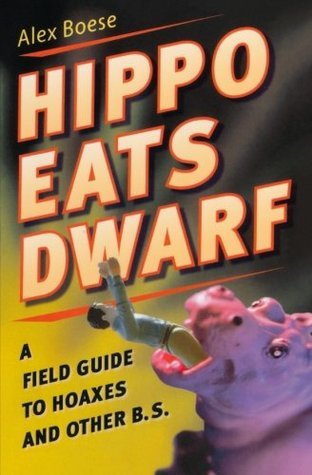
Can you grow a bonsai kitten? Should you stock up on dehydrated water? Is it easy to order human-flavored tofu? Or is this all just B.S.?
In a world of lip synching, breast implants, payola punditry, and staged reality shows, it's hard to know the real from the fake. Hippo Eats Dwarf is the essential field guide to today's Misinformation Age. Whether you're deciphering political doublespeak or trying to decide whether to forward that virus warning, hoaxpert Alex Boese provides the guidelines you need. For instance, Reality Rule 6.1: Just because you read it on the Internet doesn't make it true.
With case files, reality checks, definitions, and plenty of doctored photos, Hippo Eats Dwarf is an entertaining guide to life, death, eBay, and everything in between.
Retelling, insightful analysis and then a verification or d-verification of some of the world's greatest urban myths, fakes and hoaxes. A interesting and satisfying read, but with the internet around, there's only so much detail and context a book can bring. 7 out of 12.
Was poodle clipping included as an official competition in the 1900 Summer Olympics?
In the months preceding the 2008 Olympic Games in Beijing, Christopher Lyles wrote a daily "Beijing Countdown" column for The Daily Telegraph in which he would note how many days remained until the Games, and then offer an interesting Olympic fact related to that number.
For instance, on March 29, 2008, with 131 days to go until the games, Lyles observed that 131 was also "the number of number of competitors who took part in last November's 'first-past-the-post' US Olympic marathon trial for this year's Games."
On March 31, with 129 days remaining, he reported that the LZ 129 Hindenburg was remembered for its "brooding presence at the opening ceremony of the 1936 'Nazi' Games in Berlin," as well as for being destroyed by fire in 1937.
And on April 1, with 128 days remaining, Lyles delved into the curious history of Olympic poodle clipping. Here's his full column from that day:
128: The number of competitors who participated in the poodle-clipping event at the 1900 Olympics in Paris. The event was held in the leafy environs of the Bois de Boulogne and it was the only occasion that it featured as an Olympic discipline.
This, no doubt, came as a relief to Baron Pierre de Coubertin, the French founding father of the modern Olympic movement, who had opposed its inclusion, but was outvoted by his International Olympic Committee colleagues. The gold medal was won by Avril Lafoule, a 37-year-old farmer's wife from the Auvergne region of France, who successfully clipped 17 poodles in the allotted two-hour time frame. The poodle-clipping competition, held on April 1, was watched by 6,000 spectators, one of the larger audiences at the most chaotic Olympic Games of all.
Disappointing. The vast majority of Boese's "reality rules" don't include anything a reasonably intelligent person wouldn't already know. There are occasionally some interesting examples, but overall I feel like I wasted my time on this book. Also, some of his criticisms are ridiculous, such as saying that LotR fans don't understand what reality is because they sometimes debate the finer points of the elvish language. Apparently Boese doesn't know that Tolkein enjoyed inventing languages, and constructed the stories around his languages, making debates about the elvish languages he created just as valid as debated about any other language.Also, Boese's own grammar reflects his inability to fully follow a single train of thought.
This compilation of urban legends, hoaxes, and funny stories is oddly dated. The speed of information in the internet age makes 2006 seem a long time ago. Rather than timeless, this book is outdated. Bernie Madoff has outshone the Enron house of cards, the Michael Jackson suicide hoax has been long forgotten after his real death, and most of the slang has been usurped with new terms. Some things never change however. These sorts of books are always better as bathroom books (read a little periodically) rather than straight through. It is never a good idea to monkey around with print color. Brown print on green pages--hard to read, I found the changing page and ink colors distracting and cheap.
That being said, I do have something to say about hippos and dwarfs.
Kristin, your little friends are wrong. They have been affected by the skepticism of a skeptical age. They do not believe except they see. They think that nothing can be which is not comprehensible by their little minds. All minds, Kristin, whether they be men's or children's, are little. In this great universe of ours, man is a mere insect, an ant, in his intellect, as compared with the boundless world about him, as measured by the intelligence capable of grasping the whole of truth and knowledge.
Not believe in carnivorous hippos! You might as well not believe in Santa Claus!
Yes, Kristin, there is a circus where hippos feed on unsuspecting dwarfs and jackalopes run free. A world where Nigerian millionaires are giving away money, and Brittany Spears sings live.
No yawning hippos endangering short people! Ridiculous.Thank heavens there is a place where the Weekly World News lives and reports forever. A thousand years from now, nay, ten times ten thousand years from now, it will continue to make glad the heart of childhood.*
Ultimately a bit disappointing. I'd enjoyed 'Elephants on Acid' a few years ago, as that seemed to have quite a bit of interesting content that was new to me. This, however, was a series of sections on not particularly new or exciting urban legends, internet rumours, even just stuff that a small number of gullible folk believed. Though presented in a light and readable style, and not a problem to get through as a consequence, anyone with half a brain and/or who has lived during the internet age would not be fooled by, and would have already heard, the vast majority of what this book presents.
This is a collection of crazy things – images, stories, chain letters, warnings, fakery, etc. that have been reported in the news, found on the internet, and circulated via email. It’s perfect for browsing if you’re looking for a laugh or some interesting conversational tidbits to bring to your next gathering (and if you don’t have access to Snopes.com, where you can go to learn about and in many cases debunk all of the panicked emails forwarded to you by your mother).
I got about half way through this – reading it straight through – and then I was finished (but the book goes on!). While it can be read like this, most readers will probably want to skim it or open it randomly and feast their eyes on whatever they find on the particular page on which they’ve landed. There’s actually a lot of early internet day nostalgia betwixt these pages – if you’ve been online since the early 90s, you’ll find yourself exclaiming, “I remember that!” And since these things often make the rounds many times over the years, others may be experiencing these phenomena for the very first time. Oh lucky you! Pick it up, read a little, put it down – you’re almost sure to find something weird and hilarious in this field guide.
HIPPO EATS DWARF: A FIELD GUIDE TO HOAXES AND OTHER B.S. is hilarious! If you want something light and fun to read, then this is the book for you! And how could you not want to read a book called HIPPO EATS DWARF? As if that isn't the greatest title ever!
This book is all about hoaxes that people have created or have thought up! There are some great ones in this book. They are things as obvious as the "you must forward this e-mail or you are going to die" e-mails that everyone gets to the unreality of reality TV shows.
I really liked this book, and have a friend who really liked it, also. There are some really funny, useless facts in this book, too. I definitely will tell all of my friends to read this!
Outdated and superficial. Not worth it if you're hard pressed to find the time to read. As a toilet read though, it should be outstanding, with enough material for any amount of time you spend in the crapper. The previous book, "Elephants on Acid" was much better as it didn't rely so much on being up to date.
I was a little grossed out by the fake pregnancies, the male pregnancies, the male lactation and the disgusting plastic surgery and anorexia in the first two chapters, but after that the book got good. Surprisingly good. Alex Boese's formula includes a lot of information and misinformation, and gives you the reader in some cases the opportunity to guess which is which. For example, did a circus dwarf fall into the mouth of a yawning hippo, triggering the hippo's swallowing reflex?
How about Snowball, that 87-pound cat you've probably seen pictures of. Real? Or the bonsai kittens in a bottle?
Just to prove this is NOT a fake Amazon review written by the author in disguise (see page 112), I am going to reveal the answers (sorry Alex): no, no, and no. Well, you knew that. But if you've seen the hippo nature special on PBS you know that hippos will on occasion join the crocs and the lions at the kill.
Aside from the many hoaxes and the you've-got-to-be-kidding-me's, and various other wtf's, what Boese does so well in this book is entertain in a way that makes you think. What I was thinking was can we believe anything anymore? I mean almost any photo can be faked and photoshopped. Politicians steal elections and invent phony reasons for wars as massive Halliburton welfare projects, etc. And the media doesn't know veracity from its elbow. And it's getting so nobody really cares anymore. Boese is documenting this and calling it to our attention.
His main source is the Web in all its quirky, bogus, hoaxy and fun-loving glory. But hold on, Virginia. One would think after all these years that somebody would be getting a clue that--quoting Boese's "Reality Rule 6.1": "Just because you read it on the Internet doesn't mean it's true." Take the strange case of "The Gullible Professor" (p. 125). Weldong Xu of Harvard University (Bush's grad school, don't you know) "received an e-mail informing him of a business proposal that would transfer $50 million into his bank account...The only catch was the usual 'unforeseen expenses,' numbering hundreds of thousands of dollars. He raised $600,000 from friends and colleagues, telling them he was collecting money to fund SARS research in China... [E]ven after he was arrested, Xu continued to insist that his friends overseas were going to send him $50 million."
Judging from my email, the Nigerian scam is small potatoes compared to the lottery scam. I get several "Congratulations you have won!!!!" for every "I am Rwanda Ugamba...reply urgently my secretary." Just for the heck of it I added up how much I had won in just one 24-hour period: $32.7 million. And I do this every day.
Then there are the "Internet-Crossed Lovers" who, assuming new identities, joined an online chat room for singles. Lo and behold when they arrived at their pre-arranged rendezvous, it turned out that they were none other than each other's spouse! Shades of the "Pina Colada Song," God help us.
One of the funniest bits is Boese's report of "The New 'Honor System' Virus." You get an email that reads: "This virus works on the honor system. Please forward this message to everyone you know, then delete all the files on your hard drive. Thank you for your cooperation." (p. 123)
There's a lot of comical stuff about George W. and the Bush administration and all of its mendacities and misinformations and outright b.s., and some golden oldies from the Clinton years as well, some of it true and some of it not so true. But here's a big time reality check for you: Boese gives various definitions of neologisms throughout the book such as this one:
"Money Party, n.: The monolithic political party rumored to govern the United States. Said to camouflage its monopoly on power by periodically hiring new actors to serve as presidents, senators, and congressmen." (p. 241)
In his naivete, Boese thinks he's joking around. Actually there IS only one political party in the US with two branches, the Republican and the Democratic, and they do indeed send in a new cast every few years.
This is a "fun" book obviously with lots of photos (touched up and not) and other art work. The text appears in brown, green and white on green and brown and sometimes white, but it's not distracting. I would rate this as just a clever bon-bon book except for the fact that Boese really does come up with some startling juxtapositions between reality and unreality, and because the unavoidable message that will hit the reader is a profound one. I would call that message, "Reality, what a concept!" (From Robin Williams, some years ago, when he was still doing TV's "Mork and Mindy.")
One final warning: pictured on page 139 is a "DVD Rewinder." Regardless of how much it is marked down, don't buy it.
--Dennis Littrell, author of “The World Is Not as We Think It Is”
Hippo Eats Dwarf: A Field Guide to Hoaxes and Other B.S. by so-called "hoaxpert" Alex Boese is something of an odd book, and not actually mainly because of its subject matter. Ostensibly a pop-culture guide to navigating "bullshit" in mass media (at least as of 2006, its publication date), Hippo Eats Dwarf largely fails both as a humor book and as a study of the subject matter. I don't know whether Boese's other books on hoaxes are any better than this one, but Hippo Eats Dwarf has too much snark to be anything remotely like a serious study of untruth in media, and the humor is too hit-or-miss for Hippo Eats Dwarf to qualify as primarily a humor book.
Having read Charles Seife's Virtual Unreality, on largely the same subject matter, I feel as if Seife's book is a much more recommendable book on media untruth; I get the distinct impression—particularly in an era of "fake news" on all sides—that the subject matter benefits from a more serious treatment. Along those lines, Hippo Eats Dwarf simply doesn't work in the way Boese clearly intends: The entire tone of Boese's book lends not at all to any kind of cohesive themes and lessons to be gained from the subject matter; the overall tone is one of superficial case studies propounded essentially at random (albeit within certain supposed sub-categories set forth by Boese), and Hippo Meets Dwarf is utterly forgettable, in a way that Virtual Unreality wasn't.
I somewhat wish I could set forth more details as to what made Hippo Eats Dwarf so thoroughly disappointing, but that's just it: Writing this a few weeks later, I literally can remember barely anything of what I read in the book. Hippo Eats Dwarf is inconsequential fluff, and not in a positive way; one gets the impression that Boese's goal was snark for its own sake rather than anything actually educational or enlightening, and the entire content went in one ear and out the other.
This was first published in 2006 and this edition was updated in 2010. Therefore I didn't expect everything to be up to date and also that there would be things that the author predicted that never caught on. There is also some language that seems misplaced in the current year and also a few things I assume are typos. None of the above affected my rating of the book.
There are some interesting topics contained covering many areas of life. The question and answers at the end of each topic are nearly impossible to answer unless you already know the answers. Some of the content is probably in may other books but some I haven't read before.
As a toilet book it works. Bite-sized segments and chapters that mostly are interesting. I would like to see an updated version as we have a lot more hoaxes since. It gets 3* but a high 3*. I have read a lot worse toilet books.
It seems that people’s wisdom does not grow with their age, especially in modern age when advanced technology fosters an overflow of information (true and false) on various social media and internet.
This book shows you the world’s greatest urban myths, fakes and hoaxes. You will be surprised to know how many people take them as real and treat those very seriously.
Following from the excellent Elephants on Acid, it was great to also come across this.
Opening the Museum of Hoaxes, the author takes us through the greatest hits, as it were. The weird and wonderful are all covered and are sectioned off into very easily read chapters and short snippets of fascination.
The perfect book sitting on the crapper. Or that might be a lie too!
This reads almost like a list of thematically-related scams and hoaxes. It was all a little overwhelming and too fast-paced.
Since this book predates AI, widespread social media usage, and weaponized fake news, I did have some appreciation for the craft of these scammers and hoaxers. Fooling people was serious work a mere decade or two ago.
A mixed bag - some interesting stories but also a lot of common knowledge too. Overall an easy read and fun to dip in and out of but nowhere near as fascinating as Elephants on Acid
Boese ferrets out the truth behind urban myths, scams, hoaxes, outright lies, and a few strange things that actually turn out to be true. Some of these stories will be familiar (Is anyone still falling for that Nigerian bank scam? You know, the one where some guy asks you to send some money to help him get his money into the U.S.….). Other stories might not be (Did you know that the Sudanese press once contributed to a rumor that a Zionist agent was loaning out electric combs that removed the borrowers’ genitals? I missed that one!)
The author’s approach is lighthearted and humorous, and while this isn’t the kind of book that cites everything, Boese exudes authority and reliability in his conclusions. As each individual entry represents a quick, self-contained reading experience, you can choose to read one entry at a time, or you can enjoyably devour an entire chapter at once.
If you’re interested in some additional entertainment, take a gander at the customer reviews for this book on Amazon. They’re a perfect example of why Hippo Eats Dwarf warns “Amazon reviews should be taken with a heavy grain of salt.”
I admit, I grabbed this off the library shelf because the tornado sirens were going off and I needed something in hand to read while cowering in the shelter zone of the library. But I checked it out after the all clear and read it all the way through. This is an amusing account of hoaxes and scams, mainly on the Internet but also in real life. Some have had amazing durability as urban legends. Others are surprising only in that people actually fell for them (spaghetti trees?) This is mostly for fun, in short humorous sections perfect for reading in waiting rooms (if you can avoid snorting with laughter in public) or for ten minutes at the end of a long day when you need to turn your sour mood around. Most people won't find a lot of new or protective information here (especially given the 2006 date), although handing it to your teenager may be an acceptable way to instill a little caution. Some warnings about things like phony E-bay bids or faux blogs may be good reminders of the benefits of skepticism. But mostly this is entertainment, and I defy anyone to read it without a giggle or three.
This is an interesting book on fakery, scams, pranks and the occasional true strange fact. This was a quick, amusing read that reminds you to never take the world at face value.
The most fascinating sections are generally the more historical chapters. Those dealing with computer and email scams already seem dated, with references to slang and neologisms that may have seemed innovative at the time, but never caught on (such as Ham for spam emails with some useful content). Boese’ advice on how to avoid online scams was written before the growth of social media so seems quaint and antiquated.
This was a charity shop find and, for £1 it was an entertaining diversion.
PS - I re-read this in 2024 before sending it back to the charity shop and have knocked a star off my rating. The problem is, it is very much of its time, and just ten years on even the language used for life online has changed.
I've given this book 3 stars, but it's really more a 3.5, I'm just being stingy. Hippo Eats Dwarf is exactly my type of book, I'm really into myths and subliminal messages and things of that nature, so I was extremely and excited and surprised to receive this book. And let me tell you, it does not disappoint. This book of random and unuseful facts is extremely interesting and I soaked up every ounce of information. However, towards the end, I did feel the book got a bit too samey, and thus my interest waned. This may have been my fault, as I feel this book was more a pick up and read whenever, rather than a sit down and read front to back, which I did. Thus, I downgraded its mark. I would definitely recommend this to those who are interested in hoaxes and things like that, and I would definitely recommend it!
An interesting guide to hoaxes, and I have to admit, some of them I've been fooled by for years! While I was never going to go to Nigeria to collect my boyfriend's mysterious Uncle's fortune (did you know that these have moved on from JUST emails to actual letters as well? We didn't, but Bowie has had two rich relatives die in different countries just this year! Imagine that!) some of the urban legends had me at fact for ages.
This is the kind of book you should read occasionally, so you don't get bored with the similar stories. Also, there are questions at the end of each chapter; I recommend reading the question then flipping to the answers. I read all the questions and then answers and couldn't remember the original question!
Interesting book, well researched and written. Four stars.
The book was published in 2006, which dates it a bit, but the information contained within makes for a breezy read. This nonfiction guide to Internet hoaxes and urban legends explains itself rather well in the introduction: "Living in a hippo-eats-dwarf world requires hippo-eats-dwarf survival skills." There is so much in our world that is fraudulent, it's necessary to be able to determine what's real and what's fake. The author holds a degree in the history of science and has also authored another book, The Museum of Hoaxes, which I also recommend.