A recreation of the great 1906 earthquake that virtually leveled San Francisco presents the catastrophe through the eyes of the people there, including an architect excited by new possibilities, a photographer capturing history, and a fortune-hunting soldier
The 1906 earthquake and fire that devastated the city of San Francisco remains one of the most famous of catastrophes and is still cited as the "last big one" when Californians discuss "the next big one". Instead of yet another history of the event, Richard Wheeler has provided a historical novel showing how the sudden hell-on-earth affected the everyday citizens of the wicked Barbary Coast (the City's most famous nickname).
He learned that he had no rights as a citizen. Learned that Death visited whenever Death chose to visit. Learned that there is no dignity in dying.
Each chapter is about a different character or family and there are a plethora of characters to follow.
Harrison Barnes White - an ambitious workaholic blind to his family
Katharine Steinmetz - an aspiring photographer crippled by arthritis
Carl Lubbich - a city engineer as crooked as they come
Ginger Severance - a devout Christian devoted to good works
Jack Deal - Army Sergeant and thief
Nella Klapp - a domestic servant impregnated by her employer's son
And there are more, I lost count. I admire the author for trying to put a Dickens-ish touch to a parking lot of protagonists, but I found myself without anyone to whom I could attach my sympathies. Because each new chapter highlights a different character, I lost track of what was happening to the bedraggled folks I had met previously. Ambitious goals perhaps, for the author, but I simply became confused.
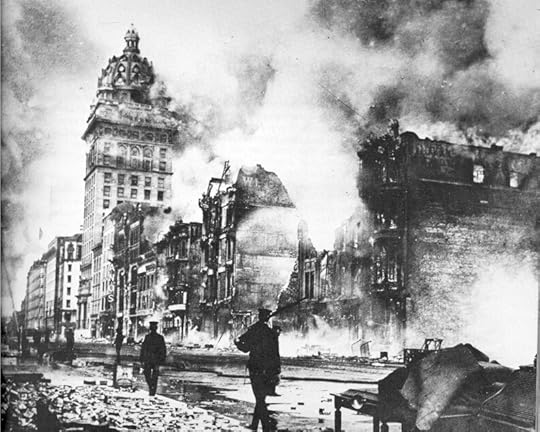
There was some good research done on the actual history of the disaster. The Army, for instance, was conveniently posted in the beloved Presidio and were able to move in to help immediately. But while they excelled in setting up soup kitchens and tent hospitals, they ended up dynamiting the City into near oblivion, causing more damage than the actual fire. Plus, the army was full of low-lifes who shot innocent civilians and raped and looted with carte blanche. San Francisco also had the dismal luck of having its elected officials as filthily corrupt as they could be, resulting in a municipal government that had long failed to prepare for such a disaster.
Prior to the 1906 quake, the City also had to deal with the Bubonic Plague (which the mayor did his best to deny). In the best example of silver linings spitting from dark clouds, the rats were mostly fried to death in the post-quake fire, allowing the new City to be rebuilt. Enrico Caruso, Jack London and John Barrymore also saunter around in the novel (The Great Profile would use the catastrophe as his excuse to miss a tour to Australia, the devil), but blink and you miss them.
Beds were treasures, unspeakably sweet places. She had not known what a bed could mean until she had gone a week without one.
A couple of characters get their do-ins, although the sudden wrap-ups didn't ring true. The San Francisco Earthquake and Fire of 1906 has almost as many absorbed followers as the 1912 Titanic Sinking, so this novel might work for them, but it did not work for moi.
"Aren't you going to take my picture?" the woman asked. Katharine took several, capturing a haunted face, a frail woman beyond tears, a woman with hurt in her brown eyes. "The eyes are the windows of the soul," the woman said. "Now you have photographed all the pain that is in me." Katharine returned to her tent because her knees--and spirit--could endure no more. Maybe, some day, some editor would want photographs of ruined people instead of ruined buildings.
Wheeler brings us into the midst of history in his novel Aftershocks , chronicling the San Francisco earthquake of 1906...and then the days, weeks, and (briefly) months afterwards. He chooses to use the viewpoint of multiple characters. We meet (1) Harrison Barnes White--an architect who is more concerned with using the disaster to promote his skills than assuring the safety of his wife and children. (2) Carl Lubbich--city engineer, and complacent enabler of the corrupt mayor, Schmitz. (3) Ginger Severance--a young woman who served as a street missionary to riff-raff in Chinatown and the surrounding slums prior to the earthquake, and who does her best to assuage misery in the wake of it. (4) Katharine Steinmetz--a middle-aged photographer with arthritic knees who attempts to escape to refuge with her crippled lover, and then painstakingly documents the refugee camp in pictures. (5) Sergeant Major Jack Deal--he, along with his troop, assist in fighting fires and "rescuing" civilians...all with a distinct lack of moral compunction. (6) Nella Clapp--a house servant prior to the earthquake, her romantic notions led her into a compromising position with the son of her employer. Post earthquake, she finds herself adrift, and despairs of any sort of future for herself.
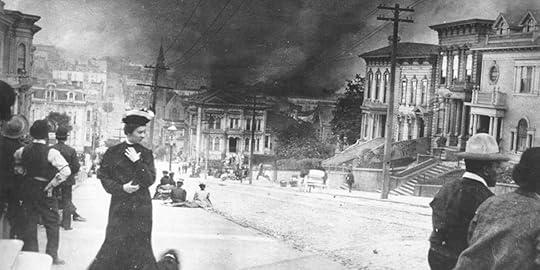
Through these various viewpoints, we experience the earthquake in all it's powerful, life-changing detail. Wheeler takes us into the ruins, past the fire and rubble, into the refugee camps, and behind the scenes of governmental intervention (both life-saving and corrupt). For those who love glimpses into history, this is a great pick.
Bottom line: While the multiple view-points allowed Wheeler to show us a broad view of the disaster and its repercussions, this approach prevented me from really getting to know any one character. Books with 3 viewpoints are problematic enough; with 6 main characters, I felt like I was reading an interesting history book more than a good novel. With that being said, Wheeler uses excellent prose, and I recommend this to anyone interested in American history. Given 3.5 stars or a rating of "Very good".
Example quote: "That day she discovered desperate and despairing people at every hand, separated from loved ones, sick, lame, in wheelchairs, devastated by loss of children, parents, brothers, and sisters. Insecure people fearing the future, mad people deranged by a catastrophe, lonely people aching for someone, anyone, to speak to, share with; people who could not speak English and didn't know how to get help; people so paralyzed they couldn't walk to the breadlines, get soup, get some of the used clothing mounded near the field kitchens, people dreading a night in the open in the cold Pacific wind[...]. She saw them not as souls in need of the Word, but as mortals to love and nurture. She saw that she must help them, that memorable day, not because they were fodder to bring to the maw of God, but as desperate people she loved, she ached for, she needed to help because her mission was to love and help and nurture and comfort."
Historical fiction has its own peculiar appeal. In one sense, it intrigues us by placing readers in a world quite different from our own. As fantasy takes us through a metamorphosis that penetrates the veil of known experience and enters the symbolic mists of myth and science-fiction transports us from the limits of the empirically known present into the asteroid fields of the future or galaxies other than our own, historical fiction sews us back into an earlier fold in the fabric of time. Yet, the historical novel also contains touch-points with our memories of history learned and stories told. Recent history, such as Wheeler’s Aftershocks (stories centering around the Great San Francisco Earthquake in the early 20th century), has a particular way of causing my eyes to open wide and say, “I remember that” or more likely, “I ALMOST remember that.” Having lived in San Francisco at a much later period of time, I can identify with the faded paint of ads on decaying brick walls—many identifying coffee mills and warehouses that no longer operate in San Francisco. So, it is no wonder that I delighted in a reference to M.J. Brandenstein coffee. My strange mind immediately made the leap to the brand of coffee I knew from my youth (MJB) and one of those dilapidated brick wall ads. Believe it or not, I found a picture of one of those I remembered from my days in “The City.” MJB ad features an ad from around 1910 (we know that MJB used this slogan at the Johnson-Jeffries heavyweight fight in 1910). At one point in the book, a refugee goes to the Hyde St. Pier. Now, a museum of old ships, it even houses an old Southern Pacific steam ferry (The “Eureka”) that is much like the ferry described in Aftershocks. And, of course, I once had an office that overlooked the ferry building, so I was totally in-synch with the idea of refugees trudging to that site from all over San Francisco. Now, those are some of the reasons that I should have liked the book better than I did. In the same vein, many of the characters portrayed in the book were memorable. The ambitious architect could easily have been me in earlier days. The temptations faced by the city engineer were similar to some lesser temptations I faced (and thankfully avoided—for once) in my career. The spiritual vision followed by one young woman was both commendable and disheartening, but it rang true with people I’ve known and, in some ways, with aspects of my own character. The cameos of famous people (Barrymore, Caruso, London, etc.) were tastefully accomplished without disrupting the flow of the book (such as it was). The inability of media and entrepreneurs to recognize the works of art placed in their hands by the photographer was so typical that it made me angry. The impetuous nature of the former insurance salesman was interesting, but seemed to lack direction other than in his mechanistic desire to do something new. The individual shanghaied onto a Pacific schooner instead of being rescued offered poetic justice and a sense of closure, but other aspects of that plot line seemed too unfinished and too cynical to offer any joy. Most of all, I was frustrated by the fact that the stories told in this book could just as easily have been individual short stories. There was no central, bearing wall to the “novel” other than the quake itself. I found myself wanting these characters to somehow interact with each other, somehow cooperate with each other in terms of preparing to build a new city from the rubble. Yet, there was no compelling aspect of the “plot” to pull them together or keep me turning pages. I get impatient with books that have casts of thousands and merely seem to jump haphazardly from character to character with no apparent reason. Aftershocks seemed the epitome of a such a book. As a result, I had placed the book in a bag I seldom use (this was prior to a long nagging, but relatively minor, illness where I spent months just going through the motions of my work) and didn’t find it again until a week ago. To be honest, I only started reading it again because I needed a book I could read between batting practice and the first pitch at Wrigley Field without worrying about leaving it behind – I DIDN’T leave it behind, but that was my original thinking. The bottom line, this book was worth reading, but left something lacking, some coherency that could have been but wasn’t there. I’m glad I did read it; there are some images that I never would have experienced without the effort. Yet, there’s the rub. It was an effort.
This was a quality novel about the aftermath of the Great San Francisco earthquake of 1906. Wheeler uses fifty dollar words at times, but does a great job of evoking the desperation, the despair, the weariness of the people of San Francisco. The author has a solid grasp on the happenings he describes, probably after pouring through numerous first person descriptions. He seems to know the political climate as well as the moral and social climate.
He take sthe time to use some real people in some non-historic ways, but he explains that uasage in the author's note along with his purpose.
The author follows the characters about and describes their hopelessness. The resolutions of the fictional stories are quite well thought out on his part, truly representing the historical setting and in some cases the social values of the times. He also takes time to debunk the concept that Frisco was destroyed by God as a judgment on a modern day Sodom and Gomorrah, both through character's speech, opinions, and beliefs, as well as through the very interesting author's note at the end of the book. WELL WORTH READING!
One of the cool things about this book is the way that the resolute (those who know what they think they need to do and are positive abou the direction they are going) gradually lose their resolution in the midst of the catastrophe, while the irresolute (those confused and feeling hopeless) gradually become resolute and rise from the ashes.
I highly recommend this to folks who like to read historical novels. This one is quite well written, high-minded, and takes the time to reflect an entire catastrophe, avoiding the cliche of some great love in the midst of tragedy a la the "Titanic" film with Leonard DiCrapio.
"Aftershocks" begins with the earthquake of 1906. San Franciscans are literally thrown from their beds and their lives will never be the same. The story follows a number of citizens affected by the quake: Harrison White, an ambitious young architect who abandons his family to help with planning of the city's reconstruction and his wife Marcia who is left the deal with their children; Ginger, a young street evangelist who finds that victims have no use for her tracts; Nella, a young domestic fired for dallying with her employer's son; Carl, the city engineer whose graft is in part responsible for the lack of water to extinguish the fires raging after the quake; Kathleen and Emil, elderly and ailing artists who only have each other, and other characters who try to deal with their new reality. The characters are well-drawn and sympathetic, and you are left wanting more of their post-quake stories. Highly recommended.
This was an interesting book on the earthquake of 1906. It was an interesting book of historical fiction. The book followed the lives of several individuals. It did give information on many events which happened as a result of the earthquake. It was entertaining and not a difficult read but I thought it made some leaps on the events happening during those days but I think the way it looked at human suffering during the 1906 earthquake was interesting.
I love my home town, San Francisco! This was an enlightening book describing some of the horrors as well as the triumphs surrounding the earthquake and fire of '06! Maybe if I wasn't a native, maybe if I didn't have grandparents who lived through this...maybe then I wouldn't think it was such a great book. But I did like it very much!
A group of San Franciscans cope with the aftermath of the 1906 earthquake. There was a lot of repetitive description , but I never did get a sense of the city's almost complete devastation. The fictional characters' stories were less than compelling.
Fictional account of the San Francisco earthquake and fire, told through the experiences of several of its survivors. Historical stuff is very interesting, but the characters are wooden and the frequent use of questions as a literary technique is irritating. Author usually writes westerns.
Wheelers books are fun and have lots of interesting characters. This, the story of the aftermath of the San Francisco earthquake of 1906 is very informative.