Now I’ve finally finished the 3rd book in the Five Children and It series. By this time, I’m almost ashamed to say, I was wearying somewhat of the episodic stories. I still enjoyed it, and it was interesting to notice parts that seem to have inspired C. S. Lewis in his Narnia books (saying ‘May he live forever’ about a ruler in Babylon and the Queen of Babylon ending up in London—reminiscent of when Jadis ended up in England in The Magician’s Nephew.)
As always, I’ve collected little tidbits for your enjoyment. I hope they will be amusing.
“The book about all this is called Five Children and It, and it ends up in a most tiresome way by saying—
“The children did see the Psammead again, but it was not in the sandpit; it was—but I must say no more—”
The reason that nothing more could be said was that I had not then been able to find out exactly when and where the children met the Psammead again. Of course I knew they would meet it, because it was a beast of its word, and when it said a thing would happen, that thing happened without fail. How different from the people who tell us about what weather it is going to be on Thursday next, in London, the South Coast, and Channel!”
And:
“I hope you notice that they were not cowardly enough to cry till their Father had gone; they knew he had quite enough to upset him without that. But when he was gone everyone felt as if it had been trying not to cry all its life, and that it must cry now, if it died for it. So they cried.
And:
“After tea Anthea went up to the room that had been Father’s, and when she saw how dreadfully he wasn’t there, and remembered how every minute was taking him further and further from her, and nearer and nearer to the guns of the Russians, she cried a little more. Then she thought of Mother, ill and alone, and perhaps at that very moment wanting a little girl to put eau-de-cologne on her head, and make her sudden cups of tea, and she cried more than ever. And then she remembered what Mother had said, the night before she went away, about Anthea being the eldest girl, and about trying to make the others happy, and things like that. So she stopped crying, and thought instead. And when she had thought as long as she could bear she washed her face and combed her hair, and went down to the others, trying her best to look as though crying were an exercise she had never even heard of.”
And:
“her rooms were furnished “for letting.” Now it is a very odd thing that no one ever seems to furnish a room “for letting” in a bit the same way as one would furnish it for living in. This room had heavy dark red stuff curtains—the colour that blood would not make a stain on—with coarse lace curtains inside. The carpet was yellow, and violet, with bits of grey and brown oilcloth in odd places. The fireplace had shavings and tinsel in it. There was a very varnished mahogany chiffonier, or sideboard, with a lock that wouldn’t act. There were hard chairs—far too many of them—with crochet antimacassars slipping off their seats, all of which sloped
the wrong way. The table wore a cloth of a cruel green colour with a yellow chain-stitch pattern round it. Over the fireplace was a looking-glass that made you look much uglier than you really were, however plain you might be to begin with. Then there was a mantelboard with maroon plush and wool fringe that did not match the plush; a dreary clock like a black marble tomb—it was silent as the grave too, for it had long since forgotten how to tick. And there were painted glass vases that never had any flowers in, and a painted tambourine that no one ever played, and painted brackets with nothing on them.”
And:
“Presently, by some wonderful chance turn of Robert’s (who had been voted Captain because the girls thought it would be good for him—and indeed he thought so himself—and of course Cyril couldn’t vote against him because it would have looked like a mean jealousy)”
And:
“Wake the boys and this dormouse of a Jane, and when you’ve had your breakfasts we’ll have a talk.”
And:
“Never mind,” said Anthea kindly; “we’ll take you anywhere you like if you want us to. What was it you were going to say upstairs when I said the others wouldn’t like it if I stayed talking to you without them?”
It looked keenly at her, and she blushed.
“Don’t be silly,” it said sharply. “Of course, it’s quite natural that you should like your brothers and sisters to know exactly how good and unselfish you were.”
And:
“No,” said the Psammead, “I seem to remember that about you. Well, sit down and listen with all your ears. Eight, are there? Right—I am glad you know arithmetic. Now pay attention, because I don’t intend to tell you everything twice over.”
And:
“a sudden cold pain caught at Anthea’s heart. Father—Mother—the darling Lamb—all far away. (If you don’t know what a cold pain is, I am glad for your sakes, and I hope you never may.)”
And:
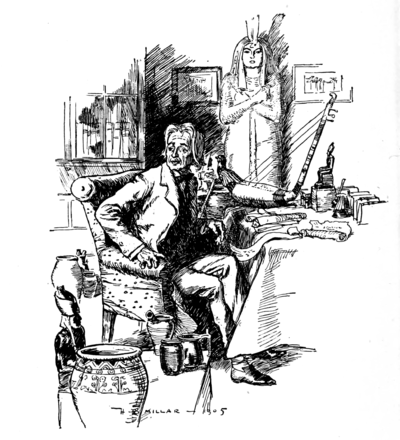
“The learned gentleman had let his dinner get quite cold. It was mutton chop, and as it lay on the plate it looked like a brown island in the middle of a frozen pond, because the grease of the gravy had become cold, and consequently white. It looked very nasty, and it was the first thing the children saw when, after knocking three times and receiving no reply, one of them ventured to turn the handle and softly to open the door. The chop was on the end of a long table that ran down one side of the room. ”
And:
“The gentleman started when Anthea put her hand on his arm.
“I hope you won’t be cross and say it’s not my business,” she said, “but do look at your chop! Don’t you think you ought to eat it? Father forgets his dinner sometimes when he’s writing, and Mother always says I ought to remind him if she’s not at home to do it herself, because it’s so bad to miss your regular meals. So I thought perhaps you wouldn’t mind my reminding you, because you don’t seem to have anyone else to do it.”
The learned gentleman looked at her for a moment before he said—
“Thank you, my dear. It was a kindly thought. No, I haven’t anyone to remind me about things like that.”
He sighed, and looked at the chop.
“It looks very nasty,” said Anthea.
“Yes,” he said, “it does. I’ll eat it immediately, before I forget.”
As he ate it he sighed more than once. Perhaps because the chop was nasty, perhaps because he longed for the charm which the children did not want to sell, perhaps because it was so long since anyone cared whether he ate his chops or forgot them.”
And:
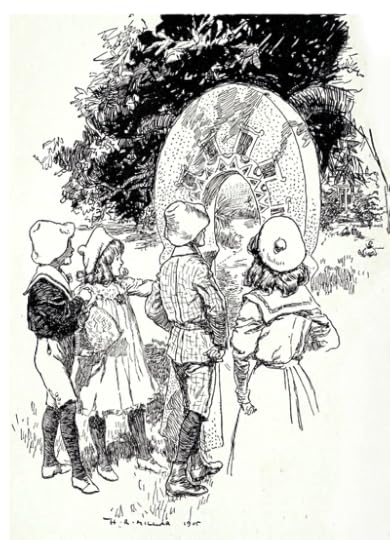
“It is no use to pretend that the children did not feel a good deal of agitation at the thought of going through the charm into the Past. That idea, that perhaps they might stay in the Past and never get back again, was anything but pleasing. Yet no one would have dared to suggest that the charm should not be used; and though each was in its heart very frightened indeed, they would all have joined in jeering at the cowardice of any one of them who should have uttered the timid but natural suggestion, “Don’t let’s!”
And:
“Now, once for all, I am not going to be bothered to tell you how it was that the girl could understand Anthea and Anthea could understand the girl. You, at any rate, would not understand me, if I tried to explain it, any more than you can understand about time and space being only forms of thought. You may think what you like. Perhaps the children had found out the universal language which everyone can understand, and which wise men so far have not found. You will have noticed long ago that they were singularly lucky children, and they may have had this piece of luck as well as others. Or it may have been that … but why pursue the question further? The fact remains that in all their adventures the muddleheaded inventions which we call foreign languages never bothered them in the least. They could always understand and be understood. If you can explain this, please do. I daresay I could understand your explanation, though you could never understand mine.”
And:
“Seeing Jane so frightened, made the others feel quite brave. They said they were certain they ought to go.
“It’s so ungrateful to the Psammead not to,” Anthea added, a little primly.
Jane stood up. She was desperate.
“I won’t!” she cried; “I won’t, I won’t, I won’t! If you make me I’ll scream and I’ll scream, and I’ll tell old Nurse, and I’ll get her to burn the charm in the kitchen fire. So now, then!”
You can imagine how furious everyone was with Jane for feeling what each of them had felt all the morning. In each breast the same thought arose, “No one can say it’s our fault.” And they at once began to show Jane how angry they all felt that all the fault was hers. This made them feel quite brave.”
And:
“I’m certain there’s nothing to be frightened of here,” said Anthea.
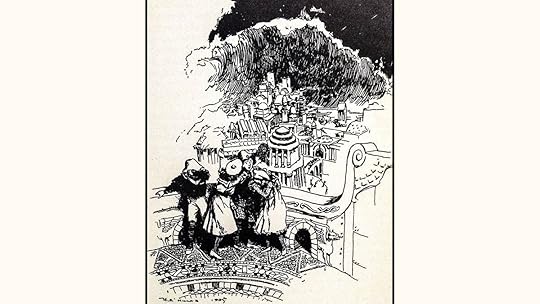
“I don’t know,” said Jane. “I suppose the fruit-trees go on just the same even when people are killing each other. I didn’t half like what the learned gentleman said about the hanging gardens. I suppose they have gardens on purpose to hang people in. I do hope this isn’t one.”
And:
“Cyril, who was fond of gardening—which meant that he liked to “watch the gardener at work—was able to command the respect of the others by telling them the names of a good many trees. There were nut-trees and almond-trees, and apricots, and fig-trees with their big five-fingered leaves. And every now and then the children had to cross another brook.
“It’s like between the squares in Through the Looking-Glass,” said Anthea.
At last they came to an orchard which was quite different from the other orchards. It had a low building in one corner.
“These are vines,” said Cyril superiorly, “and I know this is a vineyard.”
And:
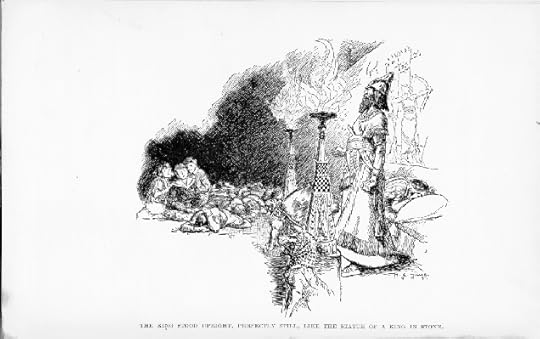
“Shouts of applause greeted the ending of the verse, and the King would not be satisfied till they had sung all their part-songs (they only knew three) twice over, and ended up with “Men of Harlech” in unison. ”
And:
“Robert’s heart sank right into those really reliable boots of his. Anthea and Cyril each had a private struggle with that inside disagreeableness which is part of all of us, and which is sometimes called the Old Adam—and both were victors. Neither of them said to Robert (and both tried hard not even to think it), “This is your doing.” Anthea had the additional temptation to add, “I told you so.” And she resisted it successfully.
And:
“But,” it added, “what possessed you to tell that Queen that I could give wishes? I sometimes think you were born without even the most rudimentary imitation of brains.”
The children did not know the meaning of rudimentary, but it sounded a rude, insulting word.”
And:
“Let’s put on our best things, then,” urged Jane. “You know what people say about progress and the world growing better and brighter. I expect people will be awfully smart in the future.”
And:
“There is no company so little pleasing as that of people who do not believe you.”
And:
“Now you’re grown up you’re not like you used to be.”
“Grown up?” said Anthea.
The learned gentleman pointed to a frame with four photographs in it.
“There you are,” he said.
The children saw four grown-up people’s portraits—two ladies, two gentlemen—and looked on them with loathing.
“Shall we grow up like that?” whispered Jane. “How perfectly horrid!”
“If we’re ever like that, we shan’t know it’s horrid, I expect,” Anthea with some insight whispered back. “You see, you get used to yourself while you’re changing. It’s—it’s being so sudden makes it seem so frightful now.”