Jump to ratings and reviews
Rate this book

The Supreme Identity

Rate this book
Modern Civilization, Watts maintains, is in a state of chaos because its spiritual leadership has lost effective knowledge of man's true nature. Neither philosophy nor religion today gives us the consciousness that at the deepest center of our being exists an eternal reality, which in the West is called God. Yet only from this realization come the serenity and spiritual power necessary for a stable and creative society.

One of the most influential of Alan Watts's early works, The Supreme Identity examines the reality of civilization's deteriorated spiritual state and offers solutions through a rigorous theological discussion on Eastern metaphysic and the Christian religion. By examining the minute details of theological issues, Watts challenges readers to reassess the essences of religions that before seemed so familiar and to perceive Vedantic "oneness" as a meeting ground of all things – "good" and "evil." In addressing how religious institutions fail to provide the wisdom or power necessary to cope with the modern condition, Watts confidently seeks the truth of the human existence and the divine continuum.

In this eye-opening account of "metaphysical blindness" in the West, Watts accents this dense exploration of religious philosophy with wry wit that will engage inquiring minds in search of spiritual power and wisdom.

204 pages, Paperback

First published January 1, 1950

35 people are currently reading
883 people want to read

About the author

Alan W. Watts

255 books7,990 followers
Alan Wilson Watts was a British philosopher, writer and speaker, who held both a Master's in Theology and a Doctorate of Divinity. Famous for his research on comparative religion, he was best known as an interpreter and popularizer of Asian philosophies for a Western audience. He wrote over 25 books and numerous articles on subjects such as personal identity, the true nature of reality, higher consciousness, the meaning of life, concepts and images of God and the non-material pursuit of happiness. In his books he relates his experience to scientific knowledge and to the teachings of Eastern and Western religion and philosophy.

Ratings & Reviews

What do you think?
Rate this book

Friends & Following

Create a free account to discover what your friends think of this book!

Community Reviews

5 stars
90 (52%)
4 stars
55 (31%)
3 stars
23 (13%)
2 stars
4 (2%)
1 star
0 (0%)
Displaying 1 - 19 of 19 reviews
Profile Image for Brandon.
128 reviews8 followers
July 11, 2012
I'll admit it, it's a tough read, and took me several tries to get through it; but it is so very worth the effort. In fact, part of the reason I had such a hard time getting through it is because Watts kept blowing my mind, which made reading on impossible; I had to absorb it a bit at a time. It was the same way with Thoreau's Walden. But maybe I'm just slow?

This is a deep book, his most scholarly that I know about, and I've read most of his work. In the foreward to the new edition, he calls the thesis "rather torturous" and while that might be somewhat true, it is still brilliant and enlightening to read.

What struck me the most was how logical it all was. He isn't just spouting New Age blather, nor parroting Eastern philosophy. He really builds up an argument from the bottom, starting with asking "what are we living for?" He says the fact that modern society has no answer for that, at least no common answer (aside from the lowest common denominator of keeping fed, clothed, and comfortable, which is mostly to say, we live so we can keep living), is the reason we have so much disharmony in the world, leading us to the point of teetering on the edge of self-destruction. He goes on from there in this exploration of the mystical worldview, which he terms "metaphysic". And keep in mind, there is nothing "fuzzy" or "wooly" about this concept of mystic/metaphysic. I found the argument highly grounded in rationality, perhaps going beyond it at points-- but not in the sense of wild leaps of faith.

This is a book that needs to be taken slow. Stop and think about the things he writes, and let the insights come. You won't be sorry.
Profile Image for Timothy Muller.
Author 2 books2 followers
January 21, 2014
I lent my copy of this book years ago, and it was never returned; so I don’t have it at hand. However it is one of Alan Watt’s best books and it was of great help to me.

Alan Watts was an intellectual in the best sense of the word. He seems a rare instance of a Jñana yogi, one whose approach to ultimate reality, both to the understanding of one’s own being and of the “Supreme Identity” is fundamentally intellectual, one for whom mere ideas had a greater impact than upon most people. In any case, he did what an intellectual should do, but rarely does; that is, he made his expert knowledge available to the non-expert, the “layman.” His work has been criticized on various counts, and I would also criticize it if I were attempting a complete critique, but then positive so outweighs the negative…

What he did for me, in his work in general, but especially in this book was to enable me to cross the bridge from my own Western set of assumptions, to an understanding of an Eastern world view. He taught me that my assumptions were just that, assumptions, and that there are radically different assumptions, and that these may well be (I think they are) more in sync with reality. This was a difficult transition. My debt is very great.
Profile Image for Casey Kiser.
Author 76 books538 followers
October 15, 2021
pg. 189

"The Church has never effectively realized its organic nature because it has projected its centre of authority outwards without any real recognition that external authority is no more than a symbol of the internal Spirit."
Profile Image for Greg.
396 reviews147 followers
Read
November 7, 2019
I bought this in the early 1970s after reading The Way of Zen. I still have both books.
I read The Supreme Identity too long ago to write a review, though I remember this as a five star rating.

I now in mature years, more than ever, reject Western religion.
I am re-reading this book, slowly.
Profile Image for David Chess.
181 reviews4 followers
December 31, 2023
I finally finished this book! Somewhat slow going just because it’s written rather densely and dryly, and tends to say the same thing multiple times from different viewpoints. And Watts will do things like casually quoting Angelus Silesius, and then I have to go look up who that was, and I fall into rabbit holes of various kinds.

The book is interesting mostly historically, as a moment in Watts’s thoughts that he eventually grew past, or perhaps psychologically as a snapshot of a particular place in the continuum from something like Christianity to something like Zen. It was written in 1949 (woot!) and the edition that I have has a Preface to the Second Edition, which he wrote in 1972. That later preface doesn’t come right out and say that all the Catholic mumbo-jumbo in the book should be ignored, but…

The main proposition that I see Watts as putting forward in the 1949 text, what the “Supreme Identity” represents, is simply that you and I and all finite beings are just the Infinite playing and having fun.

But since he’s still an Anglican (or something) priest as he’s writing this, he has to tie it to all sorts of Christian and Catholic dogma and theology and symbology and so on, and also say absolutist stuff like how a particular fun thing that the Infinite does (manifesting as finite beings and then having them realize what’s really going on) is the most important, or even the main or only, thing that it does, since he wants to claim that the Resurrection story is a metaphor or projection of this, and obviously that’s the most important thing there is if you’re a Christian.

(We could have a whole tangent here about how the Anglican Church considers itself to be Catholic, whereas the Roman Catholic Church doesn’t consider the Anglican Church to be Catholic, and how it’s therefore not entirely clear what Watts means when he refers to “the Church” or even “Catholic dogma”, especially since he is maybe an Episcopal priest which is “in the Anglican communion”, but really it doesn’t matter to the overall impact.)

He has some fun (albeit expressed in very erudite and scholarly terms) with the cycle from a baby to whom all is unthinkingly one, to a person who feels separate from the Infinite, to perhaps eventually conscious (if inexpressible) realization of the Supreme Identity. He draws circles for this, but it’s not entirely clear to me how we get back to baby again; I don’t think he says, and it’s not a personal reincarnation event because he doesn’t think that’s a thing, and doesn’t think that real Buddhism for instance does either. He draws parallels between that cycle and various things in Catholic (Christian? Anglican? Who knows!) dogma and mythology, having to do with the structure of the Church calendar, the First Adam (Adam) and the Second Adam (Yeshua), and how the Father and Son are one but also not one, and so on in somewhat clever and diverting ways.

He does venture out into symbological pareidolia a bit, as in writing of the “Church year” that the “long period of Sundays following Pentecost is without any organized character and it is possible that this formlessness of half of the year has some connection with the fact that the religious point of view must be unconscious of the dark or hidden incarnation of the Son in Adam.” Or, y’know, it’s just summer and not much is going on. :)

I was conscious throughout of the tension between the more or less cool and sensible stuff that he ultimately wants to say, and the uncool and silly Church stuff that he wants to reference and praise or at least not insult at the same time. His main move here is to say that the real stuff about the Infinite can’t be expressed directly in words or in terms of the finite, and that religion by its nature is all about words and the finite, so the best that the Church can do is introduce symbols, and talk about various “projections” of the Infinite into the finite as though they were the important thing.

Which seems to me to be a rather weak excuse, really. If Watts can spend a whole book talking about the Supreme Identity, what is it that stops “religion” from doing the same thing? If Watts can say that the important thing about the Resurrection is that it symbolizes in finite terms an important inchoate fact about the Infinite, rather than whether or not it actually happened historically, why can’t “the Church” say the same thing? Why, in particular, does the Church tend to like burn people at the stake who say the wrong thing about this mere finite projection?

The whole question of sin, judgment, and eternal punishment, and therefore of the necessity of salvation and so on, and for instance the jealousy and wrathfulness of the Church’s God, poses a very hard question for Watts here, one which he almost entirely ignores. If all finite beings are just the Infinite having fun, then what role is there for “sin” and “judgment”, “jealousy” and “wrath”, and yipes “eternal torment”? “Salvation” in the sense of a Buddhist “realization” isn’t necessary at all; it’s just a thing that you can do if you feel like it and are willing to do the work or are lucky enough to have the bottom fall out of your water bucket. This all seems to me un-Catholic in the extreme.

Aside from rather lengthy treatments of how prior theologians addressed it, and the problems with their approaches, Watts treats of this whole thing really just once, in less than a page; “judgment” doesn’t even appear in the (rather good!) index. And this is notable because he addresses pretty much everything else two or three or a dozen times, perhaps on the theory that since it’s inexpressible directly, expressing it indirectly multiple times might help. Or just on the theory that the theologians that he’s trying to reach like reading lots of scholarly-sounding words.

But back to judgment and so on. Essentially the only thing that Watts says about it in the book is that “sin” is when a finite being does things that work against the realization of the Supreme Identity, and that someone who dies without having gotten to realization “is in a special sense ‘judged’ eternally” (shame-quotes in the original). Their not getting to realization is just fine from the viewpoint of the Infinite, since it was the Infinite that did it, but it is also “eternal” in that everything is eternal from the viewpoint of the Infinite (sub specie aeternitatis). So the “eternal torment” of the sinner is pretty much exactly the same as the “eternal torment” of anyone who stubs their toe, since both exist timelessly within the Infinite, and both are just fine and cool as far as the Infinite is concerned, since the Infinite is the one what done it.

“The only eternal view of such ‘damned’ lives is one which knows them as integral threads in a fabric where light and dark are harmonized in perfect beauty.”

Which, yeah, harkens for me back to the idea of a non-judgmental God, but really leaves out pretty much everything about jealousy and wrath and actual eternal torment, and how Salvation means that Jesus suffered so you don’t have to. If the Dark Night of the Soul of an unrepentant sinner (i.e. one who never comes to Realization) is an eternal state of suffering because it exists timelessly within the Infinite, then in exactly the same way so is the Dark Night of the Soul of a sinner who eventually finds God and is redeemed (i.e. realizes his Supreme Identity with the Infinite). And the idea that the repentant and unrepentant sinner suffer eternal torment in exactly the same sense is, again, about as un-Catholic as you can get, no?

So my theory is that Watts realized this eventually, and decided that “Christian dogma” may not actually be “without the slightest alteration, … a perfect analogy of realization” after all, and that he’d be better off not tied to the Church and all its obsession with judgment and salvation and like that, and from that we get the later and less contorted-feeling works.

There’s a bunch of other stuff in this book, including some interesting analyses of the Thomist approach to the problem of evil (and why it’s not really compatible with the Supreme Identity), some rather early and overly-simple and overly-broad statements about Japanese and Chinese and generally “Oriental” philosophy and religion which he would also grow beyond in later years, how people who achieve realization behave at personal and social levels, what “achieve realization” might actually mean, and so on.

I don’t think I’d recommend this book to anyone not interested in Watts himself and how his thought developed, and it’s certainly not a good introduction to his work in general: one should read later books for that. But I enjoyed reading it (now that I’ve finally finished it!) and it did inspire a certain amount of thought. So that was good!
Profile Image for Mark.
16 reviews1 follower
January 19, 2014
Difficult at times to read. Many of his arguments are unnecessarily lengthy and there are several instances where he could have made his points equally well with fewer words. But it was an interesting read with several fascinating theories.
Profile Image for Shannon McKenzie.
7 reviews2 followers
January 29, 2013
I should always put this as "currently reading." Trees are treeing. People are peopling. We do not dance to arrive at a place on the floor. A profoundly dynamic read.
Profile Image for Mr Disco.
30 reviews1 follower
May 8, 2014
Perhaps the best book I've ever read outside of the Tao Te Ching.
Profile Image for Glen Schroeder.
61 reviews1 follower
February 13, 2019
All those books you've read, when you could have just started here all along. This is what we need.
Profile Image for Kenneth.
1,144 reviews65 followers
January 1, 2021
I had read some of this book many years ago but never finished it. Until now. Alan Watts was an adept in Eastern Religion, Zen Buddhism in particular, but also spent five years as an Episcopal priest, from 1945 - 1950. This book was written on the eve of his leaving the church (for the details of that, I refer you to Monica Furlong's biography). In it he makes a tightly reasoned case for what he calls the Supreme Identity - that the Infinite includes the Finite. He rejects pantheism as such as a form of monism. Rather he makes the case for what is called Non-Dualism - that the One and the Many each need to be respected for what they are without either canceling the other out. Throughout the book, he cites examples from Christian, Sufi, Buddhist and Hindu sources, and argues that at the level of contemplative mysticism ("metaphysic") there is a coming together of the world's great religions. He does not advocate merging the religions into a single religion. This book is not the easiest read as others have noted, but is a rewarding one. The later chapters deal with the problem of evil, and the path of "Realization" - what it is and how do you go about seeking it in your own life.
7 reviews
April 1, 2024
The Supreme Identity was one of the first pf Watts' books that I read, and it's stayed with me. It is an exploration of the relationship between the individual life and the ultimate nature of being, through the perspective of Eastern philosophy particularly Advaita Vedanta and Mahayana Buddhism, but also with references to Christian mysticism.

Watts discusses the notion of identity in a spiritual context, proposing that the true nature of being is not the sense we have of ourselves as a separated ego. Awakening to this fundamental unity, or "supreme identity," reveals that our customary and ingrained sense of division between self and world, self and other, is an illusory state that inevitably brings conflict (the meaning of 'advaita' is 'not divided' or 'non-dual').

That book provided insights into how those teachings can be relevant and transformative in contemporary culture. While It is true that in the years since I read it, I found out that Watts by no means exemplified the kind of life that he was so adept at explaining, nevertheless the idea of 'the supreme identity' really struck me. It conveys a crucial and mostly-forgotten wisdom.
Profile Image for Nathan.
82 reviews1 follower
December 27, 2019
A mentally exhausting book comparing to his other work I've read, but perhaps not to those who regularly read philosophy (not me), Alan Watts attempts to reconcile "Christian religion" with "Oriental metaphysic" making a distinction between metaphysic and religion. To the extent that he is successful in describing experiences and concepts that cannot be expressed in words, the result is a kind of Christianity that would surely be rejected by modern Christians, but as demonstrated in the book does not in itself contradict traditional Christian doctrine or mystical writings. Watts uses metaphysic to strike and demolish the ego (in a non-violent way) upon what so much of modernity and hence modern Christianity is based.
22 reviews1 follower
November 23, 2017
Fascinating and often compelling meditation on the through-lines of mystical Christian and Eastern thought.
Profile Image for Tal Rozenblat.
3 reviews9 followers
December 15, 2019
Tough read, potentially life changing. Ripe with insight about realization and enlightenment.
Profile Image for Rob Springer.
104 reviews4 followers
August 24, 2009
This may have been the last Watts I read. If so, it was the one where he took Oneness to an extreme where good and evil seemed to meet. He was trying to describe the Vedantic idea of Oneness. I realized I preferred to think of the One as Good, not beyond good and evil. It was an idea of God I would not let go of, and it became a turning point in my life. I realized I was of the West, and it was in the West I would find my way of God. For that, I'll give it five stars.
Profile Image for Aleksandar.
134 reviews7 followers
May 4, 2016
Very dense read. It makes you want to stop and think quite often, before continuing on. Sometimes he goes into splitting theological atoms, but always manages to swim out of abstraction and into practicality. I didn't care for the Christian point of view and discussion, but I still managed to get really into this book. It sums up his entire philosophy quite well.
Profile Image for Lloyd Robinson.
8 reviews1 follower
October 26, 2016
First read: profound but hard to get through. Second reading: mind blowing. Fifth read: still mind blowing.
Profile Image for Marc.
990 reviews136 followers
November 14, 2018
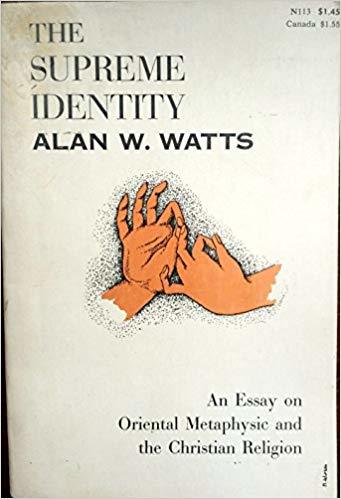
I acquired this book from a neighbor who was giving away items a few years ago. I'm not sure why I felt almost compelled to read it. Maybe it was the bizarre cover (see below, as it is the Noonday edition that's not an option on GR) or the idea of East meeting West... Ah, it looks like it was this first paragraph from the Preface:
We must face certain facts about the spiritual state of our civilization. One, too obvious to need much stress, is that in practice our religious and educational institutions are providing neither the wisdom nor the power to cope with the political, economic, and psychological predicament in which we find ourselves. There can now be little doubt that, if 'conquest of nature', scientific progress, and cultural imperialism will be a 'last state worse than the first', worse than the supposed barbarism in which the history of Europe began. The present condition of Western civilization threatens the world with dangers that far outweigh its many achievements and blessings.
This is 61 years old at this point and feels like it might as well have been written today. He continues ringing the warning bells in the Intro:
Western culture seems at the moment spiritually disintegrated beyond hope of reconstruction, and perhaps the best that my be expected is that in its final collapse it may give birth to a new culture, much as it had its own origin in the waning Classical culture of the Roman Empire.
And then he devotes the book to delineating the metaphysical knowledge we need to know reality with a capital R, that which encapsulates the meaning of human existence (I might paraphrase this as reconvening with God, separating Self from ego to realize the Holy).
I'm not sure I followed all the distinctions he was making and I definitely don't understand how any of this would work on a societal level (or even really an institutional level), but it made sense for individuals and ended with something very similar to my superficial book-learned understanding of Buddhist approaches (living in the moment and mindfulness). While I have an urge to attempt some sort of overarching analysis of both the book and the concepts, the quotes I added here on GR would probably be a better use of time for both of us.

Displaying 1 - 19 of 19 reviews

Can't find what you're looking for?

Get help and learn more about the design.