Jump to ratings and reviews
Rate this book

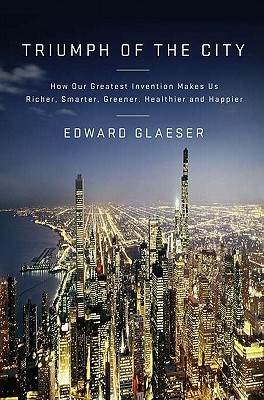
Triumph of the City: How Our Greatest Invention Makes Us Richer, Smarter, Greener, Healthier and Happier

Rate this book
A pioneering urban economist offers fascinating, even inspiring proof that the city is humanity's greatest invention and our best hope for the future.

America is an urban nation. More than two thirds of us live on the 3 percent of land that contains our cities. Yet cities get a bad they're dirty, poor, unhealthy, crime ridden, expensive, environmentally unfriendly... Or are they?

As Edward Glaeser proves in this myth-shattering book, cities are actually the healthiest, greenest, and richest (in cultural and economic terms) places to live. New Yorkers, for instance, live longer than other Americans; heart disease and cancer rates are lower in Gotham than in the nation as a whole. More than half of America's income is earned in twenty-two metropolitan areas. And city dwellers use, on average, 40 percent less energy than suburbanites.

Glaeser travels through history and around the globe to reveal the hidden workings of cities and how they bring out the best in humankind. Even the worst cities-Kinshasa, Kolkata, Lagos- confer surprising benefits on the people who flock to them, including better health and more jobs than the rural areas that surround them. Glaeser visits Bangalore and Silicon Valley, whose strangely similar histories prove how essential education is to urban success and how new technology actually encourages people to gather together physically. He discovers why Detroit is dying while other old industrial cities-Chicago, Boston, New York-thrive. He investigates why a new house costs 350 percent more in Los Angeles than in Houston, even though building costs are only 25 percent higher in L.A. He pinpoints the single factor that most influences urban growth-January temperatures-and explains how certain chilly cities manage to defy that link. He explains how West Coast environmentalists have harmed the environment, and how struggling cities from Youngstown to New Orleans can "shrink to greatness." And he exposes the dangerous anti-urban political bias that is harming both cities and the entire country.

Using intrepid reportage, keen analysis, and eloquent argument, Glaeser makes an impassioned case for the city's import and splendor. He reminds us forcefully why we should nurture our cities or suffer consequences that will hurt us all, no matter where we live.

352 pages, Hardcover

First published January 1, 2011

917 people are currently reading
11923 people want to read

About the author

Edward L. Glaeser

32 books163 followers
Professor of Economics, Harvard University

Ratings & Reviews

What do you think?
Rate this book

Friends & Following

Create a free account to discover what your friends think of this book!

Community Reviews

5 stars
1,789 (28%)
4 stars
2,696 (42%)
3 stars
1,518 (23%)
2 stars
297 (4%)
1 star
75 (1%)
Displaying 1 - 30 of 629 reviews
Profile Image for Vipassana.
117 reviews363 followers
April 24, 2020
This was one of the first books I read before grad school on urbanism and while it was a useful introduction, some of the recommendations are focussed on the short term in a way that is detrimental to cities. I haven't found a good and readable introduction to urbanism and this book remins the most accessible introduction. Until I find a better introduction, an antidote to the kind of thinking this book encourages - The Warmth of Other Suns, Isabel Wilkerson

--
One of the things he advocates for is governments to stop saving poor cities, and start saving poor people. Governments conflate the two but they are very different things. An interesting statistic he whips up is that those from New Orleans displaced by the Hurricane Katrina, made 37% gains in the test score gap between whites and African Americans, as compared to those who stayed. At least half of the 200 billion USD spent on infrastructure could have gone into housing and school vouchers. When I first read this book over 5 years ago I thought these were interesting ideas, but since then I've learned about the massive underfunding of New Orleans and this seems like one of those policy proposals that forgets that we are dealing with people.

Glaeser heavily criticizes, not people suburbanising but policies that nudge sub-urbanization, corroborating his censure with evidence of how environmentally unfriendly it is when you move to a once rural place, live there as you would in city and drive to work everyday. He advocates building up, skyscrapers within reason. An interesting example is that of Vancouver, that happens to have both tall buildings and large open spaces.

Bird's eye view of Vancouver

The book is sprinkled with interesting bits of history, like the one about Henry David Thoreau having started a massive forest fire in the Concord forest, a fire that he never repented, at least not publicly. He asked how different it was from lightning causing a fire.

--
Original review : August 3, 2015
Updated : April 21, 2020
Profile Image for Rachel Bayles.
373 reviews117 followers
April 8, 2012
This is a frustratingly uneven book, written by someone with many good, interesting ideas who has not learned to knit them into a book-length whole. His background as a published academic used to writing more focused work makes sense, given that the book reads so disjointedly.

Most of the book is written as separate chapters, touching on various mainstream urban ideas that are loosely knit together. The best parts are when the author begins to explore the role of serendipity and historical decision-making on present urban forms. However, he doesn’t spend very much time on this. Then he quickly mashes together some prescriptions for urban problems at the end. This last part should have been half the book, because the reader is left feeling like the author really could solve some of these problems, if only he would go into more detail on something he has thought so deeply about.

Reading this book is like being at a party with your smartest friend, when they are terribly distracted by personal problems and the rush of daily life. Given his many other commitments, it’s understandable. However, this book was brought to press too soon.

When he hints at brilliant, the author’s mind is clearly five-star, even if the book is only a three. This book would be enjoyable for someone who knows little about the subject matter, but for anyone more widely versed in the field, it’s likely to be disappointing. Wait for his next when he has ironed out the kinks. He is sure to hit it out of the ballpark then.
Profile Image for ☘Misericordia☘ ⚡ϟ⚡⛈⚡☁ ❇️❤❣.
2,526 reviews19.2k followers
November 14, 2020
A reasonable if a bit unfocused read. Strangely structured:
Q: CHAPTER 1 What Do They Make in Bangalore?... Ports of Intellectual Entry: Athens (c) So, it's a good thing I'm not really opposed to some inherent weirdness. Even though Athens are not precisely in Bangalore. Well they weren't the last time I checked.

Of course I'm kidding but meandering is how it goes. Across the world, across the time. A big wonder how we didn't end up somewhere across the galaxy.

A nice glimpse into congestion pricing:
Q:
The best way to reduce traffic congestion was dreamed up by a Nobel Prize-winning Canadian-born economist, William Vickrey. Vickrey first pondered the puzzles of public transportation when, in 1951, he joined a mayor’s committee to improve New York’s finances. He was assigned the problem of pricing subways, and he noted that “users of private cars and taxis, and perhaps also of buses, do not, by and large, bear costs commensurate with the increment of costs that their use imposes.” When we drive, we consider the private costs to ourselves of the time, gas, and automobile depreciation, but we don’t usually consider the costs—the lost time—we impose on every other driver. We don’t consider the congestion we create, and as a result, we overuse the highways.
The natural economists’ solution to this problem is to charge drivers for the full cost of their commute—which means adding a fee that charges drivers for the impact that their car imposes on the rest of the road. Vickrey followed up his core insight in the late 1950s in a report on the Washington, D.C., bus system, in which he first advocated charging drivers for the congestion they create. Vickrey’s insight, inspired by the city around him, is another example of self-protecting urban innovation. Decades before E-ZPass, Vickrey recommended an electronic system for imposing these congestion charges, and he suggested that charges rise during rush hours, when congestion is worse.
Decades of experience have proven Vickrey right. Building more roads almost never eliminates traffic delays, but congestion pricing does. In 1975, Singapore adopted a simple form of congestion pricing, charging motorists more for driving in the central city. Now the system is electronic and sophisticated and keeps that city traffic-jam free. In 2003, London adopted its own congestion charge and also saw traffic drop significantly. (c)

I don't precisely agree that cities make us smarter. I don't think that's the case. I think that's just cherry-picking facts (quite a lot). Basically, I think that if you strive to become better, you likely will. And in cities you have a lot more opportunities to study more, go to museums, lectures, etc.... And... there are 2 things to ponder here:
1. Studying doesn't necessarily make us smarter. We might become better at tests or, i dunno, financial modeling or negotiations. But that's not necessarily a prerequisite of smarts, not really. True wisdom might be found somewhere else.
2. You get better at what you do. So, if you don't negotiate with cows, exactly, then you don't get better at negotiating. If you start negotiating while still living out of the city, you'll get better at it, even though you are not precisely smack middle in the urban hellscape. So... So-so.

Cities making us greener? Huh. Nope.

Healthier? Debatedly. The tender mercies of the modern hospitals are, of course, better accessible in cities but would wehave needed the hospitals as much, had we lived somewhere less polluted, stressful and crazy? I tend to think nope.

Happier? I'll just refer to this read: The Nature Fix Why Nature Makes Us Happier, Healthier, and More Creative by Florence Williams

Richer likely yep. But richer in what? That's also debatable.

Historically cities could be called a triumph. But was everyone in them 'Richer, Smarter, Greener, Healthier and Happier' all the time? That should be the definition of eternal optimism.
Profile Image for Aaron Arnold.
506 reviews157 followers
October 17, 2012
If you're into urban economics at all, or even just have an interest in how living in whatever city you're in improves your life, anything by Glaeser should be mandatory reading. He's a Harvard economist who also writes for the New York Times' Economix blog about urban issues, and this book is a synthesis of much of his recent work on cities.

The first part of the book is dedicated to enumerating the many economic advantages that urban areas provide over non-urban areas, especially in their role as innovation incubators. One great insight he throws right at the beginning is that cities themselves are actually an invention - the concept of collecting buildings close together to facilitate trade and idea-sharing was something akin to the concept of running electrical pulses across wires or building irrigation channels for crops - and that this insight, that people do their best work when surrounded by other people, has helped spur countless other inventions since. The multiplier aspect of cities, the way that they encourage the commerce and idea-sharing that improves human lives, is something he explores at great depth, and it doesn't take long at all before the reader is caught up in his infectious enthusiasm for the many benefits of urban living. Each chapter in the beginning and the end thirds is full of mini-history lessons from around the world - Nagasaki's role as a port town, Bangalore's place in India's technology boom, Silicon Valley's genesis as a research center, New York City's struggles with growth and crime, Baghdad's history as an intellectual mecca - each of which are the distillation of vast amounts of research, and the cumulative impact of the artfully linked statistics is enormous.

Even the most hardened suburbanite would be forced to reconsider their SUV and backyard patio after just that first section. Glaeser himself was born in Manhattan, which he admits colors his judgment, but that never obscures the facts that back him up, and the middle third of the book, once he's finished touting the substantial health, educational, and romantic benefits that cities have brought to humanity, is an explanation of why so many people, including him, have eventually turned their back on these dynamic growth engines and decamped for the suburbs. There's a somewhat poetic cast to this story of migrations from farms to towns to big cities to suburbs to exurbs, but in Glaeser's reckoning, the biggest contributors to sprawl and deurbanization in the US are prosaic things like the invention of the automobile, the popularity of air conditioning, and in particular overzealous land regulations in the older, colder Northeast metro areas. Cities may have profound influences on economic activity but they are not exempt from the laws of economics themselves, and if housing supplies are limited by historical preservation boards, rent control laws, mandatory parking lot statutes, and poor zoning regulations, then the cost of living will increase and people will move to areas where there are fewer artificial constraints on growth.

Now that the data from the 2010 Census has been released, it's become clear just how dramatic the consequences of different attitudes towards growth are: Houston, Dallas, Atlanta, and other metropolitan areas that place few obstacles to housing construction have expanded dramatically, while New York, Chicago, and Philadelphia, etc. have struggled to move beyond their decades-old population plateaus and in some cases, like Buffalo, Detroit, and Cleveland, are seemingly unable to stop their slow downward spirals. Now obviously there are many potential factors behind these shifts, such as national-level phenomena like business cycles, taxation rates, immigration patterns, the shift from manufacturing to services, explicit and implicit car subsidies, the aging of America, and many more, but it's hard to look at the vast cost, quality, and lifestyle difference between buying a tiny TriBeCa studio and the equivalently-priced Friendswood ranch house and conclude that this choice plays no role in determining where people choose to live.

There's a fascinating breakdown of The Woodlands, a master-planned community a few miles northwest of Houston. I happen to have some friends from this city, and so I enjoyed that what they all consider the epitome of a bland exurban wasteland was originally designed as an environmentally-responsible garden city. The enduring paradox behind "environmentally friendly" developments like The Woodlands is that the more their architects plan for parks, green spaces, and open wooded areas to preserve a sylvan character, the less environmentally friendly they actually become. New Yorkers (and residents of big, dense cities) use vastly less energy in heating and transportation than Woodlanders do because they're able to take advantage of economies of scale and proximity - the true tragedy of modern NIMBY environmentalists is that by pushing people to the suburbs and less dense cities with restrictive zoning laws and historical preservation districts, they encourage much more harm to the environment than if they had simply let more people move to New York.

Glaeser has three suggestions for municipal governments to reduce this flight. First, replace permitting with simple fees based on easy criteria. If adding a bar to a residential neighborhood imposes hidden costs on that neighborhood, then simply set a price on those costs and charge the bar owner up front, rather than going through a tortuously slow approval process. Second, cap the number of undemolishable landmarks the city can have. Cities are all about growth and change, and, contra Jane Jacobs, the more buildings get designated as historical and therefore immune to demolition, the higher prices have to rise in surrounding land to accommodate demand. Setting a reasonable cap would allow cities to add new buildings as appreciation for their merits grows (remember that even the Eiffel Tower was hated at first), and also force them to delist buildings which would be better served by a wrecking ball. Finally, and this is where he loses me, he suggests devolving some powers of zoning/building approval from City Hall to individual neighborhoods. In my experience, the fiercest opponents of growth are the people most directly impacted by it, who moved to a neighborhood expecting a certain lifestyle and want to freeze their own preferred configuration of shops, libraries, offices, and parks in time.

While Glaeser's points about the downsides of centrally-directed growth are well-taken (that Baron Hausmann had the backing of the Emperor for his revitalization of Paris was surely key to its success in the face of the massive number of people his works displaced), I think it's difficult to look at the fierce opposition to growth as embodied by Regional Growth For Northcross, to use a random Walmart-hating example from my hometown of Austin, and conclude that neighborhoods actually don't have enough say in who sets up shop down the street. Strengthening the property rights of land owners is probably a safer bet for cities that want growth, and this means all land owners - individual homeowners and shopping mall builders alike.

One aspect I wish he had spent more time on was the legal regime on the state level that encourages sprawl - in the US, cities are creations of their states, whose legislatures are dominated by rural and suburban interests. I've long thought that things like funding and transportation planning should be done on a metro-level basis, because that seems like a more appropriate unit of urban policy than the state or city limit-level mechanisms in place now. Seeing cities as integrated systems and adjusting resource allocation accordingly rather than the atomized units they're currently treated as would go a long way towards allowing people to make choices about where to live that are less heavily tilted towards the suburbs, and in the process would save us a lot of money. That theme - progress as fairness, with the removal of barriers to urban growth as one of the single best ways we have to ameliorate poverty and create wealth - is reiterated here as eloquently and effectively as you'll find anywhere.
Profile Image for Mircea Petcu.
211 reviews40 followers
August 17, 2024
Orașele formează ceea ce economiștii numesc "economii de aglomerare". Se referă la banii pe care producătorii îi economisesc din costul transportului când se stabilesc aproape unii de alții și de consumatori. Nu doar bunurile pot beneficia de densitatea crescută, ci și ideile. Orașele au fost încă de la început focare pentru nașterea și diseminarea ideilor.

Un fenomen care a început la mijlocul secolului XX, și se extinde în secolul XXI, este tranziția de la orașul industrial la cel post-industrial.
Orașul industrial este dominat de câteva la grupuri industriale mari, autosuficiente, producătoare de bunuri de serie, ieftine, și care necesită forță de muncă parțial calificată. În schimb, orașul post-industrial se caracterizează prin existența unor firme mai mici și mai numeroase aflate într-o strânsă competiție, ce necesită forță de muncă înalt calificată. Principalele produse ale oraselor post-industriale sunt ideile.
Într-un fel este o revenire la orașele pre-industriale bazate pe comerț și inovație.

Recomand
Profile Image for Jim.
831 reviews127 followers
Want to read
February 9, 2017
This book is part of a special program at Nashua Public Library where our mayor and a panel of experts will talk about this book and have a Q and A session . Scheduled November 17th,2016.

Now this is a book with a lot of factoids and a series of ideas that gets one thinking.

I was taken by the statement on page one> Factoid 1: All of humanity could fit in Texas,all with our own personal townhouse.

However impractical, uncomfortable and destine to immediate catastrophe such an arrangement would be is not the question at hand. It's if they could they fit each having a small yard. Without taking into account space for roads, schools, factories, parks, sewerage ,water, food and other resources and not all area are build-able, I would say this is true mathematically. This is the density of NYC.

This controversial factoid has kicked around for a while. People have argued about this here: http://ingles.homeunix.net/rants/dens...

and created interesting graphics around this idea
https://persquaremile.com/2011/01/18/...

https://persquaremile.com/2012/08/08/...

and given the desire to quantify quality of life I found this site> Which I think is a bogus way of looking at things but interesting.

http://www.areavibes.com/nashua-nh/li...

Factoid 2 : in the developing world, people are moving to urban areas at the rate of 5 million per month.

Factoid 3: More than half of the worlds population lives in a urban setting ( what defines urban?)

Factoid 4: the Number of people working between 41st and 59th street in Manhattan is more than the number work force of New Hampshire. They have a higher annual payroll than Oregon.

Counter intuitive idea- That NYC proximity premium grew as the cost of connectivity/working remotely fell.

Factoid 5: On average as the urban population grows by 10%, per capita output grows by 30%. Per capita income is 4 x higher for those countries where majority lives in urban area than those where majority lives in rural area,

Jim's Factoid for my perspective: in 1974 US population was 213 million in 2014 it was 317 million about 50% higher. and my rural hometown of Plainfield Ct was roughly grew by less than 30% during that period.

Factoid 6: in 1950, Detroit was America's fifth largest city with 1.85 million and in 2010 had 777 thousand. 8 of the top 10 largest cities have lost at least a fifth of their population since then.

https://en.wikipedia.org/wiki/Largest...

Fun Fact from Nextbigfuture Cement consumption in China increased by 437.5 percent in the past 20 years, whereas use in the rest of the world increased by 59.8 percent. China also used more concrete over three years (2011-2013) than the United States used throughout the entirety of the twentieth century
410 reviews5 followers
October 5, 2012
Edward Glaeser was preaching to the choir - I love cities! During my 40 years, I have lived in four cities - Detroit, Chicago, NYC, and London - all cities that Glaeser uses as frequent examples in this book.

My problem with the book isn't the city love but the overall lack of structure and purpose. It is easy to understand why cities would have richer, smarter, greener, healthier, and happier citizens than rural areas - this could have been summed up in an essay. While Glaeser did an excellent job explaining the factors that led to Detroit's decline, I was disappointed with his lack of solid ideas into what could help the city rebound. Historical facts are well-expounded but theories on present-day situations and predictions for the future are lacking and when put forward are not explained thoroughly. The few times Glaeser ventured a theory, it would be an easy-breezy idea full of holes/missing important details.
For example: when discussing why people have stayed in Detroit despite the cold (Glaeser seems to despise winter!) and poverty, Glaeser states the reason is cheap, durable housing. "When cities decline, they decline very slowly, because people are loath to abandon something as valuable as a home." Have you been to Detroit!?! Have you seen the blocks of abandoned homes? It surely is more of a "I've got no where else to go" thing + that is where family/friends are.
Another section states home ownership in Manhattan is low due to the "headache" of multifamily dwellings. How about how difficult it is to get a foot on the property ladder in Manhattan due to the high prices? Also, people could want the flexibility of renting, especially in jobs that transfer employees often. And the talk about letting developers have their way in the city, Glaeser never seems to pick a side - he repeatedly states that too many restrictions on development in the city is bad but does also write that a city should be well-planned. In defense of development he states "Chicago has allowed plenty of building along its long, beautiful lakefront, while New York has decided to "preserve" almost all of the best blocks facing Central Park". First, I don't think this a true statement - I have seen lots of development on 5th ave and CPW and second, how about a shout out to Marshall Field, the man who fought to save the lakefront of Chicago from development? Thanks to Mr. Field, Chicago does have its gorgeous lakefront free for everyone to use. I know Glaeser is referring to the west side of LSD but if it wasn't for Field all that development could have been on the east side of LSD, taking away one of Chicago's best features.
That all said, I am keeping my eye out for any talks Mr. Glaeser gives - I think he has a great knowledge of cities and interesting ideas, would love to discuss further with him.
Profile Image for Terry.
390 reviews2 followers
April 8, 2013
Edward Glaeser is an economist with the Manhattan Institute--so my radar was up for conservative bias in this book, but if it's here, it's mild and mostly because he is an... economist! and looks at the world through that lens. But he also looks at -- and walks through and has lived in -- real cities so any quantitative perspective is balanced by the qualitative. He's an admirer of Jane Jacobs, my hero, but faults her for a bias towards historic preservation and relatively low urban densities that hold back the best that cities can be. His main thesis is that cities "make us richer, smarter, greener, healthier and happier" because they mix up masses of people and that fosters collaboration and innovation that can't happen in rural or suburban isolation. Hence his bias towards greater density. He loves high rises, but on the Vancouver model--slender high rises set apart so every one in them has views and there's plenty of space in between. Can't argue with that.

His critique of preservationists is persuasive. Paris is perfectly preserved and perfectly wonderful, but ordinary people can't live there because it's too expensive. He's also critical of the SF Bay Area for conservation that has driven up the cost of housing. But he's most critical of suburbia which pretends to be "green" but is actually more of an energy user and produce more carbon emissions per capita than denser cities which are more energy efficient.

He thinks it's crazy that housing is cheap in Houston and places like it, so they grow even though energy costs are higher in climates like Houston or Phoenix or Atlanta--while energy costs are much lower in places like the Bay Area, but housing is expensive, largely, he argues, due to public policy and growth limits.

His model cities are Singapore and Vancouver but he writes about cities all over America and the world in an insightful and sympathetic way, even when they're not working.

And he feels guilty about moving his family to the suburbs--"for the kids."
Profile Image for John Seno.
64 reviews8 followers
December 27, 2013
This book is very counterintuitive, the best defense I've come across for the maligned city. Cities have been and will continue to be the engine of growth. The place where cultures, ideas, people, technology and capital meet. In my backyard of Kenya, my city, Nairobi, accounts for 60% of Kenya's GDP. This emphasizes the place of cities in our lives. City life has many challenges like crime, poverty and disease but the author brilliantly illustrates that these challenges can be overcome with the right public policies and political will. A great book for city planners and anyone who is interested in cities.
Profile Image for NAT.orious reads ☾.
960 reviews413 followers
November 13, 2019
1 ★✩✩✩✩ without triumph

DNF.
I give up. I didn't expect a DNF so early in the year and especially not from this book. I had hoped for a more structured writing style and a more scientific take on things. Many of Edward's statements, provocative on purpose but failing their cause, did not agree with me.
124 reviews1 follower
January 14, 2013
And I even like cities!

I really wish I had liked this book, which made my read of it all the more disappointing. As somebody who has lived in cities my entire adult life, I felt that this book was going to be a great opportunity to gain some new knowledge and put some facts behind my intuition that cities are a good thing for our bodies, minds, and environment. What I found instead was a lazy, jumbled mass of stories, facts, anecdotes, and opinions bent to attribute all good things that have ever occurred in humanity to the conglomeration of people into urban spaces.

The tone right away in the first chapter turned me off to the book as a whole. It is opinion heavy, and the writing left you to assume that Glaser thinks that a) he's the first person who ever had the insight that there are inherent traits of cities that have greater value relative to suburban and rural areas, b) anybody that doesn't think that cities are the best solution when it comes to organizing people within a society is an idiot, and c) anybody who would choose to live outside of a city is an idiot. With that being said, we later find out that Glaser himself has moved to the suburbs because of the convenience of the drive to his workplace, the better schools offered by the suburbs, and the fact that he gets to have a yard. Once that admission makes it's first appearance, the rest of the book reads as his attempt to rationalize his decision and punt it to urban policymakers to improve cities in order to make people like him willing to live in them again. Especially caught in the crosshairs are the evil preservationists, who would choose to preserve the historical integrity of a city over turning over those lots to new skyscrapers so that we can keep housing prices low. There are some good points made about policymakers who confuse a city, which is a mass of connected humanity, with it's structures (e.g. failed attempts to build grand structures in Detroit to draw in urban professionals), but by the time I got to that point, I had lost interest.

The other part of this book that really annoyed me was the forced association between human innovation and cities. At points, he even came up with his own clever terms for obvious observations. For example, "self-protecting urban innovation!" Translation: people (of course, especially in cities) figure out answers to their problems. Another one, on page 32, almost made me put the book down right then, but I decided to hate-read my way through the rest of this. On page 32, Glaser makes the argument that an invention as sophisticated as the printing press couldn't have just been invented by a solitary genius. One needed financial backers, who in Glaser's world can only reside in cities because large urban markets allow for these economies of scale to flourish and rural people wouldn't put up the volume of capital necessary for such an unsure bet. Ergo, credit cities for the invention of the printing press. Without the printing press, Martin Luther wouldn't have been able to spread the message of Protestantism. And voila, you can thank cities for the Protestant Reformation. If you follow that stream of logic, you know everything you need to about this book.

In summary, if you have a friend that rags on cities and talks about the "Real America" and excludes cities from it, hide this book from them. It is exhibit A for the kind of arrogant, paternalistic, contemptuous thinking frequently found in the stereotypes draped onto city dwellers. Cities deserve better representation than this.


Profile Image for Michael.
167 reviews16 followers
August 4, 2011
This is not a Jane Jacobs acolyte book about urban design or about how density and walkability make us more virtuous, but an out of the box urban economics study; part Richard Florida (with more substance), part Malcolm Gladwell (with just as much trivia but fewer syllogisms). Glaeser's underlying theory is this: the last two generations of new urban form--the industrial city and automobile suburbs--are basically aberrations. Traditionally the city has been a place to make ideas, not automobiles, and places designed to attract the educated and the skilled, not the unskilled factory worker. The knowledge blender does not have to happen in a dense traditional city--the low-density Silicon Valley of office parks has launched many of our best innovations for decades--but low-density suburbia is not sustainable. Glaeser manages to hatch some truly original ideas. Some are provocative, others just eccentric. You choose:
--Why cities need and are good for poor people (but not all poor people)
--Why more people (a lot more) should live in San Francisco and LA
--How to revamp taxation to level the playing field between cities and suburbia
--Why Detroit failed and probably is never coming back
--How low-density cities that exclude affordable housing are killing themselves and the environment
--Why high rises are good for you
--How India's rural biases are strangling modern cities like Mumbai

In some respects this is the perfect cocktail party book that will supply you with Gladwell-ian trivia and hypotheses to ensure a longueur free evening. Yet Glaeser has given those of us who spend a lot of time thinking about cities some new material to chew on. Highly recommended.

Profile Image for Laura de Leon.
1,540 reviews33 followers
February 2, 2011
I'm having some trouble with capturing my reaction to this book. Overall, the content and presentation were very interesting, but I don't necessarily agree with his conclusions.

After reading the first chapter, I was very concerned about the rest of the book. It presented a whole bunch of opinions, stated as fact, with very little to back them up. I felt like arguing with all of them, even the ones I agreed with.

Luckily I did better with the rest of the book, where the arguments are arranged logically and supported with studies of particular cities.

There were still some conclusions that I did not feel were supported by the facts given, and some where I could see the argument being made but still didn't agree. These were outweighed by the number of times the book had me thinking about issues and solutions I hadn't even considered before.

This would be a good book to read with a friend or two, to discuss the ideas and to compare notes on experiences with different cities. I've got some quibbles with his comments on Silicon Valley, the only "city" mentioned that I have real experience with. I wonder what people from other parts of the country (or world) would think.
Profile Image for Mehrsa.
2,245 reviews3,580 followers
December 3, 2018
I think he's wrong on a lot of stuff according to other academics I've read and perhaps he overstates some of his opinions (and they are opinions because he doesn't cite to much data), but the book is well-written and I think he is absolutely right in broad strokes. Cities have a lower carbon footprint and they can be hubs of innovation. For a better and more recent book about some of these themes (that is backed by data), read The New Geography of Jobs.
Profile Image for Demeter.
393 reviews31 followers
August 16, 2020
O meste po tejto knihe rozmýšľam trochu inak. Najmä kapitoly o záťažiach na životné predmestia a o stavbách vyšších ako je priemer ma prekvapili. Definitívne #trebacitat
Profile Image for CatReader.
1,029 reviews177 followers
November 28, 2025
Edward Glaeser is a an American economist and Harvard professor whose research focuses on urban economics. His 2011 book Triumph of the City was an interesting, albeit dated (in 2025) read about the advantages of city life over rural or suburban life. Urban advantages, according to Glaeser, include that cities and city residents have lower carbon footprints (given that most necessary resources are within easy walking or public transit distance), and that cities serve as natural reservoirs for talented, marriageable people, well-paying jobs, and therefore innovation. He argues that having economically disadvantaged people clustering in cities isn't a bad thing, but rather a good thing, as the standard of life and potential for upward mobility they can find in the city is greater than if they dispersed.

While I don't think all arguments were equally strongly supported, and there is a lot conjecture, I did enjoy reading this book.

My statistics:
Book 354 for 2025
Book 2280 cumulatively
Profile Image for Rhubarb.
65 reviews1 follower
July 21, 2016
I don't really know why reading this was such a complete and utter chore - in small doses it was quite interesting, but attempting to read it for any longer than a couple of pages resulted in my mind wandering off and subsequently having to re read the last paragraph again. As such this took me an embarrassingly long amount of time to finish.

As you would expect from the title, the book is basically a eulogy to cities and an attempt to frame why the drive towards suburban living in America and elsewhere is fundamentally flawed. There are some very fascinating anecdotes presented along the way (e.g. brief history of Singapore) but there is also a high degree of repetition and some of the arguments feel really jumbled.

I'd give this one two thumbs down and a strong avoid recommendation.
Profile Image for Gordon.
235 reviews49 followers
March 1, 2015
Sometime around 2010, the world's population passed a great milestone: for the first time in history, more people lived in cities than lived outside of them. We are fast leaving our agricultural past behind.

Edward Glaeser argues that this transformation of the way we live is a very, very good thing. As compared with their rural cousins, people who live in cities have a much smaller carbon footprint. They are 50% more productive, if they live in a city over one million people. They live longer. They make more money. They are happier. They are less likely to commit suicide.

This argument is a little twisted, if you believe in the notion that a life closer to nature is one that returns us to our roots, allows us to leave greener lives, and makes us healthier, calmer and generally morally superior to the degenerates in the city. Alas, people are voting with their feet. All that country greenery is nice, but what good is it if you can't find a job, you can't meet interesting people, and the nearest doctor is in the next county? So they leave and head for the big city.

This process of urbanization is inexorable, says Glaeser. Other than during the Dark Ages, after the fall of Rome when the great cities of the empire returned to being villages as their starving inhabitants scattered to the countryside, the long term trend since the dawn of civilization has been towards more and more of us living in cities.

But cities can be made even better, he says. It is when we resist the natural logic of the city -- for example, by using zoning laws to prevent high density development -- that we thwart the benefits we would otherwise gain. He cites Mumbai as an extreme example of this, where buildings are limited to 1 1/2 stories in height in the city center, which has created a vast, decentralized city with horrendous traffic jams. In Paris, where the heights of buildings have been limited to about five stories since Baron Haussmann tore down much of the city in the nineteenth century only to rebuild it more elegantly, real estate supply has been so restricted that only the rich can afford to live in the central city -- the poor are confined to the outer suburbs, filled with high-rises. Contrast this with cities such as Singapore and Hong Kong, where high density has created immensely vibrant cities with public transit systems that make it easy to get around and also drastically cut carbon emissions from cars.

Glaeser generally believes that the job of city government is clear-cut: allow high density, mixed development. Keep the streets clean and above all, safe. Build basic systems infrastructure: transportation and sanitation and water and power. Provide a good educational system accessible to all. And don't impede business with excessive bureaucratic obstacles, especially the small businesses that keep the economy vibrant, adaptable and growing. Who loses out with this kind of model of governance? Lovers of old architecture will see their cities' brick and mortar heritage steadily swept away and replaced by newer, denser developments. Those who value small cities will be overcome by the forces of growth. Older businesses will have little protection from aggressive newcomers who out-compete them.

Glaeser grew up in New York, and Manhattan is his model of what a great city should be. It is immensely productive -- a few blocks of mid-town Manhattan contributes as much to the nation's GDP as entire mid-sized states such as Oregon. It is safe. Public transportation is so good that New Yorkers use less fuel per capita than any other city in the country, by a wide margin. It is the intellectual heart of the nation. It is wildly multicultural. And it continues to evolve steadily, adapting to the times. As recently as the 1970's, the biggest industry in NYC was textiles. That industry crashed when the tsunami of globalization hit it, but NYC recovered within a decade or two and replaced manufacturing with financial services.

Contrast this with what happened when Detroit was faced with a similar crisis due to the decline of its own mature manufacturing sector: the automobile industry. The city never adapted and never recovered. Today, it is bankrupt. Its population is a small fraction of what it was in 1950, and large sections of it are nearly deserted. Why the difference between NYC and Detroit? NYC relied on small businesses with a relatively high proportion of skilled workers, and invested in an excellent educational system. Detroit relied on three giant vertically integrated behemoths with a relatively low-skilled workforce, and tolerated a poor educational system. Predictably, NYC proved much nimbler at coping with environmental change than its dinosaur-like counterpart, Detroit.

There is lots more in this wonderful book, which overall makes me much more optimistic about the ability of our increasingly urbanized world to change and adapt. Read this book if you want to feel that you made the right choice about living in a city rather than retreating to that cabin in the mountains as you always fantasized.
Profile Image for Josh Friedlander.
831 reviews136 followers
June 21, 2019
A lot of this book is rambling and dull, the author pontificating about the joys of strolling through Paris or telling overlong tales of plucky entrepreneurs. As befits a product of the University of Chicago economics department, he is a true believer in free enterprise and market solutions, and has some questions about anthropogenic climate change. (He wavers on this last, but in his defense he firmly advocates policies to reduce carbon emissions.)

When he finally comes down to brass tacks, though, Glaeser has some good ideas backed by compelling arguments. He has good things to say about Jane Jacobs, but thinks she was overly fond of the low buildings of Greenwich Village: a charming urban treasure in itself, but not one that can be reproduced at scale. Noting that dense cities are far greener than sprawling ones (don't even mention suburbs*) he recommends building upwards and investing in public transport. Cars should pay a congestion tax that reflects their real cost to others, and cities shouldn't allow NIMBY preservationists to block new construction. It is an indictment of this self-serving mentality, often found in avowedly progressive places, that the four most expensive regions in the US in terms of house prices are San Francisco County, San Mateo County, Marin County and Santa Clara County, the epicenter of Silicon Valley, and the place where poor people seeking a new start would most want to relocate. This is not due to a surfeit of demand, but to restricted supply, since population density in these areas is relatively low.

Glaeser favourably compares former London mayor Ken Livingstone with Prince Charles, who promotes environmental protection through his atavistic construction of a rural village, Poundbury. This would surely be an environmental boon if its residents were willing to live like 16th century serfs; but seeing as they will want central heating, and culture/entertainment a car-journey away, it ends up being much less green. As the masses of the developing world begin to expect a higher standard of living, Glaeser warns, only well-planned, dense cities can provide it without a concomitant environmental catastrophe. But before it can preach, the West should get its own house in order.

* Glaeser cheerfully confesses that he ended up moving to one, blaming the policy failures which made it irresistible: the overly generous mortgage interest income deduction (which encourages buying a bigger house) and the lack of investment in urban schools, which are generally inferior to their suburban counterparts.
Profile Image for Ekaterina Okuneva.
145 reviews45 followers
July 19, 2020
ну наконец-то она кончилась. книжка в целом неплохая, есть несколько освежающих мыслей вроде того, что жить в мегаполисе с небоскребами намного экологичнее и разумнее - потребление электричества меньше, личными автомобилями никто не пользуется, ресурсы централизованы, издержки минимальные. но не настолько это гениальное открытие, чтобы его так часто повторять на все лады. вообще этим грешит американский нон-фикшн, который обсасывает каждую мысль часами, развития маловато.
а теперь пятиминутка отзывов из лабиринта - бумага отличная, плотная, шрифт прекрасный, под суперобложкой очень приятный переплет. но вот редактура такая, как будто я средненький диплом по переводу читаю - повторы жутких конструкций, сухо и плохо: "Научная школа Лоуренса при Гарварде и Массачусетском технологическом институте, являющаяся колледжем, созданным на средства, полученные от продажи предоставленной государством земли, - они были предназначены для передачи технических знаний". - а такое обилие страдательных конструкций предназначено для умножения страданий читателя, не иначе.
переводчица демонстрирует престранные решения - сауф или саут - она не определилась. почему-то режиссер стал СрорЦезе. Нантакет стал Нантукетом, но как передать Баффало на письме она знает. либо это корректор (редактор?) был пьян(?), потому что далее: "статус-кво" сразу среднего и мужского рода, то склоняется, то нет. сочетаемость - а что это? Сингупар, четерых, по прибытию, заработной плане, эстакЫадные, и разные несогласованности окончаний и предлогов. а также у меня большие сомнения в том, как они употребляют слово "непропорционально" - никогда не уточняется - чему, и не стоит ли половину "иммигрантов" заменить на "эмигрантов", но это такие мелочи.


Profile Image for UChicagoLaw.
620 reviews209 followers
Read
December 2, 2011
"Edward Glaeser is a graduate of our Economics Department and currently a professor of economics at Harvard University. The book argues convincingly that cities have a comparative advantage with respect to economic productivity and human flourishing. As part of his analysis Glaeser argues for policies that favor market-based development and high levels of education." - Michael Schill
2,827 reviews73 followers
December 17, 2024

3.5 Stars!

“The city has triumphed. But as many of us know from personal experience, sometimes city roads are paved to hell. The city may win, but too often its citizens seem to lose.”

This is an interesting little book falling somewhere between “Guns, Germs and Steel” and the work of Jeff Speck and Jane Jacobs. Glaeser goes on a whistle-stop tour of some of the world’s best known and not so well known cities and looks at what have made them flourish or fail, coming up with some worthwhile conclusions.

“Cities are dynamic whirlwinds, constantly changing, bringing fortunes to some and suffering to others. A city might bring a bullet, but it also offers a chance of a richer, healthier, brighter life.”

Something I quite enjoyed about this is the ways in which Glaeser will take a city and look at both sides of it, as in, “Houston’s freewheeling growth machine has actually done a better job of providing affordable housing than all the progressive reformers on America’s East and West coasts.” But then he later counters with, “If the entire world starts looking like Houston, the planet’s carbon footprint will skyrocket.”

“The average gas (petroleum) tax in France over the past thirty years has been about eight times higher than average gas taxes in the US…In the mid-90s average price for a gallon in the US was close to $1 – in France and Italy it was around $5.”

By giving such a varied overview of a city we grasp the complexity and scale of cause and effect which is baked into any city, and yet somewhere like Singapore (yes I know it’s a “country” but if you’ve ever been you’ll see it’s no more a country than Kermit is a frog!) seems to do so well. He makes a reasonably strong point about how their anti-democratic stance has proved to have been far more productive and efficient in terms of getting huge projects put through, which benefit the vast majority if not all of the small nation, and how so much blatant and chronic political corruption which goes on every day, especially at the phenomenal levels within US politics can drain money and resources away.

Elsewhere he shows how Nagasaki played such a vital role in the modern advancement of Japan and also makes a point of championing all the positive developments that have taken place in Gaborone, one of the less glamourous but more successful stories in the much maligned Sub-Saharan Africa story.

So this was an interesting read, I didn't agree with everything he said and I was occasionally left unsure as to what he was getting at sometimes, but overall this was a decent enough read and I learned a few things and certainly looked at some other things in a different way.
Profile Image for Lukas.
41 reviews5 followers
January 16, 2020
This book is a page turner.

"Cities enable collaboration, especially the joint production of knowledge that is mankind's most important creation."

While transportation costs have fallen, proximity is more valuable today than ever before.
- Three percent of the U.S. landmass is urban, but over 80 percent of Americans live in those urban areas. Cities have formed because proximity has its advantages.
- In the 18th century, that advantage mainly consisted in town walls protecting traded goods.
- In the 19th century, as ships became larger and more goods were shipped, hub-and-spoke systems emerged, making cities the hub of trade. As a consequence, manufacturing settled around the harbors as transportation on land was expensive.
- In the 20th century, transportation has become so cheap that distance barely matters. As a consequence, some cities have declined, especially those specialized in manufacturing like Detroit, and others have reinvented themselves. Successful cities have attracted knowledge intensive industries, like New York City did with the financial industry, Boston with the health science industry, and San Francisco with the tech industry. The "central paradox of the modern metropolis [is that] proximity has become ever more valuable as the cost of connecting across long distances has fallen."

Cities have historically been successful when they were magnets for human capital.
- The success stories of cities in history have often been based on concentrating human capital. Athens was a hub of independent thinkers. Baghdad became the intellectual center of the Middle East as its rulers actively brought together scholars and built research institutions. Silicon Valley owes its existence to Leland Stanford, who "decided to build a university on his eight-thousand-acre horse farm" in 1891. "[C]ities have always been the most effective way to transfer knowledge between civilizations."
- "Traditionally, single-industry cities, like Detroit and Manchester, haven't done well in the long run because their industrial monocultures discourage the growth of new ideas and companies. Jane Jacobs explained this phenomenon by pointing out that new ideas are formed by combining old ideas."
- Today, human capital is more valuable than ever before, reflected in a large earnings gap between the less and the more educated. Technological advances and globalization are two of the key reasons.

Technology increases the demand for face-to-face interactions.
- Jevons's paradox: Situations in which efficiency improvements lead to more consumption, not less.
- Data shows that telephone calls are disproportionately made among people who are in close geographic proximity to each other.
- One of the consequences of Jevons's paradox is that IT can lead to a higher demand for "face-to-face contact, because face time complements time spent communicating electronically," it does not substitute it. "Better information technology has made the world more information intensive, which in turn has made knowledge more valuable than ever, and that has increased the value of learning from other people in cities."

We need more cities to protect the environment.
- "A household in San Francisco emits 60 percent less carbon than its equivalent in Memphis."
- Not suburbia, as many environmentalists claim, is the friend of the environment, but cities are. The carbon footprint of the urban population is by far better than those of the suburban population, mainly due to greener means of getting to work.
- Urban growth is thus a crucial means to a more sustainable future, especially because the societies of India and China are yet to build a solid middle class where the masses can afford cars. If Asia becomes a continent of suburban drivers, rather than urban public-transit users, the consequences for the environment are going to be horrendous. Today, the U.S. emits one-fifth of total world CO2 emissions, 40 percent of which can be attributed to cars and homes (including air conditioning). That is around 20 tons per person per year. In Italy and France it is 8 and 7 tons respectively. In China and India it is 5 tons and one ton respectively. China's emissions are largely industrial, rather than related to homes and cars. "If carbon emissions in India and China rose to American per capita levels, the world's carbon consumption would increase by 139 percent, even if their population stayed the same."

Declining cities are not saved by building new structures.
- "Investing in buildings instead of people in places where prices were already low may have been the biggest mistake of urban policy over the past sixty years." Declining cities should invest in attracting skilled workers instead. Bilbao's Guggenheim Museum is proof that cultural institutions can be part of successful urban renewal as well. Cities can also shrink to success: In Leipzig, vacant homes have been bulldozed down, reducing the cost of city cervices and creating usable space for its citizens.

Successful cities are those which attract the poor.
- "The flow of less advantaged people into cities from Rio to Rotterdam demonstrates urban strength, not weakness." Both in developed and developing nations, cities are disproportionately poor. The free inflow of the poor makes opportunities accessible to those who need them most. "Cities aren't full of poor people because cities make people poor, but because cities attract poor people with the prospect of improving their lot in life. The poverty rate among recent arrivals to big cities is higher than the poverty rate of long-term residents, which suggests that, over time, city dwellers' fortunes can improve considerably."
- Cities should thus not be judged by its level of poverty, but by how good it is in lifting people out of poverty. "The great urban poverty paradox is that if a city improves life for poor people currently living there by improving public schools or mass transit, that city will attract more poor people." Often, overcrowding of cities comes at the cost of disease, crime, and congestion. Many western cities have struck a good balance between accessibility and quality of life -- developing nations are likely to follow.

By protecting old structures, we prevent many people from participating in the opportunities that cities have to offer.
- "Jane Jacobs liked protecting old buildings because of a confused piece of economic reasoning. She thought that preserving older, shorter structures would somehow keep prices affordable for budding entrepreneurs. That's not how supply and demand works. Preserving an older one-story building instead of replacing it with a forty-story building does not preserve affordability. Indeed, opposing new building is the surest way to make a popular area unaffordable."
- Arbitrary restrictions on the height of building are even more serious in the developing world where big cities "can help turning desperately poor nations into middle-income countries." Mumbai is only one example of a city whose strict building restrictions prevent entire communities from flourishing economically.
Profile Image for J.J. Garza.
Author 1 book761 followers
July 24, 2015
La ciudad triunfante descrita en un libro triunfal.

Una de mis aficiones menos conocidas y de mis más grandes temas de interés es el del urbanismo. ¿Cómo viven las ciudades? ¿Cómo evolucionan? ¿Cómo crecen? ¿Cómo mejorarlas para hacerlas más decentes hacia la gente? y sobretodo, ¿Cómo hacerlas fancy para vivir? Este interés nació cuando tenía como catorce años, pero la inquietud siempre me ha acompañado.

Supongo que porque nací en una ciudad destruida, mal gobernada, mal representada y con un problema de contaminación ambiental que se antojaba irresoluble. El olor del smog y la sensación de esa bruma sucia son de los recuerdos más potentes de mi infancia. En años recientes mi ciudad (que es chinampa en un lago escondido) está, de acuerdo a Lonely Planet, empezando a 'limpiar su acto' y limpiar su nombre. Con errores y omisiones, por supuesto.

Recomiendo ampliamente este libro para entender algunos de los básicos del urbanismo, y porqué algunas ciudades toman decisiones equivocadas (casi todo se reduce a complacencias electorales o a arreglos con el compadre). A saber:

De base, que la ciudad es la expresión natural de la colaboración humana, donde más personas interactúan personalmente para diseminar el conocimiento e intercambiar bienes y servicios. La gente es más próspera en las ciudades.

Y de ahí las siguientes ideas:

1. No está mal la existencia de chabolas o ciudades perdidas, porque eso implica que las ciudades están vivas y atraen a gente que de otro modo tendría una vida mucho más infame. Lo que está mal es que no tengan agua limpia, que sufran de crimen y suciedad. Y aquí se requiere la vigorosa intervención del gobierno local.
2. Está mal restringir la altura de los rascacielos. So far so good. Los requerimientos de máximos pisos (y en el caso de mi ciudad añadamos la absurda regla de los cajones mínimos de estacionamiento). Esto favorece la extensión horizontal y no es nada sostenible.
3. Está mal restringir la construcción, porque eso sólo encarece las ciudades.
4. Está mal construir más vialidades, porque eso sólo hace que aumente el tráfico. Económicamente lo correcto es comenzar a cobrar al automovilista las externalidades que genera con un cargo por tráfico.
3. Hay que aprender un balance cuidadoso en decidir qué arquitectura preservar y cuál tirar para densificar las ciudades. El preservar por preservar sólo encarece las ciudades.
4. Lo mejor en lo que puede invertir una ciudad, además de los básicos (agua, seguridad, limpieza) es educación. La buena educación sirve como un imán para el talento.
5. Los suburbios no son el diablo, pero su crecimiento se ha agravado debido políticas que favorecen la adquisición de vivienda, la adquisición de automóvil y el manejo al trabajo. Las políticas deberían reencaminarse a redensificar las ciudades.
6. Buena parte del futuro de las emisiones de carbono del mundo dependen de qué modelo de urbanización escojan China e India, con su rápido crecimiento y rápida industrialización.
7. El tratar de hacer 'verde' a un lugar, es decir, más ecológicamente sustentable, a base de limitar la densificación sólo hace que la gente viva de manera menos sustentable en otro lado.
9. El intentar revivir ciudades en declive a base de grandes obras de infraestructura sólo es 'echarle dinero bueno al malo'. Lo mejor es invertir en la gente y que ellos escojan dónde quieren vivir.

En general, el libro me ayudó a reforzar algunas ideas básicas de urbanismo que ya conocía, a cuestionarme mi normal creencia en la superioridad del suburbio (he sido suburbanita toda mi vida) y a reforzar la idea de que necesitamos desesperadamente tener un transporte público más decente.

Recomendado para cualquiera interesado en tener una mayor calidad de vida urbana.
Profile Image for Vance Ginn.
204 reviews662 followers
November 18, 2018
Glaeser takes the reader on a journey through the history of how social connections support prosperity, which is an excellent avenue to learning economics. In particular, cities allow for more human interaction such that ideas can be exchanged at a lower transaction cost.

He argues that government policy hindering vertical building in cities, such as zoning laws, along with subsidies to purchase a home, such as mortgage interest tax deduction, and other measures result in more people moving to the suburbs. As people move to suburbs, this creates traffic congestion as people drive relative to walking or using public transit.

Many of Glaeser's ideas and policy recommendations tend to be toward getting government out of the way but there's also hints of government planning that makes me a bit cautious of his approach. For example, I'm for getting rid of the mortgage interest tax deduction and zoning laws, but mass transit is often not beneficial and just because vertical building happens doesn't necessarily mean there will be less traffic congestion.

Overall, I like this book as it gave a good overview on how our personal interactions matter in satisfying our desires and urban living can build stronger ties and support more prosperity if allowed to happen. However, I think moving towards more free market capitalism and away from government planning would be the best route as prices signal where people should move and where resources should be allocated. If planning happens by a select few who are hindered by Hayek's "knowledge problem," then poor results are bound to happen.

I give this book 4 stars and recommend that you read it.
Profile Image for Marks54.
1,566 reviews1,227 followers
January 2, 2012
This is a review of current thinking on the city by a Harvard economist who specializes in such work. Glaeser is a big fan of Jame Jacobs, so the book serves as an interesting update to Jacob's book, The Death and Life of Great American Cities. He adds, however, that Jacobs was not an economist and so misunderstood some points, such as the unintended consequences of restricting the size and extent of building in a city - that preservation and limits building will lead to the marginalization of cities with gentrification along the way, which to me is a reasonable comment on Jacobs' great book. The major takeaway from this book is counterintuitive, namely that in some very important ways, building up cities is much more friendly to the economy and to limiting global warming than is limiting cities and building green suburbs. It is counterintuitive but it leads to some really interesting arguments about city planning, both in the US and in Asia. Glaeser also provides lots of updated info on lots of cities, from Chicago, Atlanta, and Detroit to Singapore and the nascent high growth Chinese cities.

Overall, it was a really good book with good policy implications that does not just reinforce established arguments but makes the reader come to grips with if not totally agree with new ones. It did not have the same impact on me as Jacobs' book had but it was a very good book.
Profile Image for asih simanis.
207 reviews130 followers
April 5, 2017
Hopefully my rating will not undermine the value of the ideas inside this book too much, since many of the arguments presented were well argued and important. However I find the book repetitive, tiring and boring. I believe the book could've been shrunk by half and it would've been better and more brilliant.
Profile Image for Ardyn.
99 reviews9 followers
March 14, 2016
So many interesting ideas in this book. It felt like a macro version of Happy City (an amazing book!), which discussed the impact cities have on societies more generally. The book felt disorganized though.
Profile Image for Paul.
19 reviews1 follower
October 16, 2025
Words cannot succinctly express how much I grew to detest Triumph of the City as I progressed through this bafflingly jumbled bestseller. To be clear, this feeling did not stem from any fundamental disagreement with Mr. Glaeser’s groundbreaking general thesis that “Cities are good, actually.” On the contrary, I probably agree with the majority of the central claims that Glaeser makes about the value of cities. It is precisely because I agree with many of the book’s objectives that I found it so frustrating.

I found the construction of his arguments lazy, his data scant, his organization messy. Glaeser presents opinions as facts. He presents correlations as causations. He extrapolates a single case study to state, “this is the way things are.” The absence of nuance is staggering. I began to connect Triumph in my head to Freakonomics and was therefore not surprised when Glaeser referenced Steven Levitt’s abortion-crime study, which has been shown to be far less definitive than Levitt claimed.

The anecdotes and focus are quite literally all over the place. We bop around from Detroit to Bangalore, all in service of repackaging some basic market capitalist theories like "supply needs to meet demand." He claims to be inspired by Jane Jacobs but lacks her attention to detail and her humility to study things at a grassroots level. I have no doubt that his editor pushed him to include the wide-reaching, bold claims, but as a bona fide Harvard economist, Mr. Glaeser should know better.

I have concluded that I am not, perhaps, the target audience for this book. I studied economics in college and have since listened to hundreds (thousands) of hours of Planet Money. I was already well familiar with the idea that the U.S. subsidizes suburbs at the expense of cities. Glaeser makes this point, but I think that really should have been the whole book with much more data, and with much more discussion of the societal effects of such a system. I am already well familiar with Glaeser’s central claim: that Pigouvian taxes should be imposed to make the cost of car ownership and suburban life proportionate to the societal costs such lifestyles incur. This perhaps was the strongest point he makes, though I am biased, as it is the one I agree with most.

I fully agree that cities are great places to learn from one another and that we are better off for being in them. Indeed, I, a remote worker, am a practitioner of this by living in expensive D.C. at my own net worth’s detriment. Yet I feel that he does not convincingly sell this argument other than to say, “good things come from cities and so cities are good,” and he fails to explain why a walkable city itself is especially good at this cross-pollinating coordination. The existence of car-dependent Silicon Valley (which he mentions) undercuts this thesis, with no further explanation of why this is an exception.

Glaeser is completely lost when he tries to port lessons from the U.S. into other countries or when he tries to talk about U.S. public education. He is addressing topics about which many thousands of Ph.D. dissertations’ worth of research and nuance exist; yet his assertions are just thrown around with unearned confidence. I have no doubt he's citing something some academic as said, but he fails to incorporate this critical evidence into the narrative.

Glaeser is also pretty dated, even though this is from the late 2000s. He confidently states that the internet can never hope to meet the same need that cities have in connecting people and creating something greater in that exchange of ideas...but why? It is unsupported. This also suggests one of his most egregious omissions - he fails to see how online communities are really the new cities of the 21st century. Even though I agree that the in-person difference counts for more, he severely underestimates how online our lives - and therefore, our community life, became.

Glaeser’s book is a completely distracted attempt to convince people that cities are good and fairness is important. His commitment to a fairly boring version of market capitalism as sacrosanct shows serious blind spots, making this a poor book to convince anyone left of Kamala Harris of much of anything. His weakly supported assertions about why our current system is unfair make this a book I would also not suggest to anyone to the right of Mitt Romney. So who is this for? I suppose someone who had never considered anything related to urbanism might find something of interest here. I would fear that the outcome of mass consumption of Triumph would be a poorly informed populace with overconfident conclusions - which is how we got into the mess we’re in in the first place.
Displaying 1 - 30 of 629 reviews

Can't find what you're looking for?

Get help and learn more about the design.