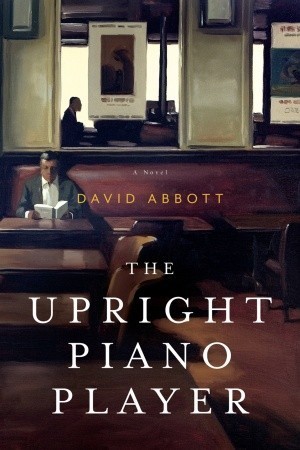
Henry Cage seems to have it all: a successful career, money, a beautiful home, and a reputation for being a just and principled man. But public virtues can conceal private failings, and as Henry faces retirement, his well-ordered life begins to unravel. His ex-wife is ill, his relationship with his son is strained to the point of estrangement, and on the eve of the new millennium he is the victim of a random violent act which soon escalates into a prolonged harassment.
As his ex-wife's illness becomes grave, it is apparent that there is little time to redress the mistakes of the past. But the man stalking Henry remains at large. Who is doing this? And why?
David Abbott brilliantly pulls this thread of tension ever tighter until the surprising and emotionally impactful conclusion. The Upright Piano Player is a wise and acutely observed novel about the myriad ways in which life tests us—no matter how carefully we have constructed our own little fortresses.
David Abbott (born ca. 1938) is a British advertising executive who founded Abbott Mead Vickers BBDO.
Abbott started as a copywriter at Mather & Crowther and then at DDB, London. In 1966, he was sent to their New York office, then returned to London as a director.
In 1971, he founded French Gold Abbott. In 1978, he founded Abbott Mead Vickers (AMV), handling clients including Volvo, Sainsbury's, Ikea, Chivas Regal, The Economist, Yellow Pages, and the RSPCA.In 1991, BBDO acquired a stake in AMV and appended their name.
The One Club for Art and Copy inducted Abbott into its Creative Hall of Fame in 2001. His first novel, The Upright Piano Player, was published in 2010 by MacLehose Press. He is married with four children and eight grandchildren.
Before I deconstruct the book, I want to make it clear that I could not put it down. In a voyeuristic manner, I kept reading and reading until the very end. When the end arrived, I was surprised it was over. The way the book begins is gut-wrenching and disturbing as Henry is attending his grandson's funeral. The grandson he loved more than his own life and whose life ended on his watch. The details of the death are revealed and they are awful. That was 2004.
The story begins in 1999 as Henry ends his 30 years as a business man, rich and forced out of his own company by partners. Through disjointed scenes, we meet Henry's ex-wife, Nessa, his grown son, Tom, and his wife, Jane, and the grandson, Hal. We continue by also meeting a rascally character, Colin, and his girlfriend, Elaine. Then there is Maude, Ed, and Charles then Walter, Mrs. Abrahamson, and Jack.
Henry kicks out Nessa because of an affair. His son is distraught and cuts him off. Nessa has cancer and is dying. Jack loves her. Henry has a grandson and he doesn't know. Colin is an unsavory character who has anger issues. Elaine has a rockin' bod. Maude is peripheral and I can't understand her part. Ed, Charles, and Mrs. Abrahamson...???
So Henry's story ends in Florida but we know that it later continues in England after the funeral. And I'm sorry to say that I don't get it and I don't want to. I was a voyeur all day by reading this book and it disturbed me with the beginning and then the random acts of violence not brought on by karma or by anything but chance. Perhaps that is the point which means that I wasted an entire day reading about a random man in England who lived a very sad life and walked around in circles, interacting with characters that offered him nothing and did not enhance the story except the mental images of naked women which might be tintillating to some. I found them useless.
This entire review has been hidden because of spoilers.
This book is proof positive that people who write good ad copy don't necessarily make good novelists. It took me weeks to get through it, and it's only 264 pages. The entire book feels like an exercise in misdirection. Abbott's writing zings around like a fart in a skillet and ultimately leads nowhere.
I now have the answers to the questions I posed below prior to reading the book. #1: It doesn't matter, because the title has nothing to do with the content of the book. #2: If anything, it should have been called The Uptight Piano Player.
_____________________________________________ Here's what has bugged me about this book's title from the first time I saw it: Is the piano player upright? Or is it an upright piano? Or both? And if it's the piano player, is he/she upright as in body position, or upright as in upstanding citizen? I tell ya, these double entendres keep me awake at night!
** My review contains spoilers This is a bad book, about a sub-par story, with boring forgettable character. Henry is a depressing, one-dimensional character whose wife cheats on him, gets estranged from his son, ousted from his company, victimized on a walk home, stalked and terrorized by the same person who attacked him. Meanwhile his ex-wife he still cares for dies before he can get to her, a girlfriend abandons him, and oh…..then he is blamed for the death of his grandson since his grandson was drug to death after he left him in running car. I don’t have to have a happy ending, but there’s not salvation on the author’s part for his character Henry. The book starts with the death of grandson Hal. Then it takes us back in the past but never circles back to Hal, or Henry’s emotions after the death of his grandson. There is no closure to that. Abbott is trying to be crafty by telling us an asinine story that leads us to understand how be came to be a fixture in Hal’s life. AND??? It’s always interesting to me when an author can so clearly hate their character but yet still be inspired to write a book about them. What baffles me about Henry is that Abbott makes no attempt to get you to like Henry either. For example, the pictures of Eileen, and Henry’s thumbprint on them. Henry is dull, lackluster, and has many character flaws. Why would I want to read a book about him? Abbott failed to see this major flaw. Mechanically the book is flawed as well. Abbott develops none of the characters, they’re all one dimensional stereotype’s. He has very rough transitions from past to future, character perspective to character perspective. Abbott does not seem to understand human behavior as his characters do many unnatural things. Examples- Why would Tom be estranged from his father when it was his mother who cheated? Why if Nessa wanted to stay with Henry would she immediately run away? A maid- (in this case Mrs. Abrahm) would never assume the pictures were not Henry’s and throw them away. That just WOULD NOT happen. Maude, who is completely shallow flees because Henry is a grandfather….really? Would you not assume that he was? And she was using him, so why would she care? If Henry fears Bateman SO much then why would he take the pictures back to Eileen, such a risky thing to do, an unnatural for his character. He writes about characters before introducing them, and confuses the issue. He includes Maude’s relationship with someone else and things that have zero to do with the story. At times he expects the reader to believe people who are strangers initially would have deeper understandings of the other. Henry dressing in front of Maude, Henry in Jack’s car. Not realistic. His characters all choose not to deal with conflict. It’s clear from the beginning that Tom won’t confront his father about Hal’s death. Nessa won’t share her feelings for Henry. Henry won’t share his feelings for Nessa. Henry won’t confront his stalker. (Almost to the point he is allowing himself, or inviting himself to continue being harassed by Bateman.) Henry won’t confront Maude. Henry will allow himself to be ousted from his company with no objections. He’s completely passive and indifferent- so why then would the reader feel any different? Any one of these things could have made the story better. We see no emotional perspective from Henry when he is accused of murder. What was the point of this book? Henry never resolves ANYTHING, except killing his stalker. Nothing with Nessa is resolved so it feels completely irrelevant, and yet it’s over 50% of the book. It’s a boring book with no real storyline about boring characters that never goes anywhere. The characters are unlikeable (except maybe Nessa). I get what Abott was trying to do, but he failed so miserably- not only in story and what he chose to focus on, but the lack of emotional perspective at such dramatic events, and the lackluster characters. The random acts of violence, and victimizations of Henry are too numerous. This book started one way and went somewhere else- it got lost. One last nit picky thing- (this always annoys me in books) This books is set in current day. Yet, Nessa has made a special purchase for a computer than can correct spelling. Laughable! Bottom line- not just a bad books, but bad writing. Very bad. I’d never read another Abbott book. This was his first novel, but it’s his last for me. The only thing it accomplishes is that Henry is further tortured, and in that long process I too was tortured!
This entire review has been hidden because of spoilers.
What does a title reveal about the contents of the book? What direct or subliminal message does it give? I asked myself these questions as I read “The Upright Piano Player” by David Abbott. Even though music plays a role throughout the novel, the upright piano is mentioned only once or twice, a hold from the narrator’s childhood.
As I pondered more, I noticed the title’s interesting word play. Is the player of the piano an upright character? Does the pianist play an upright piano? Or, perhaps, is the reference to both?
Henry Cage, a man who has defined himself by practicalities, work, and uprightness, is now retiring. Over the years, his work ethic has cost him his family. Alone now, he sits at his upright piano but doesn’t know which tune to play. The chorus of his life seems to be filled with melancholy and random events that are often violent. Cage is often in the wrong place at the wrong time and the reader wonders if he had changed the signature, whether this might have made a difference in the outcome of those events.
Part One, much as a first verse, sets the tone for the book. It is so painfully sad I almost didn’t turn the page to begin the second. But I kept reading because of the depth of Cage’s character and the complexity of the plot. And when I finished the story, I knew I would read the book again.
Like a haunting melody, this story waits for a second encounter. I kept putting off that next reading of “The Upright Piano Player” because I wasn’t sure I wanted to experience the emotions another time, but I knew I had to. I had to find the mention of the piano and I had to make the connections between the music and the characters.
You see, I think the author is making comparisons between life and an old upright piano. Some of the keys, like life experiences, are white; some are black. There are harmonious chords and discordant combinations. Each song has a beginning and each song has an ending. If the upright piano also happens to be a player piano, then whatever roll the Master inserts is the song that plays, regardless of the body whose hands are poised over the keys. Whether the music is chosen for us or we choose the song, it must be played.
Just as songs must be played, stories must be written, and books must be read. It is our obligation as readers to bear witness to the message. Perhaps our role is to join the choir and acknowledge that life is often unfair. But perhaps we are simply to gather around the piano and, even as we question the choice of the upright piano player, merely listen to the heart-wrenching beauty of those bittersweet tunes.
Gosh. I just did not like this book, but true to form, read every last daggone page. And in the end, after the last page, I think I said out loud, "Wait, what?". Nothing about a piano, did not like the main character, sub-plots went nowhere, other characters behaving unrealistically, and the purpose / message of the book was lost on me. A friend recommended this book to me. I need to find her and ask why! Not a book for me and not one I would recommend to others. (I know it shouldn’t bother me that no one played the piano in this book, but it does. I kept wondering….hey, when is someone going to play the upright piano??!!)
This work of literary fiction is a striking debut. Abbott gives us the story of Henry Cage, a successful businessman who seems to have it all: a fine home, a successful career, and a reputation for being a principled and upstanding man. But his outward success hides personal failure. Just as he has retired, his ex-wife has moved to America, his relationship with his only son is strained to the point of estrangement, and he’s the victim of a random act of violence which escalates into a long-term stalking and harassment.
There are small glimmers of hope for Henry, just as there are set-backs. He learns his ex-wife is quite ill, and he agrees to visit her in Florida, and he begins to repair his relationship with his son and to get to know and love his grandson. But he remains alone and separate, even when with those he holds dear.
One thing that did bother me, however, was how Abbott structured the tale. He begins with a chapter set in 2004. We witness Henry’s reactions to a tragedy. Then he goes back to 1999. This kind of foreshadowing is done frequently, but somehow Abbott’s use of this structure left me with more questions than answers.
A familiar structure that would be played-out if it weren't for the details that are just unusual enough to keep you turning the pages.
I can understand why some people don't like this book, but I think it's captures the beauty and the darkness of life. A man finds his way back to his family after tragedy, which is beautiful, but no guarantee of immunity from more tragedy to come.
David Abbott starts his mesmerizing and haunting debut book, The Upright Piano Player, with a quote from Nietzsche: “The consequences of our actions take hold of us, quite indifferent to our claims that meanwhile we have improved.”
It’s an apt quote because indeed, actions have consequences in the case of his protagonist, Henry Cage. Henry is, indeed, a caged man – uptight, disconnected, and alienated. Throughout his life, he has amassed the trappings of success: a sterling career, a spirited and beautiful wife, a sensitive son, an elegant London townhome. Yet he has squandered his gifts, eventually losing his marriage, destroying his relationship with his son, and ending his partnership in his firm – not of his own accord.
And then, on the eve of the millennium, a random act of violence occurs. Henry inadvertently pushes into a stranger on the crowded Westminster Bridge during a New Year’s Eve encounter. The stranger, Colin, is an angry and vindictive working-class man who strikes back in a disproportionate way and then begins to stalk Henry. A sense of menace ensues, a little reminiscent of the atmosphere in Enduring Love by Ian McEwan.
Henry is a man on the edge, ready to “improve”, to re-engage with his family and the world around him. For the first time in years, he truly reaches out, flirting with the idea of a new romance, reconnecting with his ill ex-wife, striving to create a bond with his now-grown son and his grandson, Hal, whom he has only just met. Yet at the periphery of his life is the stalker who is threatening to destroy all that he is working to put together again.
The reader knows, from the first 10 pages, that the ending will be heartbreaking and that another random incident will occur that will turn him into a man torn apart by grief. As a result, this is a particularly voyeuristic “read”; we know that none of Henry’s well-meaning actions will save him from a wrenching fate that no parent or grandparent should ever have to endure. We, as readers, maintain full awareness of where life is going for Henry, something that is denied to the protagonist himself. Henry remains blinded; for example, when views a barn owl with his grandson, he thinks, “It had seemed a gift. Like the sighting of a kingfisher, a singling our, a portent of favor. How wrong could a man be?”
Throughout the arc of the book, we observe Henry from a distance. He is not a particularly introspective man, a trait that I often find unsatisfying. However, not here; David Abbott pulls it off, propelling us along on Henry’s journey. All the while, we know that Henry will be unable to sidestep his fate; despite his rediscovery of self, he will need to confront the loss and grief that is his destiny.
This is, after all, a cautionary tale, a tale about whether “upright” motives can create harmony in lives that are tossed around by life’s circumstances. It asks provocative questions: how much of life results from past choices and how much is totally random? The Upright Piano Player is written by a founding partner of the United Kingdom’s largest advertising agency, and this is his first novel. Hopefully, it is not his last.
I was all set to adore this book, largely because it was recommended so highly by Books on the Nightstand, and I think they are Awesome. So the fact that I had very mixed feelings about The Upright Piano Player shouldn't be taken as criticism of BOTNS. But I did have mixed feelings: some things about the book seemed unusually terrific to me, and some other things unusually flawed. On the plus side: I literally didn't want to stop reading. There's a wonderfully creepy menacing feeling, which reminded me some of Ian McEwan's books, to the novel, an incredible sense of suspense. And I loved the beginning (though it's enormously sad)--really the whole first half of the book had me enthralled. But then I started to feel frustrated: too many characters without enough space given to them for them to really come alive (we're told a lot about them but don't get to truly feel/experience them), too many events that seemed random--dropped into the plot but then not followed up on. I do get it that the book is, largely, about randomness--random violence and illness and large and small sadnesses--but even a book about randomness shouldn't feel entirely random to the reader. Even the main character never became a whole human being to me--he remains something of a mystery, but not in that good, satisfying kind of way--and the conclusion left me totally baffled. Not because I didn't understand it literally, but because I couldn't understand why the author chose it (or why other people found it spellbinding). Not that I need all novels to provide a perfect sense of closure--but I do need some sense of meaning or largeness or connection between events, and this conclusion doesn't provide any of those things. So: I was fascinated and frustrated by this book, in pretty equal parts (but don't worry, BOTNS, I still love you).
This story was a bit misleading: we open with a grandfather's mourning the death of his grandson (a death that was, in a tragic tangential way, his fault) in 2004. We then flash back to 1999, where we meet Henry at his retirement - not quite at a time of his choosing, but not quite unwelcome.
Over the next year we see Henry's quiet life become disrupted. An "upright" guy, one who doesn't want to share his personal life with the public, his marriage disintegrates because not only does his wife has an affair with a film star, she does it publicly. Post-marriage, post-retirement, his life revolves around breakfast at a brasserie near his home, a few errands, reading, etc. until he is head-butted on Millennium Eve. That one act seems to cause his life to unravel somewhat: the head-butt-er starts to stalk and harass him, his ex-wife reaches out when she is in the last stages of cancer, and he learns from his long-estranged son that he has a grandson.
Woven in and around this are brief glimpses into the other people in Henry's life. We meet his son, Tom; Colin, the head-butt-er and his girlfriend, Eileen; Maude, a former intern at his company and potential casual partner; Jack, his ex-wife's friend and Nessa, his ex-wife; and a few others. These sideways glances into the people in Henry's world are sometimes on point, and sometimes just a meander into another's life.
The pacing and precise word choice are appealing, but these occasional sidetracks, along with the lack of connection to the prologue, moved this from a five to a four.
A “good” read, if a sad one. Henry, the central character is also the upright piano player, though there is scant reference to this in the novel, so the title rather intrigues me.
Set in London, East Anglia and Florida, USA, it focuses throughout on ‘family’. A smoothly flowing book, despite sudden changes of scene and time. A clever storyline and some very fine writing. A debut novel it seems. Must check out any subsequent work by this author.
There are very many glowing reviews of this book so I was very excited to receive from Library Thing. In the first few pages, I was disenchanted by the third person being used so much it seems very difficult for me to get wrapped up by a book that uses it so much. It just feels like too much distance between me and the main character to be interested in him.
This is just me, you may me be engrossed from the first page. Secondly there is gruesome accident in which a little boy is killed. Ever since I started this bookI have re-plays of it in mind every single time I picked up the book. Maybe I am just too sensitive. The same thing happened to me when I saw the movie 'The Exorcist'.
Thirdly, the writing is clear but the story keep switching from scene to scene, time period to time period, character to character. Plus, I miss a plot, there seemed to be none in the first seventy pages. The switching around left me confused most of the time. The lack of plot disappointed me. It got to the point today where I just did not want to pick up the book to read.
Fourthly, the first seventy pages depressed me. You may like it. So don't go just by my experience.I am easily depressed maybe you are not. I do not want to feel gloomy any more.
I received this book from Library Thing and was in no way influenced by that my thoughts and feelings are my own.
Hmm.... What to say of this? Although a sad and terrible incident, I have no idea WHAT the point was of Part One. It had nothing to do whatsoever with the rest of the story which, by the way, takes place five years EARLIER. They shared the same old disillusioned man, but Abbott never wrapped the story around to join the two threads of time. Makes no sense to me. If I wanted to read the horrific telling of a young boy's death at the hands of a pointless accident and then have it followed by what happened years previous, I would have preferred there be, well, a POINT! That being said, what is there to read was well written (much more so than my wee criticism.) Now if only Mr. Abbott could have continued on in that vein towards a proper conclusion (or perhaps a proper Part One!)
A disappointing read. The author can write, and write well, but the story line was depressing and pointless. The whole book was filled with hopelessness. Just as soon as things might look up, it crashed. The opening left an awful impression on me and the thing with the dog was uncalled for. Not that people don't do horrid acts but there seemed to be no redemption or hope. I could never feel for Henry. What a loser. I kept waiting for the piano player to play but all I got was a mournful refrain. If you want to be depressed, read this book.
I just finished this book a few minutes ago, and I'm still not sure what to think of it. Yes, other reviewers' comments about nihilism is correct. This is a story of pointlessness, of inevitability, and of sadness. Here we have a character who has been dealt so much hardship (and because of those nihilistic "random, meaningless events") that Abbott's message is nearly rammed down our throat. Pardon me if I say that I prefer to choose how much I am given.
Yes, the first "part" (I use quotations because it's really just a prologue) is emotionally wrenching. And depressing. And I dreaded the rest of the story because of it (and as it turns out, rightly so).
I never would have guessed that the rest of the novel would take place five years earlier. To be honest, that second part of the novel completely stands alone (and ends abruptly). I know why Abbott decided to do this. As much as the nihilistic events of the novel impact us (Henry divorces his adulteress wife, Henry's ex-wife dies of cancer, Henry loses his job, Henry is estranged from his son, Henry is the victim of a violent and creepy man) they are compounded by the fact that during the entire novel the reader has to sit there with the knowledge that the beautiful little grandson, arguably the ONLY wonderful part of Henry's life, is going to be dragged to his death down the road at fifty miles per hour. By a crackhead.
I felt like the book dragged on for two hundred pages and then just ended, but NOT before Henry is accused of murdering the very man who has been harassing him. More random events. More nihilism. I get this. But at this point I just wanted the novel to end. And then it did, just like that, with Henry finally deciding to live near his son to be close to him and his grandson. And you can't help but thinking that after all of this, after all 200+ pages of strife and horror, Henry is not going to be rewarded because of his faith and his morality, but will have that joyful life ripped away from him four short years later by the horrific death of his grandson, which, surprise he was inadvertently the cause of.
I'm sure Abbott designed the book this way so that upon further introspection we can realize that Henry will find a way to deal with yet another hardship, that eventually he will overcome the death of his grandson, that it wasn't his fault but another random event. But I'm sorry. Don't kill the kid.
And the most infuriating thing for me is that I can't write this off as a horrible book. It's NOT. Abbott's knowledge of human interaction is so incisive, so brutally honest and open, that it makes the entire novel depressingly plausible. We can easily see any or all of things happening to us. Adultery, death (by cancer), crime, murder, and unemployment, all to the same person, should seem over-the-top and trite. But it wasn't. It felt completely real, and that is the mark of a great writer.
At least one thing came out of reading this book. I now know to avoid McEwan.
David Abbott is regarded as one of the finest advertising copywriters of his generation. As a young graduate back in the 80s, I remember the thrill of being offered a student placement at his agency Abbott Mead Vickers, along with my then creative partner. We were in our final year at art school and had set our sights on a career as a creative team in one of London’s creative advertising agencies. Luckily for us, one of AMV’s senior art directors had graduated from our college (Maidstone College of Art), so it only took a letter from one of our tutors to this former student to secure our two-week placement. On arriving at the allotted hour, we were ushered up to the creative floor of a recently refurbished building that had that distinctive new building smell. Everything was grey and black, which was the height of chic back in the late 80s. In fairness, it would still look sophisticated today. We had our own sizeable office for two weeks. But the greatest disappointment to befall us was that the great man himself was on holiday and would not return until we had departed. So there would be no chance to contrive an impromptu meeting with him in the company lift of a morning. Abbott had cemented his reputation for writing memorable press ads for the likes of Volvo, Sainsbury’s, The Economist and Chivas Regal, to name but a few. But he was equally at home writing TV commercials, and his famous ‘J R Hartley’ TV commercial has gone down in advertising folklore as one of the UK’s best-loved commercials. This said, he will always be remembered for witty headlines; and cogent, eloquent and perfectly structured copy. I remember one of his very long headlines for Chivas Regal that fuelled a lively argument at college. Some of us felt it was truly heartfelt while others found it overly sentimental and cloying. The press ad ran on Father’s Day and read as follows:
'Because I’ve known you all my life. Because a red Rudge bicycle once made me the happiest boy on the street. Because you let me play cricket on the lawn. Because you used to dance around the kitchen with a tea-towel round your waist. Because your cheque book was always busy on my behalf. Because our house was always full of books and laughter. Because of countless Saturday mornings you gave up to watch a small boy play rugby. Because you never expected too much of me or let me get away with too little. Because of all the nights you sat working at your desk while I lay sleeping in my bed. Because you never embarrassed me by talking about the birds and the bees. Because I know there’s a faded newspaper clipping in your wallet about my scholarship. Because you always made me polish the heels of my shoes as brightly as the toes. Because you’ve remembered my birthday 38 times out of 38. Because you still hug me when we meet. Because you still buy my mother flowers. Because you’ve more than your fair share of grey hairs and I know who helped put them there. Because you’re a marvellous grandfather. Because you made my wife feel one of the family. Because you wanted to go to McDonalds the last time I bought you lunch. Because you’ve always been there when I’ve needed you. Because you let me make my own mistakes and never once said. “I told you so.” Because you still pretend you only need glasses for reading. Because I don’t say thank you as often as I should. Because it’s Father’s Day. Because if you don’t deserve Chivas Regal, who does?'
Abbott later admitted that the ad was, in fact, a love letter to his own father. Whether you like it or not (I happen to like it), it’s a lovely example of Abbott's perceptiveness and his ability to tap into the way we humans think and feel. And it’s this emotive and powerful line of reasoning that imbues all his copy, whether he’s writing about crumple zones on Scandinavian cars or the health benefits of a Liga baby rusk. When in 1998, he announced his retirement from the agency he founded in order to take up a new career as an author, none of us gasped in surprise. Here was a man who was already writing the most exquisite prose, albeit in a truncated form. And plenty of other copywriters had taken the plunge before him. Copywriters who certainly hadn’t received the kind of recognition Abbott had. There had been Fay Wheldon ( ‘Go to work on an egg’). There had been Peter Mayle (‘Nice one Cyril’ for Wonderloaf bread). And there had been Salman Rushdie (who readily admits to penning ‘naughty but nice’ for fresh cream cakes). Admittedly, it took some while to complete his first work of fiction, but in 2010 Abbott’s debut novel ‘The Upright Piano Player’ finally hit the shelves. And quite some novel it is. It was clearly a labour of love as every line has been so well-considered and beautifully honed. Lines like this: Designer gowns from a former era, lovingly preserved in polythene, hang uneasily on bodies that have had no such luck. The book is peppered with such lines, yet the narrative is brisk and not the least bit laboured. And, of course, there’s that sharp perceptiveness about human nature and the little observations that lift the writing to another level. We also get a real feeling for the characters themselves through Abbott’s sharp ear for dialogue. The story itself is an incredibly sad one and is structured like a Kurt Vonnegut novel starting at the end. But in all other respects, it is as far apart from a Vonnegut novel as you could possibly get. Many reviewers have compared the writing to Ian McEwan, and it’s a fair comparison. What is abundantly clear is that ‘The Upright Piano Player’ is an accomplished novel that is as deserving of shelf space as any novel I’ve read in the English language. As a debut novel, it’s remarkable. The story’s protagonist, one Henry Cage is a perfectly affable character on the surface. He has enjoyed a successful career as the founder of his own management consultancy business. But on retirement, it becomes clear that Cage’s personal life is anything but perfect. As the novel progresses, Abbott allows us to peek into Cage’s family dynamics and the fracturing of relationships, which could so easily have been averted. Added into the mix is a string of random incidents that have truly devastating consequences and are well beyond Cage’s control. Together the sequence of events makes for a tragedy of epic proportions and demonstrates the fragility of life. But don’t be put off. The narrative is utterly compelling, and you really do want to spend time in Henry Cage’s company. He is sharp, witty and likeable, if a bit obstinate and set in his ways. The closing line to the novel is utterly heartbreaking, as we know from the very first page how this story ends. And that’s another aspect that I think works so well with this novel. The way it has been structured is really clever. We know from page one how it ends but we don’t quite know how it gets there. But when we do finally get there and everything has been unravelled, the emotional punch of the very last page is enormous and gut-wrenching because we know that the last page isn’t actually the last page. Having retired from advertising myself and written a couple of self-published novels, I have only just got round to reading ‘The Upright Piano Player’. But I am baffled by the fact that this fine book has received so few reviews on Amazon - no more than a paltry 38 ratings in ten years. My own self-published scribblings have notched up twice as many ratings in ten months. But I’d be the first to admit that my writing pales in comparison. So why on earth isn’t anyone reading this fine book that has been published, I might add, by a mainstream publisher (Quercus)? Am I and those 38 other reviewers on Amazon the only people to rate ‘The Upright Piano Player’ as a terrific read? Surely not. I speak up for David Abbott’s novel not simply because I believe it to be an extraordinarily beautiful book, but because David Abbott cannot speak up for himself. He very sadly passed away rather suddenly and unexpectedly in 2014. He was one of the very few advertising men whose obituary made it into the national newspapers as well as the BBC news. This said, his debut novel only appeared as a foot-note among the reams of newsprint devoted to his contribution to British creative advertising. And yet this novel is undoubtedly his crowning achievement. The Guardian rightly described it as ‘a beautifully constructed debut.’ The saddest thing about ‘The Upright Piano Player’ is that it’s Abbott’s first and last foray into the world of literary fiction. We shan’t see any other novels from this hugely gifted and overlooked author.
Alex Pearl is author of 'Sleeping with the Blackbirds' and 'The Chair Man'
It begins at the end, a narrative format that is apt and deeply seated in the story's nihilistic philosophy. It exemplifies the antithesis of the slogan "Practice random acts of kindness and senseless beauty." The novel asserts that all of us are subject to random acts. Period. Of senselessness, violence, beauty, cruelty, and yes, also kindness. Beginning at the end is a way for the author to clarify the theme that we are not subject to fate or karma-- life is pointless, meaningless, without intrinsic value. The value we place on life, therefore, is an artificial construction.
Cynical? Well, it certainly is discomfiting, and a despairing standard to live by. On the other hand, it illustrates that there is no "one way" of being, of perching a personal or social doctrine. Abbott prefaced the book with a quote by Nietzsche, prince of nihilism, and an equally philosophical quote by E.E. Cummings, leaving no doubt about the outlook of this story.
Henry Cage is grieving over his young grandson's gruesome death as the story opens. Part I is more like a prologue, which ends with a shattering private moment. The story than segues to several years back, encompassing mostly grim and arbitrary events, including the merciless ramifications of the choices that Henry has made in his life. He was a successful businessman in his prime, but he is being winnowed out in the new millennium, as the youth and vigor of new times and changes replace the time-honored traditions.
Henry is divorced and lonely, a creature of habit who frequents coffee shops and hides behind the false front of a book. The story eventually reveals the emotional wounds and pride that prevented reconciliation with his wife. Over the course of the novel, Henry's life is complicated by a menacing stalker. Furthermore, painful events begin to open him up, release him from his implacable resolve. But, as Abbott clearly shows, a new resolve doesn't necessarily pave the way for peace and contentment.
Abbott's prose is spare, cultivated and subtle, with a mood and tone that complement its overarching theme. It is a hard story to shake off, laden with a terse contempt for belief systems. If you are uncomfortable with nihilistic themes, this is not a story you will relish. It is painful and bleak, engulfing, like watching a car accident at the side of the highway. Unforgettable, riveting, but you can't wait to escape when you are finished gawking.
The books that I love are typically quiet books, in that the characters and storyline follow a rather plain, yet interesting path. Domesticity fascinates me. So for this reason I thought I would love The Upright Piano Player. Although parts of it were lovely and beautifully crafted, the narrative structure didn’t work for me.
The story is about Henry Cage. Forced into retirement by his own company, he doesn’t quite know what to do with himself. His wife ends their marriage after having an affair, and his grown son, although “around,” is not on terribly good terms with his father. As Henry struggles to make sense of this new life, a violent encounter with a stranger on New Year’s Eve forces him to make a decision.
This in itself is a lot to deal with but the story opens with a different tragedy and then goes back five years to when he is first retired. Normally, I don’t have a problem with knowing the outcome of a particular situation before reading the story, but this outcome was so bleak, and depressing that as I was reading, it left me feeling hopeless about Henry’s situation.
Plus, I expected the story to at least circle back to the tragedy that it mentioned in the beginning of the book, especially since it had the potential of devastating Henry and his family, but it doesn’t. The decision to “not go there” made it a random tragedy and although events are often random in everyday life, this was too significant to ignore.
As lovely as the writing was, there was no payoff for me. I don’t need a happy ending…I am not about being perfect, but I didn’t see a point to that tragic opening, and that is what I was thinking about at the end of this novel. There’s no epiphany…no “aha” moment.
As harsh as that might sound, I will absolutely read another novel by Mr. Abbott. The Upright Piano Player is a debut novel for him, and shows a great deal of promise. I look forward to seeing what he writes next.
Just how much does a successful man's life change when he retires from the company that he's built? When Henry Cage's successful career and influence are gone, he becomes just another elderly man among many. David Abbott demonstrates the small ways in which Cage's life and luck has changed. The crush of the crowds on New Year's Eve leads to a random and vicious act of violence. I found myself sympathizing with Henry Cage as he finds himself uncomfortable in his new life - from his interaction with his housekeeper to the incident that gets him expelled from his favorite breakfast place.
Abbott has made Henry Cage complex and sympathetic. As he tries to behave with integrity, he faces unexpected meanness and tragedy. The Upright Piano Player is gripping, moving, and unsentimental. It's a fascinating read that will stay with you long after you've finished the novel.
ISBN-10: 0385534426 - Hardcover $22.95 Publisher: Nan A. Talese (June 7, 2011), 272 pages. Review copy provided by the publisher.
Wow! I finished David Abbott's debut novel just before midnight on one snowbound evening. Reminiscent of Kate Atkinson, Ian McEwan, or Andre Dubus III, this tautly drawn narrative leaves the reader asking more questions than were answered within its pages. How much of life results from choices made and actions carried out, and how much is pure chance? How can I possibly wait until June to share this book with our Anderson's customers? (Thank you Laura Baratto for sharing your love of this little book with me!)
Henry Cage is prematurely retired, divorced, and estranged from his son (and doesn't meet his grandson until he's about 4). What's more, he's being stalked due to some random acts-- one violent on New Year's Eve, one of absent-minded staring at a woman in a cafe. A mystery/tragedy ensues.
An event of distastrous proportions starts off the book, and I was waiting for the novel to come up to that level of intensity; it never did for me. The mystery plotline propelled me to the finish, but wow: completely unwarranted sadness.
Does every lit novel have to open with tragic death? Yes, it seems so. And I’m getting a bit bored by that.
Death. Remorse. Incrimination. As I waded through the first chapters, I felt no real momentum. This novel is well written, but lacks anything to engage me. And while it’s possible I didn’t give it enough time, I stopped reading after about 60 pages. Mainly because I couldn’t see how the plot or characters or leaden ennui could possibly explore new territory.
The plot is too worn out for me to invest the time.
A depressing book. Domestic violence, a man killing a dog, and a child's death are just a few of the sad themes explored in this book. Others include cancer, murder, divorce, and assault. These themes are fine to explore, but with some uplifting elements or some happy parts too. The way this is written just focuses on a lot of negative issues.
I didn’t hate it, but wow, THE UPRIGHT PIANO PLAYER meandered all over the place. I still have no idea who Jack is and why he spent so much time with Nessa.
The story can’t decide if it’s an ode to grief and nostalgia or a cheap thriller wherein a scarrrrry blue collar worker harasses a WASP-y retired businessman. Henry (said retiree), for his part, seems as unconcerned with the thriller plot as the reader.
As a writer, Abbott makes great use of architecture and scenery. I know more about Maude (a would-be love interest) through the clattering of cutlery at her parent’s otherwise silent dinner routine than from chapters dedicated to her shallow inner monologue. Henry frequently pontificates on the spaces he inhabits, speculating on the building or room’s original purpose and how business decisions have warped said spaces over time. If anything, I wish more of the story had been about Henry’s oddball observations.
That said, the story is pure wish fulfillment. Henry is old, but still young enough to fuck well. He and his wife divorced years ago, but she’s still hopelessly in love with him and forgives his poor behavior instantly. He can pick up a random former employee of his and sleep with her within hours. His nemesis doesn’t actually do much other than anonymously mail Henry nudes of a hot woman. Henry’s son instantly welcomes his father back into his life after going no contact for over four years. The only person who doesn’t forgive Henry instantly is the Scary Poor Guy Colin, who is a cartoon villain.
It’s dark, sure, but the darkness doesn’t feel earned. The purpose seems less catharsis and more showing how awesome super duper business genius Henry is for vaguely existing nearby while his ex-wife deals with cancer.
Side note: what the heck is the prologue about? The prologue narrator isn’t Henry (the DIL has a different name), and its events happen five years after the main plot. I enjoyed the prologue, but was disappointed when it never came back in a meaningful way.
Had some good, heart-wrenching moments, but by and large the story just felt empty. Most of the characters seemed trope-ish.
The main reason I didn’t like it though, and I think a lot of other reviewers felt the same, was because it doesn’t so much tell a meaningful story as it does simply narrate a series of events - kind of like Mrs. Dalloway. Maybe that’s what the author was going for - capturing a snapshot that showed some highs and lows of the human experience without providing any sort of commentary or hint of moral.
I honestly don’t quite know what to make of “The Upright Piano Player”. When I started it and read through Part One, the main event of that section was so horrific that I had to put the book down for a while, unsure if I could continue. I didn’t know if I could continue reading about such a heartbreaking event and the resulting pain and grief.
Days later, I started it again, and Part Two…was…a completely different story. The same characters…but a completely different story. The events in the rest of the book take place years before Part One – but then they never link up. I spent much of the rest of the book wondering when we would reach the events of the first part OR thinking I had imagined the beginning of the book.
Henry Cage is a very interesting character. The reader learns a great deal about his daily activities, how he is adapting to his life after a forced retirement and how he interacts with his world. He, too, learns a great deal about himself after leaving the workforce, as he re-enters some old relationships and tries to make new ones, and after incidents of violence that have a great impact on his life.
“So far, life had never given Henry the chance to find out if he was brave. He had been a child during World War Two and had kept his satchel on long enough to escape National Service and the skirmishes of the fifties. At school he had avoided violence, was always adept at talking his way out of trouble. He was nervous of heights, but that did not necessarily make him a coward, though he suspected that he might be. When the runaway horse threatens to flatten the child, would he spring forward and scoop the infant up in his arms, or would he be transfixed, too petrified to act? Why does one man’s adrenaline go to his legs and another’s to his fists? Faced with danger, would he be a runner or a fighter?”
“The Upright Piano Player” is a melancholic flow of words describing parts of a man’s life. The reader never fully learns everything…not about his work life, his marriage, his children and grandchildren, his desires and fears. It touches on these – but there is a sense that even Henry Cage does not have the full story of himself.
I’ve now read Part One twice – and I still can’t quite wrap my head around the disparity of that versus the rest of the book. Since the two parts never meet up, I am left not knowing how I should feel. Should the reader fear for Henry – knowing what is to come? Should the reader feel somewhat settled knowing some of how Henry’s life was before this event happened? Should the reader experience the rest of the book through the eyes of the incredible pain that is soon to be his or should the joy he experiences before that point be given stronger weight? Or are we given the rest of the book to put some (and only some) of the pieces into place that will then show how the events of Part One came to be? But then since the book ends about three years before Part One takes place – there remains a huge and frustrating gap.
“He made himself some coffee. There were already three full mugs on the draining board. They must have been there a long time, for a skin of dust had turned the black surface gray. He put the fresh cup alongside them and opened the back door into the garden. The night air was so cold he closed the door. Such is the banality of grief: the endless repetition of pointless activity.”
The overlying sadness of the book is clear. The overlying message the author is trying to get across is not nearly as clear. At least not for me.
In an age in when every new book is inevitably branded as a ‘worldwide best seller’, it’s very refreshing when you find a title which genuinely merits this description. They are still around and many of them continue to come from the pens of advertising professionals.
The admen, predictably many of them copywriters, have been making their mark on the best seller lists for several decades. Peter Carey – who used to run one of the most high profile creative consultancies of the 80’s McSpedden Carey - went on to fame and fortune in the global literary world with best sellers like Bliss and Oscar and Lucinda, both of which were made into movies.
Similarly Derek Hansen of former Sydney agency Forbes Macfie Hansen moved on from writing ads to writing very successful novels like Lunch With Mussolini and Sole Survivor. Apart from Australasia his books have sold well in Britain, Scandinavia. France and Germany.
Nigel Marsh, former CEO of Y&R Brands in Australia, became a literary life coach with Fat, Forty and Fired - an amusing account of his year’s sabbatical from adland upon entering middle age. He then produced a successor, Fit, Fifty and Fired Up.
In the UK, Charles Saatchi’s much publicised divorce from celebrity chef Nigella Lawson may well have eclipsed his success as an original and well respected author. His interesting volume Babble is a highly readable series of observations on human behaviour and life in general, clearly the outcome of the insatiable curiosity which is the hallmark of every successful copywriter. His parallel career as a prolific art collector produced the very readable paperback My Name is Charles Saatchi and I am an Artoholic.
Alastair Crompton, a much awarded DDB copywriter in the 70’s and 80’s, gave us The Man Who Drew Tomorrow, a meticulously researched biography of science fiction writer and illustrator Frank Hampson, who created the famous strip cartoon character Dan Dare.
Peter Mayle swapped the advertising fast lane with BBDO for writing novels like A Good Year, which was the basis for the 2006 film of the same name, directed by Ridley Scott and starring Russell Crowe and Marion Cotillard.
Apart from novels, he also wrote best selling accounts of his relocation from London to rural France. A Year In Provence sold a million copies in the UK and 6 million worldwide, making it one of the most successful travel books of all time.
Another highly praised and popular novel is the work of an equally well known name in London advertising, David Abbott – ex Ogilvy and Mather and DDB copywriter and founder of top creative shops French Gold Abbott, and Abbott Meade Vickers BBDO.
The Upright Piano Player is a sympathetic and realistic examination of the unexpected ups and downs of life, with particular regard to the unfortunate repercussions which can stem from an ill chosen decision or from being in the wrong place at the wrong time.
The central character of The Upright Piano Player is a management consultant, a job category which I cannot recall ever appearing in a work of fiction before. Henry Cage’s eponymous management consulting firm offers business wisdom and strategic advice to companies within a number of industrial and business sectors, including advertising – so one wonders if Abbott has built up the character of Henry Cage through personal experience.
Cage is clearly a highly confident operator with strong convictions and views, which may explain his reaction to the discovery that his wife is having an affair. His uncompromising condemnation leads to divorce, despite his wife’s assertion that her transgression was a brief fling of no long term significance.
His inflexible attitude isolates him from his son and daughter in law - both of whom sympathise with his wife - and for a long time he doesn’t know he has a grandson. His wife’s infidelity is one of several other setbacks which suddenly disrupt his well ordered lifestyle, not to mention his hitherto very successful business career.
At the age of 58, he is ousted from his own company through ethical and philosophical differences with his business partners, pitching him unexpectedly into the unchartered waters of early retirement. The book examines very sympathetically the trauma of an active business life suddenly coming to an end when there is nothing fulfilling on the horizon to replace it.
The bleakness of his retirement is exacerbated by the fact that he is living on his own, which doesn’t help him to deal with a vicious young thug, who has identified him as a target for ongoing persecution. It begins when the punk, for no reason, head butts him during the millennium celebrations in London, and escalates after he reappears in the London brasserie where Henry takes his breakfast - promptly accusing the older man of staring improperly at his girl friend.
The confrontation has an unexpectedly violent outcome and Henry has to endure a short spell in prison before being acquitted of murder– one of several unusual twists, including the exceptional remorse and guilt that overwhelms him upon learning that the wife he threw out has developed terminal cancer.
His conflicts, difficulties and misfortunes continue right to the end of the book and we are left to reflect on how many are the outcome of random circumstances and events, and how many by his own reactions and attitudes. For example the black and white judgments which have clearly made him a successful management consultant, do not appear to be helping him much in his personal life. Our ultimate conclusion is that it doesn’t take much to turn a life upside down.
The book’s title is only occasionally reflected in the narrative. Henry plays an upright piano, inherited from his parents, and his repertoire consists mainly of laid back jazz, but references to his time at the keyboard are rare. He is apparently a fan of American pianist Bill Evans, but that is all the detail we are given of his musical preferences.
David Abbott’s background in advertising is only evident once, when a friend of his ex-wife – a former voiceover specialist - plays him a tape of Orson Welles giving an agency producer and copywriter holy hell over a script he is delivering for a TV commercial.
The Upright Piano Player proves that Abbott’s gift for elegant and sensitive writing is not confined to writing legendary ads for Volvo and Sainsburys. It was first published in the UK in 2010, and has since chalked up big sales in the USA, France, Holland and Russia.
The status of ‘truly great copywriter’ has been applied rather freely to a number of wordsmiths over the years, but in David Abbott’s case the description is more than appropriate
In the 80’s our own local ad industry tried to persuade him to relocate to Sydney, but while flattered by the offer he declined it – explaining that:
I would miss Mrs Thatcher and the English cricket team – all of whom make me laugh a lot!
Like all successful books, The Upright Piano Player is the work of a really good story teller. And with today’s emphasis on the value of storytelling in advertising, anybody hoping to develop the requisite skills, can do no better than to study the brilliant story ads written by David Abbott for Volvo and Chivas Regal.
If you can become half as good, you’ll be doing brilliantly, and you will quickly realise why his switch to writing novels is proving so successful. David Abbott’s book has been described as a ‘remarkable first novel’ and apparently he is considering writing another one about Henry Cage. Bring it on David.
Nan A. Talese is quickly becoming one of my favorite imprints. The titles I've read have all been intelligent and searching. The Upright Piano Player is no exception.
We start out with a horrible tragedy and roll back through the life of Henry Cage, filled with slices of remembrances - his and others - good, bad, and indifferent. Set in England, this tale of a man who tries his best in life (with some successes as well as failures) is at times a tale of tragedy and heartbreak. Forced into early retirement, beset by a psychotic stalker-type, alone and estranged from his ex-wife and son, Henry attempts to re-forge his family ties, and, in doing so, the reader is pulled in to the struggle of a man coming to terms with what his life means.
I was so caught up in Henry's life that I felt his confusion, his anger, and the sort of quiet desperation of a man struggling to find his way in a new life without work to anchor him.
This will not be a read for everyone; there is not necessarily a happy ending with events all tied up in a neat bow and presented on a platter for the reader's digestion. You will ache at some of the things Henry goes through, and you may wonder at the injustice of such things happening to someone who has such an upright and ethical stance towards life. It is not pretty, and it is not neat, but it IS absorbing and this reader couldn't put it down.
QUOTES
"I didn't wake you?" "No, you didn't wake me." "I'm glad. I don't want you to be sleeping when I'm not." Before he could answer she had replaced the receiver. At last, blame had been apportioned. It was the first time she had spoken to him since the death of her son.
His father, holding the photograph, says, "I want you to look at this carefully, Tom." The boy leans closer, familiar with the magic of instant pictures, but happy to indulge his father with a show of wonder at the density of color and the accuracy of the flesh tones. But his father does not want to talk about photography; instead he says, "I want you to take a good look at this because I never want to see you this fat again."
The trouble with law-abiding citizens, he thought, as he bent to pull on his socks, is that they have no fear. They charge into the hidden cannons of the law in the mistaken belief that innocence makes them inviolate.
I'm not sure what I was expecting from this novel, and for the life of me I cannot remember why I picked it up. Whatever the motivations, I can't say that I was captured by it in the reading.
I suppose that there was an interest in seeing how fiction treats someone entering into retirement from a busy job. But Henry Cage - the central character - does not come out of this well. Self-obsessed and principled beyond human empathy, he does not elicit sympathy, or even understanding - the character is one that left me cold simply because I could not understand him.
For quite a short novel, this one sprawls. In hindsight I am not really sure I know what it was about (to the point that I wonder whether a one-star rating would be more appropriate!). There is a "story" of a fairly meaningless campaign of bullying by a stranger, but it is far from clear what the motivations of this vendetta are. It would have been good for the autor to explore this in more detail, but the second star goes to the enigma - a random choice or a deliberate selection. (The opening chapter rather implies that it might have been the latter, but that ambiguity gets squashed towards the end of the novel!)
So not a great read, although a passable diversion, I suppose!
What a strange little book this was. The beginning chapter was excellent, the middle was a challenge to care about and the ending was just meh. I think there could have been quiet a few passages omitted as they didn't add anything to the story and I kept wondering why they were included. Not to mention a rather disgusting event involving a dog and a masonry nail that almost had me pulling the bookmark in disgust.
The book opens with a gruesome day in the life of Henry Cage and then we get to read in reverse about his life prior. He is retiring from a white collar exec job and finds out his ex-wife is terminally ill with cancer and his relationship with his son barely exists. While he is out for a New Years holiday, he becomes the victim of a violent attack. His attacker then turns into his stalker while we get to read about a whole slew of side characters.
The side characters at times were confusing as they seemed to be inserted randomly into the story and had me flipping back to remember what was happening. David Abbott can write rather well and his descriptions are excellent. The storyline just didn't tickle me. I don't get the title either.