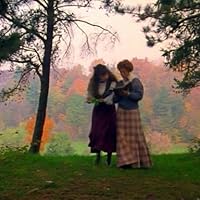
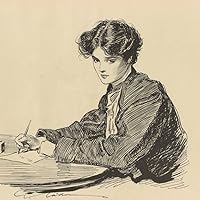
The story starts in 1914. Jane Judd works as a housekeeper for artists to earn her living while she works on her writing. When one of them, Jerry Paxton, offers her a marriage of convenience, she jumps at the chance to "live" to help her writing get better.
Novelist and playwright, Marjorie Benton Cooke was born on 27 November, 1876, in Richmond, Indiana. She was the daughter of Joseph H. and Jessie Benton Cooke. Her father was a salesman and had once served as treasurer for the city of Richmond. Marjorie attended preparatory schools in Detroit and Chicago before entering the University of Chicago.
Not long after her graduation in 1899, she became a successful recitalist of original monologues and sketches. By 1909 she was being called "the cleverest reader of monologues in America". It was also around this time that she began writing one-act plays and poetry. In 1905 she wrote the lyrics to the ditty "Is Yo'? Yo' Is!". Her first book, "The Girl Who Lived in the Woods", was published in 1910 and was followed by "To Mother" (1911), "Dr. David" (1911), "Bambi" (1914), "The Incubus" (1915), "The Duel Alliance" (1915) "Cinderella Jane" (1917) and "The Cricket" (1919). In 1936 her book for young adults, "Bambi" (not the story with Thumper), was serialized on radio starring Helen Hayes. Cooke had also authored a number of popular short stories that appeared in magazines and several plays and screenplays before her career was tragically cut short.
Marjorie Benton Cooke died at the age of 43 on April 26 1920, at Manila, after coming down with pneumonia during an around the world cruise with her mother. Her father had passed away four years earlier in New York City.
"A masterly handling of the woman question, Mrs. Paxton," said the man who sat next her at table.
"I wish we might call it the human question; it is yours as well as ours, you know," she answered. --------- This was a surprising and fascinating read and I've struggled to put my feelings into words. I expected a little bit of feminism wrapped in a breezy rom-com and it was much, much deeper than that. I'm puzzled as to why this book is not better known today. It may not be the literary equal of Chopin's "The Awakening" and it is ultimately gentler and less radical. But, it is still radical for it's day and well-written and I feel that literary folks interested in women's history and women's rights would do well to put this book on their radar. It would spark wonderful discussions in book groups, university courses, etc. The issues extend beyond gender roles to politics and war, art, theater, education, religion, science/medicine, etc.
I finished this a few months ago and it has stayed vivid in my memory. I can't say that I loved it. It wasn't the sort of book that I want to hug to myself and read over and over. But I appreciated it greatly. I had a hard time with Jane. She was, on the one hand, a remarkable person, a light to her friends, a voice of much needed progress. Yet, I never really warmed up to her. She studied people in the name of Art (she is a writer and is always clamoring for Experience to put into her work) while I could forgive aloofness I had a hard time getting past her sense of superiority. Feeling herself apart from, yet also above, their petty little daily goings on. She grows and learns as the book progresses and I ultimately felt compassion for her, and appreciation for what she went through and wanted to achieve, but I still couldn't seem to adore her as so many in the book did so easily. It was much easier to like the "lesser" characters in the book, Bobs and Jerry, whose foibles are so obvious. Interesting that Jerry and Jane are both selfish in the name of their Art, both hurt one another in the process, and both learn from the other.
To me, this is the story of two selfish people who finally find something to love that takes them out of themselves. It is not a typical love story. The ideas of parenthood and matrimony were (are?) radical. Like so much that is progressive, part of it will rankle and part of it will inspire and, because it is also art, it fills your heart as well as your mind. I'm glad I read it. I may read it again one day. I hope many others will, too. It is available free on Project Gutenberg. -------------------------------------------------------------- "[to write well] you must have lived, you must have suffered and known joy; you must be able to analyze people, to understand their motives, to love them. To write, you must have ideas and emotions. It is only when the sources of your own being run deep that you can bring up waters of refreshment for others."
"We think of the hackneyed old phrases we use in the mechanics of living, but words are like little creatures that march and fight and sing. They are like extra hands, and brains. Think of the power of them! All the passions wait on them; they bring despair, hope, courage, love; they are the golden exchange granted to man."
----- "Jerry, I thoroughly appreciate these lovely things you have given me, and I promise you to give my appearance the most careful attention. But I wish, please, that you would agree to give me a monthly allowance for my needs and desires."
"Oh, you needn't worry about money, Jane. You'll always get it when I have any. When I'm broke, we'll neither of us have any," he laughed.
"But I want to know just what I can depend on. Of course, that would be contingent upon what we have."
"What's the difference whether I give it to you every month or not?"
"It is the difference between my being a self-respecting partner, or a dependant."
"Rubbish! Sounds like woman's rights. For heaven's sake, don't be a woman's righter, Jane."
"You agree to an allowance, then?"[Pg 103]
"I don't see why I should. I must say, I think I have been pretty liberal so far——"
"You miss my point. I admit your liberality, and appreciate it, but slaves and servants are dependent upon liberality. It does something to your mind, you must see that."
"I'm hanged if I do."
"You must take my word for it, then, that no marriage can be built on such a basis."
"But I don't agree with you."
"Very well, then, I must take up my work in the studios again."
"What?"
"I must be independent, I must know where I stand."
"You mean to say that you would go about cleaning up studios? My wife cleaning up studios, to pander to this whim?" angrily.
"It isn't a whim, it's a principle. No kind of work can hurt my self-respect, but I want to be regarded as a partner, Jerry. If it is what you used to pay me, by the week, for keeping the studio clean, and your clothes mended, that is enough. But I must know how much it is, and when I get it."
"This is degrading, that's what it is! You don't trust me, that's the long and short of it."
"Oh, yes, I trust you more than you do me, apparently. If I had the money, and had married you, I should give you a check book on our joint account."
"That's nonsense, Jane. It's this modern stuff you've picked up in books. I loathe the new woman with her platforms and her freedoms. Don't begin to feed me up with that stuff."
"You think it over calmly, Mr. Paxton, and you'll see it is only fair."
-------
"How can a woman be an artist and a human being at the same time?"
She peered at him before she replied.
"She can't. She can only be them in relays. Artist awhile, human awhile. Living takes too much from her.[Pg 168] Loving, wiving, mothering are too devouring. Men manage their part of it, but women cannot; that is my decision."
"You think she must choose between them?"
"No, that is too big a price to pay for either."
"How, then?"
"She must have both some of the time, neither all the time."
"But isn't that increasingly difficult with a man to consider, possibly a child or two?"
"Difficult? Do you think there is anything more difficult than being a woman to-day? I don't," she answered bitterly.
"The most difficult thing I know is being a man."
"Why do we bother with it at all, when just a little plop out there in the fog would end it?"
"Would it, though?"
"Don't you think souls are ever allowed to rest? Do they plunge us into some new form the minute we leave the old?"
"It's the doubt about it that is salutary."
"If you go out, you're a coward. If you stay on, it's because you're afraid to go out," she cried.
"Even so. Therefore you come to grips with life, and prove yourself a good soldier."
"Like Jane," Bobs said. "Isn't she fine?"
"She is a very rare human."
"She's the best friend I ever had."
"I think I can say that, too," he said. ------- "Don't you think it's important to be happy, Jane?"
"Why, yes, but I think it just happens, doesn't it? You cannot make it happen. It is like courtesy, or spirituality, it results from everything in you, your whole habit of life and thought."
"Does it? I thought it was something you went after, and got," said Jerry.
"Like a box of sweets," she smiled.
"Like a box of sweets, and then you ran the risk of stomachache."
"I call that satisfaction, not happiness."[Pg 198]
"What is happiness to you, Jane?"
"A miracle," she evaded. ------ He went on with his study of her. She filled his mind. In the nursery she was a happy, twittering, foolish mother, adoring her baby. With him she was now a gay, bantering companion, now a dweller in Mars, with no apparent connection with the earth. With Christiansen she was a sexless challenge, calling to his mind with hers. Bobs transformed her into an affectionate big sister, interested in the doings of all the studio friends. He no sooner collected the data of one rôle, than she assumed another. Yet with all those ties, she kept an independent aloofness. Jerry felt that, any day, she might tie baby to her back and go forth, leaving them all, without a look behind. He decided that this was the secret of her fascination for them. ----- "Jerrykins, I wonder if thy great-great-great-granddaughter will be able really to call her soul her own. Jerry could have a whole series of workshops, of which I knew nothing, and consider it his business only; but if my soul has one unexplored corner—my body one unexplained resting place—I am no true wife! The times, my son, are always out of joint," she added with a sigh. ---- Ours is an age of conflict, of rapid change, taking place in our knowledge and all about us. The conflict is psychological as well as material. Take one small detail of our machinery. In Jane's own lifetime had come a total revolution in man's method of transportation. Subways, elevated trains, automobiles, aeroplanes. How swiftly must the individual readjust himself. He has within him, intensified, the struggle and the discoördination which is taking place in the large social group. He has to meet the crisis of accepting daily new truths, while he is bound, even tortured, by traditional convictions.
It was because the Jerry type of man did not see that this discoördination ramified into every corner of our lives—that it is religious, social, political, as well as material and domestic. But boy-man that he was, he recognized it only where it struck home quickest to him, in his sex life, in his marital relations. He could not realize that this was not the basis of the whole unrest and therefore to be laid at woman's door—that it was only reaction from an universal discoördination.
She had tried to work this out in her book; she had striven with all her power to get above this seething, boiling, electrified whirlpool that we call life, to find purpose in it—direction and ultimate calm. She wanted to drive home her conviction that, whether we swim with the torrent or against it, we must do it together—men and women—adjusting and readjusting. -----
2.5 stars I really loved the character when I started the book, but the second half was too involved in political/social statements that really drew me out of the enjoyment of the story. It made the woman smarter and better than everyone else, and I really appreciated the emphasis on the value of motherhood--but the men in the story were little better than mindless puppets. Even the one that I thought I could admire turned out to be holding a dark secret that prevented him from being the hero.
I guess, I liked Jane so well that I would have been happier seeing her with a true equal to her intelligence and emotion. The story seemed to downplay emotion as a weakness and yet it's given to us as a gift as long as we don't abuse it. It also had a very, very liberal view of what marriage meant, and I had a hard time with its definition of the "trappings of faith" as "traditions that had no real value." And yet at the end, Jane seems to "see Christ," so is the author okaying faith or not? It wasn't clear.
Since I varied between wanting to hug Jane and wanting to rip the book up a bit, it's two stars instead of one or three.
Recommended to adults because of the moral POV being confusing. Content: Talk of sex but discreet Feminism Twilight sleep used in childbirth (and endorsed!!)
The title of this book led me to expect a sweet, rags-to-riches romance. And so it appeared to begin with, as poor and drab Jane Judd makes a marriage of convenience with up-and-coming portrait painter Jerry Paxton. And I just knew she was going to blossom out and become pretty, and there would be another man who would want her, and then Jerry would realise how he actually loved her, and there would be happily ever after.
Well, all of that does happen. But it's not the sweet&fluffy story I was expecting. For a start, Jane is only poor and drab because she's working to survive while she becomes a writer. The Other Man turns up even before she marries Jerry, and spends most of the book as her friend and mentor. And Jane is no sweet&fluffy heroine who wants to write sweet&fluffy stories. She reads, she goes to lectures and meetings, she talks and listens - she becomes a highly educated modern woman, and that bane of most novels of the era ("Cinderella Jane" is copyright 1917), a "strong-minded" woman. In fact, she is an unashamed feminist, and her novel, from the descriptions, seems exceedingly high-brow as well as feminist. Jerry, meanwhile, besides being lazy, selfish, and most of the time rather uninterested in Jane, is an unrepentant anti-feminist, of the type that thinks women demanding equality are the source of all evil in the modern world.
The marriage is rather peculiar, as you might expect, but I found it fascinating to read a novel of that era with a feminist heroine (and a romance novel, at that!), and rather amusing to see Jane's manipulation of Jerry into making their roles equal. (Also, her seeing-off of the frightful Althea is masterly.) Really, it only fell down at the end, when the inevitable someone-else-wants-her-omg-I-love-her realisation arrives, matters are resolved over the child's sickbed...and the feminism aspect is quietly not there, but not there in such a way that it's impossible to tell whether they're just enjoying the I-love-you moment or they've reverted to cave-man-frail-woman nonsense. Plus it all seemed to be resolved a bit too fast.
But, overall, an interesting and entertaining read.
This is one of my amazing Project Gutenberg finds. I love browsing Gutenberg and finding such little gems. Sometimes, I know the author, but most of the time my choice is just based on the title. I had no idea what I was getting into. With such a title as Cinderella Jane and being published in 1917, I imagined it would be a sweet rags-to-riches story.
The story starts in 1914. Jane Judd works as a housekeeper for artists at some sort of studios to earn her living while she works on her writing. When one of them, Jerry Paxton, offers her a marriage of convenience, she jumps at the chance to "live" to help her writing get better.
What was great about Cinderella Jane was the totally unexpected turn it took. Yes, Jane flourishes as you would expect. But she is also incredibly intelligent and articulate. Her story is used as a means to explore women's rights and the place of women in society, but many other topics are also discussed through the story and dialogue - wars (still relevant today!), art, education, gender issues, etc. I think it would be particularly good for those interested in feminism, herstory or art. I do wonder why this book isn't well-known as it really deserves to be!
This book managed to be interesting enough to finish, but totally life-less at the same time. The plot was a good idea, but the characters such that by the time I came to the end, I didn't care if they were happy or not. I certainly didn't believe that they were suddenly in love.
This is the third "Cinderella" story that I have read in as many days and was the least predictable and most enjoyable so far. This Cinderella (as are most of them) is practical and logical and smartly avoids all manner of emotional traps. For being written in the early 1920s, it was an enjoyable story. Jane has a lot in common with Atwood's LouLou.
This book managed to be interesting enough to finish, but totally life-less at the same time. The plot was a good idea, but the characters such that by the time I came to the end, I didn't care if they were happy or not. I certainly didn't believe that they were suddenly in love.
Okay, this story was interesting and boring, I liked it and didn't like it, some parts were wonderful and some parts just bleh, I loved the characters but did not find the storyline anything worthy of attention.
The stuff I didn't like/enjoy: - Half of the conversation between Jane Judd and Martin Christiansen was about politics/rights bla bla bla...
- There was barely any romance
- I hated Althea Morton
- Jerry was very difficult to like until we neared the end
- The whole baby thing was kinda weird: '"It's little Jerry," the nurse said, and lifted a swaddled bundle and brought it to her. She looked at it long and seriously.
"You're sure that's mine?" she said.
"Very sure."
"Take it away, please."
"It's a grand baby, Mrs. Paxton."
"Did my husband see it?"
"Not yet. The doctor put him to bed."
"Don't let him see it. Keep it covered up."
"But he'll be wanting to see his son."
"Not till he's better looking. It would be an awful shock to Jerry to see it now."
Then she went to sleep again. When she woke, Jerry was beside her.
"I'm sorry he's so plain," was her first word.
"He's a fine boy, Jane," he said, with a gulp.
Two days later, when Bobs was admitted, Jane confessed to her, her shortcomings in the new rôle.
"I didn't do it right at all, Bobs."
"Why not?"
"In books and plays the mother always says, 'My baby, my own beautiful boy,' when they put her infant in her arms. The father always says, 'little mother!' You know, you've seen it in pictures. Well, I said: 'It's ugly, take it away,' and Jerry lied to comfort me." ' 🤨
The parts I loved: " 'to write, you must have lived, you must have suffered and known joy; you must be able to analyze people, to understand their motives, to love them. To write, you must have ideas and emotions. It is only when the sources of your own being run deep that you can bring up waters of refreshment for others. ... We think of the hackneyed old phrases we use in the mechanics of living, but words are like little creatures that march and fight and sing. They are like extra hands, and brains. Think of the power of them! All the passions wait on them; they bring despair, hope, courage, love; they are the golden exchange granted to man. Until you get this sense of the choiceness, the fragility, the power of words, you are not ready to transcribe your thoughts.' "
"It is the routine of life which helps us through the tragedy, always."
Among the characters, the most vivacious one was Isabelle, She was so silly, I agree, but she put some real humour into the story.
Martin and Jane were the best people in the story
Only towards the end of the book, in the last 50 pages, things get full of feelings and conflicts and emotions; there are tender and heart-touching scenes; it's only the ending that saved this book from getting a two-star rating.
My favourite quote:
"if [love] is something sweet and poignant that binds you to somebody, something all woven of common experiences and habits and needs; if it means something to lean on when you're in trouble and to be happy with when you're glad, why then..."