Jump to ratings and reviews
Rate this book

Grant and Twain: The Story of an American Friendship

Rate this book
In the spring of 1884 Ulysses S. Grant heeded the advice of Mark Twain and finally agreed to write his memoirs. Little did Grant or Twain realize that this seemingly straightforward decision would profoundly alter not only both their lives but the course of American literature. Over the next fifteen months, as the two men became close friends and intimate collaborators, Grant raced against the spread of cancer to compose a triumphant account of his life and times—while Twain struggled to complete and publish his greatest novel, Adventures of Huckleberry Finn.In this deeply moving and meticulously researched book, veteran writer Mark Perry reconstructs the heady months when Grant and Twain inspired and cajoled each other to create two quintessentially American masterpieces.

In a bold and colorful narrative, Perry recounts the early careers of these two giants, traces their quest for fame and elusive fortunes, and then follows the series of events that brought them together as friends. The reason Grant let Twain talk him into writing his memoirs was simple: He was bankrupt and needed the money. Twain promised Grant princely returns in exchange for the right to edit and publish the book—and though the writer’s own finances were tottering, he kept his word to the general and his family.

Mortally ill and battling debts, magazine editors, and a constant crush of reporters, Grant fought bravely to get the story of his life and his Civil War victories down on paper. Twain, meanwhile, staked all his hopes, both financial and literary, on the tale of a ragged boy and a runaway slave that he had been unable to finish for decades. As Perry delves into the story of the men’s deepening friendship and mutual influence, he arrives at the startling discovery of the true model for the character of Huckleberry Finn.

With a cast of fascinating characters, including General William T. Sherman, William Dean Howells, William Henry Vanderbilt, and Abraham Lincoln, Perry’s narrative takes in the whole sweep of a glittering, unscrupulous age. A story of friendship and history, inspiration and desperation, genius and ruin, Grant and Twain captures a pivotal moment in the lives of two towering Americans and the age they epitomized.


From the Hardcover edition.

352 pages, Paperback

First published January 1, 2004

241 people are currently reading
735 people want to read

About the author

Mark Perry

38 books22 followers
Mark^Perry. From Wikipedia:

Mark Perry (1950 – 8 August 2021) was an American author specializing in military, intelligence, and foreign affairs analysis.[1][2]

He authored nine books: Four Stars,[3] Eclipse: The Last Days of the CIA,[4] A Fire In Zion: Inside the Israeli-Palestinian Peace Process,[5] Conceived in Liberty,[6] Lift Up Thy Voice,[7] Grant and Twain,[8] Partners In Command,[9] Talking To Terrorists,[10] and The Most Dangerous Man in America: The Making of Douglas MacArthur.[11]

Perry’s articles have been featured in a number of publications including The Los Angeles Times, The Washington Post, The Nation, Newsday, the St. Louis Post-Dispatch, the Christian Science Monitor, and The Plain Dealer (Cleveland, Ohio).

Background
Perry was a graduate of Northwestern Military and Naval Academy and of Boston University.

Career
Perry was the former co-Director of the Washington, D.C., London, and Beirut-based Conflicts Forum,[12] which specializes in engaging with Islamist movements in the Levant in dialogue with the West. Perry served as co-Director for over five years. A detailed five-part series on this experience was published by the Asia Times in March and in July 2006.[13] Perry served as an unofficial advisor to PLO Chairman and Palestinian President Yasser Arafat from 1989 to 2004.[14][15]

Librarian Note: There is more than one author in the GoodReads database with this name. See this thread for more information.
Mark Perry: author of Grant and Twain: The Story of an American Friendship

Mark^^Perry: author of War of Darkness (Role Aids/Advanced Dungeons and Dragons)

Mark^^^Perry: author of A Dress for Mona

Mark^^^^Perry: author of Dead Ringers: The Television Series

Mark^^^^^Perry: Illustrator

Mark^^^^^^Perry: author of The Climb: First Steps

Ratings & Reviews

What do you think?
Rate this book

Friends & Following

Create a free account to discover what your friends think of this book!

Community Reviews

5 stars
304 (36%)
4 stars
343 (41%)
3 stars
141 (16%)
2 stars
35 (4%)
1 star
8 (<1%)
Displaying 1 - 30 of 120 reviews
Profile Image for Fergus, Weaver of Autistic Webs.
1,270 reviews18.4k followers
June 14, 2025
My mother and father always possessed strength and stamina in TRUCKLOADS.

Their son, on the other hand - me - was a Milquetoast, and a sentimental pushover, even though, like Grant, I always somehow Slogged Through the job at hand. That at least was in my genes.

How did it all turn out?

Well, I was OK - more or less - until the first really Hard Knocks of life resounded on my front door. With a childhood immersed in dreamy, other-worldly books & music, is there any wonder?

I was a pushover.

But I had my parents’ genes.

And I dusted myself off and dutifully got BACK into the Grind.

And as I got close to mid life, and witnessed firsthand the armour of transcendent stoic fortitude my mother was wearing when she was dying of cancer, I got another strong, sympathetic and genetic boost in the arm.

WELL, that started to REALLY wake me up!

My progress through life has been guided, as Tennyson says, by “one clear call.” Though our paths can never be straight and narrow, our Guide is. And with tough-loving parents like mine, who could go wrong?

Now, I am a senior citizen who has stuck to his guns of faith come heck or high water, and my father will be 100 in December!

He has the same fortitude he always had, as he gets close to the finish line.

You know, my parents’ example - and stamina - have finally and wonderfully changed me.

So I LOVED this book.

THIS is Ulysses Grant as we have NEVER known him.

A man - at the end - of titanic strength, devotion, unselfish family love ... and sheer brute stamina.

A man who really loved his family - enough to provide for them amply after his death through the Herculean labour of writing and publishing his memoirs, a sure-fire wildfire bestseller - and making them the recipients of ALL of its enormous financial dividends in his soon-necessary absence.

A man who, though afflicted with a malignant, painful and inoperable tumour, showed his TRUE - DEVOTED AND CARING - COLOURS in this last hard labour.

Grant was a TITAN, considered in abstraction as a simple human being.

As were SO many in that tumultuous time.

For it was a time of heroes, on both sides.

Perry's book is uneven in quality and in its unemotional tone (hence the four stars).

But It acts as a wake-up call to those of us who are unsure of Grant's stature - and our own.

And, more importantly, are unsure of our OWN Strength, like I was.

Read a little about Grant’s strength and love for his family and it will RUB OFF on you!

Sure, he made horrendous mistakes - quite a few of them. Don’t we all?

But somehow his unflagging energy and love continued unabated to his bitter, but ultimately VICTORIOUS Death.

And the stories of the deep humanity and devoted friendship of BOTH these men are priceless as well.
Profile Image for Eric Byrd.
623 reviews1,166 followers
August 25, 2010
In 1861, twenty-two-year-old Missourian Samuel Clemens joined a makeshift band of Confederate militia. He swaggered and boasted with the fledgling Yankee Killers until the rumored advance of Federal troops and the lure of the Comstock Lode compelled him to light out for the territories. There he panned silver and took up humorous stories. As Mark Twain he later quipped that he deserted the rebellion before he could experience the honor of being captured by Grant’s forces (one of Grant's first assignments had been to guard the rail head at Hannibal, Missouri, Twain's birthplace and boyhood home). They met shortly after war’s end, but the friendship really dates from 1879. That year Twain was invited to propose the fifteenth toast at a raucous, cigar-hazed, whiskey-irrigated reunion banquet held in Grant’s honor by former officers of the Army of the Tennessee, Grant’s Mississippi champions, and Sherman’s shock troops in Georgia. Twain’s toast cracked up the usually impassive Grant and they became close.


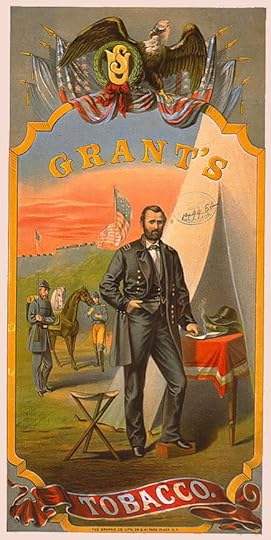
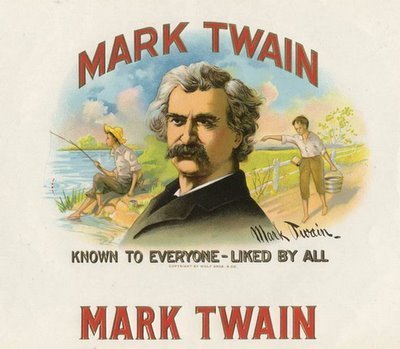
So what did the Silent General, as Melville called him, and the jawboning jokester have in common? Though it goes unmentioned by Perry, both were iconic smokers (at the height of his consumption, during the blind wilderness grapples with Lee’s army, Grant was smoking twenty-four cigars a day), and as such were among the stars of nineteenth century cigar box illustration:


description

description


Grant dreamed in his youth of becoming a Mississippi River trader, life on the big river being the romantic antithesis of his father’s bloody, foul-smelling tannery—Twain of course felt the same way, and became a steamboat pilot for the job’s nomadic, footloose, beholden-to-few aura. Because the publishing house Twain ran with his nephew, Charles Webster & Co., issued Grant’s Personal Memoirs and The Adventures of Huckleberry Finn in the same year, 1885, Perry is at pains to identify the influence of Grant’s book on Twain’s. I’ve not read Huck Finn, but Perry’s arguments on this matter seem thin and hurried through. He says Huck’s descent down river to free Jim was informed by Grant’s liberating march south. Perry also sees a veiled reference to “General Grant” (Twain’s habitual mode of address to his friend) in the “G.G., Chief of Ordinance” who gives notice to readers that

Persons attempting to find a motive in this narrative will be prosecuted; persons attempting to find a moral in it will be banished; persons attempting to find a plot in it will be shot.
Perry says he wants to portray both men struggling with racial questions, but weirdly spends but a few pages doing so for Twain—and Grant only gets two paragraphs. Brooks Simpson wrote a +300 page study of Grant’s racial attitudes, gradual embrace antislavery politics, and views on Reconstruction, so this skimpiness is baffling. I’ll say nothing more about Perry than register my disappointment; the inherent fascination of these figures carried me to the end; Bernard DeVoto, or Shelby Foote, or Gary Wills, or Edmund Wilson should have written this story.


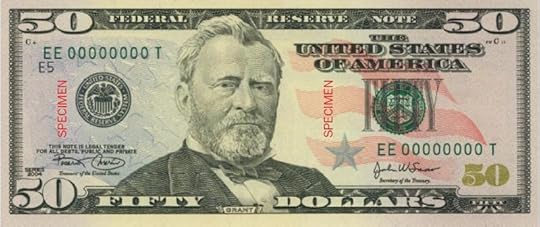
Obsession with money and anxiety over their respective places among the Gilded Age power elite are other common threads. Twain satirized his age and deplored its dollar fever—but he also lived in a grand style, and was forever trying to get richer; also: wily, litigious, with a genius for publicity. Before the war Grant had pushed a plow and sold cordwood in the rainy streets of St. Louis, so his post-Presidential prestige mattered greatly. Wiry and weathered during his campaigns, he was by the 1880s the frosty, rotund nabob we know from the $50 bill.


description


Grant relished the Wall Streeter status conferred by partnership in a prominent brokerage house, and the multi-million dollar fortune returned on his personal investments with Grant & Ward was a source of deep satisfaction. The man who once pawned his watch to buy Christmas presents for his family clearly enjoyed being able give his wife an exorbitant shopping allowance. The greatest shock of Grant’s life was the failure of the firm in May of 1884. Ferdinand Ward had cooked the books and absconded with the investors’ green, including Grant’s. It was a bad year that only got worse. The next month, Grant, already broke, found out he had throat cancer.


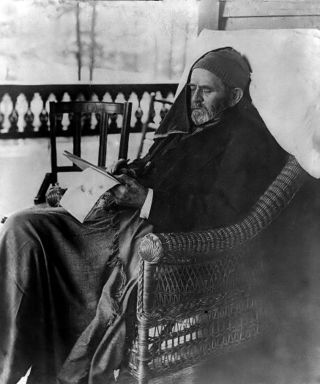
To raise some fast cash, Grant had agreed to pen a series of battle reminiscences for Century magazine. The editors had been urging him to write a full memoir, and with the terminal diagnosis Grant agreed to do the book. One day he showed Twain the contract he was preparing to sign. Twain was scandalized by what Century proposed to pay and convinced Grant to let him publish the book. Offered a sure-thing royalty, or a cut of the profits, Grant took the latter—if the book didn’t sell, he said, he would feel bad getting paid. During that last year, Twain was in and out of Grant’s Manhattan brownstone, watching as the general collapsed and rallied; stared depressively out into the winter dusk; received calls from former comrades and former opponents; nodded amusedly at the crowd of quacks and holy rollers gathered outside; choked almost to death on gobs of blood he couldn’t spit; tactfully bore the baptismal entreaties and interminable bedside prayers of his wife’s huckster preacher ("I do not care how much praying goes on if it makes your mother feel better"); convinced doctors to ease their smoking ban on April 9th 1885, the 20th anniversary of Lee’s surrender, and puffed contentedly, no doubt recalling his finest hour; all while never complaining and writing, writing, writing. With the coming of summer, Grant had to get out of the hot city. A real estate tycoon lent the Grant family a cottage near Sarasota Springs, betting that Grant’s death there would make it a national shrine and attract future resort-goers. Grant died of starvation about a week after putting down his pen.


description


The Memoirs were an astounding success and restored the Grant family fortune. Edmund Wilson, who grew up in a solidly Republican New Jersey household in the early 1900s, mentions the “thick pair of volumes” that “used to stand, like a solid attestation of the victory of the Union forces, on the shelves of every pro-Union home.”


[image error]


I’m waiting to read the book on Grant that doesn’t make me like him more. I still can’t believe he’s real, this bashful, uxorious wallflower who could become, when engaged, an implacable warlord, pantherishly maneuvering. Beneath the daydreaming math geek who hated army life, the “hopelessly impractical” failed farmer, all along, was a deft handler of ponderous armies, a coordinator of continental strategy who organized Union victory out of a stalemated muddle. Confederate vice-president Alexander Stephens crossed the lines on peace mission expecting a blunt, domineering figure, patterned after his campaigns, but instead found, he later said, a slim, spare, soft-spoken little man of charming manners and conversation; “he does not seem aware of his powers,” Stephens concluded. Sherman said, “Grant is a mystery, even to himself.”


description


Such a strange mixture of parts: at once simple and inscrutable, vulnerable and tough, deeply insecure and confident of vast strength. He was shy rather than closed-off, tender rather than touchy. And then there’s the cool concentration under pressure which enabled him to recover battlefield reverses and compose some classic American prose—prose Edmund Wilson judged “perfect in concision and clearness, in its propriety and purity of language”—while slowly starving to death (the cancer devoured his throat and tongue, and made even a drink of water excruciatingly painful). This was a man who, when he could no longer speak, and was reduced to communicating through scribbled notes, wrote his doctors thus:

...I have watched my pains, and compared them with those of the past few weeks. I can feel plainly that my system is preparing for dissolution in three ways; one by hemorrhage; one by strangulation; and the third by exhaustion. The first and second are liable to come at any moment to relieve me of my earthly sufferings. The time of the arrival of the third can be computed with almost mathematical certainty. With a decrease of daily food, I have fallen off in weight and strength very rapidly for the last two weeks. There cannot be hope of going far beyond this period.


To the end Grant remained what Sherman called him, a mystery unto himself, still strangely detached from and wryly wondering at his accomplishments. That seems a family trait: visiting his parents after Lee’s surrender, Grant’s mother, like him always understated and spare of speech, looked him over, declared “Well, Ulysses, you've become a great man, haven't you?"—and went back to her housework. Another note to his doctors, after the first volume of the Memoirs had been sent off to Twain:

It seems that one man's destiny in this world is quite as much a mystery as it is likely to be in the next. I never thought of acquiring rank in the profession I was educated for; yet it came with two grades higher prefixed to the rank of General officer for me. I certainly never had either ambition or taste for political life; yet I was twice president of the United States. If any one had suggested the idea of my becoming an author, as they frequently did, I was not sure whether they were making sport of me or not. I have now written a book which is in the hands of the manufacturers. I ask that you keep these notes very private lest I become an authority on the treatment of diseases. I have already too many trades to be proficient in any.


A note to one of his sons, about the final arrangements:

It is possible my funeral may become one of public demonstration, in which event I have no particular choice of burial place; but there is one thing I would wish you and the family to insist upon and that is that wherever my tomb may be, a place shall be reserved for your mother.
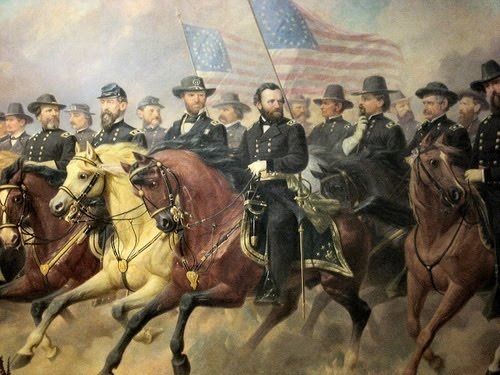

It is possible. Merely possible? Grant’s funeral procession was the largest to date, bigger than Lincoln’s. 18,000 Union veterans, 3 former presidents, thousands of dignitaries from all over the globe, and 60,000 US troops marched in the procession, which took 5 hours to snake through Manhattan. 24 black stallions drew the hearse. Every building along the route was hung with black. Grant’s pallbearers were two former Rebel generals and two former Union ones (when you starve to death, four can carry you).


description
Profile Image for Joseph.
731 reviews58 followers
September 16, 2020
One of the only books I've read and reviewed this year that made me cry. I had read another book by this author about two Civil War icons, but this book was hands down the better of the two. The author chronicles the last days of Grant and the uphill struggle he faces to finish his memoirs before his death. The book also tells the story and struggles of Mark Twain, but for me the Grant story-line was more evocative. A very powerful, well written dual biography. Well worth the time spent reading it.
Profile Image for Marty Reeder.
Author 3 books53 followers
July 12, 2017
This was going to be the perfect culmination of a year of reading Mark Twain and studying up on Ulysses S. Grant: two historical figures who had connections, respectively, to my (now one-year-old) son and my dad, who passed away one year ago. And, in a way, it was just that. The memory of these two figures as it merged and stretched with the two personal figures in my life spanning generations on either end helped me to justify the time I spent reading and learning about their part in history as I observed and remembered my own family members and their impact in my life this past year. What a treat for the United States, the world even, to have had this friendship of Mark Twain and Ulysses S. Grant--two unlikely yet laudable characters.

On the other hand, if you get past the idea of this story, if you allow Mark Perry, the author, to get in the way of an innately great story, then it is a frustrating and baffling experience.

The warning flags came up fairly soon as Mr. Perry jumps into a brief biography of each character. Having been already well-versed in this area, I was still excited to soak in another rendition of the fascinating lives of Twain and Grant. I was surprised, then, by a few inaccuracies with the geography and timelines of their lives, a misinterpretation of a Twain quote as a personal statement rather than one as a comic narrator, as well as an interesting biographical omission. The inaccuracies were benign enough, the misinterpretation of a facetious statement not significant enough to do any harm, and obviously an omission is a subjective choice. Yet these things together helped resign me to not expecting a high quality historian experience.

This rocky start only deepened as Mr. Perry seemed to wander about in the middle of the narrative, trying to make unnecessary connections between the two principal actors, and then jumping back and forth from one aspect of their character and lives to another with no seeming pattern, not even chapter breaks at obvious times. For instance, I will be the first person to laud the greatness of Huckleberry Finn (check out my review, it goes beyond mere fandom), but Perry’s awkward attempt to connect it to Twain’s relationship with Grant simply does not match the facts (nor does it need to!).

Similarly, the discussion on Twain’s and Grant’s views on slavery (heavy on Twain, super light on Grant) are separately interesting, but don’t belong together, and certainly feel out of place in the bigger story of this book. Those views simply had nothing to do with Twain and Grant’s connection, and insinuating that they do is a disservice to history by trying to add intrigue to an already fascinating-enough story. I think this is a good example of Mr. Perry trying to moralize the tale by infusing 21st century ideals where they clearly don’t belong.

In the same way, Mr. Perry’s own 21st century antagonism towards religion is clearly reflected out of both Twain and Grant’s characters. With Twain, who clearly had his problems with religious hypocrites and organized religion in general, a serious student should know better than to dismiss his correspondence with his wife as merely pandering to her religious sensibilities or disregarding overt and sincere religious themes in stories like The Personal Recollections of Joan of Arc and The Prince and the Pauper (stories that he and Livvy admitted as being personal favorites despite their limited publishing success). Grant’s similar disregard to religious showiness is more easily attributed to his humble nature than to hostility towards faith--something that not just his actions but also his words seem to prove to the contrary (even those provided by Mr. Perry himself!). Perhaps, I, like Perry, am simply projecting my own 21st century beliefs on these two characters, but I feel that Mr. Perry is reckless in asserting his position through personal interpretation of events rather than allowing the audience to come to those same conclusions using the supporting evidence of facts.

Okay. Those are the problems that I had while reading the book--all of them attributable to Mr. Perry’s approach and style. But there were plus moments. First of all, the story itself, when unencumbered by inaccuracies, irrelevant side stories and characters, or a patronizing author voice, is a powerful one. I learned more about Grant’s sickness, its development, treatment, and the close calls associated with it than any previous biography had given me. I learned more about the deal he and Twain struck for publishing the memoirs than the simplified versions I learned about previously. I loved to hear about, again, the heart-warming and hope-infusing story of the U.S. Congress finally getting something unequivocally right as they worked right up to the inauguration of a new president to confer Grant’s pension before he died, or Twain’s delivery of an unprecedented royalty check to Julia Grant after the success of Grant’s memoirs.

Ultimately, the story is one worth culminating a year--even a lifetime--of devotion to these two scions of American literature and history, especially if you have personal ties to it as I did. But if you are already that interested in either of these characters, I feel that you will get a far more accurate and just as satisfying rendition of this story from another source or other sources.
Profile Image for Mike.
1,113 reviews37 followers
July 18, 2022
I wasn't expecting much from this short work but enjoyed it quite a bit. After a few dozen pages of introductory biographical sketches, this follows the last months of U.S. Grant's life as he writes his famous memoirs while dying from cancer. Mark Twain worked with him and published the works, and the book explores both of them and a bit of the society of the time. I learned a lot and appreciated many of the anecdotes.
Profile Image for Tammy.
28 reviews1 follower
January 4, 2020
I purchased this book while on a recent trip to Galena, IL where Grant briefly resided before his military career began. This book title piqued my interest because it promised a glimpse into the private lives of not one, but two interesting historical figures. We learn of Grant’s historical significance and of Twain’s literary contributions in school, but we need books like this to bring those historical figures to life. This book focuses on Grant’s final push to provide for his family and leave behind a clear account of his life. It’s also about Twain’s struggle to create his literary opus and collect the praise and profits he desires. These two great men, who seem so opposite, actually form a surprisingly close friendship and profitable working relationship. This book was enlightening and informative while being easy to read and very entertaining.
Profile Image for Erin Bottger (Bouma).
137 reviews22 followers
August 12, 2021
Mark Perry has given us a very interesting book about a deep, historic friendship most of us were unaware of. Grant and Twain were two giants of their age, though in completely different spheres and with markedly different characters.

"Grant was reserved, modest and a man of few words. Clemens was anything but. He was outgoing and ostentatious, and his love of words... defined his character." Perry gives a summary of each man's private life and public career before they were brought together. He also tries to draw thematic parallels and differences in their positions.

For example: "It is hard to miss the plot [of "Huckleberry Finn"] that Twain was now weaving so effortlessly-- for the only way to tell the southern story and the only way to free Jim and Huck was to send them south. It was a conclusion that Ulysses S. Grant had come to during his own journey down the Mississippi almost exactly nineteen years before. The only way to free the slaves, to end the war, to go home, he had said then, was to go south."

Indeed, in 1882, Twain revisits the Mississippi River and the South and finds that "in nearly every conversation, the Civil War and the South's loss in the war was a constant subject." Perry continues, "The obsession surprised Twain, but at key points in his journey south it reinforced in him the importance of Grant. Clearing the Mississippi of rebels and Grant's capture of Vicksburg had been a key to the Union victory... That Grant looked at the Mississippi in the same way Huck did-- and that Samuel Clemens and Jim did-- is so true as to be cliched, but there are a number of remarkable similarities between Grant's descent of the Mississippi to capture Vicksburg and Huck's descent of the river to free Jim."

Midway through this readable dual biography we get to the heart of the two men's friendship and mutual admiration. First, ex-President Grant, struggling with poverty as a result of betrayal and fraud, is asked to pen his rich account of his major Civil War battles. which he begins for Century magazine. Then he starts to consider putting together a whole book about the war. But first he has to deal with a growing medical emergency as he is diagnosed with throat cancer (after a lifetime of heavy cigar smoking).

Meanwhile, Twain had known for several months that Grant planned to write his memoirs and that the Century Company wanted to publish them. But Twain, himself was eager to found a publlishing company and produce Grant's book as its first offering. He also learns that Grant is given only a year to live and that Grant's three worries- "having to retrace his steps, having to ask for money, and being unable to care for [his wife] Julia"- meant that he needed the most favorable terms in his publishing contract.

Twain is able to generously pull that off and, finally, convince Grant to publish with him. Now begins the grueling effort it took to support a debilitated Grant as he assembles a working staff to allow the suffering man to write under challenging circumstances.

"Twain was not the least bit concerned with Grant's ability to finish his work. He had known the general for nearly two decades and over the last eighteen months their easygoing but distant relationship had deepened. Twain now considered Ulysses S. Grant not simply a great soldier and former president, but a good friend... Twain was 'a Grant-intoxicated man' to be sure, but he was now much more. He was a close confidant and admirer, a moral support, a man whom Grant himself admired... The two had created a strong bond and shared important obsessions. Both were consumed by America, its people, and its past-- and had lived with and seen its most ugly manifestation."

The final section of the book reaches heroic proportions as Grant fades, recovers, and nearly dies, but "soldiers on" to complete his book. Twain kept the faith that Grant would triumph in his last battle and produce a magnificent record of his life and the Civil War to be published in two volumes.

The book gives graphic details of Grant's decline in health, which forced him to relocate from his home to buy more time. Still, in the final month he wrote a letter to one of his excellent doctors:
"Since coming to this beautiful climate and getting a complete rest for about 10 hours, I have watched my pains, and compared them with those of the past few weeks. I can feel plainly that my system is preparing for dissolution in three ways: one by hemorrhage; one by strangulation; and the third by exhaustion. The first and second are liable to come at any moment to relieve me of my earthly sufferings. The time of the arrival of the third can be computed with almost mathematical certainty. With a decrease of daily food, I have fallen off in weight and strength very rapidly for the last two weeks. There cannot be hope of going far beyond this period. All my physicians, or any number of them can do for me now is to make my burden of pain as light as possible.'"

Twain joined Grant at Mt. McGregor at the end of June as he was finishing the final pages, but he left without the completed manuscript. Twain wrote to a friend, "The old soldier battling with a deadly disease yet bravely completing his task, was a figure at once so pathetic and so noble that no breath of animosity remained to utter a single word that was unkind." Three weeks later, on July 19, Grant put down his pencil and smiled: he had completed the book. He again wrote his doctor, as his family assembled around him, "There is nothing more I should do to it [the book] now, and therefore I am not likely to be more ready to go than a6t this moment." He died four days later in 1885.

In the Epilogue, Perry concludes "If Twain, as Hemingway supposes, wrote the quintessential American novel, then Grant, his friend, wrote the single most important work of nonfiction in our literature. It ranks with "Walden" as a symbol of the American character. Grant's book is not simply a profound narrative written with 'dynamic force'; it is, as Twain rightly described it, 'a literary masterpiece.' Grant attempted to tell our story to us-- and he succeeded."

The book contains copious notes as well as a bibliography, and, in the paperback edition, a Reading Group Discussion Questions and Topics. I think most everyone will get a lot out of this book-- an appreciation for America and two great men whose friendship benefitted us all.
Profile Image for Peter Corrigan.
816 reviews20 followers
September 2, 2020
Having read a biography of U.S. Grant a while back I was familiar with the outline of his life. I think it was Geoffrey Perret's version. Twain not so much, although we have all heard plenty about him. This short book was almost a mini-biography of each man. Not entirely certain the purpose of the book, although it although it certainly elucidated the nature of their relationship. Their friendship was actually pretty short and much centers on Twain's important role in the publication of Grant's famous 'Memoirs', the writing of which dominated his last two years of life. It is a sad and touching story no matter how many time you might hear it. How Grant was bankrupted by unscrupulous businessmen and sought a way to retrieve something to leave his wife and resulted in one of the most highly lauded military memoirs in American history. There are forays into many things that have little to do with their friendship, including Twain's struggles with 'Huckleberry Finn' and interesting insights into Twain's life and what Huck Finn really meant. I certainly 'got' very little of the deeper meaning of the book when it was required reading at what, age 14? I wonder if they even require it anymore. Too racist for our tender ears today. Yet it dealt with the issue in a way that was almost revolutionary at the time. In fact, it was banned a little back then (probably for other reasons) and apparently the 'woke' crowd is trying to do the same thing today! Just use DuckDuck (not google) 'Huck Finn banned'. LOL. Anyway, this book was worthwhile if somewhat narrow in scope.
142 reviews
March 29, 2024
Grant and Twain: The story of a freioendship that changed America

Twain’s writing has been a lifelong lover as a civil war buff, I had always admired his accomplishments and marveled at them. Huck Finn is my favorite american novel. I finally read Grant’s memoirs and was blown away by the tour-de-force it is in in simplicity. Reading it caused my kindle app to suggest this book for which I am so grateful. I had no idea that the history of Huck Finn, Twain, Grant and his memoirs are all intertwined. What gift this tome is. A true must read!!
208 reviews3 followers
August 15, 2023
This was a very interesting but short read on Grant (and Twain). It was a very accurate and authentic betrayal on Grant, on whom I know a lot. Same with Twain, although here I learned much more. My only complaint was a little too much detail (almost day to day) on Grant's final days and memoir writing. Loved learning about it, but the same old, same old dying log wasn't necessary, not sure how to simplify, though.
Profile Image for Hillah.
7 reviews1 follower
September 24, 2023
DO NOT READ THIS. THIS BOOK IS ABSOLUTELY DOOKIE AND PUT ME IN A BORDERLINE READING SLUMP
13 reviews3 followers
January 18, 2021
I did not know that! Good story-telling, with research and details to back it up.
Profile Image for Chris Riehl.
13 reviews2 followers
July 20, 2025
I’ve always been a great admirer of Mark Twain but knew little about Grant outside of the conventional wisdom that he was an excellent general and below average president. This book sheds light on his remarkable character and solidifies for me his place as one of this nation’s most important and under-appreciated figures. Despite the challenges of his presidency, his genius and resolute leadership during the Civil War undoubtedly saved the Union. He faced mortality with that same resolve, racing against the clock to complete his extensive memoirs before dying, assisted, supported, and encouraged by none other than Mark Twain. I had no idea these two ever had a personal relationship, but it turns out the influence they had on one another helped shape American literary history. If The Adventures of Huckleberry Finn is the greatest American novel, the Memoirs of Ulysses S. Grant must surely be considered among the greatest works of American non-fiction, and as it turns out neither Grant nor Twain might’ve have completed their work as they did without the other.
Profile Image for Bill Tress.
279 reviews13 followers
July 11, 2019
Two iconic names set together to attract a browsing eye to the book…. and it works. Perry has presented a fast-paced narrative that includes short biographical sketches of both men. His writing style is easy to follow, and his research is quite impressive. The opportunity to escape to the gilded age was joyful and a pleasant repose.
U.S. Grant’s name has come up in this reviewers’ other studies and always in a positive light, this book enhances the stature of this great man. The short bio touches the Civil War heroics but provides little or nothing about his two terms as President which is a disappointment. Following the bio, our author goes right to the theme of the book, namely Grants diagnosis of throat cancer and his quest to finish his memoir in order to provide for his wife and children after his demise.
The author is fervent in his depiction of Grant as a man of honor unwilling to beg, borrow or steal money, and, therefore must race his fast-moving cancer in order to finish his memoir. This reviewer accepts all of this, yet, has questions about why he did not get a military or Presidential pension for his prior services to our Country, the author glossed over why his resignation vs a retirement from the military did not provide compensation. The reader must presume that things in the 1880ies were not quite the same as 2019. Certainly, this was true of medicine and science, the suffering and pain Grant experienced was uncomfortable to read and surely would have been handled differently with the amazing progress made by medical science in the twenty-first century.
The author is quite correct to hoist Grant onto a pedestal on Mount Olympus reserved for Gods. To this reviewer, we have another example of the hand of God providing the right man at the right time, in the short history of this Country, Grant was that man in 1864. Grant’s memoirs become a must read as a result of reading this text.
Our author has used another trick used many times to construct a possible metaphorical kinship between Grant and Twain, there is none! Friends, yes, kinship no!
Mark Twain’s bio is weaved throughout the narrative about Grant, and this ground has been plowed many times before, yet, it is always interesting. Hannibal Missouri, the Mississippi river and the adventures of Tom, Huck and Jim are forever inscribed in the American mental image of itself. The author points out that it was Ernest Hemmingway who stated, “All American literature comes from one book by Mark Twain called Huckleberry Finn”.
In this narrative, Twain’s motivations beyond obvious friendship with Grant, whom he idolized, are money. Twain loses some luster when his greed is so acquisitive as to hover by the death bed waiting for the final product, his opportunity to publish the memoir of the great man and become rich. While this was not the authors intentions, this reviewer felt the compulsive demeanor of Twain to be unsettling.
There are hundreds of biographies of these two individuals, yet, this manuscript provided little vignettes of things overlooked by most biographers. It was a most enjoyable look at two iconic figures and the gilded age.
Profile Image for Linda Kenny.
468 reviews3 followers
June 16, 2019
My brother sent me this book after we discussed my visit to the cottage where US Grant completed his memoirs while in the final throes of throat cancer. It describes the friendship between Grant and. Mark Twain. The ex-president and hero of the Civil War had been the victim of a ponzi scheme which left him virtually penniless. Shortly after he was diagnosed with incurable throat cancer. His only hope was to earn enough money from the memoirs to provide for his family after his death. Twain proposed a very liberal contract to be Grant’s publisher. Battling through pain Grant finished the memoir days before he died . It is a short book and well worth the read to understand this heroic effort by one man and the profound support and encouragement by the other.
Profile Image for Tanna.
66 reviews20 followers
March 15, 2018
Fascinating book on multiple levels.
The book beautifully demonstrates the friendship developing between Grant & Twain. It is interspersed with just the right amount of history.
The depiction of how Grant’s cancer advances is very well done. Grant’s character strength is incredible, his determination to finish his memoir was amazing.
While Twain did make money from being publisher of Grant’s memoir, he put together a contract to maximize profit for Grant.
When I finished the book I had a great deal of admiration for both men.
51 reviews
October 3, 2018
A fascinating book about two of my favorite historical figures. I've studied Grant's military campaigns for years but knew very little about the last years of his life. The book mainly focuses on Grant's race against time as he is dying from cancer and trying to write his memoirs so his family will be financially secure after his death. At the same time Mark Twain is working on his greatest work, Huckleberry Finn, and forming a friendship with Grant. I wouldn't call this a must read but it is an interesting and quick read for anyone interested in these two men.
9 reviews
March 2, 2018
Interesting first half

The first half, which recounted Twain and Grant’s early years was more interesting for me than reading about a play by play of Grant writing his mémoire and Twain Huck Finn. It seemed tedious, - spoiler alert, Grant is sick and he writes a lot. But it was well written and researched, and the right person might appreciate it more.
Profile Image for Bill Ibelle.
295 reviews1 follower
August 3, 2020
Fascinating portrait of a friendship between icons of history—one literary and the other military and political. If you read this book it is most likely because you are already fascinated by one of these men. You will learn a lot about the other man and also be provided with an interesting take on the man you already know a fair amount about. Highly recommended.
Profile Image for Matthew Dambro.
412 reviews74 followers
February 28, 2019
Excellent telling of the friendship between the two titans of 19th Century America.
Profile Image for Caroline Ailanthus.
Author 5 books6 followers
December 21, 2023
Despite my low rating, I don't recommend against reading this book--I enjoyed it and found it thought-provoking. Only, I urge caution. Because Mr. Perry's book fails at the one central duty of a non-fiction work: accuracy.

Most of the errors I spotted concern William Tecumseh Sherman, who appears as a somewhat peripheral figure here, but I happen to know a lot about Sherman, so I'm more likely to notice errors. If Mr. Perry gets wrong someone I know well, can I trust him to tell me about men I know less well? No, I cannot. Knowing that he's willing to let a book go to print with factual errors in it, I can't trust anything he says until it's confirmed by another source.

It's such an egregious problem for a book whose primary reason for existing is to inform that I'm tempted to dock two stars for this problem alone. But I also want to dock a star for other problems, and to give only two stars might imply that I didn't like the book, which isn't true.

The other problems:

First, Mr. Perry fails to make his case. His central premise, as stated on the blurb at the back, is that Grant and Clemens significantly influenced each other as writers, producing together Grant's Memoirs and Clemens' Huckleberry Fin--but according to Mr. Perry's own account, that's not true. Clemens was Grant's publisher and his friend. He provided some editing and doubtless much moral support, but Grant had figured out more or less how he wanted to write his memoir before Clemens got involved. And in writing Huckleberry Finn, Clemens was grappling with themes that Grant was very much wrapped up in, but Mr. Perry provides no indication that Grant actually talked with Clemens about the novel, which was finished (but not yet published) when the two men began working closely together.

It's interesting that the authors of two of the most important and influential American books ever published were friends with each other and that the one was the other's publisher, and it's interesting, too, to consider how thematically intertwined they actually are, but Mr. Perry claims more than that and doesn't make his case.

Second, there is a slight but persistent problem of organization, with the narrative zooming off into tangents for no clear reason and ending on a weak and sort of dribbly note. There is not much in the way of conclusion.

But what did I like?

I liked the vividness of the various "characters." Of those people Mr. Perry describes, I know only Sherman, Grant, and Clemens well enough to judge the description, and for all three I must report that although the details are questionable, the descriptions feel right. Grant's sweetness, his shyness, his lack of nonsense, his tremendous strength and ability all come through. Sherman's energy and loyalty and his prickly quirkiness are all on display (the book also includes my favorite photograph of him, my favorite because he looks clear-eyed and possibly happy). Clemens is...well, he's Mark Twain, isn't he? And any time spent in the company of the three of them is a good time.

Grant is particularly humanized. Because he was dying of cancer while he was writing, the story of him writing is also the story of him dying, and it's heart-rending. It's also impressive. Grant's final battle was with cancer, and despite being the battle's most obvious casualty, he won.

I read this book while also reading Grant's memoir. I heartily recommend doing so (just be cautious about the facts).
Profile Image for Erik.
Author 3 books9 followers
October 14, 2021
The first half of Perry's book covers familiar ground to anyone who's read a biography of Grant, but does include a brief story of Mark Twain's life interspersed as well. The last part of the book gets to the relationship between Twain and Grant. The general and ex-president had already decided to write his memoirs and he wanted to finish the text before he died of throat cancer in order to provide for his wife Julia. But Twain offered Grant a much better deal financially than the publisher who originally approached Grant, which wound up making a huge difference to Julia's finances after her husband's death.

The story of how Twain helped Grant has also been told in other books, but there's more detail in Perry's account. What I haven't encountered elsewhere is how Grant influenced Twain. It turns out that getting to know Grant more closely may have helped Twain unblock his stalled progress on "The Adventures of Huckleberry Finn" and change the direction of the second half of the book.

Perry concludes that the collaboration of Twain and Grant produced the two great masterpieces of American literature: "Huck Finn" for fiction and Grant's memoirs for non-fiction. It's a big claim, but well worth considering in light of the support that Perry provides.
Profile Image for Paul.
114 reviews
June 17, 2025
I enjoy reading about American history, AND about how authors write their great books, so this slim volume was right up my alley. This covers a small slice of American of American history that I was vaguely familiar with: General Ulysses S. Grant's efforts to write his memoirs during the last year of his life, as he was literally racing against death from cancer. With the consistent help and friendship of Mark Twain, Grant worked day after day to write his two volume memoirs of his life before and during the Civil War. There is no shortage of writing about Grant's Civil War heroics; this book covers his equally heroic efforts to pen his thoughts & perspective on the battles, and more importantly, what he thought it all meant to the country, some twenty years or so after the end of the War. The book also gets in to Twain's efforts to help his friend write this important book, as well as his own efforts to grapple with America's tortured relationship with slavery & race through his own masterpiece, The Adventures of Huckleberry Finn.

Mark Perry's book creates a portrait of two thoroughly decent men who believed in the power of the written word to tell the truth and to hold a mirror up to America as is, and how it could/should be.
Profile Image for Jason R. Gross.
83 reviews1 follower
August 27, 2019
Wow what a great book. I just can't believe that Mark twain took 7 years to write huckleberry Finn and twain did not write grants memoirs he just edited it and published the book with is help of Charles Webster. I also knew already about Grant life and his last year of his life. I am amazed that Grant and twain at the end of both of their lives switched rolls that the Grant family got rich off of the memoirs and twain with his business sense, which was not good, had to declare bankruptcy and put all his stories to his wife. I wonder if their is a biography of George childs, or of either dr. Douglas or dr. Shrady? I also shocked that Mark twain books in his time never made any money just huck Finn did, his great American novel, that the only time he made money was on the lecture tours. Thanks for a very informative book. I just want to ask the author of anyone that knows this, how do you know the Drexel house (grants cottage) in Wilton was painted brown because I work up at grants cottage and it is painted yellow with green and brown trim.
585 reviews2 followers
September 21, 2025
I expected a book about the relationship between these two men; hence, the title! Their stories are told side by side. Where they overlap is after Grant has begun writing his memoirs. Twain really wants to get him a better deal, for Grant's sake, but also for his own reputation. The extent of the story of their relationship, however, just says that Twain was there when Grant was sick and writing. Grant may have been inspired to take up Huck Finn and finish it during this time.

It IS an aside that it shows us how Huck Finn was intended to show the evils of slavery. It often gets a bad rap for being racist these days, due to its original language, which is no longer acceptable at all. Twain was a contemporary and friend of Harriet Beecher Stowe, author of Uncle Tom's Cabin. Perhaps, for the sake of accurate study and historical perspective, and to understand the author's intentions and the immediate post-Civil War environmnent, we should consider reading this book in its original language, and set aside our sensitivities to appreciate this.
Profile Image for Melanie.
1,619 reviews45 followers
January 26, 2021
3.5 stars

This is an interesting telling of the relationship between Ulysses S. Grant and Mark Twain. The book offers interesting, but by no means comprehensive, details about both men's lives as background. The main focus of this book, however, is Grant's writing of his memoirs in the last months of his life while he was dying of throat cancer and Twain's offer of a lucrative publishing contract to ensure that Grant and his family would have an income.

At times it feels like the author is forcing the connection between Grant and Twain, but overall this was an interesting and enjoyable read.

One of the thoughts I've had as I've read this book -- and this applies to all works of history -- is how can you be aware of and evaluate the biases of an author without being an expert on the subject? It's hard not to take a historian at their word unless you've read many other works on the same topic.
361 reviews3 followers
September 30, 2023
For those who think of U.S. Grant only as a hero on the battlefield, read this book. Perhaps even more than the determination he showed at Vicksburg, Grant's fortitude and perseverance in the face of a slow and painful death is as much a tribute to the nobility of the man as any victory he achieved on the battlefield or in the White House. Twain learned this firsthand as he watched a dying man he greatly admired, in his final months and weeks, unrelentingly author his Personal Memoirs even as the simple act of swallowing became for him a nearly impossible ordeal. Perhaps inspired by Grant's heroism, Twain finally revisited his greatest work after a seven-year hiatus and gave Huck Finn to the world in the winter of 1884 just months before Grant gave his life story to an eager American public.
Profile Image for Mary D.
430 reviews5 followers
November 29, 2023
We had to read a book on Grant for my history group and I feel like I cheated a bit by throwing in Mark Twain. It is an interesting story of Grant's partnership with Twain in getting Grant's memoirs written and published before he died.

Grant's younger life and military career are written about, but this is mostly about the writing of his memoirs and his slow painful death to cancer (this is tough to read). The parts about Mark Twain were enlightening. The literary/publishing market and Twain's need for more money shed some light on the money-making side of writing.

If you want to know about the Grant's service in the war and his presidency you will have to read a different (and I am sure much larger) book than this one.
875 reviews9 followers
April 17, 2023
The research that supports this narrative is excellent, and the idea to center it on the relationship between Grant and Twain in their later years is brilliant. I learned a ton of new-to-me information about them both, despite having read Chernow’s 2 1/2 inch thick door stopper on Grant. Twain’s generosity of spirit and Grant’s personal courage are awesome in the true sense of that much degraded word. There is even a 19th century public service aspect herein: any who chose to smoke potentially faced the same horrific consequences as the general, despite his treatment by the most respected doctors of his time. Such a powerful caveat!
Profile Image for Suzanne L. .
98 reviews2 followers
August 3, 2020
I did enjoy this book however I thought the middle and end of it dragged a little. It was interesting reading the historical information of the 2 great men especially their early life. I felt the connection with Grant and Huck Finn was a little forced as far as inspiration goes, and the decline and ultimate death of Grant went on for too long at the end. Overall it was interesting, well written and kept me reading to find out more.
Displaying 1 - 30 of 120 reviews

Can't find what you're looking for?

Get help and learn more about the design.