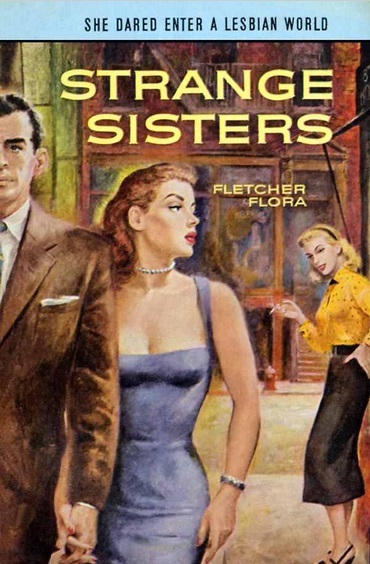
First Digital EditionLesbian Pulp Fiction ClassicGrier AShe knew it was dangerous, but she knew it had to be this way. No other way was normal—to her. From the moment she fell in love as a teenager with Stella, Kathy knew her life would take a difficult path. She tried to resist her feelings—tried to be the person her family wanted her to be—but the lure of another woman’s love was too powerful. And so Kathy strayed the dark and hidden path among the twilight women, doing things her body urged her to do, until one night she made a choice that would change her life forever and set a devastating series of events in motion. Here is the story of a lesbian, and of the actions she would attempt to undertake, when trying to disavow her body’s urgings.
Fletcher Flora was born in Parsons, Kansas in 1914. Flora began writing soon after returning from World War II. His crime and mystery short stories and novels were published in magazines like Ellery Queen’s Mystery Magazine, Mr., Cosmopolitan, and in Alfred Hitchcock’s mystery anthologies. He received the Cock Robin Mystery Award for his first hard cover novel, Killing Cousins in 1960. Flora wrote over 150 short stories and 13 novels during his writing career. Three of his works are published under the house name, Ellery Queen. Timothy Harrison was also a pseudonym for his work, Hot Summer.
I picked this book to read because I knew the author and his family. And I wanted to see if I would enjoy downloading digital books to read on my phone. I was amazed. I couldn't put this story down. Not only due to Mr. Floras writing style, but since I grew up in the town where Mr. Flora lived and wrote, I can pick out the actual places that Mr. Flora described in his book as being locations around our area. The college, his description is actually a description of a section of the campus at the University of Kansas in Lawrence. The river and the bridge scene, in my mind he describes the Centennial Bridge as the automobile bridge. And the older bridge was a train bridge that used to traverse the river, from the Missouri side to the Fort Levenworth Kansas side, but is now gone. The bus station, other scenes, things like that also intrigued me to see how he built the stories environment around his own actual environment. He does an excellent job of putting the reader inside the main characters head. Not to mention the culture and lifestyle of the lesbian in 1950s USA society. Though I found the story that unconciously tries to explain how the character became a lesbian and why she killed the man a dated view of homosexualism. One can overlook that and enjoy the story without having to compare it to todays sociology.
When I bought this book off Kindle I had no expectations at all nor did I imagine there would be any kind of happy ending. Written by a straight man during a time when homophobia and ridiculous stereotypes were alive and well, Strange Sisters could hardly be anything but a product of its time.
Even so, I found the writing itself much better than I had anticipated and a surprising sympathy for the main character (even the police who bring her in for questioning seem to feel bad for her.) Unlike his other male counterparts writing lesbian pulp during the same era (i.e. Lawrence Block as Jill Emerson) Mr. Fletcher held back on the lascivious aspects of the genre.
After reading Strange Sisters I decided to track down another Fletcher Flora book with a similar theme and a very striking cover. It's called Desperate Asylum, something I found through a private bookseller, and I hope to get to it soon.
Wow. I saw this book on Pinterest and was expecting cheesy 50s lesbian pulp. But it's actually a pretty deep, multilayered story that is far more gritty and dark than two girls hiding their forbidden love.
Don't dismiss this one by the illustration you see online. If only there was a better way to say that...
I was curious to read a lesbian pulp fiction book written (by a man!) in 1954, especially one with this title.
The protagonist is a beautiful young lesbian, Kathy, who falls into relationships with women. However, feeling unnatural, she starts to experience bouts of depression that become so intense and protracted, that she tries to escape by letting a man she meets in a bar date her. When the man makes a sexual advance at her, Kathy is so overcome by repulsion that she attacks him violently.
Considering the year this book was written, I was struck by how lacking it is in intolerance. It's an easy, fun read.
I don't know when I became so obsessed with lesbian pulp fiction. This book provides a great introduction to the genre through cursory cover art analysis. A thoughtful forward by Ann Bannon as well.
This was actually the version of Strange Sisters that I read. The annotated version and not the mass market version. loved it. See my review under the mass market version.