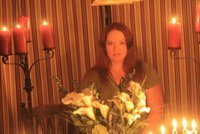
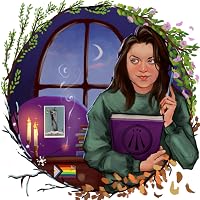
"Most people know intuitively that when you fall in love the world is full of magic. What they don't know is that when you discover the universe is full of magic, you fall in love with the world."
When high-powered Manhattan lawyer Phyllis Curott began exploring Witchcraft, she discovered a spiritual movement that defied all stereotypes. Encountering neither satanic rites nor eccentric spinsters, she came to know a clandestine religion of the Goddess that had been forced into hiding over the course of history. Book of Shadows recounts Curott's remarkable initiation into Wicca (meaning "wise one") and shares her insights as a high priestess of an elegant, ancient spirituality that celebrates the magic of being alive.
An Ivy-league graduate and promising lawyer, Curott was a typical young woman in her twenties, determined to forge a law career within the burgeoning, male-dominated music industry. But when she began having prophetic dreams and mysterious visions of ancient female figures and unfamiliar symbols, she discovered an unexpected world of magic and began searching for a rational explanation. When her friend Sophia--a practicing Witch--suggested having her cards read by a Wiccan High Priestess, Curott instinctively dismissed the idea, but then forced her natural skepticism aside on the chance that this age-old practice might help her understand the unusual occurrences in her life.
Thus begins her journey into the magical world of Witchcraft, a religion originally practiced by priestesses, shamans, and healers that empowers our lives by working with the natural cycles of nature. Fascinated by this pre-Judeo-Christian religion that honors women as the embodiment of the Goddess and emphasizes respect and love for the natural world, Curott began attending a local coven's weekly circle to learn the sacred arts. Her Book of Shadows chronicles her ascent to the position of Wiccan High Priestess and her efforts to reconcile her newfound spirituality with her struggles as a woman rising through the ranks of the corporate world. Along the way, Curott relates the history of Witchcraft and shares many traditional Wiccan practices, such as casting a circle, drawing down the Goddess, harnessing the powers of the natural world, and casting spells for health, prosperity, and love.
Engagingly written and rich with detailed rituals and techniques, this inspirational book traces a modern woman's spiritual journey into a realm of extraordinary experience and enlightenment. Book of Shadows provides us with the keys to discover an enchanted world of divine empowerment so as to unlock the power that lies within us all.
Phyllis Curott is one of America’s first public Wiccan Priestesses, an attorney, and an author whose groundbreaking books, published in fourteen countries, have made Wicca accessible to the world and awakened an entire generation to the Goddess. She is founder of the Temple of Ara, the world’s oldest shamanic Wiccan congregation, and was the Vice Chair Emerita of the 2015 Parliament of the World’s Religions, and creator of the historic Inaugural Assembly and drafter of the Declaration for the Dignity and Human Rights of Women adopted by the 2015 Parliament. Named one of the Ten Gutsiest Women of the Year by Jane Magazine and called one of "America's leading voices" by Time Magazine, Curott was inducted into the Martin Luther King, Jr. Collegium of Clergy and Scholars in 2014. Curott received her Bachelor's Degree degree in Philosophy from Brown University and her Juris Doctor from New York University. She is currently living on Long Island and working on her next book, Wicca: Awaken the Divine Magic within You, out November 2018 with a companion online class Spring 2019 for Hay House.
In honor of Samhain, I thought I would give props to my favorite book about Wicca and Paganism of all time. This book literally changed my life.
In Book of Shadows, Ms. Curott tells the incredibly compelling (and true) story of her personal journey finding the Goddess, and thereby her truest self. I found this book while I was just starting down that path myself, and it helped me release all of fear and shame I felt for leaving the religion I was raised in to find something that fit with my inherent world views. There have been many books published on this subject, many of them either misleading or downright ridiculous, and finding a good one can be difficult (especially for the beginning practitioner). However, this one is eloquent, smart, and cut through the bullshit enough to make me realize that I had found the right fit for me.
I highly recommend this book if you are 1) exploring this path yourself, 2) are just curious about what the hell it's all about, or 3) if you have a friend/relative who just "came out of the broom closet" and you're worried they are going to start sacrificing squirrels or virgins. (You think I jest, but I've heard it all...)
She is one of my personal heroes, and not just for writing her amazing guidebooks. It's because as a Priestess, a filmmaker, and a human rights lawyer, she's an inspiration to all of us who want to make the world a better place.
I was lucky enough to meet Ms. Curott in person at a book signing for one of her other books, The Love Spell, and I had the privilege of thanking her in person for what she did for me.
And I'll thank her again in this review. Thank you, Ms. Curott, for helping an awkward, agnostic, questioning girl with huge self-esteem issues find a path that has kept her grounded for the last decade.
I have to give this book 4 stars because it's just so well written and enjoyable. It's an absorbing page-turner which does a beautiful job of integrating information about witchcraft with the author's personal journey.
Now we come to the reason I can't give it full marks: I want Phyllis Curott's life. It seems she doesn't ever have to do the laundry, call the phone company to sort out billing issues, or clean puked-up red jello off the living room couch. (Yeah, no one in this book has kids... for a fertility religion, it would seem Wicca doesn't really make a lot of room for actual parents.) Besides working long hours at her glamorous, high-powered job with a cinema-worthy villain boss, her life is apparently composed of: taking scented baths to wash away her frustrations, meditating under park trees, decorating her altar with fresh flowers, reading books about ancient Goddess worship, sitting in the Metropolitan Museum's Egyptian wing meditating, going camping where she is surrounded by fireflies yet never by mosquitoes, and having fulfilling/ empowering rituals with her amazing coven that NEVER has interpersonal issues. Oh, and buying designer clothes that fit her perfectly and make her look gorgeous.
Hmmm. Perhaps I sound a little bitter. I mean, I know she has to pay her bills and change the cat litter like anyone else, and it probably wouldn't be such an exciting read if she included all that stuff. Then again... if she could make changing the cat litter into a magical act, that would be a lot more useful to me at this particular stage of my life than hearing about fantasy rituals and scented baths.
An American woman's journey into the ancient practice of Wiccan or the Old Religion of Europe. This is a true story but it is not an easy read. This book will give the reader much food for thought. It includes descriptions of the old ways of worship, the various tales and names of the goddess gathered from many lands and cultures. It describes not only what the author's group did in their circle meetings but also how the friendships she made and how it impacted both her personal and professional life. Deep and absorbing, if you have ever lived a life in which you participated in the rituals described in this book, you will dream it. I certainly did and emerged wondering, "Did I just stumble across this book or was it set in concrete that I would eventually come upon it?"
Back in the 70’s at age 25 Phyllis Currot was in her last year of law school. At age 25 she begin having prophetic visions and dreams that start coming true. In her dreams she hears the chanting dedicated to the Goddess. Isis, Astarte, Hecate, Diana, Demeter, Kali Inanna. She meets with Isis and starts doing research. Later she will move to Washington DC to fight organized crime for a labor union. The firm she works for eventually closes it’s doors and Phyllis returns to New York. While in Washington she works hard and soon loses her prophetic vision.
Back in New York Phyllis links up with a friend who introduces her to a coven of Wiccan follower. Her friend is a solitary witch. The coven is an al female coven dedicated to the Goddess that meets in the back of an occult shop. Phyllis decide to join. Along the way she is instructed by three people. Maia, Nonna and Belonna.
Phyllis also lands a new job at a record company doing contracts. Her boss Mr. Hadus is a typical powerful executive with inferiority issues underneath his macho exterior. He is demanding, verbally abusive and predatorial. The job is stressfull.
While in the circle Phyllis learns about meditation, casting spells and the philosophy of the Goddess. The true aim of magick is control over oneself not over others or the universe. Phyllises introduction into the coven prompts her on a journey into the history of witchcraft and how witches were persecuted.. She also learns how the world once worshipped the Goddess and women were Shaman and leadership. The world was peaceful until the male dominated religions took over and degraded the woman’s position
As her life progresses Phyllis discovers along with her friend Jeanette the need to do a banishing spell against Jeanette’s ex husband. They do a spell invoking a West African Goddess. They make a poppet and put it in a icebox. The man later gets arrested in a drug deal by federal agents. She does a banishing ritual against her boss by imagining pentagrams on his door. It works an he leaves her alone. She trains for a year with her mentors and during that year she does find the strengths to leave her job.
At the end she must find a magical name for herself.. She finds it in Central park and at first thinks it is prosperina but later calls herself Aradia. Excellent book filled with anecdote for newcomer to the craft.. Several useful techniques as well.
I really like this book and have re-read it numerous times over the years. Each time I pick it, something else stands out that was missed the last time it was read. If you are wanting to re-balance and re-think and move forward within from a starting point of discovering that spiritual side of you, then this is the perfect book for you.
Try not to take it too literally. Each person is on their own path spiritually, whether its Wiccan, priestess or just trying to connect to oneself. You have to remember, its Phyllis's journey, I'm sure there are aspects of the book that are embellished, and if so, just take what you like from it and put the rest aside. This book is worth the read.
I'm going to change up my review a bit, because after some re reads and deep reflection, I feel compelled to give a different viewpoint. "Book of Shadows" was one of the first books that really spoke to me when I was exploring a Wiccan path, and one of the first books I read about Witchraft that was not a boring instructional manual; it told the deep and magical story of Phyllis' spiritual journey that culminates into her Initiation as a priestess into a female-only New York coven when she was a young woman. A coven, might I add, that turned out to be one of the founding covens of the New York Witchcraft scene, with renowned teachers, but I will get into that later. Phyllis describes herself as being raised agnostic by a union-organizing, former seafaring father and a diplomat mother who came from a wealthy family. Phyllis attends Brown University and NYU Law School. She is from an intellectual and pragmatic background and mindset. Religion and spirituality has not been part of her life thus far, but she was taught solid ethics and about the "golden rule" from her parents who work for social justice. Suddenly, inexplicable spiritual occurrences, in the form of prophetic dreams, premonitions, and visions start happening to Phyllis around her last year of law school. Phyllis knows there is something to it, but isn't in a place to completely explore it yet. After passing her bar exam and working managing a rock band, Phyllis makes friends with Sophia, another lawyer in the industry. Sophia tells Phyllis that she is a witch, and educates her about what that really means. With some hesitation, Phyllis agrees to get her cards read by Maia, a High Priestess who works at a Pagan store called the Magical Cauldron. The card reading is revealing and Maia invites her to attend a women's group she is starting. Again, Phyllis is reluctant but finally attends. She's amazed to see women of all different ages, backgrounds, and professions coming together to celebrate Goddess spirituality. She starts to look beyond superstitious stereotypes of witchcraft and religion in general, and eventually joins a small group led by Maia and her magical/life partner, Bellona, to work towards being initiated into their coven. There is also an Elder witch named Nonna who assists with the coven and Phyllis is immediately very drawn to her. Around this same time, Phyllis also obtains a prestigious and impressive job as an entertainment lawyer for a high-powered firm, being recruited by an ex-lover and powerful law partner at the firm, Hadus (foreshadowing..Hadus=Hades? Phyllis=Persephone? You shall see.. ). Hadus assures her that he's moved on and not to worry about any hidden motives. During her journey towards being initiated as a witch, Phyllis finds that her spiritual life is flourishing but her professional life is going downhill. Hades has an explosive temper and is terribly sexist, as are other male lawyers and clients she has to work with, to the point where she is physically assaulted by one. It turns out Hades is still making sexual advances towards her and is very inappropriate. Phyllis finds solace in the firm's ex-hippie receptionist, Madeline, and Max Rosen, a senior partner who is very kind and warm towards her. Phyllis begins to see that the glamour and glitz of the entertainment world, and her high-powered but incredibly stressful job, are conflicting with her mental and emotional health. Phyllis makes wonderful connections with women in the training group and coven, especially with Gillian ( a magazine editor from a prominent family), Jeanette ( a West Indian , maternal woman with a dark past), and Nonna (the Elder Witch, very much like a stereotypical Italian matriarch.). The magic she works at her circle is undeniable and very powerful. Phyllis realizes she has many areas within that need healing, that the patriarchal and sexist environment she experiences as a young professional woman is part of a deeper and more widespread issue of misogyny occurring everywhere, which has threatened female spirituality so that it went largely underground and unknown. Phyllis realizes her power as a woman and is empowered through her spiritual side, eventually leaving her toxic job and starting over. Phyllis has a powerful initiation experience and takes the Craft name of "Aradia", who was a Goddess depicted in Lelland's book of the same title, a female messiah sent to Earth to teach peasants magic to defend themselves against the Catholic church. It's quite amazing how she finds her name, but I will leave you to find that out. All in all, it's a very well written book. I was spellbound (pardon the pun) and couldn't put it down. Phyllis paints a beautiful and needed picture of what witchcraft actually is, and that intelligent, strong women (and men) become witches, that it isn't just about superstition. Like any book, it wasn't perfect and had some pitfalls. One, for me anyway, was the fact that it didn't seem entirely realistic: Phyllis said she created composite characters, changed names, etc to protect privacy, but it was more than that. The women, aside from one fiery interaction that isn't even really an argument, always seem to get along without conflict. I can't see that happening in any group of people. Another is the constant comparison between Phyllis and other members' socio-economic and educational backgrounds. I understand that she is doing this to flesh out the characters and to show how incredible it was for a cerebral, unreligious person like herself to become a witch, but it got a bit tiresome. I especially bristled at one comment she makes about how her HPS' education had "stopped at high school' but she was wise, their "tinge of Bensonhurst accents", and that one of her teachers had the "air of someone from one of the finest finishing schools" in spite of the fact that she doesn't have the education or background that Phyllis or Gillian has. I found it condescending. I'm sure Phyllis was trying to show that Witchcraft and knowledge and wisdom transcend all earthly trappings of success, but it came off as awkward. I also found that the description of the magic, meditations, and spiritual work they did was quite cinematic and seemed almost too good to be true. Maybe Phyllis and others working with her experienced vivid, concrete manifestations of magic and witchcraft practice, but actually seeing visions and having spells work dramatically is incredibly rare, to my experience. Normally, the effects are far more subtle and understated. There was also, and I doubt it was intentional, an overtone of Phyllis being some sort of "chosen one"- Maia invites her after seeing something special in her card reading, she mentions that she is one of the last women to be there after a "winnowing" occurred from the larger group to choose women for the training coven, how they say they've been waiting for her when she says she's taking the name Aradia, a messiah figure. Of course, Phyllis is an extremely accomplished woman and HPS today, you just have to read about her to know that. She also seems genuinely warm and caring. I found it awkward to read that set up though and found it somewhat self-serving. The relationship between her and Jeanette I found somewhat problematic. Jeannette is older than Phyllis, a West Indian black woman,working at a low paying job and being stalked by a violent ex partner. Jeanette seeks Phyllis' help as a lawyer (understandable) and then they do a rite together to banish her ex, which has somewhat unbelievably dramatic results. There was a whiff of the whole "white saviour" dynamic there; the wealthy, educated white woman coming to the rescue of the less privileged black woman. Again, likely not intentional, but it was uncomfortable to read. Lastly, the whole witchcraft= good and abrahamic religions= bad I found to be too cut and dried. For a book that wanted to defy stereotypes about Wicca, it left in a lot of stereotypes about mainstream religions, namely Christianity and Judaism. The women do admit they've had some good experiences with some other places of worship and clergy, but they're largely painted as oppressive and awful. Now, I'm not saying they aren't. Believe me, I'm the last person to defend Christianity and think it has done and continues to do tremendous harm, especially to women and LGBTTQ+ individuals, but showing more of an ecumenical perspective would have been refreshing. Perhaps, though, that wasn't the point of the book, so it was left out. Some criticize the book as being hateful towards men. I can see on the surface where people might get that idea, as most of the male characters are pretty awful. However, there are positive males in the book :Phyllis's father, an on-again/off-again boyfriend named Jake, Max Rosen, etc. I think the toxic characters mainly being men was to illustrate how deep and dangerous the patriarchy is to women, and to illustrate the climate for women in the workforce/professional careers at the time, which was absolutely terrible. I'm guessing that the autobiography takes place in the late seventies-mid 80s, which was before we had a lot of the laws that protect us (presumably) from discrimination in the workplace today. The patriarchy and misogyny is real. It's not "man hating" to admit that. While I agree that it could stand to have more positive, prominent male characters from some points of view, I don't think this was the book for that. I suppose I could say the same about my earlier critique of the whole toxic portrayal of other religions- they are exposing both deep underbellies, which definitely exist, and as this is an autobiography with changes made to make it read more like a story/myth, perhaps that is the reason for such dramatic dichotomies as shown. As an aside, it's interesting that Phyllis uses pseudonyms for her main teachers, and then thanks them using their real names in the forward. They are pretty easy to locate after that, as they're considered the founding mothers of the Craft in NYC (Carol Bulzone and Rhea Rivera , that's not a secret, they have been out of the broom closet for many, many years and are now prominent elders). "Magical Cauldron" was actually the "Magical Childe" store, and later, there was a store run by Bulzone and Rivera (I think both..) called "Enchantments" that existed until fairly recently. The coven's actual name was the Minoan Sisterhood, an offshoot of the Minoan Brotherhood tradition that was started by Edmund("Eddie") Buczynski and Herman Slater (who owned Magical Childe) out of an expressed need for gay men to have a tradition that celebrated and reflected gay men's unique energy and spirituality that they weren't finding in mainstream covens at the time. A great place to read about this is "Bull of Heaven" by Michael Lloyd, which gives a lot of detail about Eddie's life and the birth/growth of the Craft in NYC. It's a fascinating history. (I haven't been able to trace who "Nonna" is/was- perhaps she's a composite etc. It would be interesting to know who she's based on, if anyone.) Bear in mind that during the time Phyllis is writing about , you couldn't find Witchcraft resources on just about every corner like you can today. Witches were largely underground and "closeted" due to very real discrimination. Finding them could be difficult, which makes Phyllis' journey all the more remarkable. All in all, an interesting book for anyone who wants to know more about women-centered spirituality, withcraft, and some basics about Wicca in NYC from the ground up. It's not a history book or a "how to" of Wicca, it's a story of Phyllis' labyrinthine journey towards Goddess spirituality while in a seemingly incongruent, cerebral reality of agnosticism, intellectualism, and a top-flight profession. It is a good and interesting read, in fact, for just about anyone. But, as LeVar Burton said in "Reading Rainbow" so long ago; "you don't have to take my word for it."
This entire review has been hidden because of spoilers.
This was a fun, easy read. Essentially a mix between Wicca 101 type info and the author's personal experience. Some her personal revelations are really beautifully written or reflect back experiences I, and others, have had. Other sections I just skimmed through.
For someone who is new to witchcraft/paganism I could see this being a very inspiring and informative read.
My only caveat is to keep in mind the book was published in the late 90's about events that happened in the late 70's and early 80's so a lot of the info the author provides ranges from simply being outdated to having activily been disproven.
I have a soft spot for this book. I read it at a time I was making great changes inner changes and it influenced me profoundly. Phylis Currott's delivery will not appeal to everyone. Such books can only ever be written from one's own experience and Ms Currott does come from a strong academic background, and has built a career as a successful New York lawyer and peace activist, with a strong feminist streak. It was in fact the 'urban intellectual' edge that appealed to me, being as I was at the time a childless city girl living in a farming community and surrounded by people whose beliefs I admired but which seemed reinforced by a connection they had to the the land - a connection I did not quite share. What Ms Currott was able to impress upon me through her story was how every single one of us can find our own way to a congress with the natural world and with the mystical if we are prepared to read all the signs. That particular connection will not be open to us unless we seek our own inner truth and choose lives that enable us to reflect that truth - wherever we live, whatever we do, whoever we love, whatever traditions we were raised in.
I am no longer the person I was when I first read this book. And I follow no church-, party-, or coven-line when it comes to spirituality - but I think that is the the point of the story. Do your own research and follow your conscience accordingly. This book still stands as a reminder to me never to be frightened of change and to always keep an open heart and mind. For this I thank the author and will continue to keep a well-thumbed copy of her "Book of Shadows" on my shelf.
While some of the prose is too florid for my taste, and although modern Wicca has more to do with the imagination than historically documented ancient practices, Phyllis Curott provides much insight into modern-day neopaganism. She shows how a religion based on a Goddess, interpreted to have appeared in all cultures, can appeal to feminists, in particular.
On second reading of this book, I realized that my life now is mirroring the author's, with the whole "Persephone's descent into the Underworld" theme. All that glitters most certainly is not gold, and the thing of true value in this world are our spirits.
An amazing book, and highly recommended for those people still seeking out their own form of spirituality.
The only thing that really bothers me about this book is the style of writing. I feel like the author is describing life through Cinderella's eyes or something. I feel like the author could spend an entire paragraph going into flowery description about the most mundane thing and it bothers me a bit.
Abbandonato. Io ci ho provato ma proprio non fa per me, troppo didascalico e semplicistico. Racconta una storia fin troppo personale dove trovare qualcosa di universale che valga per tutti i neofiti wiccan è davvero difficile. Non penso che possa essermi utile per rispondere alle mie curiosità sull'argomento, che sono di natura più filosofico-teorica che pratica.
This is the best book on witchcraft for beginners that I have ever read. It is not a simple spellbook, but goes into the emotion and spirituality behind the magic.
Because of the nature of this book and its theme, I sense a very personal review incoming, so I apologise in advance for this review perhaps not being helpful to people who are not me (which on last count was everyone minus one).
This is the first book I've read on the subject of Wicca, though it's been something I've been curious about for a long time. Spiritual life has become hugely important to me in my thirties (which are now almost over - yikes!), and in my quest to find meaningful ways to practice and connect to a spiritual dimension, I think Wicca or some form of Paganism come closest to what I've been searching for.
Curott's book chronicles her own journey from sceptic to devotee, with warmth, honesty and openness. As a fellow sceptic, I appreciate reading the story of someone who is down to earth and has a scientific mind and background. It makes the story and the subject more accessible to me. I share the same doubts and thoughts that Curott expresses early on in her journey, and in fact most of the way through. It's also comforting to feel like my being a sceptic and having a scientific mind doesn't mean that this type of spirituality is not accessible to me, and that it's possible to live in both worlds.
However, the flip side to this is that even given her scepticism, magic, intuition, divination and all things Wicca seem to come so easily and naturally for Curott, right from the start. She says that because of her scepticism she needed real proof of the power of what she was doing, something tangible and irrefutable - and in my mind I echo this. The problem being that Curott receives very clear signs and very clear responses to her practice, whereas I see... Nothing. It feels kind of like discovering there is a Hogwarts, but you're a muggle.
I wasn't always a muggle though, which is the thing that's equal parts frustrating and giving me hope for change. As a child I was very intuitive, to the point where I on several occasions literally read my mother's mind, I saw things/spirits that were not of this world, I talked to birds (and they talked back..), etc. But at some point in my life, something happened to completely sever my ties to this other plane of existence. I'm not sure what it was exactly. Perhaps it was a traumatic incident, or perhaps it was just growing up. When on this subject I like to bring up Douglas Adams's intriguing concept of the SEP field, from The Hitchhiker's Guide. An SEP field is a "somebody else's problem" field, whereby we - as adults - dismiss things that are extraordinary or unexplainable (therefore, in THHG, a spaceship can park on Lord's Cricket Ground without anybody noticing, because they don't expect it and subsequently dismiss its existence). I think there is some truth to this idea, and it can partly explain why we - more often - as children see and experience extraordinary things, because we do not yet know that these things are not scientifically possible, hence the SEP field is not yet activated. But then there clearly are adults who still have access to this other/spiritual dimension, which begs the question: what do they do differently than me/us? Perhaps they all have mental problems. But hey, I have mental problems too, they just don't currently seem to come with this side benefit.
It must also be said that I have only gotten more into Paganism/Wicca over the past year and more so over the past months as I've been reading this book on and off, and perhaps with consistent practice I too will succeed in accessing more tangible proofs that my work and devotions are worthwhile. But like I said, this seems to be the case for Curott from the get-go, and I am just not sure I am able to reconnect to this other dimension or how to go about it.
Another thing that makes the book a bit hard to relate to is that Curott seems to lead a very charmed life, not only because of her immediate connection with magic. She has some problems at work, but honestly in the whole book I don't see any real struggle. She just sort of waltzes through life, taking scented baths and having magical experiences and making meaningful connections. People don't live like this, do they?? Perhaps this was an editing choice in order to make the story positive and engaging, but I found it made me engage less because it seemed a bit unbelievable.
I appreciate Curott's effort to dispel common myths and misconceptions about Wicca, and get down to what it truly is - which is a benevolent and balanced force, and I did really enjoy the read, though it also left me feeling a little discouraged.
Published in 1999 and recalling events from 20 years prior, this book is a time capsule of late 20th century US Wicca. For folks who found the community (communities, really) during that time, it’ll be a walk down memory lane. Some of the alleged history is patently false, but again reflects the pseudo-histories we were taught before books like Triumph of the Moon were on most folks’ shelves. There’s a soft polytheism that borders on universalism; lots of “the” goddess instead of “a” goddess, lots of mulling together of different faith traditions, practices, and pantheons, plenty of “Wicca is ancient and came to us unbroken” claims that again flavor this book as reminiscent of a time before folks appreciated that a mythic history of the Craft wasn’t its literal history. This isn’t a book for learning facts, but then it doesn’t pretend to be.
Its true value lies not in what theology we are or aren’t exposed to, but rather the brilliant way in which Curott weaves an elegant, magical, candid (if maybe sometimes a bit fantastical-seeming) tale of what the experiences of a Wiccan seeker can be. I genuinely admire the enthusiasm with which she dedicated herself to her studies and explorations and find this memoir to be a lovely snapshot of what it feels like to tread the path towards initiation.
I love reading witchy memoirs I am fascinated by other peoples journey through witchcraft and Wicca. I really wanted to love this book but I found it lacking. I was more interested in her personal life than her spiritual journey following Wicca. The descriptions of rituals were interesting but Ms Curott's constant perception of what Wicca is and what it meant to her grates after awhile. I was tempted to skip pages as I got so bored of reading Ms Curott wax lyrical about seeing the Goddess because she is uber special. Her writing can come off as being superior due to being attractive, having a successful career and coming from a privileged background.
Book of Shadows: A Modern Woman's Journey into the Wisdom of Witchcraft and the Magic of the Goddess has not put me off reading Ms Curott's next book Witch Crafting: A Spiritual Guide to Making Magic as a lot of people has praised this book as a good beginners guide to Wicca.
Book of Shadows is a fascinating story of one woman’s journey from doubtful visitor at a ‘women’s group’ meeting to Wiccan high priestess. It is well-told and explains a lot about the Wiccan religion and related religions. It also makes a good story.
Phyllis Curott tells not only her own story but the history of the goddess religions from all over the world – those that have often been called witchcraft. Many of the goddesses are those of familiar myths and fairy tales, and others are myths that would be familiar if we knew more about other cultures. The surprising thing is how similar most of these ancient religions were, and how similar they are to most of the religions commonly practiced today.
Ms. Curott makes clear that with all the incantations and incenses and elements and whatnot, the purpose of this goddess worship is not to hurt anybody, or to gain some unfair advantage over other people, but to enhance a person’s own spirituality and spiritual growth.
This was the second, or possibly third read through for me. It's one of those books I can reread and know I'm going to learn something new each time. The reason is simple. My perspective changes as I grow. This is a book one can enjoy whether they're searching for information or if they just like a great biographical and at times historical read. This time, my reason for picking up the book was because I wanted to find a specific spell. I knew approximately where it was located in the book but realizing I'd only gain the proper essence of the spell and its various elements would be to come upon it while reading the story from its beginning. I was right to approach the book in this fashion again, and hope anyone reading for whatever reason will do so with an open mind, heart, spirit and soul. Happy reading. May Harmony find You. Blessid Be.
This book was enjoyable and easy to read. I loved reading about the author’s (and Wicca’s) stance on feminism and female empowerment. And it was very interesting to read about her coven’s Wiccan rituals, spells and chants. All of that makes me want to be part of a coven just like hers! However I’m giving the book 3 stars because everything in her experience was a bit “too perfect” (and unbelievable), like she suddenly has amazing psychic powers without really having to try. She can see spheres of energy, auras, hear the Goddess, etc, after only a few months of discovering there are witches in New York City. Maybe it was the style of writing (feels a bit like a Disney movie) but I think it would have been nice to feel more realism in her world. Anyways, it’s still a fun book if you’re discovering Wicca for the first time.
È il terzo o quarto libro di "spiritualità femminile" che leggo negli ultimi 2 anni. Mentre gli altri erano dei saggi o manuali, questa è invece la biografia romanzata della scrittrice, in cui racconta come si è avvicinata alla religione Wicca ed è diventata una strega. Questa lettura non mi è piaciuta molto. Ha approfondito troppi aspetti (che conoscevo già grazie alle letture precedenti quindi mi sono annoiata) mentre è stata troppo superficiale e frammentaria su altri (senza le letture precedenti avrei fatto fatica a mettere insieme i pezzi). Il suo coinvolgimento emotivo l'ho trovato a tratti esagerato, ed alcuni episodi risultano poco credibili. Non è un libro che consiglierei come "prima lettura" a chi desidera avvicinarsi a questo argomento.
Este libro nos abre las puertas del enigmático universo mágico de la Wicca y el culto a la Diosa, religión espiritualista que practicaron las sacerdotisas, las chamanas y las curanderas. Se trata de una religión pre-judeocristiana que venera a la mujer como encarnación de la Diosa y que promulga el amor hacia el mundo natural.
Nos encontramos ante a una poderosa crónica de descubrimiento, desafío y transformación. Un valioso testimonio personal, que rechaza los tópicos sobre las brujas, desterrándolas del mundo de la fantasía y convirtiéndolas en personas de carne y hueso que viven en nuestro mundo actual.
Una apasionante lectura, una visión moderna del mundo mágico, que intenta dar respuestas a los innumerables enigmas y problemas del nuevo milenio.
3.5 This book was a bit maddening to me. On one hand I always enjoy a bio as everyone has a fascinating story, but the prose was a bit more purple than I like, and her privilege was definitely showing.
I've been in spiritual circles with OWLs of means who feel this is all for them and they are ordained or chosen with Doreen Virtue like enthusiasm (before she switched over), and this was sometimes giving that vibe.
Also, her circle was not really fleshed out. They all felt like props to serve her story and advancement into the craft.
I definitely kept in mind the time in which it was written and how thoughts on appropriation vs appreciation have shifted.
It's a vibe for sure and I'm looking forward to an event she's part of soon to see what she's like now.
"Non c'è niente di più magico della presenza del sacro nella nostra vita. Cambia ogni cosa. È straordinaria, è magnifica e sfugge ai vincoli e ai limiti della nostra quotidianità. La magia è l'arte di vivere una vita creativa, benedetta dalla presenza divina. Non è qualcosa che facciamo all'universo; è ciò che un universo vivo fa con noi, una volta che ci siamo resi conto della sua divinità. È la danza sacra che condividiamo."
"Le persone sanno istintivamente che quando si innamorano il mondo diventa pieno di magia. Ciò che non sanno è che quando scopriamo che l'universo è pieno di magia ci innamoriamo del mondo."
I like this book but it was a little difficult to read. I thought it was very slow in some places and kind of boring in others, but it did have some interesting information in it about witches and witchcraft. I definitely agree with some of that information in here when it comes to women and feminism. Even in this age when we are not allowed to burn people for witchcraft, I still think it would probably be better to hide it a little bit more just so you’re not prosecuted by other people or the church. I don’t mean prosecuted like in court.
Pros: Her explanations of Spirituality are poetic and beautiful.
Cons: The characters seemed very stereotypical, which made it hard to believe they were real people. Certain situations seemed a little too perfect.
For the time period this was written in, I think it is a very inspiring narrative and I understand the absolute positivity and perfection in the plot because the author's goal is to challenge the ideas society has about Witchcraft.
I did write down a few quotes that I found inspirational to my own Spirituality, so I found it helpful, but I will probably not read it again.
I read this based on the recommendation of a friend. It's fine. It's one woman's journey of self-discovery, and her growing awareness of her calling as a witch. Phyllis Curott writes about her own experiences, often weaving together two disparate worlds/ways of being. I kept this in mind as I read, intentionally thinking about my friend who is now both discovering and reinventing her life. When I see her, I'll have a few questions that came as I learned about this author. Simply, I myself did not identify with her story. It was well-written, true, and will appeal to others.
This was a really well written and highly enjoyable account of Phylis’s exploration of the goddess and finding her Wiccan path. I really enjoyed it and read it in three days! At times I hoped for more concentrate reasons for belief in the goddess but I can see she is also trying to show how ultimately it is important to respect nature and see the goddess all around you. Highly recommended if you are interested in Wicca and nature magic!
I really don't want to diminish anything about this book. I have amateurish disagreement with some of her scholarship and did not always enjoy the writing. That's on me. Otherwise, I fully applaud the story of her personal journey. I read this slowly and often found myself contemplating parts of the book in casual reference to my life during the reading.