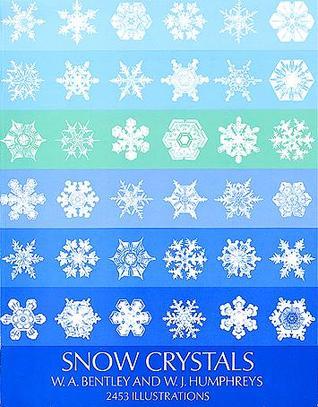
"Offers valuable material not only to students of crystallography but also to those of the arts." — The New York Times Did you ever try to photograph a snowflake? The procedure is very tricky. The work must be done rapidly in extreme cold, for even body heat can melt a rare specimen that has been painstakingly mounted. The lighting must be just right to reveal all the nuances of design without producing heat. But the results can be rewarding, as the work of W. A. Bentley proved. For almost half a century, Bentley caught and photographed thousands of snowflakes in his workshop at Jericho, Vermont, and made available to scientists and art instructors samples of his remarkable work. In 1931, the American Meteorological Society gathered together the best of these photomicrographs, plus some slides of frost, glaze, dew on vegetation and spider webs, sleet, and soft hail, and a text by W. J. Humphreys, and had them published. That book is here reproduced, unaltered, and unabridged. Over 2,000 beautiful crystals on these pages reveal the wonder of nature's diversity in uniformity; no two are alike, yet all are based on a common hexagon. The introductory text covers the technique of photographing snow crystals, classification, the fundamentals of crystallography, and markings. There are also brief discussions of the nature and cause of ice flowers, windowpane frost, dew, rime, sleet, and graupel. The book is of great value both to students of ice forms and for textile and other designers who can use the natural designs of these snow crystals in their work. Every photograph is royalty-free; you may use up to 10 without fees, permission, or acknowledgement. "A most unusual and very readable book." — Nature
An awe inspiring look at the beauty of nature as a snowflake, frost, and even dewdrops. Each is unique and amazing in itself some very simple while others are intricate and detailed. It is almost unbelievable that nature can create such artistic beauty in something so small.
W.A. Bentley spent most of his adult life photographing snowflakes. This book, displaying his incredible work, fills me with wonder, amazement, and appreciation for the beauty and symmetry of nature. -Heather
You have to see these for yourself! Check this book out and experience the awe-inspiring photos that can't help but bring happy.
I tried to pace myself going through this one, so that all of the photos would not blur together.
That was a reasonable precaution, but I was amazed at how much the opening text helped. It was only a few pages long, and as it starts with some information about the science and methodology, that is information that is useful but kind of boring. Then it did two things.
First it talked about how the symmetry is not perfect, and then you start seeing how some ends did not get as long, or there were cracks in the middle, or something. It is completely logical, but it would be something that is easy to miss when there is often so much intricate symmetry.
Then it talks about our tendency to see shapes in things (like when we look at clouds), and mentions some shapes on specific pages, getting almost whimsical. Then you start seeing them too. Yes, there are a lot of pilot wheels, perhaps, but then some look like they have writing around them, but you can't read the writing, and the shapes become even more fascinating.
Bentley's achievement in photographing snow crystals would be significant on its own, as would the photos, but the arrangement makes appreciating all of that easier.
I've finished the introductory essay that covers scientific aspects of the study of snow crystals, frost, rime, and sleet, but I don't think one can ever be "done" with the pages & pages of amazing photomicrography. The way the book is arranged starts off with simple snow crystal structure; a plate-like hexagon with maybe a tiny pattern inlaid. It slowly progresses through thousands of snowflakes, from simplest to intricate doily-like flakes. All are copyright-free, for artists to use as they wish. I think I'm moving on to a biography of W.A. Bentley next. For me, things like the beauty of nature confirm the existence of & my belief in God/Spirit. I'm very eager to know what Bentley's spiritual views were after a lifetime of the study of millions of miniature works of art.
This is a fun one from 1931. Wilson Bentley was the son of a farmer who never lost his childlike wonder of the world in general, and of snow, frost, etc. in particular.
He spent most of his life sketching (while holding his breath), and then photographing snow crystals with a microscope - a laborious process at the time (it took four years to get the first successful photograph).
I really enjoyed this delightful book, Bentley's life's work. There is a little explanation at the front, followed by 2,453 photos. Bentley died just weeks after it was published.
I read Snowflake Bentley to the kids earlier this week. They absolutely loved it. Then we were amazed to find this book: all of Bentley's images of snowflakes. Amazing! My 6 year old spent an hour or so saying, "Wow! Mom! Look at this snowflake! And this one! This is CRAZY! Wow!"
I am glad that W. A. Bentley took the time and had the persistence to photograph so many snow crystals - they truly are intricate and gorgeous - with so many designs - the beautiful, magical, breathtaking artwork of God that fills the soul with wonder and awe.
Photographers throughout the entire world consider Wilson Bentley to have been the pioneer of microphotography of snowflakes. Today, in the third decade of the 21st century, the technologies which enable scientists to take photos of droplets of various liquids which have been frozen at very high magnifications are used in research laboratories in many branches of science throughout the world In the latter decades of the 19th century and the first 3 decades of the 20th century, the technologies which enabled Wilson Bentley to take photos of snowflakes at high magnifications were all technologies which had been newly developed. Wilson Bentley died in 1931, and his collection of microphotography of snowflakes was published posthumously. During his lifetime, Wilson Bentley had intended for his photos of the crystalline structures which are present within snowflakes to be used for scientific research. Meteorologists, chemists and physicists did use his photos for their research. Today, the lenses which are available for scientists to use for microphotography are many multiples more powerful than the lenses which were available for microphotography 100 years ago, so Bentley's photos of snowflakes have been obsolete for purposes of scientific research for quite some time, but the photos that Wilson Bentley had taken of the crystalline structures which are present within snowflakes are absolutely beautiful works of art. If you're interested in microphotography and if you're interested in close up photos which show crystalline structures in great detail you will enjoy this book. You'll also enjoy this book if you're interested in the history of technologies which have been used in scientific research. There is only a minimal description of the equipment which Wilson Bentley had been using for microphotography, but the photos themselves are a piece of the history of modern science. As I've mentioned, before the resolution in microphotography lenses became as advanced as it is today, chemists, physicists and meteorologists throughout the world did use Wilson Bentley's photos of the crystalline structures within snowflakes for their research. Some of the understanding of the processes by how water molecules bond to each other at low temperatures which is still used by scientists who work in numerous branches of science throughout the world today came from the photos of snowflakes that Wilson Bentley had taken during the latter decades of the 1800's and during the early decades of the 20th century.
A unique book capturing the orderly beauty of the snowflake crystal, as well as the historical moment of microphotography. The introduction to the book is very technical regarding the methods Bentley used to procure the photographs, as well as the classification of the various crystals. I appreciate the intention for this work to benefit not just crystallographers, but also artists. I imagine that studying the hexagonal forms of snowflakes might also be helpful to shape the minds of future architects and builders. We read this in conjunction with the children's biography, Snowflake Bentley, by Jacqueline Briggs Martin. My children have been poring over the crystal-laden pages ever since we brought it home.
Only about thirty pages of this book are text, including the history of photographing snowflakes and the necessary equipment, definitions of various kinds of precipitation and ice formations, and the methodology behind the book’s creation. The remainder contain beautiful “plates” or raw images taken by W.A. Bentley in his thorough study of snowflakes. I enjoyed perusing each page and sharing them with my students, reminding them of God’s one-of-a-kind creation, not just of snowflakes, but of each one of them!!
Yes, I did indeed check out a book that is almost entirely black and white photo slides of snowflakes and I liked it very much. A place for mediation, relaxation, and winding down on a winter afternoon.
If you want to know how this book was something special to look into at our house, check out the children's book Snowflake Bentley, the story of this remarkable photographer, the first to bring the beauty of snowflakes to the world.
This is W. A. Bentley's gift to the world. This is such a wonderful book to share at storytime when I read Snowflake Bentley by Jacquelin Briggs Martin / Caldecott Medal winning illustrations by Mary Azarian. The love and care that he took in order to gather this collection. He persevered and we have these beautiful photographs of snowflakes.
A very inspiring close up look onto the beauty of nature, bigger than life and also beautiful selection of Bentley's life's work. I would only have wished for a bit more of an explanation on what some things were and more details on the documenting process, But I am fine with this being merely a "picture book". A gem!
God is so amazing! “For what can be known about God is plain to them, because God has shown it to them. For his invisible attributes, namely, his eternal power and divine nature, have been clearly perceived, ever since the creation of the world, in the things that have been made. So they are without excuse.” Romans 1:19-20
The first photographs of ice crystals from the 20s and 30s are worth the price of this book. The text was difficult for me, but it was florid prose for sure. There were even a few poems at the end of the plates. Florid poems from the era. I don't know anything about ice crystallization, so I could barely understand what I was reading and don't know enough to tell if the research cited was out of date or not. But I loved the look back at that age of discovery when everything seemed to be in reach of lay people.
One hundred years ago in Vermont this guy figured out how to photograph individual snowflakes, and apart from an introduction that's what this book is - 200 pages of white on black photographs of individual snowflakes, and some hoarfrost, rime, and frozen dew thrown in at the end.
This is reference, not sit-down-and-read, but it is THE classic collection of snow crystal photographs. Black and white, but these were made in the late 19th and early 20th century. This is one I first found in the University library, got for myself, lost in the fire and then repurchased it when it was reissued.
Absolutely stunning. I am impressed by these photographs, taken in the early 1900s. I wish that everyone could take a chance and admire Bentley's passion and life work. This is truly proof that no two snowflakes are alike.
This book is a feast for the eyes and mind, for the artist and the scientist, for the imagination and the mathematician. If you ever doubted that no two snowflakes are alike, the images and explanations here will take your mind to new heights. And it all happened in Jericho Vermont.
Nature is wonderful and inspiring. How wonderful that there are talented people who discover how to bring it's beauty to all of us! Thank you Mr. Bentley!
Read this along with the children's book Snowflake Bentley -- they were pretty incredible. I enjoyed reading about Bentley's passion and seeing the book he created after years labour.