

What do you think?

You Learn by Living: Eleven Keys for a More Fulfilling Life
From one of the world’s most celebrated and admired public figures, a wise and intimate book on how to get the most of out life. Courage is more exhilarating than fear and in the long run it is easier. We do not have to become heroes overnight. Just a step at a time, meeting each new thing that comes up, seeing it is not as dreadful as it appeared, discovering we have the strength to stare it down. One of the most beloved figures of the twentieth century, First Lady Eleanor Roosevelt remains a role model for a life well lived. At the age of seventy-six, Roosevelt penned this simple guide to living a fuller life—a powerful volume of enduring commonsense ideas and heartfelt values. Offering her own philosophy on living, she takes readers on a path to compassion, confidence, maturity, civic stewardship, and more. Her keys to a fulfilling life? Learning to Learn • Fear—the Great Enemy • The Uses of Time • The Difficult Art of Maturity • Readjustment is Endless • Learning to Be Useful• The Right to Be an Individual • How to Get the Best Out of People •Facing Responsibility • How Everyone Can Take Part in Politics • Learning to Be a Public Servant A crucial precursor to better-living guides like Mark Nepo’s The Book of Awakening or Robert Pirsig’s Zen and the Art of Motorcycle Maintenance , as well as political memoirs such as John F. Kennedy’s Profiles in Courage , the First Lady’s illuminating manual is a window into Eleanor Roosevelt herself and a trove of timeless wisdom that resonates in any era.
224 pages, Paperback
First published January 28, 1960
About the author
Eleanor Roosevelt
143 books1,685 followersAnna Eleanor Roosevelt was an American political leader who used her influence as an active First Lady from 1933 to 1945 to promote the New Deal policies of her husband, President Franklin D. Roosevelt, as well as taking a prominent role as an advocate for civil rights. After her husband's death in 1945, she continued to be an internationally prominent author and speaker for the New Deal coalition. She was a suffragist who worked to enhance the status of working women, although she opposed the Equal Rights Amendment because she believed it would adversely affect women. In the 1940s, she was one of the co-founders of Freedom House and supported the formation of the United Nations. Eleanor Roosevelt founded the UN Association of the United States in 1943 to advance support for the formation of the UN. She was a delegate to the UN General Assembly from 1945 and 1952, a job for which she was appointed by President Harry S. Truman and confirmed by the United States Congress. During her time at the United Nations chaired the committee that drafted and approved the Universal Declaration of Human Rights. President Truman called her the "First Lady of the World" in tribute to her human rights achievements.
She was one of the most admired persons of the 20th century, according to Gallup's List of Widely Admired People.
She was one of the most admired persons of the 20th century, according to Gallup's List of Widely Admired People.
Ratings & Reviews
Friends & Following
Create a free account to discover what your friends think of this book!
Community Reviews
Displaying 1 - 30 of 671 reviews

March 15, 2008
I loved, loved, loved this book. I felt this book is a rare gem that few people know about. It was like listening to a wise grandma casting her pearls of wisdom that are still very applicable today. The thing I loved the most is that I think anyone could relate to Eleanor Roosevelt! She was an extraordinary woman, yet so ordinary(like you and me) at the same time.
This is one that I will definitely read again.
This is one that I will definitely read again.

August 21, 2022
I enjoyed getting a glimpse into Mrs. Roosevelt’s life in this memoir/self-help book. She was an amazing individual, and I loved all the personal anecdotes that she included to illustrate her points. This book was originally published in 1960, yet many of the themes are still relevant today. It made me want to read more about her life.

March 23, 2017
This is a great book that discusses what we should seek in a politician. Eleanor Roosevelt's control and calm is what I admire most. She was comfortable in her own skin by the time her husband and her best friend, Tommy, died, when she wrote this book. She was well situated financially, but it was more than that: she gives examples of people who never did learn, in all their years, how giving is more rewarding than taking, and sharing is what a good life is all about.
And she ought to know. Eleanor Roosevelt became a force and a celebrity in her lifetime despite suffering in childhood from great shyness. She wasn’t pretty and she was inexperienced, and in the man’s world of the time, she was often underestimated. She learned early that discipline gave one some breathing space in a confusing and fast-paced world.
This is a personal book, but because she was a public figure from marriage, she includes observations about public life as well. Many of the difficulties that are crippling us as citizens now were already apparent when she wrote this in the late 1950’s.
The last chapter of this book is called Learning to be a Public Servant. Our consciousness has been raised lately and we are much better aware of what we think constitutes a good public servant, so reading this chapter refreshes for us what kind of person we are looking for to lead us in government.
The first thing E.R. notes in this chapter is that few people begin their careers planning to run for office. Politics provides an uncertain future because one’s position comes up for reassessment every couple of years. And secondly, politics is not generally as remunerative as other careers. A competent person will be generally looking for stability and security in a career so that politics, if it comes up at all, is an accidental or situational possibility. If a person decides to run for office they must be sure they have enough money to do so: that is, they must be able to take the risk of losing the job again and therefore not be forced into compromises that tarnish either the candidate or the office.
The family of the prospective politician must be thoroughly onboard with such an uncertain life in the public eye. And the politician must truly love people and his/her constituency to be able to spend all the time one needs to do the job well on their behalf. He/she is the conduit to introduce the particulars of his/her own state to the nation, to the world, and at the same time bring the world and the nation’s interests back home to his state, explaining on both sides and seeking agreement between needs.
E.R. talks about ‘timing,’ and how important it is for a politician to sense the best time to propose, the moment one can be assured one’s attitudes will be rewarded with agreement and compliance. The politician must be able to move people towards new ideas and grasp the moment that is auspicious for general acceptance. It helps, she says, for a politician to be able to draw people to himself/herself. The only reason E.R. did not talk more about women in politics, she says, is because women seem to be more sensitive to criticism than men, and therefore take themselves out of the fray. Even that holds some truths for us today.
We live in a world in a state of flux, she wrote in 1960…
Most of the chapters begin with a strong statement, for instance:
Look how things have changed in fifty years, that the poor see no future for themselves and so can sometimes set themselves at cross purposes to that of the larger society. This, and drug abuse rather than alcohol, have changed the dynamic. The wealthy have not as much security as before, so must continually scramble, besides the fact that the ceiling has been lifted on wealth. No longer is it crass, crude, and criminal to flaunt one’s wealth in the faces of, and obtained at the expense of, those with less.
E.R. is so grounded and unfussy, so kind and humble that we wonder if such a person could exist today. Much of what she says I recognize as the attitudes of earlier generations of women in my family. Those women are all dead now, but there is some comfort in reading someone articulate where they got their firm views about what is expected of individuals and citizens. This was a comforting, insightful book to read at this time, to give us perspective, and hope.
And she ought to know. Eleanor Roosevelt became a force and a celebrity in her lifetime despite suffering in childhood from great shyness. She wasn’t pretty and she was inexperienced, and in the man’s world of the time, she was often underestimated. She learned early that discipline gave one some breathing space in a confusing and fast-paced world.
This is a personal book, but because she was a public figure from marriage, she includes observations about public life as well. Many of the difficulties that are crippling us as citizens now were already apparent when she wrote this in the late 1950’s.
"If people come up the financial ladder but still maintain a low educational standard, with its lack of appreciation of many of the things of artistic and spiritual value, the nation will not be able to grow to its real stature."This is true for our leaders as well. Not only do we need boldness in our leaders, we need a lack of corruption, and values that elevate the chores we must undertake to allow states their individuality at the same time they add heft and stability to the group we call a nation.
"Nobody really does anything alone."Our greatness, if we have any, is ever only displayed in relation to, in concert with, our fellow citizens. Like happiness, greatness means nothing in solitude.
The last chapter of this book is called Learning to be a Public Servant. Our consciousness has been raised lately and we are much better aware of what we think constitutes a good public servant, so reading this chapter refreshes for us what kind of person we are looking for to lead us in government.
The first thing E.R. notes in this chapter is that few people begin their careers planning to run for office. Politics provides an uncertain future because one’s position comes up for reassessment every couple of years. And secondly, politics is not generally as remunerative as other careers. A competent person will be generally looking for stability and security in a career so that politics, if it comes up at all, is an accidental or situational possibility. If a person decides to run for office they must be sure they have enough money to do so: that is, they must be able to take the risk of losing the job again and therefore not be forced into compromises that tarnish either the candidate or the office.
The family of the prospective politician must be thoroughly onboard with such an uncertain life in the public eye. And the politician must truly love people and his/her constituency to be able to spend all the time one needs to do the job well on their behalf. He/she is the conduit to introduce the particulars of his/her own state to the nation, to the world, and at the same time bring the world and the nation’s interests back home to his state, explaining on both sides and seeking agreement between needs.
E.R. talks about ‘timing,’ and how important it is for a politician to sense the best time to propose, the moment one can be assured one’s attitudes will be rewarded with agreement and compliance. The politician must be able to move people towards new ideas and grasp the moment that is auspicious for general acceptance. It helps, she says, for a politician to be able to draw people to himself/herself. The only reason E.R. did not talk more about women in politics, she says, is because women seem to be more sensitive to criticism than men, and therefore take themselves out of the fray. Even that holds some truths for us today.
We live in a world in a state of flux, she wrote in 1960…
"The problems are new…To meet these new challenges we look for new ingredients in our public servants, an elasticity and flexibility of mind that enables them to change to meet changes; an alert and hospitable intelligence that can grasp new issues, new conditions, new peoples. We look especially for a man who knows that he thinks and can make his views clearly understood without ambiguity or hedging…It is no longer possible for us to look back over our shoulders if we are to keep abreast of our world, let alone maintain leadership. We cannot say “Nothing has changed,’ or ‘The old ways were best.’ The point is that the old conditions are gone and we are left confronting the new."What is so very interesting about Eleanor Roosevelt is that she says she is an optimist but does not believe “everything will have a happy ending.” She writes that she had seen too many examples where this was not true. Instead, she is congenitally hopeful, in part because she believes that we can remake our world when things get out of whack. And most instructive of all is what she says of youth:
"There is no human growth without the acceptance of responsibility and I think it should be developed as soon as it reasonably can be…it is often people who refuse to assume any responsibility who are apt to be the sharpest critics of those who do…Nearly every one of us, at some time or other, thinks what a great waste and pity it is that the older generation cannot teach the younger generation, cannot share their experiences, cannot save the young their mistakes…and yet it is possible this is the best way. After all, so much that the older generation learned is wrong! And perhaps they didn’t always learn as much by their experience as they thought they did."
Most of the chapters begin with a strong statement, for instance:
"Happiness is a by-product, not a goal."The rest of the chapter is a casual, articulate discussion of the topic with examples from her life. It must have been the crowd she hung with, but juvenile delinquency referred to drunken brats from wealthy families making no effort to involve themselves with important themes and jobs. The poor, she theorizes, see how important they are to the cohesion and survival of the family group so they do not have similar problems.
Look how things have changed in fifty years, that the poor see no future for themselves and so can sometimes set themselves at cross purposes to that of the larger society. This, and drug abuse rather than alcohol, have changed the dynamic. The wealthy have not as much security as before, so must continually scramble, besides the fact that the ceiling has been lifted on wealth. No longer is it crass, crude, and criminal to flaunt one’s wealth in the faces of, and obtained at the expense of, those with less.
E.R. is so grounded and unfussy, so kind and humble that we wonder if such a person could exist today. Much of what she says I recognize as the attitudes of earlier generations of women in my family. Those women are all dead now, but there is some comfort in reading someone articulate where they got their firm views about what is expected of individuals and citizens. This was a comforting, insightful book to read at this time, to give us perspective, and hope.

December 22, 2018
Some old wisdom will never die. I enjoyed this book by Eleanor Roosevelt, the first that I have read. She was a classy lady, and it was nice to see that she is just like everyone else. She admitted to being ignorant to a lot that went on around her, and I admire her for her courage and ability to persevere. This book made me feel like I was getting some good advice from my grandmother, and although a lot of it was pretty basic, it possesses a lot of good advice to everyday living. I also enjoyed the last part about politics, being that is not something that I ever really got into much. A brief overview was very helpful.

October 24, 2009
In this book, Eleanor Roosevelt outlines eleven actions that each person must take in order to lead a fulfilling life. They are as follows:
1. Learning to Learn--This first key makes the others possible. A fulfilled person must be curious and must learn to use his or her mind as a tool to understand and influence the world. Roosevelt insists that beyond discipline and training, a sense that life is an adventure makes people not only willing but passionate to learn about themselves, their fellow human beings, and the world. Interests cultivated by the curious mind beget new interests, which beget new interests, and so on, until the interested person is the fulfilled person.
2. Fear, The Great Enemy--For a woman whose husband intoned, "We have nothing to fear but fear itself," this key does not surprise the reader. "Fear has always seemed to me to be the worst stumbling block which anyone has to face," Roosevelt writes. "It is the great crippler." Roosevelt's suggestion for overcoming fear is self-discipline--once one has faced certain fears, the strength and confidence gained from those experiences foster the overcoming of new fears. On the flip side, not facing one's fears makes one weaker, and when one is weaker, one has a harder time facing other fears. "Do the things that interest you and do them with all your heart. Don't be concerned about whether people are watching you or criticizing you. The chances are that they aren't paying any attention to you. It's your attention to yourself that is so stultifying."
3. The Uses of Time--As someone who never feels like I'm productive enough, I was especially interested in Roosevelt's ideas on the subject. One statement, credited to a deceased relative, sticks out: "We have all the time there is." Roosevelt solves the problem of the best way to use time in three ways: 1) achieving an inner calm that allows for one to function contentedly in a stressful environment, 2) concentrating on the task at hand (TAKE THAT MULTITASKING!!!), and 3) arranging the day so that certain tasks are completed at certain times, planning for everything that must be done, and remaining flexible enough to handle the unexpected. Roosevelt also stresses the importance of maintaining good health in order to facilitate the other methods. But these steps are secondary to having something to use one's time for. "The most unhappy people in the world are those who face the days without knowing what to do with their time. But if you have more projects than you have time for, you are not going to be an unhappy person." One must decide what one's life (i.e. time) is going to count for, and then make it count.
4. The Difficult Art of Maturity--Self-respect and self-knowledge as well as an understanding of one's limitations and the limitations of others are all crucial components of maturity. Another important factor is an awareness that as people, we are interdependent. Roosevelt stresses that teaching children as early as possible how little they can do alone is key to helping them become happy, productive adults. Being able to take and use criticism and evaluation are also indicators of maturity. At the top of the heap comes an awareness of one's own values. "To be mature you have to realize what you value most.... Not to arrive at a clear understanding of one's own values is a tragic waste. You have missed the whole point of what life is for."
5. Readjustment is Endless--Here is an interesting observation on Roosevelt's part: She states (correctly, I believe) that women have the advantage of being expected, to a greater extent than men, to make adjustments throughout their lives. The key to handling life is to adjust when necessary; happy people tend to be happy in spite of their circumstances, not because of them.
6. Learning to be Useful--"Happiness is not a goal, it's a by-product." One achieves fulfillment by having a sense of purpose. "Usefulness, whatever form it may take, is the price we should pay for the air we breathe and the food we eat and the privilege of being alive." Roosevelt touts the importance of volunteer work, pointing out that needs exist for all kinds of people to do all kinds of work. One should express one's appreciation for living on this earth by helping others, regardless of monetary rewards.
7. The Right to be an Individual--Roosevelt posits that in order to be fully human, one must assert one's individuality. Human nature is all about an innate drive to be oneself and to achieve self-actualization through various expressions of that self. "It is a brave thing to have courage to be an individual; it is also, perhaps, a lonely thing. But it is better than not being an individual, which is to be nobody at all." Roosevelt lauds what she calls social conformity, which is basically the kind of behavior that allows people to co-exist in society, while decrying conformity to "alien" standards in order to go with the proverbial flow and achieve a level of acceptance by denying one's true self. Roosevelt refers to the keeping up with the Joneses as "the real menaces of this country." (And, as we have seen in the years since she wrote this book in 1960, it's also a menace to our environment and the world.) Not only will one never reach the status of the Joneses, one will lose oneself in the effort. "You can get rid of your neighbors, but you cannot get rid of yourself, so you are the person to be satisfied."
8. How to get the Best out of People--Very little can be accomplished alone. A truly happy, fulfilled person will come to accept, learn from and use the strengths and weaknesses of others as a part of life. Roosevelt identifies two qualities one must have: one must be a good listener, and one must be able to empathize with others. People share more commonalities than they do differences; being able to see oneself as a member of the human race and learning to work with others in that race is crucial.
9. Facing Responsibility--One statement in this chapter jumped out at me more so than others: "I have often thought that so much attention is paid to the aggressive sins, such as violence and cruelty and greed with all their tragic effects, that too little attention is paid to the passive sins, such as apathy and laziness, which in the long run can have a more devastating and destructive effect upon society than the others." Passivity is a far graver and more insidious enemy in that it enables aggression, but it also gives people an excuse not to take responsibility. Is to abstain from building gas chambers the same as to fight for human rights? And at the same time, if the gas chambers are built, outfitted and used while one passively looks on, is one not responsible in some part for their existence? To be responsible, one must not only monitor one's behavior, but one must have the courage to speak out when others are doing wrong. But before any of that can happen, Roosevelt maintains that one must have the courage--and take the responsibility--to decide for oneself what is right and what is wrong.
10. How Everyone Can Take Part in Politics--Bad news. Voting is a minimum, according to Roosevelt. Not only must one vote, but one must be educated about whom to vote for and what their stance on issues means in terms of its implications for the future. Challenging the "If you lie down with dogs, you wake up with fleas" argument, Roosevelt maintains that the only way to instill any sort of integrity into the dirty business of politics is to actively involve oneself in it, and, using integrity, reform it.
11. Learning to be a Public Servant--If one chooses to be a public servant, the challenge comes in understanding, first of all, what that means. A public servant must serve, first and foremost, and be empathetic to the needs of his (and Roosevelt sticks to this pronoun) constituents. At the same time, a good public servant must not rely on his position for his livelihood; only a public servant with some other means of income can truly make the best decisions. Public servants must also have an ear for the suggestions of others but not get so bogged down in public opinion that they never do anything worth the effort for fear of offending someone.
A good read, though I would have preferred more concrete examples from Roosevelt's own life and fewer anecdotes about those in her acquaintance.
1. Learning to Learn--This first key makes the others possible. A fulfilled person must be curious and must learn to use his or her mind as a tool to understand and influence the world. Roosevelt insists that beyond discipline and training, a sense that life is an adventure makes people not only willing but passionate to learn about themselves, their fellow human beings, and the world. Interests cultivated by the curious mind beget new interests, which beget new interests, and so on, until the interested person is the fulfilled person.
2. Fear, The Great Enemy--For a woman whose husband intoned, "We have nothing to fear but fear itself," this key does not surprise the reader. "Fear has always seemed to me to be the worst stumbling block which anyone has to face," Roosevelt writes. "It is the great crippler." Roosevelt's suggestion for overcoming fear is self-discipline--once one has faced certain fears, the strength and confidence gained from those experiences foster the overcoming of new fears. On the flip side, not facing one's fears makes one weaker, and when one is weaker, one has a harder time facing other fears. "Do the things that interest you and do them with all your heart. Don't be concerned about whether people are watching you or criticizing you. The chances are that they aren't paying any attention to you. It's your attention to yourself that is so stultifying."
3. The Uses of Time--As someone who never feels like I'm productive enough, I was especially interested in Roosevelt's ideas on the subject. One statement, credited to a deceased relative, sticks out: "We have all the time there is." Roosevelt solves the problem of the best way to use time in three ways: 1) achieving an inner calm that allows for one to function contentedly in a stressful environment, 2) concentrating on the task at hand (TAKE THAT MULTITASKING!!!), and 3) arranging the day so that certain tasks are completed at certain times, planning for everything that must be done, and remaining flexible enough to handle the unexpected. Roosevelt also stresses the importance of maintaining good health in order to facilitate the other methods. But these steps are secondary to having something to use one's time for. "The most unhappy people in the world are those who face the days without knowing what to do with their time. But if you have more projects than you have time for, you are not going to be an unhappy person." One must decide what one's life (i.e. time) is going to count for, and then make it count.
4. The Difficult Art of Maturity--Self-respect and self-knowledge as well as an understanding of one's limitations and the limitations of others are all crucial components of maturity. Another important factor is an awareness that as people, we are interdependent. Roosevelt stresses that teaching children as early as possible how little they can do alone is key to helping them become happy, productive adults. Being able to take and use criticism and evaluation are also indicators of maturity. At the top of the heap comes an awareness of one's own values. "To be mature you have to realize what you value most.... Not to arrive at a clear understanding of one's own values is a tragic waste. You have missed the whole point of what life is for."
5. Readjustment is Endless--Here is an interesting observation on Roosevelt's part: She states (correctly, I believe) that women have the advantage of being expected, to a greater extent than men, to make adjustments throughout their lives. The key to handling life is to adjust when necessary; happy people tend to be happy in spite of their circumstances, not because of them.
6. Learning to be Useful--"Happiness is not a goal, it's a by-product." One achieves fulfillment by having a sense of purpose. "Usefulness, whatever form it may take, is the price we should pay for the air we breathe and the food we eat and the privilege of being alive." Roosevelt touts the importance of volunteer work, pointing out that needs exist for all kinds of people to do all kinds of work. One should express one's appreciation for living on this earth by helping others, regardless of monetary rewards.
7. The Right to be an Individual--Roosevelt posits that in order to be fully human, one must assert one's individuality. Human nature is all about an innate drive to be oneself and to achieve self-actualization through various expressions of that self. "It is a brave thing to have courage to be an individual; it is also, perhaps, a lonely thing. But it is better than not being an individual, which is to be nobody at all." Roosevelt lauds what she calls social conformity, which is basically the kind of behavior that allows people to co-exist in society, while decrying conformity to "alien" standards in order to go with the proverbial flow and achieve a level of acceptance by denying one's true self. Roosevelt refers to the keeping up with the Joneses as "the real menaces of this country." (And, as we have seen in the years since she wrote this book in 1960, it's also a menace to our environment and the world.) Not only will one never reach the status of the Joneses, one will lose oneself in the effort. "You can get rid of your neighbors, but you cannot get rid of yourself, so you are the person to be satisfied."
8. How to get the Best out of People--Very little can be accomplished alone. A truly happy, fulfilled person will come to accept, learn from and use the strengths and weaknesses of others as a part of life. Roosevelt identifies two qualities one must have: one must be a good listener, and one must be able to empathize with others. People share more commonalities than they do differences; being able to see oneself as a member of the human race and learning to work with others in that race is crucial.
9. Facing Responsibility--One statement in this chapter jumped out at me more so than others: "I have often thought that so much attention is paid to the aggressive sins, such as violence and cruelty and greed with all their tragic effects, that too little attention is paid to the passive sins, such as apathy and laziness, which in the long run can have a more devastating and destructive effect upon society than the others." Passivity is a far graver and more insidious enemy in that it enables aggression, but it also gives people an excuse not to take responsibility. Is to abstain from building gas chambers the same as to fight for human rights? And at the same time, if the gas chambers are built, outfitted and used while one passively looks on, is one not responsible in some part for their existence? To be responsible, one must not only monitor one's behavior, but one must have the courage to speak out when others are doing wrong. But before any of that can happen, Roosevelt maintains that one must have the courage--and take the responsibility--to decide for oneself what is right and what is wrong.
10. How Everyone Can Take Part in Politics--Bad news. Voting is a minimum, according to Roosevelt. Not only must one vote, but one must be educated about whom to vote for and what their stance on issues means in terms of its implications for the future. Challenging the "If you lie down with dogs, you wake up with fleas" argument, Roosevelt maintains that the only way to instill any sort of integrity into the dirty business of politics is to actively involve oneself in it, and, using integrity, reform it.
11. Learning to be a Public Servant--If one chooses to be a public servant, the challenge comes in understanding, first of all, what that means. A public servant must serve, first and foremost, and be empathetic to the needs of his (and Roosevelt sticks to this pronoun) constituents. At the same time, a good public servant must not rely on his position for his livelihood; only a public servant with some other means of income can truly make the best decisions. Public servants must also have an ear for the suggestions of others but not get so bogged down in public opinion that they never do anything worth the effort for fear of offending someone.
A good read, though I would have preferred more concrete examples from Roosevelt's own life and fewer anecdotes about those in her acquaintance.

May 1, 2022
Thank you, Eleanor Roosevelt, for this wonderful dose of wisdom and common sense! Eleanor Roosevelt received hundreds of thousands of letters looking for advice on various problems, and this book was her attempt to more broadly share what she had learned during her impressive life that might help others. In my opinion, she nailed the assignment.
This is one of the top self-help books I've ever read. That's kind of shocking to me given that it was written in 1960; I would have thought some of the advice would have become stale or irrelevant over the last 60 years. While it's clear there have been some advances in equal rights since Eleanor Roosevelt's time (e.g. a number of the examples are based on the premise that only men are expected to hold positions of power), the underlying frustrations we are facing today, whether personal or societal, still can be addressed with some of the same basic human actions - respect for others, patience, empathy, hard work, a love of learning, and basic good manners.
It's amazing how much ground she was able to cover in just over 200 pages - individuality, leadership, grief, parenting, friendship, courage, being a good citizen, maturity…the list goes on and on. I loved all eleven chapters/lessons, but the one that made me smile the most was Lesson #3 - The Uses of Time. It seems like there are so many books and podcasts out there now from smart people trying to solve how to use our time effectively, but this 76-year-old woman from another generation wrote 15 pages on time management that is the most concise and practical advice I've read on the subject. The technology has changed, but the basic principles have not.
Another highlight for me was her discussion on aging in Lesson #5 - Readjustment is Endless. We think a lot about the major buckets of age (youth, middle-age, old age), but I've never really stopped to think about the spectrum of aging. Roosevelt's musings were eye-opening to me and left me with a new addition to my favorite quotes list: "Every age, someone has said, is an undiscovered country. We are constantly advancing like explorers, into the unknown, which makes life an adventure all the way."
There is so much inspiration and practical advice in this book. I had to stop highlighting passages while I was reading, because I was highlighting about every other sentence. I realized this is one of those books that I'm just going to keep coming back to again and again.
This is one of the top self-help books I've ever read. That's kind of shocking to me given that it was written in 1960; I would have thought some of the advice would have become stale or irrelevant over the last 60 years. While it's clear there have been some advances in equal rights since Eleanor Roosevelt's time (e.g. a number of the examples are based on the premise that only men are expected to hold positions of power), the underlying frustrations we are facing today, whether personal or societal, still can be addressed with some of the same basic human actions - respect for others, patience, empathy, hard work, a love of learning, and basic good manners.
It's amazing how much ground she was able to cover in just over 200 pages - individuality, leadership, grief, parenting, friendship, courage, being a good citizen, maturity…the list goes on and on. I loved all eleven chapters/lessons, but the one that made me smile the most was Lesson #3 - The Uses of Time. It seems like there are so many books and podcasts out there now from smart people trying to solve how to use our time effectively, but this 76-year-old woman from another generation wrote 15 pages on time management that is the most concise and practical advice I've read on the subject. The technology has changed, but the basic principles have not.
Another highlight for me was her discussion on aging in Lesson #5 - Readjustment is Endless. We think a lot about the major buckets of age (youth, middle-age, old age), but I've never really stopped to think about the spectrum of aging. Roosevelt's musings were eye-opening to me and left me with a new addition to my favorite quotes list: "Every age, someone has said, is an undiscovered country. We are constantly advancing like explorers, into the unknown, which makes life an adventure all the way."
There is so much inspiration and practical advice in this book. I had to stop highlighting passages while I was reading, because I was highlighting about every other sentence. I realized this is one of those books that I'm just going to keep coming back to again and again.

September 12, 2019
I suffered through the first couple "keys" in their entirety and then read the beginning pages of the others. This is soulless, formulaic self-help book bestowed to the helpless from Roosevelt's high perch. I am giving this book two stars instead of one because I do admire Eleanor Roosevelt.

August 2, 2013
I was surprised that I didn't enjoy this book more than I did. I found myself frequently saying YES! That's true! but what would have been quite controversial in 1962 seems rather mundane now. I found her writing style to be a bit arrogant or patronizing (which is hardly surprising given the life she led - she's earned the right to speak authoritatively but somehow, it just rubbed me the wrong way) and at times, the writing seemed very dated to me. I'd really like to read her autobiography - I think that would be much more fascinating, reading about her adventures put in the context of the time in which she lived/
August 14, 2026
If you’ve ever received an email from me, you’ve either seen an ER quote after the salutation…or ignored it. And if you’ve been reading my reviews (thanks to both of you), you’ve seen my little obsession with the former First Lady in having read her biographies.
Well, you can imagine my glee when I found that quote at the end of one of the chapters.
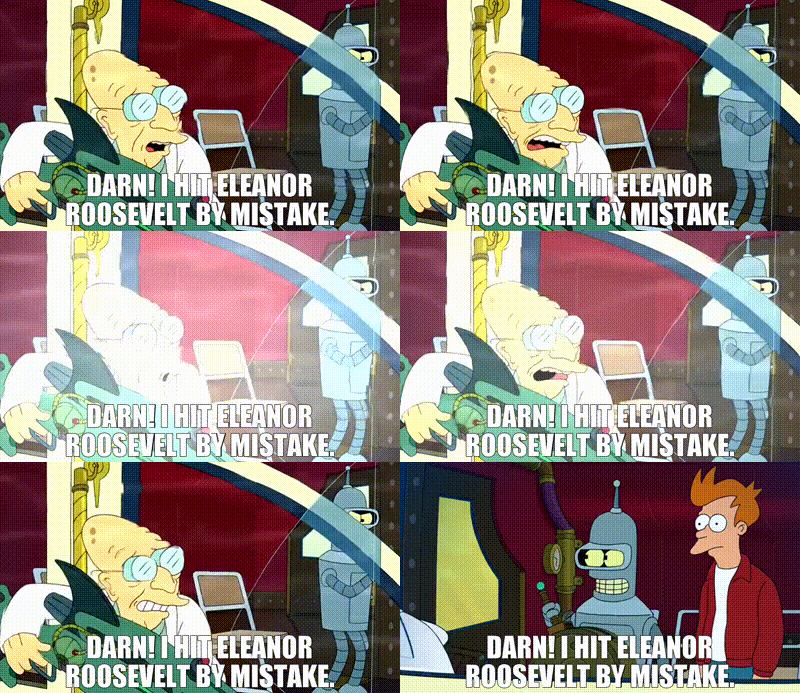
I’m headed back to the school year with a grimace on my face and a groan in my heart. But the thoughts in this book, just one of the dozens ER wrote, have made the grind a little easier. The first half is very inspirational, talking about courage and strength, openness and honesty. The second gets a little more specific about the issues of the day, which will seem a tad outdated, but still interesting.
Her style is part advice column, part philosophy. Her tone is gentle and kind. She uses real-life examples, but in a way that relates to the common person, which is unusual for someone as famous, influential, and wealthy as her. Funny how there aren’t many contractions: see my last review for how language has evolved even over the last century. But still easy to follow. Reminded me a lot of the Seven Habits.
You won’t get much history here. FDR appears and seems kinder, more human here, a thing I appreciated. She even relates stories with the King of England in a clear, approachable way.
Yeah, when I’m asked with whom I’d like to have lunch, living or dead…she’s in the top ten.
“We do not have to become heroes overnight. Just a step at a time, meeting each thing that comes up, seeing it as not as dreadful as it appears, discovering that we have the strength to stare it down.” - Eleanor Roosevelt
Well, you can imagine my glee when I found that quote at the end of one of the chapters.
I’m headed back to the school year with a grimace on my face and a groan in my heart. But the thoughts in this book, just one of the dozens ER wrote, have made the grind a little easier. The first half is very inspirational, talking about courage and strength, openness and honesty. The second gets a little more specific about the issues of the day, which will seem a tad outdated, but still interesting.
Her style is part advice column, part philosophy. Her tone is gentle and kind. She uses real-life examples, but in a way that relates to the common person, which is unusual for someone as famous, influential, and wealthy as her. Funny how there aren’t many contractions: see my last review for how language has evolved even over the last century. But still easy to follow. Reminded me a lot of the Seven Habits.
You won’t get much history here. FDR appears and seems kinder, more human here, a thing I appreciated. She even relates stories with the King of England in a clear, approachable way.
Yeah, when I’m asked with whom I’d like to have lunch, living or dead…she’s in the top ten.
“We do not have to become heroes overnight. Just a step at a time, meeting each thing that comes up, seeing it as not as dreadful as it appears, discovering that we have the strength to stare it down.” - Eleanor Roosevelt

August 25, 2013
WOW. Although written in 1960, this book still resounds with relevance today, and it should be required reading for every young adult who wants to know how to make the most of life. If students had to read this in high school, I believe that an entire generation would benefit and be better people as a result. Many of the values put forth in this book are ones that are prone to be forgotten in this day and age, but they should not be. Most likely this will be one of the 5 most influential books I'll read over the course of my life, and one that I will be referring to frequently again and again.

November 30, 2013
Eleanor Roosevelt is definitely one of my biggest historical heroes, but I have to say that I would not necessarily recommend this book. The 21st century reader has to take everything with a grain of salt given the time period it was written in, which is only to be expected, however I felt that even the core messages of the chapters (which are largely still applicable today) are not written in a way that is particularly engaging or interesting-- and for a woman who did so much, one would think she would have been able to add more fascinating, detailed anecdotes and less mere mentions of famous people she encountered. Still, despite the fact that I occasionally noticed I was forcing myself to get through the dryer parts, it was largely a worthwhile read, and the words of such an amazing person can't simply be cast aside because he or she was not primarily an author.

March 6, 2015
i've always adored eleanor roosevelt but i do so much more after this book. she is such a wise woman & has so many great things to say--i couldn't stop highlighting. so many great stories from her life experiences. it made me really think about what i have learned from living. i seriously think everyone should read this & the world would be a happier & better place, it made me want to be a better person after reading

April 19, 2020
This was a monotonous read. I hoped that it would be insightful, but I was disappointed. Either I’m not the intended audience or this book is dated. I had hoped that it would be more autobiographical, but it was lacking in that sense. It just felt dry and dull.

September 10, 2015
It's unbelievable how accurate and still relevant many of Eleanor Roosevelt's observations and recommendations are. I enjoyed this little book of reflection and found it motivating and inspiring in how I can evolve and grow in little ways throughout my day. She is a fascinating woman and this was a great read on advice from parenting to how to be a better person, citizen, role model.

February 14, 2019
'You learn by living' is a book of big wisdoms. Eleanor's words are thought provoking. As soon as I finished reading chapter 1, I became more interested in the world around me.
This book is certainly going to be one of my favorites and one that I shall revisit in the future.
This book is certainly going to be one of my favorites and one that I shall revisit in the future.
February 2, 2015
Very disappointed. I was expecting so much more after reading the great reviews. She comes out snobby, and though her advice usually makes sense, it was not very practical. Some of her advice makes for great quotes, but that's the best I can say. It was a very boring, I had a hard time even getting through it. I assume she has other better books and thats why her reviews are so good. Might have to read something else to change my mind, but will probably have to wait some years before putting myself through it again.
July 19, 2019
Everyone should read this book. What was relevant then is still relevant today. If you didn't look at the copyright date or know that Eleanor Roosevelt died in 1962 you would think it was written today. I wish had I read this book many years ago, before I got married and had children. There are many tips on discovering yourself and becoming the best you can be. There are also guides to raising children, community living and politics. I just finished reading it and I want to read it again.
November 28, 2008
A book to keep by your bedside and read a page or two before you go to sleep.
Inspirational, keeping us on the right path
Inspirational, keeping us on the right path

November 13, 2010
In just 11 chapters, Eleanor shares with us her own interpretation of the basic philosophy of life. She believes that her basic philosophy is best expressed in the choices one makes daily. She discusses fear, a stumbling block, the great crippler, is something we all face. She stated "Looking back, it strikes me that my childhood and my early youth were one long battle against fear." She realized that "the danger lies in refusing to face the fear, in not daring to come to grips with it. If you fail anywhere along the line it will take away your confidence. You must make yourself succeed every time. YOU MUST DO THE THING YOU THiNK YOU CANNOT DO."
Eleanor also discusses the uses of time, how to be a mature person, readjustment is endless, and learning to be useful. She shares her story of being with Harry Belafonte visiting 2 children's hospitals. "The next afternoon I again saw him give of himself in the same way. Moving among the hospitalized children, making their eyes shine and their faces light with smiles because he gave them a word of encouragement. For a moment the braces or the cradle in which they lay was forgotten. They were well in their bodies because he satisfied their little souls." The remaining chapters in the book are: the right to be an individual; how to get the best out of people; how everyone can take part in politics, learning to be a public servant, and facing responsibility with this quote:
"We all create the person we become by our choices as we go through life.
In a very real sense, by the time we are an adult,
We are the sum total of the choices we have made."
So much in this short book. Such an amazing woman!
Eleanor also discusses the uses of time, how to be a mature person, readjustment is endless, and learning to be useful. She shares her story of being with Harry Belafonte visiting 2 children's hospitals. "The next afternoon I again saw him give of himself in the same way. Moving among the hospitalized children, making their eyes shine and their faces light with smiles because he gave them a word of encouragement. For a moment the braces or the cradle in which they lay was forgotten. They were well in their bodies because he satisfied their little souls." The remaining chapters in the book are: the right to be an individual; how to get the best out of people; how everyone can take part in politics, learning to be a public servant, and facing responsibility with this quote:
"We all create the person we become by our choices as we go through life.
In a very real sense, by the time we are an adult,
We are the sum total of the choices we have made."
So much in this short book. Such an amazing woman!

August 14, 2011
So interesting on so many different levels. The book serves as a self-help manual, a memoir, a textbook on good citizenship and how to become a public servant, a source of small meaningful stories and inspirational tidbits, and a historical document. Written at the end of her life, Eleanor Roosevelt embraced her role as Elder and Public Servant to write a book summarizing the greatest lessons of her life to share with others. In brief, make deliberate effort to overcome your fears, small and large, and do so by living life to the fullest, learning from and serving others with compassionate curiosity. I can see this as a book that will be fun to dip back into at random now and again when in need of insight or inspiration. My new Eleanor Roosevelt motto: You must do the thing you think you cannot do.

February 12, 2010
From an academic standpoint I would give this book a 3 stars. She is constantly stating her opinion as absolute statements--some of which I didn't entirely agree. She doesn't defend her opinions and sentiments very well sometimes and for that I just thought the academic aspects of the book were "okay".
From a personal standpoint, I thought the book was a 5 stars. Perhaps because the book is a little outdated, I felt like I was reading counsel from my grandmother. She is a moral person and speaks highly of many of the standards I believe and cherish. The book was uplifting.
From a personal standpoint, I thought the book was a 5 stars. Perhaps because the book is a little outdated, I felt like I was reading counsel from my grandmother. She is a moral person and speaks highly of many of the standards I believe and cherish. The book was uplifting.

May 9, 2020
<> ▪️ Tenía tantas ganas de leer este libro que lo he devorado en un día. Eleanor Roosevelt es una mujer que siempre me ha resultado muy inspiradora y con la que siento cierta conexión en muchos valores e ideas. Esta memoria-ensayo es una delicia, casi he sentido estar conversando con una amiga muy sabia mientras tomamos el café. Al principio ella escribe que no pretende hacer de esta obra un manual de auto-ayuda, tampoco sonar dogmática ni mucho menos presentar una verdad absoluta y una forma concreta para vivir la vida. Solo busca exponer, de forma clara, todo lo que ella ha aprendido a lo largo de su vida y por lo que considera que vale la pena luchar. Desde luego, creo que consigue su objetivo. Nos habla del miedo: de cómo afrontarlo. De la política: de cómo ella empezó a iniciarse al servicio público. Del respeto, de la educación y la readaptación a las circunstancias, de lo importante que es la forma en que empleamos nuestro tiempo, de nuestro derecho a ser un individuo y a desarrollar nuestras propias ideas. Habla también de la curiosidad: el motor principal de su vida, el más valioso tesoro que un ser humano puede tener y con el que todo puede superarse. La verdad, no sé si ella dió por satisfecha su gran máxima: conocerse y conocer su entorno a través de la auto-disciplina, pero a mí me parece una mujer que logró no solo transmitir su amor por el ser humano sino también luchar por él y todos sus derechos. En definitiva, (y esto lo escribo más para mis adentros que para fuera), ojalá algún día pueda participar, amar y luchar tanto por la vida como lo hizo ella. 🌹

April 3, 2019
For me, this collection of essays was great in some places and less so in others. I appreciated the straightforward, open attitude that Eleanor Roosevelt had in life, especially the idea of being interested people and what THEY are interested in, looking at interactions as ways to connect and learn. At other times, I felt a disconnect as time has passed, because the world is not exactly what it was when Eleanor was writing. She framed women as primarily defined by their husbands and children, which - they were! So no judgment there. But I kept finding myself wrinkling my nose. I'm glad I read it, and I will definitely refer back. I think the section on civil involvement is good recurring reading for each election cycle, and the chapter about getting the best out of people is sound advice for management and leadership.

December 27, 2023
While I love Eleanor Roosevelt, this book was a bit tedious at times. It is written as a manual of sorts on how to be a good person. There were many words of wisdom and great insight, but it wasn’t something I was eager to pick up and continue.

July 30, 2019
“Surely, in the light of history, it is more intelligent to hope rather than to fear, to try rather than not to try. For one thing we know beyond all doubt: Nothing has ever been achieved by the person who says, ‘It can’t be done.’”
Eleanor Roosevelt is like the calming grandmother I need to help me make it through the Trump administration. She uses this book to impart some wisdom she’s learned over the years, but really it all amounts to something like:
- Don’t be afraid to take risks. You will learn from your mistakes.
- Seek individuality (otherwise you’re probably from the USSR)
- Help others, and ask for help yourself
- Don’t ever give up on yourself and your beliefs, but take feedback
- Stay informed
- Don’t seek happiness, aim to become useful and happiness will come to you
- Be open to learning new things
One part sound advice, and one part common sense, Mrs. Roosevelt approaches her writing with humility. It’s clear that she wants to be helpful, but admits that she doesn’t have all the answers. This alone is a refreshing perspective in 2019.
See more of my reviews: Blog // Instagram
Eleanor Roosevelt is like the calming grandmother I need to help me make it through the Trump administration. She uses this book to impart some wisdom she’s learned over the years, but really it all amounts to something like:
- Don’t be afraid to take risks. You will learn from your mistakes.
- Seek individuality (otherwise you’re probably from the USSR)
- Help others, and ask for help yourself
- Don’t ever give up on yourself and your beliefs, but take feedback
- Stay informed
- Don’t seek happiness, aim to become useful and happiness will come to you
- Be open to learning new things
One part sound advice, and one part common sense, Mrs. Roosevelt approaches her writing with humility. It’s clear that she wants to be helpful, but admits that she doesn’t have all the answers. This alone is a refreshing perspective in 2019.
See more of my reviews: Blog // Instagram

February 18, 2020
Overall, a good book, interesting read. E. Roosevelt summarizes her nuggets of wisdom in 11 different sections: Learning to Learn • Fear—the Great Enemy • The Uses of Time • The Difficult Art of Maturity • Readjustment is Endless • Learning to Be Useful• the Right to Be an Individual • How to Get the Best Out of People •Facing Responsibility • How Everyone Can Take Part in Politics • Learning to Be a Public Servant.
I think my favorite chapters were about maturity and adjustment. Roosevelt talks about how life is all about adjusting to changes, one after another. There is nothing stable about living; each relationship we form here on earth will undergo change, each season of life has its upheavals- there is grief and loss, lifestyle changes, job and income fluctuations, etc.. and it is up to us to adapt and move forward.
It's common sense stuff mostly, but her words made me think more deeply about these things. I tend to approach each day much like the one preceding, but somehow age and limitations sneak up on me somewhere in the days..and surprise me. A new ache. A stiffness I hadn't had before. My memory not being quite as sharp. And so we must go on in our new normal. It is a hard thing to face, something I hadn't thought much about when I was young.
Her other chapters are insightful too. Though in the beginning I'd thought she approached things kind of simplistically, with her "just do it!" message.
This is a relatively short book, an easy read.
I think my favorite chapters were about maturity and adjustment. Roosevelt talks about how life is all about adjusting to changes, one after another. There is nothing stable about living; each relationship we form here on earth will undergo change, each season of life has its upheavals- there is grief and loss, lifestyle changes, job and income fluctuations, etc.. and it is up to us to adapt and move forward.
It's common sense stuff mostly, but her words made me think more deeply about these things. I tend to approach each day much like the one preceding, but somehow age and limitations sneak up on me somewhere in the days..and surprise me. A new ache. A stiffness I hadn't had before. My memory not being quite as sharp. And so we must go on in our new normal. It is a hard thing to face, something I hadn't thought much about when I was young.
Her other chapters are insightful too. Though in the beginning I'd thought she approached things kind of simplistically, with her "just do it!" message.
This is a relatively short book, an easy read.

February 27, 2015
kind of a facts of life sort of thing, very practical - most of it not hugely surprising, but nice to have that voice with its background of experience and hearing what kind of advice she'd give. also a quick take toward the end on both the price of and need for participation in politics, from the local up to the international, from 'mere' voting up to representation and bill writing.
In some ways the way she thinks about and talks of the various parts of life reminded me of my grandmother, though they were a generation apart - it's a voice I miss hearing every day.
As a side note on my own reading, it was interesting to read her comment on helping out with a settlement house, even as I'm in the midst of reading Jane Addams' Twenty Years at Hull House , though these two remarkable women wouldn't have had any direct overlap in this work I don't think.
In some ways the way she thinks about and talks of the various parts of life reminded me of my grandmother, though they were a generation apart - it's a voice I miss hearing every day.
As a side note on my own reading, it was interesting to read her comment on helping out with a settlement house, even as I'm in the midst of reading Jane Addams' Twenty Years at Hull House , though these two remarkable women wouldn't have had any direct overlap in this work I don't think.

January 26, 2016
This book is basically a memoir of Eleanor's beliefs and ideas that she had during her life. It's not an autobiography which is what our bookclub was looking for our selection. Maybe we should've looked more closely at the book before choosing it. It did provide many ideas that are still relevant today; such as... The importance of education, reading, choices, happiness, politics, and being a life-long learner. My favorite quote is this... "Whatever period of life we are in is good only to the extent that we make use of it, that we live it to the hilt, that we continue to develop and understand what it has to offer us and we have to offer it. The rewards for each age are different in kind, but they are not necessarily different in value or in satisfaction."
I look forward to reading either a biography or autobiography of Eleanor Roosevelt. Does anyone know a good one?
I look forward to reading either a biography or autobiography of Eleanor Roosevelt. Does anyone know a good one?
February 8, 2020
I have always wanted to read an Eleanor Roosevelt book, but this far exceeded my expectations. I will be purchasing a hard copy and making this required reading for my children before graduating from our home school. It's interesting, because I know Mrs. Roosevelt was considered a feminist, and yet, she expressed such a profound love and high honor for being about the truly beautiful feminine work of family, raising children, and service to our neighbor that I only found a couple paragraphs in the entire work that I had disagreement with and would have found immense pleasure should I ever have had the fortune to hear Mrs. Roosevelt converse the topics further.

June 22, 2011
This book was ok. I didn't find it super life changing or anything. Its a pretty simple basic book, targets to the point where we should learn as much as we can, and face our fears, and try new things. Thats what I like about Eleanor Roosevelt. What I've read about her, it seems as if she was a shy girl, but as she got older, she wanted to learn as much as she could and do new things and stop being afraid of things. Basically she lived her life.
Displaying 1 - 30 of 671 reviews