

What do you think?
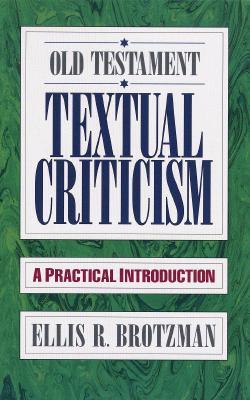
Old Testament Textual Criticism: A Practical Introduction
Old Testament Textual Criticism provides the basic knowledge for students to get the most from Biblia Hebraica Stuttgartensia (BHS). Ellis R. Brotzman explains the significance of scripts and writings of the ancient Near East, the Dead Sea Scrolls, and Hebrew manuscripts for students of Hebrew exegesis.
208 pages, Paperback
First published November 1, 1993
Ratings & Reviews
Friends & Following
Create a free account to discover what your friends think of this book!
Community Reviews
Displaying 1 - 30 of 51 reviews

January 3, 2026
Excellent! A little dense on the Hebrew side but the practical example about Ruth is very helpful and understandable.

January 28, 2021
As the title implies, this book provides a great introduction to the complex field of Old Testament Textual Criticism. Chapters 1 and 2 cover ancient writing practices and how the OT text was transmitted throughout different historical periods. Chapter 3 deals with the most important OT manuscripts like the Dead Sea Scrolls, Samaratic Pentateuch, and the Masoretic Text. Chapter 4 discusses the most crucial witnesses to the OT text, such as the Greek Septuagint, Syriac Peshitta, Aramaic Targums, and the Latin Vulgate.
Chapters 5–8 take a more academic turn, exploring how the information provided in the previous four chapters influences the practice of textual criticism. Chapter 5 dives into the textual apparatuses of the BHS (Biblia Hebraica Stuttgartensia) and the BHQ (Biblia Hebraica Quinta); chapter 6 discusses the most common scribal changes to the text; chapter 7 explores the methods of uncovering the "best reading" of the OT in light of all its textual variants; and finally, chapter 8 walks the reader through the book of Ruth illustrating the principles outlined in chapter 7.
Although there were certainly dry parts throughout the book, it transformed my understanding of the OT and revealed how much I still have to learn. Overall, I would recommend this book to anyone who wants to understand the complexity of OT textual criticism on an academic level, however, I would not recommend this book (especially the last 4 chapters) to anyone who is not interested in the academic study of the OT and does not have at least some knowledge of Biblical Hebrew.
Chapters 5–8 take a more academic turn, exploring how the information provided in the previous four chapters influences the practice of textual criticism. Chapter 5 dives into the textual apparatuses of the BHS (Biblia Hebraica Stuttgartensia) and the BHQ (Biblia Hebraica Quinta); chapter 6 discusses the most common scribal changes to the text; chapter 7 explores the methods of uncovering the "best reading" of the OT in light of all its textual variants; and finally, chapter 8 walks the reader through the book of Ruth illustrating the principles outlined in chapter 7.
Although there were certainly dry parts throughout the book, it transformed my understanding of the OT and revealed how much I still have to learn. Overall, I would recommend this book to anyone who wants to understand the complexity of OT textual criticism on an academic level, however, I would not recommend this book (especially the last 4 chapters) to anyone who is not interested in the academic study of the OT and does not have at least some knowledge of Biblical Hebrew.

May 18, 2020
Eye opening work. Definitely worth the time for reading.

January 13, 2019
Brotzman offers a digestible introduction to a subject that by nature has an extremely high starting level. The first half of the book contained especially helpful information about the various editions of Old Testament, including critical editions of the Hebrew text as well as translations. The last half gets deeply technical with more of a textbook style. Overall a great introduction to the technical and vastly complicated world of textual criticism.

December 13, 2020
A very helpful overview of how the OT was composed and transmitted. The authors carefully and thoughtfully engage with broader biblical criticism, accepting what they may while staying within evangelical orthodoxy. The basic tools and practices of text criticism are laid out clearly, and helpfully illustrated in a textual commentary on Ruth at the end. I would certainly recommend this to anyone learning to work closely with the biblical text.

May 2, 2019
A helpful introduction to a very dense field. I have very little interest in text criticism, but this book helped show its importance and necessity.

May 31, 2024
Dry in spots, but overall pretty interesting and engaging for an introduction to OT textual criticism!

May 16, 2012
Good, basic, readable introduction to the background of criticism and the BHS

April 3, 2018
Let me be upfront, this is an academic book for Bible nerds or possibly ancient language nerds. This isn't a book for everyone. However, if you've ever found yourself wanting an introduction to the development of language in the ancient near east, the manuscript history of the Old Testament, or a little about the Dead Sea scrolls, then you may be interested in giving this book a look.
So, Old Testament Textual Criticism: A Practical Introduction is pretty much as advertised. Ellis R. Brotzman is writing this to help students of the Bible get an idea of what textual criticism is and how to use it as a tool. For the uninitiated textual criticism is the process to try to figure out what the original text of the Bible was, particularly the Old Testament in this case. This is done through the use of ancient manuscripts and comparing and contrasting what is found in each of these copies.
Going into the book I was worried that it was going to be very very very dry. Surprisingly, I didn't find it to be so. It was interesting to learn about the progression of language and the path that the Old Testament took to being formed. Of course this is also a topic I enjoy, so some may find it drier than others.
The biggest downside of this book is probably in the second half of it. While I felt that the first handful of chapters could be read and appreciated by a larger number of people, the second half began to rely on a knowledge of Biblical Hebrew. This is not a skill that I imagine many people have. So it is very possible that the later parts of the book will be overwhelming and honestly the book is more burdensome in this second half even if you do have that knowledge. Due to this fact, this is very much a niche kind of book. It's for beginning Bible students who have a beginner to intermediate level of Biblical Hebrew knowledge.
So overall Old Testament Textual Criticism: A Practical Introduction is a book that I liked more than I expected to going into it. The first half to two-thirds is very interesting and I enjoyed reading it. The last few chapters do become a bit more burdensome and less easy to access. It is a book that will have a very narrow audience and while it completes its purpose it isn't a book that I would find myself coming back to very often.
So, Old Testament Textual Criticism: A Practical Introduction is pretty much as advertised. Ellis R. Brotzman is writing this to help students of the Bible get an idea of what textual criticism is and how to use it as a tool. For the uninitiated textual criticism is the process to try to figure out what the original text of the Bible was, particularly the Old Testament in this case. This is done through the use of ancient manuscripts and comparing and contrasting what is found in each of these copies.
Going into the book I was worried that it was going to be very very very dry. Surprisingly, I didn't find it to be so. It was interesting to learn about the progression of language and the path that the Old Testament took to being formed. Of course this is also a topic I enjoy, so some may find it drier than others.
The biggest downside of this book is probably in the second half of it. While I felt that the first handful of chapters could be read and appreciated by a larger number of people, the second half began to rely on a knowledge of Biblical Hebrew. This is not a skill that I imagine many people have. So it is very possible that the later parts of the book will be overwhelming and honestly the book is more burdensome in this second half even if you do have that knowledge. Due to this fact, this is very much a niche kind of book. It's for beginning Bible students who have a beginner to intermediate level of Biblical Hebrew knowledge.
So overall Old Testament Textual Criticism: A Practical Introduction is a book that I liked more than I expected to going into it. The first half to two-thirds is very interesting and I enjoyed reading it. The last few chapters do become a bit more burdensome and less easy to access. It is a book that will have a very narrow audience and while it completes its purpose it isn't a book that I would find myself coming back to very often.

March 11, 2022
Ellis R. Brotzman and Eric J. Tully have provided readers with, as the subtitle suggests, “a practical introduction” to the discipline of Old Testament textual criticism. The authors accomplish what they set out to do, for the work is both introductory and practical. For this reason, it is a helpful and important work, especially for seminary students, and even undergraduate students interested in the field.
Their succinct, yet thorough, overview of the many versions and translations of the Old Testament, provided in chapters 3 and 4, is one of the strongest aspects of the volume. They also do an excellent job of introducing the somewhat confusing world of “critical editions” of the Old Testament to beginning students (ch. 5). The final chapter is a “Textual Commentary on the Book of Ruth,” in which they discuss every textual variant noted in the apparatus of the BHS (the current critical edition of the OT) for Ruth, as well as making note of a few variants that the BHS does not include. This is a helpful chapter, as it shows what textual criticism looks like in practice.
Brotzman and Tully also pull no punches when it comes to their criticisms of BHS (although they are quite a bit more optimistic about the BHQ, which is currently in production). The fact that they were able, in this second edition, to consider the BHQ, alongside the BHS, is another valuable aspect of the book.
Overall, it’s a fine book, though it is a bit dry, and it serves more as a reference book than anything, in my opinion. For this reason, I would give it a rating of 3.5 stars. I will, no doubt, come back to it time and again, but if one is already familiar with the study of textual criticism, this book would not be as helpful, while Emanuel Tov’s tome on the subject would probably be much more stimulating and thorough (although I have not, as of yet, been able to read it.)
Their succinct, yet thorough, overview of the many versions and translations of the Old Testament, provided in chapters 3 and 4, is one of the strongest aspects of the volume. They also do an excellent job of introducing the somewhat confusing world of “critical editions” of the Old Testament to beginning students (ch. 5). The final chapter is a “Textual Commentary on the Book of Ruth,” in which they discuss every textual variant noted in the apparatus of the BHS (the current critical edition of the OT) for Ruth, as well as making note of a few variants that the BHS does not include. This is a helpful chapter, as it shows what textual criticism looks like in practice.
Brotzman and Tully also pull no punches when it comes to their criticisms of BHS (although they are quite a bit more optimistic about the BHQ, which is currently in production). The fact that they were able, in this second edition, to consider the BHQ, alongside the BHS, is another valuable aspect of the book.
Overall, it’s a fine book, though it is a bit dry, and it serves more as a reference book than anything, in my opinion. For this reason, I would give it a rating of 3.5 stars. I will, no doubt, come back to it time and again, but if one is already familiar with the study of textual criticism, this book would not be as helpful, while Emanuel Tov’s tome on the subject would probably be much more stimulating and thorough (although I have not, as of yet, been able to read it.)

February 20, 2011
According to the conclusion, this is an introduction to textual criticism for the intermediate Hebrew student (pp. 168, 170). That seemed to fit the bill since I took only a year of Hebrew prior to picking this little thing up and I had few difficulties. In fact, thanks to a book that expands on Brotzman's simplified and summarized categories (The Masorah of Biblia Hebraica Stuttgartensia by Kelley, Mynatt, and Crawford), I was not only flying through the various practical exercises with the BHS' critical apparatus, but augmenting it with a direct examination of the Masorah parva. Chapter five, however, an introduction to BHS, must have been geared toward beginners since any first-year Biblical Hebrew student will have (or should have!) already become familiar with its layout and contents.
Four things make this a good read for beginning/intermediate students: a brief analysis of the types of scribal errors encountered in biblical texts, a step-by-step guide to doing textual criticism, a hands-on examination of textual problems in Ruth and ways to work through them, and the Latin-to-English abbreviation list.
1. Scribal Errors (ch. 6). This is the meat and potatoes of textual criticism. Brotzman has laid out quickly and simply the various sorts of scribal errors and how we might identify them in a biblical text.
2. Step-by-step Guide (ch. 7). After helping us understand in the previous chapter how and why texts were altered, Brotzman proceeds to lay out a method for doing textual criticism that enables us to understand what may or may not be the better or more original reading.
3. Hands-on Examination (ch. 8). This is what makes Brotzman's book both special and practical. As we work through the various textual problems in Ruth utilizing BHS' critical apparatus, we see the previously mentioned scribal errors appear in the biblical text itself, watch the method applied again and again to each instance of textual difficulty, and gain insight into the particularities of BHS that might otherwise be difficult or confusing. What follows are some examples of that latter insight.
Although both Brotzman and BHS include a symbol list where LXX* is identified as the original Greek Septuagint, it wasn't until the hands-on examination that we were clued in on exactly how we knew that: it was the unanimous reading of all Greek witnesses (p. 134, n. 2).
Even though the purpose of the BHS critical apparatus is to clue us in to variants, it is an imperfect system. You can't always assume that just because BHS doesn't include a variant from the various Greek texts (for example) that there isn't one.
Sometimes there is no critical note in the text or in the apparatus for a verse, but there are still textual difficulties identified by the Masorah parva (p. 160). This means that the Masorah parva and the critical apparatus with its textual notes do not always work together. Both need to be consulted.
The critical apparatus references chapter and verse numbers in an odd manner. Instead of writing out 1 Ch 2:5, 9-15, it has 1 Ch 2,5.9-15 (p. 163-64).
4. Abbreviation List (appendix). Even though this is basically a spin-off from other such lists both within and without BHS, what I liked about this was not only the way it clarified definitions, but how it made common abbreviations instantly available while one already has BHS open. Given the choice between looking up the definition of an abbreviation in either BHS or Brotzman, losing one's place within that text, and then having to return and find it again, I am glad for the opportunity to leave my primary text, BHS, alone and go hunting elsewhere.
If the book's strengths reside in its second half, its weaknesses reside in the first. Chapters 1 through 4 are basically simplified summarizations of content and data available in very much the same layout and description elsewhere. Reading something like Wurthwein's Text of the Old Testament or Yeivin's Tiberian Masorah really makes most of what Brotzman says not only redundant, but obsolete. Those books are light-years better than Brotzman when it comes to either the quality of their shared content or the details. The one thing Brotzman provides on his own is a comparison of the sources he is summarizing. I believe that the biblical student will be better served by reading one or more of Brotzman's sources and skipping his first four chapters altogether.
The other major problem I have with the book is its uncritical confessional bias. As long as Brotzman is dealing with something other than textual criticism, he feels free to assume all sorts of things that would shame professionals in those fields. For instance, Brotzman has no problem talking about Moses as though Moses were a real, historical person whose very existence, not to mention what we might or might not know about such a person, were not in question and also takes for granted the historicity of the exodus account (p. 32-33). Did Brotzman really have to say something like "The existence of an alphabetic script greatly facilitated the recording of divine revelation in written form" (pp. 34-35)? What exactly does that mean? Does that mean only the Hebrew Bible was greatly facilitated by the formation of an alphabet? Does that mean only alphabetic texts that people believe are divine revelation were greatly facilitated by the alphabet? I thought the point was that the alphabet made the reading and writing of texts easier and the Old Testament took advantage of that historical shift. But, apparently, the divine realm has something to do with it. When Brotzman discusses possible dates for the biblical texts, he has no problem assuming the "traditional" view without substantiating that choice (see ch. 2). On p. 39, Brotzman is fine identifying the Pentateuch synchronically as a unified composition without giving a reason for that treatment. And last, but not least, Brotzman pretends to settle the question of whether we should rely on the Masoretic Text or something else by appealing to its "acceptance" as "standard" by 135 BC without saying who it was that accepted it as standard or why their acceptance should dictate our own (p. 44). I'm sure Brotzman would take issue with someone who decided to do textual criticism uncritically by preferring a variant in the LXX over the Masoretic because the LXX is the accepted divine scripture in their religion (see Eastern Orthodox). So why does he turn around and do the same sort of thing to those in other fields? I wanted to give this book two stars for its woeful disregard for professionalism, but the strength of the second half saves it from mediocrity.
Four things make this a good read for beginning/intermediate students: a brief analysis of the types of scribal errors encountered in biblical texts, a step-by-step guide to doing textual criticism, a hands-on examination of textual problems in Ruth and ways to work through them, and the Latin-to-English abbreviation list.
1. Scribal Errors (ch. 6). This is the meat and potatoes of textual criticism. Brotzman has laid out quickly and simply the various sorts of scribal errors and how we might identify them in a biblical text.
2. Step-by-step Guide (ch. 7). After helping us understand in the previous chapter how and why texts were altered, Brotzman proceeds to lay out a method for doing textual criticism that enables us to understand what may or may not be the better or more original reading.
3. Hands-on Examination (ch. 8). This is what makes Brotzman's book both special and practical. As we work through the various textual problems in Ruth utilizing BHS' critical apparatus, we see the previously mentioned scribal errors appear in the biblical text itself, watch the method applied again and again to each instance of textual difficulty, and gain insight into the particularities of BHS that might otherwise be difficult or confusing. What follows are some examples of that latter insight.
Although both Brotzman and BHS include a symbol list where LXX* is identified as the original Greek Septuagint, it wasn't until the hands-on examination that we were clued in on exactly how we knew that: it was the unanimous reading of all Greek witnesses (p. 134, n. 2).
Even though the purpose of the BHS critical apparatus is to clue us in to variants, it is an imperfect system. You can't always assume that just because BHS doesn't include a variant from the various Greek texts (for example) that there isn't one.
Sometimes there is no critical note in the text or in the apparatus for a verse, but there are still textual difficulties identified by the Masorah parva (p. 160). This means that the Masorah parva and the critical apparatus with its textual notes do not always work together. Both need to be consulted.
The critical apparatus references chapter and verse numbers in an odd manner. Instead of writing out 1 Ch 2:5, 9-15, it has 1 Ch 2,5.9-15 (p. 163-64).
4. Abbreviation List (appendix). Even though this is basically a spin-off from other such lists both within and without BHS, what I liked about this was not only the way it clarified definitions, but how it made common abbreviations instantly available while one already has BHS open. Given the choice between looking up the definition of an abbreviation in either BHS or Brotzman, losing one's place within that text, and then having to return and find it again, I am glad for the opportunity to leave my primary text, BHS, alone and go hunting elsewhere.
If the book's strengths reside in its second half, its weaknesses reside in the first. Chapters 1 through 4 are basically simplified summarizations of content and data available in very much the same layout and description elsewhere. Reading something like Wurthwein's Text of the Old Testament or Yeivin's Tiberian Masorah really makes most of what Brotzman says not only redundant, but obsolete. Those books are light-years better than Brotzman when it comes to either the quality of their shared content or the details. The one thing Brotzman provides on his own is a comparison of the sources he is summarizing. I believe that the biblical student will be better served by reading one or more of Brotzman's sources and skipping his first four chapters altogether.
The other major problem I have with the book is its uncritical confessional bias. As long as Brotzman is dealing with something other than textual criticism, he feels free to assume all sorts of things that would shame professionals in those fields. For instance, Brotzman has no problem talking about Moses as though Moses were a real, historical person whose very existence, not to mention what we might or might not know about such a person, were not in question and also takes for granted the historicity of the exodus account (p. 32-33). Did Brotzman really have to say something like "The existence of an alphabetic script greatly facilitated the recording of divine revelation in written form" (pp. 34-35)? What exactly does that mean? Does that mean only the Hebrew Bible was greatly facilitated by the formation of an alphabet? Does that mean only alphabetic texts that people believe are divine revelation were greatly facilitated by the alphabet? I thought the point was that the alphabet made the reading and writing of texts easier and the Old Testament took advantage of that historical shift. But, apparently, the divine realm has something to do with it. When Brotzman discusses possible dates for the biblical texts, he has no problem assuming the "traditional" view without substantiating that choice (see ch. 2). On p. 39, Brotzman is fine identifying the Pentateuch synchronically as a unified composition without giving a reason for that treatment. And last, but not least, Brotzman pretends to settle the question of whether we should rely on the Masoretic Text or something else by appealing to its "acceptance" as "standard" by 135 BC without saying who it was that accepted it as standard or why their acceptance should dictate our own (p. 44). I'm sure Brotzman would take issue with someone who decided to do textual criticism uncritically by preferring a variant in the LXX over the Masoretic because the LXX is the accepted divine scripture in their religion (see Eastern Orthodox). So why does he turn around and do the same sort of thing to those in other fields? I wanted to give this book two stars for its woeful disregard for professionalism, but the strength of the second half saves it from mediocrity.
August 26, 2024
This book is designed to teach the "intermediate" Hebrew student how to do textual criticism using the BHS. I am not an intermediate Hebrew student, nor do I want to do textual criticism using the BHS!
Yet most of this book still gave me what I was looking for. The book presents concisely and helpfully a history of the old testament text and its various versions (the Masoretic text, the Septuagint, the dead sea scrolls etc) along with descriptions of the types of errors that could occur in the copying process, with examples given, as well as an overview of how textual critics make their decisions. For the aspiring textual critic the book includes a whole textual commentary on Ruth to illustrate this process, but I only skimmed that chapter.
What the book did not give me was a good sense of the conclusions of modern textual criticism. How certain or uncertain are we are about the text of the old testament? What are the major variant passages of the OT? The book does make a few helpful comments throughout that begin to answer these questions, but I will have to look elsewhere for a proper discussion.
Yet most of this book still gave me what I was looking for. The book presents concisely and helpfully a history of the old testament text and its various versions (the Masoretic text, the Septuagint, the dead sea scrolls etc) along with descriptions of the types of errors that could occur in the copying process, with examples given, as well as an overview of how textual critics make their decisions. For the aspiring textual critic the book includes a whole textual commentary on Ruth to illustrate this process, but I only skimmed that chapter.
What the book did not give me was a good sense of the conclusions of modern textual criticism. How certain or uncertain are we are about the text of the old testament? What are the major variant passages of the OT? The book does make a few helpful comments throughout that begin to answer these questions, but I will have to look elsewhere for a proper discussion.

September 10, 2024
I read through this for school and found it to be very informative. It's a short read but is brimming with great information, which I will refer back to when making future textual criticism. The central premise is understanding how to conduct textual criticism of the OT focusing on the MT, Septuagint, and Samaritan Pentateuch, but also with mention of the Latin Vulgate and Qumran Scrolls. Having never touched a BHS before, this book has made me feel a little less daunted to open the cover and begin trying to tackle some of the Apparatus and Masorah. I would recommend this to someone who wants to understand how to study textual differences in Old Testament manuscripts. Be aware that after reading this book, it will primarily be used as a reference for identifying different textual discrepancies and their reasonings.
September 25, 2021
This is a fantastic introduction to textual criticism and provides a clear, accessible guide into a field fraught with difficulties. The authors make a few assumptions (e.g., that it is possible to get to know the text behind the LXX, Peshitta, &c. through retroversion ) that betray their modern mindset. While the merit of the discipline of textual criticism is suspect, students who wish to learn a bit more about the OT tradition of it would do well to read this book.
Helpfully, it provides a guide to the more confusing aspects of BHS and previews an upcoming edition of Biblia Hebraica which should be more accessible (I mean, you have to know at least four languages to even use BHS well) and more accurate called BHQ.
Helpfully, it provides a guide to the more confusing aspects of BHS and previews an upcoming edition of Biblia Hebraica which should be more accessible (I mean, you have to know at least four languages to even use BHS well) and more accurate called BHQ.
December 16, 2017
Great introduction to the topic
The author does a good job of introducing the key ideas necessary to understand the task of textual criticism. He keeps it at a level that is very accessible and doesn't require a knowledge of the languages to grasp the concepts.
The sections on scribal tendencies was also very informative and helpful.
I did notice that in the Kindle version there were a few spots where the Hebrew font used didn't show up. But overall it was a great introduction. The author also does a good job of providing the reader with a path forward to more in depth study.
The author does a good job of introducing the key ideas necessary to understand the task of textual criticism. He keeps it at a level that is very accessible and doesn't require a knowledge of the languages to grasp the concepts.
The sections on scribal tendencies was also very informative and helpful.
I did notice that in the Kindle version there were a few spots where the Hebrew font used didn't show up. But overall it was a great introduction. The author also does a good job of providing the reader with a path forward to more in depth study.

December 8, 2020
Readable, easy to follow introduction to the field of Old Testament textual criticism. Much attention is given to the field of New Testament textual criticism with the popular works of Bart Erhman and others, but this field is not as well known on a popular level. This little book is a laymen's guide to the question of how reliable our Old Testament text is. In the grand scheme, the answer is similar to that of the New: no theological teaching is disrupted by any textual variation. Yet at the same time, they are two very different fields. I recommend this book!

February 5, 2022
Concise intro to the tracing of the history, transmission, formulation, and textual criticism of the OT text.
From the earlier consonantal Paelo-Hebrew Scripts dated btw 1500-1400 BC all the way through ancient translations LXX, Vulgate, Targum, Peshitta etc. To our modern printing press OT there is much to be gleaned. One thing that was constantly evident about this complex process is that the fact that we even have the OT at all humanly speaking, is a miracle of divine blessing and providence. The scriptures are worthy of our complete trust and devotion (Acts 2:42).
From the earlier consonantal Paelo-Hebrew Scripts dated btw 1500-1400 BC all the way through ancient translations LXX, Vulgate, Targum, Peshitta etc. To our modern printing press OT there is much to be gleaned. One thing that was constantly evident about this complex process is that the fact that we even have the OT at all humanly speaking, is a miracle of divine blessing and providence. The scriptures are worthy of our complete trust and devotion (Acts 2:42).

September 17, 2022
A short but rather accessible introduction to Old Testament textual criticism. I think this would have some use for people who have no background in the languages but are just curious inquirers into the field. The commentary on Ruth was a good example of textual criticism in action. Definitely a useful volume with further jumping off points for further study.

May 17, 2019
I found this to be very helpful book on text criticism. It is clear, through, and practical for exegesis. It’s a helpful resource to visit when needing to freshen up on understanding the development of the OT canon.

June 6, 2021
Good place to start for understanding the basic issues related to OT textual criticism. I found the introduction to using BHS and BHQ and the application of text criticism in the commentary on Ruth to be especially helpful.

Read
August 7, 2022Perfect for someone at my level. Speaks to the textual difficulties in translating the OT without being overly critical or overly simplistic. Knowledge of Hebrew required to get the most out of this book.

December 4, 2022
Great introduction to the subject! Came in not knowing what it would be, and left feeling equipped to at least enter a conversation and engage in small text critical projects with the help of commentaries.
April 20, 2023
This book is an incredibly helpful guide to understanding OT textual criticism. There is so much good information that really shaped my understanding of how the OT came to be. I enjoyed its writing style as well.

May 10, 2023
A very good introduction to Old Testament Textual Criticism. The back half of the book contains a textual commentary on the book of Ruth, which is helpful for getting used to the BHS apparatus. The Appendix with a key for the Latin found in the BHS is indispensable.
February 27, 2018
Not exactly gripping; but an engaging presentation for the topic.

May 31, 2018
Probably one of the best introductory overviews to OT textual criticism.

June 9, 2018
Textual Criticism content: excellent.
Enjoyable to read: yikes.
Enjoyable to read: yikes.

July 14, 2018
Essential introduction for intermediate Biblical Hebrew students
March 28, 2020
Excellent.

September 3, 2021
Superb, highly practical, accessible, and wonderful prose. Buy it, read it, use it, love it.
Displaying 1 - 30 of 51 reviews